Malaria signs, symptoms, prevention knowledge and its associated factors among rural Ethiopians
Abstract
BACKGROUND: Malaria is a leading cause of morbidity, mortality and socio-economic burden in Ethiopia. Although the country set a goal to eradicate malaria by 2030, a resurgence has been reported recently AIM: This study was conducted to assess the signs of malaria, its symptoms and knowledge regarding prevention and its associated factors among rural Ethiopians SETTING: Three malaria-endemic rural districts in the Bale Zone, Ethiopia, constituted the setting for the study. The study respondents were household members aged 18 and older, predominantly the heads of households METHODS: A community-based cross-sectional study design was employed. Data were collected from a randomly selected 634 individuals using a pre-tested structured questionnaire. Descriptive and inferential statistics were computed using SPSS version 28 RESULTS: Less than half of the respondents (44.2%) demonstrated a good overall understanding of the signs, symptoms and prevention of malaria, while some participants wrongly attributed malaria transmission to staying long in the sun, lack of rest and drinking alcohol. The most commonly recognised malaria symptoms include fever, headache and uncoordinated speech. Preventive measures that were widely known included eliminating mosquito breeding sites, sleeping under insecticide-treated nets and indoor residual spraying. Factors such as education, religion, marital status, family size and the presence of children and pregnant women in the household were associated with a better understanding of malaria CONCLUSIONS: Malaria-related knowledge is low in the current study area. Some socio-demographic factors were known to have influenced malaria-related knowledge CONTRIBUTION: The study provides data on malaria-related knowledge among rural communities. The findings can be used to develop a knowledge-transfer strategy to improve communities' knowledge and accelerate malaria elimination
factors; malaria; knowledge; rural community; transmission
Introduction
In 2020, there were an estimated 241 million cases and 627 000 deaths from malaria worldwide.122345
Malaria is among the leading causes of illness and death.6,7891011Plasmodium falciparum infection typically leads to severe forms, such as cerebral malaria, which leads to high death rates and poor quality of life.12131415
Malaria epidemiology is strongly related to disease information, and a lack of malaria awareness has a negative impact on malaria prevention strategies.10,11,16,1718,19,20,2122,23
Methods
Study setting and design
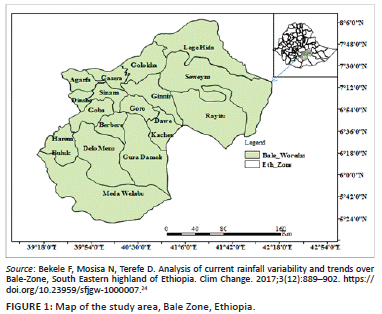
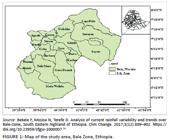
A community-based cross-sectional study design was used in three rural districts (Dallo Mena, Sewena, and Meda Welabu) in the Bale Zone, Oromia regional state, Ethiopia. The districts were specifically chosen for having high malaria transmission rates. The climatic conditions in the Bale Zone include 1.8% frosty highland, 7.7% highland, 25.5% midland, 63% lowland and 2% desert. Of the 18 districts in the Bale Zone, nine were pastoralist and the rest were agrarian; 14 districts are at risk of malaria transmission (Figure 1). The zone had a total population of 1 794 673 (909 164 men and 885 509 women), six hospitals, 84 health centres, 372 health posts, 100 private clinics, one NGO clinic, four other public clinics and 95 pharmacies and drug stores.
Study population and sampling strategy
The target populations were all household (HH) members in the randomly selected Kebeles (the smallest administrative unit in Ethiopia's context) of the three districts. Those who were permanent residents (resided there at least for 6 months) of the study area and aged 18 years and above were included in the study, while those who had a severe illness during the data-collection period or a known mental disorder that affects the accuracy of the given data were excluded. The total sample size was 634. It was calculated using a single population proportion formula based on the following assumptions:
• The estimated proportion (P) of good knowledge on malaria signs, symptoms and prevention was 50%.
• Zα/٢ = confidence level taken as 95% = 1.96
• A margin of error (d) of 5%
• A designing effect of (k) of 1.5
• A non-response rate of 10%
Therefore, n0 = (Zα/٢)2p*q)/d2
Considering a designing effect (k = 1.5), n1 = n0*k = 384*1.5 = 576.
Finally, considering the non-response rate of 10%, nf = (n1) + (n1*0.1) = 576 + 58 = 634.
Where, n0 was the initial sample size,
n1 was the sample size calculated in consideration of the design effect (k).
nf was the final sample size, including the non-response rate.
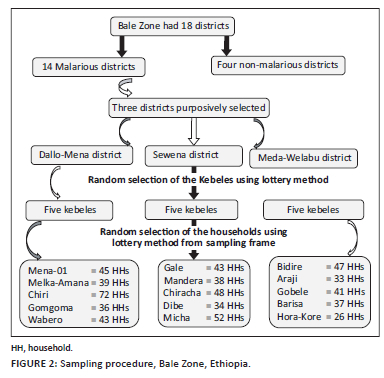
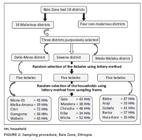
Initially, three districts were purposively selected out of 14 malarious districts in the Bale Zone. This was followed by a random selection (lottery method) of five Kebeles from each selected district. Finally, eligible households were selected by a simple random sampling technique using the lottery method from a sampling frame (Figure 2).
The heads of the selected households were then interviewed. If the head of the family was not at home during the visit, their partner or a family member aged 18 or older, was interviewed instead.
Data-collection instrument
The data were collected using a structured interviewer-administered questionnaire, which was developed by reviewing the literature from previous studies in consideration of the objectives and research questions. The questionnaire was initially developed in English, translated to Afan Oromo (the local language) and then back translated to English in order to ensure consistency between the two versions. It covered contents such as socio-demographic characteristics, economic condition, history of illness and knowledge about malaria.
The questionnaire was designed with simple instructions that improved its clarity, conciseness and logical flow while reducing ambiguity, repetition and the inclusion of extraneous items. To reduce coding errors, all possible responses to questions were pre-coded with 'other specify' as an option, except for continuous variables such as age, monthly income and family size, where open-ended questions were used.
Prior to data collection, the questionnaire was pretested on 5% (n = 32) of the sample size from the non-sampled kebele. The pre-test was useful in determining the feasibility of the actual study, the clarity of the questions and the timing of questionnaire completion. The questionnaire was also submitted to relevant specialists in the subject, and it was finalised after required changes were made to incorporate all opinions received during the process.
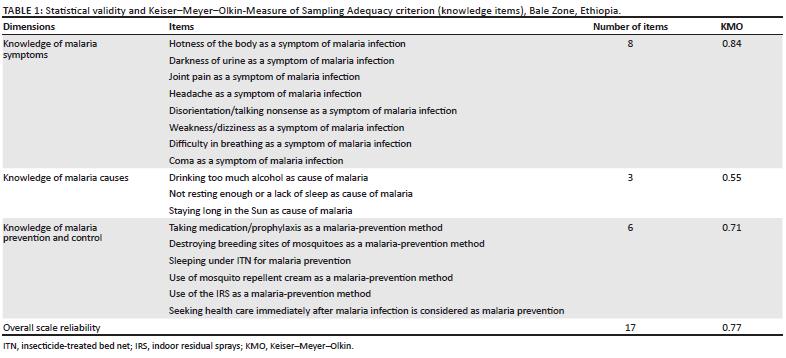
To ensure high-quality results, the questionnaire's validity and reliability were assessed. We used exploratory factor analysis (EFA) with the assistance of a statistician to confirm the construct validity of each item. To investigate the relationships between different questionnaire items, the related items were aggregated into a factor. The Keiser-Meyer-Olkin (KMO) Measure of Sampling Adequacy (MSA) criterion was used to determine the sampling adequacy of the malaria knowledge assessment questions.
The overall KMO-MSA was 0.767 for 17 items (Table 1). This value was higher than the minimum acceptable level (0.600) and ensured that the sample of items was adequate. The value for the determinants was 0.007, and that of the Bartlett's test of sphericity (BTS) was χ2
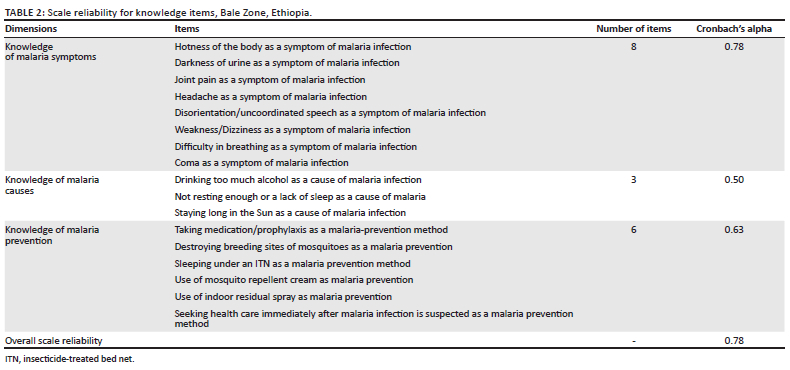
The Cronbach's alpha coefficient was calculated to assess the extent to which research respondents could deliver identical responses to the same set of questions asked several times under the same conditions (reliability). The predetermined cutoff for the Cronbach's alpha coefficient value was 0.70. In the current study, the Cronbach's alpha coefficient value for 17 items used to measure the knowledge level was 0.779. Of the 17 items, 12 items that explained 89.4% of the variance in the principal component analysis (PCA) were used for composite index construction (Table 2).
Data-collection process
Six data collectors were recruited to conduct quantitative data collection. They were master's degree holders in public health and nursing professionals working in public universities. They had four to seven years of experience conducting research activities and data collection in similar settings.
After the final version of the questionnaire was formatted and all logistics were made ready, the actual data collection took place from 05 March 2018 to 25 March 2018, using an interviewer-administered questionnaire.
Data analysis
Each complete questionnaire was checked item by item to ensure that the data were error-free and complete. The data were entered in the Statistical Package for Social Science (SPSS) version 28. Each item used to assess knowledge was dichotomised and coded '0' for incorrect and '1' for correct responses. To compute the overall knowledge score, a composite index was constructed based on the PCA. Descriptive statistics such as mean, proportions and percentages were calculated. Inferential statistics including crude and adjusted odds ratios with 95% confidence intervals were computed using binary logistic regression to investigate a relationship between the dependent variable (knowledge level) and independent variables including sociodemographic characteristics (residence, age, gender, marital status, ethnicity, religion, educational status and occupation), history of malaria infection (current illness and ever contracting malaria) and family information (family size, presence of children younger than five years-old and pregnant women).
The model fit was checked using the Hosmer-Lemshow goodness-of-fit test, and multicollinearity was checked using the variance inflation factor (VIF) and tolerance. Nine variables that showed a significant association with knowledge level at a p-value of less than 0.05 during bivariable logistic regression analysis were included in the multivariable logistic regression model. The presence of an association was declared at a p-value of less than 0.05.
Ethical considerations
Ethical approval and an ethical clearance certificate (REC-012714-039) were obtained from the higher degree committee of the University of South Africa (Unisa). A letter of permission was obtained from the Oromia regional health bureau and communicated to the zonal health department and district health offices. The respondents were informed about the study's purpose, benefits, potential effects (if any), their freedom to participate or not and privacy and confidentiality concerns, and written consent was obtained. To ensure anonymity, study respondents were interviewed at their residences. In terms of information confidentiality, no identifiers of the respondents' identities were recorded; also, all data were securely stored to prevent unauthorised access.
Results
Socio-demographic characteristics
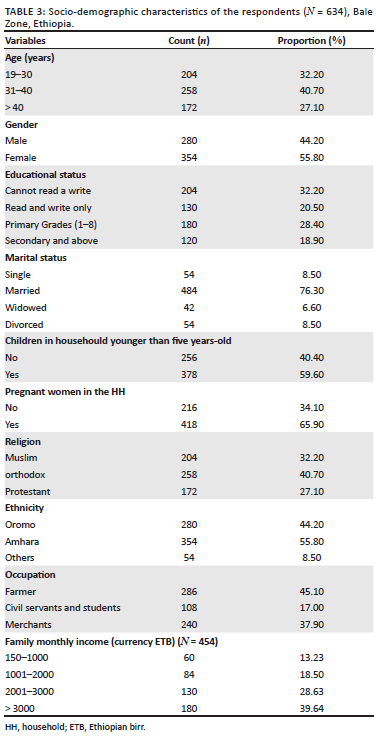
The study had a total of 634 respondents. The study respondents' mean age was 35.3 years, with an 8-year standard deviation (s.d.). As shown in Table 3, most (40.7%; n = 258) of the study respondents were in the age group of 31-40 years; more than half were females (55.8%; n = 354) and about three-quarters (76.3%; n = 484) were currently married. Slightly more than half (52.7%, n = 334) did not attend formal education. About 59.6% (n = 378) and 65.9% (n = 418) of the households had children aged below 5 years and pregnant women, respectively. Nearly four-fifths (79.2%; n = 502) were Oromo by ethnicity, 76.3% (n = 484) were Muslims, 45.1% (n = 286) were farmers and 13.23% (n = 60) earn a monthly income of only 150-1000 Ethiopian birr (Table 3).
Knowledge of the cause and signs and symptoms of malaria
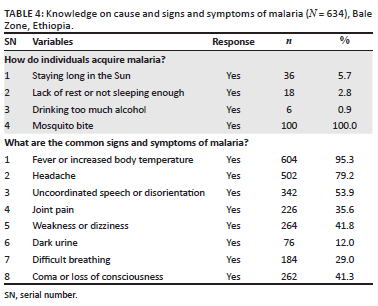
The study respondents demonstrated good knowledge of the cause of malaria, with the exception of a few misunderstandings. All study respondents attribute malaria transmission to mosquito bites. However, in addition to the mosquito bite, about 5.7% (n = 36), 2.8% (n = 18) and 0.9% (n = 6) attributed malaria transmission to staying long in the sun, lack of rest or not sleeping enough and drinking too much alcohol, respectively (Table 4).
Unlike the cause of malaria, most study respondents lacked knowledge of most of the signs and symptoms of malaria. Of the eight common signs and symptoms of malaria presented to the study respondents, only three were known by more than 50% of the respondents, which indicates a lower level of understanding in this regard (Table 4).
Knowledge of malaria prevention methods
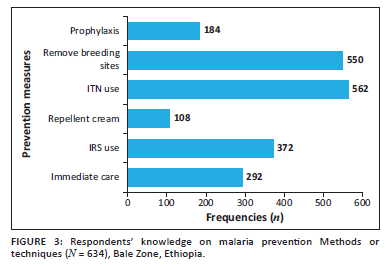
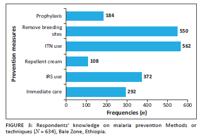
Malaria prevention methods relatively known by the majority (more than 50% of the respondents) include destroying malaria breeding sites 86.8% (n = 550), sleeping under insecticide-treated bed nets (ITNs) 88.6% (n = 562) and using indoor residual sprays (IRS) 58.7% (n = 372), while the lesser-known prevention methods include the use of prophylactic medications (29% n = 184), mosquito repellent cream (16.7% n = 108) and immediate health seeking for suspected malaria cases 46.1% (n = 292) (see Figure 3).
Overall malaria knowledge
The overall knowledge was measured based on the composite index that was constructed from 17 items used to assess the respondents' knowledge on the symptoms of malaria, the causes of malaria and the method of malaria prevention after performing PCA. Slightly less than half (44.2%, n = 280) had good knowledge of malaria; the rest, 54.8% (n = 354), had poor knowledge.
Factors associated with the level of knowledge
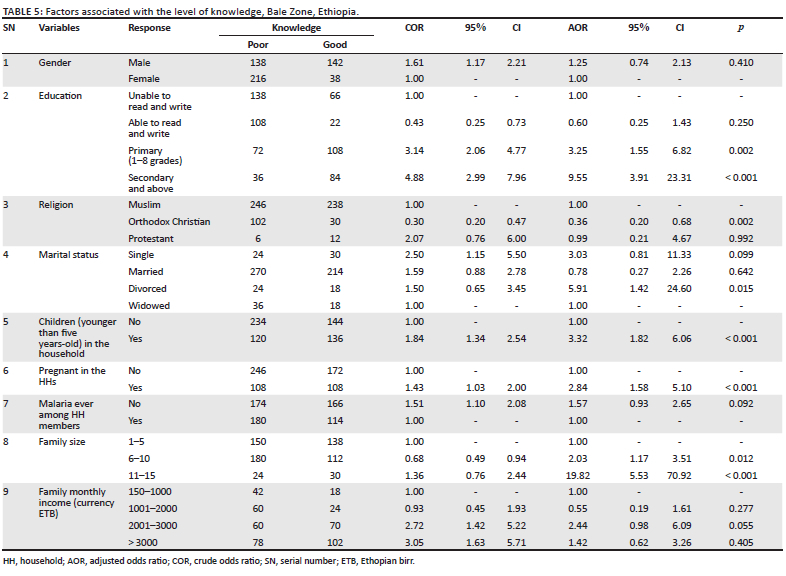
Educational level, religion, marital status, family size, the presence of children under the age of 5 and pregnant women in the household all had a substantial impact on knowledge of malaria. However, gender, family monthly income and malaria infection among household members did not show a significant association with the dependent variable in the current study (Table 5).
Individuals who had attended primary school and secondary school and above were 3.25 (adjusted odds ratio [AOR]: 3.25, 95% CI: 1.55-6.72) and 9.55 (AOR: 9.55, 95% CI: 3.91-23.31) times more knowledgeable, respectively, than those who were unable to read and write. Orthodox Christians were 64% less likely to have good knowledge of malaria compared to their Muslim counterparts (AOR: 0.36, 95% CI: 0.02-0.68), while no statistically significant difference was observed between Muslims and Protestants.
Divorced individuals were 5.91 times more likely to be knowledgeable compared to widowed ones (AOR: 5.91, 95% CI: 1.42-24.60), while no significant difference was observed between single, married and divorced individuals. People from households with children aged below 5 years were 3.32 times more knowledgeable than their counterparts (AOR: 3.32, 95% CI: 1.82-6.06).
People from households with pregnant women were 2.84 times more knowledgeable than their counterparts (AOR: 2.84, 95% CI: 1.58-5.10). Those from households with family sizes 6-10 and 11-15 were 2.03 (AOR: 2.03, 95% CI: 1.17-3.51) and 19.82 (AOR: 19.82, 95% CI: 5.53-70.92) times more knowledgeable compared to those with 1-5 sized families (Table 5).
Discussion
The current study found that people had inadequate knowledge about malaria signs and symptoms, as well as how to prevent them. Only 44.2% of research respondents had an adequate understanding. Education, religion, marital status, family size and the presence of children and pregnant women in the household all have a substantial impact on knowledge.
Knowledge of malaria cause
In the current study, all respondents attributed malaria transmission to mosquito bites, while some study respondents additionally attributed it to staying long in the sun, lack of rest or not sleeping enough and drinking too much alcohol. In agreement with this study, studies conducted in Gabon, India and Cameroon revealed that the majority attributed the cause of malaria to mosquito bites.19,20,2519,20,26
The current study revealed that water-containing pits, the bushes in the home environment, poor environmental sanitation and unsanitary human actions, including poor liquid waste and latrine management, were sources of malaria transmission. Other studies from Cameroon and India also reported that stagnant or dirty water, gutters, muddy sludge and puddles were sources of malaria transmission.20,2526
In contrast to the current study, another study conducted in rural Zambia reported drinking dirty water and touching a malaria patient as routes of malaria transmission.2119,202019
These findings clarified the presence of misconceptions about malaria that should be considered, which calls for the design of a contextual intervention strategy and effective implementation for a better understanding of the community at the grassroots level.
Knowledge of sign and symptoms of malaria
The current study revealed that the community had limited knowledge of the signs and symptoms of malaria. Only three signs and symptoms were known by more than 50% of the respondents, which include fever (95.3%), headache (79.2%) and talking nonsense (53.9%). The studies that agreed with the current study also revealed that fever, headache, vomiting and appetite loss are the most common malaria symptoms known by the majority of the respondents.20,26,2726,272627
In general, even though the community is aware of a few very common symptoms, their knowledge of malaria symptoms is limited. Thus, detailed gap identification and appropriate intervention are necessary to overcome the associated consequences.
Knowledge of malaria prevention methods
The majority of the survey respondents mentioned destroying malaria-breeding sites, sleeping under ITNs and using IRS as malaria prevention methods. However, only a few respondents mentioned the use of prophylactic medications, mosquito repellent cream and immediate health-seeking for suspected malaria cases. The study conducted in South Gondor also revealed that the majority of the respondents mentioned using ITNs and IRS, while a few individuals mentioned fumigation.2829
In contrast, neither of the two studies reported other malaria-prevention measures such as the use of prophylactic medications, the use of a mosquito repellent cream or immediate health seeking for suspected malaria cases.28,29
Overall malaria knowledge
Malaria awareness is low in the current study area. The majority of the survey respondents (54.8%) lacked knowledge. This finding is consistent with the findings of a study conducted in Cambodia,30
On the other hand, the findings of the current study are lower than the results of other studies conducted in southern Africa and Cameroon.26,312931
Factors associated with malaria knowledge
The present study shows that those persons who completed elementary school and secondary school or higher possessed knowledge levels 3.25 and 9.55 times more, respectively, than those who were illiterate. This finding aligns with the study conducted in South Gonder, Ethiopia, which indicated that the highest knowledge scores were observed among persons with college education and above (84.3%) and those with high school education (82.9%) compared to uneducated individuals.2830
Orthodox Christians were 64% less likely to have good knowledge of malaria compared to their Muslim counterparts, while no statistically significant difference was observed between Muslims and Protestants. Divorced individuals were 5.91 times more likely to be knowledgeable compared to widowed individuals, while no significant difference was observed between single, married and divorced individuals. Contrary to the current study, a cross-sectional household survey conducted in Nyabondo, Western Kenya, reported that marital status and religion were not significantly associated with knowledge related to malaria.32
People from households with children younger than five years-old were 3.32 times more knowledgeable compared to their counterparts; people from households with pregnant women were 2.84 times more knowledgeable compared to their counterparts. Those from households sizes six to 10 family members, and 11-15 family members were 2.03 and 19.82 times more knowledgeable compared to those with one to five family members. This finding suggests that larger families and those with young children or pregnant women are more engaged in acquiring knowledge, possibly because of the heightened need for information related to child-rearing and prenatal care. Consequently, targeted educational resources may be beneficial in further enhancing awareness and understanding among smaller families.
The current study contradicts previous research that found statistically significant relationships between malaria knowledge and other factors such as age, gender, family monthly income, place of residence and occupation.28
Strengths and limitations
Strengths
The existing literature was used to inform the construction of the data-collection tool, which ensured its reliability and statistical validity. During the data-collection period, repeated visits to households ensured the highest response rate. Furthermore, the study produced very informative findings on malaria signs, symptoms and preventive knowledge in rural areas.
Limitations
Because of the cross-sectional character of this study, determining a cause-effect relationship is difficult. Furthermore, the knowledge assessment primarily focused on three aspects: knowledge of malaria causes, signs and symptoms, and prevention methods, with little emphasis placed on sources of information and malaria definition. However, these elements were considered for further qualitative investigation.
Conclusion
Malaria knowledge is limited in the current study area. Knowledge of malaria signs and symptoms, as well as prevention methods, was quite limited, despite a thorough grasp of the cause of malaria. Sociodemographic characteristics such as education level, religion, marital status and family size all had an impact on malaria knowledge. Furthermore, having pregnant women and children younger than five years-old in the household was linked to malaria knowledge. Identification of the community's malaria control knowledge is critical for malaria prevention and the establishment of malaria-free zones.
Recommendations
We recommend a meticulous design and execution of a contextualised knowledge transfer strategy to enhance the community's understanding of malaria and expedite the journey towards malaria elimination. Subsequent research should concentrate on an effective knowledge transmission technique suitable for rural contexts.
Competing interests
The authors declare that they have no financial or personal relationships that may have inappropriately influenced them in writing this article.
Authors' contributions
All authors contributed to the successful execution of the study. K.A.K. conceived the study, participated in data collection and analysis, drafted the article and created all tables and figures. S.M.Z. was involved throughout the study process, including supervision, review and article preparation. All authors have read and approved the final draft of the article.
Funding information
This research received no specific grant from any funding agency in the public, commercial or not-for-profit sectors.
Data availability
The data that support the findings of this study are available from the corresponding author, K.A.K., upon reasonable request.
Disclaimer
The views and opinions expressed in this article are those of the authors and are the product of professional research. It does not necessarily reflect the official policy or position of any affiliated institution, funder, agency, or that of the publisher. The authors are responsible for this article's findings, and content.
Acknowledgements
The authors are grateful to individuals and institutions who have directly or indirectly supported them and whose contributions enabled the success of this study.
References
-
1. Centers for Disease Control and Prevention. Malaria impact worldwide [homepage on the Internet]. Centers for CDC; 2021 [cited 2022 July 27]. Available from: https://www.cdc.gov/malaria/malaria_worldwide/impact.html
» https://www.cdc.gov/malaria/malaria_worldwide/impact.html -
2. World Health Organization. World malaria report 2023 [homepage on the Internet]. 2023 [cited 2023 Dec 08]. Available from: https://www.who.int/news-room/fact-sheets/detail/malaria
» https://www.who.int/news-room/fact-sheets/detail/malaria -
3. World Health Organization. World malaria report 2021. World Health Organization; 2022 [cited 2022 July 30]. Available from: https://reliefweb.int/report/world/world-malaria-report-2021
» https://reliefweb.int/report/world/world-malaria-report-2021 -
4. Jemal A, Ketema T. A declining pattern of malaria prevalence in Asendabo Health Center Jimma zone, Southwest Ethiopia. BMC Res Notes. 2019;12:1-5. https://doi.org/10.1186/s13104-019-4329-6
» https://doi.org/10.1186/s13104-019-4329-6 -
5. National Data Management Center for Health. Trend and burden of malaria in Ethiopia [homepage on the Internet]. National Data Management Center for Health. 2022 [cited 2024 Jan 22]. Available from: https://ndmc.ephi.gov.et/download/trend-and-burden-of-malaria-in-ethiopia/
» https://ndmc.ephi.gov.et/download/trend-and-burden-of-malaria-in-ethiopia/ -
6. Kendie FA, Hailegebriel W/kiros T, Nibret Semegn E, Ferede MW. Prevalence of malaria among adults in Ethiopia: A systematic review and meta-analysis. J Trop Med. 2021;2021(1):8863002. https://doi.org/10.1155/2021/8863002
» https://doi.org/10.1155/2021/8863002 -
7. Memvanga PB, Nkanga CI. Liposomes for malaria management: The evolution from 1980 to 2020. Malar J. 2021;20(1):327. https://doi.org/10.1186/s12936-021-03858-0
» https://doi.org/10.1186/s12936-021-03858-0 -
8. Ketema T, Bacha K, Getahun K, Portillo HA, Bassat Q. Plasmodium vivax epidemiology in Ethiopia 2000-2020: A systematic review and meta-analysis. PLoS Negl Trop Dis. 2021;15(9):e0009781. https://doi.org/10.1371/journal.pntd.0009781
» https://doi.org/10.1371/journal.pntd.0009781 -
9. Tefera S, Bekele T, Getahun K, Negash A, Ketema T. The changing malaria trend and control efforts in Oromia special zone, Amhara regional state, North-East Ethiopia. Malar J. 2022;21(1):128. https://doi.org/10.1186/s12936-022-04149-y
» https://doi.org/10.1186/s12936-022-04149-y -
10. Rudasingwa G, Cho SI. Determinants of the persistence of malaria in Rwanda. Malar J. 2020;19:1-9. https://doi.org/10.1186/s12936-020-3117-z
» https://doi.org/10.1186/s12936-020-3117-z -
11. Fornace KM, Diaz AV, Lines J, Drakeley CJ. Achieving global malaria eradication in changing landscapes. Malar J. 2021;20(1):69. https://doi.org/10.1186/s12936-021-03599-0
» https://doi.org/10.1186/s12936-021-03599-0 -
12. Schiess N, Villabona-Rueda A, Cottier KE, Huether K, Chipeta J, Stins MF. Pathophysiology and neurologic sequelae of cerebral malaria. Malar J. 2020;19:1-2. https://doi.org/10.1186/s12936-020-03336-z
» https://doi.org/10.1186/s12936-020-03336-z - 13. Initiative UP. Malaria operational plan FY 2020. Washington, DC: US President's Malaria Initiative. 2020.
- 14. Bakken L, Iversen PO. The impact of malaria during pregnancy on low birth weight in East-Africa: A topical review. Malar J. 2021;20:348
-
15. Romero M, Leiba E, Carrión-Nessi FS, et al. Malaria in pregnancy complications in Southern Venezuela. Malar J. 2021;20:1-8. https://doi.org/10.1186/s12936-021-03728-9
» https://doi.org/10.1186/s12936-021-03728-9 -
16. Fikrie A, Kayamo M, Bekele H. Malaria prevention practices and associated factors among households of Hawassa City Administration, Southern Ethiopia, 2020. PloS One. 2021;16(5):e0250981. https://doi.org/10.1371/journal.pone.0250981
» https://doi.org/10.1371/journal.pone.0250981 -
17. Tarekegn M, Tekie H, Dugassa S, Wolde-Hawariat Y. Malaria prevalence and associated risk factors in Dembiya district, North-western Ethiopia. Malar J. 2021;20(1):372. https://doi.org/10.1186/s12936-021-03906-9
» https://doi.org/10.1186/s12936-021-03906-9 -
18. Vilay P, Nonaka D, Senamonty P, et al. Malaria prevalence, knowledge, perception, preventive and treatment behavior among military in Champasak and Attapeu provinces, Lao PDR: A mixed methods study. Trop Med Health. 2019;47:1-2. https://doi.org/10.1186/s41182-019-0138-9
» https://doi.org/10.1186/s41182-019-0138-9 -
19. Imboumy-Limoukou RK, Maghendji-Nzondo S, Sir-Ondo-Enguier PN, et al. Malaria in children and women of childbearing age: Infection prevalence, knowledge and use of malaria prevention tools in the province of Nyanga, Gabon. Malar J. 2020;19(1):1-8. https://doi.org/10.1186/s12936-020-03411-5
» https://doi.org/10.1186/s12936-020-03411-5 -
20. Rajvanshi H, Saha KB, Sharma RK, et al. Assessing community knowledge, attitude and practices to strengthen communication strategy for malaria elimination demonstration project in Mandla. Malar J. 2021;20(1):354. https://doi.org/10.1186/s12936-021-03884-y
» https://doi.org/10.1186/s12936-021-03884-y -
21. Jumbam DT, Stevenson JC, Matoba J, et al. Knowledge, attitudes and practices assessment of malaria interventions in rural Zambia. BMC Public Health. 2020;20(1):1-5. https://doi.org/10.1186/s12889-020-8235-6
» https://doi.org/10.1186/s12889-020-8235-6 -
22. Initiative PM. President's malaria initiative Ethiopia. Malaria Operational Plan FY [homepage on the Internet]. Center for Communicable Diseases Control; 2017 [cited n.d.]. https://reliefweb.int/report/ethiopia/president-s-malaria-initiative-ethiopia-malaria-operational-plan-fy-2019
» https://reliefweb.int/report/ethiopia/president-s-malaria-initiative-ethiopia-malaria-operational-plan-fy-2019 - 23. Presidents Malaria Initiative. President's Malaria Initiative Ethiopia Malaria Operational Plan FY. Center for Communicable Diseases Control; 2019.
- 24. Bekele F, Mosisa N, Terefe D. Analysis of current rainfall variability and trends over Bale-Zone, South Eastern highland of Ethiopia. Clim Change. 2017;3(12):889-902.
-
25. Talipouo A, Ngadjeu CS, Doumbe-Belisse P, et al. Malaria prevention in the city of Yaoundé: Knowledge and practices of urban dwellers. Malar J. 2019;18(1):1-3. https://doi.org/10.1186/s12936-019-2799-6
» https://doi.org/10.1186/s12936-019-2799-6 -
26. Kanyangarara M, Hamapumbu H, Mamini E, et al. Malaria knowledge and bed net use in three transmission settings in southern Africa. Malar J. 2018;17(1):1-2. https://doi.org/10.1186/s12936-018-2178-8
» https://doi.org/10.1186/s12936-018-2178-8 -
27. Flatie BT, Munshea A. Knowledge, attitude, and practice towards malaria among people attending Mekaneeyesus Primary Hospital, South Gondar, Northwestern Ethiopia: A cross-sectional study. J Parasitol Res. 2021;2021(1):5580715. https://doi.org/10.1155/2021/5580715
» https://doi.org/10.1155/2021/5580715 -
28. Yasuoka J, Kikuchi K, Nanishi K, et al. Malaria knowledge, preventive actions, and treatment-seeking behavior among ethnic minorities in Ratanakiri Province, Cambodia: A community-based cross-sectional survey. BMC Public Health. 2018;18:1206. https://doi.org/10.1186/s12889-018-6123-0
» https://doi.org/10.1186/s12889-018-6123-0 -
29. Yitayal Ayalew Goshu YA, Azeb Ewinetu Yitayew AE. Malaria knowledge and its associated factors among pregnant women attending antenatal clinic of Adis Zemen Hospital, North-western Ethiopia, 2018. PLoS One. 2019;14(1):e0210221. https://doi.org/10.1371/journal.pone.0210221
» https://doi.org/10.1371/journal.pone.0210221 -
30. Munisi DZ, Nyundo AA, Mpondo BC. Knowledge, attitude and practice towards malaria among symptomatic patients attending Tumbi Referral Hospital: A cross-sectional study. PLoS One. 2019;14(8):e0220501. https://doi.org/10.1371/journal.pone.0220501
» https://doi.org/10.1371/journal.pone.0220501 -
31. Kala Chouakeu NA, Ngingahi LG, Bamou R, et al. Knowledge, attitude, and practices (KAP) of human populations towards malaria control in four ecoepidemiological settings in Cameroon. J Trop Med. 2021;2021(1):9925135. https://doi.org/10.1155/2021/9925135
» https://doi.org/10.1155/2021/9925135 -
32. Ng'ang'a PN, Mutunga J, Oliech G, Mutero CM. Community knowledge and perceptions on malaria prevention and house screening in Nyabondo, Western Kenya. BMC Public Health. 2019;19(1):423. https://doi.org/10.1186/s12889-019-6723-3
» https://doi.org/10.1186/s12889-019-6723-3

Accepted: 16 Apr. 2025
Published: 22 Aug. 2025