Risk factors for sexually transmitted infections among men who have sex with men
Abstract
BACKGROUND: Sexually transmitted infections (STIs) are a global public health concern and sub-Saharan Africa, has limited data on STIs in the men who have sex with men (MSM) population. Syndromic management has controversies for treating asymptomatic STIs (ASTIs AIM: The aim of this study was to describe the risk factors for STIs among MSM SETTING: This study was conducted in Tshwane North, Gauteng Province in South Africa METHODS: A cross-sectional quantitative design was employed using structured questionnaires, rapid plasma reagent test, from December 2021 to May 2022. Bivariate and multivariate analyses were used for statistical analysis RESULTS: A total of 200 MSM with the mean age of 27.6, standard deviations: 6.8 participated, and STIs prevalence was 66%, with 37% concurrent infections. Ureaplasma urealyticum was (24%), Mycoplasma hominis (23%), Chlamydia trachomatis (20%), Treponema pallidum (20%) and Neisseria gonorrhoeae (9%). The risk factors for acquisition of STI include having a new partner in the last month (OR = 1.68; CI: 0.98-3.13 CONCLUSION: The prevalence of ASTIs is high. Serial and multiple sexual partners are the risk factors CONTRIBUTION: This study contributes to the body of knowledge of the burden of STIs among high-risk population
men who have sex with men; asymptomatic; sexually transmitted infections; risk factors; sexual behaviour; alcohol use; HIV
Introduction
Sexually transmitted infections (STIs) are a major public health concern. They may increase the risk of contracting human immunodeficiency virus (HIV) through receptive and insertive anal intercourse.1,2 In South Africa, the prevalence of reported asymptomatic STIs (ASTIs) varies wildly, ranging from 19% to 90%.3,4,5 Among the other drivers of STIs among men who have sex with men (MSM) such as risky behaviours, undetected or ASTIs might be an important contributor to the high prevalence of STIs.36,7 The Sibanye Health Project reported that 91%, 95% and 97% of diagnosed rectal Neisseria gonorrhoeae (NG)and/or Chlamydia trachomatis (CT),urethral NG and CT and syphilis infections, respectively, were clinically asymptomatic among South African MSM.89
The data collected from Europe, the United States and China indicated that MSM have a high burden of HIV and other STIs.1011n = 33 853; 44%) and CT (n = 23 187; 30%) were the most common. In the same year, there were 5875 (8%) new cases of syphilis in MSM.1111n = 46 192; 47.4%) followed by NG (n = 15 253; 15.7%). There were 1016 (1%) new syphilis infections. The number of new gonorrhoea cases diagnosed in 2019 (n = 70.936) was the largest annual number reported since records began in 1918, and 33 853 (47.7%) of those cases were reported in MSM.11
Social stigma and punitive civil environments may lead to delays in seeking HIV and STI screening and consequently later initiation of treatment.1213,14,15,16,17 Spinner et al. reported high numbers of asymptomatic syphilis, hepatitis C, CT and gonorrhoea in MSM with a shorter duration of HIV infection and having more than one sexual partner within the last six months.133
The guidelines for STI treatment in South Africa employ the syndromic management approach.183
Hence, the study sought to assess the risk factors for STIs among MSM.
Research methods and design
Study design
The study conducted cross-sectional baseline data which were nested in the longitudinal study from December 2021 to May 2022 and enrolled asymptomatic MSM.
Study setting and population
This study was carried out in Ga-Rankuwa, Tshwane North, Gauteng province in South Africa. Participants in the study were recruited from December 2021 to May 2022. Men were eligible if they were 18 years of age or older and had anal intercourse with one or more men in the previous year. Outreaches in the streets, dance clubs, bars, sex clubs, health clubs and adult video stores were among the recruitment strategies used. Participants were also recruited through community forums and snowballing.
Studies conducted among the MSM community have reported the lack of robust MSM population size estimates,1920,21 Respondent-driven sampling is a referral-based system in which participants refer friends and acquaintances who are also member of target population to participate in the study.
Previous studies and trial conducted among MSM in Medunsa Clinical Research Unit (MeCRU), which is a setting for this research, enrolled approximately 200 MSM participants and our study plans to achieve 377, which is a sample size calculated by the Raosoft sample size calculator using a value of unknown population size.22
Data collection and measures
Following informed consent, a self-administered questionnaire was used to collect demographic and behavioural data. The participants reported their age, gender and sexual orientation, as well as their highest educational attainment and employment status. Sexual risk factors including receptive condomless anal intercourse, the number of sex partners, transactional sex and alcohol use were among the relevant behavioural variables. The questionnaire was administered in the participants' preferred languages, English or Setswana.
All study participants were offered STI screening. A clinician used direct swabbing to obtain samples for testing from rectal, oral and genital swabs. Participants who received an STI diagnosis were referred to a local clinic based on their laboratory results. The participants were tested for the following: NG, CT, Mycoplasma genitalium (MG) and Mycoplasma hominis (MH), Trichomonas vaginalis (TV), Ureaplasma urealyticum (UU) and Ureaplasma parvum (UP), Treponema pallidum (TPHA) and syphilis.
Data analysis
The data were analysed using Stata 17.0 (Stata Corporation, College Station, TX, USA). The data were summarised using descriptive statistics (proportions and means with standard deviations [s.d.]). Nonparametric tests such as Wilcoxon signed-rank test and stepwise forward logistic regression were used to determine the risk factors. Logistic regression models were set at 95% confidence intervals. Statistical significance was determined at p ≤ 0.05. The dependent variable was positive STI diagnosis and the independent variables were age, source of income, known HIV-positive sex partner status, type of relationship, sexual orientation, number of sexual partners in the last month, and prevention method during sex, sex under influence, transaction sex, tested for STI last 3 months, and tested for HIV last 3 months.
Ethical consideration
Ethical clearance and approval to conduct this study was obtained from the Sefako Makgatho Health Sciences University Research Ethics Committee (No. SMUREC/H/168/2019:PG). The study was conducted in accordance with the Helsinki Declaration. All participants provided written informed consent. Participants' specimens were labelled with a unique identity number (range from 1 to 200) to enable linkage to the risky sexual behaviour survey.
Results
Sociodemographic characteristics of the men who have sex with men
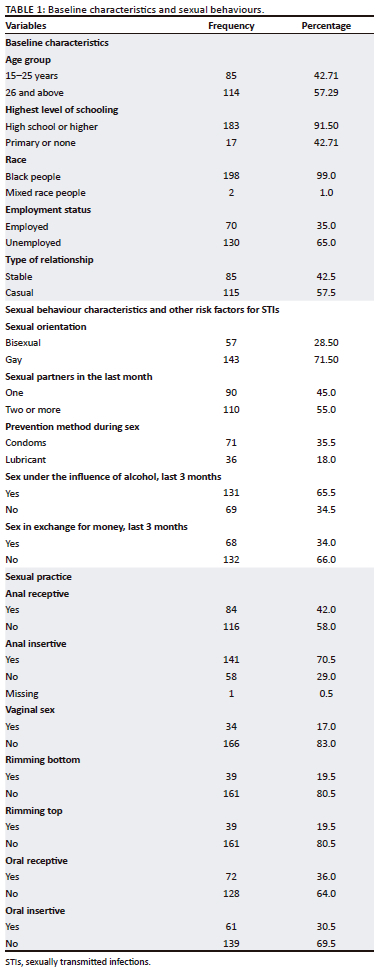
Table 1 summarises the baseline characteristics of the participants as well as the range of their sexual activities and risk behaviours. The study included 200 MSM as participants. Their average age was 27.6 years (s.d. 6.9). Most of the participants were black (99%), had no job (65%) and had finished high school (84%).
Sexual behaviour characteristics of the participants
Most participants (57.5%) had casual partners, with 28.5% having three or more sex partners in the last month. According to their sexual orientation, 63.5% were gay, with bisexuals coming in second (25%). In their lifetime, 66.5% of the participants reported having sex with a male partner, while 31.1% reported having sex with both male and female partners. A total of 37% of the participants used both condoms and lubricants during their last sexual relationship, while 34% used male condoms only. In the past 3 months, 65.5% of the individuals had sex while under the influence of alcohol, while 34% had transactional sex. Most participants (95.5%) had anal receptive or insertive sex; 83% had vaginal sex; 80% had had rimming bottom or top; 64.0% had oral receptive sex; and 69.5% had oral insertive sex.
Sexually transmitted infection prevalence, differences in proportions and associated factors
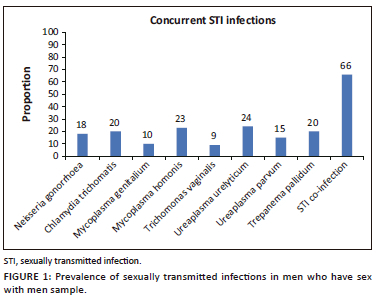
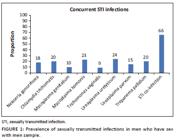
Ureaplasma urealyticum was the most common STI (24%, n = 48), followed by M. hominis (23%, n = 46), CT (20%, n = 40), TPHA (20%, n = 40) and NG (36%, n = 18).
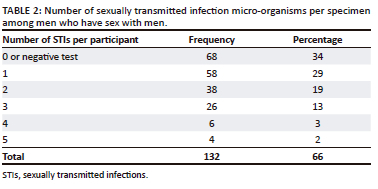
Two-thirds of the participants (66%, n = 132) were infected with one or more types of STI organisms and 34% (n = 68) tested negative for STIs (Figure 1). As indicated in Table 2, 29% (n = 58) of the participants tested positive for only one STI, 19% (n = 38) for two STIs, 13% (n = 26) for three STIs, 3% (n = 6) for four STIs and 2% (n = 4) for five STIs.
Factors associated with sexually transmitted infection acquisition
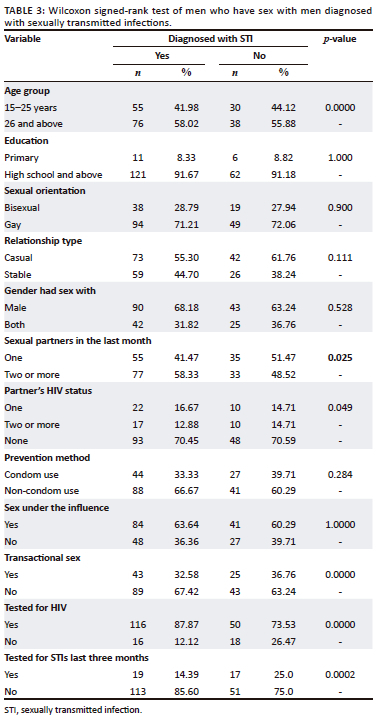
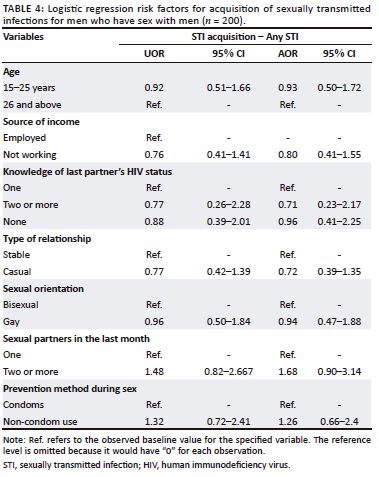
A Wilcoxon signed-rank test showed that age group, transactional sex and being tested for HIV were statistically significant with the acquisition of STIs in MSM (p = 0.0000). Additionally, the number of sexual partners in the last month, partner's HIV status and being tested for STIs in the last three months were statistically significant with the acquisition of STIs (p < 0.05) (Table 3). The odds ratio (OR = 1.68, CI = 0.90, 3.14) for the number of sexual partners in the last month indicated that a person who had had more than one sexual partner was 1.6 times more likely to have acquired an ASTI. Similarly, men who did not use a condom as a prevention method were 1.26 times more likely to have acquired an ASTI than men who used a condom for prevention (OR = 1.26. CI = 0.66, 2.41) (Table 4).
Discussion
The prevalence of ASTI among the MSM was found to be high, and most MSM were infected with multiple organisms including U. urealyticum, M. hominis, C. trachomatis, T. pallidum, N. gonorrhoeae. The 66% STI prevalence in this study is relatively low compared with a study conducted in another city in Gauteng province, South Africa,3,5,19 however, higher than in other studies conducted in Kenya, Thailand and Tanzania. Rebe and colleagues3237,24 A study of 172 MSM in two Tanzanian cities found NG, CT and syphilis rates of 21%.25
The prevalence reported in the current study population is also higher than in the United States, where the prevalence rates of asymptomatic infection have been reported to be 38% and 56% concurrent infections among 326 MSM attending an STI clinic.2682728
The results of this study indicated that 29% of participants were diagnosed with at least one STI. This relatively high prevalence is possibly due to the fact that up to 90% of STIs do not cause any symptoms,29330,31
The increased STI burden is unlikely to be because of an undiagnosed reservoir of STIs. High-risk sexual behaviour remains a significant barrier to STI control among MSM. Our findings show that MSM engage in risky sexual behaviours. Fifty-five percent of the enrolled participants had more than one sexual partner in the previous month; 1 in 10 had sex without any protection; roughly two-thirds had had sex under the influence of alcohol; and 34% had sex for money in the previous 3 months. These findings highlight the importance of MSM-focused HIV and STI prevention interventions, which are multifaceted and include increased testing, prompt treatment and the ongoing promotion of safer sexual behaviour among MSM.32
In this study, the most prominent risk behaviour for STI acquisition was having more than one sexual partner in the past month. This finding implies that having serial partners, multiple partners and being in an unstable sexual relationship predisposed the MSM to infections and could compromise protective behaviours for prevention of STIs. A follow-up study of MSM discovered that self-reported behavioural information such as unsafe sex practices, having partners who practise unsafe sex and alcohol use were not predictive of the incidence of STIs, and even without confirmed association, the MSM in this study displayed similar behaviours.6627
Further research into the relationship between sexual and behavioural risks and psychosocial risk factors is required, using a longitudinal study design with a large sample size comparing risk factors among MSM who develop symptomatic STIs to those with ASTIs.
Limitations
The study has some limitations. To begin with, the cross-sectional analyses included STI diagnoses at a single point in time only. Because cross-sectional studies do not identify newly acquired infections, longitudinal studies of the incidence of ASTIs are important. Previous research has shown that NG and CT can live in asymptomatic people for months, making them persistent reservoirs of infection.6
Conclusion
Asymptomatic STIs were common and would have gone undetected if a syndromic management approach had been used. The high rate of STI co-infections is especially concerning, indicating that people do not perceive themselves at risk for another STI. As part of the established HIV prevention efforts, the regular testing and treatment of asymptomatic MSM is a crucial element of effective control. It is important to obtain accurate STI surveillance data to develop prevention programmes and measures to evaluate the effect of behavioural interventions among the MSM population.
Competing interests
The authors declared no potential conflicts of interest with respect to the research, authorship and/or publication of this article.
Authors' contributions
M.A.M. designed and directed the project and contributed to the implementation of the research, to the analysis of the results, to the writing of the manuscript and data collection. M.A.M. also wrote the article with input from M.M.M. and O.A.Y. M.M.M. contributed to the design and implementation of the research, directed the project, contributed to the analysis of the results and to the writing of the manuscript, supervision, review and editing of the manuscript. O.A.Y. contributed to the review and editing of the manuscript, directed the project and provided supervision.
Funding information
The authors' received financial support from the National Research Funding (NRF). This work received additional support for data analysis training from the Flemish government (IUC-VLIROUS) and the funding agency had no role in the study design, data collection, analysis, interpretation or writing of the manuscript.
Data availability
Raw data were generated at Sefako Makgatho Health Science University. Derived data supporting the findings of this study are available from the corresponding author, M.A.M., on request.
Disclaimer
The views and opinions expressed in this article are those of the authors and are the product of professional research. It does not necessarily reflect the official policy or position of any affiliated institution, funder, agency, or that of the publisher. The authors are responsible for this article's results, findings, and content.
Acknowledgements
The authors would like to acknowledge Ms Dineo Baloyi (recruiter and counselor), Ms Kedibone Malebye (nurse) and Professor Nchabeleng, MeCRU and the microbiology department staff.
References
-
1. Cohen MS, Council OD, Chen JS. Sexually transmitted infections and HIV in the era of antiretroviral treatment and prevention: The biologic basis for epidemiologic synergy. J Int AIDS Soc. 2019;22(suppl. 6):e25355. https://doi.org/10.1002/jia2.25355
» https://doi.org/10.1002/jia2.25355 -
2. Ward H, Rönn M. Contribution of sexually transmitted infections to the sexual transmission of HIV. Curr Opin HIV AIDS. 2010;5(4):305-310. https://doi.org/10.1097/COH.0b013e32833a8844
» https://doi.org/10.1097/COH.0b013e32833a8844 -
3. Rebe K, Lewis D, Myer L, et al. A Cross sectional analysis of gonococcal and chlamydial infections among men-who-have-sex-with-men in Cape Town, South Africa. PLoS One. 2015;10(9):e0138315. https://doi.org/10.1371/journal.pone.0138315
» https://doi.org/10.1371/journal.pone.0138315 -
4. Van Liere G, Kock MM, Radebe O, et al. High rate of repeat sexually transmitted diseases among men who have sex with men in South Africa: A prospective cohort study. Sex Trans Dis. 2019;46(11):e105e107. https://doi.org/10.1097/OLQ.0000000000001041
» https://doi.org/10.1097/OLQ.0000000000001041 -
5. Lewis DA, Pillay C, Mohlamonyane O, et al. The burden of asymptomatic sexually transmitted infections among men in Carletonville, South Africa: Implications for syndromic management. Sex Trans Infect. 2008;84(5):371-376. https://doi.org/10.1136/sti.2008.029751
» https://doi.org/10.1136/sti.2008.029751 -
6. Rieg G, Lewis RJ, Miller LG, Witt MD, Guerrero M, Daar ES. Asymptomatic sexually transmitted infections in HIV-infected men who have sex with men: Prevalence, incidence, predictors, and screening strategies. AIDS Patient Care STDs. 2008;22(12):947-954. https://doi.org/10.1089/apc.2007.0240
» https://doi.org/10.1089/apc.2007.0240 -
7. Sanders EJ, Thiong'o AN, Okuku HS, et al. High prevalence of Chlamydia trachomatis and Neisseria gonorrhoeae infections among HIV-1 negative men who have sex with men in coastal Kenya. Sex Trans Infect. 2010;86(6):440-441. https://doi.org/10.1136/sti.2010.043224
» https://doi.org/10.1136/sti.2010.043224 -
8. Jones J, Sanchez TH, Dominguez K, et al. Sexually transmitted infection screening, prevalence and incidence among South African men and transgender women who have sex with men enrolled in a combination HIV prevention cohort study: the Sibanye Methods for Prevention Packages Programme (MP3) project. J Int AIDS Soc. 2020;23(suppl. 6):e25594. https://doi.org/10.1002/jia2.25594
» https://doi.org/10.1002/jia2.25594 -
9. Ong JJ, Fethers K, Howden BP, et al. Asymptomatic and symptomatic urethral gonorrhoea in men who have sex with men attending a sexual health service. Clin Microbiol Infect. 2017;23(8):555-559. https://doi.org/10.1016/j.cmi.2017.02.020
» https://doi.org/10.1016/j.cmi.2017.02.020 -
10. Blondeel K, Say L, Chou D, et al. Evidence and knowledge gaps on the disease burden in sexual and gender minorities: A review of systematic reviews. Int J Equity Health. 2016;15:16. https://doi.org/10.1186/s12939-016-0304-1
» https://doi.org/10.1186/s12939-016-0304-1 - 11. Mitchell H, Allen H, Sonubi T, et al. Sexually transmitted infections and screening for chlamydia in England, 2019. London: Public Health England; 2020.
-
12. Mayer KH, Wheeler DP, Bekker LG, et al. Overcoming biological, behavioral, and structural vulnerabilities: New directions in research to decrease HIV transmission in men who have sex with men. J Acquir Immune Def Syndr (1999). 2013;63(02 suppl. 2):S161-S167. https://doi.org/10.1097/QAI.0b013e318298700e
» https://doi.org/10.1097/QAI.0b013e318298700e -
13. Spinner CD, Boesecke C, Jordan C, et al. Prevalence of asymptomatic sexually transmitted infections in HIV-positive men who have sex with men in Germany: Results of a multicentre cross-sectional study. Infection. 2018;46(3):341-347. https://doi.org/10.1007/s15010-018-1124-6
» https://doi.org/10.1007/s15010-018-1124-6 -
14. Lane T, Raymond HF, Dladla S, et al. High HIV prevalence among men who have sex with men in Soweto, South Africa: Results from the Soweto Men's Study. AIDS Behav. 2011;15(3):626-634. https://doi.org/10.1007/s10461-009-9598-y
» https://doi.org/10.1007/s10461-009-9598-y -
15. Burrell E, Mark D, Grant R, Wood R, Bekker LG. Sexual risk behaviours and HIV-1 prevalence among urban men who have sex with men in Cape Town, South Africa. Sex Health. 2010;7(2):149-153. https://doi.org/10.1071/SH09090
» https://doi.org/10.1071/SH09090 -
16. Siegler AJ, Voux A, Phaswana-Mafuya N, et al. Elements of condom-use decision making among South African men who have sex with men. J Int Assoc Prov AIDS Care. 2014;13(5):414-423. https://doi.org/10.1177/2325957414535979
» https://doi.org/10.1177/2325957414535979 -
17. Williams PP, Carney T, Parry CDH. Reducing substance use and sexual risk behaviour among men who have sex with men in South Africa. S Afr J Sci. 2016;112(9/10):1-5. https://doi.org/10.17159/sajs.2016/20150425
» https://doi.org/10.17159/sajs.2016/20150425 -
18. Unemo M, Bradshaw CS, Hocking JS, et al. Sexually transmitted infections: Challenges ahead. Lancet Infect Dis. 2017;17(8):e235-e279. https://doi.org/10.1016/S1473-3099(17)30310-9
» https://doi.org/10.1016/S1473-3099(17)30310-9 -
19. Council SANA. National strategic plan on HIV, STIs and TB 2012-2016 [homepage on the Internet]. Pretoria: South Africa; 2011 [cited 26 Sept 2018]. Available from: http://www.sanac.org.za/files/uploaded/NSP8-12.pdf
» http://www.sanac.org.za/files/uploaded/NSP8-12.pdf - 20. Eluwa GI, Sylvia A, Luchters S, Ahonsi B. HIV risk perception and risk behaviors among men who have sex with men in Nigeria. J AIDS Clin Res. 2015;6(7):1.
-
21. Mmbaga EJ, Dodo MJ, Leyna GH, Moen K, Leshabari MT. Sexual practices and perceived susceptibility to HIV infection among men who have sex with men in Dar Es Salaam, mainland Tanzania. J AIDS Clin Res. 2012;2012:1-6. https://doi.org/10.4172/2155-6113.S1-012
» https://doi.org/10.4172/2155-6113.S1-012 -
22. Raosoft. Raosoft sample size calculator [homepage on the Internet] 2004 [cited 10 June 2020]. Available from: http://www.raosoft.com/samplesize.html
» http://www.raosoft.com/samplesize.html -
23. Budkaew J, Chumworathayi B, Pientong C, Ekalaksananan T. Prevalence and factors associated with gonorrhea infection with respect to anatomic distributions among men who have sex with men. PLoS One. 2019;14(4):e0211682. https://doi.org/10.1371/journal.pone.0211682
» https://doi.org/10.1371/journal.pone.0211682 -
24. Maduna LD, Kock MM, Van der Veer B, et al. Antimicrobial resistance of Neisseria gonorrhoeae isolates from high-risk men in Johannesburg, South Africa. Antimicrob Agents Chemother. 2020;64(11). https://doi.org/10.1128/AAC.00906-20
» https://doi.org/10.1128/AAC.00906-20 -
25. Ross MW, Nyoni J, Ahaneku HO, Mbwambo J, McClelland RS, McCurdy SA. High HIV seroprevalence, rectal STIs and risky sexual behaviour in men who have sex with men in Dar es Salaam and Tanga, Tanzania. BMJ Open. 2014;4(8):e006175. https://doi.org/10.1136/bmjopen-2014-006175
» https://doi.org/10.1136/bmjopen-2014-006175 -
26. Turner AN, Reese PC, Ervin M, Davis JA, Fields KS, Bazan JA. HIV, rectal chlamydia, and rectal gonorrhea in men who have sex with men attending a sexually transmitted disease clinic in a midwestern US city. Sex Trans Dis. 2013;40(6):433-438. https://doi.org/10.1097/OLQ.0b013e31828fd163
» https://doi.org/10.1097/OLQ.0b013e31828fd163 -
27. Ye ZH, Chen S, Liu F, et al. Patterns of sexually transmitted co-infections and associated factors among men who have sex with men: A cross-sectional study in Shenyang, China. Front Public Health. 2022;10:842644. https://doi.org/10.3389/fpubh.2022.842644
» https://doi.org/10.3389/fpubh.2022.842644 -
28. Read TRH, Murray GL, Danielewski JA, et al. Symptoms, sites, and significance of Mycoplasma genitalium in men who have sex with men. Emerg Infect Diseases. 2019;25(4):719-727. https://doi.org/10.3201/eid2504.181258
» https://doi.org/10.3201/eid2504.181258 -
29. Dudareva-Vizule S, Haar K, Sailer A, Wisplinghoff H, Wisplinghoff F, Marcus U. Prevalence of pharyngeal and rectal Chlamydia trachomatis and Neisseria gonorrhoeae infections among men who have sex with men in Germany. Sex Trans Infect. 2014;90(1):46-51. https://doi.org/10.1136/sextrans-2012-050929
» https://doi.org/10.1136/sextrans-2012-050929 -
30. Hakim AJ, Iwamoto C, Badman SG, et al. High prevalence of Chlamydia and Gonorrhea and the need for sexually transmitted infection testing among men who have sex with men and transgender women in Papua New Guinea. Sex Trans Dis. 2021;48(2):109-117. https://doi.org/10.1097/OLQ.0000000000001300
» https://doi.org/10.1097/OLQ.0000000000001300 -
31. Kent CK, Chaw JK, Wong W, et al. Prevalence of rectal, urethral, and pharyngeal chlamydia and gonorrhea detected in 2 clinical settings among men who have sex with men: San Francisco, California, 2003. Clin Infect Dis. 2005;41(1):67-74. https://doi.org/10.1086/430704
» https://doi.org/10.1086/430704 -
32. Saxon C, Hughes G, Ison C. Asymptomatic Lymphogranuloma Venereum in men who have sex with men, United Kingdom. Emerg Infect Dis. 2016;22(1):112-116. https://doi.org/10.3201/EID2201.141867
» https://doi.org/10.3201/EID2201.141867

Accepted: 26 July 2023
Published: 17 Oct. 2023