Postnatal care knowledge and perceptions among women in the Oshana region, Namibia
Abstract
BACKGROUND: Postnatal care (PNC) knowledge and positive perceptions are crucial for women's utilisation of PNC services AIM: The study aimed to assess the level of PNC knowledge, perceptions of PNC, and determinants of both among women SETTING: Public healthcare facilities in the Oshana region, Namibia METHODS: The study followed a quantitative cross-sectional survey design. A self-administered questionnaire was administered to 814 participants selected via systematic random sampling. PNC knowledge and perceptions were used separately as dependent variables. Participants' characteristics were used as independent variables. Chi-square tests and binomial and multinomial logistic regression were used to analyse associations between PNC knowledge or perceptions and participants' characteristics RESULTS: Among the participants, 55.6% (n = 434) demonstrated good PNC knowledge, while 27.3% (n = 213) had positive PNC perceptions. Participants who had no formal education, were unemployed, and did not utilise PNC services had a lower likelihood of having good PNC knowledge; adjusted odds ratio (AOR) = 0.33, 95% confidence interval (CI), 0.21-0.53, crude odds ratio (COR) = 0.68, 95% CI, 0.49-0.92; and AOR = 0.72, 95% CI, 0.52-0.98. Similarly, women who did not attend antenatal care had a lower likelihood of having positive PNC perceptions; COR = 0.56, 95% CI, 0.33-0.96 CONCLUSION: There is a need for multipronged interventions to improve PNC knowledge and perceptions among women in the Oshana region CONTRIBUTION: This study identified context-specific factors that influence women's PNC knowledge and perceptions
postnatal care knowledge; postnatal care perceptions; associated factors; Oshana region; Namibia
Introduction
Sub-Saharan Africa (SSA) experiences a significant share of maternal and newborn mortality, representing 70% of global maternal deaths in 2020.123224567899,10
Postnatal care knowledge empowers women to make informed decisions about utilising postpartum critical services.112,122,1314,159,1617,18,1920,21,222,1323,24,2515,17,26,279,2814,16,20,242910
Postnatal care services can be accessed at Namibia's public hospitals, health centres, clinics and private healthcare facilities. Namibians can access PNC services free of charge at public healthcare facilities. However, women can still incur costs, such as transport and food while accessing the services, since some stay far from healthcare facilities. Despite these interventions, there is inadequate knowledge of the determinants of PNC knowledge and perceptions in the Oshana region. This study aimed to assess the level of knowledge and perceptions regarding PNC as well as the determinants influencing these factors among women in the Oshana region of Namibia. The findings aim to guide policymakers in developing strategies to improve PNC knowledge and perceptions. Ultimately, this could increase PNC utilisation and potentially reduce the region's maternal and neonatal morbidity and mortality.
Research methods and design
Study setting and period
The research was carried out from 01 October 2023 to 30 January 2024, across all 18 public healthcare facilities in the Oshana region. Approximately 175 000 individuals reside in the Oshana region.303031
Study design
We have utilised a quantitative cross-sectional survey study design. This design was used because it is suitable for determining associations between variables at a particular moment in time.
Study population
All women of reproductive age in Namibia's Oshana region made up the study population.
Sample size
The size of the sample was calculated using Epi Info version 7.2.4.0. An estimated 8000 women met the study's inclusion criteria.308
Inclusion criteria
Participants included women who had given birth within the 5 years prior to the study and were receiving ANC or women receiving PNC at any of the Oshana region's 18 public healthcare facilities. This timeframe ensured that participants had relatively recent knowledge of PNC services and perceptions relevant to their most recent childbirth experience.
Exclusion criteria
This study excludes seriously ill women, those unable to speak, those who did not reside in the Oshana region and those who had training in a healthcare-related profession.
Sampling and data collection
The study used data from a PNC utilisation study conducted by the authors, whose sampling, questionnaire's reliability and validity as well as data collection procedures were described in another publication.32 Briefly, a systematic random sampling method was used to select the participants. A self-administered questionnaire, available in both English and Oshikwanyama, was used to collect the data. The questionnaire's reliability and validity were determined during a pilot study with 73 participants.
Data analysis
Coded data were entered into IBM Statistical Package for Social Sciences (SPSS) version 29 for analysis. Postnatal care knowledge and perceptions were separately used as dependent variables, while participants' characteristics were used as independent variables. We used frequencies and percentages, two descriptive statistics, to analyse nominal and ordinal data. A percentage was given for each response's frequency. By adding up each participant's total scores from the relevant questionnaire sections, the authors statistically quantified the participants' knowledge and perceptions of PNC. Knowledge was classified into good or poor, while perceptions were classified into positive or negative. A participant was deemed to have good PNC knowledge if their total score was within the range of 216-270; if it was 215 or lower, they were deemed to have poor knowledge. Participants with positive PNC perceptions were identified by having 40-50 total scores, whereas scoring 39 or lower was considered to reflect negative PNC perceptions. Chi-square tests were employed to evaluate the relationships between participants' characteristics and their perceptions of PNC as well as between participants' characteristics and their knowledge of PNC. Binomial logistic regression was employed to determine the extent of associations that demonstrated statistical significance in Chi-square tests. The Adjusted Odds Ratios (AOR) were calculated through multinomial logistic regression, utilising characteristics that exhibited statistically significant associations in binomial logistic regression. A p-value below 0.05 and a 95% CI were utilised to evaluate the statistical significance of the results.
Ethical considerations
The Biomedical Research Ethics Committee of the University of KwaZulu-Natal (Protocol reference number: BREC/00005788/2023) and the Ministry of Health and Social Services in Namibia (Ref: 22/4/2/3) both approved this study. The researchers explained to all potential participants that participation was voluntary and that there would be no penalties for failure to participate. The researchers ensured that all the participants were above the age of 18 years. Those who decided to participate in the study provided informed consent before completing the questionnaire.
Results
Characteristics of participants
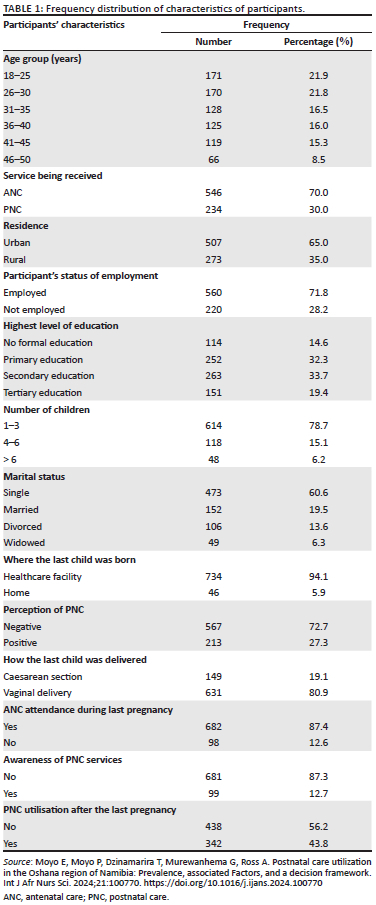
A total of 814 participants were selected to participate in the study. However, only 780 participants returned questionnaires that were completed fully, resulting in a response rate of 95.8%. The majority of the participants (n = 546; 70%) were receiving ANC services, n = 507; 65% were urban residents, n = 614; 78.7% had one to three children, n = 734; 94.1%, were single n = 473; 60.6% had a healthcare facility delivery for their last child, n = 631; 80.9% had a normal vaginal delivery for their last child, n = 681; 87.3% had an awareness of available PNC services, n = 438; 56.2% did not use PNC services and n = 417; 53.5% had poor PNC perceptions. Further information is provided in Table 1.
Postnatal care knowledge among participants
Overall, 434 participants (55.6%) had good PNC knowledge, 95% CI, 52.1-59.1, while 346 (44.4%) had poor PNC knowledge, 95% CI, 40.9-47.9.
Determinants of postnatal care knowledge among participants
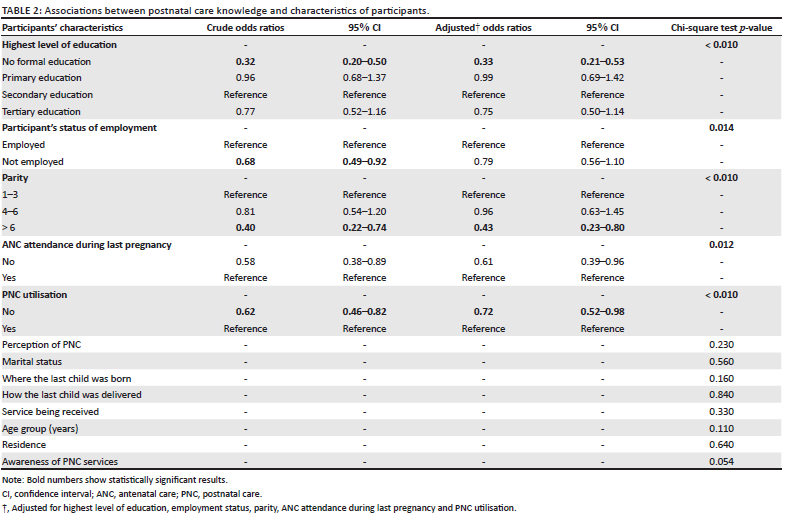
According to the results of Chi-square tests, the associations between PNC knowledge and parity, the highest level of education, employment status, ANC attendance during the last pregnancy and PNC utilisation during the last pregnancy were statistically significant (p < 0.05). When using secondary education as the reference group, participants without a formal education had a 67% lower likelihood of having good PNC knowledge, AOR = 0.33, 95% CI, 0.21-0.53. Unemployed participants had a 32% lower chance of having good PNC knowledge compared to the employed, Crude Odds Ratio (COR) = 0.68, 95% CI, 0.49-0.92, but the relationship was not statistically significant in multinomial logistic regression. Participants with more than six children had a 57% lower chance of having good PNC knowledge than those who had one to three children, AOR = 0.43, 95% CI, 0.23-0.80. Participants who did not attend ANC visits or did not utilise PNC services had a 39% and 28% lower likelihood of having good PNC knowledge, AOR = 0.61, 95% CI, 0.39-0.96 and AOR = 0.72, 95% CI, 0.52-0.98, respectively. More details are shown in Table 2.
Postnatal care perceptions among participants
Overall, 213 (27.3%) participants had positive PNC perceptions, 95% CI, 24.2-30.4, while 567 (72.7%) had negative PNC perceptions, 95% CI, 69.6-75.8.
Determinants of postnatal care perceptions among participants
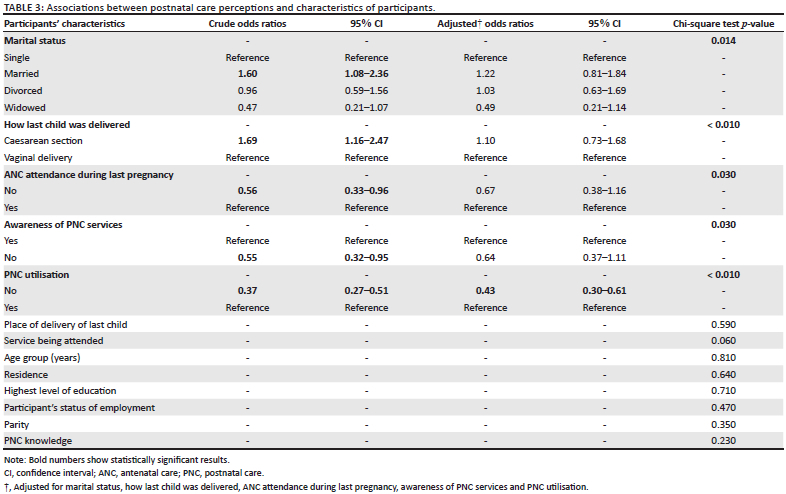
According to Chi-square test results, the associations between PNC perceptions and marital status, mode of delivery of the last child, ANC attendance during the last pregnancy, awareness of PNC services and PNC utilisation during the last pregnancy were statistically significant (p < 0.05). The study used single women as the reference group and found that married women were statistically more likely to have positive perceptions of PNC, COR = 1.60, 95% CI, 1.08-2.36. However, the association was not statistically significant in multivariate logistic regression. Women who gave birth to their last child by caesarean section had a statistically significantly higher likelihood of having positive PNC perceptions compared to those who gave birth vaginally, COR = 1.69, 95% CI, 1.16-2.47, but the association did not hold in Adjusted Regression Analysis (ARA). Women who were not aware of PNC services or failed to attend ANC during their last pregnancy had statistically significant lower chances of having positive PNC perceptions, COR = 0.55, 95% CI, 0.32-0.95; and COR = 0.56, 95% CI, 0.33-0.96, but the associations were not statistically significant in multivariate logistic regression. Furthermore, women who did not utilise PNC services during their last pregnancy were less likely to have positive PNC perceptions, AOR = 0.43, 95% CI, 0.30-0.61. Further information has been provided in Table 3.
Discussion
The study findings indicated that just over half (55.6%) of the participants had good PNC knowledge. This is much higher than the 26.9% that a study from Kenya reported.933,34
This study also revealed that unemployed women had a lower chance of having good PNC knowledge compared to the employed. The findings align with those of a study conducted in Ethiopia16922,2721,33
The current study reveals that women with more than six children had a lower likelihood of having good PNC knowledge than those with one to three children. These findings are similar to those of an Ethiopian study.35
The findings of this study indicated no statistically significant association between maternal age and PNC knowledge. This is at variance with two earlier studies,2,12
Nonetheless, the results might be a result of the region's trend of women beginning families later in life. Another unexpected finding in this study was that the place of delivery was not associated with PNC knowledge. This finding contrasts with the results of other studies,15,17,2036
The current study reveals that only 27.3% of the participants had positive PNC perceptions. This low proportion of positive PNC perceptions can be attributed to several factors. One factor that acted as a barrier to positive PNC perceptions was being single. Therefore, since most participants were single, this might have contributed to the low proportion of positive PNC perceptions among the participants. Married women had a higher likelihood of having positive PNC perceptions than single women. This finding may be explained by the possibility that women who have partners may also receive PNC information from their partners, resulting in a better understanding of PNC, leading to good PNC perceptions. According to the present study, women who delivered their most recent child via caesarean section had a higher likelihood of having positive PNC perceptions. The finding might be the result of providing more care to women who would have delivered via caesarean section in anticipation of complications, which might produce favourable PNC experiences.
The present study found that women who did not attend ANC and PNC visits after the delivery of their last child were less likely to have positive PNC perceptions. These findings align with those of a study conducted in Ethiopia.2910
We recommend empowering women through education and income-generating projects to enhance their understanding of PNC information and to ensure they have the resources necessary to attend both ANC and PNC services, where such information is provided. Furthermore, the use of community health workers (CHWs) in disseminating PNC information to women is recommended so that even those who do not attend maternal healthcare services are informed about the importance of PNC. In addition, an improvement in the provision of information about contraception so that women in the region can limit their family sizes is recommended, since women with high parity are less likely to have good PNC knowledge. To improve PNC perceptions, it is recommended that the region devise strategies to increase both ANC and PNC attendance. Furthermore, the ANC and PNC services should be of good quality to ensure positive experiences, resulting in positive PNC experiences.
Recall bias might have impacted the study's findings. This is because some participants had delivered 5 years before this study. However, the findings are considered generalisable to the rest of the region, since all public healthcare facilities were included in the study. The findings of this study may also apply to other regions of the country with the same population characteristics as the Oshana region.
Conclusion
The study revealed that, although 56% of the participants had good PNC knowledge, only 27% had good PNC perceptions. Participants' education levels, employment statuses, parity and attendance at ANC and PNC services all impacted their PNC knowledge. Marital status, the method of delivery of the previous child, awareness of PNC services and attendance at ANC and PNC services all had an impact on participants' perceptions of PNC. Therefore, the empowerment of women through education and income-generating projects and also the use of CHWs to improve PNC knowledge in the Oshana region are recommended. An improvement in the provision of information on contraception to promote smaller family sizes is also recommended. Strategies should also be developed to enhance the utilisation of good-quality ANC and PNC services to improve PNC perceptions among women in the region. Furthermore, it is essential that both ANC and PNC services maintain good qualities in them to ensure women have positive experiences.
Competing interests
The authors declare that they have no financial or personal relationship(s) that may have inappropriately influenced them in writing this article.
Authors' contributions
E.M. contributed towards the conceptualisation, data collection, analysis and the writing of the original draft. P.M. and T.D. contributed towards the writing, review and editing. A.R. assisted with the supervision, writing, review and editing.
Funding information
This research received no specific grant from any funding agency in the public, commercial or not-for-profit sectors.
Data availability
The data that support the findings of this study are available on reasonable request from the corresponding author, E.M.
Disclaimer
The views and opinions expressed in this article are those of the authors and are the product of professional research. It does not necessarily reflect the official policy or position of any affiliated institution, funder, agency or that of the publisher. The authors are responsible for this article's results, findings and content.
Acknowledgements
This article is partially based on the author E.M.'s thesis titled 'Knowledge, perceptions, and the utilization of postnatal care services by women in the Oshana region of Namibia: An explanatory sequential mixed methods study' towards the degree of Doctor of Philosophy in Public Health Medicine in the Department of Public Health Medicine, University of KwaZulu-Natal, South Africa on 06 November 2024, with supervisor Professor Andrew Ross.
References
-
1. WHO, UNICEF, UNFPA, World Bank Group, UNDESA/Population Division. Trends in maternal mortality 2000 to 2020: Estimates from WHO, UNICEF, UNFPA, World Bank Group, and UNDESA/Population Division [homepage on the Internet]. 2023 [cited 2024 Feb 05]. Avialable from: https://www.who.int/publications/i/item/9789240068759
» https://www.who.int/publications/i/item/9789240068759 -
2. Beraki GG, Tesfamariam EH, Gebremichael A, et al. Knowledge on postnatal care among postpartum mothers during discharge in maternity hospitals in Asmara: A cross-sectional study. BMC Pregnancy Childbirth. 2020;20(17):1-10. https://doi.org/10.1186/s12884-019-2694-8
» https://doi.org/10.1186/s12884-019-2694-8 -
3. United Nations International Children's Emergency Fund (UNICEF). Neonatal mortality [homepage on the Internet]. 2021 [cited 2024 Feb 16]. Available from: https://data.unicef.org/topic/child-survival/neonatal-mortality/
» https://data.unicef.org/topic/child-survival/neonatal-mortality/ -
4. McCauley H, Lowe K, Furtado N, Mangiaterra V, Van den Broek, N. Essential components of postnatal care - A systematic literature review and development of signal functions to guide monitoring and evaluation. BMC Pregnancy Childbirth. 2022;22:448. https://doi.org/10.1186/s12884-022-04752-6
» https://doi.org/10.1186/s12884-022-04752-6 -
5. Asfaw AG, Koye DN, Demssie AF, Zeleke EG, Gelaw YA. Determinants of default to fully completion of immunization among children aged 12 to 23 months in south Ethiopia: Unmatched case-control study. Pan Afr Med J. 2016;23:100. https://doi.org/10.11604%2Fpamj.2016.23.100.7879
» https://doi.org/10.11604%2Fpamj.2016.23.100.7879 -
6. Abraha T, Teferra A, Gelagay A. Postpartum modern contraceptive use in northern Ethiopia: Prevalence and associated factors. Epidemiol Health. 2017;39:e2017012. https://doi.org/10.4178%2Fepih.e2017012
» https://doi.org/10.4178%2Fepih.e2017012 -
7. UNAIDS. Start Free Stay Free AIDS free-2017 progress report [homepage on the Internet]. 2018 [cited 2024 Mar 05]. Available from: https://www.unaids.org/en/resources/documents/2018/start-free-stay-free-aids-free-2017-progress-report
» https://www.unaids.org/en/resources/documents/2018/start-free-stay-free-aids-free-2017-progress-report -
8. Tessema Z, Yazachew L, Tesema G, Teshale A. Determinants of postnatal care utilization in sub-Saharan Africa: A meta and multilevel analysis of data from 36 sub-Saharan countries. Ital J Pediatr. 2020;46(175):1-11. https://doi.org/10.1186/s13052-020-00944-y
» https://doi.org/10.1186/s13052-020-00944-y -
9. Kiragu C, Osero J, Wanyoro A. Factors influencing women's knowledge at scheduled postnatal visits: A multi-centre study in Kakamega, Kenya. Afr J Midwifery Womens Health. 2021;15(4):1-8. https://doi.org/10.12968/ajmw.2020.0044
» https://doi.org/10.12968/ajmw.2020.0044 -
10. Lythgoe C, Lowe K, McCauley M, McCauley H. How women's experiences and perceptions of care infuence uptake of postnatal care across sub-Saharan Africa: A qualitative systematic review. BMC Pregnancy Childbirth. 2021;21(1):506. https://doi.org/10.1186/s12884-021-03910-6
» https://doi.org/10.1186/s12884-021-03910-6 -
11. Berhe A, Bayray A, Berhe Y, et al. Determinants of postnatal care utilization in Tigray, Northern Ethiopia: A community based cross-sectional study. PLoS One. 2019;14(8):e0221161. https://doi.org/10.1371/journal.pone.0221161
» https://doi.org/10.1371/journal.pone.0221161 -
12. Batamuriza M, Uwingabire E. Essential newborn care among postnatal mothers at selected health centers in Eastern Province, Rwanda. Rwanda J Med Health Sci. 2020;3(2):139-151. https://doi.org/10.4314/rjmhs.v3i2.5
» https://doi.org/10.4314/rjmhs.v3i2.5 -
13. Deynu M, Nutor J. Determinants of comprehensive knowledge on mother-to-child transmission of HIV and its prevention among childbearing women in Rwanda: Insights from the 2020 Rwandan Demographic and Health Survey. BMC Public Health. 2023;23(1):5. https://doi.org/10.1186/s12889-022-14925-9
» https://doi.org/10.1186/s12889-022-14925-9 -
14. Kebede A, Cherkos E, Taye E. Mother's knowledge of neonatal danger signs and health-seeking practices and associated factors in Debretabor, Northwest Ethiopia: A community-based cross-sectional study. Res Rep Neonatol. 2020;10:47-58. https://doi.org/10.2147/RRN.S257768
» https://doi.org/10.2147/RRN.S257768 -
15. Roney E, Morgan C, Gatungu D, et al. Men's and women's knowledge of danger signs relevant to postnatal and neonatal care-seeking: A cross sectional study from Bungoma County, Kenya. PLoS One. 2021;16(5):e0251543. https://doi.org/10.1371/journal.pone.0251543
» https://doi.org/10.1371/journal.pone.0251543 -
16. Guta A, Sema A, Amsalu B, Sintayehu Y. Knowledge of neonatal danger signs and associated factors among mothers of <6 months old child in Dire Dawa, Ethiopia: A community based cross-sectional study. Int J Womens Health. 2020;12:539-548. https://doi.org/10.2147/IJWH.S263016
» https://doi.org/10.2147/IJWH.S263016 -
17. Getachew T, Dheresa M, Eyeberu A, Balis B, Yadeta TA. Magnitude and determinants of postnatal mothers' knowledge of essential newborn care at home in rural Ethiopia. Front Pediatr. 2022;10:860094. https://doi.org/10.3389/fped.2022.860094
» https://doi.org/10.3389/fped.2022.860094 - 18. Chembe B, Siziya S. Level of knowledge on postnatal care and its associated factors in Ndola, Zambia. Health Press Zambia Bull. 2017;1(4):58-64.
-
19. Kanu J, Tang Y, Liu Y. Assessment on the knowledge and reported practices of women on maternal and child health in rural Sierra Leone: A cross-sectional survey. PLoS One. 2014;9(8):e105936. https://doi.org/10.1371/journal.pone.0105936
» https://doi.org/10.1371/journal.pone.0105936 -
20. Mekonnen B, Gelagay A, Lakew A. Knowledge and associated factors of postpartum contraceptive use among women in the extended postpartum period in Gondar City, Northwest Ethiopia. Open Access J Contracept. 2021;12:7-15. https://doi.org/10.2147/OAJC.S290337
» https://doi.org/10.2147/OAJC.S290337 -
21. Yitayew DG, Tadele AS, Yalew ZM, Mamuye SA, Jember DA. Knowledge of neonatal danger signs and associated factors among mothers. Heliyon. 2021;7:e07553. https://doi.org/10.1016/j.heliyon.2021.e07553
» https://doi.org/10.1016/j.heliyon.2021.e07553 -
22. Mose A, Abebe H, Shitu S, Shimels H. Determinants of maternal knowledge of neonatal danger signs among postpartum mothers in Southern Ethiopia: Institutional-based cross-sectional study. BMJ Open. 2021;11:e048888. https://doi.org/10.1136/bmjopen-2021-048888
» https://doi.org/10.1136/bmjopen-2021-048888 -
23. Hassen S, Lelisho M. Determining factors associated with the prevalence of knowledge, attitude, and practice in seeking skilled maternal healthcare services among women in a remote area of Gesha district. BMC Health Serv Res. 2022;22(1):1318. https://doi.org/10.1186/s12913-022-08710-y
» https://doi.org/10.1186/s12913-022-08710-y -
24. Seifu B, Yilma D, Daba W. Knowledge, utilization and associated factors of postpartum family planning among women who had delivered a baby in the past year in Oromia Regional State, Ethiopia. Open Access J Contracept. 2020;11:167-176. https://doi.org/10.2147/OAJC.S268561
» https://doi.org/10.2147/OAJC.S268561 -
25. Nchimbi D, Joho A. Puerperal sepsis-related knowledge and reported self-care practices among postpartum women in Dar es salaam, Tanzania. Women's Health. 2022;18. https://doi.org/10.1177/17455057221082954
» https://doi.org/10.1177/17455057221082954 -
26. Yaya Tessema, G, Ayele, G, Fikadu Tessema, K, Gendisha Ukke, G, Godana Boynito, W. Knowledge of postpartum complications and associated factors among women who gave birth in the last 12 months in Arba Minch Town, Southern Ethiopia, 2019: A community-based cross-sectional study. PLoS One. 2023;18(2):e0281242. https://doi.org/10.1371/journal.pone.0281242
» https://doi.org/10.1371/journal.pone.0281242 -
27. Berhan D, Gulema H. Level of knowledge and associated factors of postnatal mothers' towards essential newborn care practices at governmental health centers in Addis Ababa, Ethiopia. Adv Public Health. 2018;2018:8921818. https://doi.org/10.1155/2018/8921818
» https://doi.org/10.1155/2018/8921818 -
28. Berhea T, Belachew A, Abreha G. Knowledge and practice of essential newborn care among postnatal mothers in Mekelle City, North Ethiopia: A population-based survey. PLoS One. 2018;13(8):e0202542. https://doi.org/10.1371/journal.pone.0202542
» https://doi.org/10.1371/journal.pone.0202542 -
29. Tesfahun F, Worku W, Mazengiya F, Kifle M. Knowledge, Perception and utilization of postnatal care of mothers in Gondar Zuria District, Ethiopia: A cross-sectional study. Matern Child Health J. 2014;18(1):2341-2351. https://doi.org/10.1007/s10995-014-1474-3
» https://doi.org/10.1007/s10995-014-1474-3 - 30. Namibia Statistics Agency (NSA). Namibia vital statistics report-births, deaths, and marriages registered in 2016 and 2017. Windhoek: Namibia Statistics Agency; 2020.
-
31. Ministry of Health and Social Services (MOHSS). Namibia master health facility list [homepage on the Internet]. MOHSS; 2018 [cited 2024 Feb 09]. Available from: https://mfl.mhss.gov.na/location-manager/locations.
» https://mfl.mhss.gov.na/location-manager/locations -
32. Moyo E, Moyo P, Dzinamarira T, Murewanhema G, Ross A. Postnatal care utilization in the Oshana region of Namibia: Prevalence, associated Factors, and a decision framework. Int J Afr Nurs Sci. 2024;21:100770. https://doi.org/10.1016/j.ijans.2024.100770
» https://doi.org/10.1016/j.ijans.2024.100770 -
33. Degefa N, Diriba K, Girma T, et al. Knowledge about neonatal danger signs and associated factors among mothers attending immunization clinic at Arba Minch General Hospital, Southern Ethiopia: A cross-sectional study. Biomed Res Int. 2019;2019:9180314. https://doi.org/10.1155/2019/9180314
» https://doi.org/10.1155/2019/9180314 -
34. Bulto GA, Fekene DB, Moti BE, Demissie GA, Daka KB. Knowledge of neonatal danger signs, care seeking practice and associated factors among postpartum mothers at public health facilities in Ambo town, Central Ethiopia. BMC Res Notes. 2019;12(1):549. https://doi.org/10.1186/s13104-019-4583-7
» https://doi.org/10.1186/s13104-019-4583-7 -
35. Tesfaye D, Koboto D, Gezahegn H. Maternal knowledge, health care seeking behaviour and associated factors for neonatal danger signs among postpartum mothers in Shashamane Town, Ethiopia: Cross sectional study. Int J Afr Nurs Sci. 2022;17:100438. https://doi.org/10.1016/j.ijans.2022.100438
» https://doi.org/10.1016/j.ijans.2022.100438 -
36. Ashipala D, Nghole T. Factors contributing to burnout among nurses at a district hospital in Namibia: A qualitative perspective of nurses. J Nurs Manag. 2022;30(7):2982-2991. https://doi.org/10.1111%2Fjonm.13693
» https://doi.org/10.1111%2Fjonm.13693

Accepted: 14 July 2025
Published: 11 Sept. 2025