Challenges experienced by community health workers and their motivation to attend a self-management programme
Abstract
BACKGROUND: Community health workers (CHWs) are change agents expected to assist in decreasing the global burden of disease in the communities they serve. However, they themselves have health risk behaviours, which predispose them to non-communicable diseases and thus need to be empowered to make better health choices. There is a gap in literature detailing the challenges faced by CHWs in addressing their own health risk behavioursAIM: This study aimed to explore the challenges experienced by CHWs in carrying out their daily duties and the motivating factors to join a self-management programmeSETTING: The study was conducted in a low socio-economic urban area of the Western Cape, South AfricaMETHODS: This study used a qualitative exploratory design using in-depth interviews to obtain rich data about the personal and professional challenges that CHWs experience on a daily basisRESULTS: Five themes emerged with regard to professional challenges (social conditions, mental health of patients, work environment, patient adherence and communication). This cadre identified ineffective self-management as a personal challenge and two themes emerged as motivation for participating in a self-management programme: empowerment and widening perspectiveCONCLUSION: The challenges raised by the CHWs have a direct impact on their role in communities. This study therefore highlights an urgent need for policymakers and leaders who plan training programmes to take intentional strategic action to address their health challenges and to consider utilising a self-management intervention model to improve their overall health status
challenges; community health workers; health behaviours; motivation; self-management
Introduction
Community health workers (CHWs) are central to driving health promotion and prevention strategies as part of community-based primary healthcare infrastructure. The global shortage of health professionals has driven an increase in the use of CHWs as a key cadre to meet the health needs of society. Globally, there is a shortage of health workers such as midwives, nurses and physicians.123145
Community health workers have very basic-level healthcare skills and they require training to achieve 'structural competency' in primary healthcare practice.67,8 Structural competence has been defined as 'the capacity for health professionals to recognise and respond to health and illness as the downstream effects of broad social, political and economic structures.698101112
The impact of CHWs in the care of non-communicable diseases has garnered empirical support. Community health workers' roles as health educators, advisors, rehabilitation workers and group support facilitators stand them in good stead to influence community health.1314
Literature highlights that CHWs use their personal experiences to play a crucial role as a buffer between communities and the health system.15161718
One tool that has been identified as an effective way to promote behaviour change is self-management. Self-management is a health behaviour change strategy,19202122,23 A recent study24
Methods
Study design
This study employed a qualitative exploratory design using in-depth interviews amongst CHWs prior to enrolment in a self-management programme. The interviews were conducted with two primary purposes, namely to describe the CHWs' personal and professional challenges in performing their duties and to examine motivations for wanting to join a self-management programme. This study design allows for the in-depth, rich and holistic understanding of the phenomena under investigation.25
Research setting
The study was conducted in an urban setting in the Western Cape, South Africa. According to the 2011 Census of Cape Town, the high rates of poverty (47%) within the community tend to compromise the mental health and well-being of the residents.2627
With the re-engineering of primary healthcare in South Africa, the support for the CHW workforce has expanded, consequently they are being employed by non-governmental organisations (NGOs) sanctioned by the provincial health departments.2813
Sampling
Participants formed part of a bigger study where they completed a survey related to determining their risk factors for non-communicable diseases.29303030
Data collection
Data were collected by means of in-depth interviews. In-depth interviews are relevant when comprehensive insight about participants' concepts, perspectives, behaviours and experiences regarding a specific intervention, idea or situation is sought.3131,32 This interview strategy provides a comfortable and natural atmosphere, which facilitates conversation,323124
Data analysis
Each interview was transcribed verbatim. Given the exploratory nature of the study, thematic analysis was conducted following a rich and detailed account from the participants.33
To promote confidence in the research and ensure quality it is essential that the protocols and procedures employed in the study are detailed.34
Ethical considerations
Ethical clearance was obtained from the Human and Social Sciences Research Ethics Committee at the University of the Western Cape (HS17/8/23), and permission was obtained from NGOs in the sub-district. Written informed consent was obtained from all respondents and confidentiality was ensured.
Results
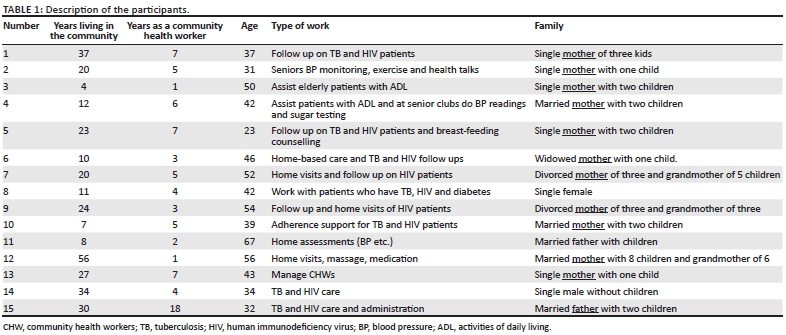
Fifteen participants were interviewed. As indicated in Table 1, CHW participants lived in the communities in which they worked for an average of 21.5 years and have been working as CHWs for an average of 3.7 years. The participants were primarily female (80%), 33% were married and had a mean age of 43.2 years. All the participants received a monthly stipend through the two NGOs. Participants were primarily engaged in home visits, providing home-based assistance with activities of daily living, ensuring adherence to tuberculosis (TB) and human immunodeficiency virus (HIV) medication regimens and conducting blood pressure and blood glucose monitoring.
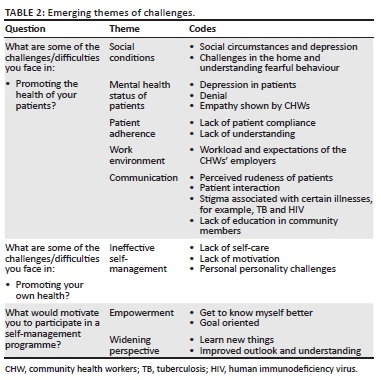
Interpretation of the results yielded five themes (social conditions, mental health of patients, work environment, patient adherence and communication) of challenges experienced by the CHWs in performing their duties. Personal challenges revealed ineffective self-management as a theme, and motivation for participating in a self-management programme was characterised by two themes: CHW empowerment and widening CHWs' perspectives (Table 2).
Quotations are used to illustrate how the information is rooted in the participants' perceptions and experiences.
Challenges experienced by community health workers
The challenges experienced by the CHWs included influence of social conditions, mental health status of the patient, patient adherence, communication and work environment.
Social conditions
This theme comprised social factors influencing patient health status, such as the impact of socio-economic status on individual and community mental health:
'Sometimes it is difficult for us to get through to them in a sense like they have their own house problems as well.' (Participant 5, female, 23 years old)
Participants also observed that poverty affected patients' response to healthcare interventions:
'[I]t's already poor communities so all that circumstances depress these people.' (Participant 1, female, 37 years old)
The participants also commented about gaining access to patients' homes and the patients' reactions that arriving at their homes could evoke. These reactions are because of the CHWs daily interaction in the community and living in fear. They expressed being received poorly by patients, such as instances in which patients rudely addressed CHWs and were dismissive of CHWs when CHWs requested access to patient homes. These CHWs observed that this was particularly prevalent when the CHWs started working in a particular area and were not yet well known to community members.
Community health workers in the study also reported being denied access to clients' homes, albeit for different reasons. Community health workers observed that clients were concerned that the police were at their door. This is consistent with the high-crime neighbourhoods in which the CHWs conduct their work and police visits were not associated with favourable news or outcomes:
'I discovered that when you get to people, sometimes … A lot of them are very edgy if you knock they think it is the police.' (Participant 11, male, 67 years old)
Mental health status of patients
This theme captured how participants experienced their patients when doing home visits. Although the CHWs realised that they cannot diagnose patients, they were able to recognise mental health symptoms and demonstrate empathy as they dealt with patients:
'[S]ome of them are very depressed, they have other issues as well, so when you try and speak to them, they are very closed.' (Participant 1, female, 37 years old)
'[M]ost of them are in denial mode or they don't want to know they are sick.' (Participant 2, female, 31 years old)
'It is basically trying to like bring yourself on the same level as the person because obviously you are not as sick as that person is, so sometimes it is difficult for you to get through to the patient.' (Participant 5, female, 23 years old)
Patient adherence
Community health workers communicated frustration in getting community members to change their health behaviours:
'She does nothing that I tell her - no exercise, nothing. Every time when I must go to treat her then her skin is everywhere and arms are stiff like rocks, then I massage it right again.' (Participant 3, female, 50 years old)
Participants expressed a perception that patients refuse to adhere to health advice despite concerted CHW efforts:
'I struggled a lot to get through because it puts a strain on me especially when I communicated with a patient but they don't want to listen.' (Participant 8, female, 42 years old)
Follow up of patients who defaulted treatments can be complicated and unsuccessful:
'[W]hen the patient defaults and you are supposed to go and look for the patient and you find out that this patient doesn't live there. This patient gives the incorrect address and stuff like that.' (Participant 13, female, 43 years old)
Work environment
Community health workers in the study also identified this struggle to manage workload in their high-need, low-resource community settings:
'Sometimes it feels like they didn't think this through because there is just so much that a person can do in a day but then they expect you must have a workload of so much.' (Participant 1, female, 37 years old)
Occupational stress triggered by perceived inadequate staffing to ensure patient safety was also a factor:
'I was so scared that I will do something with the old people, because if they fall, I will get into trouble.' (Participant 3, female, 50 years old)
Communication
Participants reported communication challenges when met with disrespect from community members and how they manage this dynamic as they ensure appropriate health service delivery:
'Some of the patients are very rude. What we came to learn is that one must just be quiet.' (Participant 9, female, 54 years old)
'A lot of times I have been in peoples' homes who are a bit rude, [previously] some of the patients were not rude, but they are now so rude.' (Participant 12, female, 56 years old)
Community health worker participants observed that community members' lack of education is a factor limiting their ability to comprehend healthcare instructions. Community health workers in this study showed insight into this barrier and were able to utilise their knowledge of the community to advance the treatment or programmes they were administering:
'[S]ometimes we have to explain more detail for the patient because sometimes the people don't know exactly about TB and then the stigma.' (Participant 10, female, 39 years old)
'I mean, not everybody is educated and etcetera, so you have to come down on a level of understanding so that would have to be patience and understanding also.' (Participant 15, male, 32 years old)
Challenges with their own health
The second question of this study focused on the challenges that CHWs experienced with their own health. The themes that emerged were ineffective self-management with lack of self-care, lack of motivation and CHWs' own personality challenges.
Ineffective self-management
'The challenges that I had is to eat healthy and even if I'm on medication and not taking medication.' (Participant 10, female, 39 years old)
'For myself, I will say, yes because I'm very lazy hey - I'm not lazy, it's almost like, I always need a coupling [colleague] to do something.' (Participant 13, female, 43 years old)
'I faced a lot of challenges and so with that I had destructive ways about me because that was the way I managed things to keep it there and not let it go any further.' (Participant 15, female, 32 years old)
Motivations to participate in a self-management programme
The third line of inquiry in interviews focused on why the CHWs would want to engage in a self-management programme. The two themes that emerged were empowerment and widening perspectives.
Empowerment
Participants indicated a desire to become more confident and to take control of their own lives, including the need to focus on themselves at times rather than on the community:
'So obviously that has to do with me personally and I wanted to like, basically just get to know myself much better also than what I do at the moment and manage myself properly also in a way that is pleasing and also pleasant for other people around me.' (Participant 15, male, 32 years old)
'The main emphasis … - I would say it was like mostly goal orientated and that was, kind of, exactly what I needed. To be honest with you, the way I grew up I wasn't really motivated and I needed to get motivated.' (Participant 14, male, 34 years old)
'For me, it was that I wanted to learn more about myself and when I learn about myself, I can teach other people what I had learnt.' (Participant 8, female, 42 years old)
Widening perspectives
Community health worker participants communicated their interest in gaining new knowledge. New knowledge acquisition fuels possible job advancement (personal benefit) and the transference of new-found knowledge to benefit others (community benefit):
'I like to learn new things. I like to do so because to me, if I learn new things, tomorrow I come somewhere and I can educate somebody else.' (Participant 13, female, 43 years old)
'I told myself every training or something that you get … that …uhmmm … um … um … it makes you more … um … um … more aware of things, not just things that fit into your field of work, but to learn how to look after yourself, how to handle things, so I grab every opportunity that I get.' (Participant 12, female, 56 years old)
Discussion
The aim of the study was twofold: (1) to explore the challenges CHWs' experience in carrying out their duties and (2) to explore their motivation to join a self-management programme. Based on the findings of the study the emerging themes that describe the challenges are discussed initially and then the motivation to join the self-management programme.
Social conditions and mental health
In this study, the CHWs reported that the social conditions of the patients led to fear, depression and an inability to focus on what the CHWs wanted them as patients to do. Literature from India commented on the CHWs' description of not gaining access to clients' homes as one of the negative experiences of the job.35363738
Patient adherence and communication
The lack of patient adherence to the prescribed treatment regimens were identified as a challenge. Factors contributing to the lack of adherence to proposed health regimens are multi-faceted, ranging from undervaluing preventative measures to psychosocial and socioeconomic hurdles to fears over stigma and challenges with traversing the health sector.39,40,41 As CHWs can play a key role in areas where health service access or motivation is poor,134239434044,45
Work environment and ineffective self-management
In this study the CHWs raised workload and the environment as a barrier to successfully implementing their duties. Literature has previously highlighted CHW workload as a barrier to achieving goals set by supervisors or health systems.46474847,49,50 Studies have documented these factors as significant contributors to occupational stress.51,52
Aligned to the fact that the CHWs were not coping with their increased workloads, was their inability to successfully manage their own health. Literature reveals much research about the roles that CHWs play in addressing health challenges in the communities, yet there is a dearth of information on CHWs' health needs and how they manage their own health. A substantial proportion of health professionals including CHWs struggle to manage their own health behaviours and to 'practice what they preach'.18,53 A recent study amongst rural CHWs reported that they present with chronic conditions such as those of the community members they serve and that they also experience physical and emotional barriers to managing their own chronic conditions, suggesting that CHWs themselves may be good candidates for self-management interventions.54
Motivations to participate in a self-management programme
In this study the participants highlighted empowerment and widening perspectives as two key reasons for joining a self-management programme. Research indicates that CHWs feel empowered when they are valued for the healthcare contributions they make, when they are included as part of the healthcare team and when they receive training to improve their competence.35,43,55 With the expectation that CHWs need to contribute productively to improvements in overall community health, it is important that CHWs feel empowered.555657
It has been found that CHWs were very keen to gain new knowledge, as such new information modified their worldview.35
Implications for practice
Research has shown that most engagement with the CHW workforce has been around upskilling to improve the health and empowerment in the communities they serve.581335,43 Empowerment of this cadre should be high on the agenda, as CHWs cannot transfer skill sets of confidence, goal setting and action planning needed to create behaviour change without themselves developing and maintaining these skills. A self-management programme, which by its design is problem-based and incorporates the person's perception in the process, is ideally suited as a tool to achieve this end, and CHWs as frontline providers are ideal candidates to be trained as self-managers.2021,59
Simply belonging to the same community and having shared experiences is not sufficient to equip CHWs to work with clients who are unresponsive, who undervalue CHWs' role and who do not adhere to recommended health behaviours. Therefore, there is a need to incorporate these competencies into all training offered to CHWs coupled with regular maintenance sessions. Self-management is a cost-effective strategy60
The formal health system has been remiss in failing to fully accept the CHW as a critical link in the patient-centred delivery model.45,47 It is important that health systems develop insight into the critical role of CHWs, the impact CHWs make in their communities and work to remedy the strained relationship that currently exists between CHWs and health systems. Self-management is an empowerment strategy of meta-skills that does not rely on deep content knowledge within an aspect of medicine. One strategy to improve mutual respect could be to enable CHWs to serve as self-management trainers to members of the formal health system. During these trainings CHWs can present their field findings to formal health professionals. Community health workers-led training may improve the structural competence of health professionals. Another way to address this current divide is to have more 'multidisciplinary' engagements, wherein all parties have an equal voice to contribute.
Conclusion
Community health workers affiliated with community-based organisations are central to the implementation of primary healthcare in district health services in South Africa. The themes presented here offer insight into the benefits and challenges described by CHWs. Although these findings are context-specific and so cannot be generalised to the global population, there is sufficient commonality amongst CHW roles worldwide to warrant an urgent response to these challenges. Hearing these often 'silenced voices' and responding with tangible risk mitigation strategies will support motivation and empowerment levels required by CHWs to work optimally. This study highlights that CHWs are eager to find solutions to these challenges and one of the ways they did it was by taking the opportunity to learn self-management skills by signing up for self-management training.
Equipping CHWs with self-management tools should positively influence the communities they serve and may ultimately result in healthier communities and a decreased disease burden.
Competing interests
The authors declare that they have no financial or personal relationships that may have inappropriately influenced them in writing this article.
Authors' contributions
L.J.J. and J.M.F. analysed the data and drafted the article. L.H.S. and F.W. contributed to conceptualising the study and reviewing the manuscript.
Funding information
The authors acknowledge the NRF, through which funding was received, as a bursary to conduct this study.
Data availability
Data are available upon special request from the corresponding author, L.J.J.
Disclaimer
The views and opinions expressed in this article are those of the authors and do not necessarily reflect the official policy or position of any affiliated agency of the authors.
Acknowledgements
The authors would like to acknowledge the community health workers who participated in this study.
References
-
1. Campbell J, Dussault G, Buchan J, et al. A universal truth: No health without a workforce [homepage on the Internet]. Geneva: World Health Organization; 2013 [cited 2020 Aug 5]. Available from: http://www.who.int/workforcealliance/knowledge/resources/hrhreport2013/en/
» http://www.who.int/workforcealliance/knowledge/resources/hrhreport2013/en/ -
2. World Health Organization. WHO methods and data sources for global burden of disease estimates [homepage on the Internet]. Geneva; 2018 [cited 2020 Aug 5]. Available from: https://www.who.int/healthinfo/global_burden_disease/GlobalDALY_method_2000_2016.pdf?ua=1
» https://www.who.int/healthinfo/global_burden_disease/GlobalDALY_method_2000_2016.pdf?ua=1 - 3. Ballard M, Madore A, Johnson A, et al. Concept note: Community health workers. Boston, MA: Harvard Business Publishing; 2018.
-
4. UNAIDS. 2 million African community health workers - Harnessing the demographic dividend, ending AIDS and ensuring sustainable health for all in Africa [homepage on the Internet]. Geneva; 2017 [cited 2020 Aug 20]. Available from: https://www.unaids.org/sites/default/files/media_asset/African2mCHW_en.pdf
» https://www.unaids.org/sites/default/files/media_asset/African2mCHW_en.pdf -
5. Najafizada SAM, Labonté R, Bourgeault IL. Community health workers of Afghanistan: A qualitative study of a national program. Confl Health. 2014;8:26. https://doi.org/10.1186/1752-1505-8-26
» https://doi.org/10.1186/1752-1505-8-26 -
6. Neff J, Holmes SM, Knight KR, et al. Structural competency: Curriculum for medical students, residents, and interprofessional teams on the structural factors that produce health disparities. MedEdPORTAL: J Teach Learn Resour. 2020;16:10888. https://doi.org/10.15766/mep_2374-8265.10888
» https://doi.org/10.15766/mep_2374-8265.10888 -
7. Metzl JM, Hansen H. Structural competency: Theorizing a new medical engagement with stigma and inequality. Soc Sci Med. 2014;103:126-133. https://doi.org/10.1016/j.socscimed.2013.06.032
» https://doi.org/10.1016/j.socscimed.2013.06.032 -
8. Logan RI. 'A poverty in understanding': Assessing the structural challenges experienced by community health workers and their clients. Glob Public Health. 2020;15(1):137-150. https://doi.org/10.1080/17441692.2019.1656275
» https://doi.org/10.1080/17441692.2019.1656275 - 9. Cacal SL, Spock N, Quensell ML, Sentell TL, Stupplebeen DA. Legislative definitions of community health workers: Examples from other states to Inform Hawaii. Hawaii J Med Public Health. 2019;78(6 Suppl 1):23-29.
-
10. Sabo S, Flores M, Wennerstrom A, et al. Community health workers promote civic engagement and organizational capacity to impact policy. J Community Health. 2017;42(6):1197-1203. https://doi.org/10.1007/s10900-017-0370-3
» https://doi.org/10.1007/s10900-017-0370-3 -
11. Bourgois P, Holmes SM, Sue K, Quesada J. Structural vulnerability: Operationalizing the concept to address health disparities in clinical care. Acad Med. 2017;92(3):299-307. https://doi.org/10.1097/ACM.0000000000001294
» https://doi.org/10.1097/ACM.0000000000001294 -
12. Trinh-Shevrin C, Taher M, Islam N. Community health workers as accelerators of community engagement and structural competency in health. In: Structural competency in mental health and medicine [homepage on the Internet]. Cham: Springer International Publishing, 2019 [cited 2020 Jun 14]; p. 167-177. Available from: http://link.springer.com/10.1007/978-3-030-10525-9_14
» http://link.springer.com/10.1007/978-3-030-10525-9_14 -
13. Tsolekile LP, Puoane T, Schneider H, Levitt NS, Steyn K. The roles of community health workers in management of non-communicable diseases in an urban township. Afr J Prim Health Care Fam Med. 2014;6(1):a693. https://doi.org/10.4102/phcfm.v6i1.693
» https://doi.org/10.4102/phcfm.v6i1.693 -
14. Friedman I. CHWs and community caregivers: Towards a unified model of practice: Human resources. S Afr Health Rev [serial online]. 2005 [cited 2020 Jun 14];2005(1):176-188. Available from: https://journals.co.za/content/healthr/2005/1/AJA10251715_21
» https://journals.co.za/content/healthr/2005/1/AJA10251715_21 -
15. Mlotshwa L, Harris B, Schneider H, Moshabela M. Exploring the perceptions and experiences of community health workers using role identity theory. Glob Health Action. 2015;8(1):28045. https://doi.org/10.3402/gha.v8.28045
» https://doi.org/10.3402/gha.v8.28045 -
16. Gale N, Sidhu M. Risk work or resilience work? A qualitative study with community health workers negotiating the tensions between biomedical and community-based forms of health promotion in the United Kingdom. PLoS One. 2019;14(7):e0220109. https://doi.org/10.1371/journal.pone.0220109
» https://doi.org/10.1371/journal.pone.0220109 -
17. Karuguti W, Frantz J, Phillips J. Physical inactivity and counseling practices among medical doctors: A review [serial online]. 2020 [cited 20 Aug 2020];6(1):1-7. Available from: https://repository.uwc.ac.za/handle/10566/2804
» https://repository.uwc.ac.za/handle/10566/2804 -
18. Hidalgo KD, Mielke GI, Parra DC, et al. Health promoting practices and personal lifestyle behaviors of Brazilian health professionals. BMC Public Health. 2016;16(1):1114. https://doi.org/10.1186/s12889-016-3778-2
» https://doi.org/10.1186/s12889-016-3778-2 -
19. Bandura A. Self-efficacy: Toward a unifying theory of behavioral change. Psychol Rev. 1977;84(2):191-215. https://doi.org/10.1037/0033-295X.84.2.191
» https://doi.org/10.1037/0033-295X.84.2.191 -
20. Kinney J, Kahana E, Corbin J, Strauss A. Unending work and care: Managing chronic illness at home. Contemp Sociol. 1989;18(6):358. https://doi.org/10.2307/2074227
» https://doi.org/10.2307/2074227 -
21. Lorig KR, Holman HR. Self-management education: History, definition, outcomes, and mechanisms. Ann Behav Med. 2003;26(1):1-7. https://doi.org/10.1207/S15324796ABM2601_01
» https://doi.org/10.1207/S15324796ABM2601_01 -
22. Jonker A, Comijs H, Knipscheer K, Deeg D. Promotion of self-management in vulnerable older people: A narrative literature review of outcomes of the chronic disease self-management program (CDSMP). Eur J Ageing. 2009;6(4):303-314. https://doi.org/10.1007/s10433-009-0131-y
» https://doi.org/10.1007/s10433-009-0131-y -
23. Brady TJ, Murphy L, O'Colmain BJ, et al. A meta-analysis of health status, health behaviors, and health care utilization outcomes of the chronic disease self-management program. Prev Chronic Dis. 2013;10:120112. https://doi.org/10.5888/pcd10.120112
» https://doi.org/10.5888/pcd10.120112 -
24. Majee W, Anakwe A, Johnson L, Rhoda A, Frantz J, Schopp L. A self-management training intervention: Perceptions and practices of community health workers in South Africa. Health Promot Pract. 2020;21(6):983-992. https://doi.org/10.1177/1524839918820038
» https://doi.org/10.1177/1524839918820038 - 25. Polit DF, Beck CT. Essentials of nursing research. In: Appraising evidence for nursing practice. 7th ed. Philadelphia: Lippincott-Raven, 2014; pp. 258-283.
-
26. City of Cape Town - 2011 Census [document on the Internet]. 2011 [cited 2020 Aug 10]. Available from: http://resource.capetown.gov.za/documentcentre/Documents/Mapsandstatistics/2011_Census_Cape_Town_Profile.pdf
» http://resource.capetown.gov.za/documentcentre/Documents/Mapsandstatistics/2011_Census_Cape_Town_Profile.pdf -
27. Western Cape Provincial Crime Analysis. Analysis of Western Cape reported crime based on the 2018/19 crime statistics issued by the South African Police services on 2019 September 13 [document on the Internet]. 2020 [cited 2020 Sep 5]. Available from: https://www.westerncape.gov.za/sites/www.westerncape.gov.za/files/wccs_crime_report_2020-03-25_medres.pdf
» https://www.westerncape.gov.za/sites/www.westerncape.gov.za/files/wccs_crime_report_2020-03-25_medres.pdf -
28. Languza N, Lushaba T, Magingxa N, Masuku M, Ngubo T. Community health workers - A brief description of the HST experience. Health Syst Trust [homepage on the Internet]. 2011 [cited 2020 July 16]; p. 1-8. Available from: https://www.hst.org.za/publications/HST%20Publications/CHWs_HSTexp022011.pdf
» https://www.hst.org.za/publications/HST%20Publications/CHWs_HSTexp022011.pdf -
29. Johnson L, Schopp L, Waggie F, Frantz J. Assessment of risk factors for non-communicable diseases among a cohort of community health workers in western cape, South Africa. Malawi Med J. 2021;33(3):196-203. https://doi.org/10.4314/mmj.v33i3.7
» https://doi.org/10.4314/mmj.v33i3.7 - 30. Patton MQ. Qualitative research and evaluation methods. Thousand Oaks, CA: Sage; 2002.
-
31. Boyce C, Neale P. Conducting in-depth interviews: A guide for designing and conducting in-depth interviews for evaluation input. Sci Res J [serial online]. 2006 [cited 2020 Aug 7]. Available from: https://www.scirp.org/(S(i43dyn45teexjx455qlt3d2q))/reference/ReferencesPapers.aspx?ReferenceID=1702348
» https://www.scirp.org/(S(i43dyn45teexjx455qlt3d2q))/reference/ReferencesPapers.aspx?ReferenceID=1702348 - 32. Lisa M, Given KS. The Sage encyclopedia of qualitative research methods. Volume 1 and 2. Thousand Oaks, CA: SAGE; 2008.
-
33. Braun V, Clarke V. Using thematic analysis in psychology. Qual Res Psychol [serial online]. 2006 [cited 2020 Aug 27];3(2):77-101. Available from: http://eprints.uwe.ac.uk/11735.
» http://eprints.uwe.ac.uk/11735 - 34. Connelly LM. Trustworthiness in qualitative research. Medsurg Nurs. 2016;25(6):435-436.
-
35. George MS, Pant S, Devasenapathy N, Ghosh-Jerath S, Zodpey SP. Motivating and demotivating factors for community health workers: A qualitative study in urban slums of Delhi, India. WHO South-East Asia J Public Health. 2017;6(1):82-89. https://doi.org/10.4103/2224-3151.206170
» https://doi.org/10.4103/2224-3151.206170 -
36. Eftekhari M, Falahat K, Mirabzadeh A, et al. Social determinants of positive mental health in Iranian society: A qualitative approach. Int J Prev Med. 2019;10(1):170. https://doi.org/10.4103/ijpvm.IJPVM_94_18
» https://doi.org/10.4103/ijpvm.IJPVM_94_18 -
37. Nyalunga SLN, Ndimande JV, Ogunbanjo GA, Masango-Makgobela A, Bogongo T. Perceptions of community health workers on their training, teamwork and practice: A cross-sectional study in Tshwane district, Gauteng, South Africa. S Afr Fam Pract. 2019;61(4):144-149. https://doi.org/10.1080/20786190.2019.1613061
» https://doi.org/10.1080/20786190.2019.1613061 -
38. Ngo VK, Rubinstein A, Ganju V, et al. Grand challenges: Integrating mental health care into the non-communicable disease agenda. PLoS Med. 2013;10(5):e1001443. https://doi.org/10.1371/journal.pmed.1001443
» https://doi.org/10.1371/journal.pmed.1001443 -
39. Grossman-Kahn R, Schoen J, Mallett JW, Brentani A, Kaselitz E, Heisler M. Challenges facing community health workers in Brazil's family health strategy: A qualitative study. Int J Health Plann Manage. 2017;33(2):309-320. https://doi.org/10.1002/hpm.2456
» https://doi.org/10.1002/hpm.2456 -
40. Loeliger KB, Niccolai LM, Mtungwa LN, Moll A, Shenoi SV. Antiretroviral therapy initiation and adherence in rural South Africa: Community health workers' perspectives on barriers and facilitators. AIDS Care - Psychol Socio-Med Asp AIDS/HIV. 2016;28(8):982-993. https://doi.org/10.1080/09540121.2016.1164292
» https://doi.org/10.1080/09540121.2016.1164292 -
41. Michel J, Matlakala C, English R, Lessells R, Newell ML. Collective patient behaviours derailing ART roll-out in KwaZulu-Natal: Perspectives of health care providers. AIDS Res Ther. 2013;10:20. https://doi.org/10.1186/1742-6405-10-20
» https://doi.org/10.1186/1742-6405-10-20 -
42. Haq Z, Hafeez A. Knowledge and communication needs assessment of community health workers in a developing country: A qualitative study. Hum Resour Health. 2009;7:59. https://doi.org/10.1186/1478-4491-7-59
» https://doi.org/10.1186/1478-4491-7-59 -
43. Ozano K, Simkhada P, Thann K, Khatri R. Improving local health through community health workers in Cambodia: Challenges and solutions. Hum Resour Health. 2018;16:2. https://doi.org/10.1186/s12960-017-0262-8
» https://doi.org/10.1186/s12960-017-0262-8 -
44. Winn LK, Lesser A, Menya D, et al. Motivation and satisfaction among community health workers administering rapid diagnostic tests for malaria in Western Kenya. J Glob Health. 2018;8(1):010401. https://doi.org/10.7189/jogh.06.0207028.010401
» https://doi.org/10.7189/jogh.06.0207028.010401 -
45. Malcarney M-B, Pittman P, Quigley L, Horton K, Seiler N. The changing roles of community health workers health services research. Health Serv Res. 2017;52(S1):360-382. https://doi.org/10.1111/1475-6773.12657
» https://doi.org/10.1111/1475-6773.12657 -
46. Ma Z, Huang H, Chen Q, et al. Mental health services in rural China: A qualitative study of primary health care providers. Biomed Res Int. 2015;2015:151053. https://doi.org/10.1155/2015/151053
» https://doi.org/10.1155/2015/151053 -
47. O'Donovan J, Hamala R, Namanda AS, Musoke D, Ssemugabo C, Winters N. 'We are the people whose opinions don't matter': A photovoice study exploring challenges faced by community health workers in Uganda. Glob Public Health. 2020;15(3):384-401. https://doi.org/10.1080/17441692.2019.1663233
» https://doi.org/10.1080/17441692.2019.1663233 - 48. Aryal S, Shastry CS, Chand S, et al. The linkage between occupation and stress among community health workers: An indo-global perspective. Biomed. 2019;39(3):388-393.
-
49. What needs to be done to solve the shortage of health workers in the African Region [homepage on the Internet]. WHO | Regional Office for Africa. 2020 [cited 2020 Aug 5]. Available from: https://www.afro.who.int/news/what-needs-be-done-solve-shortage-health-workers-african-region
» https://www.afro.who.int/news/what-needs-be-done-solve-shortage-health-workers-african-region -
50. Long H, Huang W, Zheng P, et al. Barriers and facilitators of engaging community health workers in non-communicable disease (Ncd) prevention and control in china: A systematic review (2006-2016). Int J Environ Res Public Health. 2018;15(11):2378. https://doi.org/10.3390/ijerph15112378
» https://doi.org/10.3390/ijerph15112378 - 51. Grunfeld E, Whelan TJ, Zitzelsberger L, Willan AR, Montesanto B, Evans WK. Cancer care workers in Ontario: Prevalence of burnout, job stress and job satisfaction. CMAJ. 2000;163(2):166-169.
-
52. Gray-Stanley JA, Muramatsu N. Work stress, burnout, and social and personal resources among direct care workers. Res Dev Disabil. 2011;32(3):1065-1074. https://doi.org/10.1016/j.ridd.2011.01.025
» https://doi.org/10.1016/j.ridd.2011.01.025 -
53. While AE. Promoting healthy behaviours - Do we need to practice what we preach? London J Prim Care. 2015;7(6):112-114. https://doi.org/10.1080/17571472.2015.1113716
» https://doi.org/10.1080/17571472.2015.1113716 -
54. Majee W, Schopp L, Johnson L, Anakwe A, Rhoda A, Frantz J. Emerging from the shadows: Intrinsic and extrinsic factors facing community health workers in Western Cape, South Africa. Int J Environ Res Public Health. 2020;17(9):3199. https://doi.org/10.3390/ijerph17093199
» https://doi.org/10.3390/ijerph17093199 -
55. Kane S, Kok M, Ormel H, et al. Limits and opportunities to community health worker empowerment: A multi-country comparative study. Soc Sci Med. 2016;164:27-34. https://doi.org/10.1016/j.socscimed.2016.07.019
» https://doi.org/10.1016/j.socscimed.2016.07.019 -
56. Jarvis JD, Kataria I, Murgor M, Mbau L. Community health workers: An underappreciated asset to tackle NCD. Glob Heart. 2016;11(4):455-457. https://doi.org/10.1016/j.gheart.2016.10.004
» https://doi.org/10.1016/j.gheart.2016.10.004 - 57. Kelkar S, Mahapatro M. Community health worker: A tool for community empowerment. Health Popul Perspect Issues. 2014;37:57-65.
-
58. Niang M. What are the roles of community health workers? Looking back at the philosophies of primary health care. Glob Health Promot. 2019;27(2):117-120. https://doi.org/10.1177/1757975918811087
» https://doi.org/10.1177/1757975918811087 -
59. Lorig KR, Sobel DS, Ritter PL, Laurent D, Hobbs M. Effect of a self-management program on patients with chronic disease. Eff Clin Pract. 2001;39(11):1217-1223. https://doi.org/10.1097/00005650-200111000-00008
» https://doi.org/10.1097/00005650-200111000-00008 -
60. Basu R, Ory MG, Towne SD Jr, Smith ML, Hochhalter AK, Ahn S. Cost-effectiveness of the chronic disease self-management program: Implications for community-based organizations. Front Public Health. 2015;3:27. https://doi.org/10.3389/fpubh.2015.00027
» https://doi.org/10.3389/fpubh.2015.00027

Accepted: 04 Nov. 2021
Published: 12 Jan. 2022