Psychological distress among undergraduate health sciences students in Uganda
Abstract
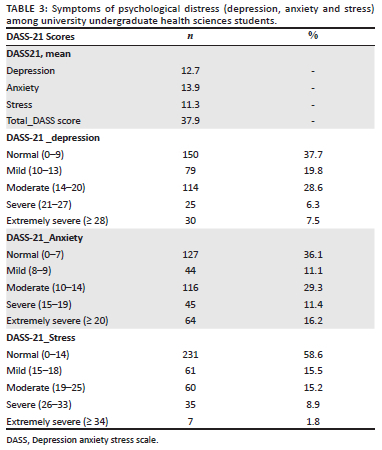
BACKGROUND: Psychological distress (PD) is a prevalent concern among undergraduate health science students globally. Despite this, data specific to Uganda is limited AIM: This study assessed the prevalence of PD among undergraduate health sciences students in Uganda METHODS: We obtained data on the psychological distress burden using self-administered DASS-21 questionnaires. Data were analysed using SPSS version 20 RESULTS: We enrolled 398 participants, of whom 217 (54.5%) were males. The median age of the participants was 22 years (interquartile range [IQR], 21 to 24). Of the participants, more than half (57%) had moderate to severe symptoms of anxiety. Nearly half of them (42%) reported moderate to severe symptoms of depression, while 26% of the students had moderate to severe symptoms of stress LESSONS LEARNT: This study highlights significant psychological distress among health science students at Makerere University, with high levels of anxiety, depression and stress. It emphasises the need for improved mental health support in academic settings, aligning with the African Journal of Primary Health Care & Family Medicine's focus on contextual healthcare challenges
psychological distress; health science; students; undergraduate; university
Introduction
Social value
Globally, psychological distress (PD) has been a longstanding issue affecting university students.1,234,56,7
Scientific value
Psychological distress is an indicator of students' psychological well-being.895,10
Additionally, the rigour of education curricula could differ across disciplines. Health sciences disciplines are known for their rigorous academic and clinical demands, requiring students to balance extensive coursework with practical rotations. Health sciences students are a future key resource for the health care system, and understanding the burden of PD among this cohort has wider implications to highlight the need for appropriate policies and support services.
Aim
This study aimed to document the burden of PD among undergraduate health sciences students in Uganda.
Research methods and design
Study design
This study employed a cross-sectional design.
Setting
The study was conducted at Makerere University College of Health Sciences (MakCHS),1111
Study population and sampling strategy
To estimate the study sample size, we aimed for 5% precision, assuming a PD prevalence of 40.2% from a previous study among students in Uganda.12
Data collection
The Depression Anxiety Stress Scale (DASS-21), a 21-item self-report tool designed to measure symptoms of depression, anxiety and stress, was used to obtain data on symptoms of depression, anxiety and stress. It uses a four-point (0-3) scale to assess the extent of symptoms experienced over the previous week and has been widely used among patients, occupational workers and students in a number of settings, including Africa.13,14,1516,17,18
Data analysis
Data were analysed using SPSS version 20. Cronbach's alpha assessed the reliability of the DASS-21 questionnaire, which has three subscales (depression, anxiety and stress), each containing seven items. Sum scores for each subscale were calculated, doubled and categorised into levels: (1) depression: normal (0-9), mild (10-13), moderate (14-20), severe (21-27), very severe (≥ 28); (2) anxiety: normal (0-7), mild (8-9), moderate (10-14), severe (15-19), very severe (≥ 20) and (3) stress: normal (0-14), mild (15-18), moderate (19-25), severe (26-33), very severe (≥ 34).19
Ethical considerations
Ethical clearance to conduct this study was obtained from the Makerere University School of Health Sciences Research Ethics Committee (No. MAKSHSREC-2023-500). Written consent was obtained from participants, and confidentiality was maintained by anonymising data and storing it on password-protected devices. All procedures adhered to the ethical standards of the Declaration of Helsinki (2013 revision).
Results
Population characteristics
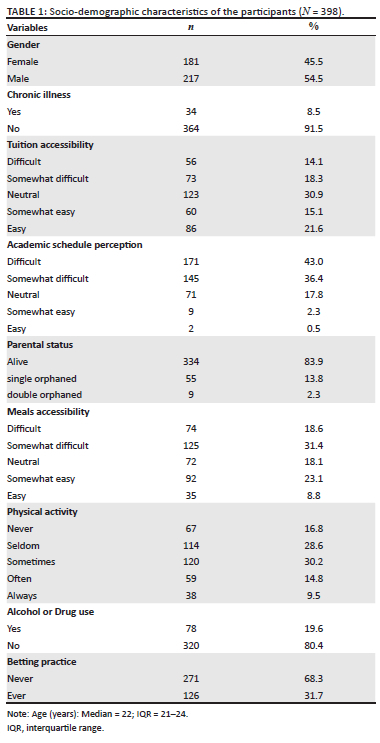
A total of 398 students participated in the survey. The median age was 22 years (interquartile range [IQR], 21 to 24). Just over half (54.5%) were males, nearly half (44%) were Medicine (MBChB) students and 16.1% were orphans. Of the participants, 316 (79.4%) perceived the academic schedule as either difficult or somewhat difficult, and 129 (32.4%) described obtaining tuition as either difficult or somewhat difficult. Half (50%) of the participants reported difficulty accessing meals. Additionally, 19.6% reported current alcohol or drug use, 8.5% had a history of chronic illness, and 32% engaged in a betting practice. Less than half (32%) participated in regular physical activity (Table 1).
Construct reliability
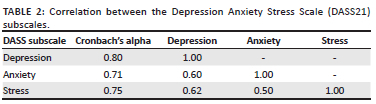
The internal consistency of the DASS subscales was evaluated using Cronbach's alpha, with each subscale showing strong reliability (α > 0.71) (Table 2). Correlation analysis indicated a statistically significant relationship between the depression, stress and anxiety subscales.
Symptoms of psychological distress (depression, anxiety and stress) among undergraduate health sciences students
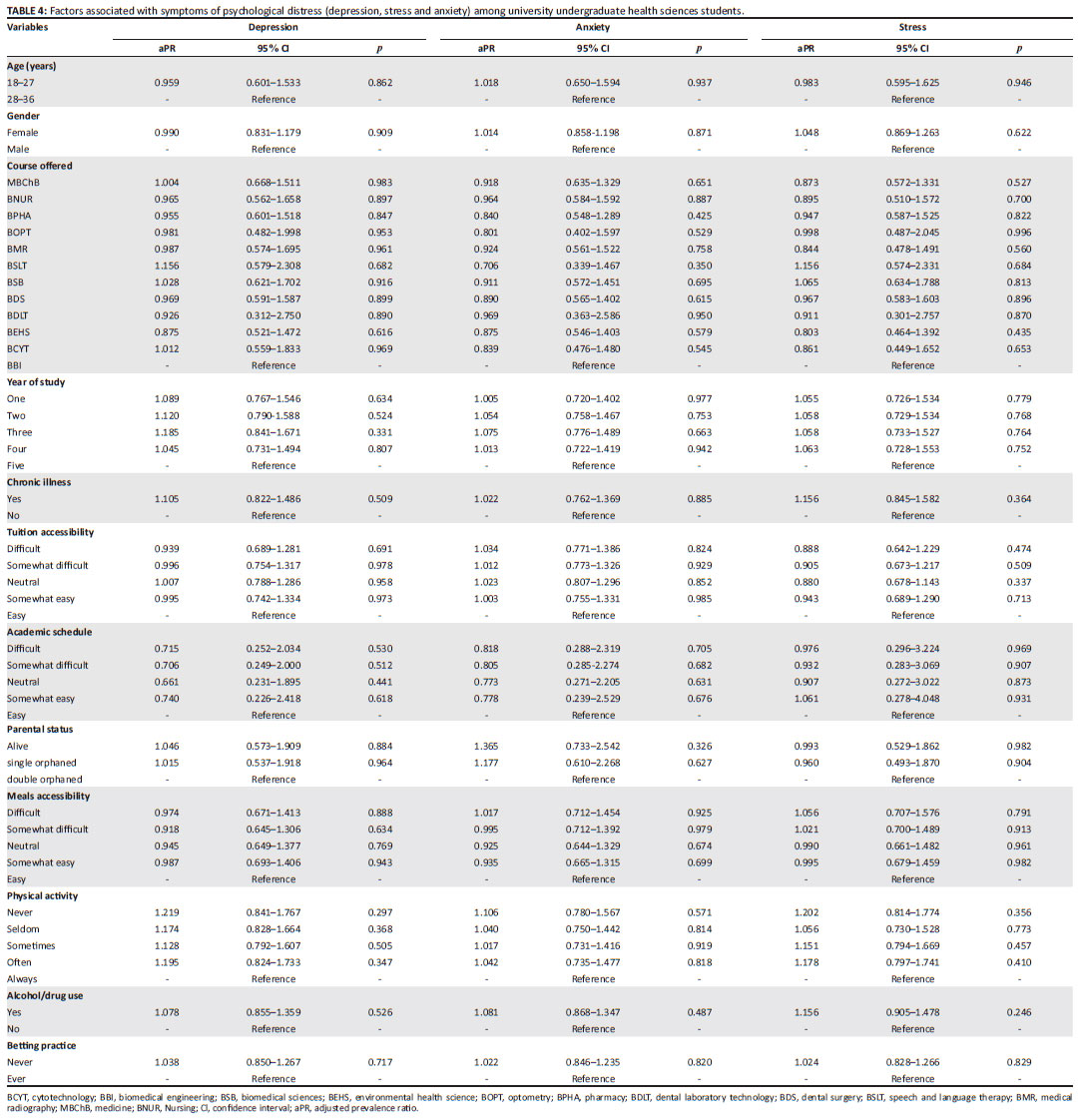
A significant proportion of undergraduate health sciences students experienced moderate to severe symptoms of poor mental health, with 57% reporting anxiety, 42% depression and 26% stress, according to DASS-21 scores (Table 3). However, no statistically significant relationships were found between poor mental health and demographic characteristics of respondents (Table 4).
Discussion
In this study, a high prevalence of PD was observed among undergraduate health sciences students, likely attributed to the demanding academic workload, high expectations and challenging coursework. These findings highlight the need for institutions to integrate mental health support into their curricula to help students manage stress effectively.
The prevalence rates in this study align with prior research in Uganda. Nantaayi et al.122012,2021,222,4,5,10,16,17
Our findings emphasise the need for stakeholders to address poor mental health by implementing targeted strategies: universities should establish mental health services like counselling and stress management workshops; policymakers should invest in services addressing academic stress and post-pandemic challenges while evaluating intervention effectiveness; researchers should conduct longitudinal studies to track mental health trends and assess interventions and students and the community should promote awareness campaigns to encourage help-seeking and normalise mental health discussions.
Our study utilised the standard, validated DASS-21 questionnaire and is the first, to our knowledge, to assess PD among undergraduate health science students in Uganda post-coronavirus disease 2019 (COVID-19). However, the study has limitations. The cross-sectional design prevents the evaluation of changes in PD over time, underscoring the need for future longitudinal studies to assess mental health trends and the long-term impact of university stressors. Additionally, recall bias from self-administered questionnaires was mitigated by pre-testing the tool, but future research should consider incorporating diverse data collection methods (e.g., interviews or focus groups) for deeper insights. Despite these limitations, our findings align with previous studies among undergraduate health science students.
Conclusion
A high prevalence of PD was observed among undergraduate health science students. This highlights the need for strategies to address mental health, such as improving access to counselling, offering stress management resources and fostering supportive academic environments.
Competing interests
The authors reported that they received funding from Fogarty International Center of the National Institutes of Health, U.S. Department of State's Office of the U.S. Global AIDS Coordinator and Health Diplomacy (S/GAC), President's Emergency Plan for AIDS Relief (PEPFAR) and the University of California Global Health Institute (UCGHI). The content is solely the responsibility of the authors and does not necessarily represent the official views of the NIH or UCGHI.
Authors' contributions
R.M. conceived the research idea. R.M. and N.N. participated in the design of the study and statistical data analysis. N.N. coordinated the data collection process and wrote the first draft. All authors contributed to the interpretation of the results, the writing of the article, and approval of the final article.
Funding information
This work was supported by the Fogarty International Center of the National Institutes of Health, U.S. Department of State's Office of the U.S. Global AIDS Coordinator and Health Diplomacy (S/GAC), and President's Emergency Plan for AIDS Relief (PEPFAR) under Award Number: 1R25TW011213. M.R. is a Fogarty UCGHI GloCal Fellow supported by the Fogarty International Center of the National Institutes of Health (NIH) under Award Number: D43TW009343 and the University of California Global Health Institute (UCGHI).
Data availability
The data that support the findings of this study are available on reasonable request from the corresponding author N.N.
Disclaimer
The views and opinions expressed in this article are those of the authors and are the product of professional research. It does not necessarily reflect the official policy or position of any affiliated institution, funder, agency or that of the publisher. The authors are responsible for this article's results, findings and content.
Acknowledgements
Special thanks is given to the undergraduate students at MakCHS for their willingness to participate in this study.
References
-
1. Akdemir M, Aktekin MR, Şenol YY, et al. Depression and psychological distress in medical students, a prospective study. Arch Neuropsychiatr. 2022;59(2):116. https://doi.org/10.29399/npa.27799
» https://doi.org/10.29399/npa.27799 -
2. Tuck D, Wiley J, Patlamazoglou L, Berger E. Distress of tertiary education students in Australia during the COVID-19 pandemic. J Clin Psychol. 2023;79(3):818-834. https://doi.org/10.1002/jclp.23445
» https://doi.org/10.1002/jclp.23445 - 3. Aline D, Alain M, Dominic BP. Mental illnesses - Understanding, prediction and control. In: L'Abate L, editor. Epidemiology of Psychological distress. Rijeka: IntechOpen, 2012; p. 1.
-
4. Porru F, Robroek SJW, Bültmann U, Portoghese I, Campagna M, Burdorf A. Mental health among university students: The associations of effort-reward imbalance and overcommitment with psychological distress. J Affect Disord. 2021;282:953-961. https://doi.org/10.1016/j.jad.2020.12.183
» https://doi.org/10.1016/j.jad.2020.12.183 -
5. Dachew BA, Azale Bisetegn T, Berhe Gebremariam R. Prevalence of mental distress and associated factors among undergraduate students of University of Gondar, Northwest Ethiopia: A cross-sectional institutional based study. PLoS One. 2015;10(3):e0119464. https://doi.org/10.1371/journal.pone.0119464
» https://doi.org/10.1371/journal.pone.0119464 -
6. David S. Mind and health: The human journey [homepage on the Internet] 2023. [cited 2023 Mar 31]. Available from: https://humanjourney.us/health-and-education-in-the-modern-world/mind-and-health/?gclid=Cj0KCQjwiZqhBhCJARIsACHHEH-itGXWPoMAvqkkL4OzLB_E-s31fOjrxoVOqqb6TECZYkqqyPzHn4MaAojGEALw_wcB
» https://humanjourney.us/health-and-education-in-the-modern-world/mind-and-health/?gclid=Cj0KCQjwiZqhBhCJARIsACHHEH-itGXWPoMAvqkkL4OzLB_E-s31fOjrxoVOqqb6TECZYkqqyPzHn4MaAojGEALw_wcB -
7. Yolanda W. Psychological distress [homepage on the Internet]. 2021. [cited 2023 feb 22]. Available from: https://study.com/learn/lesson/what-is-psychological-distress.html
» https://study.com/learn/lesson/what-is-psychological-distress.html -
8. Arvidsdotter T, Marklund B, Kylén S, Taft C, Ekman I. Understanding persons with psychological distress in primary health care. Scand J Caring Sci. 2016;30(4):687-694. https://doi.org/10.1111/scs.12289
» https://doi.org/10.1111/scs.12289 -
9. Qureshi A, Dickenson E, Wall P. Psychological treatments for post-traumatic stress disorder, anxiety and depression following major physical civilian trauma: A systematic review and meta-analysis. Trauma. 2021;23(4):146040862110261. https://doi.org/10.1177/14604086211026104
» https://doi.org/10.1177/14604086211026104 -
10. Peng P, Hao Y, Liu Y, et al. The prevalence and risk factors of mental problems in medical students during COVID-19 pandemic: A systematic review and meta-analysis. J Affect Disord. 2023;321:167-181. https://doi.org/10.1016/j.jad.2022.10.040
» https://doi.org/10.1016/j.jad.2022.10.040 -
11. MakCHS. Makerere University College of Health Sciences. Makerere University, College of Health Sciences, 2023. [cited 2023 Apr 04]. Available from: https://chs.mak.ac.ug/
» https://chs.mak.ac.ug/ -
12. Nantaayi B, Ndawula RK, Musoke P, et al. Psychological distress and access to mental health services among undergraduate students during the COVID-19 lockdown in Uganda. Front Psychiatry. 2022;13:792217. https://doi.org/10.3389/fpsyt.2022.792217
» https://doi.org/10.3389/fpsyt.2022.792217 -
13. Almhdawi KA, Kanaan SF, Khader Y, Al-Hourani Z, Almomani F, Nazzal M. Study-related mental health symptoms and their correlates among allied health professions students. Work. 2018;61(3):391-401. https://doi.org/10.3233/WOR-182815
» https://doi.org/10.3233/WOR-182815 -
14. Elgohary HM, Sehlo MG, Bassiony MM, Youssef UM, Elrafey DS, Amin SI. Depression among health workers caring for patients with COVID-19 in Egypt. Egypt J Neurol Psychiat Neurosurg. 2021;57:1-10. https://doi.org/10.1186/s41983-021-00394-1
» https://doi.org/10.1186/s41983-021-00394-1 -
15. Rao S, Ramesh N. Depression, anxiety and stress levels in industrial workers: A pilot study in Bangalore, India. Ind Psychiatry J. 2015;24(1):23-28. https://doi.org/10.4103/0972-6748.160927
» https://doi.org/10.4103/0972-6748.160927 -
16. Al Saadi T, Zaher Addeen S, Turk T, Abbas F, Alkhatib M. Psychological distress among medical students in conflicts: A cross-sectional study from Syria. BMC Med Educ. 2017;17(1):173. https://doi.org/10.1186/s12909-017-1012-2
» https://doi.org/10.1186/s12909-017-1012-2 -
17. Coker A, Coker OO, Sanni D. Psychometric properties of the 21-item Depression Anxiety Stress Scale (DASS-21). Afr Res Rev. 2018;12(2):135. https://doi.org/10.4314/afrrev.v12i2.13
» https://doi.org/10.4314/afrrev.v12i2.13 -
18. Najjuka SM, Checkwech G, Olum R, Ashaba S, Kaggwa MM. Depression, anxiety, and stress among Ugandan university students during the COVID-19 lockdown: An online survey. Afr Health Sci. 2021;21(4):1533-1543. https://doi.org/10.4314/ahs.v21i4.6
» https://doi.org/10.4314/ahs.v21i4.6 -
19. Le MTH, Tran TD, Holton S, Nguyen HT, Wolfe R, Fisher J. Reliability, convergent validity and factor structure of the DASS-21 in a sample of Vietnamese adolescents. PLoS One. 2017;12(7):e0180557. https://doi.org/10.1371/journal.pone.0180557
» https://doi.org/10.1371/journal.pone.0180557 -
20. Anyanwu MU. Psychological distress in adolescents: Prevalence and its relation to high-risk behaviors among secondary school students in Mbarara Municipality, Uganda. BMC Psychol. 2023;11(1):5. https://doi.org/10.1186/s40359-023-01039-z
» https://doi.org/10.1186/s40359-023-01039-z -
21. Amanya SB, Nakitende J, Ngabirano TD. A cross-sectional study of stress and its sources among health professional students at Makerere University, Uganda. Nurs Open. 2018;5(1):70-76. https://doi.org/10.1002/nop2.113
» https://doi.org/10.1002/nop2.113 -
22. Olum R, Nakwagala FN, Odokonyero R. Prevalence and factors associated with depression among medical students at Makerere University, Uganda. Adv Med Educ Pract. 2020;11:853-860. https://doi.org/10.2147/AMEP.S278841
» https://doi.org/10.2147/AMEP.S278841

Accepted: 27 Jan. 2025
Published: 26 Mar. 2025