Understanding barriers to treatment-seeking in Mseleni joint disease: A multistaged study in rural KwaZulu-Natal, South Africa
Abstract
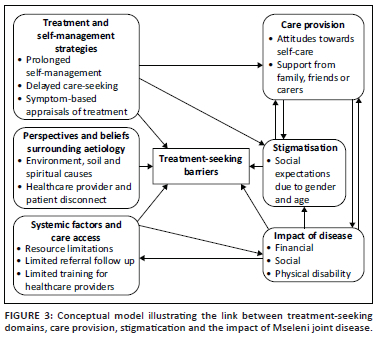
BACKGROUND: Mseleni joint disease (MJD) is a degenerative chondrodysplasia of unknown aetiology that is endemic to uMkhanyekude in KwaZulu-Natal, South Africa. Delayed treatment-seeking for MJD results in severe joint pain, which commonly progresses to permanent loss of mobility and reliance on caregivers AIM: This study aimed to identify systemic, social and cultural barriers to MJD treatment-seeking from the perspectives of patients and healthcare providers SETTING: The research was conducted at the Mseleni Hospital in KwaZulu-Natal, South Africa METHODS: A multistage mixed methods study was conducted. Stage One involved quantitative analysis of patient medical records (n = 53) and administration of questionnaires to patients (n = 37). Stage Two involved a thematic analysis of interviews with MJD patients (n = 6), nurses (n = 7) and treating MJD (n = 9). Findings from both stages were analysed thematically to barriers to treatment-seeking for MJD RESULTS: Treatment-seeking barriers fell into three domains: (1) current approaches to treatment and self-management, (2) aetiological perspectives and (3) systemic barriers to healthcare access. Treatment and self-management through traditional medicine and delays in the primary healthcare system were cited as reasons for latent treatment-seeking. Healthcare providers highlighted structural barriers including unstandardised record-keeping, poor cross-facility communication and limited resources, while MJD patients emphasised failed treatments, pain and immobility and inadequate care as key obstacles. Variable aetiological perspectives between MJD patients and healthcare providers were reflected in appraisals of treatment. Gender disparities in sociocultural expectations and stigma-linked to symptoms restricted women's access to care CONCLUSION: Differing perspectives between MJD patients and healthcare providers contributed to delayed treatment-seeking and hindered the management of MJD. Patients discussed barriers to MJD relative to traditional knowledge, beliefs and lived experience, while healthcare providers discussed barriers relative to systemic and structural factors through a biomedical lens CONTRIBUTION: This study highlights the need to align clinical approaches to treating MJD with patient and provider experiences of this disease to address both individual and systemic barriers to treatment
South Africa; Mseleni joint disease; rural, endemic; treatment-seeking; arthritis; chronic pain
 Thumbnail
 Thumbnail