Understanding barriers to treatment-seeking in Mseleni joint disease: A multistaged study in rural KwaZulu-Natal, South Africa
Abstract
BACKGROUND: Mseleni joint disease (MJD) is a degenerative chondrodysplasia of unknown aetiology that is endemic to uMkhanyekude in KwaZulu-Natal, South Africa. Delayed treatment-seeking for MJD results in severe joint pain, which commonly progresses to permanent loss of mobility and reliance on caregivers AIM: This study aimed to identify systemic, social and cultural barriers to MJD treatment-seeking from the perspectives of patients and healthcare providers SETTING: The research was conducted at the Mseleni Hospital in KwaZulu-Natal, South Africa METHODS: A multistage mixed methods study was conducted. Stage One involved quantitative analysis of patient medical records (n = 53) and administration of questionnaires to patients (n = 37). Stage Two involved a thematic analysis of interviews with MJD patients (n = 6), nurses (n = 7) and treating MJD (n = 9). Findings from both stages were analysed thematically to barriers to treatment-seeking for MJD RESULTS: Treatment-seeking barriers fell into three domains: (1) current approaches to treatment and self-management, (2) aetiological perspectives and (3) systemic barriers to healthcare access. Treatment and self-management through traditional medicine and delays in the primary healthcare system were cited as reasons for latent treatment-seeking. Healthcare providers highlighted structural barriers including unstandardised record-keeping, poor cross-facility communication and limited resources, while MJD patients emphasised failed treatments, pain and immobility and inadequate care as key obstacles. Variable aetiological perspectives between MJD patients and healthcare providers were reflected in appraisals of treatment. Gender disparities in sociocultural expectations and stigma-linked to symptoms restricted women's access to care CONCLUSION: Differing perspectives between MJD patients and healthcare providers contributed to delayed treatment-seeking and hindered the management of MJD. Patients discussed barriers to MJD relative to traditional knowledge, beliefs and lived experience, while healthcare providers discussed barriers relative to systemic and structural factors through a biomedical lens CONTRIBUTION: This study highlights the need to align clinical approaches to treating MJD with patient and provider experiences of this disease to address both individual and systemic barriers to treatment
South Africa; Mseleni joint disease; rural, endemic; treatment-seeking; arthritis; chronic pain
Introduction
Mseleni joint disease (MJD) is a bilateral, degenerative condition that is primarily localised to the hip joints and causes chronic pain and physical disability in those affected.1unyonga - meaning 'a disease of the joints'.2Figure 134,5,67,89,104,114,12,131141511
Extensive delays (often up to 17 years15621641515214,151718191818,202122,23
Research methods and design
Study design
We conducted a multistaged mixed methods study incorporating qualitative and quantitative data from medical record reviews, patient questionnaires, and interviews. Figure 2 provides an illustration of the multiple stages in this study. Stage One included medical record reviews and patient questionnaires of MJD patients at the Mseleni Hospital. These data were analysed to identify patterns in onset, diagnoses and treatment-seeking information from healthcare providers and patients' perspectives, respectively. Stage Two involved in-depth interviews with MJD patients, nurses and doctors to triangulate barriers to treatment-seeking identified in Stage One.
This study was undertaken at the Mseleni Hospital, which is a state-funded district hospital that services more than 90 000 people living in an area spanning 30 000 km22 The Outpatients Department manages a weekly MJD clinic, hospital admissions, emergency care, day-clinic visits, patient transfers and appointments with therapists, radiologists, doctors and surgeons. Patients and healthcare providers sampled in our study were recruited from the Outpatient's Department of the Mseleni Hospital.
Data collection
Stage One
Medical records from the Outpatients Department at the Mseleni Hospital in May 2019 were screened in July 2019 to identify MJD patients. Due to the absence of International Statistical Classification of Diseases and Related Health Problems (ICD-10 codes) in the medical records at the Mseleni Hospital, cases of MJD were identified using diagnoses from clinicians under the terms: 'Bilateral joint disease', 'MJD' or 'MJD diagnosis'. From these records, descriptive clinical information were extracted, including documented disease duration, recorded signs and symptoms, and treatments prescribed or received during routine care. These data were used solely to characterise patterns of healthcare use and clinical management, not for inferential analysis. Questionnaires were developed based on instruments used in previous MJD studies and included a combination of closed and open-ended questions.6,7,12
Stage Two
Based on the domains identified from Stage One, in-depth interviews were conducted with MJD patients (n = 6), doctors (n = 9) and nurses (n = 7). Participants were purposively sampled to capture perspectives of both treatment-seekers and treatment providers at Mseleni Hospital. Written informed consent was obtained from all participants prior to interviews. Doctors and nurses were interviewed in English by a researcher, while patients were interviewed in isiZulu by the same researcher, with the assistance of a trained translator who was locally known to the community. Interviews took place at participants' locations of choice: patients were interviewed in their homes, and doctors and nurses at Mseleni Hospital. All interviews were audio-recorded using an Olympus® (VN-541PC) digital voice recorder. Recordings were translated into English (for patients) by two independent translators and then transcribed. Interviews lasted between 30 min and 90 min. To ensure accuracy, transcripts were cross-checked by two individuals, and discrepancies were resolved through discussion with co-authors until consensus was reached.
Data analyses
Quantitative data from medical records and surveys were assessed statistically using χ224
A priori codes were developed collaboratively by the primary researcher and principal investigator - informed by findings from the medical record review and questionnaires in Stage One. Open coding was then applied to the interview transcripts to identify emergent concepts and themes from the interviews. The steps in coding, sorting and merging, and identifying themes were applied systematically to maximise the validity and reliability of each subsequent step.24,2524
Ethical considerations
Ethical clearance to conduct this study was obtained from the University of Cape Town Human Research Ethics Committee (HREC: 079/2019), Mseleni Hospital, the District Health Authority and the KwaZulu-Natal Provincial Department of Health (KZ_201902_002). Ethical guidelines in the Declaration of Helsinki (2008) and the South African Department of Health: Ethics in Health Research: Principles, Structures and Processes (2004) were followed in this study.
Results
MJD was diagnosed in 66 out of 1409 patients. Of these MJD patients approximately 37 came to the MJD clinic in May 2019. Complete medical records could only be obtained for 53 MJD patients. The sample comprised more medical records from women (70%, n = 37/53) than men (30%; n = 16/53). The MJD patients sampled in medical records were largely skewed towards old age. Specifically, 26% (n = 22/53) were older than 71 years-of-age, and 19% (n = 14/53) were 61-70 years-of-age. In medical records, approximately, 42% (n = 22/53) of MJD patients had disease durations of 0-5 years (Table 1), with 13% (n = 7/53) and 9% (n = 5/53) with disease durations of more than 6-15 years. The survey sample of MJD patients was also skewed in representation of women (92%, n = 34/37), and individuals over 61 years-of-age (Table 1). Approximately, 56% (n = 20/37) of surveyed patients described onset compared to an age or year while 28% (n = 10/37) described onset compared to stage-of-life, and 17% (n = 6/37) according to a significant life event (Table 2). In-depth interviews were conducted with 6 MJD patients, 7 nurses and 9 doctors. More interviewed patients were female (n = 4) than male gender (n = 2). Patients had a mean age of 69 years-of-age and a range between 58- and 76-years-of-age. Doctors were mostly of male gender (n = 6/9) and had been practicing for 2-25 years at the Mseleni Hospital. Nurses were primarily of female gender (n = 6/7) with an average of 10-30 years of experience at the Mseleni Hospital.
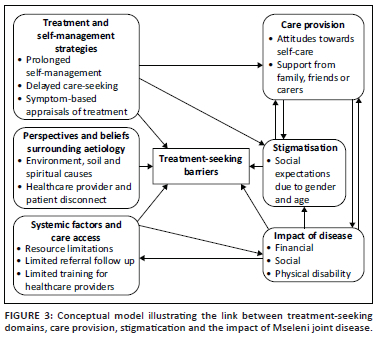
We identified 3 primary domains and several overlapping subthemes linked to treatment-seeking behaviours in patients with MJD (Table 3). These were: (1) current treatment and self-management strategies; (2) perspectives and beliefs surrounding aetiology; and (3) systemic barriers and access to care. In Figure 3, we present a conceptual model illustrating the linkage between these domains and their relationship between individual experiences of MJD inclusive of systematic challenges to seeking treatment.
Current approaches to treatment and self-management strategies
Approximately, 40% (n = 21/53) of MJD patients visiting the OPD during the study period reported new sources of pain, and 21% (n = 11/53) were given prescription renewals for analgesia (Table 2). From medical records (n = 52/53; 98%) and surveys (n = 29/37; 78%), it was clear that NSAIDS were the most used treatment for MJD (Table 2). No referrals to physiotherapy were recorded in medical records for 21% (n = 11/53) of individuals, and furthermore, non-adherence to physiotherapy was only identified in one patient's medical record. Self-reporting of non-adherence to physiotherapy was common among surveyed MJD patients (46%, n = 17/37), although no significant associations were detected between age and adherence to physiotherapy treatment (Table 2). Approximately 23% (n = 12/53) of MJD patients from the medical record reviews had undergone a single joint replacement, while 8% (n = 4/53) had multiple operations including revision surgeries (Table 2). Older patients sampled in the medical record review were more likely to refuse surgery than younger patients.
In interviews, patients described seeking treatment for MJD only when their symptoms were resistant to self-management strategies or were disrupting their daily activities. Collectively, these accounts reflect a reactive pattern of care-seeking, in which engagement with formal healthcare occurs only after prolonged self-management and functional decline. Treatment appraisals discussed were symptom-based, with pain relief driving decisions to initiate or discontinue care. As a result, analgesia and surgery were discussed more positively than physiotherapy (Table 3):
'I don't think there is anything else that could help me except for the pills I'm already using.' (Patient, F)
'I only knew pain that was different, and which was slightly better after surgery …' (Patient, F)
'I stopped going [to physiotherapy] because it felt like they were just finishing me off when they were doing it.' (Patient, M)
Both doctors and MJD patients found that surgery resulted in good reductions in joint pain and improved mobility. Patients and doctors believed that the demands of rural environments and lifestyle were limiting to the longevity of prosthetics. Pain-related functional decline was described as loss of independence and livelihood, particularly through reduced ability to garden and farm:
'You have, prosthesis sizing problems and then you have a, you have a higher demand of a rural life on the joint afterwards.' (Doctor, M)
'These metals they put on my hip get sweaty because I spend too much time in the sun. They told me to try and decrease the amount of work I do but I don't like sitting and doing nothing, my heart longed to do more work.' (Patient, F)
'It has affected me greatly because I used to farm a lot. When I was affected, I used to think how am I going to live now? Because farming sustained my livelihood.' (Patient, F)
'I can go to garden. But I go with pain, but I still persist, stubbornly so that I can farm or garden maize, samp, nuts … but now I cannot do that because of the pain, as soon as I stand, I have to sit.' (Patient, M)
Gender and care provision
Gendered differences in care networks were evident. Women who completed questionnaires more often attended care alone, while men were accompanied by wives or daughters-in-law at the Mseleni Hospital. One doctor found that younger women with MJD experienced stigma when pain and immobility prevented them from fulfilling household roles. Age and community-wide expectations of women as hardworking and caregivers were cited as a cause of stigmatisation and social disharmony for younger MJD patients:
'So, if it is a younger population, you may find that they're not, uh, sympathetic towards those women that are having the condition. Whereas you kind of look to older people with the joint disease and you're kind of saying, well the gogos' [grandmothers or older ladies] are sitting at home and they're being cared for …' (Doctor, F)
'I think the immobility part becomes sort of the point of stigmatization. For instance, I remember someone in the community had two wives, one of the wives didn't have MJD and then the other had MJD. So, it was almost like this one [with MJD] was the lazy one, just because she couldn't mobilize.' (Doctor, F)
Across interviews, daughters and daughters-in-law (uMakoti) were identified as primary caregivers. uMakoti's fulfil the role of caregiver within households, thereby enabling and facilitating treatment-seeking for MJD. One patient found that her own daughter could not be expected to provide care as she was uMakoti in another family. She described struggling to care for herself prior to receiving assistance from her new daughter-in-law:
'I don't except this for my own child, she's someone's child [daughter-in-law]. What I mean to say is he [my son] has a child with this child [my daughter-in-law]. She helps me, but before she was here I used to struggle for myself.' (Patient, F)
Perspectives and beliefs surrounding aetiology
In open-ended questionnaire responses, patients most commonly cited soil and environmental conditions as a suspected cause of MJD. Interviewed doctors and nurses cited soil as a cause; they hypothesised this was because of mineral deficiencies in locally farmed food or soil contaminants:
'I don't know. They, they research, but they say it's this soil, it's not having the iron.' (Nurse, F)
'What about the food that is growing in the soil? Is the soil setting a problem with the food that we are eating? Because maybe there are toxic things that are already in the food.' (Doctor, M)
'They talk about environmental and you are kind of thinking that it's quite an unusual, um, place to live in because it's all sand-based. And I'm sure if you're living here and this is the normal terrain that you're coping with, it's probably related.' (Doctor, F)
While patients also cited soil as a cause of MJD, this was conceptualised and explained in reference to the type, quantity of soil and local beliefs surrounding witchcraft:
'Ei! I haven't heard anything apart from the fact that it's the soil where we live.' (Patient, F)
'They [the community] say it's caused by the sand but now there is sand everywhere … So that's why I don't believe in that theory. There's a lot of sand in Manaba compared to here but they are still saying it's the sand. I don't believe in that'. (Patient, M)
Intersecting knowledge systems
Patients were reluctant to describe traditionally held beliefs surrounding the cause and treatment of MJD, and only one patient cited the belief that MJD was caused by someone in the community cursing them, using umeqo. Doctors and nurses were informed about traditional healing beliefs and practices, and provided an explanation of umeqo and the use of caba as a treatment for MJD (Table 3):
'Well, this started like this. When it enters someone, they would say that they have Umeqo. You remember right? Yes, something painful will entered my leg. So, we started with the traditional route, do you see these cuts, they did this saying that they were healing us saying that it will end but it never stopped.' (Patient, F)
'So umeqo is when a witch basically, casts a spell on a path that you're gonna' walk on and as soon as you step over that spell then you may have issues with your legs and mobilization. And. So, it's likely that as the MJD develops, that can be viewed as some form of witchcraft of sorts.' (Doctor, F)
'Okay, yeah, sometimes they think they are being punished by the ancestors and so they will do maybe, ceremonies and other rituals for the ancestors.' (Nurse, M)
'Witches, this kind of things is happening. Is that person who did this to me, that person did this to me. So, they want to resolve the problem first in the community.' (Nurse, F)
Systemic factors and care access
Review of medical records indicated that all identified MJD patients had been diagnosed using radiographs; however, no written radiographic descriptions or interpretive reports were documented in the clinical files. In addition, there was no evidence of a standardised diagnostic protocol for assessing MJD across patient records. Considerable inconsistencies in the documentation of pathology, diagnostic assessments, and disease progression were observed, which limited the depth of quantitative analyses that could be conducted using these data. During interviews, some doctors also reported limited formal training in the diagnosis and management of MJD, expressing uncertainty in distinguishing MJD from more generalised arthropathies based on available clinical information. These findings highlight variability in diagnostic practices and documentation for MJD within the hospital setting:
'I'm not sure exactly how to actually diagnose MJD compared to other joint diseases. So I think we'll do like a basic arthritis work up, usually X-rays, rheumatoid factor, inflammatory markers and then, depending on what you find on that, if there's an obvious breakdown in the joint, then we will discuss with Doctor X or we'll discuss it with Orthopedics at Ngwelezana.' (Doctor, M)
'There wasn't a specific orientation regarding it, but as it's in the roster, and there are operations done, and you've seen patients in OPD, you kind of find out about it. So, it was more learn as you go type of thing.' (Doctor, M)
During interviews, doctors described how late presentation as a critical issue in treating MJD and cited systemic causes (fragmented record-keeping, geographic and transport barriers) that interact with these individual-level challenges such as pain, immobility and a lack of support (Table 3):
'If they're having problems, severe problems walking, they may end up being referred.' (Doctor, F)
'They'll pick them up, send them for an X Ray. Then that's when we pick them up, they come you, you go into the old notes you find out that they've been complaining about joint pain. And then they also present late, you know. Late presentation, when you do X-ray, you'll see that the joints just destroyed and then there's nothing that you can do that to try to give them hope of walking again.' (Doctor, M)
'The mobile clinic is going there, and then if there are nurses who can give the patient medication. You see how you are hiding the condition. So, the time you'll be worse, is the time when you'll come to the hospital.' (Doctor, M)
'So it depends where the patient lives, distance from the hospital, some live far away. Then obviously they can't walk, they would rely on someone else taking them to the hospital. And if they don't have transport, they're not going to come here.' (Doctor, F)
Discussion
Previous work on the management of MJD has primarily focused on understanding the aetiology of this disease1,4,5,6,8,9,12,16,26,27,28,29,3011,15
Current approaches to treatment and self-management
Individuals sampled in our study used various combinations of treatments available for MJD - analgesia, physiotherapy, joint arthroplasties and traditional medicines. From both clinical records and patient surveys, it was clear that pain management with analgesia was most utilised by MJD patients, while physiotherapy was the least utilised treatment. Patients consistently appraised treatments according to their ability to relieve pain, resulting in favourable views of analgesia and surgery, while physiotherapy was often perceived as harmful as a result of short-term increases in pain. These findings align with evidence that individuals with arthritis commonly avoid physical activity because of fears of worsening symptoms, favouring pharmacological or surgical approaches instead.31,322,152
Perspectives and beliefs surrounding aetiology
Aetiological beliefs surrounding MJD differed substantially between patients and healthcare providers. Doctors and nurses commonly cited soil-related causes, hypothesising that these were because of mineral deficiencies in locally farmed food or environmental contaminants. In contrast, patients described soil as a cause within culturally embedded frameworks involving the type and quantity of soil and beliefs related to witchcraft. Within traditional African medicine, being healthy and prosperous requires living in harmony with ones umhlaba [world or soil], umhakathi [community], isintu [culture] and ingqikithi [the soul].33,34umeqo, which is caused by walking over soil containing the harmful creation of a sorcerer.34umeqo include joint pain and limited range of movement - chronic symptoms of MJD. Treatment for umeqo is called caba, which involves administering traditional medicines and herbs through incisions made at painful joints in an attempt to remove and treat 'bad blood'.34caba, only one patient openly discussed personal use. Patients were often reluctant to articulate spiritual explanations during interviews, yet freely discussed biomedical care received at the hospital. This suggests that patients may selectively disclose beliefs depending on perceived power dynamics and institutional affiliations. Traditional explanations of illness in South Africa are deeply linked to land, ancestry, and community, and may not be readily shared with those who do not share this context.34,35,3634,35,36
Systemic factors and care access
Healthcare providers identified inconsistent record-keeping, limited specialised equipment and high patient volumes as major systemic barriers to MJD management. These systemic constraints are linked to individual-level barriers, contributing to delayed presentation and fragmented follow-up. From medical record, a lack of consistency in record keeping was evident between clinicians and across visits. One recommendation towards improving this would be the introduction of a proforma detailing diagnosis, progression and management of MJD. This simple and cost-effective solution may indeed improve patient management and promote treatment-seeking for MJD. This has already been successfully achieved in South Africa, as demonstrated by HIV and TB management programmes, as more consistent care and communication has been linked to adherence to disease management plans.33,376,15uMakoti [daughters-in-law] in facilitating treatment-seeking for MJD. uMakoti is an isiZulu word that directly translates as 'the bride' or 'the wife', and commonly refers to a daughter-in-law (the prefix 'u' denotes a definitive article). Makoti is not simply a title; it is a position of significant status within the community and household.33uMakoti carries a set of cultural expectations, which include being a 'good' woman, wife, mother, and in-law - demonstrated through caring, hard work at home, obedience to male authority figures and being well respected in the public domain.33uMakoti bearing a disproportionate caregiving burden. Healthcare providers interviewed in our studies described stigma and social disharmony affecting younger women with MJD who were unable to fulfil these roles because of pain and immobility. Men with MJD interviewed in our study were accompanied in interviews by uMakoti's, suggesting that they likely had more extensive support and care networks than the interviewed women - although it must be observed that this sample of men was relatively small (n = 2). Exploring the treatment-seeking behaviours, and disease outcomes of uMakoti's with MJD should be prioritised towards implementing interventions that provide for care-needs patients with this condition, regardless of their gender. Such stigma may further delay care-seeking and worsen disease outcomes among younger women. While uMakhoti's are central to care provision, they are not typically healthcare-decision makers. One study caregivers to TB-patients reported that uMakhotis were more likely to defer treatment decisions to male authority figures, including doctors.33
Study's limitations
Our findings may not be directly translatable to other osteoarthropathies or sociocultural contexts. The study design involved three data sources - medical record reviews, questionnaires and in-depth interviews - and it was not possible to link these data sources at the individual patient level. As a result, we cannot assume consistency of experiences, beliefs or treatment histories across all participants represented in the different datasets, and findings should be interpreted as complementary rather than individually longitudinal. In addition, we acknowledge that our sample represents a cohort of patients with MJD who sought care at the Mseleni Hospital and is thus biased towards individuals employing more active coping strategies. Interpretation of disease duration of participants of this study should be approached with caution, as medical records reflect duration of documented care rather than symptom onset, while interview may reflect memories of symptoms that occurred several years prior. As such, these may not necessarily be comparable. Information on comorbidities (e.g. human immunodeficiency virus [HIV], tuberculosis [TB], obesity or smoking status) was not collected as this was not the focus of the study. However, given the high burden of chronic comorbidities in this setting, future research should explicitly examine how coexisting conditions influence MJD progression, treatment-seeking behaviour, and outcomes, as this remains an important gap in the literature. As researchers were not locals to the region, and it is possible that study participants were cautious about what they said to the researchers, leading to reporting bias. While we worked from translated verbatim transcripts and engaged in collaborative coding to minimise interpretive bias, subtle linguistic and cultural nuances may not have been fully captured. Despite the involvement of a local isiZulu-speaking translator, the positionality of the primary researcher as a white English-speaking woman may have shaped the dynamic of the interviews.
Conclusion
This study provides insight into the complexity of treating a disease with an unknown cause when community perspectives are at odds with biomedical frameworks. We identified that barriers to treatment-seeking for MJD are multifaceted, arising from the interplay of treatment practices, aetiological beliefs and systemic constraints, including access to care and the role of family caregivers. These findings highlight that systemic and individual barriers are closely linked, and that improving disease management and patient outcomes requires addressing the concerns and experiences of both healthcare providers and patients. Targeted interventions that consider these intersecting barriers, particularly culturally appropriate education, physiotherapy support, and strengthened care provision by family members such as uMakotis, could have a meaningful impact on mobility, pain management, and overall quality of life for patients with MJD.
Competing interests
The author reported that they received funding from the National Research Foundation (South Africa) (No. 120816 and no. 115357), the Rare Disease Foundation (Microgrant no. 2312) and the Department of Human Biology at the University of Cape Town, which may be affected by the research reported in the enclosed publication. The author has disclosed those interests fully and has implemented an approved plan for managing any potential conflicts arising from their involvement. The terms of these funding arrangements have been reviewed and approved by the affiliated university in accordance with its policy on objectivity in research.
CRediT authorship contribution
Elizabeth S. Dinkele: Conceptualisation; Formal analysis; Funding acquisition; Investigation; Methodology; Project administration; Visualisation; Writing - original draft; Writing - review & editing. Robea Ballo: Supervision; Writing - review & editing. Victor Fredlund: Conceptualisation; Data curation. Victoria E. Gibbon: Conceptualisation; Funding acquisition; Methodology; Project administration; Supervision; Writing - review & editing. All authors reviewed the article, contributed to the discussion of results, approved the final version for submission and publication, and take responsibility for the integrity of its findings.
Funding information
This work was funded by the National Research Foundation (South Africa) (No. 120816 and no. 115357), the Rare Disease Foundation (Microgrant no. 2312), and the Department of Human Biology at the University of Cape Town. Opinions expressed, and conclusions arrived at, are those of the authors and are not necessarily attributed to the funders.
Data availability
The data that support the findings of this study are available on request from the corresponding author, Elizabeth S. Dinkele.
Disclaimer
The views and opinions expressed in this article are those of the authors and are the product of professional research. They do not necessarily reflect the official policy or position of any affiliated institution, funder, agency or that of the publisher. The authors are responsible for this article's results, findings, and content.
Acknowledgements
The authors would like to thank the participants for their involvement in this research. They thank Tafadzwa Tawha for assistance in collecting data form medical records. They acknowledge Sifundo Mthambo, Slindile, Sandile Ntuli and Noluthando Magubane for translation and transcription of participant interviews. They thank the South African Department of Health and Mseleni community for permitting and supporting this research. This article includes content that overlaps with research originally conducted as part of Elizabeth S. Dinkele's doctoral thesis titled 'Socio-ecological risk factors, explanatory models and treatment-seeking behaviours associated with Mseleni joint disease: a biocultural mixed methods study', submitted to the Faculty of Health Sciences, Department of Human Biology, University of Cape Town in 2021. The thesis was supervised by Victoria Gibbon and Robea Ballo. Portions of the data analysis and discussion have been revised, updated and adapted for publication as a journal article. The original thesis is publicly available at http://hdl.handle.net/11427/36436. The author affirms that this article complies with ethical standards for secondary publication, and appropriate acknowledgement has been made of the original work.
References
-
1. Gibbon VE, Harington JS, Penny CB, Fredlund V. Mseleni joint disease: A potential model of epigenetic chondrodysplasia. Jt Bone Spine. 2010;77(5):399-404. https://doi.org/10.1016/j.jbspin.2010.01.013
» https://doi.org/10.1016/j.jbspin.2010.01.013 -
2. Fredlund V. Total hip replacement for Mseleni joint disease undertaken in a rural hospital: Five-year follow-up. S Afr Fam Prac. 2003;45(9):10-14. https://doi.org/10.4102/safp.v45i9.1879
» https://doi.org/10.4102/safp.v45i9.1879 -
3. McLaren PA, Gear JSS, Irwig LM, Smit AE. Prevalence of motor impairment and disability in a rural community in KwaZulu. International Rehabilitation Medicine. 1986;8(3):98-104. https://doi.org/10.3109/03790798709166189
» https://doi.org/10.3109/03790798709166189 -
4. Yach D, Botha JL. Mseleni joint disease in 1981: Decreased prevalence rates, wider geographical location than before, and socioeconomic impact of an endemic osteoarthrosis in an underdeveloped community in South Africa. Int J Epi. 1985;14(2):276-284. https://doi.org/10.1093/ije/14.2.276
» https://doi.org/10.1093/ije/14.2.276 - 5. Fellingham S, Elphinstone C, Wittmann W. Mseleni joint disease: Background and prevalence. S Afr Med J. 1973;47:2173.
- 6. Lockitch G, Fellingham SA, Wittman W, De Villiers PD, De Wet IS, Du Toit GT. Mseleni joint disease: The pilot clinical survey. S Afr Med J. 1973;47(47):2283-2293.
-
7. Agarwal S, Phadke S, Fredlund V, Viljoen D, Beighton P. Mseleni and Handigodu familial osteoarthropathies: Syndromic identity? Am J Med Gen. 1997;72(4):435-439. https://doi.org/10.1002/(SICI)1096-8628(19971112)72:4<435::AID-AJMG12>3.0.CO;2-S
» https://doi.org/10.1002/(SICI)1096-8628(19971112)72:4<435::AID-AJMG12>3.0.CO;2-S - 8. Solomon L, McLaren P, Irwig L, et al. Distinct types of hip disorder in Mseleni joint disease. S Afr Med J. 1986;69(1):15-17.
- 9. Ballo R, Viljoen D, Machado M, et al. Mseleni joint disease: A molecular genetic approach to defining the aetiology. S Afr Med J. 1996;86(8):956-958.
- 10. Nurse G, Jenkins T, Elphinstone C. Mseleni joint disease: Population genetics study. S Afr Med J. 1974;70(12):360-365.
-
11. Mann D, Fredlund V. The social impact of Mseleni joint disease. S Afr Fam Prac. 1988;9(4):a2995. https://doi.org/10.4102/safp.v9i4.2995
» https://doi.org/10.4102/safp.v9i4.2995 - 12. Lubbe S. Mseleni joint disease: Food and water supplies. S Afr Med J. 1973;47(46):2225-2232.
- 13. Burger FJ, Elphinstone CD, Fellingham SA, Grey PC, Hogewind ZA. Mseleni joint disease: Biochemical survey. S Afr Med J. 1973;47(48):2331-2338.
-
14. Mthethwa NS, Mayor Umhlabuyalingana local municipality infrastructure development plan (2020/2021) [homepage on the Internet]. KwaZulu-Natal; 2022. [cited 2025 Sept 24]. Available from: https://umhlabuyalingana.gov.za/wp-content/uploads/2020/05/2020-2021-DRAFT-UMHLABUYALINGANA-LOCAL-MUNICIPALITY-IDP.pdf
» https://umhlabuyalingana.gov.za/wp-content/uploads/2020/05/2020-2021-DRAFT-UMHLABUYALINGANA-LOCAL-MUNICIPALITY-IDP.pdf -
15. Waller R. Mseleni joint disease: Social priorities. Brit J Rheumatol. 1998;37(5):585-586. https://doi.org/10.1093/rheumatology/37.5.585
» https://doi.org/10.1093/rheumatology/37.5.585 -
16. Dinkele ES, Ballo R, Fredlund V, Ramesar R, Gibbon V. Mseleni joint disease: An endemic arthritis of unknown cause. Lancet Rheumatol. 2020;2(1):e8-e9. https://doi.org/10.1016/S2665-9913(19)30104-3
» https://doi.org/10.1016/S2665-9913(19)30104-3 -
17. Kleinman A, Eisenberg L, Good B. Culture, illness, and care: Clinical lessons from anthropologic and cross-cultural research. Ann Intern Med. 1978;88(2):251-258. https://doi.org/10.7326/0003-4819-88-2-251
» https://doi.org/10.7326/0003-4819-88-2-251 -
18. Camara BS, Belaid L, Manet H, et al. What do we know about patient-provider interactions in sub-Saharan Africa? A scoping review. Pan Afr Med J. 2020;37:88. https://doi.org/10.11604/pamj.2020.37.88.24009
» https://doi.org/10.11604/pamj.2020.37.88.24009 -
19. Kleinman A, Benson P. Anthropology in the clinic: The problem of cultural competency and how to fix it. PLoS Med. 2006;3(10):e294. https://doi.org/10.1371/journal.pmed.0030294
» https://doi.org/10.1371/journal.pmed.0030294 -
20. Boyer CA, Lutfey KE. Examining critical health policy issues within and beyond the clinical encounter: Patient-provider relationships and help-seeking behaviors. J Health Soc Behav. 2010;51(suppl_1):S80-S93. https://doi.org/10.1177/0022146510383489
» https://doi.org/10.1177/0022146510383489 -
21. Day C, Gray A, Cois A, Ndlovu N, Massyn N, Boerma T. Is South Africa closing the health gaps between districts? Monitoring progress towards universal health service coverage with routine facility data. BMC Health Serv Res. 2021;21(suppl 1):194. https://doi.org/10.1186/s12913-021-06171-3
» https://doi.org/10.1186/s12913-021-06171-3 -
22. Kyu HH, Abate D, Abate KH, et al. Global, regional, and national disability-adjusted life-years (DALYs) for 359 diseases and injuries and healthy life expectancy (HALE) for 195 countries and territories, 1990-2017: A systematic analysis for the Global Burden of Disease Study 2017. Lancet. 2018;392(10159):1859-1922. https://doi.org/10.1016/S0140-6736(18)32335-3
» https://doi.org/10.1016/S0140-6736(18)32335-3 -
23. Vos T, Lim SS, Abbafati C, et al. Global burden of 369 diseases and injuries in 204 countries and territories, 1990-2019: A systematic analysis for the Global Burden of Disease Study 2019. Lancet. 2020;396(10258):1204-1222. https://doi.org/10.1016/S0140-6736(20)30925-9
» https://doi.org/10.1016/S0140-6736(20)30925-9 - 24. Clarke V, Braun V, Hayfield N. Thematic analysis. Qualitative psychology: A practical guide to research methods. London: SAGE Publications, 2015; p. 222-248.
- 25. Wahyuni D. The research design maze: Understanding paradigms, cases, methods and methodologies. J Appl Man Acc Res. 2012;10(1):69-80.
-
26. Fincham JE. Mseleni joint disease. Lancet 1986;327(8474):206-207. https://doi.org/10.1016/S0140-6736(86)90671-9
» https://doi.org/10.1016/S0140-6736(86)90671-9 - 27. Fincham JE, Van Rensburg SJ, Marasas WF. Mseleni joint disease - A manganese deficiency? S Afr Med J. 1986;60(12):445.
-
28. Nurse G. Slow virus in Mseleni joint disease? Lancet. 1985;326(8458):784. https://doi.org/10.1016/S0140-6736(85)90666-X
» https://doi.org/10.1016/S0140-6736(85)90666-X -
29. Schnitzler CM, Pieczkowski WM, Fredlund V, Mesquita JM, Sweet MBE, Smit AE. Histomorphometric analysis of osteopenia associated with endemic osteoarthritis: Mseleni joint disease. Bone. 1988;9(1):21-27. https://doi.org/10.1016/8756-3282(88)90023-3
» https://doi.org/10.1016/8756-3282(88)90023-3 -
30. Sokoloff L, Fincham JE, Du Toit GT. Pathologic features of the femoral head in Mseleni disease. Hum Path. 1985;16(2):117-120. https://doi.org/10.1016/S0046-8177(85)80059-9
» https://doi.org/10.1016/S0046-8177(85)80059-9 -
31. Bowden JL, Lamberts R, Hunter DJ, Melo LR, Mills K. Community-based online survey on seeking care and information for lower limb pain and injury in Australia: An observational study. BMJ Open. 2020;10(7):e035030. https://doi.org/10.1136/bmjopen-2019-035030
» https://doi.org/10.1136/bmjopen-2019-035030 -
32. Bunzli S, O'Brien P, Ayton D, et al. Misconceptions and the acceptance of evidence-based nonsurgical interventions for knee osteoarthritis. A qualitative study. Clin Ortho Rel Res. 2019;477(9):1975-1983. https://doi.org/10.1097/CORR.0000000000000784
» https://doi.org/10.1097/CORR.0000000000000784 -
33. Boffa J, Mayan M, Ndlovu S, et al. The role of agency in the implementation of Isoniazid Preventive Therapy (IPT): Lessons from oMakoti in uMgungundlovu District, South Africa. PLoS One. 2018;13(3):e0193571. https://doi.org/10.1371/journal.pone.0193571
» https://doi.org/10.1371/journal.pone.0193571 - 34. Washington K. Zulu traditional healing, Afrikan worldview and the practice of Ubuntu: Deep thought for Afrikan/Black psychology. J Pan Afr Stud. 2010;3(8):24-39.
-
35. Edwards SD. A psychology of indigenous healing in Southern Africa. J Psych Afr. 2011;21(3):335-347. https://doi.org/10.1080/14330237.2011.10820466
» https://doi.org/10.1080/14330237.2011.10820466 - 36. Pemunta NV, Tabenyang TC-J. Traditional medicine, colonialism and apartheid in South Africa. In Biomedical hegemony and democracy in South Africa. Brill, Leiden: the Netherlands, 2020; p. 47-76.
- 37. Palmer D, Miedany YE. Measures of outcome in patients with inflammatory arthritis. Brit J Nurs. 2008;17(16):1052-1056.

Accepted: 01 Feb. 2026
Published: 13 May 2026