CLEVER maternity care: A before-and-after study of women's experience of childbirth in Tshwane, South Africa
Abstract
BACKGROUND: Birthing care matters to women and some women experience mistreatment during childbirth. AIM: To determine the effect the 'CLEVER Maternity Care' package, a multi-faceted intervention to improve respectful, quality obstetric care. SETTING: Ten midwife-led obstetric units in Tshwane health district, South Africa; five intervention and five control units. METHODS: We conducted an anonymous baseline and end-line survey to measure the change in women's perceptions and experiences of childbirth care after the implementation of the CLEVER package. A convenience sample of women returning for a postnatal follow-up visit was obtained at baseline (n = 653) and after implementation of CLEVER (n = 679). RESULTS: Six survey items were selected as proxies for respectful clinical care. There was no significant change in proportions of responses regarding one question, and with regard to patients receiving attention within 15 min of arrival, both the intervention and control group units showed a significant increase in positive responses (odds ratios of 8.4 and 6.1, respectively, and p values of 0.0001 and 0.0007). For the remaining four items (asking permission before doing an examination, positive communication, respectful treatment and overall satisfaction), only the intervention group showed a significant positive change (odds ratios ranging from 2.4 to 4.3; p ≤ 0.0018), with no significant change for the control group (odds ratios between 1.0 and 1.8; p ≥ 0.0736. CONCLUSION: After the implementation of CLEVER Maternity Care, women reported a more positive experience of childbirth. The CLEVER intervention is a potential strategy for addressing respectful, quality obstetric care that warrants further investigation
respectful maternal care; obstetric care; childbirth; quality improvement
Background
Health services need to achieve the optimal balance between what health systems can provide in low- and middle-income countries (LMICs) and what women expect during birthing.1,23456
Skilled birth attendants who provide quality care during labour and childbirth and behave respectfully could improve women's satisfaction with childbirth378,910,11,12,13
Bowser and Hill's landscape analysis of abuse in facility-based childbirth1415,16,17,18192021
Many studies in LMICs have highlighted the barriers and the actions required to achieve respectful birthing care.22,23,24,252627
Studies from South Africa and other LMICs attempted to understand why mistreatment was so prevalent during facility births.15,16,18,28,293030
The effects of the pilot implementation of the CLEVER package in the Tshwane health district, South Africa, were measured in terms of perinatal morbidity and mortality as proxies for quality obstetric care and in terms of women's experience of childbirth. Results on the significant improvements in the rates of fresh stillbirths, birth asphyxia and meconium aspiration have been reported elsewhere.31
Methods
Study design
The study reported in this paper was part of the pilot implementation of the broader CLEVER intervention. This study entailed a survey of women's experiences of childbirth and early postnatal care before the start of the intervention, which was repeated after the end of the intervention.
Study setting
The study was conducted in the Tshwane health district. The district had about 50 000 deliveries per annum, of which 18% were conducted in its MOUs. Midwife-led obstetric units are primary healthcare units that provide 24-h maternity services and are attached to community health centres. All 10 MOUs in the district were included in the study. There were five non-intervention MOUs. Five MOUs were purposively selected to receive the CLEVER intervention. The latter five were the more underserved facilities located in one geographical area under the same area manager. This minimised intervention spillover to the control MOUs.
Intervention
The CLEVER Maternity Care package was implemented in three phases. The first phase consisted of a period of creating awareness, soliciting participation from MOUs and carrying out activities aimed at strengthening health systems. Creating awareness included giving feedback of women's experiences of their birthing treatment in MOUs using a baseline survey.3231
Study population and sampling
The study population comprised women who had recently given birth in any of the 10 MOUs and returned for a postnatal follow-up visit at primary healthcare facilities from 3 days to 6 weeks after delivery. Contextual constraints prevented sample realisation through random sampling, and a convenience sample of women visiting postnatal care clinics was obtained.
The sampling design was based on historical data of annual deliveries at each MOU in 2015 (delivery range: 390-1502). Although a sample size of 800 was planned for both pre- and post-surveys, 653 questionnaires were returned for the baseline assessment and 679 for the end-line assessment. The sampling design was originally based on 90% power for a proportional difference; the observed power was 80% - 85% based on the realised sample.
Data collection
The baseline and end-line surveys were conducted for both the intervention and non-intervention MOUs using a self-administered survey tool. Trained research assistants approached potential participants to complete the questionnaire anonymously. Participants were asked about their experiences regarding communication, labour, clinical care and respectful care during confinement. Seven items in the questionnaire elicited demographic data. The remaining 25 items were derived from similar validated surveys that focused on the clinical care received and on client satisfaction. More details on the survey tool have been published in a previous study.32
The baseline survey was conducted in the period February 2016 to April 2016. After the intensive 3-month engagement with the intervention MOUs between May 2016 and August 2016, the survey was repeated between October 2016 and December 2016. One unit had to be re-sampled between February 2017 and March 2017 because of compromised data.
Data analysis
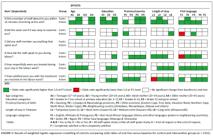
Data were captured on Excel and exported to SAS version 9.4.33 Hotdeck imputation3414,19 were selected for analysis in greater depth (see Tables 2 and 3 and Figure 1). Three items (A, B, C) required a Yes/Unsure/No response, and three items (D, E, F) were measured on a four-point semantic scale. The responses to the last three items were dichotomised between the most positive response versus the rest of the responses reduced to a single category.
The results of the six items were analysed using weighted logistic regressions applied to the survey data stratified by MOU and period (baseline/end-line). The analysis was performed using the Procedure Surveylogistic function of the SAS version 9.4 software.33
Ethical considerations
The study was approved by the Research Ethics Committee of the Faculty of Health Sciences, University of Pretoria (Protocol 541/2015), and the Tshwane District Research Committee (Project 62/2015). Written permission for the study was obtained from the facility managers of all participating MOUs. No maternal participants could be identified because the survey was completed anonymously. The cover letter of the questionnaire indicated that giving back the questionnaire to the research team was considered informed consent that the information may be used.
Results
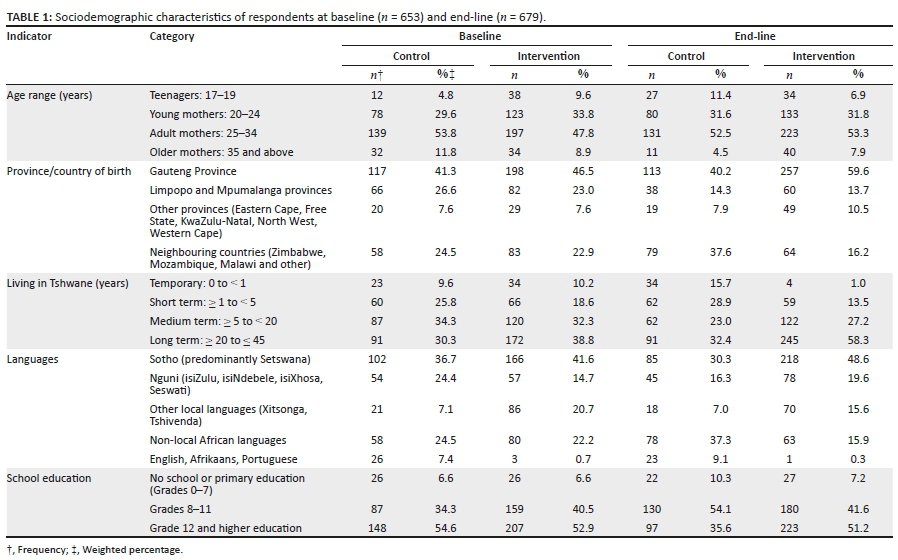
Table 1 illustrates the sample distribution of the two surveys, based on the sociodemographic characteristics of the baseline and end-line respondents. Although these characteristics cannot be controlled in a before-after study with different respondents in the two surveys, the weighting of the statistical modelling made provision for the population characteristics of historically observed births. Because of the small number of participants, English, Afrikaans and Portuguese first-language speakers were grouped as speakers of languages with a European linguistic structure. The age ranges were similar in the two cohorts.
One observable difference in the end-line survey was the higher percentage of intervention group respondents born in Gauteng (baseline, 47%; end-line, 60%) and the lower percentage born in neighbouring countries (baseline, 23%; end-line, 16%). For the control units, the proportion of respondents born in Gauteng varied by 1% between baseline and end-line; however, there was an increase in the number of respondents born in neighbouring countries (baseline, 25%; end-line, 38%). In the end-line survey, the control and intervention units saw a decline of 12% in respondents born in Mpumalanga and 9% in those born in Limpopo. All the above observations explain some of the differences observed in the length of stay in Tshwane and the first-language mix of respondents between baseline and end-line. Of further note is the higher percentage of respondents with an education level of Grades 8-11 from the control units at the end-line (20% increase) and the lower percentage of respondents with Grade 12 and above (19% decrease). This observation could possibly be explained by the larger representation of foreign respondents in the control group in the end-line survey.
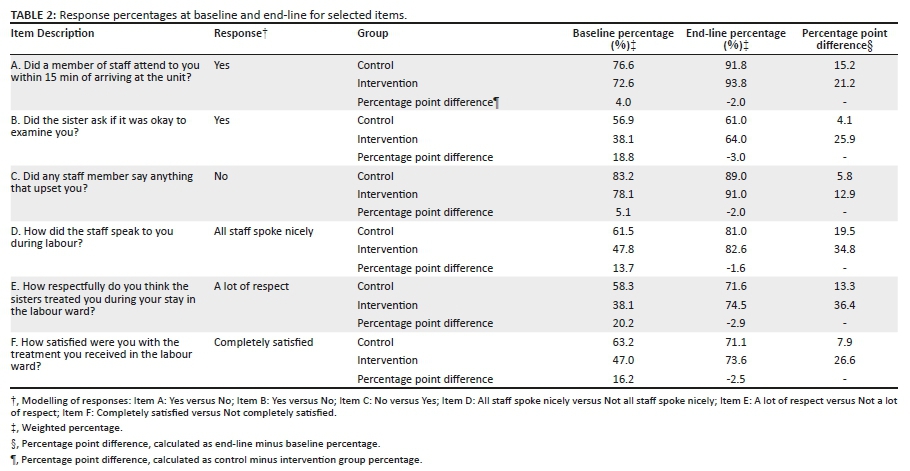
Table 2 focuses on the percentage change in the results of the six items relevant to clinical respectful care that were selected for in-depth analysis. Differences were calculated (1) for baseline and end-line within the control and intervention groups and (2) between the control and intervention groups at baseline and end-line. In the baseline survey, the positive responses for Items A and C started at more or less the same level for the control and intervention MOUs. With regard to women who were attended to within 15 min of arrival (Item A), the control group showed an increase of 15% in positive responses from baseline to end-line and the intervention group, an increase of 21%. For both the control and intervention groups, relatively few respondents reported that remarks they perceived as upsetting had been made to them (Item C). The positive responses of the intervention units for the remaining four items started from a lower level of 14 to 20 percentage points compared to the control units. In the end-line survey, positive responses for the intervention units 'caught up' with those of the control units, with minor differences between the two groups' responses.
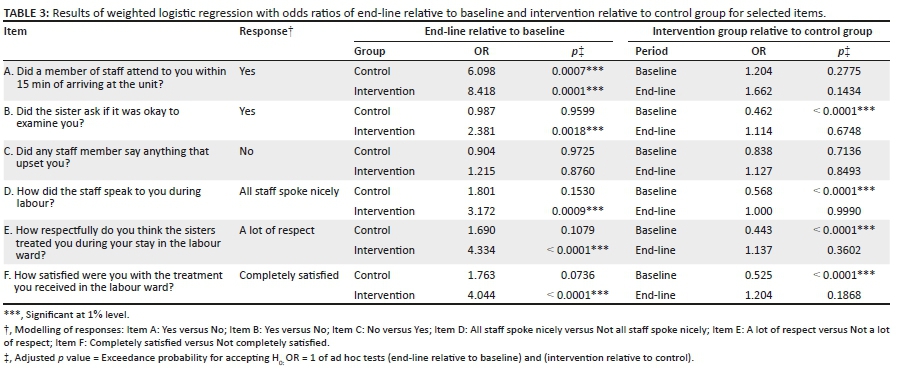
Table 3 contains an extract of the main results of the weighted logistic regression with odds ratios of end-line relative to baseline and intervention group relative to control group for the six selected items. For Item A (attended to within 15 min), there was a significant positive change in women's experiences from baseline to end-line for both the control and intervention group units (OR = 6.1 and OR = 8.4; p = 0.0007 and p = 0.0001, respectively). There was, however, no significant change for both groups for Item C (staff said something upsetting). The remaining four items (B, D, E and F) showed a significant positive change from baseline to end-line regarding the intervention group units (ORs ranging between 2.4 and 4.3, with p values ≤ 0.0018). There was no significant change in these items for the control group (ORs between 1.0 and 1.8; p ≥ 0.0736). When comparing the intervention group with the control group, the same four items (B, D, E and F) displayed odds ratios significantly below 1 at baseline (OR from 0.4 to 0.6; p < 0.0001). At end-line, the odds ratios for all six items (intervention group relative to control group) were above 1.0 (p ≥ 0.1434), and all were larger than the odds ratios at baseline.
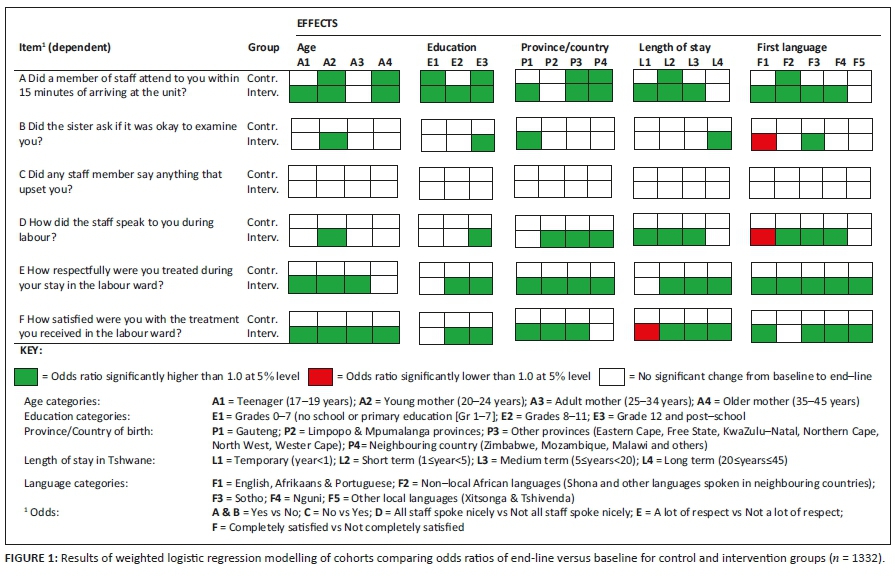
Differences in odds ratios between baseline and end-line responses are visually compared for the control and intervention groups in Figure 1. The results of the weighted logistic regression modelling of cohorts are broken down by the sociodemographic domains of age, education, province or country of birth, length of stay in Tshwane and first language. Item A (attended to within 15 min) shows odds ratios significantly higher than 1.0 from baseline to end-line for many of the categories across the different sociodemographic domains in both the control and intervention groups, with about twice as many significant domains for the intervention group. Items E (respectful treatment) and F (satisfaction) have significantly higher odds ratios for the majority of categories across the sociodemographic domains in the intervention group only. One category (length of stay in Tshwane < 1 year) under Item F has an odds ratio significantly lower than 1.0, which could possibly be explained by the low number of respondents in this category in the end-line survey (1%). For Item D (staff spoke nicely), the higher odds ratios for the intervention group are concentrated in the domains for the province or country of birth, length of stay in Tshwane and first language. There is a significantly lower odds ratio for English, Afrikaans and Portuguese first-language speakers (< 1% of respondents in baseline and end-line surveys). Item B (consent to examination) has one category in each sociodemographic domain with a significantly higher odds ratio in the intervention group between baseline and end-line and a lower odds ratio for English, Afrikaans and Portuguese first-language speakers. For Item C (staff made upsetting remarks), there was no significant change in any odds ratios from baseline to end-line in either the control or intervention group.
Discussion
To our knowledge, the 'working CLEVER' study3135,36,37,38,39,40
The first questionnaire item (A) relates to the withholding of care. The waiting time before being given attention in all units started at approximately the same service level and ended at almost the same improved level. The similarity between the before-and-after performance of the two groups may reflect the effect of the routine engagement of the district clinical specialist team on the improvement of adherence to clinical guidelines in all health facilities. Compliance with minimal patient waiting time is also addressed in different government documents, such as the 'Ideal Clinic Framework: Definitions, Components and Checklists',414243
Two African studies35,40Staha study was a comparative community and health-system intervention conducted to reduce disrespect and abuse in Tanzania that investigated non-consented care for surgical procedures in an intervention and a comparison between districts before and after the intervention.35Heshima project in Kenya4044
Communication practices in our study improved significantly after the CLEVER intervention. The Heshima study in Kenya40Staha study in Tanzania35
In our study, respectful treatment of birthing women and complete satisfaction with treatment improved significantly in the intervention group from baseline to end-line. Tanzania's Staha project35Heshima study in Kenya40
Another study37
Our study results indicate that midwives and managers could be engaged to mitigate disrespect and abuse, whilst flexible, adaptable teams of midwives could improve negative birth experiences.45
Study's strengths and limitations
A strength of this study is the baseline and end-line surveys on experiences of care during childbirth that were conducted at all MOUs in Tshwane district. The same survey tool was used at end-line to obtain a follow-up view of care experiences after the CLEVER intervention.
Limitations of the study relate to the fact that the MOUs in the study could not be randomised but had to be allocated purposively to minimise contamination,31
Conclusion
CLEVER Maternity Care is a complex intervention package, and it is not always possible to link specific outcomes to specific components of the package. In addition to the demonstration of a significant reduction in perinatal morbidity and mortality,31 it appears as if the implementation of the package contributed towards a better match between women's expectations of childbirth and midwives' realities. The CLEVER package set out to change birthing mothers' experiences of care by providing the skills and tools needed to form small effective teams of midwives, adhering to high-quality respectful obstetric care. The results indicate that the CLEVER package is a potential strategy to address respectful, quality obstetric care and that the integration of CLEVER Maternity Care into district health systems warrants further investigation in more healthcare facilities.
Competing interests
The authors have declared that no competing interests exist.
Authors' contributions
All authors were involved in the design of the study. S.J.O. supervised the data collection. J.G. was responsible for the statistical analysis. S.J.O. drafted the manuscript, which was reviewed and revised by A.-M.B., R.C.P. and J.G. All authors read and approved the final manuscript.
Funding information
This project was supported by the South African National Department of Health, the South African Medical Research Council Unit for Maternal and Infant Health Care Strategies and the Department of Family Medicine, University of Pretoria.
Data availability statement
Data are available on request.
Disclaimer
The views and opinions expressed in this article are those of the authors and do not necessarily reflect the official policy or position of any affiliated agency of the authors.
Acknowledgements
We are grateful to the healthcare professionals who participated in the intervention, the women who completed the survey and colleagues who provided input and support.
References
-
1.Larson E, Vail D, Mbaruku GM, Kimweri A, Freedman LP, Kruk ME. Moving toward patient-centered care in Africa: A discrete choice experiment of preferences for delivery care among 3 003 Tanzanian women. PLoS One. 2015;10(8):e0135621. https://doi.org/10.1371/journal.pone.0135621
» https://doi.org/10.1371/journal.pone.0135621 -
2.Clark K, Beatty S, Reibel T. 'What women want': Using image theory to develop expectations of maternity care framework. Midwifery. 2015;31(5):505-511. https://doi.org/10.1016/j.midw.2014.12.011
» https://doi.org/10.1016/j.midw.2014.12.011 -
3.Sawyer A, Ayers S, Abbott J, Gyte G, Rabe H, Duley L. Measures of satisfaction with care during labour and birth: A comparative view. BMC Pregnancy Childb. 2013;13:108. https://doi.org/10.1186/1471-2393-13-108
» https://doi.org/10.1186/1471-2393-13-108 -
4.World Health Organization. World Health Statistics 2018: Monitoring health for the SDGs [homepage on the Internet]. Geneva: World Health Organization; 2018 [cited 2019 Dec 3]. Available from: https://www.who.int/gho/publications/world_health_statistics/2018/en/
» https://www.who.int/gho/publications/world_health_statistics/2018/en/ -
5.Vogel JP, Bohren MA, Tunçalp Ö, Oladapo OT, Gülmezoglu A. Promoting respect and preventing mistreatment during childbirth. BJOG. 2015;123(5):671-674. https://doi.org/10.1111/1471-0528.13750
» https://doi.org/10.1111/1471-0528.13750 -
6.Hollander MH, Van Hastenburg E, Van Dillen J, Van Pampus MG, De Miranda E, Stramrood CIA. Preventing traumatic childbirth experiences: 2192 women's perceptions and views. Arch Womens Ment Health. 2017;20(4):512-523. https://doi.org/10.1007/s00737-017-0729-6
» https://doi.org/10.1007/s00737-017-0729-6 -
7.Lavender T. Improving quality of care during labour and childbirth and the immediate postnatal period. Best Pract Res Clin Obstet Gynaecol. 2016;36:57-67. https://doi.org/10.1016/j.bpobgyn.2016.05.011
» https://doi.org/10.1016/j.bpobgyn.2016.05.011 -
8.Franco L, Marquez L. Effectiveness of collaborative improvement: Evidence from 27 applications in 12 less-developed and middle-income countries. BMJ Qual Saf. 2011; 20(8):658-665. https://doi.org/10.1136/bmjqs.2010.044388
» https://doi.org/10.1136/bmjqs.2010.044388 -
9.Ten Hoope-Bender P, De Bernis L, Campbell J, et al. Improvement of maternal and newborn health through midwifery. Lancet. 2014;384(9949):1226-1235. https://doi.org/10.1016/S0140-6736(14)60930-2
» https://doi.org/10.1016/S0140-6736(14)60930-2 -
10.Ten Hoope-Bender P, Lopes S, Nove A. Midwifery 2030: A woman's pathway to health. What does this mean? Midwifery. 2016;32:1-6. https://doi.org/10.1016/j.midw.2015.10.014
» https://doi.org/10.1016/j.midw.2015.10.014 -
11.Atun R. Health systems, systems thinking and innovation. Health Pol Plann. 2012;27(Suppl 4):iv4-iv8. https://doi.org/10.1093/heapol/czs088
» https://doi.org/10.1093/heapol/czs088 -
12.Adam T, De Savigny D. Systems thinking for strengthening health systems in LMICs: Need for paradigm shift. Health Pol Plann. 2012;27(Suppl 4):iv1-iv3. https://doi.org/10.1093/heapol/czs084
» https://doi.org/10.1093/heapol/czs084 -
13.Oosthuizen SJ, Bergh AM, Pattinson RC. Systems thinking: A turning point for improving respectful obstetric care in South African health districts. S Afr Med J. 2018;108(11):910-914. https://doi.org/10.7196/SAMJ.2018.v108i11.13312
» https://doi.org/10.7196/SAMJ.2018.v108i11.13312 -
14.Bowser D, Hill K. Exploring evidence and abuse in facility-based childbirth: Report of a landscape analysis [homepage on the Internet]. Washington, DC: USAID-TRAction Project; 2010 [cited 2017 March 18]. Available from: https://www.ghdonline.orgrespectful_care_at_birth_9-20-101_final_1.pdf
» https://www.ghdonline.orgrespectful_care_at_birth_9-20-101_final_1.pdf -
15.Bohren MA, Vogel JP, Tunçalp Ö, et al. Mistreatment of women during childbirth in Abuja, Nigeria: A qualitative study on perceptions and experiences of women and health care providers. Reprod Health. 2017;14:9. https://doi.org/10.1186/s12978-016-0265-2
» https://doi.org/10.1186/s12978-016-0265-2 -
16.Jewkes R, Penn-Kekana L. Mistreatment of women in childbirth: Time for action on this important dimension of violence against women. PLoS Med. 2015;12(6):e1001849. https://doi.org/10.1371/journal.pmed.1001849
» https://doi.org/10.1371/journal.pmed.1001849 -
17.McMahon SA, George AS, Chebet JJ, Mosha IH, Mpembeni RN, Winch PJ. Experiences of and responses to disrespectful maternity care and abuse during childbirth: A qualitative study with women and men in Morogoro Region, Tanzania. BMC Pregnancy Childb. 2014;14:268. https://doi.org/10.1186/1471-2393-14-268
» https://doi.org/10.1186/1471-2393-14-268 -
18.Kruk ME, Kujawaski S, Mbaruku G, Ramsey K, Moyo W, Freedman L. Disrespectful and abusive treatment during facility delivery in Tanzania: A facility and community survey. Health Pol Plann. 2018;33(1):e26-e33. https://doi.org/10.1093/heapol/czu079
» https://doi.org/10.1093/heapol/czu079 -
19.World Health Organization. Standards for improving quality of maternal and newborn care in health facilities [homepage on the Internet]. Geneva: World Health Organization; 2016 [cited 2017 Sep 28]. Available from: http://apps.who.int/iris/bitstream/10665/249155/1/9789241511216-eng.pdf?ua=1
» http://apps.who.int/iris/bitstream/10665/249155/1/9789241511216-eng.pdf?ua=1 -
20.White Ribbon Alliance. Respectful maternity care charter. Washington, DC: White Ribbon Alliance; 2011 [cited 2019 Dec 3]. Available from: https://www.whiteribbonalliance.org/wp-content/uploads/2017/11/Final_RMC_Charter.pdf
» https://www.whiteribbonalliance.org/wp-content/uploads/2017/11/Final_RMC_Charter.pdf -
21.Tunçalp Ö, Were WM, MacLennan C, Oladapo OT, Gulmezoglu AM, Bahl R. Quality of care for pregnant women and newborns - the WHO vision. BJOG. 2015;122(8):1045-1049. https://doi.org/10.1111/1471-0528.13451
» https://doi.org/10.1111/1471-0528.13451 -
22.Bohren MA, Hunter EC, Munthe-Kaas HM, Souza JP, Vogel JP, Gülmezoglu AM. Facilitators and barriers to facility based delivery in low- and middle-income countries: A qualitative evidence synthesis. Reprod Health. 2014;11(1):71. https://doi.org/10.1186/1742-4755-11-71
» https://doi.org/10.1186/1742-4755-11-71 -
23.Bradley S, Kamwendo F, Chipeta E, Chimwaza W, De Pinho H, McAuliffe E. Too few staff, too many patients: A qualitative study of the impact on obstetric care providers and on quality of care in Malawi. BMC Pregnancy Childb. 2015;15:65. https://doi.org/10.1186/s12884-015-0492-5
» https://doi.org/10.1186/s12884-015-0492-5 -
24.Byford-Richardson L, Walker M, Muckle W, et al. Barriers to access of maternity care in Kenya: A social perspective. J Obstet Gynaecol Can. 2013;35(2):125-130. https://doi.org/10.1016/S1701-2163(15)31016-1
» https://doi.org/10.1016/S1701-2163(15)31016-1 -
25.Gashaye KT, Tsegaye AT, Shiferaw G, Worku AG, Abebe SM. Client satisfaction with existing labor and delivery care and associated factors among mothers who gave birth in University of Gondar Teaching Hospital, Northwest Ethiopia: Institution based cross sectional study. PLoS One. 2019;14(2);e0210693. https://doi.org/10.1371/journal.pone.0210693
» https://doi.org/10.1371/journal.pone.0210693 -
26.Mcconville F, Lavender T. Quality of care and midwifery services to meet the needs of women and newborns. BJOG. 2014;121(Suppl. 4):8-10. https://doi.org/10.1111/1471-0528.12799
» https://doi.org/10.1111/1471-0528.12799 -
27.World Health Organization. Everybody's business: Strengthening health systems to improve health outcomes: WHO's framework for action [homepage on the Internet]. Geneva: World Health Organization; 2007 [cited 2018 Mar 23]. Available from: apps.who.int/iris/bitstream/10665/43918/1/9789241596077_eng.pdf
» apps.who.int/iris/bitstream/10665/43918/1/9789241596077_eng.pdf -
28.Chadwick RJ, Cooper D, Harries J. Narratives of distress about birth in South African public maternity settings: A qualitative study. Midwifery. 2014;30(7):862-868. https://doi.org/10.1016/j.midw.2013.12.014
» https://doi.org/10.1016/j.midw.2013.12.014 -
29.Moyer CA, Adongo PB, Aborigo RA, Hodgson A, Engmann CM. 'They treat you like you are not a human being': Maltreatment during labour and delivery in rural northern Ghana. Midwifery. 2014;30(2):262-268. https://doi.org/10.1016/j.midw.2013.05.006
» https://doi.org/10.1016/j.midw.2013.05.006 -
30.Bohren MA, Vogel JP, Hunter EC, et al. The mistreatment of women during childbirth in health facilities globally: A mixed-methods systematic review. PLoS Med. 2015;12(6):e1001847. https://doi.org/10.1371/journal.pmed.1001847
» https://doi.org/10.1371/journal.pmed.1001847 -
31.Oosthuizen SJ, Bergh A-M, Grimbeek J, Pattinson RC. Midwife-led obstetric units working 'CLEVER': Improving perinatal outcome indicators in a South African health district. S Afr Med J. 2019;109(2):95-101. https://doi.org/10.7196/SAMJ.2019.v109i2.13429
» https://doi.org/10.7196/SAMJ.2019.v109i2.13429 -
32.Oosthuizen SJ, Bergh A-M, Pattinson RC, Grimbeek J. It does matter where you come from: Mothers' experiences of childbirth in midwife obstetric units, Tshwane, South Africa. Reprod Health. 2017;14:151. https://doi.org/10.1186/s12978-017-0411-5
» https://doi.org/10.1186/s12978-017-0411-5 - 33.SAS Institute, Inc. SAS® 9.4 In-database products: User's guide. 6th edn. Cary, NC: SAS Institute, Inc.; 2015.
- 34.Lohr SL. Sampling: Design and analysis. 2nd ed. Boston, MA: Brooks/Cole, 2010; pp. 348-349.
-
35.Kujawaski S, Freedman L, Ramsey K, et al. Community and health system intervention to reduce disrespect and abuse during childbirth in Tanga region, Tanzania: A comparative before-and-after study. PLoS Med. 2017;14(7):e1002341. https://doi.org/10.1371/journal.pmed.1002341
» https://doi.org/10.1371/journal.pmed.1002341 -
36.Ndwiga C, Warren C, Ritter J, Sripad P, Abuya T. Exploring provider perspectives on respectful maternity care in Kenya: 'Work with what you have'. Reprod Health. 2017;14(1):99. https://doi.org/10.1186/s12978-017-0364-8
» https://doi.org/10.1186/s12978-017-0364-8 -
37.Ratcliffe H, Sando D, Lyatuu G, et al. Mitigating disrespect and abuse during childbirth in Tanzania: An exploratory study of the effects of two facility-based interventions in a large public hospital. Reprod Health. 2016;13:79. https://doi.org/10.1186/s12978-016-0187-z
» https://doi.org/10.1186/s12978-016-0187-z -
38.Kambala C, Lohmann J, Mazalale J, et al. Perceptions of quality across the maternal care continuum in the context of a health financing intervention: Evidence from a mixed methods study in rural Malawi. BMC Health Serv Res. 2017;17:392. https://doi.org/10.1186/s12913-017-2329-6
» https://doi.org/10.1186/s12913-017-2329-6 -
39.Sheferaw ED, Bazant E, Gibson H, et al. Respectful maternity care in Ethiopian public health facilities. Reprod Health. 2017;14:60. https://doi.org/10.1186/s12978-017-0323-4
» https://doi.org/10.1186/s12978-017-0323-4 -
40.Abuya T, Ndwiga C, Ritter J, et al. The effect of a multi-component intervention on disrespect and abuse during childbirth in Kenya. BMC Pregnancy Childb. 2015;15:e224. https://doi.org/10.1186/s12884-015-0645-6
» https://doi.org/10.1186/s12884-015-0645-6 -
41.Republic of South Africa, Department of Health. Final ideal clinic framework - version 19 (July 2020): Ideal clinicTM definitions, components and checklists [homepage on the Internet]. Tshwane: National Department of Health; 2020 [cited 2020 Aug 1]. Available from: https://www.idealhealthfacility.org.za/
» https://www.idealhealthfacility.org.za/ -
42.Republic of South Africa, Department of Health. Final ideal clinic manual - version 19 (July 2020) [homepage on the Internet]. Pretoria: National Department of Health; 2020 [cited 2019 Dec 3]. Available from: https://www.idealhealthfacility.org.za/
» https://www.idealhealthfacility.org.za/ -
43.Republic of South Africa, Department of Health. National core standards for health establishments in South Africa: Towards quality care for patients [homepage on the Internet]. Tshwane: National Department of Health; 2011 [cited 2018 July 13]. Available from: http://www.rhap.org.za/wp-content/uploads/2014/05/National-Core-Standards-2011-1.pdf
» http://www.rhap.org.za/wp-content/uploads/2014/05/National-Core-Standards-2011-1.pdf -
44.Sharma G, Mathai M, Dickson KE, et al. Quality care during labour and birth: A multi-country analysis of health system bottlenecks and potential solutions. BMC Pregnancy Childb. 2015;15(Suppl 2):S2. https://doi.org/10.1186/1471-2393-15-S2-S2
» https://doi.org/10.1186/1471-2393-15-S2-S2 -
45.Cornthwaite K, Edwards S, Siassakos D. Reducing risk in maternity by optimising teamwork and leadership: An evidence-based approach to save mothers and babies. Best Pract Res Clin Obstet Gynaecol. 2013;27(4):571-581. https://doi.org/10.1016/j.bpobgyn.2013.04.004
» https://doi.org/10.1016/j.bpobgyn.2013.04.004

Accepted: 05 Aug. 2020
Published: 15 Oct. 2020