Prevalence of excess weight and associated socio-demographic factors among postmenopausal women: A population-based study in Ghana
Abstract
BACKGROUND: Excess weight (obesity and overweight) is a pervasive condition that is considered a global epidemic and a threat to public health. Furthermore, numerous changes in fat deposits occur with the advent of menopause, leading to a change in the distribution of body fat. Knowledge of sociodemographic factors and prevalence can inform the effective management of these women. AIM: This study aimed to investigate the prevalence of excess weight among postmenopausal women in Ghana's Bono East (Techiman) region. SETTING: This study was conducted in Bono East regional capital, Techiman, Ghana. METHODS: This is a cross-sectional study conducted over 5 months at Bono East regional capital, Techiman in Ghana. Anthropometric parameters such as body mass index (BMI), waist-to-hip ratio (WHR) and waist-to-height ratio (WHtR) were obtained using physical measurements while socio-demographic data were gathered using questionnaires. Data analysis was performed using IBM SPSS 25. RESULTS: The mean age of the 378 women who participated in the study was 60.09 ± 6.24 years. Body mass index, WHtR and WHR indicated excess weight of 73.2%, 91.8% and 91.0%, respectively. Education and ethnicity were predictors of excess weight (WHR). Women of the Ga tribe with high school education have 4.7- and 8.6-times increased odds of having excess weight. CONCLUSIONS: There are higher prevalence rates of excess weight (obesity and overweight) among postmenopausal women using BMI, WHtR and WHR. Education and ethnicity are predictors of excess weight. CONTRIBUTION: The study's findings can be used to develop interventions that focus on addressing excess weight in postmenopausal women within the Ghanaian context.
desirable weight; body mass index; obesity; postmenopausal; waist-to-height ratio; waist-to-hip ratio; prevalence
Introduction
One of the major factors of poor health is excess weight (obesity and overweight),12345,678
Excess weight is the outcome of a complex interaction of different genetic factors derived from a person's eating behaviours, energy expenditure factors and physical activity.39,103
Obesity is a key public health problem that significantly raises the risk of osteoarthritis, cardiovascular disease, dementia and several cancers among other diseases, thereby contributing to a decline in both quality of life and life expectancy.11312,13
Multiple measures are required to decrease the burden of excess weight, including individual interventions as well as changes in the society and environment.14
Research methods and design
Study site and design
A 5-month cross-sectional study was undertaken in Ghana's Bono East regional capital, Techiman, from October 2019 to February 2020.
Study population and sampling strategy
The population consisted of three geopolitical zones in Ghana: northern, middle and southern. Sequentially, a zone, region and district were selected by simple random sampling. The study participants were recruited via public invitation (such as information centres and announcements at churches and mosques). Women's fellowships, women's groups, churches and mosques were randomly selected throughout the district. Participants who responded to the invitations were recruited from their households, churches, mosques and communities. Using Ghana's 2010 population and housing census, the sample frame consisted of postmenopausal women aged 45 and older.1516p = 0.37),17

Criteria for inclusion and exclusion
The study included postmenopausal Ghanaian women over the age of 45 who were not on any weight-loss therapy and did not have any physical or mental disabilities. Women who are not Ghanaian and had not resided in Ghana for the previous three years before the study were not eligible.
Data collection
Questionnaire
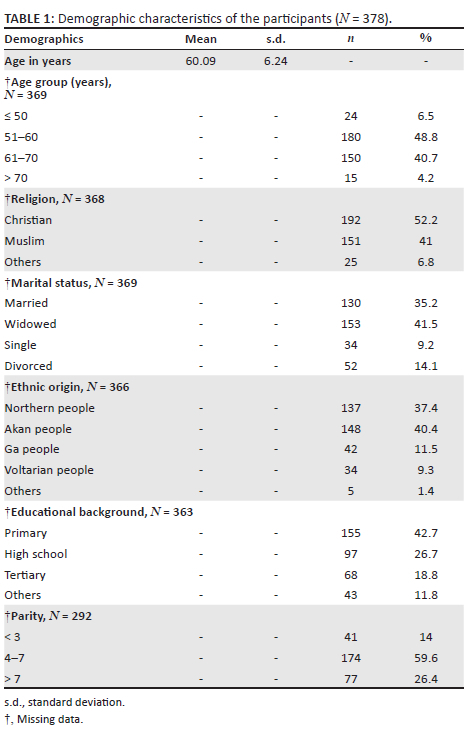
The self-developed questionnaire obtained demographic information such as age, educational background, ethnic origin, marital status, parity and religion. Information regarding participants' last menstrual period was also obtained (Table 1). The last menstrual period was defined as the final menstrual period and is confirmed when a participant has not had her period for 12 consecutive months.
Measurement of weight, height and body mass index measurement
An analogue balance stadiometer (SECA 285) was used to assess body weight and height (to the nearest 0.5 kg and 0.5 cm, respectively). The participants' posture was measured to ensure that essential postural points were constantly positioned, such as the feet being together, knees touching, buttocks, scapulae and head in contact with the vertical backboard, the back against the board and heels at the base of the vertical board. The arms of the participant hang freely by the sides of the trunk with palms towards the thighs. The ratio of body weight to height squared was used to calculate body mass index (BMI). Using the World Health Organization (WHO) criteria, BMI < 18.5 kg/m222222182
Measurement of waist circumference, hip circumference, waist-to-hip ratio and waist-to-height ratio
With the participant in a standing position (with feet together), the inelastic tape was used to measure waist and hip circumference (to the nearest 0.1 cm) as the smallest girth around the waist and the region of maximum girth around the buttocks - (the trochanteric region) for hip circumference.19
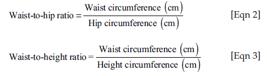
Waist circumference (WC) >88 cm and waist-to-hip ratio (WHR) > 0.82021,22
Data analysis
Microsoft Excel was used to enter and clean the data, then it was exported to IBM SPSS (version 25.0) for analysis. In order to minimize measurement inconsistencies, the authors double-checked the data that were captured on an Excel spreadsheet. The descriptive statistics included frequencies, percentages, means and standard deviation to summarize all variables. The K-test was used to determine the differences between proportions. Multivariate logistic regression with the Enter method was used to assess the association between demographics and the various indexes of weight gain. The dependent variable was obesity, and the independent variables were socio-demographic and clinical characteristics. The multivariate logistic regression model was adjusted for age. Statistical significance was set at p < 0.05 for all comparisons. Missing data were treated as missing.
Ethical considerations
Ethical approval for this study was obtained from the Human Research Ethics Committee at the University of the Witwatersrand, South Africa (Ref no. M190467). In Ghana, permission was also obtained from the Committee on Human Research, Publication and Ethics of Kwame Nkrumah University of Science and Technology, Kumasi (Ref No. 596/19).
Results
A total of 378 postmenopausal women who participated in this study ranged in age from 45 to 80 years old, with a mean age of 60.09 ± 6.24 years.
Prevalence of excess weight among participants
Excess weight is described as overweight and obese on all three indices (BMI, WHR and WHtR), whereas desirable weight is defined as those with normal body weight using all three indices. Using the WHO cut-offs of excess weight as a reference, 37.8% of the participants were obese, 35.4% overweight, 22.8% had normal weight and 4.0% were underweight (Figure 1a). Figure 1b shows that 70.1% of the participants were obese, while 8.2% had a normal WHtR. According to the WHR, 82.0% were obese, and 9.0% were overweight (Figure 1c).
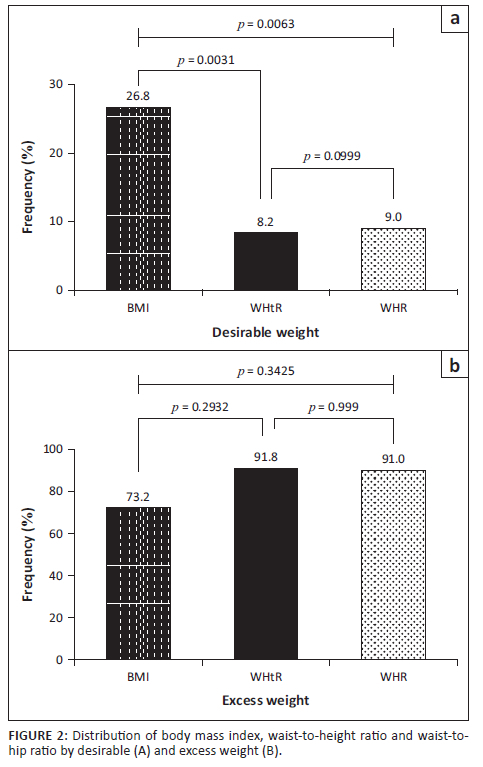
Although there was no significant difference (p = 0.999) between the proportion of study participants with a desirable weight for WHtR and WHR, the BMI, WHtR and WHR findings revealed that 26.8%, 8.2% and 9.0% of the sample had a desirable weight (Figure 2a). The distribution of study participants with desirable weight categorized by BMI was significantly higher than that of WHtR (p = 0.0031) and WHR (p = 0.0063). Results indicated that 73.2%, 91.8% and 91.0% of the participants had excess weight using BMI, WHtR and WHR, respectively, and there was no substantial difference in excess weight among the anthropometric indices (BMI, WHtR or WHR) measured (Figure 2b).
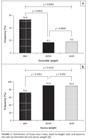
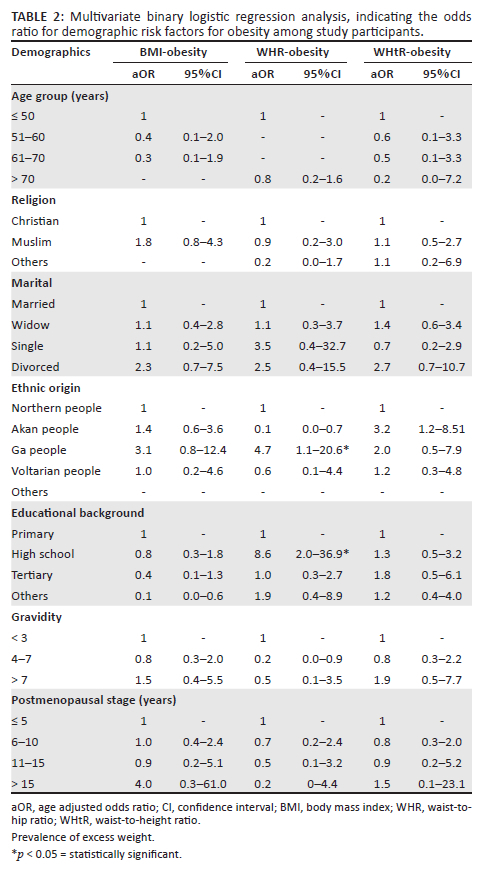
Table 2 shows a multivariate binary logistic regression analysis of socio-demographic factors for the odds ratio of developing obesity among study participants. Postmenopausal women of the Ga tribe compared with the northern tribe had 4.7 times increased odds of obesity characterized by the WHR criterion. Also, postmenopausal women who were high school graduates compared with those who only had primary school education, had 8.6 times increased odds of being obese characterized by the WHR criterion. Conversely, participants who have given birth 4-7 times were at 20% decreased odds of obesity. Age group, marital status and postmenopausal stage were independent factors that were not associated with excess weight.
Discussion
Using BMI, WHtR and WHR, the study found a high prevalence rate of excess weight among the participants of 73.2%, 91.8% and 91.0%, respectively. The stratified study participants using the anthropometric indices (BMI, WHtR or WHR) showed no significant differences. Postmenopausal women of the Ga tribe compared with the northern tribe had 4.7 times increased odds of excess weight indicated by WHR criterion. Women from the northern tribe are known to engage in non-mechanized farming, which is the major occupation compared with the other ethnic groups. Again, cultural settings in the northern tribe are such that women are mostly responsible for all household activities such as washing, cooking sweeping and these are forms of physical activities that prevent excess weight to thrive. Women from this tribe are mostly stout, which shows an inverse BMI-height association.23
Furthermore, participants who were high school graduates compared with primary school had 8.6 times increased odds of being obese indicated by the WHR criterion. Conversely, participants who have given birth 4-7 times had 20% decreased odds of excess weight. Age group, religion, marital status and postmenopausal stage were not independent factors associated with excess weight.
The postmenopausal stage (years) was not significantly associated with excess weight among participants. Menopause is often a source of anxiety for women.2425262727
Weight gain was found to be prevalent among participants. According to the BMI, 37.8% of the participants were obese, followed by overweight (35.4%), normal (22.8%) and underweight (4.0%). Gravena and Brischiliari2828
The natural history of the menopausal transition was explored by the Study of Women's Health Across the Nation (SWAN), which found that WC increased with age and accelerated after menopause.29309,10
According to WHR findings, 82.0% were obese, 9.0% were overweight and 9.0% were normal. Also, 70.1% were obese and 8.2% were normal according to the WHtR. This trend is evident in similar populations elsewhere,31313131,32
In addition, Kissebah and Krakowah found that WHR presents significant indices of abdominal fat accumulation and has a better link with a higher risk of diseases than BMI alone.3334
There was no significant difference in proportions for WHtR and WHR with a desirable weight gain, which was an interesting finding. Waist-to-height ratio and WHR, on the other hand, had a much larger distribution among study participants with a desirable weight based on their BMI than WHtR and WHR. Body mass index, WHtR and WHR recorded percentages of excess weight of 73.2%, 91.8% and 91.0%, respectively, among the general study participants, and there was no significant difference among the stratified study participants. Al-Safi and Polotsky35
Excess weight prevalence rates in this study differed from those in previous studies, which could be attributable to age variations. The average age of the participants in this study was 60.09 ± 6.24 years, which was slightly higher than the average age (57.25 ± 0.80) of participants in the study conducted by Kow Nanse Arthur et al.3136,37
Study participants who acquired high school education compared with primary school had 8.6 times increased odds of being obese, as characterized by WHR criterion. Changing nutritional trends and exposure to Western lifestyles might be contributing factors to these trends, which have health complications. Examples could include following a Western diet, a sedentary lifestyle and physical inactivity. The finding of this study is consistent with a survey conducted by Ziraba et al.,38p < 0.01). Ofori-Asenso391739
The WHR revealed that postmenopausal Ga women were more likely to be obese. This could be driven by the societal acceptability of weight gain in women in this tribe. The earlier study of women's perceptions and experiences of body weight in the Ga East District by Aryeetey40414242
Although the results of this study are comparable to those of prior investigations, the cross-sectional design prevents causality from being established. The lack of evaluation of the participants' nutritional status as part of the factors of nutritional state in older age34
Conclusion
Excess weight was common among postmenopausal Ghanaian women in this study. These results may have important implications for women's health because excess weight can lead to a risk of chronic diseases, higher healthcare costs, and a reduction in quality of life and overall well-being. However, factors that influence excess weight, including social influences, lifestyle, and levels of physical activity, should be studied and evaluated. Furthermore, it will be useful to explore weight management practices among postmenopausal women. Exploring indigenous practices may be useful for the future management of weight gain.
Contributions to research
This study confirms a high prevalence of postmenopausal women with excess weight using BMI, WHtR and WHR. The higher prevalence of excess weight based on BMI, WHR and WtHR is associated with vascular and metabolic risk and this reinforces the importance of strategies to address overweight and obesity issues to prevent complications. Postmenopausal women from the Ga tribe and high school graduates have a higher chance of being overweight or obese characterized by WHR criterion. This study found that the prevalences of excess weight were higher for postmenopausal women who had four to seven children. Future research should focus on developing intervention programmes for postmenopausal women to lose body weight and improve health.
Competing interests
The authors declare that they have no financial or personal relationships that may have inappropriately influenced them in writing this article.
Authors' contributions
All authors worked closely together to plan and execute the study. I.M.B conceived the study, data collection, data analysis and prepared the manuscript, H.M., C.B. and A.T.A. supervised study design and study tools, analysed data. M.M.O. and A.T.A. participated in coordination and helped with the literature search. All authors read and approved the final manuscript. This article is part of the author's thesis on the degree of PhD in physiotherapy at the University of the Witwatersrand South Africa, with supervisors Prof. H. Myezwa, Dr C. Brandt, and Dr A.T. Ajidahun.
Funding information
This research received no specific grant from any funding agency in the public, commercial or not-for-profit sectors.
Data availability
The datasets analysed in this study are accessible from the corresponding author, I.M.B., upon reasonable request.
Disclaimer
The views and opinions expressed in this article are those of the authors and do not necessarily reflect the official policy or position of any affiliated agency of the authors.
Acknowledgements
The authors would like to express their profound gratitude to the women in Techiman South and North constituency who volunteered and cheerfully participated in the study. They are also grateful to the leaders of churches and mosques and the municipal health director in Techiman for their assistance.
References
-
1.Teede H, Lombard C, Deeks A. Obesity, metabolic complications and the menopause: An opportunity for prevention. Climacteric. 2010;13(3):203-209. https://doi.org/10.3109/13697130903296909
» https://doi.org/10.3109/13697130903296909 -
2.Lau DC, Douketis JD, Morrison KM, Hramiak IM, Sharma AM, Ur E. 2006 Canadian clinical practice guidelines on the management and prevention of obesity in adults and children. Can Med Assoc J. 2007;176(8):S1-S13. https://doi.org/10.1503/cmaj.061409
» https://doi.org/10.1503/cmaj.061409 -
3.Blüher M. Obesity: Global epidemiology and pathogenesis. Nat Rev Endocrinol. 2019;15(5):288-298. https://doi.org/10.1038/s41574-019-0176-8
» https://doi.org/10.1038/s41574-019-0176-8 -
4.Wang YC, Colditz GA, Kuntz KM. Forecasting the obesity epidemic in the aging US population. Obesity. 2007;15(11):2855-2865. https://doi.org/10.1038/oby.2007.339
» https://doi.org/10.1038/oby.2007.339 -
5.Dubnov-Raz G, Pines A, Berry E. Diet and lifestyle in managing postmenopausal obesity. Climacteric. 2007;10(sup2):38-41. https://doi.org/10.1080/13697130701586428
» https://doi.org/10.1080/13697130701586428 -
6.Flegal KM, Carroll MD, Ogden CL, Curtin LR. Prevalence and trends in obesity among US adults, 1999-2008. JAMA. 2010;303(3):235-241. https://doi.org/10.1001/jama.2009.2014
» https://doi.org/10.1001/jama.2009.2014 - 7.Ogden CL, Carroll MD, Fryar CD, Flegal KM. Prevalence of obesity among adults and youth: United States, 2011-2014. NCHS data brief, no 219. Hyattsville, MD: National Center for Health Statistics; 2015.
-
8.Agbeko MP, Akwasi K-K, Andrews DA, Gifty OB. Predictors of overweight and obesity among women in Ghana. Open Obes J. 2013;5(1):72-81. https://doi.org/10.2174/1876823701305010072
» https://doi.org/10.2174/1876823701305010072 -
9.Douchi T, Kosha S, Uto H, et al. Precedence of bone loss over changes in body composition and body fat distribution within a few years after menopause. Maturitas. 2003;46(2):133-138. https://doi.org/10.1016/S0378-5122(03)00162-2
» https://doi.org/10.1016/S0378-5122(03)00162-2 -
10.Sowers M, Zheng H, Tomey K, et al. Changes in body composition in women over six years at midlife: Ovarian and chronological aging. J Clin Endocrinol Metab. 2007;92(3):895-901. https://doi.org/10.1210/jc.2006-1393
» https://doi.org/10.1210/jc.2006-1393 -
11.Cuadros JL, Fernández-Alonso AM, Cuadros AM, Chedraui P, Pérez-López FR. Body mass index and its correlation to metabolic and hormone parameters in postmenopausal Spanish women. Gynecol Endocrinol. 2011;27(9):678-684. https://doi.org/10.3109/09513590.2010.521269
» https://doi.org/10.3109/09513590.2010.521269 -
12.Lizcano F, Guzmán G. Estrogen deficiency and the origin of obesity during menopause. BioMed Res Int. 2014;2014:757461. https://doi.org/10.1155/2014/757461
» https://doi.org/10.1155/2014/757461 -
13.Ikram MA, Brusselle GG, Murad SD, et al. The Rotterdam Study: 2018 update on objectives, design and main results. Eur J Epidemiol. 2017;32(9):807-850. https://doi.org/10.1007/s10654-017-0321-4
» https://doi.org/10.1007/s10654-017-0321-4 -
14.Gortmaker SL, Swinburn BA, Levy D, et al. Changing the future of obesity: Science, policy, and action. Lancet. 2011;378(9793):838-847. https://doi.org/10.1016/S0140-6736(11)60815-5
» https://doi.org/10.1016/S0140-6736(11)60815-5 - 15.GSS G. Ghana statistical service (GSS), Ghana health service (GHS), and ICF macro. Accra: Ghana Demogr Health Surv. 2009;2008:79-96.
-
16.Charan J, Biswas T. How to calculate sample size for different study designs in medical research? Indian J Psychol Med. 2013;35(2):121. https://doi.org/10.4103/0253-7176.116232
» https://doi.org/10.4103/0253-7176.116232 - 17.Benkeser RM, Biritwum R, Hill AG. Prevalence of overweight and obesity and perception of healthy and desirable body size in urban, Ghanaian women. Ghana Med J. 2012;46(2):66-75.
-
18.World Health Organization (WHO). The World health report 1998 : Life in the 21st century : A vision for all. [homepage on the Internet]. c1998 [cited No date]. Available from https://apps.who.int/iris/handle/10665/42065
» https://apps.who.int/iris/handle/10665/42065 -
19.McArdle AN, Jackson MJ. Exercise, oxidative stress and ageing. J Anat. 2000;197(4):539-541. https://doi.org/10.1046/j.1469-7580.2000.19740539.x
» https://doi.org/10.1046/j.1469-7580.2000.19740539.x - 20.WHO Waist Circumference. Waist-hip ratio report of a WHO expert consultation. Geneva: Data WLCiP; 2008.
-
21.Ashwell M, Gunn P, Gibson S. Waist-to-height ratio is a better screening tool than waist circumference and BMI for adult cardiometabolic risk factors: Systematic review and meta-analysis. Obes Rev. 2012;13(3):275-286. https://doi.org/10.1111/j.1467-789X.2011.00952.x
» https://doi.org/10.1111/j.1467-789X.2011.00952.x - 22.World Health Organization Consultation. Obesity: Preventing and managing the global epidemic. Geneva: World Health Organization technical report series 894. 2000, p. 1-253.
-
23.Sperrin M, Marshall AD, Higgins V, Renehan AG, Buchan IE. Body mass index relates weight to height differently in women and older adults: Serial cross-sectional surveys in England (1992-2011). J Public Health. 2016;38(3):607-613. https://doi.org/10.1093/pubmed/fdv067
» https://doi.org/10.1093/pubmed/fdv067 -
24.Graziottin A. Menopause and sexuality: Key issues in premature menopause and beyond. Ann N Y Acad Sci. 2010;1205(1):254-261. https://doi.org/10.1111/j.1749-6632.2010.05680.x
» https://doi.org/10.1111/j.1749-6632.2010.05680.x -
25.Kapoor E, Collazo-Clavell ML, Faubion SS. Weight gain in women at midlife: A concise review of the pathophysiology and strategies for management. Mayo Clin Proc. 2017;92(10):1552-1558. https://doi.org/10.1016/j.mayocp.2017.08.004
» https://doi.org/10.1016/j.mayocp.2017.08.004 -
26.Kozakowski J, Gietka-Czernel M, Leszczyńska D, Majos A. Obesity in menopause-our negligence or an unfortunate inevitability? Prz Menopauzalny Menopause Rev. 2017;16(2):61. https://doi.org/10.5114/pm.2017.68594
» https://doi.org/10.5114/pm.2017.68594 -
27.Shikora S, Toouli J, Herrera MF, et al. Vagal blocking improves glycemic control and elevated blood pressure in obese subjects with type 2 diabetes mellitus. J Obes. 2013;2013:245683. https://doi.org/10.1155/2013/245683
» https://doi.org/10.1155/2013/245683 -
28.Gravena AA, Brischiliari SC, Lopes TC, Agnolo CM, Carvalho MD, Pelloso SM. Excess weight and abdominal obesity in postmenopausal Brazilian women: A population-based study. BMC Women's Health. 2013;13(1):1-7. https://doi.org/10.1186/1472-6874-13-46
» https://doi.org/10.1186/1472-6874-13-46 -
29.Callahan JL. Constructing a manuscript: Distinguishing integrative literature reviews and conceptual and theory articles. Hum Resour Dev Rev. 2010;9(3):300-304. https://doi.org/10.1177/1534484310371492
» https://doi.org/10.1177/1534484310371492 -
30.Stevens J, Katz EG, Huxley RR. Associations between gender, age and waist circumference. Eur J Clin Nutr. 2010;64(1):6-15. https://doi.org/10.1038/ejcn.2009.101
» https://doi.org/10.1038/ejcn.2009.101 -
31.Kow Nanse Arthur F, Adu-Frimpong M, Osei-Yeboah J, Obu Mensah F, Owusu L. The prevalence of metabolic syndrome and its predominant components among pre-and postmenopausal Ghanaian women. BMC Res Notes. 2013;6(1):1-2. https://doi.org/10.1186/1756-0500-6-446
» https://doi.org/10.1186/1756-0500-6-446 -
32.Cao Q, Yu S, Xiong W, et al. Waist-hip ratio as a predictor of myocardial infarction risk: A systematic review and meta-analysis. Medicine. 2018;97(30):e11639. https://doi.org/10.1097/MD.0000000000011639
» https://doi.org/10.1097/MD.0000000000011639 -
33.Kissebah AH, Krakower GR. Regional adiposity and morbidity. Physiol Rev. 1994;74(4):761-811. https://doi.org/10.1152/physrev.1994.74.4.761
» https://doi.org/10.1152/physrev.1994.74.4.761 - 34.World Health Organization (WHO). The world health report 2002: Reducing risks, promoting healthy life. Geneva: World Health Organization; 2002.
-
35.Al-Safi ZA, Polotsky AJ. Obesity and menopause. Best Pract Res Clin Obstet Gynaecol. 2015;29(4):548-553. https://doi.org/10.1016/j.bpobgyn.2014.12.002
» https://doi.org/10.1016/j.bpobgyn.2014.12.002 -
36.Matthews KA, Abrams B, Crawford S, et al. Body mass index in mid-life women: Relative influence of menopause, hormone use, and ethnicity. Int J Obes. 2001;25(6):863-873. https://doi.org/10.1038/sj.ijo.0801618
» https://doi.org/10.1038/sj.ijo.0801618 -
37.Bener A, Yousafzai MT, Darwish S, Al-Hamaq AO, Nasralla EA, Abdul-Ghani M. Obesity index that better predict metabolic syndrome: Body mass index, waist circumference, waist hip ratio, or waist height ratio. J Obes. 2013;2013:269038. https://doi.org/10.1155/2013/269038
» https://doi.org/10.1155/2013/269038 -
38.Ziraba AK, Fotso JC, Ochako R. Overweight and obesity in urban Africa: A problem of the rich or the poor? BMC Public Health. 2009;9(1):1-9. https://doi.org/10.1186/1471-2458-9-465
» https://doi.org/10.1186/1471-2458-9-465 - 39.Amoah A. Obesity in adult residents of Accra, Ghana. Ethn Dis. 2003;13(2 Suppl 2):S97-S101.
-
40.Aryeetey RNO. Perceptions and experiences of overweight among women in the Ga East District, Ghana. Front Nutr. 2016;3:13. https://doi.org/10.3389/fnut.2016.00013
» https://doi.org/10.3389/fnut.2016.00013 - 41.Biritwum RB, Gyapong J, Mensah G. The epidemiology of obesity in Ghana. Ghana Med J. 2005;39(3):82.
-
42.Ofori-Asenso R, Agyeman AA, Laar A, Boateng D. Overweight and obesity epidemic in Ghana - A systematic review and meta-analysis. BMC Public Health. 2016;16(1):1-18. https://doi.org/10.1186/s12889-016-3901-4
» https://doi.org/10.1186/s12889-016-3901-4
Accepted: 04 Jan. 2023
Published: 09 Mar. 2023