Knowledge, attitudes and practices regarding cervical cancer prevention at Thulamela Municipality of Vhembe District in Limpopo Province
Abstract
BACKGROUND: Cervical cancer is a widespread and often fatal disease that affected 1 million women globally in 2005. Not only is it the second most common cancer in women but it was also the second leading cause of cancer deaths, accounting for over 250 000 in 2006. PURPOSE: The purpose of the study was to assess the knowledge, attitudes and practices regarding cervical cancer prevention among rural women in Vhembe District in Limpopo Province. METHODOLOGY: A quantitative descriptive approach was adopted. The quantitative design enabled the discovery of more information by means of direct questioning of a sample of women aged 30 years and older. A convenience sampling was used to select the respondents. Data were analysed using the Statistical Package for Social Sciences. Measures to ensure ethical issues were adhered to RESULTS: The findings revealed that women lacked knowledge about cervical cancer and preventive methods, and displayed positive attitudes to the use of services if made available as health workers did not adequately inform them about the availability of the services. CONCLUSION: The awareness of cervical cancer among women in Vhembe District is limited. There is a need to educate and promote awareness of cervical cancer among women to reduce the burden of morbidity and mortality.
Introduction
Cervical cancer is a public health problem both in developed and developing countries although it is preventable and curable if identified at an early stage.123
Throughout the world, prevention, control and treatment of cervical cancer have been a public health priority.4525
Cervical cancer continues to be the leading cause of death for women in America. Incidence rate of cervical cancer in America is (8.9 per 100 000). More than 10 000 new patients develop cervical cancer each year, and 3600 women in the USA die from the advanced stage of this disease annually.66
Sub-Saharan Africa has by far the highest burden and mortality associated with cervical cancer in the World.78
A total of 5318 new cases of cervical cancer were detected in South Africa in 1997, while the risk of development of cervical cancer in South African women has been estimated to be 1 in 29.79
Cervical cancer is a major problem in South Africa and it is the second most common cancer and affects one out of every 41 women.9310811
The South African Department of health launched the national guideline on cervical cancer screening programme to reduce the incidence and the burden of cervical cancer. The aim of the programme is to screen all women over 30 years three times in their lifetime at a 10 year interval912 13
Aim of the study
The aim of the study is to determine the knowledge, attitudes and practices regarding cervical cancer prevention among rural women in Thulamela Municipality at Vhembe District in Limpopo Province.
The objectives of the study were:
• To assess the knowledge of rural women regarding cervical cancer and preventative measures.
• To describe the attitudes and practices of cervical cancer prevention.
• To recommend ways to improve screening uptake.
Contribution to the field
The study has added to the already existing body of knowledge about cervical cancer prevention strategies. Primary health care services need to improve on the strategies to disseminate information regarding cervical cancer screening, prevention, treatment and benefits by marketing the service and disseminating pamphlets in local languages. The reduction of morbidity and mortality associated with cervical cancer will reduce the expenditure on the treatment of invasive cancer. Therefore, intense knowledge dissemination and access to preventive measures will increase provincial targets and reduce the burden of cervical cancer and mortality.
Methodology
A quantitative, cross-sectional descriptive design was used to assess and describe knowledge, attitudes and practices regarding cervical cancer prevention among rural women aged 30 years and older in Vhembe District in Limpopo Province. Target population is the aggregate of cases about which the researcher would like to make generalisations.14 15p-values of less than 0.05 were considered significant.
Results
Knowledge regarding cervical cancer prevention
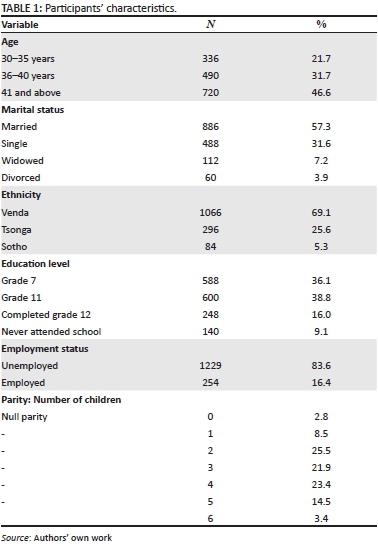
This subsection deals with data on the knowledge regarding cervical prevention. The following were used to gather data from the respondents (see Table 1).
Knowledge of cervical cancer
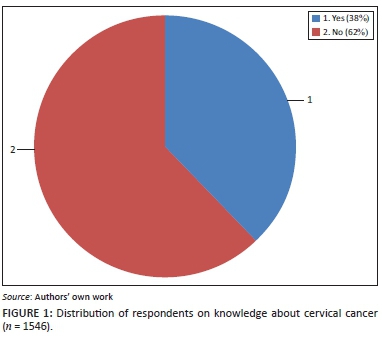
The results show that the majority of the respondents, 62.0% (958), indicated that they had never heard about cervical cancer while 38.0% (588) indicated that they had heard about cervical cancer (see Figure 1).
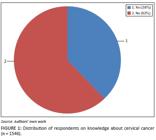
These results show that the majority 62.0% of women aged 30 and above were not aware of cervical cancer and only 38.0% were aware of cervical cancer (see Table 2).
The chi-square results show a significant relationship between level of knowledge of cervical cancer and the age range of respondents; X2N = 1546) = 10.641, p < 0.005. Knowledge of cervical cancer was associated with age range. The results show that 46.6% of respondents aged between 30 and 35 were more likely to have knowledge of cervical cancer compared with 31.7% of respondents aged between 36 and 40 years and 21.7% of women aged 41 and above. The correlation of age and respondents' knowledge revealed that as the age range increased the knowledge about cervical cancer decreased, r = -0.671 at p < 0.01. This implies that age range was an influential factor with regard to the respondents' knowledge about cervical cancer. Young women were likely to have more knowledge on cervical cancer than elderly women.
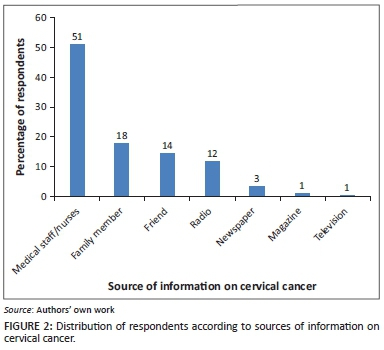
Figure 2 shows the distribution of respondents with respect to the source of information.
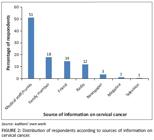
Content of information about cervical cancer: A follow-up was made on the content of information about cervical screening that the respondents had received. The results show that the content information was relevant to cervical cancer; however, only 15.8% (244/1546) of the whole sample indicated that the content information was relevant to cervical cancer.
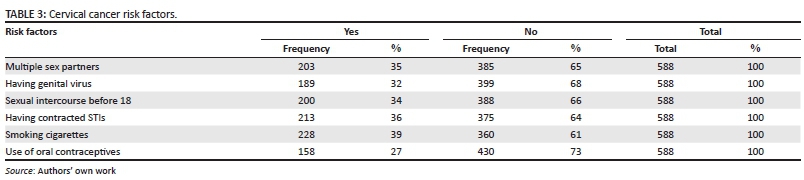
On cervical cancer risks factors: The results show that the minority of the sample had some knowledge about risk factor for cervical cancer (see Table 3).
The results show that only 6.1% (97) of the respondents indicated that cervical cancer could be diagnosed using the Pap smear, 12.2% (188) indicated biopsy and 19.4% (302) indicated blood tests. These results indicate that in this sample, 18.2% (282) of the respondents knew the diagnosis of cervical cancer while the majority 81.8% (1264) of the respondents did not know the diagnosis of cervical cancer (see Table 4).
The results show that only 50 respondents (3.2%) took a Pap smear and that 1496 (96.8%) did not. This points to the lack of awareness of cervical cancer and lack of knowledge on the importance of taking the screening.
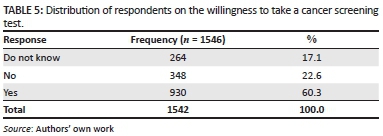
Table 5 shows the findings on the possibility of respondents getting a test done when given a pamphlet about Pap smear.
The results show that 264 (17.1%) respondents were not decided about taking a cancer screening test and majority were not keen even when given a pamphlet about Pap smear. These results are an indication of the negative effects of lack of information on cervical cancer.
Discussions
Cervical carcinoma is still the most common cancer among women in the African continent. Mortality remains high worldwide at 50% mainly because of late presentation, advanced stage of the disease and absence of a functioning screening process.121610 17
The results show that knowledge about cervical cancer is fairly and negatively related to the age range of respondents. As the age range increased, the knowledge about cervical cancer decreased, r = -0.671 at p < 0.01. This implies that age range was an influential factor on the respondents' knowledge about cervical cancer. Young women were likely to have more knowledge on cervical cancer than elderly women. There is a need to target these young groups so as to increase their level of knowledge and curb future morbidities and expel myths and beliefs that cervical cancer does not affect older women. There is a critical need for the primary health nurses, private sector and government to increase the level of knowledge and awareness of cervical cancer and screening methods among women and also provide screening facilities. Educational campaigns are important in improving knowledge about cervical cancer prevention and promote acceptance of Pap smear screening.18181920r = -0.263, p < 0.01. This means that most of the elderly people have never heard about Pap smear compared with younger women. The knowledge about Pap smear also associates positively with the highest standard of education attained, r = 0.184 and p < 0.01. Results also show that worriedness associates negatively with age range and the highest standard of education achieved, r = -0.184, p < 0.01., which implies that young women are worried of contracting cervical cancer than older women. Worriedness also associates with the highest standard of education attained, r = 0.131, p < 0.01; the higher the level of education the more likely the women are worried about contacting cervical cancer. It is therefore necessary to target the older age groups in cervical cancer campaigns and to increase cervical cancer uptake as the incidence of cervical cancer increases with age, sensitising women about the risk factors such as parity since most participants reported parity of two to five. Other risk factors such as the use of oral contraceptives 430 (73.0%), genital warts 399 (68.0%) and early sexual intercourse 388 (66.0%) were suggestive of the fact women lacked knowledge about these risk factors. Lack of awareness of related risk factors and screening measures delays early and prompt diagnosis; this is also confirmed by21
Limitations
The study findings are not transferable to other settings as the study was conducted only in one district and only limited primary healthcare facilities were utilised. The study employed only one method of data collection on knowledge, attitudes and practices of cervical cancer prevention using close coded instrument which may have yielded more information if triangulated.
Recommendations
Health promotion campaigns need to ensure that all women, particularly older women, continue to be educated on cervical cancer as well as the importance of having regular Pap smear test.
Providing women with informational pamphlets written in the indigenous languages outlining the risks and benefits:
1. Health education about cancer should be encouraged at social and cultural gatherings.
2. Primary healthcare nurses at local clinics should promote the uptake of cervical cancer screening.
3. Multi-sectoral approach in education with participation by private sector/NGOs, government, community groups and faith-based organisations.
Conclusion
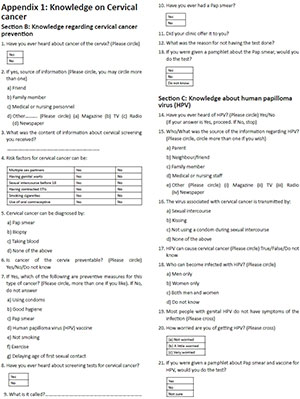
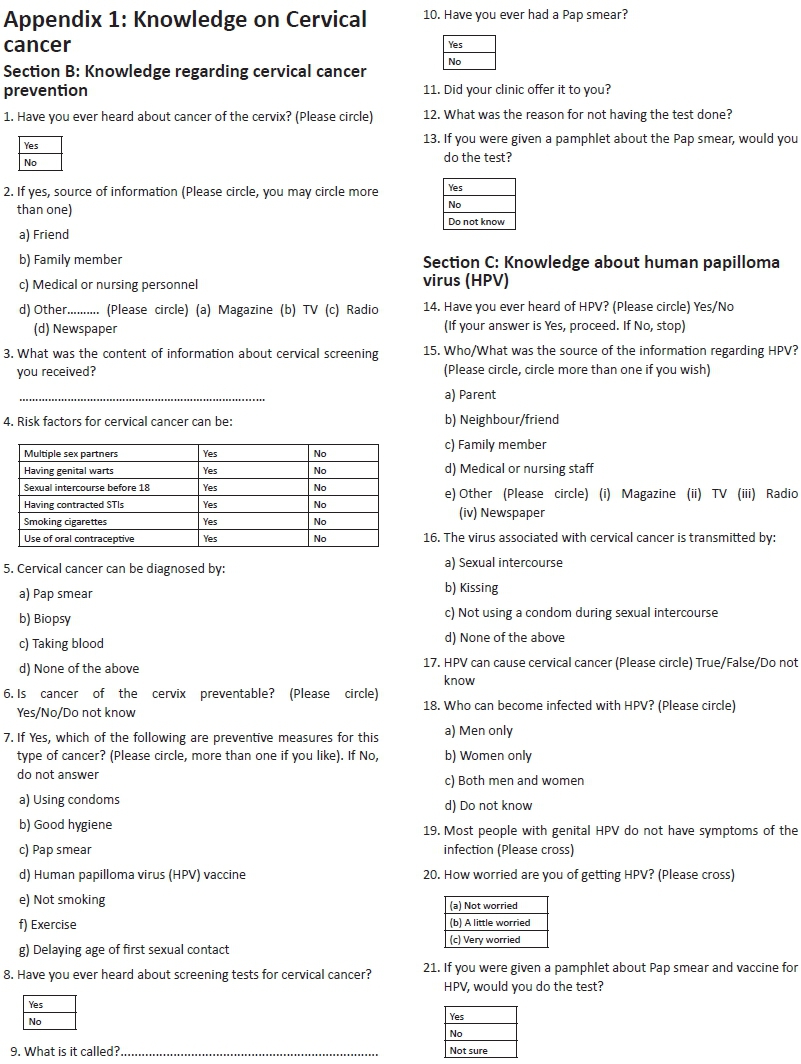
The knowledge on cervical cancer and preventive screening among rural women is lacking in Vhembe District (see Appendix 1). Knowledge increases the worriedness of having cancer and increases the uptake of having a Pap smear than those having no information. There is a need to educate and promote awareness among rural women regarding cervical cancer screening and prevention. Educating women at an early age through to the menopausal age and promoting awareness about risk factors and prevention measures will curb maternal mortality rates and improve the quality of lives of women. Targeting older women is of utmost significance as the results revealed that older women lacked information about cervical cancer and the preventive measures.
Appendix 1
Competing interests
The authors have no financial or personal relationships which may have inappropriately influenced them in writing this article.
Authors' contributions
D.N. collected data and D.U.R. assisted with conceptual design and wrote the article. L.B.K. and N.J.R. co-supervised the project and assisted in literature review.
Acknowledgements
References
- 1. Magawa R. Cervical cancer - The silent killer: A growing concern in Africa public health discussion papers 1-5. Zambia: Lusaka; 2012.
- 2. Bologun MR, Odukoya OO, Oyediran MA, Ujomu PI. Cervical cancer awareness and preventive practices: A Challenge for Female Urban Slum Dwellers in Lagos, Nigeria. Afr J Reprod Health. 2012;16(1):7582.
- 3. Hoque ME. Cervical cancer awareness and preventive behaviour among Female University Students in South African. Asian Pac J Cancer Prev. 2010;(11):127-130.
- 4. World Health Organisation (WHO). News care. American cancer society statistics. Atlanta: GA; 2012.
-
5. Wright KO, Faseru B, Kuyini YA, Faduyile FA. Awareness and uptake of Pap smear among market women in Lagos, Nigeria. J Public Health Afr. 2011;2(1):1-7. http://dx.doi.org/10.4081/jphia.2011.e14
» http://dx.doi.org/10.4081/jphia.2011.e14 - 6. Denny L. Cervical cancer in South Africa: an overview of current status and prevention strategies. CME. 2010;28(2):70-73.
-
7. Okonofua F. HPV vaccine and prevention of cervical cancer in Africa. Afr J Reprod Health. 2007;11(2):7-12. http://dx.doi.org/10.2307/25549711
» http://dx.doi.org/10.2307/25549711 - 8. Sibiya N, Grainger L. Registered nurses 'perceptions of the cervical screening programme in primary health care clinics in the Kwazulu-Natal Province of South Africa. J Nurs Midwifery. 2010;12(1):15-26.
- 9. Pillay P, Knight SE, Rmaih WNS. Cervical cancer screening in urban clinics in e Thekweni municipality area. S Afr J Epidemiol Infect. 2009;24(2):18-20.
- 10. Hoque E, Hoque M. Knowledge of and attitude towards cervical cancer among female university students in South Africa. S Afr J Epidemiol Infect. 2009;24(1): 21-24.
- 11. Bradshaw D, Nannan N, Laubscher R, Groenewald P, Joubert J. South African National burden of disease study, estimates of Provincial Mortality, Limpopo Province South Africa. Burden Dis Res. Unit 1-15;2000.
-
12. Botha H, Cooreman B, Dreya G, et al. Cervical cancer and human papillomavirus: South African guidelines for screening and testing. S Afr J Gynaecol Oncol. 2010;2(1):23-26. http://dx.doi.org/10.1080/20742835.2010.11441154
» http://dx.doi.org/10.1080/20742835.2010.11441154 - 13. African National Congress. A national health plan for South Africa. Johannesburg: Bahr Mapping & Printing; 1994.
- 14. Polit DF, Beck TC. Nursing research generating and assessing evidence for nursing practice. 6th ed. Philadelphia, PA: Lippincott; 2008.
- 15. De Vos AS, Strydom H, Fouché CB, Delport CSL. Research at grassroots for social science and human service professions. 4th ed. Hatfield: Van Schaik; 2011.
- 16. Saiti KH. Attitudes, knowledge, and practices in relation to cervical cancer and its screening among women in Saudi Arabia. Saudi Med J. 2009;30(9):1208-1212.
-
17. Perkins RB, Langrish S, Stern LJ, Simon CJ. A community-based education program about cervical cancer improves knowledge and screening behaviour in Honduran women. Rev Panam Salud Publica. 2007;22(3):187-193. http://dx.doi.org/10.1590/S1020-49892007000800005
» http://dx.doi.org/10.1590/S1020-49892007000800005 -
18. Nwankwo KC, Aniebue UU, Aguwa EN, Anarado AN, Aguwa E. Knowledge attitudes and practices of cervical cancer screening among urban and rural Nigerian women: A call for education and mass screening. Eur J Cancer Care. 2011;20: 362-367. http://dx.doi.org/10.1111/j.1365-2354.2009.01175.x
» http://dx.doi.org/10.1111/j.1365-2354.2009.01175.x - 19. Reyes-Ortiz CA, Camacho ME, Amador LF, et al. The impact of education and literacy levels on cancer screening among older Latin American and Caribbean adults. Cancer Control. 2007;14(4):388-395.
-
20. Lee-Lin F, Pett M, Menon U, et al. Cervical cancer beliefs and Pap test screening practices among Chinese American immigrants. Oncol Nurs Forum. 2007;34(6): 1203-1209. http://dx.doi.org/10.1188/07.ONF.1203-1209
» http://dx.doi.org/10.1188/07.ONF.1203-1209 - 21. Jonge ETM, Makin JD, Lindeque BG. Is cancer of the cervix more aggressive disease in black women. The South African Journal of Epidemiology and Infection. 14(2),4045.

Accepted: 01 Apr. 2016
Published: 17 June 2016