Prevalence of hypertension and associated factors in people living with HIV at Senkatana Clinic Maseru
Abstract
BACKGROUND: Cardiovascular diseases (CVDs), including hypertension (HTN), have emerged among people living with HIV (PLHIV) as the most important prevalent contributors of non-AIDS-related mortality. Moreover, HTN itself is a modifiable risk factor for other CVDs. Data are limited regarding the prevalence of HTN and associated factors among PLHIV in Lesotho AIM: To determine the prevalence of HTN and associated factors among PLHIV attending Senkatana ART Clinic SETTING: The study was carried out at Senkatana ART Clinic in urban Maseru, Lesotho METHODS: A cross-sectional study was conducted from February to July 2022. Data were analysed using SAS statistical software (v9.4) and Microsoft Excel. To determine HTN prevalence, blood pressure (BP) was measured, and a questionnaire was administered to participants who were randomly selected using the lottery method from the clinic's daily attendance list. Multiple logistic regression was used to assess factors associated with HTN in PLHIV while controlling for potentially confounding factors RESULTS: The prevalence of HTN was 57% (exact 95% CI: 51.2%, 62.7%). Of those with HTN, 33.3% were newly diagnosed during this study (exact 95% CI: 26.3%, 40.9%), while 69% of those previously diagnosed with HTN had uncontrolled HTN at enrollment (exact 95% CI: 60.0%, 77.6%). Age older than 50 years (p < 0.0001) and a body mass index (BMI) of 25.0 kg/m2 or higher (p < 0.0002) were independently associated with HTN CONCLUSION: Hypertension was highly prevalent and poorly controlled. Factors associated with HTN in PLHIV were older age and higher BMI. The study's findings support models of comprehensive healthcare delivery
hypertension; prevalence; antiretroviral therapy; people living with HIV; cardiovascular diseases; healthcare delivery
Introduction
There is a growing burden of non-communicable diseases (NCDs) among people living with HIV (PLHIV), particularly in resource-limited health systems of the sub-Saharan Africa, which also bear high burdens of human immunodeficiency virus (HIV) prevalence.1,23,4,567
Global prevalence of HTN in PLHIV on antiretroviral therapy (ART) was estimated to be 35%.82,910,1112123,4,5
People living with HIV are at higher risk of HTN because of low CD4 count, high viral burden, prolonged exposure to HAART and longer duration of HIV infection. This may be explained by association with HTN-related mechanisms such as renin-angiotensin activation, long-term immune suppression, chronic inflammation and endothelial dysfunction. Some side effects of highly active antiretroviral therapy (HAART), include dyslipidemia, lipodystrophy and nephrotoxicity, which contribute to increase in blood pressure (BP). People living with HIV are also subject to risk factors for HTN, including older age, smoking, high BMI and positive family history of HTN, which are known for people who are not infected with HIV.4,5,8,13
Approximately 22.7% of the Lesotho population, a Southern African LMIC, aged 15 years and above live with HIV according to the Lesotho Population-Based HIV Impact Assessment 2020.1415
Research methods and design
Study design
A cross-sectional study was conducted from February to July 2022 at Senkatana ART Clinic, Maseru, Lesotho. Analytical cross-sectional design is used, as it can determine the prevalence of a condition and association with several factors, at a given point in time, without establishing risks, causality or a cause-effect between exposure and outcome.16,17
Study setting
Senkatana ART Clinic is found in Maseru, the capital district of Lesotho. Lesotho is a landlocked country surrounded by the Republic of South Africa. It has a total population of 2 135 000, with approximately 25% residing in the Maseru district. Senkatana ART Clinic primarily serves a total population of 23 120 from nine villages in Maseru. All are HIV-positive adults receiving HAART from this centre. It also serves as a national referral centre for special HIV and TB cases. It provides HIV services comprising of prevention, counselling, diagnosis, treatment and monitoring. It follows the test and treat criteria regardless of CD4 cell count.
Study population, sample and sampling strategy
Participants randomly selected from among PLHIV who attended the clinic were aged 18 years and above, were on HAART for at least 12 months and provided informed consent. Excluded from the study were pregnant patients because of the complexity of hypertensive disease in pregnancy and all those unwilling to provide consent or severely ill. SAS PROC POWER version 9.4 (SAS Institute Inc.) was used to determine that a sample size of 300, drawn from a total clinic population of 23 120, would ensure, with a probability of at least 0.8, that the 95% confidence interval for the study estimates of the prevalence of HTN would have a half-width no larger than 0.05.1815
Data collection tool and procedure
During patients' follow-up visits to the clinic, study participants were randomly selected using the lottery method from the attendance list. They were then invited to participate in the study and provide informed consent. Structured questionnaires were used to collect data on socio-demographic, behavioural, medical and family history. Family history of HTN was considered positive for individuals with first-degree relatives known to have HTN. Participants were categorised as smokers if they smoked at least one cigarette per week in the last 12 months, and as alcohol consumers if they consumed any alcoholic drink at least seven times per week during the last 12 months. Clinical data (including duration of HIV Infection and HAART regimen) were collected from both the patients and their clinical records, including WHO clinical staging I, II, III and IV.
Anthropometric data (weight in kg and height in meters) were measured during the interview, and BMI was calculated (kg/m2222222
Data analysis
Data were analysed using SAS statistical software (v9.4) and Microsoft Excel. Hypertension prevalence was calculated as the number of participants qualifying as having HTN divided by the total number sampled. The percentage of undiagnosed HTN was calculated as the number of participants newly diagnosed during the study divided by the total number qualifying as having HTN. Categorical variables (sex, family history of HTN, duration on HAART, age, duration of HIV infection, HAART regimen, WHO clinical stage, smoking status, BMI, alcohol use, educational status, marital status) were summarised using counts (frequencies and percentages/proportions). Continuous variables (age, BMI) were summarised as means and standard deviations. To identify potential factors associated with HTN, participants with and without HTN were compared with respect to each factor in separate bivariable analyses, using exact Pearson Chi-square tests.
To address potential confounding in the identification of associated factors, the study excluded pregnant women and people who were severely ill. Otherwise, the study included anyone living with HIV who was 18 years or older and had been on HAART for at least 12 months. This relatively broad inclusion criteria did not restrict participation on the basis of several known risk factors. Accordingly, multivariable logistic regression models were used to assess potential confounding in the bivariable comparisons.
Hypertension status was the dependent variable in multivariable models constructed through an investigator-mediated forward selection process that regarded a p-value of < 0.05 as evidence of statistical significance. The initial multivariable model included, as independent variables, three known risk factors for HTN: age, BMI status and sex. This model found that older age (p < 0.0001) and BMI of 25.0 kg/m2p = 0.0002) were independently associated with HTN, but sex, after controlling for age and BMI status, was not (p = 0.3148). Based on this finding, each factor's association with the dependent variable, HTN status, was then assessed in separate multivariable logistic regression models that controlled only for age (in years) and BMI status.
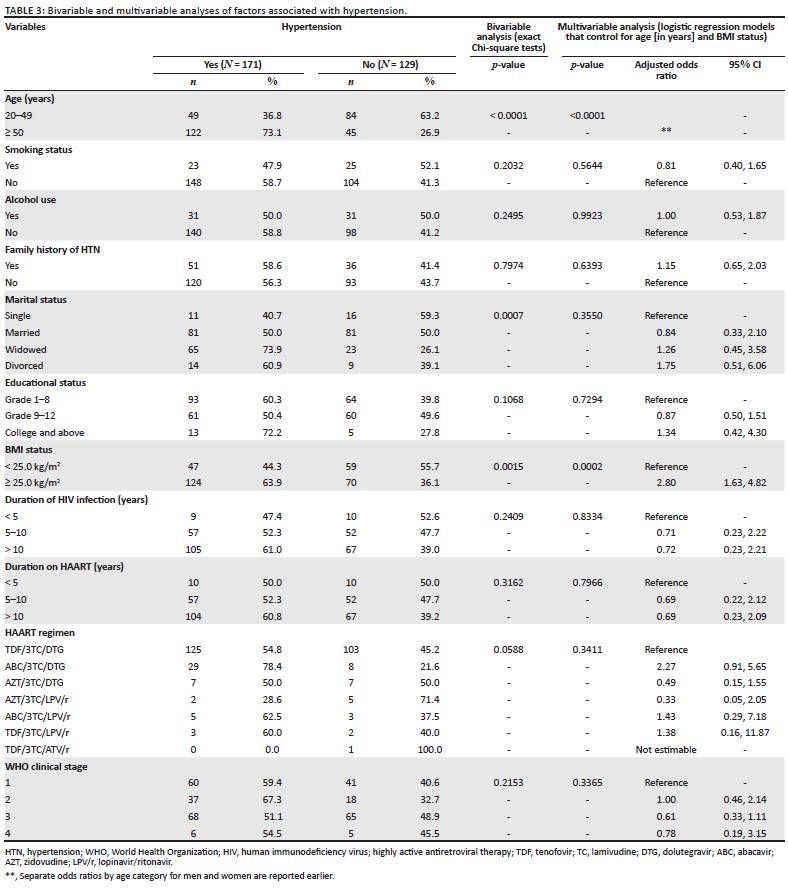
To determine whether a given factor modified the association between HTN and either age or BMI status, that factor's regression model included two-factor and three-factor interaction terms. For factors for which no statistical interactions were detected, the interaction terms were then removed, and results from a multivariable model that controlled only for age (in years) and BMI status were reported (Table 3). Results for the single factor for which the presence of a statistical interaction indicated that the factor modified the association between HTN and age are reported. For all analyses, a p-value of < 0.05 was considered evidence of statistical significance. Analyses were performed using SAS statistical software (v9.4).
Ethical considerations
Ethical clearance to conduct this study was obtained from the Ministry of Health Lesotho, National Health Research Ethics Committee (NREC) (No. ID 171-2021), as well as from the clinic management. Before participation, the purpose of the study, NREC safeguards and written informed consent were explained to each study participant. The information obtained from participants was the minimum necessity to conduct the study, and interactions occurred in private settings. The confidentiality of the data was protected by assigning a unique study number to each participant. Data collection questionnaires were translated into Sesotho for participants who did not understand English.
Results
Demographic characteristics of the study participants
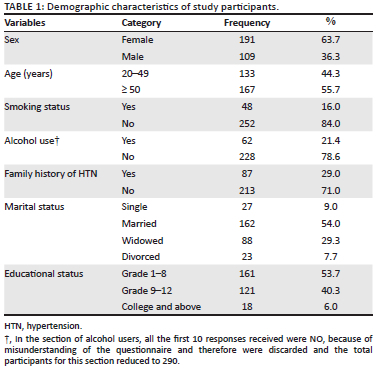
Demographic characteristics are presented in Table 1. A total of 300 participants were included in the study analysis, of whom 63.7% were female. The mean (SD) age was 51.6 years (10.8 years) and 55.7% of the participants were aged 50 years and above. Eighty-seven (29.0%) participants had a positive family history of HTN (first-degree relative), 162 (54%) were married and 161 (53.7%) had not attended school beyond grade 8. Only 48 (16.0%) of the participants were smokers and 62 (20.7%) consumed alcohol.
Clinical characteristics
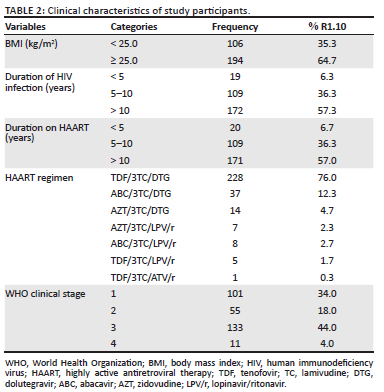
The mean (SD) BMI was 28.1 kg/m22Table 2).
Prevalence of hypertension
The prevalence of HTN was found to be 57% (171/300) (95% CI: 51.2%, 62.7%). Of the 171 participants with HTN, 57 (33.3%) were newly diagnosed during this study (exact 95% CI: 26.3%, 40.9%). Of the 114 participants who were already on HTN treatment, 79 (69.3%) had uncontrolled HTN (exact 95% CI: 60.0%, 77.6%).
Demographic and clinical factors associated with hypertension in people living with HIV
Hypertension prevalence among people older than 50 years (73.1%) was higher than among younger participants (p from exact Chi-square test <0.0001). The overweight and obese group, BMI ≥ 25.0 kg/m2p from exact Chi-square test = 0.0015) as compared to the normal and underweight group with a HTN prevalence of 44.3%.
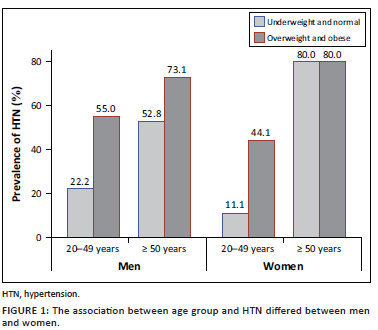
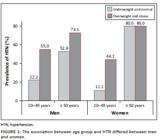
Sex was not independently associated with HTN after controlling for age and BMI status. The association between age group and HTN differed between men and women (p for sex*age interaction = 0.0237). For men with a given BMI status, the odds of HTN were 3.05 times higher (95% CI: 1.34, 6.94; p = 0.0079) among those who are fifty years of age or older, than among those who are younger than 50. For women in a given BMI status, the odds of HTN are 7.19 times higher (95% CI: 3.70,13.97; p < 0.001) among those who are fifty years of age or older, than among those who are younger than 50 (Figure 1). In a given age category, the odds of HTN were 2.80 times higher (95% CI: 1.63, 4.82) among those whose BMI of 25.0 kg/m22
The significant bivariable association between HTN and marital status (p from exact Chi-square test 0.0007) reflects a higher prevalence of HTN among the widowed (73.9%) and divorced (60.9%) participants, who are older on average than the other groups. In the multivariable analyses, married participants were, on average, older than those who were single, and those who were divorced were not older than those who were married. Widowed participants were older than those in other marital groups. At a given age (in years), HTN was not associated with marital status (p = 0.3550). The significant bivariable association between HTN and marital status was confounded by between-group differences in mean age (Table 3).
The bivariable association between HTN and HAART regiment approached significance (p = 0.0588). The prevalence of HTN was found highest in the subgroup receiving ABC/3TC/DTG. However, in multiple logistic regression, the bivariable association between HTN and HAART regimen was found to be confounded and explained by differences in age among the groups undergoing different regimens (Table 3).
Discussion
The aim of this study was to determine the prevalence of HTN and associated factors among PLHIV attending Senkatana ART Clinic, Maseru, Lesotho. The prevalence of HTN was found to be high (57%), with a third of the participants newly diagnosed during the study. This prevalence is comparable to the 53% reported in rural districts of the Eastern Cape, South Africa.119,1981510
The mean age of participants in this study (51.6 years) is higher than mean age of 38.4 years in a similar study conducted in the Western Cape. This population's relatively high prevalence of HTN could be attributed to demographic and clinical characteristics of the study's sample, including a higher BMI status (63.9%) and older age. It could also be because of differing sampling processes, as in the Western Cape, participants were selected from 62 different health facilities, had a lower mean age (38.4 years) and lower proportion of overweight (43.9%) participants.10,20
Among participants previously on antihypertensive medication, more than half had uncontrolled HTN. This rate was higher than the 25.9% reported in the Western Cape, South Africa, but comparable to the 58.2% reported in a prospective cohort from a public ART clinic in South Africa.10,206,84,13,20
Evidence of statistical interaction was detected in the multivariable logistic regression model that explored associations between HTN and sex. The interaction between sex and age (p = 0.0237) signifies that differences in the prevalence of HTN between men and women differ for older and younger participants. Prevalence is higher among older participants, regardless of sex, but that difference in prevalence is larger for women than for men. This finding is supported by other studies that show that at younger age, males are at higher risk for HTN, but it changes in older age where women are more at risk.4,8,19,20
This study's finding that older age and higher BMI were independently associated with HTN is in agreement with other African studies.8,10,20,213,13
This study found no association between the prevalence of HTN- and HIV-related factors, such as the duration of infection, the duration of HAART use, HAART regimen and HIV WHO clinical stage. This is contrary to findings in other studies that suggest a significant association between HTN prevalence and HAART regimen, duration of HAART use and of HIV infection, and WHO clinical staging. These studies state that HIV infection leads to endothelial dysfunction because of chronic inflammation, platelet activation and hypercoagulability. Moreover, they state that side effects of HAART put PLHIV at risk for HTN, such as nephrotoxicity and changes in body constitution.10,11,20,21
In bivariable analysis, there was a significant difference in prevalence of HTN among marital status groups (p value 0.0009). Nonetheless, multivariable analysis suggests that this association is confounded by differences in the groups' mean ages. However, a study conducted in Benin reported that having a partner reduced the risk of HTN, which could be explained by calming effects of a stable support structure, thereby limiting the effects of stress.5
These findings suggest that comorbidities such as HTN are probably contributing to non-AIDS mortalities in this population, as HTN is a well-known risk factor for other NCDs.3,4
Recommendation is made to conduct further studies, with different designs including participants from various health facilities to determine the contribution of HIV-related factors to the prevalence of HTN and other NCDs in PLHIV in Lesotho. Therefore, this study is a model for future investigations of their prevalence and association to HIV. These investigations can contribute to the development of optimal clinical practice guidelines for Lesotho.
This study demonstrates an intersection between HIV and HTN. It can be expected that this applies to other NCDs. It is therefore additionally recommended that the health system integrates services for PLHIV to optimise care and make efficient use of resources allocation.
Strengths and limitations
Generalisability to the greater population of PLHIV may be limited because Senkatana ART is a referral centre for other ART clinics. However, such complicated referred cases are a minority of the general clinic attendees. The study being carrie out in only one ART clinic may not be very representative of the Lesotho general HIV context. The study design offers limitation with regard to causality and risks, as this could not be established; other study designs would need to be implemented towards this goal. Regardless of the questionnaire being in the two local languages, participants still found it difficult to comprehend some questions; hence, mostly the tool was not self-administered, leaving room for information bias.
Conclusion
People living with HIV are not exempted from NCDs and their complications. Hypertension is highly prevalent among PLHIV, and in a significant percentage of such patients, HTN is either undiagnosed or uncontrolled. Older age and high BMI were found to be independently associated with HTN, and the introduction of routine HTN prevention, diagnostic and treatment measures has the potential to reduce morbidity and mortality within this population and improve the quality of life of patients. There is a need for patient-oriented approach with holistic, comprehensive and integrated medical care rather than siloed, disease-oriented care to address the complexities of PLHIV.
Competing interests
The authors reported that they received funding from the Lesotho Boston Health Alliance, which may be affected by the research reported in the enclosed publication. The authors have disclosed those interests fully and have implemented an approved plan for managing any potential conflicts arising from their involvement. The terms of these funding arrangements have been reviewed and approved by the affiliated university in accordance with its policy on objectivity in research.
Authors' contributions
M.S.M.S. was the principal investigator, B.J.B. and J.E.S. were the research supervisors. D.M.T. was the bio-statistician and supervisor.
Funding information
The authors reported that they received funding from the Lesotho Boston Health Alliance.
Data availability
Data that support the findings of this study are available upon reasonable request from the corresponding author M.S.M.S.
Disclaimer
The views expressed in this articles are those of the authors and not an official position of any affiliated institution, funder, agency, or that of the publisher. The author is responsible for this article's results, findings, and content.
Acknowledgements
The authors wish to acknowledge the Lesotho Boston Health Alliance (LeBoHA) Family Medicine Specialty Training Programme (FMSTP) faculty supervisors, Dr Chelsea Mcguire, Boston University, and Dr Brian Jack, Boston University, for their assistance in proposal development and article writing and reviewing. This article is partially based on the author M.S.M.S.'s thesis titled "Prevalence of Hypertension in people living with HIV at Senkatana ART clinic, Maseru, Lesotho" towards the degree of Master of Medicine in Family Medicine in the Department of Family Medicine, Boston University School of Medicine, US on the 27th June 2024, with supervisor Dr Benjamin J. Bryden. It is available here: https://www.researchgate.net/publication/384273871_The_prevalence_of_hypertension_in_people_living_with_HIV_at_Senkatana_ART_Clinic_Maseru_Lesotho.
References
-
1. Manne-Goehler J, Siedner MJ, Montana L, et al. Hypertension and diabetes control along the HIV care cascade in rural South Africa. J Int AIDS Soc. 2019;22(3):e25213. https://doi.org/10.1002/jia2.25213
» https://doi.org/10.1002/jia2.25213 -
2. Bigna JJ, Ndoadoumgue AL, Nansseu JR, et al. Global burden of hypertension among people living with HIV in the era of increased life expectancy: A systematic review and meta-analysis. J Hypertens. 2020;38(9):1659-1668. https://doi.org/10.1097/HJH.0000000000002446
» https://doi.org/10.1097/HJH.0000000000002446 -
3. Unger T, Borghi C, Charchar F, et al. International society of hypertension global hypertension practice guidelines. Hypertension. 2020;75(6):1334-1357. https://doi.org/10.1161/HYPERTENSIONAHA.120.15026
» https://doi.org/10.1161/HYPERTENSIONAHA.120.15026 -
4. Dechasa M, Nigussie S, Jambo A, et al. The magnitude of hypertension and its contributing factors among patients receiving antiretroviral therapy in public hospitals in Harar City, Eastern Ethiopia: A cross-sectional study. Integr Blood Press Control. 2023;16:81-93. https://doi.org/10.2147/IBPC.S433907
» https://doi.org/10.2147/IBPC.S433907 -
5. Assogba CO, Ale BM, Youm E, et al. Prevalence and associated factors of hypertension among people living with HIV/AIDS on antiretroviral therapy in Benin's National Teaching Hospital. Sci Rep. 2024;14(1):17035. https://doi.org/10.1038/s41598-024-64212-3
» https://doi.org/10.1038/s41598-024-64212-3 - 6. World Health Organization. Global report on hypertension: The race against a silent killer. Geneva: World Health Organization; 2023.
-
7. Yoruk A, Boulos PK, Bisognano JD. The state of hypertension in sub-Saharan Africa: Review and commentary. Am J Hypertens. 2018;31(4):387-388. https://doi.org/10.1093/ajh/hpx196
» https://doi.org/10.1093/ajh/hpx196 -
8. Fiseha T, Belete AG, Dereje H, Dires A. Hypertension in HIV-infected patients receiving antiretroviral therapy in Northeast Ethiopia. Int J Hypertens. 2019;2019:4103604. https://doi.org/10.1155/2019/4103604
» https://doi.org/10.1155/2019/4103604 -
9. Dakum P, Kayode GA, Abimiku AL, et al. Prevalence of hypertension among patients aged 50 and older living with human immunodeficiency virus. Medicine. 2019;98(15):e15024. https://doi.org/10.1097/MD.0000000000015024
» https://doi.org/10.1097/MD.0000000000015024 -
10. Mutemwa M, Peer N, De Villiers A, et al. Prevalence, detection, treatment, and control of hypertension in HIV-infected patients attending HIV clinics in the Western Cape Province, South Africa. Medicine. 2018;97(35):e12121. https://doi.org/10.1097/MD.0000000000012121
» https://doi.org/10.1097/MD.0000000000012121 -
11. Tsuro U, Oladimeji KE, Pulido-Estrada GA, Apalata TR. Risk factors attributable to hypertension among HIV-infected patients on antiretroviral therapy in selected rural districts of the Eastern Cape Province, South Africa. Int J Environ Res Public Health. 2022;19(18):11196. https://doi.org/10.3390/ijerph191811196
» https://doi.org/10.3390/ijerph191811196 -
12. Batavia AS, Severe P, Lee MH, et al. Blood pressure and mortality in a prospective cohort of HIV-infected adults in Port-au-Prince, Haiti. J Hypertens. 2018;36(7):1533. https://doi.org/10.1097/HJH.0000000000001723
» https://doi.org/10.1097/HJH.0000000000001723 -
13. Bigna JJ, Noubiap J. Global burden of hypertension in people living with HIV. BMC Med. 2021;19(1):112. https://doi.org/10.1186/s12916-021-01981-y
» https://doi.org/10.1186/s12916-021-01981-y - 14. Lesotho Ministry of Health (MOH). Lesotho Population-based HIV Impact Assessment 2020 (LePHIA 2020): Final Report. Maseru: MOH; 2022.
- 15. World Health Organization. Non-communicable diseases country profiles 2018. Geneva: World Health Organization; 2018.
-
16. Wang X, Cheng Z. Cross-sectional studies: Strengths, weaknesses, and recommendations. Chest. 2020;158(1):S65-S71. https://doi.org/10.1016/j.chest.2020.03.012
» https://doi.org/10.1016/j.chest.2020.03.012 - 17. Chirico F. Cross-sectional studies in occupational health research: An overview of strengths and limitations. G Ital Psicol Med Lav. 2023;3(3):86-93.
- 18. SAS Institute Inc. SAS/STAT® 15.3 User's Guide. Cary, NC: SAS Institute Inc; 2023.
-
19. Okyere J, Ayebeng C, Owusu BA, Dickson KS. Prevalence and factors associated with hypertension among older people living with HIV in South Africa. BMC Public Health. 2022;22(1):1684. https://doi.org/10.1186/s12889-022-14091-y
» https://doi.org/10.1186/s12889-022-14091-y -
20. Brennan AT, Jamieson L, Crowther NJ, et al. Prevalence, incidence, predictors, treatment, and control of hypertension among HIV-positive adults on antiretroviral treatment in public sector treatment programs in South Africa. PLoS One. 2018;13(10):e0204020. https://doi.org/10.1371/journal.pone.0204020
» https://doi.org/10.1371/journal.pone.0204020 -
21. Gebrie A. Hypertension among people living with human immunodeficiency virus receiving care at referral hospitals of Northwest Ethiopia: A cross-sectional study. PLoS One. 2020;15(8):e0238114. https://doi.org/10.1371/journal.pone.0238114
» https://doi.org/10.1371/journal.pone.0238114

Accepted: 27 May 2025
Published: 22 July 2025