Knowledge of symptoms and self-management of hypoglycaemia amongst patients attending a diabetic clinic at a regional hospital in KwaZulu-Natal
Abstract
BACKGROUND: Diabetic patients on insulin and sulphonylureas are at risk of developing hypoglycaemia. Many patients do not respond appropriately because of poor knowledge and understanding of the symptoms of hypoglycaemia, which if not promptly treated can lead to permanent neurological and renal damage. Hypoglycaemic complications can be avoided if patients have a good knowledge of the early symptoms of hypoglycaemia and know how to respond appropriately. AIM: The aim of this study was to assess the knowledge of adult diabetic patients attending a diabetic clinic about symptoms of hypoglycaemia and how they responded to these symptoms. SETTING: A hospital-based diabetic clinic in northern KwaZulu-Natal. METHODS: This was a cross-sectional, descriptive study involving 200 diabetic patients. Demographic data and details of current medication, knowledge of hypoglycaemia and how patients responded to the symptoms were collected using a validated questionnaire. RESULTS: The majority of the patients had fair to good knowledge of hypoglycaemia; however, less than 25% knew what action to take when they experienced symptoms suggestive of hypoglycaemia. CONCLUSION: There is a need to improve the education given to diabetic patients on stepwise measures to take to avoid life-threatening complications associated with hypoglycaemia.
Introduction
Diabetes mellitus (DM) is the most common non-communicable disease in the world, with the largest number of DM patients being in developing countries.11
DM is characterised by prolonged periods of persistently high blood glucose levels and is broadly divided into type 1 DM (also known as juvenile-onset diabetes or insulin-dependent DM) and type 2 DM (also known as maturity-onset or non-insulin-dependent DM). Approximately 90% of DM patients have type 2 DM.2
As part of diabetic management, glycaemic goals must be set appropriately. The 2012 Society for Endocrinology, Metabolism and Diabetes of South Africa (SEMDSA) guidelines recommend target levels of HBA1C ranging from 6.5% to 7.5% and allow elderly patients to have a HBA1C level as high as 8%. Achieving glycaemic targets has been shown to reduce macrovascular and microvascular complications associated with prolonged hyperglycaemia. Although there is evidence that tight control of blood glucose leads to a greater reduction in micro- and macrovascular complications,34
Achieving these glycaemic targets involves lifestyle changes, which may include weight management, exercise and dietary changes. In addition, most patients require pharmacological agents to achieve optimum glycaemic control. The choice of pharmacological agent must be individualised, based on age, pre-existing risk factors for hypoglycaemia such as renal and liver problems, type of DM and the concomitant use of other medications.
All type 1 DM patients require insulin and those with type 2 DM are initially started on metformin, to which a sulphonylurea is added if the blood sugar levels remain above target levels. Long-acting insulin given at night is initially added to the treatment of type 2 DM patients who do not reach glycaemic targets despite maximal oral medication.3,43,4
An integral part of the management of DM is appropriate diabetes education, which should include information about adherence, weight management, diet (including alcohol intake) and exercise as well as information on what constitutes hypoglycaemia and how it can be prevented and treated.5678
Hypoglycaemia is diagnosed when the blood glucose level falls below 4 mmol/L.39101112
The international literature suggests that hypoglycaemia is poorly recognised by many at-risk diabetic patients on insulin and/or sulphonylureas.6,7,8,1313
Currently, there are no South African data on the knowledge of patients that attend public sector DM clinics about hypoglycaemia and their response to these symptoms. The purpose of this study was to fill this gap and to assess the knowledge of adult DM patients about symptoms of hypoglycaemia and how they responded to these symptoms, particularly early symptoms, in order to ensure early and appropriate management.
Ethical permission to carry out this study was given by the Biomedical Research Ethics Committee of the University of KwaZulu-Natal (Ref. BE326/13). Permission to conduct this study was also obtained from the KwaZulu-Natal Department of Health and the hospital management. All patients signed informed consent after reading the information sheet provided.
Research methods and design
Study design
This was an observational, cross-sectional and descriptive study.
Setting
The Family Medicine Department is responsible for running a weekly outpatient diabetic clinic at a 560-bed regional hospital in northern KwaZulu-Natal. Patients who have multiple co-morbidities, and those for whom it is difficult to achieve diabetic control, are referred to the diabetic clinic from the primary health care clinics which are supported by the hospital. Approximately 50-60 patients are seen at the diabetic clinic each week, with up to 50% of the patients being new referrals. In total approximately 1000 patients are seen at the diabetic clinic annually. Patients are seen monthly until stable and then where appropriate patients are referred back to their Primary Health Care (PHC) clinic.
Sample size and sampling
A sample size of 200 patients, representing 20% of the patients seen in a year, was considered sufficient for a small descriptive study.14
Data collection
Data were collected using a previously validated questionnaire from a study done among diabetic patients in India in 2008.15
The questionnaire took on average 10 minutes to complete and participants were asked to complete the questionnaire on their own where possible while waiting to see the doctor. Charts of those patients who completed the questionnaire were marked to ensure that patients did not participate more than once.
Data analysis
A scoring system, previously used and validated in a study carried out in India in 2008,15p-value of < 0.05 was taken as significant.
Results
A total of 200 diabetic patients were interviewed, of whom 152 (76%) were women and 48 (24%) were men. The majority of the participants 132 (69%) were from the district serviced by the regional hospital. Twenty three (11.5%) were aged between 18 and 39 years, and more than half (55%) were aged between 40 and 59 years (see Table 1). The median age was 54.5 years. Thirty patients (15%) were only on metformin; 40 (20%) were on metformin and a sulphonylurea; 98 (49%) were on metformin, insulin and sulphonylurea; 13 (6.5%) were on metformin and insulin; and 19 (9.5%) were only on insulin (Table 1).
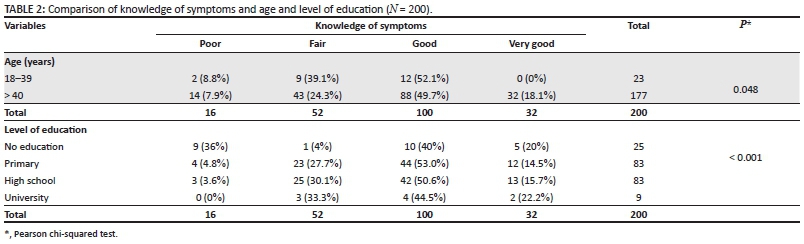
With regard to knowledge of the symptoms of hypoglycaemia, 66% (100/200, 50% good; 32/200, 16% very good) of patients had good or very good knowledge, whilst only 8% of patients were unable to identify any symptoms of hypoglycaemia. However, less than a quarter of patients (48/200, 24%) were aware of what to do when experiencing symptoms of hypoglycaemia.
Only 26 patients (13%) had no education; most participants had completed primary school and eight (4%) had university-level education (see Table 2).
There was no statistical association between being on insulin and knowledge of hypoglycaemia or how to manage hypoglycaemia. There was also no statistical association between good and excellent knowledge of the symptoms of hypoglycaemia and the ability to manage hypoglycaemia.
Forty-eight patients (24%) had a glucometer at home, whilst 68 (34%) were able to check their sugar levels at home or at a nearby pharmacy. Eighty-six patients (43%) indicated that they adjusted their medication at home.
Discussion
Two hundred adult diabetic patients participated in this study, the majority of whom (88.5%) were older than 40 years and had type 2 DM. This is in keeping with international literature, which suggests that approximately 90% of all diabetic patients fall into the type 2 DM category.11621616
The majority of patients (170; 85%) were on sulphonylureas or on insulin (Table 2) and therefore at risk of developing hypoglycaemia. In Britain, in 2005, it was estimated that the annual risk for hypoglycaemia associated with use of sulfonylureas was 1.8% per person per year. This risk is age dependent, with those older than 65 years having an annual risk of 2.0%, whilst those younger than this have a 1.4% risk of developing hypoglycaemia.6141513
While this study did not specifically ask patients whether or not they had experienced an episode of hypoglycaemia, evidence from international studies would suggest that at least one in four patients would have experienced an episode of hypoglycaemia each year.15
It was encouraging that 132 (66%) of 200 patients reported good to very good knowledge about the symptoms of hypoglycaemia, suggesting that the education they received on diabetes is effective in covering this aspect of diabetic care. This finding is similar to that from an online survey in San Diego (2011), wherein most type 2 DM patients were aware of the symptoms of hypoglycaemia.131617
However, it was of concern that 16 patients (8%) in this study were unable to list any symptoms of hypoglycaemia. This finding is however not completely unexpected, as other studies have shown that a significant number of patients on drugs which put them at risk of hypoglycaemia are unable to recognise symptoms suggestive of hypoglycaemia, which puts them at risk of severe neurological impairment if the unrecognised symptoms result in delay in the management of hypoglycaemia.17
In this study, there was a statistically significant association between level of education and knowledge of hypoglycaemia. Most patients who had good and fair knowledge had at least high school education. This is consistent with a study done in Saudi Arabia involving 1039 diabetic patients, which showed an association between levels of education and knowledge of hypoglycaemia.18
It was of concern that despite 184 (92%) of the patients having at least fair knowledge of hypoglycaemia, less than a quarter knew what actions to take, suggesting a need to improve this aspect of health education in diabetes clinics. This finding is worse than that of a study in Kaduna, Nigeria, where over 50% of the diabetic patients were aware of how to manage hypoglycaemia.1715,193
Sixty-eight (34%) of the patients reported their ability to self-monitor their glucose levels, even though 83 (43%) patients reported self-adjusting their medications at home. This finding is difficult to explain, as self-adjustment of medication requires a good understanding of the role that diet, physical activity and pharmacotherapy play in determining blood glucose levels. Without the ability to monitor the actual glucose level in the blood, it is impossible to effectively self-adjust medication. This worrying finding suggests that some patients are self-adjusting their medication at home based on how they feel, without being able to measure their blood sugar objectively. This may put them at risk of developing hypoglycaemia or hyperglycaemia, and suggests a need for better education about diabetes and adjusting their medication, and the need to supply home glucometers to diabetic patients so that they can self-monitor and safely self-adjust their medication as appropriate.
A third of the patients (34%) self-monitoring their blood sugar level (SMBG) is consistent with a study in Japan in 1997, which showed that only 35% of patients on insulin performed SMBG.1212,1919
Numerous trials have assessed the impact of SMBG on glycaemic control. Amongst patients with type 1 DM, SMBG has been associated with improved health outcomes,2072142212,19,22
As there is evidence to suggest that self-monitoring and self-adjustment of medication improves glycaemic control and helps in the prevention of hypoglycaemia in patients with type 1 DM3,2020,22
The low socio-economic status of most patients accessing government services as well as the many competing demands for government resources may account for the low number of patients with home glucometers who are thus able to self-monitor their blood glucose.
Limitations
This was a small observational study in one public hospital setting, the questionnaire was self-administered by the majority of patients and there was no opportunity to confirm the responses. For these reasons, the findings might not be applicable in other settings.
Conclusion and recommendations
Knowledge about the symptoms of hypoglycaemia was fair to good in the majority of patients who participated in this study. However, practical knowledge of what needs to be done in the event of hypoglycaemia seems to be lacking.
There is a need to improve the education of diabetic patients on stepwise measures to be taken in order to avoid life-threatening complications associated with hypoglycaemia. In addition, there is a need for greater education about who should adjust their medication and what parameters should be taken into consideration when self-adjusting medication. Consideration should also be given to greater provision of home use glucometers as part of the patient care plan in public hospital diabetes clinics.
Competing interests
The authors declare that they have no financial or personal relationship(s) that may have inappropriately influenced them in writing this article.
Authors' contributions
A.E. was the project leader and was responsible for writing the protocol, collecting and analysing the data and writing the article. K.N. was responsible for providing input and guidance in the writing of the protocol, collection of the data and in the writing of the article. A.R. was responsible for reviewing the data, focusing the analysis, reviewing and helping with the writing of the article.
Acknowledgements
References
- 1. International Diabetes Federation. IDF Diabetes Atlas, 6th ed. Brussels, Belgium: International Diabetes Federation; 2013 [cited 2015 Jun 5].
- Available from: http://www.idf.org/diabetesatlas
- 3. Amod A, Ascott Evans BH, Berg GI, et al. The 2012 SEMDSA guideline for the management of type 2 diabetes. JEMDSA 2012 [cited 2012 Oct 26];
-
17(2)(Suppl 1):S1-S95. Available from:http://www.semdsa.org.za/images/2012_SEMDSA_Guideline_July_FINAL.pdf downloaded 26/10/2012
» http://dx.doi.org/10.1016/j.jdiacomp.2005.08.010 -
4. Harashima S, Fukushima T, Sasaki M, et al. SMBG improves glycaemic control in (SMBG-OHA study). Diabetes Metab Res Rev 2013, 29(1):77-84. http://dx.doi.org/10.1002/dmrr.2363
» http://dx.doi.org/10.1002/dmrr.2363 - 5. Boughton B. Patients with diabetes lack knowledge about hypoglycemia.
- [cited 2012 Dec 20]. Available from: http://www.medscape.com/viewarticle/740881
- 7. Scottish Intercollegiate Guidelines Network. Management of diabetes. Diabetes UK 2010 [cited 2015 Jun 6].
-
Available from: www.joshd.net/article.asp?issn=2321-0656;year=2015
» http://dx.doi.org/10.1016/0168-8227(94)90260-7 - 8. Wafaaf T, Ridah H, Baker TY, Malath K, et al. Knowledge of diabetic patients about hypoglycaemia. Iraq Academic J [cited 2012 Dec 23].
- Available from: www.iasj.net/iasj?func=fulltext.ad 35225
-
[cited 2012 Dec 20]. Available from: http://www.ncbi.nlm.nih.gov/pubmed/12462815
» http://dx.doi.org/10.4103/2230-8210.152779 - 10. Clayton D, Woo V, Yale J-F. Clinical practice guideline on hypoglycaemia.
- [cited 2015 Jun 3]. Available from: http://guidelines.diabetes.ca/chapter14 full text
- 11. Nicola N, Zammitt NN, Frier BM. Hypoglycaemia in type 2 diabetes. Diabetes Care 2005 [cited 2012 Oct 28].
-
Available from: http://care.diabetesjournals.org/content/28/12/2948.full.pdf
» http://dx.doi.org/10.1136/bmj.319.7202.83 - 13. Healio, Endocrine Today. Survey: People with diabetes uncertain about management of hypoglycemia.
- [cited 2015 Jun 3]. Available from:http://www.healio.com/endocrinology/diabetes/news/print/endocrine
-
15. Gulabani M, Rajesh IJ. Knowledge of diabetes, its treatment and complications amongst diabetic patients in a tertiary care hospital. Indian J Comm Med 2008;33(3):204-206.http://dx.doi.org/10.4103/0970-0218.42068
» http://dx.doi.org/10.4103/0970-0218.42068 - 17. Hamoudi NM, Al Ayoubi ID, Vanama J, Yahaya H, Usman UF. Assessment of knowledge and awareness of diabetic and non-diabetic population towards diabetes mellitus in Kaduna, Nigeria. J Adv Sci Res 2012;3(3):46-50.
- 19. Patient: Trusted medical information and support. Self-monitoring in diabetes mellitus.
- [cited 2015 Jun 9]. Available from: http://patient.info/doctor/self-monitoring-in-diabetes-mellitus
-
21. Franciosi M, Pellegrini F, De Bernardis G, Belfiglio M, Nicolucci A. The impact of blood glucose self-monitoring on metabolic control and quality of life in type 2 diabetic patients. Diabetes Care 2001;24:1870-1877. http://dx.doi.org/10.2337/diacare.24.11.1870
» http://dx.doi.org/10.2337/diacare.24.11.1870 -
22. Harris MI. Frequency of blood glucose monitoring in relation to glycemic control in patients with type 2 diabetes. Diabetes Care 2001;24:979-982. http://dx.doi.org/10.2337/diacare.24.6.979
» http://dx.doi.org/10.2337/diacare.24.6.979

Accepted: 02 Oct. 2015
Published: 17 June 2016