Awareness of prevention of teenage pregnancy amongst secondary school learners in Makhado municipality
Abstract
BACKGROUND: Sexuality plays a very significant role in the lives of both boys and girls. It is, therefore, considered important for schools to recognise and accept sexuality as part of the development process of the child. Professor Kader Asmal (previous South African Minister of Education) suggested that the earlier the school begins to teach learners about sexuality, the better because they can be easily misled by their peers if proper guidance regarding their sexuality is not given. AIM: The current study was conducted to assess the awareness of teenagers on the prevention of teenage pregnancy (TP) in six secondary school learners situated in the Soutpansberg-West circuit, Makhado Municipality in Limpopo province. SETTING: The study was conducted at six secondary schools situated in the Soutpansberg-West circuit, Makhado Municipality in Limpopo province in 2014. METHODOLOGY: A quantitative descriptive survey study was conducted where data were collected, using self-administered questionnaires, from 381 systematically sampled participants from six secondary schools situated in the Soutpansberg-West circuit, Makhado Municipality in Limpopo province. Data were analysed descriptively using the Statistical Package for the Social Sciences (SPSS) software, version 22.0. Necessary approval procedures and ethical clearance were obtained prior to data collection. RESULTS: Ninety-four percent of participants agreed that TP can be prevented through abstaining from sex, whilst 65% of participants agreed that TP could be prevented by using contraceptives such as pills and injections. Eighty-three percent of participants agreed that TP could be prevented through the use of condoms. Seventy-four percent participants disagreed that bathing after sex prevents teenage pregnancies. Furthermore, 28% participants agreed that TP can be prevented by oral sex. CONCLUSION: The conclusion drawn was that learners are aware of the measures for preventing TP.
Effectiveness; Sexuality Education; Teenage Pregnancy; Teenagers
Introduction
Children are sexualised human beings, and it is important for them to understand the sexual nature of their bodies.11
The aims and objectives of sexuality education prescribed by the Department of Education113
Teenage pregnancies have doubled in the past years, despite a decade of spending on sexuality education.3,44565
According to Panday et al., the South African National Youth Risk Behaviour conducted by the Medical Research Council in 2002 examined the prevalence of behaviour that places secondary school pupils at risk for diseases and ill health and discovered that a substantial number of young people are engaging in unprotected sex.75
The purpose of the study is to assess the awareness of learners about the prevention of TP through a sexuality education programme. The study intended to find out whether teenagers are aware of the different pregnancy preventative measures.
Research methods and design
Research design
A quantitative cross-sectional descriptive survey study was conducted to evaluate and describe the effectiveness of sexuality education (SE) for the reduction of teenage pregnancies (TP). The researcher conducted a cross-sectional descriptive design to provide an explicit description and to address the awareness of TP prevention by learners.8
Study population
The total population for this study were Grade 11 and 12 secondary school learners at Sinthumule/Kutama area. Grade 11 and 12 learners were used as they had been taught SE since Grade 9, and they possess the characteristics required for the study to be productive.99,10
Sampling and sample size
Sampling refers to the selection procedure of people who possess the characteristics of the desired population for the study.10
Schools selection procedure
The researcher obtained the list of secondary schools from the Soutpansberg-West circuit offices. The area consists of 12 secondary schools, and the total population of Grade 11 and 12 learners was 678. Twelve pieces of paper with school names were placed in a bowl, and the bowl was shaken thoroughly before six secondary schools were picked from the bowl.
Sample size calculation
Six randomly sampled secondary schools had a population of 451 in total. To determine the estimated sample size per school, the following Slovin statistical formula was used:

Where:

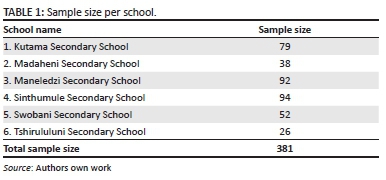
Researchers expected a response rate of 95% with only a 5% (e = 0.05) anticipated error margin. Slovin's statistical formula was used to calculate the sample size in each school. From the sampled schools, the following sample sizes were found per school using Slovin's statistical formula, as outlined on the table below. The sample sizes were calculated based on the researcher's expected response rate of 95%, and the expected error margin of 5% (e = 0.05). Table 1 below indicates the sample size per school from six randomly selected secondary schools in the Soutpansberg-West circuit.
Learners' sampling procedure
After determining the sample size per school, learners were randomly sampled in the same manner as that for the schools. The process involved writing names of Grade 11 and 12 learners in each school and then placing them in a bowl. After shaking the bowl, participants were selected until the desired sample size was reached for each school.
Data collection
A self-administered questionnaire was constructed following a literature review, and the content of Life Orientation Grade 10, 11 and 12 text books was used to collect data for this study.910
Participants completed questionnaires anonymously and voluntarily after being reassured that the data collected would not be used to the detriment of all involved in the research project. Consent was sought from the parents of the learners sampled for the study in order to abide by the ethical code of conduct. Participants were given questionnaires to complete in the classroom at the same time in each school. The time allocated for their completion was 45 minutes. To avoid disturbance to normal teaching periods, data were collected in the afternoon during self-study time. Data collection was conducted in one secondary school per day in a two-week period. Three hundred and eighty-one questionnaires were administered and all 381 questionnaires were returned. The questionnaires were self-administered with the help of three trained research assistants. According to Maree, the advantage of this was that the researcher was able to gather information from all participants at the same time and to assist with issues in the questionnaires which were not clear to the participants.10
Data analysis
Data analysis commenced after all questionnaires were collected from the six secondary schools. However, data was captured each day after data collection, i.e. data was captured in Microsoft Excel software the same day it was collected. After all the questionnaires were captured, the Excel data sheet was then imported to SPSS for analysis.
Questionnaires were analysed with the help of a statistician, using the SPSS V22.0 software program. The SPSS is ideal because it makes analysis quicker as the software recognises the location of the cases and variables after the data has been captured.111212
Ethical considerations
The research was conducted after approval was granted by the University of Venda, School of Health Sciences Committee as well as the University's Higher Degrees and Ethics Committee (Project number: SHS/14/PSYCH/01/1508). Permission to gain entry to the research population was obtained from the Department of Education, Limpopo Province and the Soutpansberg-West circuit as well as the principals for the research to be conducted in schools.
The researcher ensured that participants knew about the purpose of the study by describing the aims of the research and procedures to be used.9138,9,109
Results
Demographic characteristics of the participation
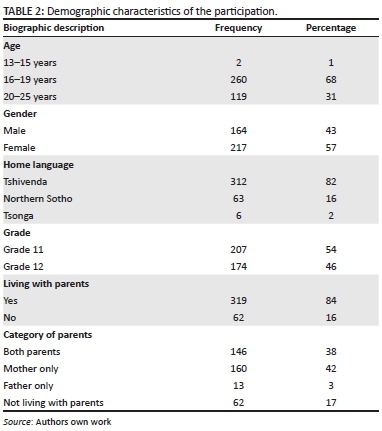
The ages were distributed between 13 and 25 years. Participants between 13 and 15 years were 1% and those between 16 and 19 years were 68%. Thirty-one percent participants were between 20 and 25 years. Forty-three percent of participants were male, whilst 57% were female. Eighty-two percent of participants were Tshivenda speakers, 16% were Northern Sotho speakers, whilst only 2% of learners were Tsonga- speaking. From the study, 54% of participants were doing Grade 11, whilst 46% of participants were doing Grade 12.
Eighty-four percent of the participants were living with their parents, whilst 16% were not. Table 2 indicates that participants living with their mothers comprised 42%, whilst those living with their fathers were only 3%. The numbers of those living with both parents were slightly below those living with their mothers at only 38%, and 16% of the participants were not living with their biological parents.
Findings
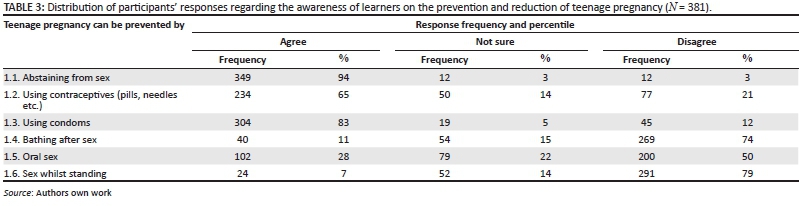
The findings by this study show that learners are aware of the preventive measures of TP. Table 3 below shows that, out of 381 participants, 349 (94%) participants agreed that TP can be prevented through abstaining from sex. The results further revealed that 234 (65%) participants agreed that TP could be prevented by using contraceptives such as pills and needles.
Furthermore, 304 (83%) participants agreed that TP could be prevented through the use of condoms. The results further show that 40 (11%) participants agreed that TP could be prevented by bathing after sex, whilst 269 (74%) participants disagreed that bathing after sex prevents TP. Furthermore, 102 (28%) participants agreed that TP can be prevented by oral sex. One hundred and eighty-four (50%) of participants disagreed that oral sex could prevent TP, whilst 79 (22%) participants were unsure.
Even though the findings show that the majority of participants were aware that oral sex cannot prevent TP, it is evident that teenagers still needed more information about the prevention of pregnancy. And, lastly, it is shown that 24 (7%) participants agreed with the statement that TP could result by having sex whilst standing. Fifty-two (14%) participants were unsure whether having sex when standing prevented TP, whilst 291 (79%) participants disagreed with the statement that having sex when standing could prevent pregnancy.
Discussion of findings
The results revealed that teenagers were aware that TP could be prevented by properly using contraceptives, for example, pills, needles and condoms. This correlates with Myeza,14151
The study determined that teenagers know that the proper use of condoms can prevent unexpected pregnancies. As indicated above, the study by Myeza14
The study further revealed that teenagers were aware that bathing after sexual intercourse does not prevent pregnancy. However, there were some who were not sure if bathing after intercourse prevented pregnancy or not. The findings above indicate a need for on-going preventive programmes, as some of the participants were either not sure, or agreed, that bathing after sex prevented pregnancy. These findings are supported by Mchunu16
The results revealed that the majority of teenagers disagreed that oral sex prevented pregnancy. From the findings it is evident that almost half of the participants (50%) were not knowledgeable about whether oral sex is a preventive measure or not. According to their Grade 11 text book, oral sex has a zero chance of causing pregnancy.1556515
Recommendations
The following recommendations were made:
Teachers need continuous trained on conducting SE and on encouraging learners to open up in discussing sexual-related issues.
The Department of Education, in conjunction with other government stakeholders such as the Department of Health, needs to establish an awareness campaign with regard to the prevention of TP in rural areas such as Sinthumule/Kutama.
SE should be integrated with other subjects rather than it only being part of the Life Orientation subject.
Conclusion
The findings of the study indicate a beneficial role that the SE programme has played in alerting teenagers of the preventive measures for TP since its implementation in 1999. It is evident that, although there are some learners lacking knowledge in some of the sexual-related issues, to date, the majority are acquiring proper knowledge.
The conclusion drawn was that learners are aware of the preventive measures for TP.
Competing interests
The authors declare that they have no financial or personal relationships with the participants which may have inappropriately influenced them in conducting the study and writing this article.
Authors' contributions
G.M.M. (University of Venda) was the project leader, M.R.M. (University of Venda) and J.F.T. (University of Venda) were responsible for supervision. M.R.M. was the principal supervisor responsible for the guidance in proposal writing and final report writing. G.M.M. was responsible for data collection, data analysis and final article writing.
Acknowledgements
The authors are grateful to the Department of Education, Vhembe District for granting permission to conduct the study in the sampled secondary schools around Sinthumule/Kutama area, as well as all research assistants for their cooperation and assistance in data collection and data capturing. Appreciation is extended to the National Research Foundation (NRF) and the University of Venda (RPC) fund for providing financial support. Appreciation is further extended to the participants' parents for giving consent for their children to participate in the study. The authors are also grateful to all participants for taking part in the study.
References
-
1. South Africa. Department of Education. Protecting the right to innocence: Importance of sexuality education: Report of the protecting the right to innocence conference on sexuality education [homepage on the Internet]. c2001 [cited 2012 Oct 28]. Available from: http://www.dhet.gov.za/Reports%20Doc%20Library/Protecting%20the%20right%20to %20innocence %20The%20importance%20of%20Sexuality%20Education.pdf.
» http://www.dhet.gov.za/Reports%20Doc%20Library/Protecting%20the%20right%20to %20innocence %20The%20importance%20of%20Sexuality%20Education.pdf - 2. South Africa. Department of Education. National Educational Act, 1996 [revised 1999]. Pretoria: Department of Education; 1999.
-
3. Naidoo M. An evaluation of sexuality education programme implemented in South African schools [homepage on the Internet; unpublished PhD thesis]. South Africa: University of Zululand; 2006. [cited 2012 Oct 23]. Available from: http://uzspace.uzulu.ac.za/bitstream/handle/10530/246/An+evaluation+of+th+sexuality +education +programme+being+implemented+in+South+Africans+schools+-+M.pdf?sequence=1.
» http://uzspace.uzulu.ac.za/bitstream/handle/10530/246/An+evaluation+of+th+sexuality +education +programme+being+implemented+in+South+Africans+schools+-+M.pdf?sequence=1 -
4. Van Eijk RT. Factors contributing to teenage pregnancies in Rarotonga [homepage on the Internet]. Avarua: United Nations Population Fund (UNFPA); 2007. [cited 2012 Sep 04]. Available from: http://countryoffice.unfpa.org/pacific/drive/TeenPregnancies_Cooks.pdf.
» http://countryoffice.unfpa.org/pacific/drive/TeenPregnancies_Cooks.pdf -
5. Panday S, Makiwane M, Ronchad C, Letsoalo T. Teenage pregnancy in South Africa: With a specific focus on school-going learners. Commissioned by UNICEF [homepage on the Internet]. 2009. [cited 2012 Aug 17]. Available from: http://www.education.gov.za/LinkClick.aspx?fileticket=uIqj%2BsyyccM%3D&
» http://www.education.gov.za/LinkClick.aspx?fileticket=uIqj%2BsyyccM%3D& -
6. Richter MS, Mlambo GT. Perceptions of rural teenagers on teenage pregnancy. Health SA Gesondheid [homepage on the Internet]. 2005;10(2):61-69. [cited 2014 March 20]. Available from: http://www.ajol.info/index.php/hsa/article/view/10311.
» http://www.ajol.info/index.php/hsa/article/view/10311 -
7. Love Life Report: A National survey of South African teenagers [homepage on the Internet]. c2008 [cited 2012 Oct 28]. Available from: http://www.lovelife.org.za/corporate/files/4713/3848/3460/South_African_National_HIV_ prevalence_incidence_behaviour_and_communication_survey_2008_A_turning__ tide_among_teenagers.pdf.
» http://www.lovelife.org.za/corporate/files/4713/3848/3460/South_African_National_HIV_ prevalence_incidence_behaviour_and_communication_survey_2008_A_turning__ tide_among_teenagers.pdf - 8. Burns N, Grove SK. Understanding nursing research. 3rd ed. Philadelphia, PA: Saunders; 2005.
- 9. De Vos AS, Strydom H, Fouche CB, Delport CSL. A research at grassroots: For the social sciences and human service professionals. 4th ed. Pretoria: Van Schaik; 2011.
-
11. David H. Benefits of SPSS [homepage on the Internet]. c2012 [cited 2013 Feb 4]. Available from: http://benefitof.net/benefits-of-spss.
» http://benefitof.net/benefits-of-spss -
12. Jaggi S, Batra PK. SPSS: An overview. Design of experiment application [homepage on the Internet]. c2013 [cited 2013 Feb 04]. Available from: http://www.iasri.res.in/iasriwebsite/DESIGNOFEXPAPPLICATION/Electronic-Book/Module%201/6SPSS-overview.pdf.
» http://www.iasri.res.in/iasriwebsite/DESIGNOFEXPAPPLICATION/Electronic-Book/Module%201/6SPSS-overview.pdf - 13. Babbie E, Mouton J. The practice of social research. Cape Town: Oxford University Press; 2009.
-
14. Myeza NP. Attitudes of high school learners towards sexuality education in Zululand [homepage on the Internet; unpublished dissertation]. South Africa: University of Zululand; 2008. [cited 2014 July 13]. Available from: http://uzspace.uzulu.ac.za/bitstream/handle/10530/125/Attitudes+of+high+school+learners +towards+Sexuality+Education+-+NP+Myeza.pdf?sequence=1.
» http://uzspace.uzulu.ac.za/bitstream/handle/10530/125/Attitudes+of+high+school+learners +towards+Sexuality+Education+-+NP+Myeza.pdf?sequence=1 - 15. Gumede H, Martinuzzi PT, Moore LM, et al. Focus on life orientation: Grade 11. Cape Town: Maskew Miller Longman; 2006.
-
16. Mchunu NJ. Teachers' perceptions of the teaching of sexuality education in secondary schools in Pinetown district [homepage on the Internet; unpublished dissertation]. University of Zululand: South Africa; 2007. [cited 2014 Jul 13]. Available from: http://researchspace.ukzn.ac.za/xmlui/bitstream/handle/10413/1351/Mchunu_ NJ_2007.pdf?sequence=1.
» http://researchspace.ukzn.ac.za/xmlui/bitstream/handle/10413/1351/Mchunu_ NJ_2007.pdf?sequence=1
Accepted: 30 Nov. 2015
Published: 01 Apr. 2016