Trade Facilitation: An Analysis of the Divergences in the Legal Texts of the World Trade Organisation and the African Continental Free Trade Area
Abstract
There has been debate on whether the legal texts on trade facilitation under the African Continental Free Trade Area (AfCFTA) are a duplicate of the World Trade Organisation's (WTO) Trade Facilitation Agreement. This study compares the two sets of legal texts and finds that they are premised on different backgrounds. The WTO has a broader mandate on global trade and aims to ensure that trade among its members is conducted in conformity with agreed-upon rules. On the other hand, the AfCFTA has a trade agreement pursuant to the political vision of the African Union (AU) within the confines of article XXIV of GATT 1994. This article focuses on the divergences in the two sets of legal texts. While acknowledging that there are some similarities in themes and measures on trade facilitation, the study finds that the legal texts themselves are not duplicates and, in a number of cases, have different implications. This article, therefore, discusses some of the major differences between the legal texts on trade facilitation of the WTO and the AfCFTA.
AfCFTA; Divergences; Free Trade Area; Legal texts; Trade facilitation; Trade Facilitation Agreement; WTO
1 INTRODUCTION
On 21 March 2018, the African Union (AU) made history when the Assembly of Heads of State and Governments, during its 10th Extraordinary Summit held in Kigali, Rwanda, adopted the Agreement Establishing the African Continental Free Trade Area (AfCFTA Agreement).1 A total of 44 member states of the AU signed the AfCFTA Agreement on the day of adoption.2 The negotiations and signing of the AfCFTA Agreement within two years of the launch of negotiations was an unprecedented achievement.3 As of 1 January 2024, a total of 54 member states of the AU had signed the AfCFTA Agreement, and of these, 47 had ratified it.4 The AfCFTA narrative demonstrates the political commitment and unity of Africa's leadership to implement the AfCFTA Agreement.
The AfCFTA Agreement created a mega free trade area (FTA) for the continent. In line with the General Agreement on Tariffs and Trade (GATT) XXIV, one of the key objectives in creating an FTA was to facilitate trade among AU members. Consequently, the legal instruments of the AfCFTA on trade facilitation exist side by side with the WTO Trade Facilitation Agreement (TFA). Some have claimed (informed by reasonable suppositions rather than research) that the legal texts on trade facilitation contained in the AfCFTA Agreement are a duplicate of those of the TFA.5 The objective of this article is to investigate the divergences that exist and demonstrate that the legal texts on trade facilitation of the AfCFTA are not duplicates of the TFA. The article commences by examining the definitions of trade facilitation in the context of the WTO and the AfCFTA respectively, and then explains the study design, followed by a discussion of the differences between the TFA and the AfCFTA, and a conclusion.
2 PERSPECTIVES ON TRADE FACILITATION
2 1 WTO definition
GATT 1947 established some fundamental principles to facilitate world trade, laying the groundwork for GATT 1994 and the TFA while serving as a reference tool for Regional Trade Agreements (RTAs) around the world. The WTO ensures the smooth flow of international trade, and its members account for 98 per cent of world trade, which figure is similar to the volume of global trade that is facilitated under the World Customs Organisation (WCO).6 The WTO, through its influence on world trade, has been responsible for removing trade barriers and creating today's global marketplace.7 Although articles V, VIII and X of GATT 1994 (hereafter simply referred to as articles V, VIII, and X) are the legal cornerstones of trade facilitation, they do not define the important term "trade facilitation". The closest reference to the term is found in article XXIV, which states that the purpose of forming FTAs and customs unions is to "facilitate trade".8 The TFA does not define "trade facilitation" either, but it identifies about 39 activities that members must undertake in order to facilitate trade.9 The definition provided by the WTO is found on its website, which states that trade facilitation is "the simplification, modernization, and harmonization of export and import processes".10 Although the definition is official and is universally used in the literature, it is not backed by any legal instrument of the WTO.11 Any references to the WTO's definition have therefore always been drawn from either the website or literature issued by the WTO and not from any legal instrument. The absence of a legal definition is a serious gap in the WTO jurisprudence, considering the status and authority of the organisation in global trade. This disparity found under the WTO is in contrast to the legal instruments of RTAs or FTAs, which, though they are bodies subordinate to the WTO, have their own legal definitions provided for either in their treaties or in some of their subordinate legal instruments.12
The WTO's definition, as given in its literature, is premised on reducing border delays and the removal of "red tape" at entry points.13 The WTO is emphatic, in its own literature, about linking trade facilitation to border procedures.14 The definition is based on three separate but interdependent processes dealing with exports and imports, namely simplification, modernisation, and harmonisation. Simplification entails the elimination of bureaucracy and making processes easier and more understandable, whereas modernisation entails using the most up-to-date techniques to deal with processes. Harmonising involves replacing existing laws and procedures or introducing common rules aligned to international standards.15
2
2 AfCFTA definitionThe Preambles of the AfCFTA Agreement and its Protocol on Trade in Goods (Protocol on TiG) set the tone and commitment to facilitating trade in the AfCFTA.16 The Agreement, however, becomes more explicit when its specific objectives highlight the need for cooperation and implementation of trade-facilitation measures.17 The objectives include the high ideals of creating a liberalised market and the need for efficiency when dealing with cross-border trade. The Protocol on TiG stipulates the need for the AfCFTA parties to implement measures to cooperate on matters involving customs,18trade facilitation and transit.19 The crux is in Annex 4 of the Protocol on TiG, which provides the following definition of trade facilitation:
"the simplification and harmonisation of international trade procedures, including activities, practices, and formalities involved in collecting, presenting, communicating, and processing data for the movement of goods in international trade."20
Though similar in context to the definition of the WTO, it is distinct and not an exact duplicate. This definition is also derived from the objectives of articles V, VIII and X.
3 STUDY DESIGN
3 1 Objectives of the study
Each of the institutions - that is, the WTO and the AfCFTA - has its own legal texts on trade facilitation. The two sets of legal texts used for comparison are the TFA in respect of the WTO and Annex 4 from the Protocol on TiG of the AfCFTA Agreement. Although trade facilitation issues are found in various legal instruments of the WTO and the AfCFTA, the selected legal texts represent a comprehensive compendium of measures, and they fulfilled the objectives of the study.
The main objective of this article is to identify the extent of the differences between the two sets of legal texts on trade facilitation, and it is essentially a comparative analysis of the legal texts employed by the WTO and the AfCFTA respectively for the purpose of facilitating trade. In conducting the study, the author analyses the legal texts to understand their intentions, interpretations and relevance in both continental and global trade.
3 2 Research methodology
This study consists of a desktop review of existing literature related to the legal texts on trade facilitation as developed by the WTO and AfCFTA regimes. The primary sources are relevant treaties and agreements, protocols and annexes, case law and records of negotiations, legal writings, law reports, and other publications on trade. The study uses secondary sources that include published and unpublished books and other related papers. The research is multidisciplinary and is therefore influenced by various subject areas such as Economics, Politics, Diplomacy and International Relations. However, it remains primarily legal research in the area of Trade Law.
3 3 Delimitations
The focus of this study is on trade facilitation insofar as it relates to trade in goods. It does not include trade in other areas, such as in services. The study limits itself to trade-facilitation matters involving the soft aspects of trade procedures, based on the TFA of the WTO and on Annex 4 of the Protocol on TiG (hereafter Annex 4). References are made to articles V, VIII and X because the TFA, although a separate agreement, was meant to clarify and improve the provisions in GATT 1994.21 While acknowledging that Annexes 3 and 8 of the Protocol on TiG, dealing with customs cooperation and transit respectively, are key pillars of trade facilitation, these areas are not part of this article.
3 4 Comparing similar functionalities
From the two definitions examined above, the trade-facilitation measures of the WTO and the AfCFTA are both derived from GATT 1994 and have the same functionality of supporting trade and contributing towards the fast movement of goods across borders. Both the WTO and AfCFTA consider trade facilitation as a process of streamlining and continuously improving trade procedures. This common base for the two regimes provides an ideal context for a comparative investigation. The comparative approach demonstrates any apparent similarities and differences. Incomparables cannot be properly compared, and in law, the only entities that are comparable are those that perform the same function.22 The analysis illustrates whether the legal texts of the AfCFTA are compatible with those of the WTO and if they attain the intended results. Since the WTO is a multilateral organisation with a mandate to operate a global system of global rules between nations,23 the comparison uses the legal texts of the WTO as the point of reference. RTAs such as the AfCFTA are created pursuant to article XXIV and are, therefore, subordinate to the WTO.
While focusing on the divergences, the study draws lessons from Kamba, who identified three constituent phases in a comparative study. He argued that these phases did not have to occur in any specific order but could be intertwined throughout the same discussion.24 The phases involve a description of the concepts, identification of similarities and differences, and an explanation to account for divergences and resemblances.25 The descriptive phase entails a discussion of the isolated subject matter that is compared or analysed.26 It involves an interpretation or explanation of the subject theme before proceeding into the analysis. The identification phase, in this case, analyses the two texts from the WTO and the AfCFTA on a given subject or theme in order to identify the differences as per the focus of this article.27 Based on the identified thematic and textual analysis, the final phase explains the divergences while drawing conclusions on each of the themes discussed.28
The analysis is therefore based on thematic areas, which are all drawn from the legal texts of the WTO and AfCFTA. The analysis is carried out based on the content of thematic texts or the overall message conveyed by the relevant articles. The analysis focuses on both textual language and the themes in certain cases.
4 RESULTS AND FINDINGS
In conducting the comparative analysis, the study not only identifies the differences but also critically examines their implications. This article therefore shows that the legal texts of the WTO and the AfCFTA on trade facilitation are not duplicates of each other, although the themes or measures may be the same. The highlighted examples come from the following areas: publication and availability of information; opportunity to comment on information; advance rulings; appeal procedures; general measures to improve on impartiality; movement of goods under customs control; formalities connected with cross-border movement of goods; and use of international standards. Each of the themes discussed has its own conclusion.
4 1 Publication and availability of information (article 1 of the TFA; articles 4 and 5 of Annex 4)
4 1 1 Description
International trade can take place more effectively when information is available and shared. The seller of goods must be aware of the market available, and the buyer must be aware of potential suppliers. As goods cross borders, both the seller and the buyer must be aware of the regulatory requirements of the exporting and importing countries, as well as of the territories through which the goods will transit. The publication of trade information is a fair practice and was also provided for in GATT 1947, when the first global agreement to liberalise trade was signed. The importance of the publication of information was highlighted in a GATT 1947 case, European Economic Community - Restrictions on Imports of Dessert Apples - Complaint by Chile (EEC - Dessert Apples), in which Chile, among other issues, complained about the EEC's backdating of import quotas.29 In the matter, the panel ruled that the operation of a backdated import restriction was incompatible with the requirement for information publication as outlined in article X.30
Advances in technology have resulted in modern methods of disseminating information. Furthermore, the number of RTAs has increased substantially. These formations all call for the availability of information in order to facilitate regional and global trade. The information required includes regulatory requirements, fees and charges levied, duties and taxes payable upon either exportation or importation, and documentation involved. Any trade regime committed to creating a trade-friendly environment would make relevant information publicly available to importers, exporters, manufacturers and other stakeholders.
4 1 2 Comparison
Article 1 of the TFA addresses these issues under the headings "Publication, Information available through the Internet, Enquiry points, and Notification".31Annex 4 splits the broad subject matter into various units - namely, publication, availability of information through the Internet, and enquiry points. The major differences are in the areas of publication, availability of information through the Internet, and enquiry points.
(i) Publication
Both the TFA and the AfCFTA Agreement require non-discriminatory publication of certain identified areas of information, such as applied rates of duty, rules of origin (ROO), valuation rules and appeals for review.32However, Annex 4 identifies additional types of information that are not specified in the TFA but must be published. These pertain to the data required for completion of mandatory forms used in the movement of goods;33 laws, policies and processes relating to the movement of goods;34and import and export guidelines.35
By the use of the word "shall" (being an imperative command), the TFA makes the publication of information mandatory.36 Although Annex 4 aims for the same best endeavour as the TFA, it uses the phrase: "shall, to the extent possible".37 This distinction is significant for AfCFTA because the availability of information facilitates easy access to trade. The fact that the publication of information is not a strict requirement for AfCFTA could have a negative impact on continental trade. In effect, this means that AfCFTA countries that are not WTO members are under no obligation to share trade information with other AfCFTA members because the continental trade regime is not binding.
(ii) Information available through the Internet
The TFA makes provision for information to be published on the Internet.38Under Annex 4, the use of the Internet is optional, and State Parties39 can use any other means to publish.40
(iii) Enquiry points
Both texts recognise the need for at least one enquiry point to handle queries from traders and stakeholders, including other governments.41 The TFA makes it a best endeavour through the use of the phrase "Each Member shall, within its available resources ...".42 In contrast, Annex 4 makes it mandatory when it states: "Each State Party shall establish and maintain one or more enquiry points... ."43The TFA, being a WTO instrument, already has contact points in place, usually through ambassadors and government departments responsible for trade. The WTO, therefore, experiences fewer challenges when communicating with its members. By making enquiry points mandatory, the AfCFTA demonstrates a commitment to ensuring that information will be easily available when required. The AfCFTA text proceeds further to highlight that there can be one or more enquiry points. Practically, AfCFTA also falls under the government agency responsible for foreign trade, but this leeway gives states parties the option of additional enquiry points. As an example, a state party can have a contact point to deal with trade-policy issues and then proceed further to have a customs contact point to deal with enquiries related to import and export processes.
In addition, the TFA encourages WTO members not to raise fees for answering enquiries and issuing forms, and if any amount is to be paid, it must then be limited to the service fees.44 The principle applied in respect of fees for enquiry points applies in respect of other service fees covered under the TFA.45 The AfCFTA Agreement does not cover any issues in respect of service fees for enquiry points. This could have a negative implication for trade in the AfCFTA, in that, without appropriate regulations, service providers may charge exorbitant fees.
4 1 3 Conclusion on publication and availability of information
Although there are some similarities, there are also significant differences in the requirements for publication of information for WTO members and under AfCFTA respectively. The AfCFTA Agreement requires more details to be published with respect to the completion of forms. It recognises that some of its members may face constraints when it comes to publishing information and encourages the use of any other means to disseminate information.46The AfCFTA text, therefore, considers Africa's situation in respect of the availability of resources and the use of information and communication technology. The TFA, on the other hand, makes information dissemination on the Internet mandatory. The similarity between the TFA and the International Convention on the Simplification and Harmonisation of Customs Procedures (Revised Kyoto Convention or RKC) regarding the availability of information is also an indication that the provisions in the TFA were borrowed from the RKC.47 The RKC, however, focuses on customs, whereas both the TFA and the AfCFTA Agreement extend beyond customs and include other governmental agencies. There is also a fundamental difference regarding enquiry points.
4 2 Opportunity to comment on information (article 2 of the TFA; no equivalent provision in the AfCFTA Agreement)
4 2 1 Description
This measure is based on the precept that before any country implements new legislation or policy changes, the affected stakeholders must be consulted. Trade laws, for example, have an impact on a wide range of stakeholders, including transporters, importers, exporters, manufacturers, and shipping agents. Allowing consultations and inputs before implementing any changes is a critical trade-facilitation measure. Certain changes may require stakeholders to seek out resources and make necessary preparations prior to implementation. To the extent possible, the introduction of new laws or policies in a country should involve consultation with stakeholders prior to publication. Modern governance increasingly recognises the importance of stakeholder consultation in policy setting and lawmaking.48 Several jurisdictions recognise the principle of consultation. In certain jurisdictions, the affected groups often participate freely in the lawmaking process.49 Draft laws in the form of bills are published in other jurisdictions to allow the public to engage with their legislators before the law is presented to Parliament for debate. Murphy contends that in the Anglo-American democracy, the public has a right of full access to the lawmaking process.50 Allowing consultations and input before implementing any changes is a critical trade-facilitation measure.
4 2 2 Comparison
The TFA obliges its members to consult stakeholders for comments on any proposed new laws related to the cross-border movement of goods.51 These provisions are in line with what is provided for in the RKC.52 The TFA, however, mentions that such a process must be conducted within the framework provided by national laws.53 The reference to domestic laws is important because it recognises that laws are promulgated in line with national constitutions or domestic laws. The provision in the TFA is an improvement and is a restructuring of article X, which was very general and lacked specificity. The AfCFTA text does not cover this measure, which would have been appropriate in Annex 4.
4 2 3 Conclusion on opportunity to comment on information
Practically, there is no basis for a comparison because these provisions are not covered under the AfCFTA Agreement. This, however, demonstrates that the legal texts of the AfCFTA do not necessarily duplicate WTO law.
The lack of provisions in the AfCFTA's legal texts on an opportunity to comment raises the question why AfCFTA did not incorporate the concept of consultations into its legal texts. Such provisions represent a modern and democratic principle that encourages consultations, at least "in a manner consistent with its domestic law and legal system".54 This is a progressive measure that allows stakeholders to provide inputs while adequately preparing themselves for the implementation of any pending changes. This comparison shows that stakeholders have better opportunities to make inputs into international trade law under the TFA framework than under the AfCFTA regime.
4 3 Advance rulings (article 3 of the TFA; article 6 of Annex 4)
4 3 1 Description
The movement of commercial goods across borders necessitates the submission of certain mandatory information and documents to facilitate clearance formalities and assessment of any customs duties that may be due.55 These particulars usually constitute the minimal requirements for a commercial consignment. Non-commercial goods or importations by travellers would not be subject to the above requirements. In relation to travellers' effects, most customs administrations follow the provisions of the RKC, which advocate for more convenient procedures for travellers.56 It is submitted that the most basic information required (which must be supported by documentary evidence where possible) comprises:
• Details or the nature of the goods: this is the description of the goods. Customs authorities are then able to determine if the goods are subject to any health or other regulatory controls. As an example, the importation of firearms and ammunition might require an import licence issued by the relevant security organs, whereas the importation of some agricultural products might require relevant permits.
• Tariff classification: this is the coding of goods using the WCO's Harmonised System (HS) nomenclature, which is a tool used to allocate the rates of duty. Before importing goods into a country, a trader should know the tariff classification so as to prepare to comply with requirements such as customs duties or any controls that may apply.
• Origin of the goods: ROO is used to determine if goods produced in an FTA comply with the stipulated origin criteria. This determines whether the goods qualify for preferential treatment. A trader wishing to export or import goods may wish to check if the origin criteria used would qualify the commodity as an originating product.
• Value: this is needed for reasons such as levying duties and trade statistics. There are various valuation methods in use, and the WTO has its own valuation system stipulated in GATT 1994.57
Based on the above, an importer or exporter might seek an advance ruling to confirm certain details so that border clearances are prepared correctly in advance. Advance rulings are a recent phenomenon in trade. They are used to enhance the transparency and predictability of border requirements.58Although not covered under articles V, VIII and X, the aspect of advance rulings is also part of the RKC, which states:
"The Customs shall issue binding rulings at the request of the interested person, provided that the Customs have all the information they deem necessary."59
With all the required information available, customs officials are able to give reasonable advance rulings to enable importers and exporters to process their documentation. In this respect, the facility to provide advance rulings is regarded as facilitating trade. The facility provides importers and exporters with binding information before goods arrive at the border.
4 3 2 Comparison
The TFA and the AfCFTA Agreement share the same definition of the concept on an advance ruling as a written commitment given to an applicant outlining the treatment to be accorded to goods at the border on issues such as tariff classification and origin.60 There are, however, inherent differences between the two texts. Two significant differences are the definition and the validity period of the advance ruling.
(i) Definition of applicant
Both texts define an applicant for an advance ruling. The TFA states:
"An applicant is an exporter, importer or any person with a justifiable cause or a representative thereof."61
The definition in the AfCFTA Agreement is more comprehensive. It states:
"'Applicant' in relation to advance rulings means the exporter, importer, producer or any person with justifiable cause or a representative thereof."62
Although on the surface, the definitions appear to be similar, there is a distinction. A producer or manufacturer of goods would not be an automatic applicant under the TFA but would need to demonstrate an interest in the case. Under the AfCFTA trade regime, the producer or manufacturer does not need to justify any interest in order to be deemed an applicant. The definition already recognises a producer as an applicant.
(ii) Validity period of an advance ruling
An advance ruling must be valid for a specific duration.63 The TFA provides:
"The advance ruling shall be valid for a reasonable period of time after its issuance unless the law, facts, or circumstances supporting that ruling have changed."64
The AfCFTA Agreement is different in that it states:
"The Advance Ruling shall be valid for at least six (6) months from the date of its issuance unless the law, facts, or circumstances supporting that ruling have changed."65
The TFA leaves it up to each member to decide what counts as a reasonable amount of time. There is no set standard for WTO members, and the validity period is open-ended. The AfCFTA Agreement requires a minimum validity period of six months, and any period longer than that is acceptable. As a result, the AfCFTA Agreement is more flexible since applicants are guaranteed that an advance ruling will be valid for a minimum of six months,66 whereas under the TFA, it may be less than six months, depending on what the customs administration considers to be a reasonable period.67 The maximum duration for either scenario is not specified.
These two approaches are not the same, and each has advantages and disadvantages. A minimum period of six months allows an importer or exporter sufficient time to plan for the importation or exportation of goods, whereas defining a statutory period as "reasonable" is open to debate and different interpretations. The legal texts of the WTO and the AfCFTA both prescribe that the procedures and requirements for applying for an advance ruling should be made public so that potential applicants can access such information.68 Both texts require that an effort be made to publish advance rulings while keeping commercially confidential information in mind.69 The AfCFTA Agreement proceeds to clarify that to uphold confidentiality, a state party may redact elements of an advance ruling in accordance with national law.70 The publication of information on advance rulings is useful to the general public and it makes the process transparent. The AfCFTA Agreement has an additional provision not found in the TFA in which an advance ruling may be denied on the basis that it does not relate to the intended use.71
4 3 3 Conclusion on advance rulings
Although the provisions on advance rulings are similar, differences between the application of measures on advance rulings in the legal texts of the TFA and the AfCFTA respectively have been noted. The AfCFTA Agreement includes some areas of detail that differentiate the two texts. In addition to the three cases discussed, each of the seven paragraphs in the TFA is different from the related eleven paragraphs in the AfCFTA Agreement.
4 4 Appeal procedures (article 4 of the TFA; no provisions in the AfCFTA Agreement)
4 4 1 Description and comparison
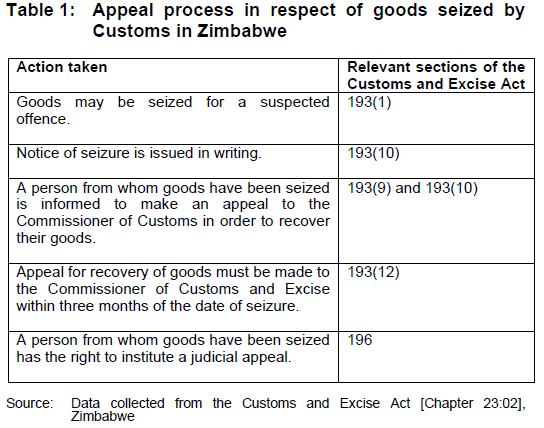
This measure is based on the fundamental principle that a person has the right of appeal to an independent body if it is considered that a regulatory authority, such as customs or any other government department, has not fairly resolved a case. The person filing an appeal must be given the reasons for the decision so that it helps the appellant to present a focused and appropriate appeal.72 This measure is similar to specific prescriptions for the customs agency in the RKC.73 The measure to appeal and review decisions by customs or other agencies enhances trade facilitation.74 The right to appeal improves trade accountability, transparency, and predictability. It also serves as an effective control measure against rent seeking and corruption. The provision implies that there must be procedures and timelines in place to handle appeals and reviews.75
Table 1 is a practical illustration of how Zimbabwean customs laws comply with transparency procedures for appeal and review with respect to goods seized on import or export, and the necessary steps that the customs authority or the owner of the items must take. The table illustrates that, after the formal seizure of goods, the importer must get a formal notice advising that the goods have been taken away and the reasons why the goods have been seized. The owner of the goods must also be advised of the steps that must be taken to reclaim the goods. The person from whom goods have been seized must be advised of the time limits within which to apply or engage in a judicial process of appeal for their release.
The intention of this measure is to ensure that customs or other regulatory agencies do not become final arbiters in their own cases, as this could create power bases that infringe on traders' freedoms and rights. Even though the TFA specifically mentions the customs agency, it concludes by suggesting that the provisions also apply to other regulatory agencies.76 It follows therefore that Zimbabwe, as a WTO member, complies with the provisions of the WTO.
4 4 2 Conclusion on appeal procedures
Whereas the TFA has provisions on appeal procedures for its members involved in global trade, it has been noted that the AfCFTA Agreement does not have similar provisions. This demonstrates that the legal texts of the AfCFTA are not a mere duplication of the TFA, and there are major areas of difference. The provisions on appeal or review procedures are crucial for holding border or regulatory agencies accountable for their decisions. The accessibility and dependability of the appeals process reflect the fairness and transparency of administrative decisions. The trading system under the AfCFTA Agreement would be seen as more open and transparent if its own legal texts spelled out the appeal procedures.
4 5 General measures to improve impartiality (article 5 of the TFA; no corresponding measures in AfCFTA Agreement)
4 5 1 Description and comparison
Most countries have sanitary and phytosanitary (SPS) measures and technical barriers to trade (TBT) policies in place to prevent the importation of goods that are sub-standard or unfit for consumption or that endanger the lives of humans and other living species (including plants). This policy concerns the uniform implementation of border-control measures governing the movement of food, beverages and feedstuffs to ensure that control measures for the importation of human and animal foods are applied consistently and transparently. Although the WTO has adequate measures to cater for these through its SPS Agreement77 and TBT Agreement,78 the AfCFTA does not have enough border-control measures regarding the detention and testing of human and animal foodstuffs, despite the provisions in Annex 6 of the Protocol on TiG dealing with SPS. It has been observed that the TFA facilitates the movement of goods, whereas the SPS Agreement and TBT Agreement emphasise public-health issues to the extent that they may slow down the movement of goods and be a non-tariff barrier.79 Some of the key measures required by article 5 are:
• provide the carrier or importer information in respect of detained goods;80
• make the recommended laboratories for such tests public;81 and
• where the results of a test reveal adverse results, members shall not deny a request for a second test whose outcome must be taken into consideration.82
The following words used in article 5 of the TFA imply that these provisions apply to imports only:
• "protecting ... life or health within its territory";83
• "points of entry";84
• "inform the exporting country or the importer";85
• "goods declared for importation";86 and
• "declared for importation".87
In a globalised world, these provisions should apply to both imports and exports. Both exports and imports should be concerned about the exportation of contaminated and uncontaminated foodstuffs. However, this will only be possible if SPS and TBT standards are harmonised.
4 5 2 Conclusion on general measures to improve impartiality
Although the provisions on improving impartiality in the TFA are not included under the AfCFTA Agreement, the discussion has underscored a key finding in this study - that is, the legal texts under comparison are not duplicates. It is submitted that similar provisions should be extended to facilitate trade under the AfCFTA Agreement to avoid the dumping of inferior goods. African countries must take steps to control trade in sub-standard and contaminated food, which endangers people's lives. Furthermore, the provisions must apply to exports for global trade in order to take a comprehensive approach to controlling the movement of such goods. As long as product and food standards are different, WTO members, together with states parties, will be enforcing different standards in line with their national laws.
4 6 Movement of goods under customs control (article 9 of the TFA; no similar provisions in the AfCFTA Agreement)
4 6 1 Description
The provisions of article 9 of the TFA, which are not included in the AfCFTA Agreement, specify that goods arriving at a border must be removed to an inland office for the final processing of customs paperwork. This amounts to authorised deferred clearance or payment of duty to another office. The movement of goods referred to in article 9 can be considered to be a national transit procedure.88 Since it decongests border crossings, it facilitates trade. By deferring full customs clearance to an inland office, this regime eliminates the need for an inland importer to travel to a border post to submit customs papers. These provisions, as with some other TFA measures, were copied from the RKC.89
4 6 2 Comparison
Although the movement of goods is an important measure in decongesting ports, the legal text of the AfCFTA does not cover this.
4 6 3 Conclusion on movement of goods under customs control
The provisions relating to the movement of goods under customs control are important because they decongest the border and facilitate the smooth flow of trade. As a result, it falls to national legislation to allow goods to be removed from the border for final clearance at an inland office. The absence of such provisions in the AfCFTA Agreement implies that AfCFTA members prefer imported goods to be cleared and duty to be paid at the borders, and that goods only proceed inland once import requirements have been complied with. Considering that an FTA must have a better trade-facilitation regime for its members compared to the global regime, the AfCFTA needs such provisions in its legal texts.
4 7 Formalities connected with cross-border movement of goods (article 10 of the TFA; articles 20, 23 and 24 of Annex 4)
4 7 1 Description
Provisions on formalities are an extension of article VIII of GATT 1994; they deal with the need to simplify border procedures, including areas such as documentation and procedures. They desire to streamline the formalities to allow for the fast movement of goods across borders. Delays in the movement of goods can be attributed to the various procedures that must be followed when goods cross borders. The border post has evolved into a convergence point for many stakeholders involved in the formalities regarding the cross-border movement of goods. In addition to customs officials, there are other regulatory authorities,90 transportation companies, shipping companies and many others who need to comply with cross-border requirements. Border formalities can be extremely onerous and oppressive if they are not coordinated. Issues concerning trade facilitation and border formalities are of common interest to the WTO, WCO and RTAs, and these are also provided for under the RKC.
4 7 2 Comparison
A comparison of the legal texts is made on the following issues: pre-shipment inspection; goods whose importation is denied; temporary imports; and formalities and documentation requirements.
There are differences in the legal texts in respect of these four areas that have an impact on trade facilitation.
1. Pre-shipment inspection: the texts differ regarding the use of pre-shipment inspection (PSI) companies. PSI activities involve the verification of goods on behalf of governments by third parties, who are usually non-governmental. This usually covers features such as quality, currency exchange rates and financial terms of payments, quantity, price, customs values and tariff classification of goods in international trade.91 If not properly monitored and coordinated, PSI companies can easily take over the role of governmental agencies, when in fact the ideal situation is for a government to strengthen its professional skills in the appropriate fields, such as in customs and trade banking. The Agreement on PSI notes that a number of developing countries employ PSI services.92 Those who advocate for PSI consider it an engagement of external expertise to combat border fraud and corruption, while those opposed to it see it as introducing an additional layer of bureaucracy to a service already mandated to government agencies.93 The business model for PSI services is that they usually collect their fees through service charges on work assigned to existing governmental departments. They are, therefore, perceived as an additional cost to both importers and exporters. This article argues that PSI services can be of national benefit if they are engaged for a specific non-renewable agreed term during which time they transfer skills to the relevant governmental agencies. Some of the core functions defining the assessment of customs duties are the HS tariff code, and the valuation of goods and the origin of the goods. Through capacity-building programmes, skills in the given areas can be easily incorporated into a customs administration, which is, in any case, the core function of a customs agency. Both the TFA and AfCFTA Agreement prohibit the use of PSI to do tariff classification or customs valuation.94 In addition to prohibiting PSI on tariff classification and valuation, the TFA, unlike the AfCFTA Agreement, proceeds further to discourage its members from introducing any other forms of PSI. Because customs administrations were heavily involved in the TFA negotiations, it cannot be ruled out that they used the opportunity to protect their own area of expertise and ensure that their functions would not be subcontracted. Whereas the TFA goes on to discourage any other form of PSI, the AfCFTA Agreement simply prohibits PSI on tariff classification or valuation while remaining silent on other forms of PSI, such as quality and currency exchange rates.
2. Goods denied for importation: regulatory authorities often deny the importation of goods if they do not meet the prescribed safety requirements, technical standards or conditions in sanitary and phytosanitary regulations. Products such as human and animal feeds and certain manufactured commodities are therefore denied entry into the importing country if they do not conform to the prescribed standards. There is a continuous process to harmonise standards both in global trade and under the AfCFTA Agreement.95 The easy interpretation under customs law is to confiscate and destroy such goods for non-compliance with import requirements. The TFA includes provisions for the reexportation or reconsignment of such goods to another person as designated by the exporter.96 These provisions are very important to ensure certainty for both importer and exporter on how such goods will be dealt with at the border. If law enforcement is too open to discretion, it could result in rent seeking and corruption. However, the AfCFTA text does not have similar provisions, thus leaving this matter to national legislation or to the discretion of border officials. Thus, under the AfCFTA document, states parties have no obligations on this matter. The implication is that the implementation of this aspect would not be harmonised within participating countries of AfCFTA.
3. Temporary imports: the TFA contains concessionary provisions requiring its members to facilitate the importation of temporary imports when they enter a country for a specific period, together with goods being imported for processing, manufacture or repair.97 The temporary importation of such goods is also covered in the RKC.98 The AfCFTA text does not include such provisions. It must, however, be noted that some countries have adopted the RKC provisions into their national legislation. Ghana99and Zambia100 are examples of AfCFTA states parties who have domesticated provisions of temporary admissions into their national laws.
4. Formalities and documentation: there are other cosmetic differences between the TFA and the AfCFTA Agreement. Although not affecting the meaning, the differences make the AfCTFA Agreement more readable and understandable. The TFA includes a subheading, "Formalities and Documentation Requirements",101 dealing with the need to review formalities and documentation to simplify them continuously. The AfCFTA text captures these matters under a simpler heading, "Documentation".102 Without defining the concept, it mentions that reviews should be periodic, as opposed to the TFA, which simply refers to reviews.103 The AfCFTA text uses the term "procedures" whereas the TFA refers to "formalities".104
4 7 3 Conclusion on formalities connected with importation, exportation and transit
At the heart of trade facilitation is the question of formalities related to border processes. Both the WTO and the AfCFTA declare that trade facilitation hinges on how simple and modern the border formalities are. The subject matter under this theme is broad. Although there are certain similarities between the legal texts on trade facilitation by the WTO and the AfCFTA respectively, there are also instances where there are differences in the texts on PSI, the re-export of goods, and the handling of temporary imports. There are also some differences in textual language, with the AfCFTA using simpler and more understandable language.
4 8 Use of international standards (article 10 of the TFA; article 16 of Annex 4)
4 8 1 Description
The use of international standards is a key component of trade facilitation because it brings with it the application of "standard" processes, which are harmonised. International standards are associated with generally agreed acceptable procedures that are transparent and thus make the trade supply chain predictable. This has a direct relevance to the definition of "trade facilitation" itself. In the end, the application of international standards facilitates trade at all levels, be it global or regional, since this involves the application of uniform standards.
4 8 2 Comparison
Although both texts encourage the use of international standards, the TFA has a strategic element in it, and it calls upon WTO members to be active in the preparation and review of international standards. The text reads:
"Members are encouraged to take part, within the limits of their resources, in the preparation and periodic review of relevant international standards by appropriate international organizations."105
The respective focus of the TFA and Annex 4 on this theme is different. The WTO requires its members to set the tone and develop or review international standards to ensure that they are relevant. This is relevant since the WTO is a global player and must, therefore, be a driver in establishing international standards. Annex 4 places emphasis on states parties' benchmarking operations against international best practices.
4 8 3 Conclusion on the use of international standards
The provisions on international standards are relevant in that they show that trade facilitation cannot be an isolated activity but is interconnected with other global players. The same applies when countries develop their own standards that could have an impact on regional and global trade. The TFA, therefore, has an added dimension that is not found in the AfCFTA Agreement.
5 CONCLUSIONS
The emphasis of the two sets of legal texts analysed in this study is different, and there is evidence of significant differences. While the WTO's legal texts on trade facilitation are designed to address global trade, those of the AfCFTA are meant to foster closer cooperation among African nations so that they can facilitate trade among themselves, expand intra-African trade, accelerate socio-economic development, and realise the dreams envisaged under the Abuja Treaty. While there are some similarities in the themes and measures, there are inherent areas of difference in the legal texts and application thereof.
In the first category, the legal texts do not have matching provisions. As an example, the appeal procedures laid out in the TFA have no related specifications under the AfCFTA Agreement, while the restriction on advance rulings stipulated in the AfCFTA has no corresponding match in the TFA. The second category shows that the AfCFTA Agreement has some provisions that are more comprehensive than those under the WTO, whereas in the third, the WTO has certain provisions that are more all-embracing than those found in the AfCFTA. The fourth category covers areas of significant differences, such as advance rulings and the scope of coverage on PSI. As an example, the establishment of enquiry points is obligatory under the AfCFTA text, whereas, under the TFA, the members of the WTO would consider their available resources. The study has also found differences in cases such as the administration and implementation of advance rulings and the scope of coverage of PSI.
On the whole, the study has shown that the AfCFTA's legal texts on trade facilitation differ in some respects from those of the WTO. Even in cases where the legal texts resemble each other, there are instances where the language used in the legal texts of the AfCFTA is comparably simplified and easier to comprehend. This study has gone some way to disprove the perception that the legal texts of the AfCFTA are an exact reproduction of the TFA. The findings in this study, therefore, provide a new understanding of the nexus between the legal texts of the AfCFTA and the TFA regarding trade facilitation.
* The author is an international customs expert with the AfCFTA Secretariat based in Accra, Ghana. Some parts of this article were derived from a thesis that the author submitted as a requirement for a PhD (Law) degree at the University of South Africa in Pretoria, South Africa. The views expressed in this article are those of the author.
1 African Union Assembly of Heads of State and Government Decision on the Draft Agreement Establishing the African Continental Free Trade Area (AfCFTA) (21 March 2018) Ext/Assembly/AU/Dec.1(X) and Ext/Assembly/AU/2(X); 58 ILM 1028. Adopted: 21/03/2018; EIF: 30/05/2019.
2 AU "List of Countries Which Have Signed, Ratified/Acceded to the Agreement Establishing the African Continental Free Trade Area" (19 September 2023) https://au.int/sites/default/files/treaties/36437slAGREEMENT%20ESTABLISHING%20THE%20AFRICAN%20CONTINENTAL%20FREE%20TRADE%20AREA.pdf (accessed 202312-08).
3 AU Assembly Decision on the Launch of Continental Free Trade Area Negotiations (14-15 June 2015) Assembly/AU/Dec.569(XXV); AU Heads of State and Government Declaration on the Launch of the Negotiations for the Establishment of the Continental Free Trade Area (CFTA) (14-15 June 2015) Assembly/AU/11(XXV).
4 AfCFTA "Creating One African Market" (2023) https://au-afcfta.org/ (accessed 2023-12-30).
5 Parshotam Implementing the TFA: Trade Facilitation Activities in Zambia South African Institute of International Affairs (SAIIA) Occasional Paper 298 (June 2019) https://saiia.org.za/research/implementing-the-tfa-trade-facilitation-activities-in-zambia/ (accessed 2022-10-22) 8-9; Kuhlmann and Agutu "The African Continental Free Trade Area: Toward a New Legal Model for Trade and Development" 2020 51 Geo J Int'l L 753 758.
6 WTO "The WTO" (undated) www.wto.org/english/thewto_e/thewto_e.htm (accessed 202309-28); WCO "Discover the WCO" (undated) www.wcoomd.org/en/about-us/what-is-the-wco/discover-the-wco.aspx (accessed 2023-09-15).
References
- 7 Murray, Holloway and Timson-Hunt The Law and Practice of International Trade 12ed (2012) 943.
-
8 GATT 1994 art XXIV:4 reads: "The members ... also recognize that the purpose of a customs union or of a free-trade area should be to facilitate trade between the constituent territories and not to raise barriers to the trade of other members with such territories."
» www.wto.org/english/tratope/tradfa_e/tradfa_introduction e.htm - 9 World Trade Organisation (WTO) Agreement on Trade Facilitation WT/L/940. Adopted: 27/11/2014; EIF: 22/02/2017 (hereafter TFA). Some literature refers to the "Agreement on Trade Facilitation" (ATF) as the "Trade Facilitation Agreement". This study refers to it as the Trade Facilitation Agreement (TFA) as used by the WTO on its website: see WTO "Trade Facilitation" (undated) www.wto.org/english/tratop_e/tradfa_e/tradfa_e.htm (accessed 202212-27).
- 10 WTO "Trade Facilitation" (undated) https://www.wto.org/english/tratop_e/dtt_e/dtt-tradfa_e.htm (accessed 2023-12-15).
- 11 Orliac The Economics of Trade Facilitation (PhD dissertation, Paris Institute of Political Studies) 2005 20.
- 12 As examples, trade facilitation is defined in art 2 of the Treaty Establishing a Common Market for Eastern and Southern Africa (COMESA Treaty) (Adopted: 05/11/1993; EIF: 08/12/1994); and in art 1 of Annex III of the Southern African Development Community (SADC) Protocol on Trade (1996) (Adopted: 24/08/1996; EIF: 01/09/2000).
- 14 Ibid.
- 15 Fontaine "Law Harmonization and Local Specificities - A Case Study: OHADA and the Law of Contracts" 2013 18(1) Unif L Rev 50 51.
- 16 Preamble to the AfCFTA Agreement Protocol on Trade in Goods (Protocol on TiG) (Adopted: 21/03/2018; EIF: 30/05/2019) states: "COMMITTED to expanding intra-African trade through the harmonisation, coordination of trade liberalisation and implementation of trade facilitation instruments across Africa, and cooperation in the area of quality infrastructure, science and technology, the development and implementation of trade related measures."
- 17 Art 4 of the AfCFTA Agreement.
- 18 See WCO Glossary of International Customs Terms (2013) 8 for the meaning of "Customs". The meaning is as accorded by the WCO which defines "Customs" as the governmental agency mandated with enforcing various laws and rules pertaining to the import, export and transit of goods as well as the administration of customs legislation and the collection of tariffs and taxes. It is also used adjectivally in relation to customs officials and duties.
- 19 Art 14-16 of the AfCFTA Protocol on TiG.
- 20 Definitions in Annex 4 (on trade facilitation) of the AfCFTA Protocol on TiG.
- 21 Preamble of the TFA.
- 23 WTO "The WTO in Brief (undated) www.wto.org/english/thewto_e/whatis_e/inbrief_e/_inbr_e.htm (accessed 2021-02-11).
- 24 Kamba "Comparative Law: A Theoretical Framework" 1974 23(3) ICLQ 485 511-512.
- 25 Kamba 1974 ICLQ 511 -512.
- 27 Gustavo and Cirigliano 1966 Comparative Education Review 18-20.
- 28 Kamba 1974 ICLQ 511 -512.
- 29 European Economic Community - Restrictions on Imports of Dessert Apples - Complaint by Chile: Report of the Panel (circulated 25 May 1989. Adopted: 22/06/1989) L/6491 -36S/93 [5.26].
- 30 Ibid.
- 31 Art 1 of the TFA.
- 32 Art 1(a)-(j) of the TFA.
- 33 Art 4:1(b) of Annex 4.
- 34 Art 4:1(c) of Annex 4.
- 35 Art 4:1(n) of Annex 4.
- 36 Art 1:1.1 of the TFA prescribes: "Each Member State shall promptly publish ..."
- 37 Art 4:1 of Annex 4 provides: "Each State Party shall, to the extent possible ..."
- 38 Arts 1:1 and 2:2 of the TFA.
- 39 A state party means a member country of the AU that has signed the AfCFTA Agreement, ratified it and then deposited its instrument of ratification. The term has been used to distinguish the AU member states that have ratified the AfCFTA Agreement from those that have not. See the definition provided for under the AfCFTA Agreement.
- 40 Art 4:2 of Annex 4.
- 41 Art 1:3.1 of the TFA; art 5:1 of Annex 4.
- 42 Art 1:3.1 of the TFA.
- 43 Art 4:2 of Annex 4.
- 44 Art 1:3.3 of the TFA.
- 45 Art 6:1.2 and 6.2 of the TFA.
- 46 Art 4:2 of Annex 4.
- 47 Customs Co-operation Council (WCO) International Convention on the Simplification and Harmonisation of Customs Procedures 950 UNTS 269 (Adopted: 18/05/1973; EIF: 25/09/1974), as amended by the Protocol of Amendment to the International Convention on the Simplification and Harmonisation of Customs Procedures 2370 UNTS 27 (Adopted: 26/06/1999; EIF: 03/02/2006) General Annex, ch 9:9.2.
- 48 Fraussen, Albareda and Braun "Conceptualizing Consultation Approaches: Identifying Combinations of Consultation Tools and Analyzing Their Implications for Stakeholder Diversity" 2020 53 Policy Sciences 473.
- 49 Bailey "The Promulgation of Law" 1941 35(6) APSR 1059 1084.
- 50 Murphy "The Duty of the Government to Make the Law Known" 1982 51 (2) Fordham L Rev 255.
- 51 Art 2:1.1 of the TFA.
- 52 Standard 9.2 in Annex A of the RKC reads: "When information that has been made available must be amended due to changes in Customs law, administrative arrangements or requirements, the Customs shall make the revised information readily available sufficiently in advance of the entry into force of the changes to enable interested persons to take account of them, unless advance notice is precluded."
- 53 Art 2:1.1, 2:1.2 and 2:1.3 of the TFA.
- 54 Art 2:1.1, 2:1.2 and 2:1.3 of the TFA.
- 55 Using customs terminology, and as borrowed from the definition in the Zimbabwe Customs and Excise Act [Chapter 23:02], commercial goods usually refer to goods used for the generation of profits as opposed to goods for personal use.
- 56 Specific Annex J of the RKC provides for special procedures for travellers.
- 57 Art VII of GATT 1994.
59 Standard 9.9 in the General Annex of the RKC.
60 Art 3:9 of the TFA; Art 6 of Annex 4.
61 Art 3:9(c) of the TFA.
62 Art 1: b of Annex 4.
63 Art 3:6(d) of the TFA; art 6:7(d) of Annex 4.
64 Art 3:3 of the TFA.
65 Art 6:6 of Annex 4.
66 Art 6:6 of Annex 4.
67 Art 3:3 of the TFA.
68 Art 3:6 of the TFA; art 6:7 of Annex 4.
69 Art 3:8 of the TFA; art 6:11 of Annex 4.
70 Art 6:11 of Annex 4.
71 Art 6:4 of Annex 4.
72 Art 4:5 of the TFA.
73 Ch 10 in the General Annex of the RKC.
74 Yadav "Weighing India's Trade Facilitation Commitments in the Light of the WTO Disciplines" in Rai and Winn (eds) Trade Facilitation and the WTO (2019) 140.
75 Art 4:2, 4:3 and 4:4 of the TFA.
76 Art 4:6 of the TFA.
77 WTO Agreement on the Application of Sanitary and Phytosanitary Measures 1867 UNTS 493. Adopted: 15/04/1994; EIF: 01/01/1995 (SPS Agreement).
78 Agreement on Technical Barriers to Trade 1867 UNTS 120. Adopted: 15/04/1994; EIF: 01/01 January 1995 (TBT Agreement).
79 Wang "The Agreement on Trade Facilitation and Its Implications: An Interpretative Perspective" 2014 9(2) Asian Journal of and International Health Law and Policy 445 470.
80 Art 5:2 of the TFA.
81 Art 5:3 of the TFA.
82 Art 5:3 of the TFA.
83 Art 5:1 of the TFA.
84 Art 5:1(a) of the TFA.
85 Art 5:1(d) of the TFA.
86 Art 2 of the TFA.
87 Art 5:3 of the TFA.
88 Wolffgang and Kafeero "Old Wine in New Skins: Analysis of the Trade Facilitation Agreement vis-à-vis the Revised Kyoto Convention" 2014 8(2) WCJ 27 33.
89 Ch 1 of Specific Annex E of the RKC.
90 Apart from Customs and Immigration, there may be more than ten other regulatory authorities depending on domestic legislation, e.g., Agriculture, Health, Plant Inspectorate, Police, Army, Intelligence Services, Transport Authorities, Drug Enforcement Authorities, Bureau of Standards, Road Authorities, Vehicle Inspection Department, and Specialists on Minerals.
91 WTO Agreement on Pre-shipment Inspection 1868 UNTS 368. Adopted: 15/04/1994; EIF: 01/01/1995 (Agreement on PSI) art 1.
92 Preamble of Agreement on PSI.
93 Walsh "The Role of the Private Sector in Customs Administration" in Keen (ed) Changing Customs Challenges and Strategies for the Reform of Customs Administration (2003) 171.
94 Art 10:5 of the TFA; art 24 of Annex 4.
95 In respect of the WTO, these are governed by the WTO TBT Agreement and the WTO SPS Agreement. Under the AfCFTA Agreement, Annex 6 governs Technical Barriers to Trade and Annex 7 governs Sanitary and Phytosanitary Measures.
96 Art 10:8 of the TFA.
97 Art 10:9 of the TFA.
98 Ch 1-3 of Special Annex F of the RKC.
99 Ss 74-78 of the Customs Act 891, 2015 (Ghana).
100 Ss 89-90 of the Customs and Excise Act [Chapter 322] (Zambia).
101 Art 10.1 of the TFA.
102 Art 20 of Annex 4.
103 Art 20.3 of Annex 4.
104 Examples are in art 20:1, 20:2 and 20:3 of Annex 4.
105 Art 10:3.1 of the TFA.