Lexical Understanding of Native Bahasa Indonesia Speakers through Word Association to Improve Dictionary Definitions
Abstract
This study examined lexical cognitive word associations of Bahasa Indonesia native speakers. A word association task using 30 cue nouns was conducted with 45 educated adult native speakers of Bahasa Indonesia aged 20-29, after which the generated data was classified based on the extensive semantic taxonomy. It was found that most responses related to the cue words were associated with lexical features, followed by entity features, situation features, taxonomic category, and introspective features, all of which suggested that this group of Bahasa Indonesia speakers related words to other words that shared similar lexical features, and especially with words that usually come after the target words. It was also found that the participants rarely associated feelings to the cue words as there were very few introspective feature associations. While this was a limited study focused on a specific population and only used nouns, the results could be of assistance in developing dictionaries and thesauri, or could be used as preliminary data to build databases, such as WordNet in Bahasa Indonesia. As there have been few studies focused on Bahasa Indonesia word associations, this study could also be used for future comparative word association studies.
word association; semantic properties; conceptual processing; semantic taxonomic coding; bahasa indonesia; cognition; dictionary definitions; word retrieval; lexical access
Abstract
Cette étude a examine les associations de mots lexicaux cognitifs en Bahasa Indonesia de ses locuteurs natifs. Une tâche d'association de mots utilisant 30 noms de mots-clés a été réalisée en impliquant 45 locuteurs indonésiens bien instruits âgés de 20 à 29 ans à la suite de quoi les données générées ont été classées selon la vaste taxonomie sémantique. Cette étude a révélé que la plupart des réponses liées aux mots-clés étaient associées à des caractéristiques lexicales, suivies des entités, des caractéristiques de situation, de la catégorie taxonomique et des caractéristiques introspectives, ce qui suggère que ce groupe de locuteurs indonésiens associe des mots avec d'autres mots partageant des caractéristiques lexicales similaires, en particulier avec les mots qui viennent habituellement après les mots cibles. Par ailleurs, il est à constater que les participants associaient rarement les sentiments aux mots-clés car il y avait très peu d'associations présentant des caractéristiques intro-spectives. Bien qu'il s'agisse d'une étude limitée centrée sur une population spécifique et utilisant uniquement des noms, les résultats pourraient être indispensables pour le développement de dic-tionnaires et de thésaurus, ou pourraient s'utiliser comme données préliminaires pour créer des bases de données, telles que Wordnet en Bahasa Indonesia. Puisque peu d'études ont été consacrées aux associations de mots en Bahasa Indonesia, cette étude pourrait également servir à de futures études comparatives sur les associations de mots.
association de mots; propriétés sémantiques; traitement con-ceptuel; codage taxonomique sémantique; bahasa indonesia; cognition; définitions de dictionnaire; recherche de mots; accès lexical
4.5 Introspective features
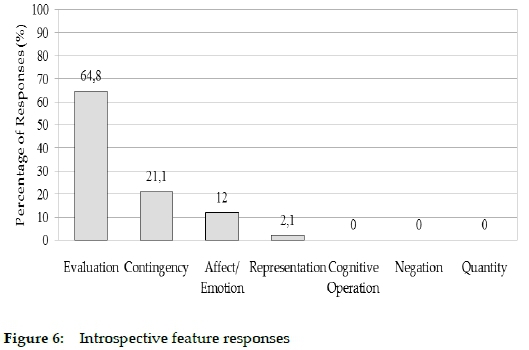
Introspective word association represents the mental state of the participants toward the cue words (De Deyne and Storms 2008). As Figure 6 shows, the majority (64.8%) of the responses in this category that had introspective features were related to the participants' positive or negative evaluations of the cues; for example, the word mobil 'car' elicited keren 'cool', hedon 'hedonic', mahal 'expensive', and mewah 'luxurious'. Cause and effect features - labeled as contingency features - were found in 21.1% of responses; for example bugar 'fit', capek 'exhausted', keringat 'sweat', and sehat 'healthy' from the cue word senam 'gymnastics'. Emotional features were found in 12.5% of responses; for example, takut 'afraid', seram 'scary', and lucu 'funny' were responses to the cue word badut 'clown'. The representation feature was found in only a small number of responses (4/144 or 2.2%); for example, the cue word sayap 'wing' elicited patah 'broken' and enak 'tasty'.
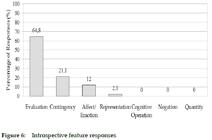
These results indicated that the introspective responses were mainly in the form of participants' judgement, positive or negative, and that words related to the cue words for causal effect were stored closer than those related to emotion. The absence of responses that are related to the cue words by cognitive operation, negation or quantity may suggest that when thinking of nouns, Bahasa Indonesia speakers rarely associate them with something that does not exist within them or state their comparison to other nouns.
5. Conclusion
Observing the way speakers of a certain language think about words and concepts can reveal the ways that these concepts are stored in the mental lexicon. This research has revealed information about how young native speakers of Bahasa Indonesia process words in their lexicon by connecting them with words that share lexical features or share one or more entity feature aspects. Generally, it was found that the Bahasa Indonesia participants, with reference to the entity features, perceive nouns based on their outside characteristics first. There was also a tendency for them to access nouns according to how they were used in speech, such as in phrases.
Therefore, the physical properties, situation, taxonomic categories, and feelings influenced how the words were processed in the mental lexicon. The appearance of these features in the retrieved words indicates the contexts attached to the words as conceptualized by native speakers of Bahasa Indonesia.
In conclusion, knowing how the native speakers of a certain language understand a word in their language can assist in formulating dictionary definitions so that language learners and native speakers can understand the best possible way that new words can be learned and stored. Lexicographers could use this type of research information to include more outside characteristics for the words listed in the dictionary, such as defining the meaning of a noun to ease the understanding of those particular words. Further, the words associated with the lemma in the dictionary entry could be used as the best example of how the lemma is used in a sentence and as a prototype of the language users' cognition.
Knowing how native speakers of Bahasa Indonesia understand a word in their language and its characteristics could also assist in developing a Bahasa Indonesia thesaurus to assist writers or learners understand how words in Bahasa Indonesia are used. The words generated in this study could also be used as examples of the domains in which the synonyms belong. Knowing how words are related to another in the minds of certain cultures could be a base to create a tool that relates words, such as WordNet, which has not yet been developed for Bahasa Indonesia.
However, as the cue words used in this study were only nouns, different results were found from the extensive study done by De Deyne and Storms (2008). Further, although the cue words were all nouns, it is undeniable that there might be a possibility that the participant consider some of those as verbs since the classification of word categories according to the speakers of Bahasa Indonesia is vague. This is corroborated in Jewalani's study (2019), which found that many of the participants - Bahasa Indonesia speakers - mistakenly classified the category of target words, or in other words, different from what is stated in the KBBI V. According to Jewalani (2019: 71-72), this phenomenon demonstrated that the theoretical system of Bahasa Indonesia, especially regarding word class category, is different from its implementation in the Bahasa Indonesia speech community. Thus, the upcoming studies should take this possible phenomenon into consideration.
In addition, as the participants were educated young people aged 20-29, there is a wide scope for future studies to add to these results and develop a database of Bahasa Indonesia lexical associations. Future research could focus on wider age and socio-economic groups in Indonesia and also assess whether there are any word association differences between the many ethnic Indonesian groups, all of which would deepen understanding of the way that Bahasa Indonesia is lexically stored.
We also would like to express our special thanks to Sansiviera M. Sari for her major contribution to data collection.
Dictionaries
Badan Pengembangan dan Pembinaan Bahasa. 2016. Kamus Besar Bahasa Indonesia (KBBI) V (Version 0.2.1 Beta (21)) [Mobile application software]. Retrieved from http://play.google.com/store/apps/details?id=yuku.kbbi5.
Acknowledgements
The authors are very thankful for the financial support given by Direktorat Riset dan Pengabdian kepada Masyarakat (DRPM) Universitas Indonesia through Publikasi Internasional Terindeks untuk Tugas Akhir Mahasiswa (PITTA) grant 2018.
References
- Endarmoko, E. 2007. Tesaurus Bahasa Indonesia [Thesaurus of Bahasa Indonesia]. Jakarta: Gramedia Pustaka Utama.
- Other References
- Bahar, M., A.H. Johnstone and R.G. Sutcliffe. 1999. Investigation of Students' Cognitive Structure in Elementary Genetics through Word Association Tests. Journal of Biological Education 33(3): 134-141.
- Barsalou, L.W., A. Santos, W.K. Simmons and C.D. Wilson. 2008. Language and Simulation in Conceptual Processing. De Vega, M., A.M. Glenberg and A.C. Graesser (Eds.). 2008. Symbols and Embodiment: Debates on meaning and cognition: 345-283. Oxford: Oxford University Press.
- Brysbaert, M., I. van Wijnendaele and S. de Deyne. 2000. Age-of-acquisition Effects in Semantic Processing Tasks. Acta Psychologica 104(2): 215-226.
- De Deyne, S. and G. Storms. 2008. Word Associations: Network and Semantic Properties. Behavior Research Methods 40(1): 213-231.
- Dewi, J. 2013. Wujud Kesalahan Bahasa Guru Bahasa Indonesia SMP Laboratorium Undiksha: Tinjauan Aspek Struktur dan Diksi. [Form of Errors of Bahasa Indonesian Teachers of Undiksha Laboratory Junior High School: Overview of Structural and Dictional Aspects]. Jurnal Pendidikan Bahasa dan Sastra Indonesia Undiksha 1(6): 1-15. Retrieved from https://ejournal.undiksha.ac.id/index.php/JJPBS/article/view/991/859.
- Geeraerts, D. 1987. Types of Semantic Information in Dictionaries. Ilson, R. (Ed.). 1987. A Spectrum of Lexicography: Papers from AILA, Brussels 1984: 1-10. Amsterdam: John Benjamins.
- Jewalani, A.P. 2019. Pengaruh Kelas Kata pada Akses Leksikal Penutur Bahasa Indonesia dalam Kasus Tip-of-the-tongue [The Influence of Word Categories on Lexical Access of Indonesian Speakers in Tip-of-the-tongue Cases]. Unpublished Thesis. Depok: Universitas Indonesia.
- Pranoto, B.E. and L.K. Afrilita. 2018. The Organization of Words in Mental Lexicon: Evidence from Word Association Test. TEKNOSASTIK 16(1): 26-33.
- Sari, S.M. 2019. Defisit Semantik Leksikal pada Anak Autism Spectrum Disorder [Lexical Semantics Deficit in Children with Autism Spectrum Disorder]. Unpublished Thesis. Depok Universitas Indonesia.
- Van Sterkenburg, P. (Ed.). 2003. A Practical Guide to Lexicography. Terminology and Lexicography Research and Practice 6. Amsterdam/Philadelphia: John Benjamins.