Gebruiksetikette en hul leksikografiese betekenis - Voorbeelde uit die Dictionary of the Montenegrin National and Literary Language
Abstract
This paper addresses a key component of every descriptive dictionary - lexicographic qualifiers, with a particular focus on one of their types, namely usage qualifiers. The analysis draws on examples from the first volume of the Dictionary of the Montenegrin National and Literary Language. It considers both normative and functional-stylistic qualifiers, which are essential elements of lexicographic description. Their significance is highlighted in both the standardization of the lexicon and its functional-stylistic stratification. By providing explanations and illustrative examples, this paper emphasizes the importance of usage qualifiers for an accurate understanding of the semantic content of lexemes in a broader context, as well as their communicative value and pragmatic relevance. Moreover, the paper points out the inherent susceptibility of usage qualifiers to change (which reflects the dynamic nature of the lexicon and language changes in general), thereby highlighting the need to establish general principles and criteria for their more consistent use in descriptive dictionaries. Some characteristic examples of the use of qualifiers have also been examined comparatively, in relation to their treatment in other dictionaries from the formerly shared Serbo-Croatian linguistic area. Attention is likewise drawn to the challenges lexicographers face in marking and classifying lexical items, as well as to possible approaches to overcoming these issues.
Usage Qualifiers; Lexicography; Lexeme; Lexicon; Lexicographic Description; Descriptive Dictionaries; Functional-stylistic Qualifiers; Normative Qualifiers; Context; Pragmatics
Abstract
In hierdie artikel word daar op 'n sleutelkomponent van elke beskrywende woordeboek gefokus - leksikografiese etikette, met spesifieke klem op een van die tipes, naamlik gebruiksetikette. Hierdie analise gebruik voorbeelde uit die eerste volume van die Dictionary of the Montenegrin National and Literary Language. Beide normatiewe en funksioneel-stilistiese etikette wat noodsaaklike elemente van leksikografiese beskrywing is, word beskou. Hul betekenis word belig in beide die standaardisering van die leksikon as die funksioneel-stilistiese stratifikasie daarvan. Deur verklarings en illustratiewe voorbeelde te verskaf, beklemtoon hierdie artikel die belangrikheid van gebruiksetikette vir 'n akkurate begrip van die semantiese inhoud van lekseme in 'n breër konteks, sowel as hul kommunikatiewe waarde en pragmatiese relevansie. In die artikel word daar verder gewys op die inherente vatbaarheid van gebruiksetikette vir verandering (wat die dinamiese aard van die leksikon en taalveranderings oor die algemeen weerspieël), wat sodoende die behoefte aan die bepaling van algemene beginsels en kriteria vir hul meer konsekwente gebruik in beskrywende woordeboeke beklemtoon. Enkele kenmerkende voorbeelde van die gebruik van etikette is ook vergelykenderwys ondersoek, spesifiek in verhouding tot hul hantering in ander woordeboeke van die voormalig gedeelde Serwo-Kroatiese taalgebied. Aandag word eweneens gevestig op die uitdagings waarmee leksikograwe te kampe het met die merk en klassifiseer van leksikale items, sowel as die moontlike benaderings om hierdie kwessies te oorkom.
Gebruiksetikette; Leksikografie; Lekseem; Leksikon; Leksikografiese Beskrywing; Beskrywende Woordeboeke; Funksioneel-stilistiese Etikette; Normatiewe Etikette; Konteks; Pragmatiek
1. Introduction
Lexicographic qualifiers provide important information about the domain of usage, normative status, and functional-stylistic stratification of lexemes in dictionaries - particularly those of a descriptive nature. Qualifiers can be seen as elements that describe the language system, but at the same time, they serve as guidelines indicating how the units of this abstract system can be used in actual discourse (Anastassiadis-Syméonidis 2011: 59, in Vasiljević 2024).
In this paper, we use the term usage qualifier, as it most accurately conveys the essence of this type of lexical marking - based on the domain of their use.1 A concise yet comprehensive overview of this term is provided by Vasiljević (2024: 79), who points out that the term usage qualifier is not unambiguous; its interpretation varies across different lexicographic traditions and often even from author to author. Additionally, there is a precise definition describing usage qualifiers as a collective term for a heterogeneous and open set of markers or labels placed within a dictionary entry, most often in the form of an abbreviation informing the user that the entry is marked according to specific properties (or multiple properties), and that its use in a speech situation is consequently subject to certain restrictions (Polguère 2021: 5, in Vasiljević 2024). Thus, the presence of a qualifier alongside a lexical unit not only specifies and marks the lexeme but also restricts the domain of its usage. For this reason, usage qualifiers are particularly relevant in the field of pragmatics, since they carry communicative value. They cannot be considered in isolation but must be understood within a broader contextual framework.2
We will examine this important segment of lexicographic description through an analysis of the first volume of the Dictionary of the Montenegrin National and Literary Language (A-V) (hereinafter: DMNLL), a monolingual descriptive dictionary published in 2016 by MASA (Montenegrin Academy of Sciences and Arts).3 In the same year, however, the DMNLL was withdrawn from use by a Resolution on the Dictionary of the Montenegrin National and Literary Language, adopted by the Montenegrin Parliament at the proposal of representatives from certain Albanian and Bosniak political parties. They were dissatisfied with the definitions of several entries in the Dictionary (such as albanizacija 'Albanization', Albanac 'Albanian', Bošnjak 'Bosniak'). From a methodological perspective, the paper is structured so that, in presenting examples from the DMNLL, consideration is given to those lexemes that best represent a given category of qualifiers, as well as to those examples that may serve as a basis for more detailed analysis and the exploration of alternative systemic solutions in dictionaries of this type. We will also examine some characteristic cases of the use of qualifiers comparatively, by considering practices in other dictionaries from the formerly unified Serbo-Croatian language area.4 We will point out the specificities of their use depending on the time frame of the dictionaries' compilation, and for certain markers, also the individual sensibility of the lexicographers themselves.5 The comparative analysis will be conducted by taking into account the same category of qualifiers, and, in certain cases, by examining identical or differing solutions in the use of qualifiers for the same lexeme across different dictionaries from the Serbo-Croatian linguistic area. This approach highlights the challenges lexicographers face with regard to the use of qualifiers and their systematic distribution. The aim of this study is to contribute to overcoming, or at least alleviating these lexicographic issues.
The study begins with an overview of the general characteristics of usage qualifiers, followed by an analysis of individual types of qualifiers, highlighting characteristic examples and analyzing them, with particular attention to their significance, (in)consistency, or other problematic aspects of their use in the DMNLL, and, indirectly, in descriptive dictionaries in general. This primarily qualitative analysis will be complemented at the end of the paper by a quantitative component presented in tabular form, showing the distribution of particular types of qualifiers in the DMNLL. In addition, the concluding section includes tables presenting examples of some of the dominant solutions in the use of qualifiers in the dictionaries included in the comparative analysis.
2. Usage qualifiers in descriptive dictionaries: A general consideration
There are various classifications of qualifiers in the literature dealing with their use in descriptive dictionaries. Broadly speaking, they can be divided into two main categories: grammatical qualifiers and usage qualifiers. Unlike grammatical markers, usage qualifiers in the DMNLL are placed before the definition of the lexeme. It is standard practice to place a qualifier after the headword, but not necessarily after its derivatives, especially when these belong to the same word-formation and semantic cluster. When a qualifier refers to all meanings of a lexeme, it is placed before the first listed meaning. If it refers to a specific meaning only, the qualifier appears immediately after the number that indicates the particular meaning but still preceding the definition itself. In this way, the qualifier serves to specify the lexeme even before its definition, guiding users toward the relevant domain of usage or indicating its normative status. Accordingly, Ristić (2014: 116) classifies usage markers as normative and functional-stylistic qualifiers. This paper focuses primarily on these two types of qualifiers, while the grammatical information in the DMNLL has been extensively and meticulously analyzed by Nenezić (2024).
The Instructions for Using the DMNLL state that one part of a dictionary entry contains the headword along with its "grammatical6 and functional-stylistic features". These features include information explicitly presented in the form of abbreviations, which serve as specific qualifiers or markers of a lexeme's usage value. In the list of abbreviations provided at the beginning of the DMNLL, these qualifiers are among the most numerous, alongside the abbreviations denoting sources from which usage examples have been drawn.
A phenomenon frequently observed in dictionaries of this type, including the DMNLL, is that a single lemma may have multiple usage qualifiers placed before a single meaning (e.g., bùkvara pren. (transferred meaning), nar. (vernacular), pejor. (pejorative) - 'a coarse, uneducated woman'). It is even more common for polysemous words to be assigned different usage qualifiers for most, or even all, of their meanings. In such cases, it is very important to distinguish the primary meaning from secondary semantic realizations, and to assign qualifiers accurately to each of the corresponding semantic nuances.
The presence of usage qualifiers enables the entire lexicon of the DMNLL to be divided into two major groups: lemmas with usage qualifiers, which are therefore marked, and unmarked, neutral lemmas, which appear without qualifiers.
Depending on what they indicate, various types of usage qualifiers can be identified in dictionaries. Apart from their different types, we can also talk about their higher or lower frequency of occurrence. According to Ristić (2006b: 94), regardless of the number of qualifiers present in a given dictionary, some general principles can be identified for determining the stylistic markedness of lexemes: functional-stylistic, socio-historical (normative), communicative (pragmatic), and aesthetic (stylistic) qualifiers.
3. Terminological and related qualifiers in the DMNLL
The use of a large number of so-called terminological qualifiers is evident in the DMNLL. They belong to the group of qualifiers determined according to the functional-stylistic status of lexemes. In fact, the most precise parameters for usage qualifiers can be applied to this group, which may explain their broader presence in dictionaries and the greater consistency in their use. A significant number of these qualifiers are associated with the scientific style, i.e., with specific fields of science or the arts. Thus, the list of abbreviations at the beginning of the DMNLL includes numerous qualifiers that refer to various scientific or artistic fields (anatomy, biology, geography, electrical engineering, zoology, literature, linguistics, mathematics, medicine, music, fine arts, etc.). Closely related are qualifiers referring to crafts, occupations, professions, or other areas of human cultural life (theater, religion, church, mythology, finance, beekeeping, fishing, printing, politics ...), encompassing the lexicon of various functional styles.
In the analyzed dictionary material, so-called pure terms (words with a single meaning limited to a particular professional or scientific field indicated by the qualifier) are relatively rare. Examples include: àlgēbra (mat. - matematika) 'algebra (math - mathematics)', albùmīn (hem. - hemija) 'albumin (chem. - chemistry)', àmpermetar (fiz. - fizika) 'ammeter (phys. - physics)', bilirùbin (biol. - bilogija) 'bilirubin (biol. - biology)', vèrgl (muz. - muzika) 'barrel organ (mus. - music)'. More commonly, one of the meanings of a polysemous, general-use lexeme is realized as a terminological one with restricted usage, representing a case of the terminologization of general vocabulary (Ristić 2014: 122). There are multiple examples of this in the DMNLL - for instance, the lexeme brzìna (speed), after its primary, general meaning "the property of being fast", has a second meaning marked by the qualifier fiz. (phys.), referring to the field of physics: "the distance traveled per unit of time". The third meaning, marked tehn. (tech.), belongs to the field of technology: "the ratio between engine speed and the speed at which the wheels turn".
Conversely, the process of determinologization (Ristić 2014: 122) occurs when the primary terminological meaning of a word gives rise to broader, general meanings - this, too, is evident in the DMNLL. In such cases, the primary meaning of a word is typically tied to a specific field, and subsequent meanings evolve from it, resulting in variants of the original nominative meaning, known in the literature as semantic allolexes (Vtov 1998: 15; Šipka 1998: 12-14). For example, the lexeme àdīcija (addition), whose primary meaning belongs to mathematics and secondary to chemistry, also acquires a general meaning in its third semantic realization: "addition in general".
There are also numerous examples where a single lexeme has semantic realizations in various scientific and artistic fields. In such cases, qualifiers play a crucial role - acting as a guideline before the definition itself, they indicate the specific field in which the lexeme has actualized a specialized meaning (often in fields that are not closely related). For example, àbrāzija (abrasion) appears in medicine, geology, and technology, while aglutinácija (agglutination) is used in linguistics, medicine, and geology.
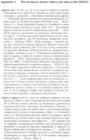
Language is a living system, which is why words change over time, acquiring new meanings or losing old ones. This dynamism is particularly evident in the lexicon7 and inevitably affects the entire lexical system of a language, which is therefore reflected in lexicographic description, too. This is another reason why usage qualifiers should be regarded as a dynamic category of lexicographic description, with their use adapted to lexical and language changes in general. Accordingly, the rise of certain scientific fields has led to the expansion of qualifiers like inf. (informatics, information science) in more recent dictionaries, including the DMNLL. This can be seen both in the inclusion of new lexemes not recorded in older Serbo-Croatian dictionaries (e.g., bȁjt 'byte', bàner 'banner', blȍg 'blog', vȅb 'web') and in the addition of new specialized meanings to existing general-use lexemes, marked by the terminological qualifier inform. For example, the words adrèsa (address) and vȋrus (virus) acquire new meanings related to information technology (see Appendix 1). For comparison, these informatics-related meanings are also found in the Comprehensive Dictionary of the Croatian Language (CDCL 2015), while they are understandably absent from earlier dictionaries, such as the first volume of the Dictionary of the Serbo-Croatian Literary Language (DSCLL 1967) or in the even older first volume of the Dictionary of the Serbo-Croatian Literary and National Language (DSCLNL 1959). All of this indicates language development, specifically lexical changes, and at the same time, the corresponding expansion of functional-stylistic qualifiers in dictionaries. In these examples, we are able to observe so-called internal lexical changes, specifically semantic changes that create new meanings for existing lexemes without increasing the overall number of entries in the lexicon (Šipka 2002: 43).
The use of qualifiers in specific scientific and artistic fields serves as a good indicator of the field to which particular lexemes belong. This can be practically useful for selecting and extracting lexemes when compiling terminological dictionaries, dictionaries of spiritual and material culture, etc.
4. Standard language domain qualifiers in the DMNLL
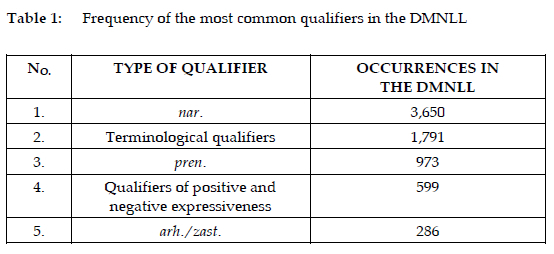
In addition to the widely used qualifiers discussed so far, the DMNLL employs a number of other qualifiers that are equally frequent. They can be distinguished based on specific linguistic parameters, particularly as markers of stylistic features related to the socio-historical development of the language (Ristić 2006b: 97). In the relevant literature, these are often referred to as standard language domain qualifiers (Ivanović 2014: 207). According to this criterion, the vocabulary in the DMNLL is primarily divided into two major categories: literary (standard)8 and vernacular (non-literary). In the DMNLL, a large number of lexical entries (specifically 3,683 entries) are marked with the qualifier nar. (vernacular)9 (this qualifier is in fact the most frequent, with 3,650 occurrences; see Table 1). This indicates that the given lexeme is taken from Montenegrin vernacular dialects or that a particular meaning of a standard literary word is linked to vernacular usage. The lexicon marked with nar. includes both dialectisms - words that phonologically or morphologically diverge from the standard, and regionalisms, region-specific words that are lexically distinctive but not part of the standard language. This corresponds to the very title of the DMNLL, as it includes the term "national (vernacular) language". In this respect, the DSCLNL is the most typologically similar to the DMNLL as it also encompasses both literary and vernacular vocabulary (unlike the DSCLL, DSL, CDCL, and DBL1 and DBL2, which do not include this lexical layer). In the DSCLNL, however, such qualifiers are treated differently. There, the qualifier nar. is used for words from folklore or non-literary dialectal speech. The qualifier pokr. (regionalism) is used for regionally specific words limited to specific regions, while dijal. (dialectism) is used for words that phonologically or morphologically deviate from the standard.
It is noticeable that the DMNLL does not use the qualifier neknj. (non-literary), which is present in the DSCLNL and refers to words of non-standard, non-literary use. Given the title of the DMNLL, the use of the qualifier neknj. might have been expected. However, the DMNLL instead employs the qualifier nest. (non-standard) in several instances.
Some lexemes are entirely confined to vernacular usage, while others, though fewer in number, have the nar. qualifier only attached to one of their meanings. This dictionary therefore presents a blend of different and often contrasting lexical layers. In fact, due to the modernization of society and the migration towards urban centers, certain crafts and professions connected to rural life are disappearing. With their disappearance, the related lexicon is also fading away from everyday use, but it is preserved from oblivion precisely through documentation in dictionaries such as the DMNLL. On the other hand, the influence of younger generations has contributed to the increasing influx of new, modern words of foreign origin (primarily Anglicisms), as well as a growing body of slang, both of which now constitute significant components of the language's overall lexical inventory. Dictionaries of this type, which record vocabulary from all spheres of usage, serve as unique and comprehensive inventory of a language's lexicon. For this reason, descriptive dictionaries of national languages that include both vernacular and standard language forms are considered especially valuable. In such conceptually structured dictionaries, the use of qualifiers becomes even more important for the precise differentiation and categorization of this heterogeneous lexical corpus. This process also takes into account the modification of existing lexical meanings while adhering to the principle of so-called proportional focusing.10
5. On the stratification of the lexicon according to other parameters in the DMNLL
In addition to the division between vernacular and literary language, the vocabulary can also be stratified according to other parameters, with a large number of qualifiers corresponding to these categories. For example, based on usage frequency, we encounter qualifiers such as neob. (uncommon) and indiv. (individual). According to the criterion of temporal usage11 - i.e., the level of diachronic lexical value (Ivanović 2014: 211) - qualifiers include zast. (obsolete), arh. (archaic), ist. (historical), and neol. (neologism). Social stratification also yields qualifiers such as žarg. (slang), sport. (sports terminology), vojn. (military), fam. (familiar), among others. Speaking about these types of qualifiers, Ristić (2014: 125) rightly points out that lexical norming in the use of such qualifiers is subject to both change and the subjective judgment of the lexicographer, as is also confirmed in the DMNLL.
5.1 On the stratification of the lexicon according to usage frequency and social layers
The susceptibility to change and the lexicographer's subjective judgment regarding the use of qualifiers in terms of usage frequency can be most clearly illustrated with the example of the qualifier neob. (uncommon). With this qualifier, it is important to clarify whether "uncommon" refers to the headword itself - more precisely, to its formal-grammatical structure, its meaning, or its actual usage. Among the analyzed entries in the DMNLL marked with neob., the most frequently represented are lexemes with unusual morphological structures, with compounds predominating: bèsplotkinja 'barren woman', bèstīđe 'impudence' (alongside the more common nerotkinja, zastiđe). If only one of the word's meanings is unusual, then the qualifier neob. is placed in front of that particular meaning (e.g., vȉsorāvan 'plateau, highland' - its second, figurative meaning: "point of view, standpoint" is marked with neob.). Sometimes a lexeme is marked with this qualifier solely because of its phonetic structure: bòhēm (boem 'bohemian'); vȅledūšan (velikodušan 'magnanimous'); vodòtēčje (vodotok 'watercourse'). However, the status of this qualifier is sometimes debatable. For example, in the entries višeìmenovānī and višepòmenūtī (the above mentioned), the definitions refer to višerèčenī, which is also marked with the qualifier neob. The established lexicographic practice is that, in cases of synonymous lexemes with the same normative status, the most commonly used variant in language is the one provided with a definition. Here, this was done with višerečeni, although in our opinion, višepomenuti could have been chosen as well, given that it is equally, if not more, frequent in usage. Beyond the question of frequency, this also raises the question of whether it is justifiable to assign the neob. qualifier to all three lexemes - especially to the one provided with a definition, since this typically indicates that it is considered the most commonly used, and thus the most "usual".
This is one of the cases that shows us that by monitoring actual use and frequency of lexical units, it is both possible and necessary to simultaneously evaluate the justification and consistency in assigning qualifiers to these units in a descriptive dictionary. Only in this way can the dictionary reflect the actual state of lexical usage at a given point in time.
We also draw attention to examples involving the žarg. qualifier (slang), which belongs to the qualifiers based on social stratification and is, as expected, appears more frequently in more recent dictionaries. In the DMNLL, numerous cases illustrate the semantic extension of an existing general-use lexeme with a new slang meaning, for example: banána (banana), in addition to its primary meaning, also has the slang meaning (marked with žarg.): "a block of an opponent's shot with an outstretched arm in basketball". Another example is the fixed phrase banana-država (banana republic/state), denoting: "a small, economically and politically underdeveloped country, subject to the influence of great powers and dependent on foreign capital". On the other hand, the DMNLL also documents the introduction of new lexemes, most often borrowed from other languages, which falls under so-called external lexical changes (Šipka 2002: 43). An example of this is the slang term bàsket, meaning: "a game in which two teams of five players each compete to score points by throwing a ball into the opponent's basket; basketball". These examples illustrate how lexicographers monitor contemporary language trends and, in doing so, enrich the lexical treasury of a language through comprehensive lexicographic processing. The use of appropriate qualifiers plays a crucial role in this process as it contributes to the precision of lexical categorization by marking relevant lexemes as slang terms.
5.2 On the stratification of the lexicon according to the temporal dimension
Both literary and dialectal lexis can be stratified according to the temporal dimension into contemporary and obsolete vocabulary. Within the lexicon of the standard, literary language, this stratification further encompasses the categories of historicisms, archaisms, and neologisms. The DMNLL uses the qualifiers arh. (arhaizam, arhaično 'archaic'), zast. (zastarjelo 'obsolete'), and ist. (istorija, istorijski 'historical') to mark words from earlier epochs. These categories are closely related and, in certain cases, overlapping. A relatively high frequency of the qualifiers arh. and zast. can also be observed in the DMNLL (see Table 1). Notably, the abbreviation ist. is presented as a qualifier meaning "history, historical", rather than explicitly denoting the lexical category of historicisms, which in some instances in the DMNLL are classified under the broader category of archaisms.
Several types of archaisms are attested in the DMNLL. First, there are archaisms of origin, predominantly lexemes borrowed from Old Church Slavonic, such as: bespokójstvije (disturbance/restlessness), blagoutròbije (mercy/compassion), vedènije (leadership/guidance), velikòdūšje (generosity), etc. Then there are phonological archaisms, such as bogòmil/bogùmil (bogomil 'a follower of the Bogomil religious movement in the medieval Balkans'), vàljāda/valjda (probably/hopefully); derivational archaisms, e.g., bjelòća (bjelina 'whiteness'), blízōst (blizina 'closeness'), vàjatelj (vajar 'sculptor'). Semantic archaisms pertain to specific, now-obsolete meanings of lexemes, where the distinction between the qualifiers arh. (archaic) and zast. (obsolete) becomes particularly nuanced. Unlike typical archaisms, the qualifier zast. can refer to just one outdated meaning of a lexeme that still exists in contemporary language in other senses. For example, aklamácija (acclamation) in the DMNLL is marked zast. (obsolete) after the terminological qualifier muz. (muzika 'music'), indicating that this particular meaning is obsolete, while the lexeme itself does not belong to the lexical category of archaisms. Classic examples of archaisms are words that have been replaced by their contemporary synonyms in everyday use - such as bȑzojāv (superseded by telegram 'telegram'), ȁeroplān (superseded by avion 'airplane'), vȏjna (superseded by rat, vojevanje 'war'). Such words are typically preserved in literary texts, where they serve a stylistic function.
Special caution is required when differentiating and clearly delimiting these qualifiers. The categorization of historicisms presents a particular challenge, as the qualifier ist. (istorija, istorijski 'history, historical') may denote vocabulary belonging to this lexical category; however, words that are historicisms are often not explicitly marked as such in the DMNLL. For example, vèlmoža (nobleman) is a historicism since it refers to a title that no longer exists; however, in the DMNLL it is labeled only with the qualifier ist. (history, historical), without explicitly noting the obsolete character of the term. Conversely, the lexeme ȁbadžija (a craftsman who makes traditional woolen garments) is marked arh. (archaic) because it primarily denotes a profession that no longer exists. This lexeme, like vèlmoža, could also be categorized as a historicism in its primary sense.
Neologisms are not represented in the first volume of the DMNLL, and the corresponding qualifier for this category is absent from the list of abbreviations. Therefore, when discussing the temporal stratification of lexis in the DMNLL, the focus remains primarily on various types of archaisms (both lexical and semantic), as well as historicisms - sometimes subsumed under archaisms, sometimes marked with the qualifier ist. (istorija, istorijski 'history, historical') - and, finally, on obsolete meanings of lexemes that are still in general use, labeled with zast. (obsolete). Determining the most practical and comprehensive method for marking lexis according to temporal stratification in descriptive dictionaries remains a stimulating topic for further analysis and reflection. In our view, the effective division and differentiation of qualifiers within this lexical group can only be achieved after a clear distinction is made between the concepts of archaism, historicism (in relation to the qualifier ist. 'history, historical'), and obsolete lexical meanings realized in specific contexts. One possible solution (already implemented in the DMNLL) is to interpret the category of archaisms broadly, encompassing both archaisms in the narrow sense (lexical and semantic) and historicisms. However, in such cases, it is essential to emphasize the obsolete nature of those lexical units that have fallen out of use due to the disappearance of the concepts or entities they once denoted. For this purpose, the qualifier ist. meaning 'history, historical' is insufficient, as, when used as a terminological qualifier, it can also refer to vocabulary that is still in active use and does not necessarily imply obsolescence.
5.3 Semantic domain qualifiers
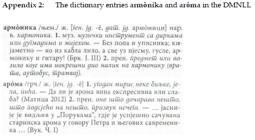
One of the most frequently used qualifiers in the DMNLL is the qualifier pren. (transferred meaning), which occurs 973 times in the DMNLL (see Table 1). Ivanović (2014: 212-213) classifies this type of qualifier within the category of semantic domain qualifiers, which function as metalinguistic markers indicating processes within the polysemous structure of a word or signaling semantic relationships between the analyzed word and other entries in the lexicon. Transferred meaning involves the shift from the basic, primary sense of a word to a figurative one. Such semantic transfers may be motivated in various ways, and are often based on metaphorical associations grounded in different properties of the concepts involved. Given the broad scope of transferred meanings in polysemous words, the use of pren. in the DMNLL is justified. This qualifier has a wider range than fig. (figurative), as figurative meaning is frequently associated with stylistic markedness, whereas not every transferred meaning is necessarily stylistically marked. This is supported by the observation that, "not every metonymy, synecdoche, and metaphor is necessarily a lexical metonymy, synecdoche, or metaphor. Lexical realizations occur in specific semantic positions and always result in new semantic manifestations. These new semantic realizations are, as a rule, stylistically unmarked; indeed, they are always unmarked when induced by metonymy or synecdoche, while metaphor-induced realizations may be either marked or unmarked" (Gortan-Premk 2004: 116). Various examples from the DMNLL illustrate this point. For instance, in the case of the lexeme armònika (accordion), there is a stylistically unmarked metaphorical transfer of meaning from one object to another based on the visual similarity between the accordion as a musical instrument and a type of bus, which, due to the joint connecting its two sections, resembles an accordion bellows. With the lexeme aróma (aroma), on the other hand, we have a stylistically marked semantic metaphor, where meaning is transferred from the concrete to the abstract (see Appendix 2). This raises the question of whether it would be useful to complement these meanings that are stylistically marked with a qualifier indicating expressiveness, thereby distinguishing them from stylistically neutral examples marked with the qualifier pren., that is, from usage in a neutral, stylistically unmarked context.
By using the qualifier pren., the DMNLL diverges from the lexicographic tradition, since the DSCLNL and DSCLL exclusively use the qualifier fig.12 Instead, it aligns with the approach adopted in more recent dictionaries, such as the CDCL and DBL1 and DBL2.
6. Contextually conditioned qualifiers in the DMNLL
In addition to the qualifiers mentioned above, the DMNLL includes numerous functional-stylistic qualifiers based on the "communicative-pragmatic principle" (Ristić 2014: 125), or, as they are also known in the literature, qualifiers of pragmatic-stylistic value (Ivanović 2014: 216): šalj. (humorous), iron. (ironic), pogrd. (derogatory), pejor. (pejorative), hip. (hypocoristic). Such qualifiers indicate a special stylistic markedness and point to functional styles characterized by expressiveness, most notably the conversational and literary styles. For this group of qualifiers, it is especially important that they indicate the broader context of word usage and specify that context. The qualifier expr. (expressive) also belongs to this group, as it marks lexemes on the level of expressiveness. Generally, labels of this type explicitly indicate expressive meaning realized through the use of a marked lexical unit (Ristić 2006b: 98).
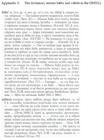
These kinds of qualifiers are of great value in lexicographic descriptions. Although their primary role is to help better understand a lexeme's definition, functioning as a kind of supplement to the definition, sometimes their absence might lead to the misinterpretation of examples. Consider, for instance, the qualifier humor. (humorous). Its presence is crucial in the case of the lexeme bȁba in the DMNLL, whose third meaning, listed under "a", is "wife (woman spouse)". However, when the qualifier humor. is added in front of that meaning, the intended sense becomes clear - that is, the contextual usage of the word in this meaning becomes clear. This is especially significant because the same entry also contains a related meaning, listed under "b" - "a woman who is no longer young or beautiful", which is marked with the qualifier pejor. (pejorative). The use of qualifiers is thus immediately highlighting a different nuance between two seemingly related meanings. A similar case is observed with the verb vábiti se, where the final listed meaning "to be called" is marked with the qualifier humor., which helps convey the correct nuance. Without this qualifier, the semantic content of the verb might be misunderstood as pejorative, especially because the example provided does not clarify the humorous context (see Appendix 3). In cases like this (where examples fail to make the word's usage obvious), the role of such qualifiers is crucial. They guide, direct, and precisely define the semantic content of a lexeme by linking it to a particular context, guiding dictionary users toward the accurate interpretation.
Iron. (ironic) is another qualifier that is important for the correct understanding of contextually conditioned meanings. Associating a word with an ironic context signals that the word is being used to express the opposite of its literal meaning, which is the essence of the stylistic figure of irony. For example, the third meaning of aristòkrat(a) in the DMNLL is "a person who considers themselves superior to others", but the qualifier iron. indicates that this meaning is intended to be interpreted ironically. As a result, the accompanying example of usage is correctly interpreted.
6.1 Qualifiers of positive and negative expressiveness
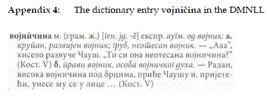
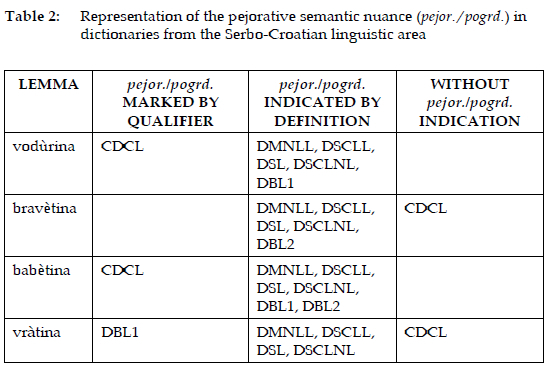
Among qualifiers that depend on contextual usage, particular attention is given to those that indicate the positive or negative semantic nuances of a lexeme. Although lexicographic practice aims to provide "transparent" examples and to derive definitions from the semantic nuances evident from the context, this is not always possible. This is partly because dictionaries (for practical reasons) typically include only one or, at most, two example sentences. Often, a broader context is required (especially with examples taken from literary works), and sometimes even this proves insufficient. In such cases, it becomes necessary to take into account the socio-cultural context and the linguistic-cultural background in order to correctly interpret the semantic realization of a lexeme in discourse. This involves considering the connotative components of the complex structure of lexical meaning and accordingly selecting the appropriate usage qualifier. This is especially relevant for lexemes marked with qualifiers of positive and negative expressiveness: hip. (hypocoristic) and pejor. (pejorative). It is important to note that in the Serbo-Croatian lexicographic tradition, there is no separate qualifier for derogatory meaning (pogrd.) for negative semantic nuances. In the DMNLL, too, such cases are subsumed under the pejorative category. These qualifiers (pejor./hip.) are highly frequent in the DMNLL - they rank among the four most frequent types of qualifiers (see Table 1), whether highlighted separately as typical usage qualifiers or mentioned as part of a definition to indicate that particular semantic nuance. It is clear that the subjective judgment of the lexicographer often plays a role in choosing these qualifiers. In this regard, the inconsistency in using these qualifiers can be found in the DMNLL: out of context, the noun vojnìčina (big soldier) carries a positive semantic nuance. However, in the DMNLL, the first usage example clearly conveys a negative semantic nuance, yet the qualifier pejor. is omitted, although its inclusion would have been justified (see Appendix 4). Furthermore, when comparing the explicit use of the pejor. and hip. qualifiers in dictionaries from the former Serbo-Croatian linguistic area, we notice differences related to the augmentative or diminutive suffixes involved. This suggests that the use of qualifiers can reflect systematic features of certain word-formation and semantic models. For example, the noun vodùrina (water) is marked in all dictionaries as augm. and pejor./pogrd., which is certainly influenced by the nature of the augmentative suffix -urina that is primarily associated with negative semantic coloring. On the other hand, the noun bravètina 'big door lock' (with the suffix -ina) is explicitly defined as both augmentative and pejorative of brava (door lock) in the DMNLL, DSCLL, DSL, and DSCLNL. Meanwhile, in the CDCL, only the augmentative meaning is noted, without any qualifier indicating negative expressiveness. These are not isolated cases: A similar inconsistency has been observed with the nouns babètina and vràtina. At the same time, such examples suggest that, in most dictionaries from the Serbo-Croatian linguistic area, the pejorative nuance - if it is primary - is often conveyed through the definition rather than by a qualifier. This is best illustrated in Table 2. It is also worth mentioning that pejorative meaning can originate from the base word itself (budàlina and budalètina from budala - 'fool', avétinjāk and avétnīk from avet(inja) - 'ghost-like figure'). This is to be expected, given that derived words usually rely heavily on the primary meaning of their base forms - adjective (Dragićević 2002: 113-114), or of the noun or verb. The same applies to diminutives and related hypocoristic nuances of meaning. When the base word or the suffix inherently implies positive or negative expressiveness, the context becomes less relevant. However, in examples involving neutral lexemes, it is precisely the context that plays a decisive role in determining whether the pejor. or hip. qualifier will be used. As a result, the same word may be treated differently in dictionaries from closely related linguistic areas, depending on the context in which it appears. This supports the observation in the relevant literature that nominal augmentatives, as expressively charged lexemes, cannot be clearly semantically defined without context (Šunjevarić 2020: 197). We conclude that, for the reasons mentioned above, it is crucial to take context into account when using this type of qualifier. At the same time, this also explains why achieving systematic and consistent use of such qualifiers in dictionaries is often challenging.
7. Qualifiers with phraseological units in the DMNLL
Phraseological units and fixed word combinations provided alongside the central lexeme13 are important constitutive elements of the DMNLL. Unlike fixed word combinations, phraseological units are, by definition, characterized by figurative meaning. For practical reasons, dictionaries often omit the explicit use of the qualifier fig. (figurative) after each phraseological unit. Nevertheless, some of these units are preceded by other types of usage qualifiers. As expected, the qualifier razg. (colloquial) appears frequently with phraseological expressions, since many of them are embedded in the colloquial register. This paper focuses on this aspect. In examining the DMNLL, we can observe inconsistencies in the use of qualifiers. For example, the phraseological expression ne mogu mu pomoći bečki ljekari ('even the doctors from Vienna can't help him') (listed under bêčkī) includes the label razg., indicating that the phraseological unit belongs to the conversational style. On the other hand, the phraseological expression živjeti kao beg ('to live like a bey'), listed under bȅg, lacks the qualifier razg., in spite of the fact that there is no clear difference between the two examples - both are equally associated with everyday, colloquial usage. Such examples raise questions about consistency in the use of qualifiers for phraseological units - not only in the DMNLL but in descriptive dictionaries in general. Many phraseological units belong to conversational language, yet only some explicitly carry the qualifier razg. It is likely that the qualifier is used for those units that are predominantly associated with the colloquial functional style, since it is important to consider the nature of this qualifier as a normative marker. From the perspective of lexical meaning, the most dominant feature of phraseological units belonging to conversational vocabulary is their emotional and expressive markedness (Ristić 2006a: 56). They function as expressive linguistic tools, although they are often presented in dictionaries without the qualifier ekspr. (expressive).
This leads to a logical question: should the principle of economy be the primary goal in dictionaries, since dictionaries naturally strive for economy? Should this principle, as such, justify the omission of qualifiers for phraseological units when their stylistic status is, in a sense, implied? On the other hand, this can be seen as a shortcoming - when the qualifier is omitted, the phraseological unit becomes equated with neutral vocabulary. Nevertheless, we believe that the priority should be to establish a principle and adhere to it consistently, striving for a paradigm wherever possible. In this context, we can cite the opinion of Šipka (2002: 45), who argues that "various labels (usage, regional, social, etc.) should be used abundantly. And not only that. They should be considerably elaborated so that they can handle the internal lexical dynamics of usage." Rather than focusing solely on the number and variety of qualifiers, attention should be paid to the consistency and systematic use of these qualifiers, as they serve as reliable indicators of the general, systemic characteristics of a language's lexicon.
8. Conclusion
The diversity and number of usage qualifiers in the DMNLL suggest that the dictionary has a well-developed lexicographic metalanguage.14 Unlike grammatical qualifiers, which are standardized and form a "stable system of units of lexicographic metalanguage" (Ristić 2014: 118), usage qualifiers often vary. This variation depends on numerous factors, and to some extent, it can also reflect the lexicographer's individual judgment, competence, familiarity with the material, and sensibility. This is generally common in dictionaries of this type, which has been confirmed by our analysis of the DMNLL.
This paper highlights the multiple functions of lexicographic qualifiers in monolingual descriptive dictionaries. While grammatical qualifiers clarify the formal-structural aspects of lexemes, usage qualifiers indicate domains of use and contribute to the correct semantic and stylistic interpretation of entries. One specific type of usage qualifiers - normative qualifiers - delineate the lexicon into two broad categories: literary (standard) and colloquial (non-standard), thereby also contributing to the domain of lexical codification. Thus, by stratifying the lexicon through the use of qualifiers based on the criterion of normativity vs. non-normativity, dictionaries of this type have not only a descriptive but also a prescriptive character.
One of the key functions of usage qualifiers in lexicography is their contribution to the functional-stylistic stratification of the lexicon, which has been repeatedly emphasized in this article. Different types of qualifiers classify lexical items according to linguistic criteria such as usage frequency, time of usage, social distribution, and other parameters. Some qualifiers further contribute to stylistic stratification by clearly differentiating expressive vocabulary - associated with specific functional styles (literary, colloquial) - from stylistically neutral, unmarked vocabulary. In addition, this paper has underscored the pragmatic and communicative importance of qualifiers, which enable the correct interpretation of the connotative components of lexical meaning through the broader contextual realization of lexical items in actual speech. By profiling individual lexemes, usage and stylistic qualifiers simultaneously help portray the general, systemic properties of a language's lexicon.
The comparative analysis has indicated, among other things, the existence of certain systematic solutions in dictionaries from the Serbo-Croatian linguistic area, as well as the potential problems and challenges that lexicographers face regarding the use of qualifiers. Consequently, despite these significant functions, we cannot say there is clear consistency in the listing of usage qualifiers, not only in the DMNLL, but more broadly, in descriptive dictionaries.
In short, this analysis shows that while usage qualifiers are not consistently used, they remain an indispensable and highly relevant component of lexicographic description. Therefore, it is necessary to establish general principles and criteria to achieve greater consistency and precision in their purposeful use in dictionaries.
Endnotes
1. In recent linguistic literature, the term pragmatic information is often used alongside the term usage qualifier, especially in studies dealing with qualifiers in bilingual dictionary corpora (cf. Karlić and Barčot 2021; Stojanović 2021). By contrast, Zgusta (1991) uses the term gloss as one of the fundamental tools for describing lexical meaning (p. 238), defining it as "any descriptive or explanatory comment within an entry" (p. 253). In his terminology, usage qualifiers are referred to as labels and are considered a subtype of glosses. These labels are related to "the entire field of connotations and the field of restricted languages, styles, etc." (p. 255).
2. In Ivanović's study (2014: 247), dictionary qualifiers are described as metalinguistic constants, with an emphasis on the idea that in modern lexicography "qualification represents a method of definition in which lexemes, during dictionary processing, are assigned specific metalinguistic labels".
3. This issue was addressed by Šubarić and Đurčević (2023), in the introductory section of a paper that concisely yet thoroughly and factually reviewed the complex socio-political context and the complicated situation regarding language and national identity in Montenegro. These factors led to the withdrawal of the DMNLL and, unfortunately, shortly thereafter, to the suspension of the entire lexicographic project for compiling the first dictionary of the Montenegrin language within MASA. Although only the first volume was published, the dictionary's material and the methodology employed in its compilation offer a substantial corpus of lexicographic data. Analyzing this material can help refine the lexicographic principles for compiling dictionaries of this type.
4. From the once unified Serbo-Croatian language, the modern standard varieties of Serbian, Croatian, Montenegrin, and Bosnian have since developed and been standardized. For the comparative review of certain phenomena related to our topic, we will use the following dictionaries: the Dictionary of the Serbo-Croatian Literary and National Language (DSCLNL), the Dictionary of the Serbo-Croatian Literary Language (DSCLL), the Dictionary of the Serbian Language (DSL), the Comprehensive Dictionary of the Croatian Language (CDCL), the single-volume Bosnian Language Dictionary (DBL1), and the multi-volume Bosnian Language Dictionary (DBL2).
5. Zgusta (1991: 255) emphasizes that the use of usage qualifiers (or labels, in his terminology) in a dictionary depends on "the actual variation existing in a given language and the degree of descriptive subtlety and generative power that the lexicographer intends to achieve with their dictionary".
6. In the DMNLL, grammatical qualifiers are placed immediately after the headword (for example, gender and, where relevant, number for nouns; aspectual categories for verbs; gender-specific endings for adjectives; and other characteristic grammatical forms presented in the grammatical block) thus providing a concise summary of all the essential grammatical features of the lexeme.
7. "The lexicon, as a part of the language system, represents a very complex subsystem. It is open and dependent on the life of the speech community" (Dragićević 2010: 17).
8. The term "literary language" refers to "a normed linguistic form which, in a specific national community, serves as the basic means of communication and as the universally accepted language code of a particular culture" (Popović 2007: 351).
9. At the same time, this points to the richness and diversity of Montenegrin vernaculars, as evidenced by the large number of dialectal dictionaries from various regions of Montenegro.
10. Piper (2002: 134) explains that this term was introduced in the foreword to the Great English-Russian Dictionary (Apresjan 1997). It refers to the need for dictionaries to include "well-graded representation of phenomena that are at the lexicographic focus, as well as those more or less on the periphery of description - whether in terms of time (e.g., living lexicon vs. archaisms), space (e.g., regionally unrestricted words vs. regionalisms), usage (e.g., the degree to which colloquial usage is incorporated into literary language norms), or stylistic criteria (e.g., stylistically unmarked vs. stylistically marked vocabulary).
11. Or according to the level of the diachronic value of the lexicon (Ivanović 2014: 211).
12. In the DSCLNL, for example, the qualifier fig. appears in three contexts: before examples illustrating figurative use of lexemes alongside their literal meaning, before brief definitions of such figurative uses, and thirdly, before meanings induced by metonymy, synecdoche, or metaphor. In the first two cases, fig. denotes so-called figurative use, while in the third, it indicates figurative meaning. However, it has been pointed out in literature that using the same marker to represent two distinct values is problematic (Gortan-Premk 2004: 113).
13. These two categories are distinguished in the DMNLL by different symbols - fixed expressions are marked with a circle, while phraseological expressions (which also include proverbs) are marked with a square.
14. "In a descriptive dictionary, the lexicographic metalanguage represents a specific idiom, distinct from natural language. The function of this idiom is to define various types of linguistic regularities within the lexical system" (Ivanović 2014: 229).
A. Dictionaries
References
- CDCL (Comprehensive Dictionary of the Croatian Language). Jojić, L. (Ed.). 2015 Veliki rječnik hrvatskoga standardnog jezika. Zagreb: Školska knjiga.
- DBL1 (Dictionary of the Bosnian Language). Čedić, I. (Ed.). 2007. Rječnik bosanskog jezika. Sarajevo: Institut za jezik.
- DBL2 (Dictionary of the Bosnian Language). Jahić, Dž. 2010. Rječnik bosanskog jezika 1, A-Ć. Sarajevo: Akademija nauka i umjetnosti Bosne i Hercegovine, Bošnjačka asocijacija 33.
- DMNLL (Dictionary of the Montenegrin National and Literary Language). Montenegrin Association of Sciences and Arts. 2016. Rječnik crnogorskog narodnog i književnog jezika I, A-V. Podgorica: Institut za jezik i književnost "Petar II Petrović Njegoš", CANU.
- DSCLL (Dictionary of the Serbo-Croatian Literary Language). Matica srpska, Matica hrvatska. 1967-1976. Rečnik srpskohrvatskoga književnog jezika 1-6. Novi Sad: Matica srpska (1-3, Zagreb: Matica hrvatska).
- DSCLNL (Dictionary of the Serbo-Croatian Literary and National Language). Serbian Association of Sciences and Arts. 1959-(2023). Rečnik srpskohrvatskog književnog i narodnog jezika I-(XXII). Beograd: Institut za srpskohrvatski jezik, SANU.
- DSL (Dictionary of the Serbian Language). 2007. Vujanić, M., D. Gortan-Premk, M. Dešić, R. Dragićević, M. Nikolić, L. Nogo, V. Pavković, M. Radović-Tešić, N. Ramić, R. Stijović and E. Fekete (Eds.). 2007. Rečnik srpskoga jezika. Novi Sad: Matica srpska.
- B. Other literature
- Anastassiadis-Syméonidis, A. 2011. Les marques d'usage dans le dictionnaire du grec standard de l'Institut d'études néohelléniques (Fondation Manolis Triantaphyllidis). Baider, F., E. Lamprou and M. Monville-Burston (Eds.). 2011. La marque en lexicographie: États présents, voies d'avenir: 51-63. Limoges: Lambert-Lucas.
- Апресян. Ю.Д. (Apresjan, J.D.). 1997. Предисловие. Новы большой англо-руский словарь. Изд. 3-е стереотипное. Том 1. А-Ф. Москва: Русский язык.
- Dragićević, R. 2002. Pridevi sa značenjem ljudskih osobina kao deo semantičko-derivacionog rečnika srpskog jezika. Deskriptivna leksikografija standardnog jezika i njene teorijske osnove: 111-117. Beograd: Institut za srpski jezik SANU; Novi Sad: Matica srpska.
- Dragićević, R. 2010. Leksikologija srpskog jezika. Beograd: Zavod za udžbenike.
- Gortan-Premk, D. 2004. Polisemija i organizacija leksičkog sistema u srpskome jeziku. Beograd: Zavod za udžbenike i nastavna sredstva.
- Ivanović, N.B. 2014. Leksikografski metajezik u Rečniku SANU. Dragićević, R. (Ed.). 2014. Savremena srpska leksikografija u teoriji i praksi: 195-231. Beograd: Filološki fakultet, Univerzitet u Beogradu.
- Karlić, V. and B. Barčot. 2021. Leksikografska obrada pragmatičkih informacija u dvojezičnim rječnicima. Rasprave Instituta za hrvatski jezik 47(2): 349-369. https://hrcak.srce.hr/file/389288 [January 30, 2025]
- Nenezić, S. 2024. Grammatical Data in the Dictionary of Montenegrin National and Literary Language. Lexikos 34: 218-235.
- Polguère, A. 2021. Vers une approche systémique des marques d'usage. Armianov, G. (Ed.). 2021. Marques de registre dans les dictionnaires bilingues: 7-26. Paris: Presses de l'Inalco.
- Popović, T. 2007. Rečnik književnih termina. Beograd: Logos Art.
- Ristić, S. 2006b. Stilske informacije u deskriptivnom rječniku. Raslojenost leksike srpskog jezika i leksička norma: 93-98. Beograd: Institut za srpski jezik SANU.
- Ristić, S. 2014. Kvalifikatori u srpskoj leksikografiji. Dragićević, R. (Ed.). 2014. Savremena srpska leksikografija u teoriji i praksi: 113-130. Beograd: Filološki fakultet, Univerzitet u Beogradu.
- Stojanović, J.S. 2021. Pragmatičke informacije u dvojezičnim rečnicima za jezički par nemački i srpski (ili hrvatski). Uzdanica 18(1): 159-180. https://doi.org/10.46793/uzdanica18-1-159s/ [March 27, 2025]
- Šipka, D. 1998. Osnovi leksikologije i srodnih disciplina. Novi Sad: Matica srpska.
- Šipka, D. 2002. Unutrašnja i spoljna leksička dinamika i njena leksikografska obrada. Deskriptivna leksikografija standardnog jezika i njene teorijske osnove: 39-47. Beograd: Institut za srpski jezik SANU; Novi Sad: Matica srpska.
- Šubarić, S. and J. Đurčević. 2023. The Names of the Balkan Peoples and the Names of the Inhabitants of Balkan Countries in Lexicography (on the Example of the Dictionary of Montenegrin National and Literary Language). Lexikos 33: 68-89.
- Šunjevarić, Đ. 2020. Kontekstualna (ne)uslovljenost augmentativa na -ina (-čina) sa značenjem muških osoba. Jezik, književnost, kontekst: 183-199. Niš: Filološki fakultet, Univerzitet u Nišu.
- Vasiljević, A. 2024. Upotrebni kvalifikatori u dvojezičnim francusko-srpskim rečnicima: pragmatika u službi prosečnog korisnika. Marjanović, S. (Ed.). 2024. Moderni rečnici u funkciji prosečnoga korisnika: stari problemi, savremeni pravci i novi izazovi: 77-89. Beograd: Filološki fakultet. https://doi.fil.bg.ac.rs/pdf/eb_ser/lexicog_meet/2024-1/lexicog_meet-2024-1-ch6.pdf [April 14, 2025]
- Вътов, В. (Vtov, V.). 1998. Лексикология на българския език. Велико Търново: Абагар.
- Zgusta, L. 1991. Priručnik leksikografije. Sarajevo: Svjetlost.