
 Gopal Naransamy: A Photographer without Photographs
Stefanie Lotter
Social Anthropology Department, University of the Witwatersrand
The picture shown alongside was taken in 1940. It depicts a large group of people gathered for a photo-shoot. A tripod visible in the background and the sand piled in the foreground indicate a building site. A closer look at the individuals pictured reveals considerable diversity. Most of the nearly one hundred people appear to be of Indian descent, though recognisably of a variety of religious backgrounds. Immediately below the tripod stands a Christian priest identifiable by his attire, while the fourth man to the right of him, clad in white, is most likely a Hindu priest. Four men in the group sport a topi which identifies them either as Muslims or Parsis, and the group of women seen in the right hand side of the frame can be identified with some certainty as Hindu by their saris. There are a few black men discernible in the background and two white men seated in the front row. The picture thus shows the residents of a mixed community that appears to have come together to celebrate the commencement of construction on a building site. This is what even an uninformed viewer can glean from the image itself.
Photo-elicitation with a known image
I interviewed the owner of the photograph Gopal Naransamy in order to acquire more information about it. He was present when the photograph was taken, appearing directly behind the Christian priest whom he identified as Reverend Sigam-oney. During my interviews with Naransamy, I used a method known as photo-elicitation which 'involves using photographs to invoke comments, memory and discussion in the course of a semi-structured interview.'1 Photo-elicitation is used in the social sciences to establish contextual information and to gain further understanding of visual material. It is used to identify individuals, places and events by confronting informants with images, thus evoking their memory.
When discussing the photograph in March 2007 Naransamy was able to identify a third of the people by name and was, in many cases, also able to provide information regarding their occupation and relationship to one another. He identified the Transvaal Cricket Board President B.D. ('Bob') Pavadai (to his left), the flower-seller Tozie (to his right), the Star Cinema manager Dorsan Pillay (second to the right of Reverend Sigamoney) and many others who were relatives, friends, teachers and businessmen.
Naransamy recalled that he received the picture, taken by Boris Leiboff, as a present from his sister Dolly in 1990 when he started on a project to reassemble a collection of photographs that he had taken but whose negatives he had lost. This project eventually motivated Naransamy to publish the book Gems from Gopal,2but this photograph did not features in it - as it had been taken by Leiboff and not Naransamy.
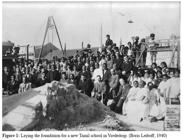
Naransamy remembered that the picture was taken in Vrededorp, which together with Pageview formed a suburb known as Fietas. This was a racially mixed residential area in central Johannesburg which was cleared between 1960 and 1980 under the Group Areas Act. The large group of people seen in the photograph had come together to lay the foundation for a new Tamil school in Krause Street. The school was financed by the Naidoo brothers (Naini Naidoo, fifth from the left, front row, seated) and K.Thambi, the uncle of Naransamy (third from the left, front row, seated). The Tamil school was built in memory of Gopal Naransamy's father, Naransamy Kistasamy,3 (who had died two years earlier) as well as three other distinguished local men of importance, including Gopal Naransamy's grandfather. It is for this reason that most of Naransamy's family was present at the photo-shoot. Gopal Naransamy was given the honour of addressing the assembly.
I made the opening speech in Tamil. My Tamil school teacher made me read almost twenty written pad pages. To my relief the chairperson asked me to stop and other speakers took over and I remember the attorney Lazaar complimenting me to go through the lengthy speech I delivered in Tamil. Boy was I happy when they asked me to stop! Plenty of eats, plenty of music.4
Naransamy explained that the death of his father, Naransamy Kistasamy, had brought about major changes in the life of the family. Initially his uncle, K.Thambi, helped the family but the situation deteriorated when Naransamy's mother, Raja-niah, also died prematurely. Rajaniah Kistasamy is also present in the photograph standing among the group of women on the right, her face partially obscured by the shadow of her daughter Dolly (the girl with the braids standing elevated behind her grandmother 'Archie Pati'). When Naransamy's mother died Dolly left school to look after the younger siblings (including Shirley, located behind the presumed Hindu priest) under the supervision of this grandmother. Naransamy, who had started studying at Sastri College in Durban, was forced to abandon his plans for a career in medicine and returned to Johannesburg to seek work. On his uncle's advice he trained as an accountant, a profession in which he worked at various stages of his life without ever developing a passion for numbers. This photo-elicitation interview with Naransamy had opened up not only additional information about the picture, but had also provided some biographical clues that could be investigated further.
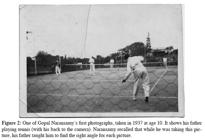
In his early twenties, Naransamy explained, he was able to leave accountancy and turn his longstanding hobby of photography into a breadwinning occupation. He had received his first camera from his father on his tenth birthday in March 1937, a 620 Kodak Brownie. For the next year and a half father and son experimented with photography. They also shared a great passion for all kinds of sports, but their collaboration was cut short by his father's death.
It is surely more than mere coincidence that Gopal Naransamy, whose life changed so profoundly following the early death of his father, should go on to become a professional photographer with a lifelong interest in sports photography. He persisted with photography as his favourite pastime and in his teens went through several cameras either owned or borrowed. He even convinced his uncle K.Thambi, a wholesale dealer by profession, to order cheap cameras from Japan that, according to the catalogue, came with developing solution, fixing trays, chemicals and paper. Unfortunately, these turned out to be matchbox-sized children's toys that only allowed pretend play without producing real pictures. Nevertheless, his love of photography was undefeated and he was determined to have his own darkroom. Naransamy borrowed a chemical directory and ordered the necessary ingredients. With the help of a friend who worked at the local chemist, he mixed developing solutions and started experimenting in a makeshift 'darkroom' under his bed created by hanging a blanket over the sides. Later he organised a photographic club with friends and took part in photographic competitions. By 1950 he had built a proper darkroom in the spare bathroom of the house. He successfully established himself in Fietas as a sports photographer with a good track record and a reputation for reasonable prices.
Working for Drum
In 1953 Gopal Naransamy landed his first job as a professional photographer at the famous monthly magazine Drum. Initially he worked as a darkroom assistant. Bob Gosani, who ran the darkroom under Jürgen Schadeberg, came to Naransamy's house one Saturday night to borrow fixing solution for both film and paper as Drum had run out of stock.
I said it would be a pleasure to assist and mixed up two bottles of fixers both for film and paper ... He rushed back to his office and I never heard from him, until a couple of months later he popped in again at my home in 18th Street. I thought he had run out of some chemicals again. But this time he came to offer me a job as his boss Jim Bailey requested Jürgen Schadeberg to get someone to run the darkroom as Schadeberg left Drum on several occasions to go overseas.5
A few months later Naransamy left accountancy and joined the magazine's darkroom team. Naransamy took pictures mostly of sports events over the weekends. Following the appearance of the Golden City Post he was increasingly assigned to work as a sports photographer. At this time sports photography was still a neglected field in South Africa's media. Thanks to his keen interest, some previous experience, and the help of Hank Margolis, an expert in sports photography who temporarily worked for Drum, Naransamy developed his skills and soon started to excel in this field. Over the years he became a permanent member of the staff, taking pictures and later working as a darkroom manager. From 1960 he worked as assistant photo editor for the Golden City Post, the weekly sister publication of Drum.
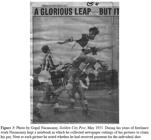
After a decade of working for Drum and Golden City Post, Naransamy left in 1962 or 1963 following a clash with the editor Cecile Eprile.6 He has since worked variously as an accountant and in-house-photographer for an insurance company and several NGO's. His photographs of local sports and society events still appear regularly in the monthly papers in Lenasia where he now lives. In contrast to many of his competitors in the commercial Lenasia market who cater mainly for weddings and anniversaries, Naransamy has not taken up digital photography or video recording. Over the years his style has become less adventurous and, looking back, he reflects that the black-and-white pictures that he took between the 1940s and the1960s were the best of his career.
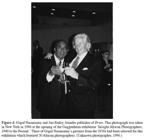
As a photographer for Drum and Golden City Post, Naransamy formed part of what has been referred to as South Africa's school of 'Resistance Photography'. In the 1950s Drum, with its glamorous take on jazz musicians, gangsters and cover girls, challenged the dominant perceptions reflected in colonial photography, while at the same time developing a critical perspective on racial segregation.7 The magazine featured articles of groundbreaking investigative journalism.8 Its stories were heavily illustrated,9 making them accessible to even moderately literate readers. To be used by Drum photographs had to fulfil specific aesthetic criteria. As Ranjit Kally, a photographer who worked for the magazine in Durban explains, Drum photographers were sent on the same assignments as their daily news colleagues, and 'we had to take pictures that could be kept alive after the other publications came out with their stories. This made us look at the same story from different angles.'10
South African social documentary had begun to take on a critical perspective even before Eli Weinberg (banned from his work as trade unionist) turned to photography in 1953 and Drum published its first issue in 1951. Libertas (a South African monthly magazine that ran from 1940 to 1947) and its photo editor J.P. Vorster, encouraged illustrated stories on urban social issues much in the style of the later Drum. Another pioneer of visual critique of social inequality was Ellen Hellmann who ventured into Johannesburg's deprived suburbs in the late 1930s and early 1940s to document the living conditions of the urban poor.11
After joining Drum two years after its inception Gopal Naransamy, with some experience in photography under his belt, soon turned out to be a valuable asset. He found himself in the role of tutor to some of his younger colleagues who were new to the art of photography. Naransamy remembers that Peter Magubane joined Drum as a driver in 1954. While being driven to photo-shoots by Magubane in the small company car, Naransamy noticed Magubane's interest in photography and, as he puts it, 'sensed his eagerness to learn'.12 He started off the younger man's career by organising a Rolleicord camera for him, deducting two pounds every week from Magubane's salary to pay it off.
Gopal Naransamy was at the pinnacle of his career as a photographer in the late 1950s when he took a number of exceptional pictures for Drum and the Golden City Post. Some of these are included in publications and photographic collections.13
Naransamy turned 80 in March 2007. Today he is hard of hearing and a little forgetful, but he still gets excited when conversation turns to the topic of photography. When we first met, I was surprised that Naransamy did not show me many of his pictures. What I got to see were fairly recent, mostly colour shots included in his publication Gems from Gopal, an album mainly documenting local events in Lenasia during the 1980s. I was allowed to peep into his darkroom where mysterious cardboard boxes lined the shelves. Despite months of regular conversations not many exciting images appeared. Instead the method of photo-elicitation became the basis of our conversations. We began with Naransamy's memories in semi-structured interviews. I hoped that once we had established a relationship of trust I might get to see what the darkroom shelves held.
It took me some time to understand that Gopal Naransamy was not hiding treasures but was, in fact, a photographer without photographs. The pictures he took professionally for Drum and Golden City Post are, of course, preserved in the publication's archive.14 Due to the legislation framed by the South African Patents, Designs, Trade Marks and Copyright Act of 1916, which was still applicable in the 1950s, he unfortunately has no rights over these. On submission of their pictures, newspaper photographers like Naransamy surrendered both negatives and copyright to the 'proprietor', that is, the publishing house. While his famous colleagues Peter Magubane and Jürgen Schadeberg have fought and won court cases against Bailey's African History Archive (BAHA) to restore ownership of their photographs, Naransamy can only access this part of his artistic work through the Bailey's Archive and through publications that sometimes do not even mention his name,15 or worse still, through exhibitions that sometimes attribute the wrong photographer's name to his work.16 The fact that the authorship of many pictures in the BAHA is disputed further complicates Naransamy's case,17 as the photographer's name was not always recorded and sometimes several photographers were sent out to document the same event.18 While Naransamy's professional work is thus widely inaccessible to him, his large collection of private and unsold assignment pictures from the 1940s to 1960s suffered a different fate.
Drawing mental images
Naransamy created his own archive of negatives and freelance pictures over which he retained copyright. He stored the negatives in a wooden bluesoap-box measuring roughly three foot by one foot. He inserted partitions in order to file the negatives upright in rows. Individual negatives were stored in little semi-transparent cellophane bags provided by his Chinese friend, Ah-Pen, who ran a corner shop down the road and used them to package pink 'Romantic Sweets'. Naransamy numbered these little bags alphabetically, beginning with A0001 and carrying on until Z0456 (or whatever the last picture number turned out to be). The negatives were documented in a notebook with their archive number and details such as date and place taken and scene depicted.
This private archive was kept in his bedroom for safety while he lived in Vrededorp. It was clear that nobody was to interfere with this treasure. Even his wife Angela, who termed herself 'the darkroom widow' because Naransamy spent more time with his pictures than with her, did not dare to touch the wooden box. In September 1960 the Naransamys left Vrededorp to move to Lenasia, sharing an open lorry with Gopal Naransamy's brother-in-law to transport the furniture. At the time, Naransamy still worked for the Golden City Post as a picture editor. Fearing his private archive might in some way come to harm on the lorry, Nara-nsamy deposited the wooden box with his brother Perry for safekeeping. What was intended to protect the archive turned out to be its undoing.
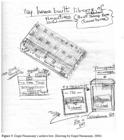
Naransamy's archive was burned to ashes when the factory where it was being stored went up in flames and all his private negatives were lost.19 In a single night more than two decades of his work were destroyed. For some time after the loss Naransamy gave up taking any pictures and for an even longer time he did not organize his negatives in a private archive. It was only in the early 1990s that he began to reclaim photographs from friends and family in an attempt to reconstruct his lost archive. The result of his reconstruction can be found in his publication Gems from Gopal which documents not only how little from the 1950s survived, but also how little he had archived in the two decades after his entire private work had burned.
The loss of his archive has been traumatic for Naransamy and even now, forty years after the disaster, it took him several attempts to finally write down - in one long breathless sentence - how his private picture archive was burnt to ashes.20With his agreement I have arranged this long sentence into lines as an epitaph, shown below. Recording his memories related to the picture archive and describing his lost negatives has become our recent project, which Naransamy refers to as his 'mammoth task'.
This mammoth task
of trying to reconstruct
from pure memory
the contents of my treasured missing box
of my collection,
that I sent to Lenasia with my brother Perry
who in turn gave it to his brother-in-law Sonny Boy
who because he had a kitchen dresser manufacturing factory
was the ideal person to keep
my treasured box of negatives
with his factory products that were well protected from theft,
but, what should happen, is,
that the factory caught on fire and,
besides losing his stock of finished and unfinished kitchen dressers
and factory machines
and equipment
my treasured box also went up in flames.
I will just get it off my chest,
will leave it as god's will.
Gopal Naransamy has begun to describe and draw what he remembers of the many negatives he lost in notebooks that I supplied to him. In order to communicate the images he relies on verbal descriptions and on drawings. Being a photographer and no graphic artist or writer, he is never satisfied with his drawings and texts. He constantly searches his memory for further details, mourning the loss of the 'complete picture', often painfully realising that he simply cannot remember the past.
Berger states that: 'All photographs are there to remind us of what we forget' .21 I would suggest that this can also be applied to mental images that exist in the absence of physical pictures. When Naransamy recalls a mental image of one of his lost negatives, he is aware that there were more details in the picture, but he simply cannot remember them. He knows that he had thousands of negatives in his wooden box but can remember only a tiny fraction of them.
While reading through Naransamy's notebooks and discussing his work, I have come to understand that for him mental images take an intermediate position between physical pictures and fading memories. The descriptions focus initially on a specific lost photograph. But the mental image also triggers contextual memory in much the same way as physical pictures might have evoked memories through photo-elicitation had I confronted Naransamy with them. In his case his mental images almost always trigger a memory that takes him back into the situation of taking the picture. This includes his position as the photographer, the reason why he was asked, or decided, to take the picture, and his own emotional involvement in the event. Sontag states that photographs are mute.22 She identifies their shortcoming not as a lack of detail or complexity, but a lack of context. Naransamy's mental images, on the other hand, are anything but mute. Full of context, if not necessarily detail, they speak with the nostalgic voice of a lost time.
Afonso is one of the few anthropologists to have recently worked on ethnographic drawing as a method. He regrets that the tradition of ethnographic drawing has almost disappeared, pointing to Newman and Ramos's work as examples of attempts by anthropologists-cum-artists to revive this practice.23 Afonso specifically points to the danger of photographs which he believes contain 'too much'.24He points out how it is possible to misguide the viewer with photographs not produced specifically for photo-elicitation. Such photos, he claims, can easily distract through unintended details and surroundings. Unlike photographs that show an excess of detail, drawings tend to focus and essentialise, something which Afonso sees as an advantage. In addition drawings transcend the limits of linear textual representation and can therefore, for example, mediate questions of social practice. Unlike photographs which are capable of showing only what was visible at the moment, drawings can reconstruct hidden aspects, involving informants as a source of remembrance, as checkers and authenticators, or even as artists. Afonso describes the advantages of drawings over photographs:
It is interesting to note that with the exhibiting of my photographs I gained the reputation as a museum collector, while showing Manuel Joao's drawings seemed to produce the effect of jogging their memories, and each time something else came to their minds that inspired new sketches ... Thus by offering the informants the possibility of actively participating in creating and modifying sketches, I could see that we were involving them in further construction of their discourses in interpreting their memories, which contributed to give coherence to fragmentary accounts and allowed the successive incorporation of new details into the narrative.25
Unlike photographs drawings are an open medium. Gopal Naransamy sometimes redraws memorable pictures in order to get a specific aspect right. He produces enlarged drawings of important details, draws bird's-eye perspectives to show the position of people in a photograph and to illustrate his own position as the photographer in relation to everybody else. Most of Naransamy's drawings are schematic and come with some inserted text labels combining the visual and the verbal.
The drawing below illustrates the context of a picture which Naransamy took, developed and finally lost. This one was not in his box of negatives, but got lost through other circumstances. The photograph in question was a black and white print. It showed a white man in police uniform pointing a camera from an elevated position at a crowd of people. Naransamy's photograph also showed how the elbow of the police officer touched a painting on the wall behind him tilting it in the process. Why Naransamy remembers this particular photograph so vividly is apparent from his description of the events surrounding the party where the picture was taken.
My close ANC friend and stalwart Fareed Adam lived in 18th Street in Fietas, the same street I lived. He came to my home to break the heartwarming news of the withdrawal of charges against the treason trial-ists. . He also tipped me off about a party to be held at the home of Joe Slovo who was then married to the sociologist Ruth First. I made doubly sure my camera was loaded with new film and was all set when he came to pick me up. The party was held in the northern suburbs and when we arrived there, Ruth hugged Fareed and me and we later met several other friends black and white. While some of the mixed couples were dancing to terrific recorded music, the whole atmosphere was one of jubilant merrymaking. I was inwardly a bit disappointed at not seeing many other Indians except for Saleh Asvat my close friend, and a Durbanite whom I mistook for G. R. Naidoo at first.26 It was a Durbanite alright - but someone I had never met before.
Being equipped with my camera, the crowd inside accepted me as a Golden City Post/Drum photographer. I was however not on official assignment, but took pictures on my own initiative.
In his account Naransamy emphasises his emotional involvement in the event. He remembers the circumstances of getting to the party accompanying an ANC friend, being greeted as a friend at the party, and still being perceived by party guests as a photographer. It is crucial to Naransamy's self-understanding, that he is a guest as well as a fellow ANC member and a photographer.
As usual I was clicking at the couples on the dance floor. The large dining room and lounge improvised with the connecting doors widely open, resembled an original makeshift dance floor accompanied by settees and padded sofas to make the walls more relaxing. There was plenty of liquor, beer and for some of the ladies, tea and biscuits. The music and the dance was in full swing when about ten thirty or eleven we heard the crash of a broken glass and saw white cops climbing through the window. Clad in khaki uniform and batons swinging in their hands trying to stop the mixed couples from dancing.
The large table in the lounge was a high view for one of the cops who jumped onto the table, boots and all. He did not have a gun in his hand but a camera which looked like a 35mm to me. Whilst he was photographing the mixed couples who were deliberately hugging one another posing for the picture, I grabbed the opportunity to photograph the cop in action. My added luck was, that I noticed his elbow touching the huge canvas painting that adorned the wall and was now tilted though it did not fall off the wall.
This description of the situation as Naransamy took the picture of the police officer is complemented by his drawing above which reconstructs his position and that of the protagonists at the scene. Naransamy emphasises in both the drawing and his description the situation in which the picture had been taken.
The next day I was unusually early at work, and when the films of the night before were developed, I was thrilled. As soon as Schadeberg arrived, I showed him my masterpieces. He went and called Cecile and in his usual stuttering voice, Cecile congratulated me. It was not long afterwards, before lunch when I was requested to make a copy of the photo showing the cop and his elbow whilst standing on Ruth's table with his large boots on. Boy was I happy that the Slovos were going to sue the police for damages. Apparently the office was already in touch with the Slovos to give them the good news that I took a picture showing especially the huge canvas painting, how it hung slanting on the wall. Brother! Was I disappointed when the two rolls of film went missing the next day from the rack in the cupboard.
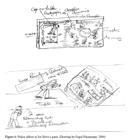
Naransamy recalls his feelings of pride when his work is praised by both his photo editor, Jürgen Schadeberg, and the editor of Golden City Post, Cecile Eprile. He was obviously disappointed when the two rolls of film disappeared from the darkroom to which only a few people had access. Apart from the emotional journey of taking and losing the picture, Naransamy has a vivid mental image of the photograph itself. This is not necessarily because the image was aesthetically stunning or spectacular with the slanting painting, but because he remembered developing a single print in a hurry, being pleased that it might be used as proof in court and that he had been there with his camera at exactly the right moment.
Naransamy never found out who took the two rolls of film from the darkroom cupboard. As only a few people had access to the room and knew of the pictures, it can be speculated that the Slovos requested they be given all pictures due to their rather personal content. It is possible that Naransamy's ambivalent position as guest, ANC member and photographer which he emphasises in his narration was perceived as undesirable. It is possible, too, that Eprile used his right to Naransamy's pictures, passing them on to the Slovos. However, if this had been the case it is odd that Naransamy should not have been informed of this.
Photo-elicitation with unknown images
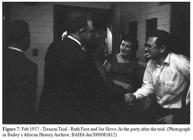
Naransamy's vivid mental image of the photograph and its circumstances of production, together with his disappointment over the loss of the picture inspired me to try and find a trace of the two lost film rolls. Looking through the BAHA archive I came across an image taken in February 1957 with the caption: 'Treason Trial - Ruth First and Joe Slovo. At the party after the trial'. I thought the caption was likely to refer to the very party Naransamy had described. As the photograph was not ascribed to a specific photographer, the picture could indeed have been part of the two rolls of negatives that had disappeared from the darkroom at Drum. I was curious as to what Gopal Naransamy would make of the picture when confronted with it.
I showed a print of the picture to Naransamy without any comment. He looked at it for a while and then said: 'I know this woman - who is it?'27 Clearly the picture had not sparked any immediate recognition. Naransamy wondered if the woman in the picture might be Helen Joseph, but when I told him about the caption he agreed that she must be Ruth First. However, he made no connection with the party described above. Trying my luck with photo-elicitation, I asked if he remembered the Slovo's house, pointing to the part of the house that was visible in the background of the photograph. Naransamy conceded that the photograph might have been taken on the outside veranda, but insisted that he certainly had not taken it: 'You know I would never claim a picture I have not taken', he said emphatically.28
Unlike photos that hold unchanging factual accuracies, memories fade or flourish with time. Hume holds that visual memory or an idea of memory 'by losing its force and vivacity, may degenerate to such a degree, as to be taken for an idea of the imagination'.29 To the person who has the memory the experience of degeneration is often painful and disorienting. The above experiment with photo-elicitation illustrates the capacity of mental visual images to degenerate and transform.
The visual image we hold of a person is to a degree flexible, allowing for adaptive changes to accommodate, for example, the ageing process or a change in hairstyle. In our visual memory we are trained to recognize identities, but do not keep a static image. Looking at old pictures we may be surprised how family and friends look or what unattractive (but fashionable) clothing we were wearing. However what is surprising here is that Naransamy clearly remembers Ruth First, but could not recognize her in the photograph. Rather than evoking memory the photograph created confusion. One only has to read through the perfectly concise account of the Slovo's party and look at the reconstructive drawing of the scene to understand that Naransamy is not simply the confused elderly man that he may appear to be when confronted with this unfamiliar photograph.
Esposito defines memory as eine ständige Überprüfung der Kohärenz, a continuous revision of coherence.30 Contributing to the construction of this coherence is not only what we know, but also what we forget. This determines our perception of reality along with the fact that our own memory interacts with social memory (as in the writing of official history and our everyday discourse). Esposi-to bases her argument on Luhmann, who sees memory as a function or construct which selects on the basis of coherence with reality.31 Luhmann dismisses the idea of memory as a container, introducing the concept of memory as a control mechanism oriented towards the future.
This flexible understanding of memory allows us to see Naransamy's confusion over the context of an unfamiliar photograph in a different light. His visual memory had adapted and focused on the question of who had taken the negatives from the darkroom cupboard. He remembered his own role in the evening confidently. When I confronted him with an unfamiliar photograph, he did not rely on his own memory of the event. He did not cross-check plausibility and coherence. He did not question whether the picture was indeed taken at the same event or whether there might have been several after-treason-trial-parties. What Naransa-my did instead was to search his memory for all available associated information regarding Joe Slovo and a woman he does not immediately recognize.
Photo-elicitation is a sensitive method that does not always lead to coherent and connected memory retrieval. My reformed understanding of photo-elicita-tion is that unfamiliar photographs are too precise and unbending to allow us to relate to them. I would suggest that in order to use photo-elicitation effectively the interviewee needs to be directly linked to the photograph by being either the photographer, the photographed, or otherwise present at the reproduced event. The interview with Naransamy demonstrated the effective use of the method, particularly in the initial discussion of the Boris Leiboff picture taken in 1940. Naransamy's presence at the occasion allows him to relate to the picture effectively. However, where he has not been directly linked to a photograph, as in the case of the picture of Ruth First and Joe Slovo, Naransamy is unable to relate to the picture effectively. I would agree with Afonso that the flexible nature of memory is more adaptive to a constructive method employing the narration of events or ethnographic drawings.32 Furthermore, as has been shown above, in the absence of photographs, mental images can be discussed productively together with narrations and drawings.
Ever since the invention of photography photographs have been used to refresh our memories of the past. They have been used as factual proof of events and as aids to recover and re-create memories.33 Working with Naransamy and his memories of lost photographs has provided me with the opportunity to explore the interconnectedness of the senses. Naransamy often emphasised his emotional involvement in events, his conscious self-positioning as a photographer, and his contextual memory when trying to remember a physical picture. How far Naransamy's memories and metal images correspond with the memories of other people who were present will - considering his age and the lack of contemporaries - remain an unresolved question. Gopal Naransamy's accounts of his lost 'box of negatives' communicate his personal link to the past and provide us with new images which he alone has processed.
1 M.Banks, Visual Methods in Social Research (London: Sage, 2001), 87.
2 G.Naransamy, Gems from Gopal: A Pictorial Review of Black History in the Making (Lenasia: Naransamy, 1993).
3 First and second names are sometimes reversed when handed down to the next generation. Kistasamy Thambi is the brother of Naransamy Kistasamy, the father of Gopal Naransamy. Gopal's grandfather went by the name of Kistasamy Harry Singh.
4 Personal papers of Gopal Naransamy, Notebook Nr 5 (2006)
5 Personal papers of Gopal Naransamy, Notebook Nr 5 (2006).
6 It is unclear when exactly Naransamy left Drum, but remembered events point to the end of 1962 or the beginning of 1963.
7 Okwui Enwezor claims that Drum was 'less a voice of political consciousness than it was an entertaining lifestyle magazine'. (O.Enwezor, A Critical Presence: Drum Magazine in Context in In/sight African Photographers, 1940 to the Present (New York: Guggenheim Museum, 1996), 185).
8 See for example Henry Nxumalo's 'Mr. Drum goes to jail' with pictures by Bob Gosani (Drum, March 1954).
9 See for example 'Baby come Duze': text by D. Can Temba, pictures of the model Abigail Kubeka by Gopal Naransamy. Reprinted in: M.Chapman, The Drum Decade: Stories from the 1950s (Pietermaritzburg: University of Natal Press, 1989), 109-113.
10 Kally cited in: Thangevelo, D., Vivid visions of the struggle years. In: Tonight 22/10/2004 http://www.tonight.co.za/index.php?fArticleId=2271231&fSectionId=359&fSetId=251 (accessed 13.07.2007)
11 E.Hellmann, Rooiyard: A Sociological Study of an Urban Native Slum Yard (Oxford: Oxford University Press, 1948). See discussion in Marijke du Toit, 'The General View and Beyond: From Slumyard to Township in Ellen Hellmann's Photographs of Women and the African Familial in the 1930s' in Gender & History, vol 17(3), November 2005.
12 Personal papers of Gopal Naransamy, Notebook Nr.3 (2006).
13 Chapman, The Drum Decade; J.Schadeberg, The Fifties People of South Africa (Johannesburg: Bailey's African Photo Archives, 1987); The Finest Photos from the old Drum (Johannesburg: Bailey's African Photo Archives, Penguin Books, 1987); Sof'town Blues: Images from the Black '50s (Pinegowrie, South Africa: Jürgen Schadeberg, 1994); Exhibition at the Guggenheim Museum 1996; Baileys African History Archive (http://www.baha.co.za).
14 Today: Bailey's African History Archive (BAHA) (http://www.baha.co.za).
15 For example a private letter by Schadeberg to Naransamy dated 7 March 1995 confirming the payment of a compensation for the unauthorised usage of five of Naransamy's pictures in Schadeberg's publication Sof'town Blues without acknowledging the photographer.
16 For example Gopal's famous picture 'Old Man River' from June 1954 published in Jürgen Schadeberg, The Finest Photos from the old Drum, 43 and part of the permanent collection in the South African Galleiy in Cape Town, is exhibited in the Apartheid Museum Johannesburg giving Jürgen Schadeberg as the photographer.
17 Controversies over picture authorship as in the case of the picture of the boxing Mandela (published in: Mandela 1994 Long Walk to Freedom, 354a) ascribed to Bob Gosani and claimed by Gopal Naransamy cannot be resolved on evidence. The early death of Gosani makes it impossible to verify Naransamy's claim.
18 For example the March 1956 the Women's March to the Union Building in Pretoria was documented by several Drum and Golden City Post photographers. Authorship of individual pictures cannot always be established.
19 The strong suspicion that the factory was burned on purpose in September 1960 to claim insurance money gives the story of the lost archive a further tragic twist.
20 Surendra Bhana notes - though he does not explain - the fact that Naransamy's publication Gems from Gopal omits the period of the 1960s and 1970s. He interprets the absence of pictures from this time as an artistic take. See: S.Bhana, Popular Conceptions of History in Community : Pictorial Reviews of the Apartheid Era with Special Reference to Gems from Gopal (Unpublished paper presented at the History Workshop 13-15 July 1994, University of Wiwatersrand), 7.
21 J .Berger, About Looking (London: Random House, 1992), 72.
22 S.Sontag, On Photography (London: Penguin, 1997).
23 D.Newman, Prophecies, Police Reports, Cartoons and Other Ethnographic Rumours in Addis Ababa, Etnofoor, vol. 11(2), 1998, 83-110; A.I.Afonso, 'New Graphics for Old Stories: Representation of Local Memories through Drawings' in S.Pink, L.Kürti and A.I.Afonso, eds., Working Images: Visual Research and Representation in Ethnography (London: Routledge, 2004), 74, 76.
24 Ibid., 83.
25 Ibid., 79.
26 G.R.Naidoo, Drum photographer who worked in the Durban office.
27 Gopal Naransamy interviewed by Stefanie Lotter, Lenasia, 20 October 2006.
28 Gopal Naransamy interviewed by Stefanie Lotter, Lenasia, 20 October 2006.
29 D.Hume, A Treatise on Human Nature: Being an attempt to introduce the experimental method of reasoning into moral subjects; and dialogues concerning natural religion (London: Longmans, 1886 edition), vol. 1, part 3, section 5.
30 E.Esposito, Soziales Vergessen: Formen und Medien des Gedächnisses der Gesellschaft (Frankfurt: STW, 2002), 26.
31 N.Luhmann, Die Gesellschaft der Gesellschaft (Frankfurt: Suhrcamp, 1998), 578-9.
32 Afonso, 'New Graphics for Old Stories'.
33 D.Strange, M.P.Gerrie and M.Garry demonstrate in their research report how photographs can be used to implant false memories. 'A few seemingly harmless routes to a false memory', Cognitive Process, (2005) DOI 10.1007/s10339-005-0009-7.
