Research collaboration in asymmetric power relations: A study of postgraduate students' views
Abstract
Collaboration among researchers and across disciplinary, organisational and cultural boundaries is essential for addressing the increasingly complex challenges and opportunities facing international development. Despite the known advantages and various incentives, research collaboration within Africa (specifically within South Africa) is lacking. To better understand the reasons for this lack of research collaboration, this study explored collaboration between students and supervisors in an information and communication technology for development (ICT4D) postgraduate student project in South Africa. South Africa, a country with major social inequalities and asymmetric power relations, provides an appropriate context. The students' perspectives provided a space for investigating the collaboration factors by unpacking the capability inputs according to Robeyns' representation of personal capabilities. Data were captured from a survey and focus groups (FG) with students and supervisors in ICT4D from different universities in South Africa. Thematic analysis was used to identify and link the participants' expectations of research collaboration with their perceptions of the challenges of such collaborations. The contribution is a conceptualisation of the main components representing research collaboration viewed in terms of personal capabilities, including the factors that influence collaboration. TRANSDISCIPLINARITY CONTRIBUTION: Research collaboration is fundamental to promoting multi-, inter- and transdisciplinary research. The novelty of this study lies in applying a theoretical lens from the field of human development to explore research collaboration in the transdisciplinary field of ICT4D. Given the research application context and the theoretical lens applied, the findings have implications for initiatives and policies on funding transdisciplinary research collaboration.
Research collaboration; capabilities; conversion factors; ICT4D; postgraduate students
Introduction
National and international research collaboration is advocated with a view to maximising scientific research productivity,123456
While institutional support is vital for forming an alliance, individual scientists remain the key actors,788
The potential of research collaboration for human development has been studied to some extent. Examples include the work of Persson6910118
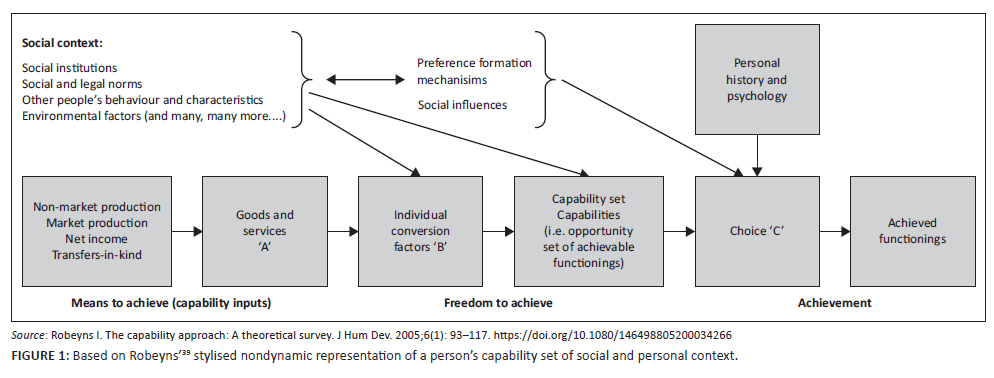
Ibrahim1213Figure 1) to unpack their findings towards presenting the main research collaboration components and factors that impact research collaboration from a personal capabilities perspective. The perspectives of master's, doctoral and postgraduate students (also known as novice researchers) are significant as they represent the future generation of research collaborators,14,15,16 yet extant studies have not considered their voices in this regard.
This interpretivist study was conducted using a case study research design. The context was Southern African postgraduate students in the field of information and communication technology for development (ICT4D). The exploratory data capturing involved surveys and focus group discussions (FGDs) with ICT4D postgraduate students in 2019.
In the next section, an overview of research collaboration is presented, which is followed by an overview of the CA and then the research context. Thereafter, the research design is explained, the findings are presented and the article is concluded by looking at the limitations and the research contribution.
Review of related literature
Research collaboration
Collaboration in academia has been defined in many ways. According to Cataldi et al.,1776
Given the link between high levels of collaboration and scientific research productivity, many developed countries seek to stimulate collaboration through a mix of research grant schemes and grant criteria designed to fund collaborative research.14
Lewis et al.1fluid, expressive and concrete, instrumental collaboration, noting that the two are not mutually exclusive and their use varies from one discipline to the next. Arguably, the former (fluid and expressive) can be seen as the process perspective, whereas the latter (concrete and instrumental) fits the product perspective. Kumar and Ratnavelu,18
Researchers' engagement in collaborative activities are motivated by a multitude of factors which can be grouped under the categories of personal, social and environmental. Personal factors include intrinsic motivation, researcher characteristics and individual behaviour.191820,21,22,23Social factors comprise productivity, association with a prominent co-author, cultural diversity, gender, communication and membership of a researcher's social network.21,22,23,24,25Environmental (also referred to as institutional) factors encompass higher-quality results, access to funding, the pooling of expertise for solving complex problems, top management support, disciplinary measures, detailed supervision policy and rewards.19,21,22,23
Personal factors motivate a researcher to engage in collaborative activities, while environmental and social factors strengthen collaboration.21211025
This section highlighted core aspects in the theorisation on research collaboration, and the next section motivates the relevance of the application context, namely ICT4D for research collaboration.
Research collaboration in information and communication technology for development
Information and communication technology for development is an interdisciplinary field concerned with the use of information and communication technologies (ICTs) for international development;326
According to the social network analysis of researchers at the International Conference on Information and Communication Technologies and Development (ICTD), there are fewer collaborative ties among academic institutions in developing countries.2728,29,302888
In summary, extant findings on research collaborations in Africa indicates mostly intra-institutional collaboration or collaborations with countries outside of Africa. Involving researchers from the application context can improve the authenticity of the findings, given that South Africa has been identified as the main research hub in Africa.28,293132
Despite the dynamic research context and the prevalence of novice researchers (postgraduate students), there is little evidence of studies into the factors influencing this cohort's collaboration at South African universities, let alone an investigation that applies the CA to human development in the context of novice researchers in South Africa as one of the hubs for research collaboration in Africa. Against this background, the authors argue that the capability set of postgraduate students, as the future research generation, should be investigated and that South Africa provides an appropriate context.
The capabilities approach
According to Boni and Walker,133334
Unpacking the CA for the design of policies and proposals related to social change in society, Robeyns3939Figure 1 is thus applicable to research collaboration as follows.
Research collaboration involves several capability inputs that a researcher ought to have; these include educating, writing, engagement and argumentation.25,38,40,418
The CA focuses on the process of expanding people's real freedoms so that they can live the kind of lives they have reason to value.42good (personal property or service) and the functionings needed to achieve certain beings and doings is influenced by three groups of conversion factors: the personal, the social and the environmental.34
Postgraduate students' research collaboration contexts, delineated by the personal, social and environmental conversion factors, can be unpacked as follows: personal conversion factors refer to students' mental and physical condition, literacy, intelligence, gender, affiliation, emotions and so on. Social conversion factors refer to public policies (such as Goal 17 of the Sustainable Development Goals [SDGs], the South Africa National Development Plan [NDP 2030] to increase the number of graduates by producing more than 100 doctoral graduates per million per year by 2030),14network weaving to foster resilience and sustainability in ICT4D research, Marais and Vannini43
Environmental conversion factors include geographical location, which considers the crime rate in some cities and how it may deter collaboration, and the presence of power rationing, which affects some cities in the country more than others. Environmental conversion factors also include issues such as climate and infrastructure, which can affect the conversion from a characteristic of goods and services to individual functioning (e.g. enrolling for distance learning if the geographical location impedes face-to-face tuition).
The significance of research collaboration for capabilities can be conceptualised in terms of enhancing individual conversion factors ('B' in Figure 1). Dejaeghere37Figure 1).
In accordance with the normative aspect of the CA, research collaboration should be guided by a concern to expand individual capability sets. The CA takes account of human diversity in two ways: firstly, by focusing on the variety of capabilities and functionings as the evaluative space, and secondly, by explicitly focusing on personal and socio-environmental conversion factors converting commodities into functionings, and on the whole social and institutional context that directly affects the conversion factors and also the capability set.44
As mentioned, research collaboration can be deemed either a product or a process. The product view (which connects to the functionings) focuses on research collaboration as an artefact of institutional policy or funding agency grants, with measurable outcomes such as interinstitutional agreements, publications, students graduating and so on. The process view adopts a relational ontology to account for the power constituted in social relations and structures, the researchers' internal processes and the external processes needed to deliver envisaged outcomes. The latter presents the fact that research collaboration is valued for personal development, which cannot be measured in terms of research outputs.
Against this overview of the CA, the authors focus on investigating students' personal capability set that could support human development. The next section describes the context followed by the philosophical assumptions that guide the study; motivates and explains the research design and data-capturing strategies; and details the way in which the research was done.
Research context
Supervision relationships are asymmetrical by design. Supervisors generally have more knowledge and experience than the student in the research area and often more access to resources. The latter is specifically true in South Africa, a country with major socio-economic inequalities.4546
Socio-economic inequalities, together with the provision of financial support for historically disadvantaged students, mean that many of them are the first members of their family to obtain a degree and enrol for postgraduate studies. The now-abolished political system of apartheid, which led to the institutionalised, race-based disadvantaging of nonwhite groups in South Africa, had negative consequences for human capacity development. That legacy, coupled with the 2018 parliamentary decision to increase the scope of NSFAS aid, underlies the imbalance in power relations between supervisors and students. Thus, the case of South African student-supervisor collaborations in 2019 is unique and timely to investigate.
Research methods and design
There is no standard or exclusive procedure for 'translating' the theoretical level of the CA into its empirical counterpart.474841
This study followed the philosophical assumptions of interpretivism, which are based on the premise that our knowledge of reality is a human social construct.498
Case study research is advocated for understanding a real-world phenomenon when it involves important contextual conditions which are pertinent to the case.49,50
Scope
Data capturing was limited to postgraduate students undertaking master's, doctoral studies and postdoctoral fellowships in the field of ICT4D at South African universities. The focus was on students' perceptions, but supervisors' inputs were considered when they were available (during an ICT4D chapter launch) and found useful for understanding issues related to the conversion and collaboration factors.
Data capturing
• In July 2019, exploratory data were captured during the chapter launch of the international network for postgraduate students in the area of ICT4D (IPID) in Southern Africa. The event was hosted in the Gauteng province of South Africa.
• The attendees hailed from six institutions (five universities across South Africa, plus the National Research Foundation). The participants represented six different countries in Africa, including South Africa, Uganda, Kenya, Nigeria, Tanzania and Namibia. The presence of the novice researchers in South Africa speaks to the value that South Africa has in fostering their academic development, including access to resources, finances and knowledge, and supports with the claim that South Africa is the hub for research in Southern Africa.
• A hard copy of a questionnaire containing seven open-ended questions on research collaboration was handed to 38 junior researchers (master's and doctoral candidates and a postdoctoral fellow) and 5 senior researchers (associate professors and professors) with the request to complete it. After 35 min, all participants had completed the questionnaires. Thereafter, they were asked to form groups of five or more individuals, so that each group included master's and doctoral students.
The senior researchers formed a separate group. The groups engaged with the same seven questions (from the questionnaire) in FDGs lasting between 30 min and 45 min. Each group had a coordinator who facilitated the discussion and audio-recorded the discussion using a smartphone. The coordinator would pose questions (from the questionnaire) to the group and entice engagement from the FGD members. For the novice researchers, each group had a coordinator who was a fellow novice researcher. For the senior researchers, the coordinator was also a senior researcher. The intention of using peers was to reduce power imbalance and afford open discussions. Although the CA informed the authors' thinking on identifying concepts related to research collaboration, the questions were not formulated in terms of CA terminology, as the authors could not assume that the participants were adequately familiar with the terminology of capabilities, functionings and conversion factors (see Questionnaire in Appendix 1). The majority of the questions formulated targeted an understanding of the conversion factors (personal, social and environmental). The purpose was to use these constructs during the data analysis to abstract and present the capabilities and functioning from the novice researchers' perspective.
Data analysis
The authors followed the six-phase thematic analysis, advocated by Braun and Clarke,51
• The first phase, familiarisation with the data, began with an edited transcription of the recorded FGDs. A research team member transcribed all three focus group (FG) interview recordings. Each questionnaire was given a unique identifier and scanned to retain a digital copy of the responses. All the transcripts (from the FGDs and open-ended questionnaires) were loaded on ATLAS.ti version 8 (ATLAS.ti GmbH, Berlin, Germany), and the researchers read and reread the transcripts to understand the breadth and depth of participants' contributions from the FG.
• The second phase involved generating initial codes on the transcripts, assigned to a sentence or paragraph, to address the research questions. The authors did not have an externally created code list. Initial codes included 'challenges of research collaboration', 'conditions for research collaboration', 'intention to collaborate' and 'benefits of collaborations'. The researchers also took note of tensions (contradictions) in the transcripts, as the participants engaged with the questions.
• The third phase involved searching for themes and engaging with the initial codes (from the second phase) by collating all related, relevant data extracts. Related codes were connected using networks on ATLAS.ti, and a code group was created to link them. A few initial codes were grouped under 'miscellaneous', since they did not fit into any of the related codes. At this stage, the code groups were referred to as themes. Examples of themes emerging during this phase included 'common understanding', 'roles and responsibilities', 'distribution of intellectual property' and 'publication credits'.
• The fourth phase focused on refining the code groups, with each being assessed for internal homogeneity and external heterogeneity. In the process, the researchers coded more data extracts (returning to the second phase) in a recursive manner, based on new ideas that emerged while reviewing the themes. The fifth phase involved defining and naming themes obtained during phase four. The themes (including subthemes and counterarguments) were reconsidered in terms of their contribution to the broader perspective of research collaboration.
• The sixth phase involved producing the research report - a complete data-based story to allow the reader to understand the merit and validity of the analysis. The current study represents phase six of the thematic analysis.
Ethical considerations
Ethical clearance (ref. no. 2019_RPSC_037) was obtained from the Unisa College of Science, Engineering and Technology's (CSET) Research and Ethics Committee and the Research Permission Sub-Committee (RPSC) of the Senate Research, Innovation, Postgraduate Degrees and Commercialisation Committee (SRIPCC). Each participant was requested to read and sign the ethics consent form before the questionnaire was distributed. Participant names were not captured, so responses cannot be traced to any individual person.
Findings and discussion
The following main themes emerged from the thematic analysis (followed by the number of occurrences in brackets): common goals (51), transparency (30), finance (98), knowledge sharing (107), institutional requirements (86), diversity (54) and power imbalance (59). Knowledge sharing and finance being the most mentioned relates to the reasons for collaborating, while the other themes relate to the factors that support or hinder collaboration.
The themes are multidimensional in terms of having personal and institutional aspects and constraints. The personal dimension focuses on what an individual values and views as important in a research collaboration. The institutional dimension considers the policy, resources and any documentation that goes beyond the personal dimension and is bound (or restricted) by the researcher's affiliation. The constraints refer to challenges that researchers are encountering in creating, engaging and ensuring they have a sustainable collaborative working space. The differentiation of the different dimensions is crucial, as it allows for data to show the transition of the personal to the institutional issues and accounts for any challenges encountered, which connects to viewing a research collaboration as a process. The themes and dimensions are now presented, supported by quotations and linked to the extant literature where relevant. Data from FG are identified by a number for each FG (i.e. FG1, FG2 and FG3). FG3 represents the FGD among supervisors. Questionnaire data are noted as 'Q', followed by a number for each analysed questionnaire based on the unique identifier.
Common goals
The researchers identified the need for a common understanding of what research collaboration requires, what roles and responsibilities each researcher or institution should have, and how intellectual property and publication credits are distributed.
Personal goals
'[…F]rom the onset, having that discussion to state what are the actual benefits, and then allowing rooms for continuous engagements to go through those expectations …' (FG2)
Institutional goals
'[…S]o it is better to be upfront and put forward to say that these are my institution policies and vice versa.' (FG1)
Constraints
'What I think is that if I want to collaborate with you there might be what I want to achieve through my sponsors. So you might see literally when I want to discuss this topic, but the way I understand it, my financers or people who are sponsoring me will understand it different from you. So there is nothing you can do to have a common ground …' (FG1)
Noticeably, in some cases these common goals may be affected by the demands of supervisors, sponsors and organisations assisting the researchers. Freshwater et al.52
Transparency
The researchers argued that each party involved in collaborative research had to be clear not only on their common goals but also on the expected benefits. At an institutional level, the use of a memorandum of understanding (MoU) was proposed as a tool for researchers to work towards common goals.
Personal
'So, I think if we are transparent that, yes there is a common but here are my intended benefits - whether it's financial or otherwise - if we disclose that upfront at least I know that my contribution comes from my heart rather than an embedded expectation.' (FG1)
Institutional
'Having the MoU upfront about those things may be helpful.' (FG3)
Constraints
'Let's say I found certain findings that are opposite to what the company that is funding you is saying. And then these people are saying no you mustn't write these results, you must look for the results that speak to our agenda.' (Q17)
A sponsor's agenda was perceived as a possible obstacle to providing credible, empirical evidence. Concerning student-supervisor collaboration, there should be a contract outlining action plans, intentions and expected outcomes before commencing the collaboration - an argument that Van den Hoven and Connell25
Finances
Funding is an essential component of most collaborative research projects. It is associated with the cost of data collection, data analysis, acquiring tools and travelling. Travel may involve visiting a location for data collection or attending conferences.
Personal
'Research collaboration could maybe provide funding to travel.' (Q12)
Institutional
'It is difficult to have fundamental access to resources, journals, journals database, [Et cetera] Students cannot access because institutions cannot afford into the journals. All they do is doing profit. But we can't read our colleagues work.' (FG3)
Constraints
'In a case where finances are not balanced, I believe success will be limited; especially in a case where the researcher is sponsored by a particular organization they may be required to report results that are beneficial to the particular company.' (Q9)
'We have no funding to attend conferences.' (Q8)
'We have no access to the fund, yet our full input is required during the inception.' (Q8)
The findings on the importance of the availability and management of funding during a research collaboration are in line with those reported by Cottrell and Parpart,105253
Knowledge sharing
A lack of experience, few publications, limited research networks and being ill-equipped to operate in a multidisciplinary collaborative space were cited as barriers to research collaboration.
Personal
'The challenge that I think we are experiencing as emerging researchers; you will find that the people who are already well established do not want to collaborate with us. Because the information is only going in one direction, they don't gain anything. […] So, if they are working with an emerging researcher, they know that you are dragging them and going to ask too many questions.' (FG2)
Institutional
'Because for projects you need people from multi-disciplines - technologies, sociologists, etc. Then when you collaborate you can't be master of all trades.' (FG3)
Constraints
'I think also just to hub on the knowledge side, it is really a case of "you know what you know" and "you don't really know what you don't know". In that collaboration space, it gives you that ability to actually test what you don't know, and obviously once an acknowledgement is there you are the one that actually knows and there is actually new knowledge that is being generated.' (FG2)
Knowledge sharing allows novice researchers to test new ideas, concepts or arguments and acquire feedback that will assist them in better understanding their area of specialisation. Tan23
Institutional requirements
Institutional requirements relate to the research policies which guide the credits and rewards afforded to joint publications, external supervisors and collaborative programs (e.g. visiting researchers).
Personal
'[…F]or example, our papers are marked by external examiners. So, if I get an external Wits [the University of the Witwatersrand] perspective and maybe my paper is going to be marked by a Wits lecturer I mean it is quite beneficial for me to sort of understand how Wits perceive writing styles or expectations out of your research paper. Unless if there is a standard in research on how you should research terms of what is expected.' (FG2)
Institutional
'In terms of institutional practices and background, I think ethics can be different … For example, in terms of let's say when you are conducting research, some institution may have to incentivize that research giving people gifts etc., whereas some institutions do not allow researchers to give out any gifts, data etc. I think that could be a challenge in my perspective.' (FG2)
Constraints
'[… L]ike the issue you pointing out of students not getting informed about certain things, I find that a lot of time maybe we tend not to read through the websites, [Et Cetera] because a lot of information is there but we tend to mostly rely on what did the next person tell me about.' (FG2)
The participants noted that much of the information (issues relating to intellectual property, the application of ethics and incentives) about research is found on the university website but that they prefer to consult colleagues instead of university information structures. Based on a study of research collaboration at Kenyan universities, Muriithi et al.1953
Diversity
The participants' comments related to cultural differences or differing contexts were combined under the heading 'diversity'. Increasing diversity in terms of demographic and knowledge levels within research teams has been proposed as a worthwhile goal. However, the findings of this study show that cultural norms can have a negative effect when they overshadow the expectations of the collaborative space, to the extent where research collaboration is inhibited.
Personal
'This brings blended research ideas, with different perspectives and ways of thinking; because of different backgrounds and environments we grew up in.' (Q7)
Institutional
'I think we have different cultures in general. I think it's good because it neutralizes the bias. If I publish and not mention you then you would be neutralized. But if you are from my culture you will understand that woman don't do partnership.' (FG1)
'I think fully I agree with you where cultural differences being seen in terms of strength. In fact, if you go back from one of the information system perspective, we know that the most successful teams in projects are those where the members of the team are from diverse backgrounds.' (FG3)
Constraints
'I think there is a huge bias when it comes to collaborations. Almost all of us, we try collaborations with researchers from Europe.' (FG3)
Respecting diversity successfully means understanding the expectations and capabilities of the participants well enough to create opportunities to collaborate within the scope of their capabilities, expectations and aspirations. Muriithi et al.195254
Power imbalance
The consequences of a power imbalance were a pervasive theme. Arguably, some institutions have facilities and resources that others might not, and these can be used to benefit those undertaking collaborative research. Conversely, a power imbalance may work to the detriment of researchers or institutions, as the focus of the research collaboration can be influenced by the funders or interests of the better-resourced partner(s).
Personal
'It depends on stakeholders how they use that power imbalance.' (FG2)
'Power imbalance could be good, in the sense that you might have all the knowledge and I can learn from you, but you can also learn from me.' (FG1)
Institutional
'You might have to conflict your interest or way of thinking or doing things, that you are interested in this particular project but your funder or organisation you are working with has other interests …' (FG2)
Constraints
'These things are happening; I have had a situation where some piece of my writing was presented by my supervisor in a conference without my knowledge.' (FG1)
The perception of unequal power distribution was evident in the relationships between participants and their supervisors. Based on a study of collaboration between academics and communities, Cottrell and Parpart10
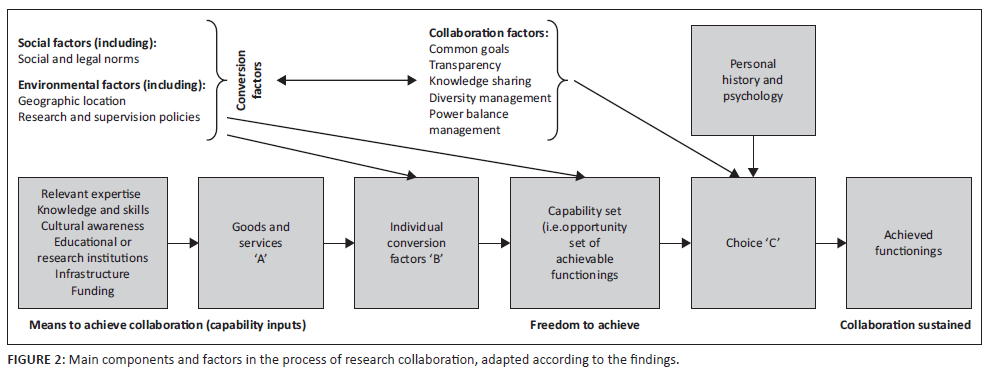
Reconsidering Robeyns' representation of a person's capability set in the light of the findings of the present study (see Figure 2), the required capability inputs are relevant expertise, knowledge and skills, cultural awareness, educational and research institutions, infrastructure and funding. The conversion factors that will influence the individual's capability set derived from the capability inputs are the social, environmental and the personal history and psychology. The main contribution of the findings lies in the identification of collaboration factors, that is, having common goals for the collaboration, transparency in the agendas, processes and resource allocation, knowledge sharing between researchers, acceptable diversity management and power balance management. The themes 'institutional requirements' and 'finance' influence the collaboration but are already represented in the capability inputs. The themes of common goals and transparency may be more relevant on a personal level, while the themes of knowledge sharing, diversity management and power balance management are relevant on a social level.
The functionings that novice researchers may realise include graduating, publishing, having academic dexterity and being part of a community of ICT4D researchers for networking.
Limitations
As a result of the limitations hampering the direct measurement of capabilities, most research focuses on the achievement of functionings.47
Conclusion
Research collaboration has the potential to promote human development while improving research impact by providing the diverse expertise required for interdisciplinary research projects. The lack of research collaboration in ICT4D, as is evident in bibliometric studies of developing countries and specifically in South Africa, signals untapped potential and the need to better understand the factors influencing research collaboration.
Applying the CA, specifically Robeyns' focus on personal capability inputs as a theoretical lens, offers a broader vision of research collaboration, with a focus on improving human well-being and agency in the context of unequal power relations between senior researchers (supervisors) and novice researchers (postgraduate students). Besides the methodological novelty of applying the CA to the research collaboration space (previously dominated by bibliometric studies), there is the theoretical contribution which consists of the identification and conceptual presentation of the main components and factors that govern postgraduate students' agency in terms of collaboration. The findings of this study confirmed the elements of a common endeavour and transparency and added shared ethical values, knowledge sharing, respecting diversity, power balance management, access to research environment, tools and opportunities and orientation and training as factors influencing research collaboration.
Besides general respect for humanity, the study participants did not consider a partnership among equals to be a prerequisite for successful collaboration. They considered asymmetrical power relations as something to be managed rather than something to be avoided. Some participants considered a power imbalance as inevitable in triggering a collaboration that involves the sharing of knowledge and access to resources in collaborative endeavours. This finding could be influenced by the transference of the asymmetrical power relations (even if only in terms of supervision experience) inherent in supervision relations. The research collaboration factors are proposed as a point of departure for further investigation in inter- and transdisciplinary research settings, rather than as a final, prescriptive determination.
The findings suggest that novice researchers have a restricted expectation of research collaboration, which would inhibit them from promoting collaborations at a national or international level. Novice researchers advancing their research ability to becoming senior researchers and helping other novice researchers may be hampered by the view that research collaboration should focus on the engagement with the supervisor. To this extent, novice researchers may struggle to build collaborative networks with colleagues within the department, institution(s) and even within Southern African countries.
This suggests the need to reassess the current qualification and publication-based perception of research collaboration, to investigate the potential for promoting the core values of well-being, participation, empowerment and sustainability that underlie capability enhancement and human development. The practical implications for policy and practice are that supervisors' involvement should be considered in collaborative initiatives. The expressed preference to collaborate with a scholar who is either more senior or better established provides some explanation for the lack of mutual regional research undertakings, since researchers from more developed countries are perceived as having more agency in terms of knowledge and other resources. Further research is needed to verify the generalisability of the findings to other contexts and international collaborations and to include the perspectives of university managers, funding agencies and other stakeholders.
Competing interests
The authors declare that they have no financial or personal relationships that may have inappropriately influenced them in writing this article.
Authors' contributions
J.v.B. conceptualised the research problem. Both J.v.B and S.M. contributed equally to the research and writing the article.
Funding information
This article is based on the research supported by the South African Research Chair's Initiative of the Department of Science and Technology and National Research Foundation of South Africa (grant no. 98564).
Data availability
Data sharing is not applicable to this article as no new data were created or analysed in this study.
Disclaimer
The views and opinions expressed in this article are those of the authors and do not necessarily reflect the official policy or position of any affiliated agency of the authors.
Acknowledgements
References
-
1.Lewis JM, Ross S, Holden T. The how and why of academic collaboration: Disciplinary differences and policy implications. High Educ. 2012;64(5):693-708. https://doi.org/10.1007/s10734-012-9521-8
» https://doi.org/10.1007/s10734-012-9521-8 - 2.Neylon C, Willmers M, King T. Rethinking impact: Applying altmetrics to Southern African research. In Scholarly communication Africa Program. Ottawa: International Development Research Centre, 2013; p. 1-20.
-
3.Walsham G. ICT4D research: Reflections on history and future agenda. Inf Technol Dev. 2017;23(1):18-41. https://doi.org/10.1080/02681102.2016.1246406
» https://doi.org/10.1080/02681102.2016.1246406 -
4.Hall KL, Vogel AL, Huang GC, et al. The science of team science: A review of the empirical evidence and research gaps on collaboration in science. Am Psychol. 2018;73(4):532-548. https://doi.org/10.1037/amp0000319
» https://doi.org/10.1037/amp0000319 - 5.SDG's. Sustainable Development Goals. New York, NY: Sustainable Development Goals Knowledge Platform; 2015.
- 6.Persson J. Talking collaboration : Conceptualizing collaborative research for sustainable development in theory and practice. Uppsala: Uppsala University; 2018.
-
7.Sooryamoorthy R. Scientific collaboration in South Africa. S Afr J Sci. 2013;109 (5-6):1-5. https://doi.org/10.1590/sajs.2013/a0016
» https://doi.org/10.1590/sajs.2013/a0016 -
8.Adams J, Gurney K, Hook D, Leydesdorff L. International collaboration clusters in Africa. Scientometrics. 2014;98(1):547-556. https://doi.org/10.1007/s11192-013-1060-2
» https://doi.org/10.1007/s11192-013-1060-2 - 9.Bon A. Intervention or collaboration? Rethinking information and communication technologies for development. Amsterdam: Vrije Universiteit, 2019; p. 232.
-
10.Cottrell B, Parpart JL. Academic-community collaboration, gender research, and development: Pitfalls and possibilities. Dev Pract. 2006;16(1):15-26. https://doi.org/10.1080/09614520500450768
» https://doi.org/10.1080/09614520500450768 -
11.Walsham G. South-South and triangular cooperation in ICT4D. Electron J Inf Syst Dev Ctries. 2020;86(4):2-7. https://doi.org/10.1002/isd2.12130
» https://doi.org/10.1002/isd2.12130 -
12.Ibrahim SS. From individual to collective capabilities: The capability approach as a conceptual framework for self-help. J Hum Dev. 2006;7(3):397-416. https://doi.org/10.1080/14649880600815982
» https://doi.org/10.1080/14649880600815982 - 13.Boni A, Walker M. Human development, capabilities and universities of the twenty-first century. In: Boni A, Walker M, editors. Human development and capabilities: Re-imagining the university of the twenty-first century. London: Routledge, 2013; p. 238.
-
14.Grossman ES, Crowther NJ. Co-supervision in postgraduate training: Ensuring the right hand knows what the left hand is doing. S Afr J Sci. 2015;111(11-12):1-8. https://doi.org/10.17159/sajs.2015/20140305
» https://doi.org/10.17159/sajs.2015/20140305 -
15.Levy Y, Ellis TJ. A systems approach to conduct an effective literature review in support of information systems research. Informing Sci. 2006;9:181-212. https://doi.org/10.28945/479
» https://doi.org/10.28945/479 -
16.Van Zyl I. Disciplinary kingdoms: Navigating the politics of research philosophy in the information systems. Electron J Inf Syst Dev Ctries. 2015;70(1):1-17. https://doi.org/10.1002/j.1681-4835.2015.tb00501.x
» https://doi.org/10.1002/j.1681-4835.2015.tb00501.x - 17.Cataldi M, Caro LD, Schifanella C. Ranking researchers through collaboration pattern analysis. In: Berendt B, Bringmann B, Fromont E, et al, editors. Joint European Conference on machine learning and knowledge discovery in databases. Cham: Springer, 2016; p. 50-54.
-
18.Kumar S, Ratnavelu K. Perceptions of scholars in the field of economics on co-authorship associations: Evidence from an international survey. PLoS One. 2016;11(6):1-18. https://doi.org/10.1371/journal.pone.0157633
» https://doi.org/10.1371/journal.pone.0157633 -
19.Muriithi P, Horner D, Pemberton L, Wao H. Factors influencing research collaborations in Kenyan universities. Res Policy. 2018;47(1):88-97. https://doi.org/10.1016/j.respol.2017.10.002
» https://doi.org/10.1016/j.respol.2017.10.002 - 20.Austin AE, Baldwin RG. Faculty collaboration: Enhancing the quality of scholarship and teaching. Washington, DC: ERIC Clearinghouse on Higher Education; 1991.
-
21.Sonnenwald DH. Scientific collaboration. Annu Rev Inf Sci Technol. 2007;41(1): 643-681. https://doi.org/10.1002/aris.2007.1440410121
» https://doi.org/10.1002/aris.2007.1440410121 - 22.Bukvova H. Studying research collaboration: A literature review. Sprouts Work Pap Inf Syst. 2010;10(3):1-17.
-
23.Tan CNL. Enhancing knowledge sharing and research collaboration among academics: The role of knowledge management. High Educ. 2016;71(4):525-556. https://doi.org/10.1007/s10734-015-9922-6
» https://doi.org/10.1007/s10734-015-9922-6 -
24.Muriithi P, Horner D, Pemberton L. Factors contributing to adoption and use of information and communication technologies within research collaborations in Kenya. Inf Technol Dev. 2016;22(sup1):84-100. https://doi.org/10.1080/02681102.2015.1121856
» https://doi.org/10.1080/02681102.2015.1121856 -
25.Van den Hoven E, Connell J. Joint doctoral supervision across countries: Changes, challenges and considerations. Innov High Educ Teach Learn. 2016;6:259-280. https://doi.org/10.1108/S2055-364120160000006021
» https://doi.org/10.1108/S2055-364120160000006021 - 26.Heeks R. The ICT4D 2.0 Manifesto: Where next for ICTs and international development? Development informatics, Working Paper Series. 2009; p. 1-35.
-
27.Mukerji M, Chauhan U. A social network analysis of ICTD conferences (2006-2017). Inf Technol Dev. 2019;26(3):1-23. https://doi.org/10.1080/02681102.2019.1685930
» https://doi.org/10.1080/02681102.2019.1685930 -
28.Toivanen H, Ponomariov B. African regional innovation systems: Bibliometric analysis of research collaboration patterns 2005-2009. Scientometrics. 2011;88(2):471-493. https://doi.org/10.1007/s11192-011-0390-1
» https://doi.org/10.1007/s11192-011-0390-1 -
29.Naude F. Country trends and scholarly collaboration in the ICT4D research community 2000-2013: A single journal study. Electron J Inf Syst Dev Ctries. 2016;72(4):1-26. https://doi.org/10.1002/j.1681-4835.2016.tb00521.x
» https://doi.org/10.1002/j.1681-4835.2016.tb00521.x -
30.Marwa CW, Sangeda RZ, Lwoga ET. Mapping the research collaboration networks in computer science: The case of central, eastern and southern African Countries [homepage on the Internet]. In: UbuntuNet Connect 2017. Addis Ababa; 2017 [cited n.d]. Available from: https://www.academia.edu/65232584/Mapping_the_research_collaboration_networks _in_computer_science_the_case_of_central_eastern_and_southern_African_Countries
» https://www.academia.edu/65232584/Mapping_the_research_collaboration_networks _in_computer_science_the_case_of_central_eastern_and_southern_African_Countries -
31.Badat S, Sayed Y. Post-1994 South African education: The challenge of social justice. Ann Am Acad Pol Soc Sci. 2014;652(1):127-148. https://doi.org/10.1177/0002716213511188
» https://doi.org/10.1177/0002716213511188 -
32.Maluleka JR, Onyancha OB, Ajiferuke I. Factors influencing research collaboration in LIS schools in South Africa. Scientometrics. 2016;107(2):337-355. https://doi.org/10.1007/s11192-016-1846-0
» https://doi.org/10.1007/s11192-016-1846-0 -
33.Tiwari M, Ibrahim S. Sustainable human development at the grass roots: Different contexts, similar ingredients?. Oxford Dev Stud. 2012;40(1):69-85. https://doi.org/10.1080/13600818.2011.650161
» https://doi.org/10.1080/13600818.2011.650161 - 34.Sen A. Inequality reexamined. Oxford: Oxford University Press, 1992.
- 35.Hatakka M, Sæbø O, Thapa D. A framework to explain the relation between ICT and development: Combining affordances and the capability approach. In: Nielsen P, Kimaro HC, editors. Information and communication technologies for development: 15th IFIP WG 94 International Conference. Cham, Switzerland: Springer Nature, 2019; p. 60-71.
-
36.Zheng Y, Walsham G. Inequality of what? Social exclusion in the e-society as capability deprivation. Inf Technol People. 2008;21(3):222-243. https://doi.org/10.1108/09593840810896000
» https://doi.org/10.1108/09593840810896000 -
37.Dejaeghere JG. Reconceptualizing educational capabilities: A relational capability theory for redressing inequalities. J Hum Dev Capab. 2020;21(1):17-35. https://doi.org/10.1080/19452829.2019.1677576
» https://doi.org/10.1080/19452829.2019.1677576 -
38.Robeyns I. Three models of education. Theory Res Educ. 2006;4(1):69-84. https://doi.org/10.1177/1477878506060683
» https://doi.org/10.1177/1477878506060683 -
39.Robeyns I. The capability approach: A theoretical survey. J Hum Dev. 2005;6(1): 93-117. https://doi.org/10.1080/146498805200034266
» https://doi.org/10.1080/146498805200034266 -
40.Ngwenyama O. The ten basic claims of information systems research: An approach to interrogating validity claims in scientific argumentation. SSRN Electron J. 2019;1-40. https://doi.org/10.2139/ssrn.3446798
» https://doi.org/10.2139/ssrn.3446798 -
41.Robeyns I. Capabilitarianism. J Hum Dev Capab. 2016;17(3):397-414. https://doi.org/10.1080/19452829.2016.1145631
» https://doi.org/10.1080/19452829.2016.1145631 - 42.Sen A. Development as freedom. New York, NY: Alfred A. Knopf, Inc., 1999; p. 1-384.
- 43.Marais M, Vannini S. Network weaving to foster resilience and sustainability in ICT4D. In Proceedings of 1st Virtual Conference Implications of Information and Digital Technologies for Development. 2021; p. 43-56.
-
44.Vaughan RP, Walker M. Capabilities, values and education policy. J Hum Dev Capab. 2012;13(3):495-512. https://doi.org/10.1080/19452829.2012.679648
» https://doi.org/10.1080/19452829.2012.679648 - 45.Mestry R, Berry B. The perceptions of stakeholders of the implementation of a state funding model in South African public schools. Africa Educ Rev. 2016;13(2):82-95.
- 46.NSFAS. National student financial aid scheme (NSFAS) mission statement. Cape Town: NSFAS; 2020.
- 47.Chiappero-Martinett E, Roche JM. Operationalization of the capability approach, from theory to practice: A review of techniques and empirical applications. In: Martinetti E, editor. Debating global society: Reach and limits of the capability approach. Fondazione Giangiacomo Feltrinelli: Milan, 2008; p. 157-203.
-
48.Apsan Frediani A, Boni A, Gasper D. Approaching development projects from a human development and capability perspective. J Hum Dev Capab. 2014;15(1): 1-12. https://doi.org/10.1080/19452829.2013.879014
» https://doi.org/10.1080/19452829.2013.879014 -
49.Walsham G. Doing interpretive research. Eur J Inf Syst. 2006;15(3):320-330. https://doi.org/10.1057/palgrave.ejis.3000589
» https://doi.org/10.1057/palgrave.ejis.3000589 - 50.Halaweh M. Integration of grounded theory and case study: An exemplary application from e-commerce security perception research. J Inf Technol Theory Appl. 2012;13(1):31-51.
-
51.Braun V, Clarke V. Using thematic analysis in psychology. Qual Res Psychol. 2006;3(2):77-101. https://doi.org/10.1191/1478088706qp063oa
» https://doi.org/10.1191/1478088706qp063oa -
52.Freshwater D, Sherwood G, Drury V. International research collaboration: Issues, benefits and challenges of the global network. J Res Nurs. 2006;11(4):295-303. https://doi.org/10.1177/1744987106066304
» https://doi.org/10.1177/1744987106066304 -
53.van Biljon J, Naude F. Collaboration towards a more inclusive society: The case of South African ICT4D researchers. In: Kreps D, Ess C, Leenen L, Kimppa K, editors. This changes everything - ICT and climate change: What can we do?. IFIP Advances in Information and Communication Technology. Cham: Springer; HCC13 2018;vol. 537. https://doi.org/10.1007/978-3-319-99605-9_6
» https://doi.org/10.1007/978-3-319-99605-9_6 -
54.Cumming AS. Results from research collaboration - A review over 20 years. Propellants, Explos Pyrotech. 2009;34(3):187-193. https://doi.org/10.1002/prep.200900027
» https://doi.org/10.1002/prep.200900027 - 55.Tacchi J. Meeting people: Reframing ICTD through choice? Inf Technol Int Dev. 2013;9(4):71-74.

Accepted: 14 Nov. 2022
Published: 16 Feb. 2023