Formation of professionalism: A courtship between academic staff and prospective clinical associates
Abstract
BACKGROUND: The study was conducted to the background of a qualification in medical clinical practice offered at a Faculty of Health Sciences at a university in South Africa. AIM: The aim of the study was to determine how the theory of Whole Brain® thinking informed our professionalism and its relevance to transforming self and practice. SETTING: The study was conducted in the context of a higher education institution, the University of Pretoria. The focus is specifically on the Bachelor of Clinical Medical Practice (BCMP). It has been offered since 2009. METHODS: Participatory action research was the design of choice. The participatory part culminated in working as a collective in a scholarly community of practice. What is reported is the use of the Herrmann Brain Dominance Instrument® (HBDI®) as a research instrument. It was used to determine the thinking preferences of the lecturers. Each lecturer obtained their brain profile that served as baseline data for self-study in the future. The profiling revealed their strengths and areas that they needed to work on - as individuals and as a team RESULTS: The theory of Whole Brain® thinking was identified as an enabler towards transforming self and practice. This transformation involved both lecturers and prospective clinical associates. CONCLUSION: The value of the study mainly lies in the development of the professionalism of the lecturers. Linked to professionalism is the value of using the theory of Whole Brain® thinking that primarily informed the teaching practice of the lecturers. And secondary to this, the students' authentic clinical practice, which included patients and simulated practice where peers act as patients. The study contributed to the scholarship of teaching and learning in a medical clinical context and to participatory action research - both interrogated from a Whole Brain® perspective for the first time in the context in question.
clinical associates; early-career academics; participatory action research; professionalism; scholarly community of practice; scholarship of teaching and learning (SoTL); self-study; thinking preferences; Whole Brain® thinking
Introduction
This article has been written from a value perspective. What we value as academic staff in relation to our lecturer and scholar identity formation resonates with values stipulated by the University of Pretoria.112,345community of practice that is commonly used. Our projects are initiative driven opposed to problem driven.
Secondly, the social/ethnographic value relates to the reciprocal learning that enriches the professionalism of both the prospective clinical associates and lecturers. It entails learning from one another. As lecturers we learn from one another and from our students. Our students learn from us and their peers.
Our scholarship of teaching and learning (SoTL) - so-called scientific value - extends to authentic real-life settings. The authors follow a scholarly approach to our teaching practice. By using a scholarly lens to investigate practice, they are able continuously to construct living theory, following Whitehead67best-practice and evidence-based practice. Fitting our article and context best is the reference to evidence-based practice in both teacher education and the health care sector by Diery et al.8
Creating a culture of well-being includes lecturer well-being. Part of well-being is self-awareness. We used a single questionnaire - the Herrmann Brain Dominance Instrument® (HBDI®)9
We question the insight the higher education community, including ourselves, have about the use of the principles of contemporary learning theories in our teaching practice. For example, the notion of best practice in teaching in higher education is continually under scrutiny by scholars such as Zabalza Beraza101112metacognition. This essential construct, metacognition, is then blurred when they add the construct training - metacognitive training. How would one train a one-sided lecturer-centred approach, to have students become knowlegable about metacognition and have them use the principles if the principles of metacognition are negated within the learning process? At face value, this paradox shouts betrayal. Furthermore, Bidabadi, Isfahani, Rouhollahi and Khalili12lecture as appropriate to university teaching instead of lesson. They would think that a constructivist approach should complement metacognition. This revelation by the interviewee indicated that a lecturer-centred approach was followed - what could have been done by the students themselves was now being done on their behalf. In this way, the value of metacognition becomes redundant. In our view, this is a perfect example of what best practice is not, cannot and should not be. Furthermore, the question arises: Is the construct best practice the best? Should we not agree with the given discourse, the question is: What is our stance?
What is reported is only a fraction of the sub-project on the thinking preferences of the lecturers. The theory on Whole Brain® thinking®9,13,14,15®.9® thinking is one of the learning theories used in our teaching practice and research and is included in the construct frame.
The purpose of conducting this research is consequently briefly highlighted.
Aim
It is common in traditional research that a research problem that serves as a point of departure for a research project is identified. The authors opted for a different way of commencing with conducting research projects. They came across innovative ideas that they wanted to 'try out', as McNiff1617
As a group of scholars they engage with an innovative idea and experiment with the idea. Action research16,1819
This study provides an insight into different modes of thinking, using the HBDI®9
Consequently, the construct frame that pertains to teaching and learning has been outlined. However, the outline is not rigid, boxing in our thoughts and insight, but rather streams throughout our scholarly discourse, allowing the reader to construct their own frame of mind.
Construct frame
It is common to find reference to theoretical or conceptual frameworks in traditional research. The epistemological grounding of our discourse is constructivism. Therefore, using construct frame as sub-heading makes sense. The construct Whole Brain® thinking9,13,14,151520Whole Brain® constructivism. The authors have added epistemology to this construct. It is rich in meaning: Whole Brain® constructivist epistemology. Other constructs are derived from the respective learning theories. Important constructs pertaining to our developing professionalism are self-regulated professional learning,20modes of thinking,9,13,14,15self-empowerment17living theory.6,7
Action learning21,2222inter alia, action learning, metacognition, self-regulated learning and reflexivity that is visible in the use of principles that are closely related. All of these notions of quality learning expect students and/or professionals to plan, execute the plan, observe what is happening and reflect on the process and the outcome. In this way, individuals enable themselves to re-plan for innovation and transformation.
As we advocate transformational practice as part of our professionalism, we expect our students to become transformational clinical associates - professionals in their own right and own context. As we promote a student-centred approach in our authentic teaching practice, we expect our students to advance a patient-centred approach in authentic clinical settings. Moreover, we advocate a Whole Brain® approach9,13,14,15® teaching practice and Whole Brain® clinical practice. Moreover, the study is innovative insofar as the same principles enrich action research and participatory action research. New meaning making gave birth to constructs coined by Du Toit (cited in Smit),20® action research (WBAR) and Whole Brain® participatory action research (WBPAR).
The authors have constructed a new meaning of best practice, based on new insight gained whilst engaging with literature, taking part in discourse on the subject and contemplating their practice. During our deliberations the authors came to realise that best is not good enough. We contemplated constructs such as Whole Brain® facilitating of learning and Whole Brain® assessment. These constructs suggested innovative and transformational thinking about teaching practice. Our living theory6,7
Our meaning making became a Whole Brain® process in itself - in our view a transformational process. Our teaching practice gradually was transformed by using the principles of Whole Brain® thinking. Similarly, the authors expect their students to become Whole Brain® meaning makers. As prospective professionals they have to make meaning of what a transformed clinical practice entails. As the authors form an integral part of their teaching practice and students of their clinical practice, the transformational intent is focused on an intra-, inter-personal and a structural dimension. The latter includes managerial and administrative dimensions of practice that are distinct to teaching or clinical practice. The intrapersonal dimension refers to the self - the one that needs to be transformed.232425
Our view of curriculum is holistic. It includes infrastructure, including educational media and platforms for online and virtual modes of learning; study material in different formats compiled by ourselves and students, such as readers and Power Point slides; methods of facilitating and assessing learning, including peer teaching and peer and self-assessment; strategies for ensuring the well-being of self and students; and, unavoidable, content (What) and the How and related-learning outcomes. The how of learning undeniably includes learning theories such as learning-centred approaches, constructivism, self-regulated learning, Whole Brain® thinking - all touched on by Smit.20Whole Brain® curriculum resonates with what we are, what we intend to be - our becoming as Slabbert, De Kock, Hattingh26
To ensure the sustainability of our transformational practice the scholarly community of practice convenes by means of in-person or online meetings, attending one another's learning opportunities, whether in the form of contact sessions such as clinical skills mastery in the laboratories or joining online sessions. In this way, we build professionalism of which reflexivity is an essential ingredient and attribute of 21st century learning.272829
This community of practice is constituted by six academics. Four are early-career academics, specialising in medical clinical practice. Two are established academics: one specialising in the educational professional development of academic staff and the other the coordinator of the BCMP programme. In our context professionalism is a two-sided synchronistic endeavour that the authors had to pursue - metaphorically referred to as a courtship. Students' enactment of what professionalism in clinical settings entails, is demonstrated whilst on authentic clinical practice experience at public hospitals that serve as clinical learning centres (CLCs) - also referred to as work-integrated learning (WIL) - under the supervision of clinical mentors and facilitators. Or, in simulated environments, such as clinical skills laboratories where peers act as 'patients' to one another.
As a number of the students are familiar with the public hospital and clinic settings in rural areas, our learning from them is invaluable. These students have a wealth of knowledge built on real-life experiences.2630
In addition, another attribute involves competence in contributing as a member of a team. As lecturers, we are members of the scholarly community that was established. For example, in the case of students, learning tasks often have to be performed by small groups in a clinical skills laboratory. This execution of tasks as a collective prepares them for the authentic world of work. In work settings as clinical associates, they will become members of a multidisciplinary team consisting of an array of health science practitioners as alluded to here. They will form their distinct communities of practice as Naidoo and Vernillo31
Further to this discourse about what a construct frame entails, the authors offer the following view: to us a conceptual framework is not a loose standing entity within a scientific document, but gives flow to the scholarship demonstrated in our text from the very first sentence. However, this study offers a framework built from the cornerstones - work of leading scholars - found in relevant and recent literature. Where sources seem to be outdated it simply means that it is a seminal work. As constructivists, the authors prefer using construct frame instead of conceptual framework. Our construct frame is offered as the epicentre of the theories around which our study revolves. Citing sources throughout the text shows the fluidness of our thinking and insights and putting it into words. Whilst putting their thoughts into words the authors came to realise that they create new meaning during writing. The authors came to the conclusion that the entire article is a construct frame in itself; the construct frame changes continuously as we reflect before writing, whilst writing and after writing, imitating Schön's32332829
Whilst we conduct action research, action learning2122inter alia, action learning, metacognition, self-regulated learning, reflexivity which is visible in the use of principles that are closely related. All of these notions of quality learning expect the student/professional to plan, execute the plan, observe what is happening and reflecting on the process and the outcome. The quality of our professional learning enriches our professionalism.
Distinct traits of professionalism is to act independently and to take responsibility for self-empowerment.17262634
Peer mentoring resonates with self-exploring of own leader potential. Peer mentoring is yet another role lecturers and clinical associates need to fulfil. Peer mentoring, in our context, is activated when a scholarly community of practice is formed. The formation of such communities of practice is common in education contexts but is used in other contexts such as the corporate world and any health sciences35reversed mentoring.36
The context-specific educational professional development of the members of the scholarly community of practice in question was self-initiated. Our approach to educational professional development regards transformation as an overarching developmental process for all involved. Our aim with transforming self and practice, as advocated by Du Toit,23
Our ontological stance complements our epistemological view. Through a lens of Whole Brain® constructivist thinking, we constantly look at the self and practice - what we do daily. Using the Whole Brain® lens, activates self-study, and this offers us the opportunity to zoom in on the actions of the self - the 'I' and as a collective, we look into the actions of the community of practice - the 'we'. These actions pertain to what we do in our teaching practice and what we do in terms of research. It is about self-empowerment and self-regulated professional development - becoming a well-rounded independent academic who takes ownership of maximising own potential.26® constructivist thinking lens, activates the study of themselves as prospective clinical associates. They are expected to take responsibility for own self-regulated learning - becoming a well-rounded independent clinical associate. The notion of maximising potential is enriched by the values the university1excellence, innovative thought and inquiring mind, for example, allow for new meaning making. The qualities that the values embody are integral to scholarly communities of practice; they are the educational ingredients we use for sustaining our transformational teaching practice claim. These values are to be instilled into our students: as clinical associates they need to pursue excellence in clinical practice, should become innovate thinkers and develop an inquiring mind.
As alluded to here, any best practice, cutting-edge practice, evidence-based practice has transformation as its foundation. Any transformation, although, starts with the self as Du Toit239,1337® thinking informs our entire ontological existence: who we are; what we do; how we do it; our mindset that includes willingness to be innovative; how we think; our becoming, as Slabbert et al.26
The essence of our preference for different modes of thinking is that it informs what we do; it informs the way we facilitate and assess learning; our communication; our problem solving; execution of tasks; how we approach conducting research; how we contribute to the actions of a scholarly community of practice - all dimensions of the dynamics of our becoming. Our becoming269
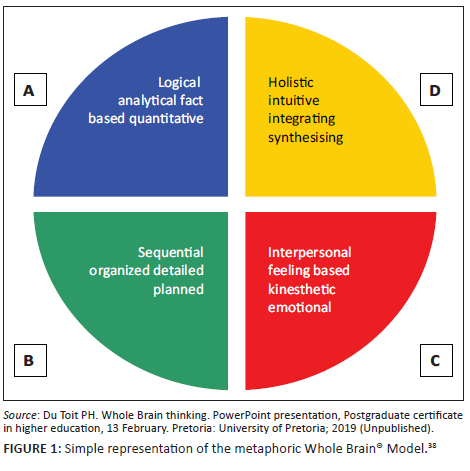
Herrmann9Figure 1) on the principle of 'interconnected clusters of specialised mental processing modes that function together situationally and iteratively, making up a Whole Brain® in which one or more parts naturally' take dominancy.15
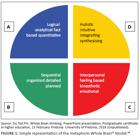
The Model (Figure 1) represents Herrmann's9intellectual self. This quadrant focuses on 'logic and analytical thinking that revolves around, for example, quantitative measures'. The B-quadrant represents a mindset that thrives on sequential thinking - referred to as the safekeeping self. Thinking in this quadrant is, inter alia, about 'being organised, detailed and planned when executing a task. The C-quadrant is about emotive thinking' - the emotional self. This quadrant is about thinking where interpersonal 'relations are prominent and feeling-based thinking and kinaesthetic movement, for example, contribute to one's thinking' when executing tasks. The D-quadrant represents an experimental mindset - experimental self. It is about 'thinking in a holistic way' that may 'include synthesising', integration, 'visuals, thinking intuitively', etc. These modes of thinking inform, amongst others, one's approach to solving problems, communication and teaching.
Embarking on a trajectory of professional development requires reflecting on self. Our professional learning includes reflective practice.2039402641
Research design
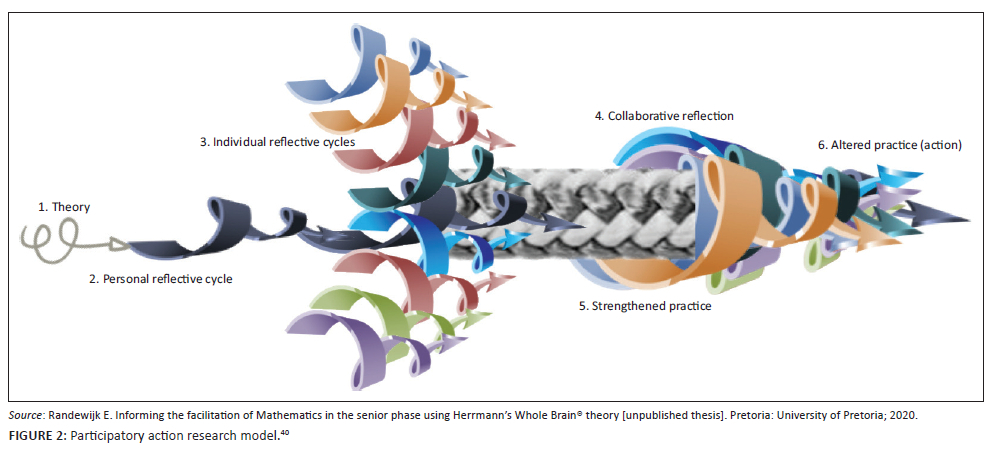
Our research design of choice is both action research and participatory action research. However, the latter is the focus in this article. The authors opted for using Randewijk's model.40Figure 2 is a representation of the model.
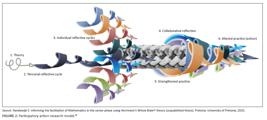
What intrigued us about the model is its metaphoric value. The authors consider their tight community of practice a rope consisting of a number of strands. To fit our context we have made some minor changes to explain the different phases. However, the phases do not follow one another in a sequential manner as can be derived from our discussion that follows.
The point of departure for our participatory action research is our distinct BCMP context and making meaning of it. The context includes all assets, such as human capital - lecturers and students - facilities, learning theories, teaching and learning practice. In Phase 1 we use existing theories and create our own, based on lived experiences. The latter are part of the notion of living theory.6,716,18,21
Our vision is to transform our practice continually, Phase 5, by strengthening our competence in offering quality teaching with a view to ensuring quality learning and strengthening our SoTL. Within Phase 6 continual acting to transform becomes evident. However, all six phases are executed continually and simultaneously. It is typical of the fluid nature action research and participatory action research take as McNiff16
Each individual's transforming of self and practice strengthens their professionalism, here shown as strands of rope, alluded to here but also contributes to the strengthening of the community of practice, indicated as the rope itself.
In our meaning making of how our participatory action research could be enriched, we integrate participatory action research with the principles of thinking preferences. This integration makes sense in our context as WBPAR becomes integral to our practice. We consider our conducting of WBPAR as transformational scholarship.
Our differences in ways of thinking become evident in the data presented here. As individuals the authors have strengths that might be lacking in others; as a group they are positioned to determine where we are lacking in terms of modes of thinking. This is touched on next.
Complementing our participatory action research is evidence gathered to justify our claims of using the principles of Whole Brain® thinking in practice. Using the principles of Whole Brain® thinking relates to multiple relationships: Firstly, the relationship with self. It assists in insight into how one executes tasks. Secondly, the relationship with others - peers and students. This relationship relates to accommodating as the other have their own thinking preferences. It is the self who needs to adapt. One needs to adapt in terms of facilitating and assessing learning, communicating with others, etc. In the same way, students need to master the skills of adapting to others' modes of thinking. This is essential when working as a member of a team. This is essential as this will have a bearing on one's entire demeanour as a clinical associate in the future.
Ethical considerations
The study is based on the principles of self-study. The authors are the participants. They report on themselves. The study was approved by Faculty of Health Sciences, University of Pretoria, reference number: 56/2011.
Results
The research method explained next-generated baseline data applicable to all the sub-projects we are conducting and will be conducting in the future - strands of rope. In identifying thinking preferences, the HBDI® was employed to generate essential data. The questionnaire was developed around 1995/1996 by the father of Whole Brain® Learning, Ned Herrmann. The HBDI® consists of 120 items.42424342
The way in which qualitative data are generated is discussed next. It gives an overview of what brain profiling is about. The brain profile displayed is that of one of the lecturers.
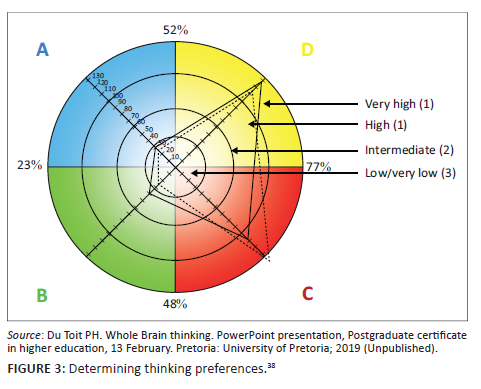
Figure 3 indicates the extent to which one has a preference for a specific mode of thinking. It is indicated by separate quadrants, identified by means of symbols A, B, C and D as mentioned earlier. The extent to which an individual has a preference for a particular mode of thinking is shown in the circles within circles. The closer the end of the plotted line on the diagonal axes to the perimeter, the greater the preference. The further the end of the line from the perimeter, the lesser the preference.
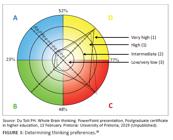
When an individual has a very strong or strong preference for modes of thinking that fit a specific quadrant it is indicated in the two circles closest to the perimeter. This is referred to as a primary choice. If the choice is indicated in the second inner circle, it means that the individual has an intermediate preference (choice) for the specific quadrant. A low or very low choice would fall in the inner circle, closest to the centre. This is referred to as a tertiary choice. A primary choice is indicated by 1; an intermediate choice by 2 and a low or very low (tertiary) choice by 3. Using these numbers in sequence, for example, 3>2>1>1, indicates a preference code. The exemplary profile used is the profile of one of the established academics. It indicates that the academic with this profile has a tertiary preference for quadrant A, indicated by 3; a secondary choice for quadrant B (2); a high preference for quadrant C (1) and the highest for D (1). Such a profile, with two first choices (primary) is referred to as being double dominant.
Based on preference codes, different types of profile are distinguished. Double dominant profiles are the most common. Double dominancy means that two quadrants are most preferred, whilst other quadrants may be secondary or tertiary choices. It may be the case that three quadrants are chosen as most preferred. In this case, the profile is triple dominant. Quadruple profiles, where all quadrants are chosen as most preferred, are rare.
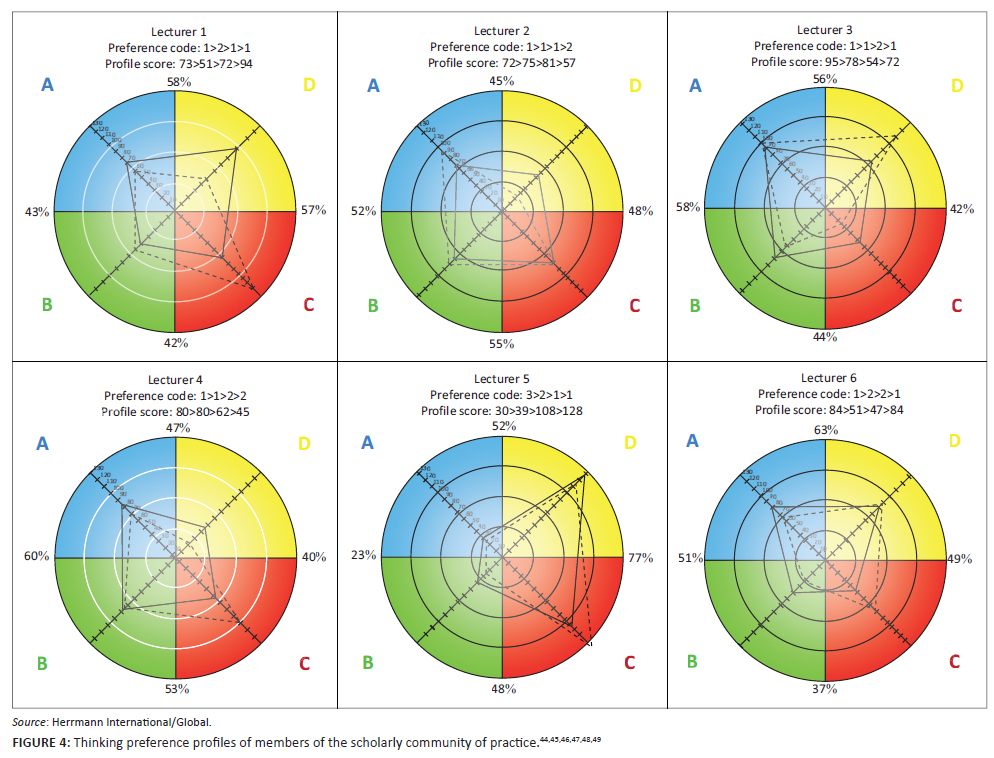
The results from the HBDIs®44,45,46,47,48,49Figure 4. It constitutes sets of qualitative data. The qualitative data includes a visual representation of the thinking preference profile (commonly referred to as a brain profile) for each lecturer. The solid line indicates the individual's preferred modes of thinking. The dotted line indicates how one's profile may shift when under stress. A narrative description forms part of each data set. The sets of quantitative data are not reported accept for an indication of the Preference Code and Profile Score. In Figure 4, the six profiles serve as exemplars showing how we as a group of lecturers differ in the way we think. This, as alluded to here, inevitably has implications for the way we facilitate and assess learning, communicate, do research, execute tasks in general, etc.
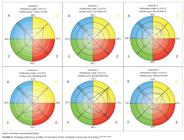
The preference code is an indication of the quadrant each individual has a high preference for, indicated by 1; which one is intermediate or secondary, indicated by 2, and which one is tertiary, indicated by 3. In case of the latter, 3 is an indication of avoidance or aversion of the specific quadrant. It should be observed that the theory is simply about preferences and not abilities. Should one indicate a 2 or a 3 for a specific quadrant, it does not suggest that one would not be able to execute tasks that require modes of thinking within this quadrant. The profile of Lecturer 5 indicates that he does not have an affinity for quadrant A that has fact-based thinking as focus. Fact-based thinking aligns with research. Therefore, it does not mean that the lecturer cannot conduct research. This is where maximising one's potential features. The profile works like a rubber band - indicating one's comfort zone. One can, as for Lecturer 5, stretch oneself - out of one's comfort zone - to work within quadrant A. But, as soon as the task of conducting research is performed, the rubber band comes back to its original resting place. One might have the ability to do something, but should one be offered a choice, one may prefer to avoid becoming involved in tasks of which the nature is such that one's preferred modes of thinking are not accommodated. The brain profile of each lecturer is explained next. It comes in narrative format. It is taken from the feedback report, with some sentences changed - it is not a verbatim report and therefore cannot be put in quotation marks. Putting only a few words in each sentence in quotation marks would be superfluous. As most of the profiles across the globe are similar and discussed in the same manner by using the same descriptive words, it becomes quite general. Similarities are unavoidable.
Lecturer 1 (Herrmann Global)
The interpretation of the profile of Lecturer 144intuitive, creative and synthesiser. The one most descriptive of her is intuitive. Work elements she strongly relates to are innovating, conceptualising and creative. The next preferred quadrant is C. Descriptors selected are emotional and intuitive. The descriptor indicated as most descriptive of her work is intuitive. Work elements she strongly relates to are expressing ideas and interpersonal aspects. In the B-quadrant, which is the next preferred, the one key descriptor is conservative. The work element she strongly relates to is planning. 'A' is the less preferred quadrant. Key descriptors selected are logical, critical and analytical. Work elements are analytical and problem solving. Under pressure there is a shift: moving away from the preferred quadrant whilst C becomes the highest.
Lecturer 2 (Herrmann Global)
The description of the profile of Lecturer 245musical, emotional, spiritual and reader. These descriptors represent a general overview of her mental preferences in day-to-day life. Work elements she strongly relates to in this quadrant are teaching and writing. These elements reflect mental preferences at work. By only a slight margin, her next most preferred is the B-quadrant. She selected conservative and reader as descriptors. Work elements she does well include implementation. Next is the A-quadrant. Mathematical and analytical are descriptors selected with analytical being her key descriptor - the one most descriptive of her. Work elements include analytical and problem solving. The least preferred quadrant is D. Holistic was selected as a characteristic. Her stress profile suggests that she can contain herself under pressure. It is only the D-quadrant that recedes into the background.
Lecturer 3 (Herrmann International)
The narrative for Lecturer 346logical, analytical, critical and quantitative. Rational is her key descriptor. These descriptors represent a general overview of her mental preferences in day-to-day life. Work elements she strongly relates to in this quadrant include analytical, technical and problem solving. These elements reflect her mental preferences at work. Her next most preferred quadrant is B. As descriptor, she selected conservative. Work elements identified as ones she does well include planning, administrative and implementation. Next preferred quadrant is the D-quadrant. Descriptors selected are holistic and intuitive. Work elements she does well include creative. Her least preferred quadrant is C. She selected intuitive as a characteristic of her. Under pressure her profile may shift to A being the second most preferred quadrant, with B the third, then C as the lowest and D becoming more dominant.
Lecturer 4 (Herrmann International)
The profile of Lecturer 447
Lecturer 5 (Herrmann International)
The profile of Lecturer 548imaginative, synthesiser, artistic, holistic and intuitive - representative of mental preferences in day-to-day life. Work elements include integration, creative and innovating. The next most preferred quadrant for this Lecturer is C. Descriptors selected are musical, talker and intuitive with emotional as the most descriptive. Work elements include teaching, writing and interpersonal. B is the next preferred quadrant. Talker was selected as descriptor; work elements identified include implementation. The least preferred quadrant is A. No descriptors were selected. When under pressure this lecturer's profile does not shift much, except for the C-quadrant that becomes more dominant.
Lecturer 6 (Herrmann International)
The quadrant most preferred, based upon this lecturer's49analytical, rational and mathematical. These descriptors represent a general overview of the lecturer's preferences in day-to-day life. Work elements the lecturer strongly relates to in this quadrant include analytical and problem solving. These elements reflect the lecturer's mental preferences at work. Work preferences may align completely with general preferences or they may stem from situations unique to the working environment. In the D-quadrant the lecturer selected imaginitive and synthesiser with holistic as key descriptor. Work elements identified as ones the lecturer does well include conceptualising, creative and innovating. The next most preferred is the B-quadrant. In this quadrant detailed was selected as descriptor. The least preferred quadrant, based on the lecturer's responses, is Quadrant C. In this quadrant, spiritual was selected as characteristic of the lecturer. Responses to items that indicate one's preferences under pressure may or may not be consistent with the general behaviour of the lecturer. When under pressure this lecturer's profile shifts to the less-preferred quadrant, namely C that becomes more dominant, with generally preferred ones, such as Quadrants A and B, receding into the background.
The mean preference code of the group is 1 > 1 > 1 > 1. This indicates that the group of lecturers as a collective form a composite whole group. However, as the group is quite small, a closer look into the highest scores on the respective quadrants is needed. The highest score is for Quadrant B with a total of 474; second is the score of 434 for the A-quadrant. The total score for the C-quadrant is 424 and for D it is 400.
The data sets are discussed in the next section.
Discussion
When the scores of the profiles are studied more closely, it becomes clear to what extent the scores for the different quadrants per individual differ. An exemplar of comparing the profiles of two lecturers when they have to work together on a task is offered next. It is of note that for Lecturer 6 the score for Quadrant A and D is the same (84), whilst Quadrant C is lowest at 47. For Lecturer 1, the highest score is for Quadrant D (94) and the lowest for Quadrant B at 51. If Lecturer 6 and Lecturer 1 were to work together as a team, it can be deducted that they will complement one another to some extent. However, what they need to work on is Quadrant B as they both have a low score of 51. It may most probably be the case that the low score (47) of Lecturer 1 for Quadrant C will be compensated for by Lecturer 1 owing to the higher score of 72. These scores will influence both their teaching practice and research. Lecturer 6 might struggle with working on the curriculum as part of a curriculum development team or doing research as part of a team. This lecturer most probably prefers working as an individual.
Another exemplar of having two lecturers working together is in the case of Lecturers 4 and 5. The score for Quadrant A (30) - the lowest for all the quadrants of the entire group - shows almost an aversion for this Quadrant by Lecturer 5. This is in contrast to the high score of 80 for A by Lecturer 4. It can be said that the low score of Lecturer 5 will be compensated for by the high score of Lecturer 4. The same is to be observed in the case of Quadrant B: Lecturer 5 displays a low score of 39 whilst the score for Lecturer 4 is a high of 80. Opposed to this, it is of note that the high score of Lecturer 5 on Quadrant C (108) may compensate for the lower score (62) of Lecturer 4. The same counts for Quadrant D: The score for Lecturer 5 is 128, whilst for Lecturer 4 it is 45. It must be reiterated that Whole Brain® thinking is not about abilities but preferences. It is of note that Lecturer 5 is the principal researcher. It does not mean that, whilst struggling with doing research (Mainly Quadrant A) he does not have the ability to conduct research. It, however, is significant that the research is performed by a community of practice - the profile score for Quadrant C is 108. And, as this lecturer's score for Quadrant D is very high (128) it is evident that many of the creative ideas when it comes to conducting research, or to transform teaching practice is initiated by Lecturer 5. The high score of 108 on Quadrant C and the low score for Quadrant A (30) may indicate that he has a preference for doing action research and being included in participatory action research and not so much for quantitative, empirical studies.
Lecturer 4, for example, needs to work on becoming more creative when facilitating and assessing learning. And she might need to keep attributes of the C-quadrant in mind as her teaching practice and research are most probably very structured and focused on facts.
Although there are some indications of compensation where two individuals work together, one should keep in mind that each individual has to attend to quadrants with low scores with a view to becoming a Whole Brain® lecturer, Whole Brain® researcher and to maximising own potential.
For the group of six, there is evidence that the community of practice will be able to come up with constructive solutions to problems as the members will contribute from different perspectives. What the group will need to work on is Quadrant D. This is true for their teaching practice and their research.
Action research and participatory action research are C-quadrant dominant. As these research designs are focused on intrapersonal aspects (the 'I') and interpersonal aspects (the 'we'), the group as a collective need to work on attributes of the C-quadrant with a lowest group profile score of 400. For example, individuals, especially those with a low score for Quadrant C, need to work on expanding their repertoire of aspects related to working with others.
One has to keep in mind that these data sets on the profiles of the lecturers are exemplars of what we can expect in the first-year cohort. To accommodate all the differences in preferences for specific modes of thinking, we have to be adaptable. For example, Students need to perform learning tasks in the laboratories for mastering clinical skills; these tasks need to accommodate students with preferences for different modes of thinking. What the tasks require includes all modes of thinking. When working in small groups, or performing a head-to-toe examination on a peer who acts as a patient, the dominant quadrant is C, accommodating students who prefer working with others, sharing ideas, etc. It also accommodates D-quadrant thinking as students may be challenged to come up with visual representations. New meaning is constructed that fits the A-quadrant that includes fact-based thinking. Students have to organise themselves and devise a plan that they need to follow and execute with a view to achieving the envisaged final outcome and monitor the execution of the plan in terms of steps to be taken, typical of the B-quadrant.
Similarly, prospective clinical associates have to keep in mind that their profiles are exemplars of what they can expect in clinical practice - be it authentic real-life settings or simulated settings, such as clinical skills laboratories. To accommodate the differences in preferences for specific modes of thinking that peers in class contexts, patients and other health professionals may have, they need to be adaptable. For example, students need to perform learning tasks in the clinical laboratories, execute tasks in authentic real-life settings, such as hospitals and work with multidisciplinary teams and with patients. These tasks need to accommodate students with an array of different thinking preferences. What completing the tasks requires includes all modes of thinking. When working in small groups or performing a head-to-toe examination on a peer who acts as a patient the dominant quadrant is C, accommodating students who prefer working with others, sharing ideas, etc. It also accommodates D-quadrant thinking as students may be challenged to come up with visual representations. New meaning is constructed that fits the A-quadrant that includes fact-based thinking. Students have to organise themselves and devise a plan that they need to follow and execute with a view to achieving the envisaged final outcome and monitor the execution of the plan in terms of steps to be taken - attributes of the B-quadrant.
In essence, what the courtship comes to is the following: we have to demonstrate to students how the principles of Whole Brain® thinking are used to transform our teaching practice in Whole Brain® facilitating and assessing learning and in other roles we have. Students as prospective clinical associates need to use the principles of Whole Brain® thinking with a view to adapting their learning to become Whole Brain® professionals and transforming practice to ensure Whole Brain® patient care, Whole Brain® communication with members of a multidisciplinary team and other roles they have to enact.
The two groups of professionals appreciating the courtship are students as prospective Whole Brain® clinical associates and Whole Brain® lecturers. Transformational clinical practice and transformational teaching practice are only possible when the professionals take responsibility for transforming self and practice - Whole Brain® transformational practice. Any courtship can last only as long as the two parties involved nourish each other.
In the context of our study, a scholarly courtship may be the means to achieve a designated and sustainable professionalism.
Conclusion
Our claim to transformational practice and transformational participatory action research is justified by implementing the principles of Whole Brain® thinking. Our claim that our practice is transformational because it uses reciprocal professional learning is justified by evidence of learning from one another in that our preferences of modes of thinking are different. This is also evidence of how our respective modes of thinking inform our lecturer identity. In view of the fact that our practice is learning centred, reciprocal learning is extended to what the authors can learn from our students. By demonstrating attributes to be enacted in an authentic place of work, the authors act as role models for our students who should enact the same attributes in their future clinical world of work.
The authors advocate that the notion of empowering others is a misnomer. One can only empower the self. This highlights the fact that self-empowerment and self-regulated professional learning are approaches that would help monitor one's professional development trajectory. These acts of taking responsibility feed into both lecturer-identity formation and clinical associate-identity formation.
In essence, professionalism takes centre stage. In our meaning making, staying true to our constructivist epistemology, the authors would like to add to the current body of knowledge on professionalism the construct Whole Brain® professionalism. This distinct attribute of professionalism is true for all professions, but in the context of this article specifically the profession of university teachers and the profession of clinical associates. This is the insight the authors bring into the domain of SoTL and the scholarship of professional development of clinical associates. The authors would like to contribute to scholarship of participatory action research by adding the constructs Whole Brain® participatory action research and Whole Brain® action learning.
Do we dare leave the reader with the following: What about a Whole Brain® scholarly courtship?
Competing interests
The authors declare that they have no financial or personal relationships that may have inappropriately influenced them in writing this article.
Authors' contributions
P.H.d.T. was responsible for research leadership, conceptualising of the study, literature review, writing of manuscript, data gathering and management, editing; L.T., S.C-Z., M.O. and B.M. were involved in co-conceptualising of study, literature review, acting as educational practitioners they generated self-knowledge as data; M.L. was involved in co-conceptualising of study. He acted as a critical reader, monitored and evaluated the study as coordinator of the BCMP programme and generated self-knowledge as data.
Funding information
This research received no specific grant from any funding agency in the public, commercial or not-for-profit sectors.
Data availability
Data sets contain confidential information per individual participant that is not accessible to any other person as it is coded. It is the prerogative of each participant to share own data on request. The data sets are kept in the data verification and analysis system of Herrmann International and/or Herrmann Global. Although the company and the registered HBDI practitioner have access to the data, the data cannot be revealed. This provision is in line with the POPI act with a view to honouring integrity and ethics practice.
Disclaimer
The views expressed in this article are that of the authors and do not constitute the official position of the university.
Acknowledgements
The authors would like to acknowledge the following: The Department of Family Medicine, Faculty of Health Sciences, University of Pretoria for the advancement of scholarship of teaching and learning; the Head of the department, Professor Jannie Hugo, for initiating projects concerning the educational professional development of academic staff; and Professor Tinus Kühn for meticulous language editing of the manuscript.
References
-
1.University of Pretoria. Vision, mission and values [homepage on the Internet]. [cited 2021 March 29]. Available from: https://www.up.ac.za
» https://www.up.ac.za - 2.Lichtman M. Qualitative research for the social sciences. Thousand Oaks, CA: Sage; 2014.
- 3.Christensen LB, Johnson RB, Turner LA. Research methods, design, and analysis. Boston, MA: Pearson; 2014.
-
4.Hugo JFM, Slabbert J, Louw JM, et al. The clinical associate curriculum: The learning theory underpinning the BCMP programme at the University of Pretoria. Afr J Health Pr Ed. 2013;4(2):128-131. https://doi.org/10.7196/ajhpe.188
» https://doi.org/10.7196/ajhpe.188 - 5.Fringe JJS. Promoting critical reflection for academic professional development in higher education [unpublished thesis]. Pretoria: University of Pretoria; 2013.
-
6.Whitehead J. Generating living theory and understanding in action research. Action Res. 2009;7(1):85-99. https://doi.org/10.1177/1476750308099599
» https://doi.org/10.1177/1476750308099599 -
7.Huxtable M, Whitehead J. Enhancing educational influences in learning with a living educational theory approach to pedagogical action research in higher education. Educ Act Res. 2020;29(2):310-327. https://doi.org/10.1080/09650792.2020.1779771
» https://doi.org/10.1080/09650792.2020.1779771 -
8.Diery A, Vogel F, Knogler M, Seidel T. Evidence-based practice in higher education: Teacher educators' attitudes, challenges, and uses. Front Educ. 2020;5:article 62. https://doi.org/10.3389/feduc.2020.00062
» https://doi.org/10.3389/feduc.2020.00062 - 9.Herrmann N. The creative brain. Lake Lure, NC: Brain Books; 1995.
-
10.Zabalza Beraza MA. Best teaching practices of higher education professors. Rev Electrón Investig Docencia. 2012;10(1):17-42. https://doi.org/10.4995/redu.2012.6120
» https://doi.org/10.4995/redu.2012.6120 -
11.Fook CY. Best practices of teaching in higher education in United States: A case study. Behav Sci. 2012;46:4817-4821. https://doi.org/10.1016/j.sbspro.2012.06.341
» https://doi.org/10.1016/j.sbspro.2012.06.341 - 12.Bidabadi NS, Isfahani AN, Rouhollahi A, Khalili R. Effective teaching methods in higher education: Requirements and barriers. JAMP. 2016;4(4):170-178.
- 13.Herrmann N. The whole brain business book: Unlocking the power of whole brain thinking in organizations, teams, and individuals. New York, NY: McGraw Hill; 1996.
- 14.Herrmann N, Herrmann-Nehdi A. The whole brain business book: Unlocking the power of whole brain thinking in organizations, teams, and individuals. 2nd ed. New York, NY: McGraw Hill; 2015.
- 15.De Boer A-L, Du Toit PH, Scheepers D, Bothma T. Whole Brain® learning in higher education: Evidence-based practice. Oxford: Chandos; 2013.
-
16.McNiff J. Action research for professional development: Concise advice for new action researchers [homepage on the Internet]. [cited 2021 Aug 30]. Available from: www.jeanmcniff.com/booklet1.html#12
» www.jeanmcniff.com/booklet1.html#12 - 17.Du Toit PH. Reflecting on more than twenty years of involvement in a postgraduate higher education qualification for academics: May I dare using an auto-ethnographic lens? J Transdisc Res. 2018;32(6):425-439.
- 18.Dlamini C. Whole Brain® participatory action research to enhance professional development of academic staff in higher education [unpublished thesis]. Pretoria: University of Pretoria; 2020.
- 19.McNiff J, Whitehead J. All you need to know about action research. London: Sage; 2006.
- 20.Smit T. Self-regulated professionalism: A Whole Brain® participatory action research design in a pre-service mentoring context [unpublished thesis]. Pretoria: University of Pretoria; 2020.
-
21.Kelliher F, Byrne S. The thinking behind the action (learning): Reflections on the design and delivery of an executive management program. J Work-Appl Manag. 2018;10(1):35-49. https://doi.org/10.1108/JWAM-05-2018-0010
» https://doi.org/10.1108/JWAM-05-2018-0010 -
22.Masangu-Muzindutsi Z, Haskins L, Wilford A, Horwood C. Using an action learning methodology to develop skills of health managers: Experiences from KwaZulu-Natal, South Africa. BMC Health Serv Res. 2018;18:907. https://doi.org/10.1186/s12913-018-3693-6
» https://doi.org/10.1186/s12913-018-3693-6 -
23.Du Toit PH. Social transformation starts with the self: An autobiographical perspective on the thinking style preferences of an educator. SAJE. 2013;44(4):1. https://doi.org/10.15700/201412171325
» https://doi.org/10.15700/201412171325 -
24.Li LM, Grimshaw JM, Nielsen C. Use of communities of practice in business and health care sector: A systematic review. Implement Sci. 2009;4:271. https://doi.org/10.1186/1748-5908-4-27
» https://doi.org/10.1186/1748-5908-4-27 - 25.Hicks O. Curriculum in higher education in Australia - Hello? The Carrick Institute for Learning and Teaching in Higher Education, Melbourne, Australia; 2007.
- 26.Slabbert JA, De Kock DM, Hattingh A. The brave 'new' world of education: Creating a unique professionalism. Cape Town: Juta; 2009.
- 27.Manwaring G. The reflexive graduate. In: Norman C, Anderson L, editors. Graduate attributes in higher education: Attitudes on attributes from across the disciplines. London: Routledge, 2017; p. 193-195.
- 28.Baerheim A, Ness IJ, Raaheim A. Reflexivity in interprofessional workplace learning. Int J Soc Policy Educ. 2021;3(6):68-74.
-
29.Phrabo DP. Change and leadership: An Indian perspective. NHRD Netw J. 2021;14(4):438-449. https://doi.org/10.1177/26314541211038130
» https://doi.org/10.1177/26314541211038130 -
30.Ngunyulu RN, Sepeng N, Moeta M. The perspectives of nursing students regarding the incorporation of African traditional indigenous knowledge in the curriculum. Afr J Prim Health Care Fam Med. 2020;12(1):a2171. https://doi.org/10.4102/phcfm.v12i1.217
» https://doi.org/10.4102/phcfm.v12i1.217 -
31.Naidoo SS, Vernillo AT. Adapting a community of practice model to design an innovative ethics curriculum in healthcare. Med Princ Pract. 2013;23(1): 60-68. https://doi.org/10.1159/000353149
» https://doi.org/10.1159/000353149 - 32.Schön DA. The reflective practitioner: How professionals reflect in action. New York, NY: Basic Books; 1983.
-
33.Bothelo M, Bhuyan SY. Reflection before and after clinical practice - Enhancing and broadening experience through self-, peer- and teacher-guided learning. Eur J Dent Educ. 2021;25(3):480-487. https://doi.org/10.1111/eje.12623
» https://doi.org/10.1111/eje.12623 -
34.Skinner S. Towards a theory of leader identity formation and its application in executive coaching. Philos Coaching Int J. 2020;5(1):71-89. https://doi.org/10.22316/poc/05.1.07
» https://doi.org/10.22316/poc/05.1.07 -
35.Ranmuthugala G, Plumb JJ, Cunningham FC. How and why are communities of practice established in the healthcare sector: A systematic review of the literature. BMC Health Serv Res. 2011;11:273. https://doi.org/10.1186/1472-6963-11-273
» https://doi.org/10.1186/1472-6963-11-273 -
36.Clarke AJ, Burgess A, Van Digelle C, Mellis C. The role of reverse mentoring in medical education: Current insights. Adv Med Educ Pract. 2019;10:693-701. https://doi.org/10.2147/AMEP.S179303
» https://doi.org/10.2147/AMEP.S179303 -
37.De Boer A-L, Du Toit PH, Bothma T. Activating Whole Brain® innovation: A means of nourishing multiple intelligence in higher education. TD The J Transdisc Res S Afr. 2015;11(2):55-72. https://doi.org/10.4102/td.v11i2.78
» https://doi.org/10.4102/td.v11i2.78 - 38.Du Toit PH. Whole Brain thinking. PowerPoint presentation, Postgraduate certificate in higher education, 13 February. Pretoria: University of Pretoria; 2019 (Unpublished).
-
39.Cho Y, Egan TM. Action learning research: A systematic review and conceptual framework. Hum Resour Dev Rev. 2009;8(4):431-462. https://doi.org/10.1177/1534484309345656
» https://doi.org/10.1177/1534484309345656 - 40.Randewijk E. Informing the facilitation of Mathematics in the senior phase using Herrmann's Whole Brain® theory [unpublished thesis]. Pretoria: University of Pretoria; 2020.
- 41.Gardner H. Multiple intellligences: Theory into practice. New York, NY: Basic Books; 1993.
- 42.Coffield F, Moseley D, Hall E, Ecclestone K. Learning styles and pedagogy in post-16 learning: A systematic and critical review. London: The Learning and Skills Research Centre; 2004.
-
43.Clayton P, Kimbrell J. Thinking preferences as diagnostic and learning tools for managerial styles and predictors of auditor success. Manag Finance. 2007;33(12):921-934. https://doi.org/10.1108/03074350710831701
» https://doi.org/10.1108/03074350710831701 -
44.Herrmann Global. HBDI® Zama Mahlangu (pseudonym), confidential information, coded [homepage on the Internet]. Lake Lure, NC: Herrmann Global; 2014 [cited 2021 Sept 20]. Available from: www.hbdi.com (Unpublished).
» www.hbdi.com -
45.Herrmann Global. HBDI®: Dinah Dlamini (pseudonym), confidential information, coded [homepage on the Internet]. Lake Lure, NC: Herrmann Global. 2021 [cited 2021 Sept 20] Available from: https://www.thinkerrmann.com (Unpublished).
» https://www.thinkerrmann.com -
46.Herrmann International. HBDI®: Zanele Tembe (pseudonym), confidential information, coded [homepage on the Internet]. Lake Lure, NC: Herrmann International; 2014 [cited 2021 Sept 20]. Available from: https://www.thinkerrmann.com/ (Unpublished).
» https://www.thinkerrmann.com/ -
47.Herrmann International. HBDI®: Myriam Ndlovo (pseudonym), confidential information, coded [homepage on the Internet]. Lake Lure, NC: Herrmann International; 2014 [cited 2021 Sept 20]. Available from: https://www.thinkerrmann.com/ (Unpublished).
» https://www.thinkerrmann.com/ -
48.Herrmann International. HBDI®: Willem Kok (pseudonym), confidential information, coded [homepage on the Internet]. Lake Lure, NC: Herrmann International 2006 [cited 2021 Sept 20]. Available from: www.hbdi.com (Unpublished).
» www.hbdi.com -
49.Herrmann International. Johan Fick (pseudonym), confidential information, coded [homepage on the Internet]. Lake Lure, NC: Herrmann International; 2014 [cited 2021 Sept 20]. Available from: www.hbdi.com (Unpublished).
» www.hbdi.com

Accepted: 08 Mar. 2022
Published: 28 Apr. 2022