Water shortages in Beaufort West: Lessons learnt and applied during the 2009-2011 and 2017-2019 droughts
Abstract
Increasing and prolonged droughts have become a feature of the South African environmental landscape. This article investigates the sustainability of water procurement to the town of Beaufort West and the reasons for the town's water provision crises during the droughts of 2009-2011 and 2017-2019. Emergency measures were implemented to alleviate the serious water shortages during these droughts. Data to illustrate population increases and precipitation decreases, which impacted on the town's water resources, were collected from census records of Statistics South Africa and the Department of Water and Sanitation, respectively. A number of risk factors contributed to the town's water crises, for example, unsustainable water extraction at times of serious droughts, poor water monitoring, metering and attention to leakages, an expansion of informal settlements within the municipal boundaries of Beaufort West, as well as annual rainfall patterns that became increasingly unpredictable. The article concludes that water resource development had not kept pace with demand; therefore water infrastructure should be built with enough capacity to cope with regular dry periods. Equilibrium should be reached between the water expectations of the community and the water availability to avoid future social instability in water-stressed towns such as Beaufort West. Rainfall data indicate that precipitation patterns in the arid regions of South Africa are decreasing; therefore the water shortage experience of Beaufort West during the recent droughts serves as a clear and present warning that rural towns in these regions should seek and implement alternative water augmentation strategies timeously.
Beaufort West; drought; Gamka Dam; groundwater; water load shedding; reclamation plant; unsustainable water extraction
Introduction
The historiography of water provision has a relatively long record in Southern Africa, and many of these histories also focussed on the quest for water during periods of severe drought. For example, Bodill referred to the augmentation of Port Elizabeth's (Gqeberha) vulnerable water supply from the Orange River in dry periods,1234
Increasing and prolonged drought conditions have prompted urgent research on the sustainability of water procurement and provision to rural communities in the arid interior of South Africa. As early as 2009, a study by Le Maitre et al.567891011
The studies mentioned above are focused on the problems experienced by predominantly agricultural communities under the strain of serious droughts and efforts to provide water security in arid regions such as the Karoo, the Northern Cape, the West Coast and even Cape Town as a city with limited freshwater resources. However, there is a lacuna in the literature on water studies that focus on the responses and dynamics of rural town communities with a history of coping with water provision struggles during times of severe drought duress. This article investigates the reasons for the water provision crises of the town of Beaufort West in the Central Karoo region during the droughts of 2009-2011 and 2017-2019 and the innovative solutions reached to alleviate the problems of water scarcity.
Research methodology and data analysis
The study is based on comprehensive research into the history and processes of water provision to water-stressed rural towns in South Africa, with a specific focus on Beaufort West. Archival research was based on the following: Beaufort West municipal council minutes, reports and documents preserved in the Western Cape Archives and Records Service (WCARS) in Cape Town. This research material was complemented with data from various published scientific articles and reports, press releases and media reports pertaining to Beaufort West's water woes covering the period 2008-2020.
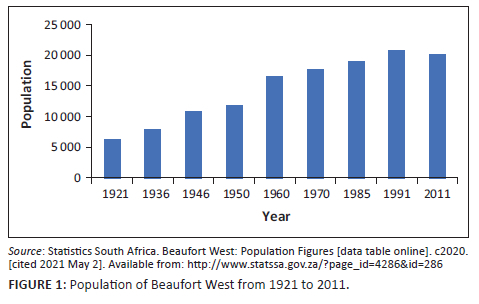
In addition, data were collected from the official census records, dating from 1921 to 2011 via Statistics South Africa. The study only made use of census records from years where a full population count was held. A graph was created to demonstrate growing population tendencies over time in Beaufort West that also put pressure on the town's available water sources during times of water duress.12
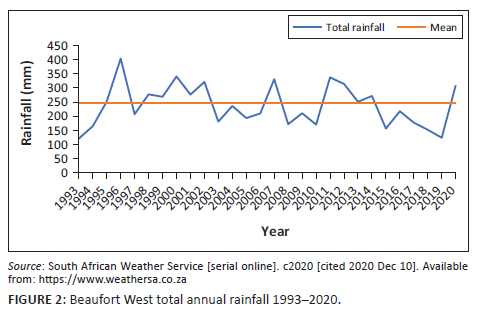
Annual precipitation data were gathered from the South African Weather Service (SAWS) for the period 1993-2020. These data were used to create two graphs, the first provided a representation of annual rainfall for the area by adding the total precipitation for each year and dividing the total of all the years from 1993 to 2020 by the number of years (i.e. 27 years). The second graph is known as a Standard Precipitation Index (SPI). The SAWS data were processed and analysed using the SPI software package of the University of Nebraska's Drought Mitigation Centre. This was performed to calculate the average rainfall in comparison to the previous 12 months for each year over a 40-year period. The advantage of using an SPI over a 12-month period is that it highlights how the rainfall in an area compares to previous years' rainfall while using sampling data over a longer period. This makes the results more reliable and less divergent as would occur with a shorter period such as a 3- or 6-month SPI.1314
Geographical and climatological features of Beaufort West
Beaufort West, the primary focus of this study, was proclaimed a town in 1818 and was the first town in South Africa to receive municipal status as early as 1837. The town is situated in the semi-arid central Great Karoo, 491 km from Cape Town and 961 km from Johannesburg. It is the major administrative, agricultural, and economic centre of the region. The town also serves as a major road and rail transit and is a crossing to many other South African towns. Beaufort West lies in a hollow between two hills and is flanked by the Gamka River in the west and the Kuils River in the east. Both rivers, which became semi-perennial as a result of urbanisation, flow in a generally north to south direction. With an average annual rainfall of a mere 250 mm, the municipality has two main sources of water, namely groundwater and surface runoff, that is captured in two dams. The Springfontein Dam, an irrigation reservoir, was completed in 1869 but has run dry for several years because of diminishing precipitation. The Gamka Dam, completed in 1955, which provides 45% of the town's water supply, is the town's major freshwater reservoir but has been experiencing severe water-stressed conditions in recent years. Therefore, the town's water supply is heavily reliant on rainfall and under severe pressure.
Groundwater, extracted from boreholes, played an increasingly important role in the development of Beaufort West. Beaufort West is known for its so-called east-west trending 'dyke' cutting through the town. A dyke is a natural barrier to groundwater flow because of its low permeability. This barrier inhibits the southward migration of groundwater and effectively compartmentalises its flow.15,16,17,18,19
Throughout its municipal history, Beaufort West was plagued by occasional floods and recurring periods of prolonged drought. Visser201521
As explained above, groundwater supplies would become crucial in periods when the town suffered from inevitable drought and water duress. Between 150 and 200 boreholes were drilled north of the dolerite dyke by the late 1940s in search of water and mainly in areas close to town.2019
Over the years, more boreholes were drilled in the continued quest for more water sources. Eighteen boreholes were sunk since 1985 with an average depth of 49.83 m. Between 2007 and 2009, aquifer units south of the town's dolorite dyke were successfully explored, and several boreholes became available for use by the Beaufort West Municipality at the Hansrivier (southeast of town) and Droërivier (southwest of town) well fields, collectively known as the Southern well field. Thus over a 50-year period, starting in the 1970s, more than 300 boreholes had been drilled in the Beaufort West area, and some of these have become production boreholes for the town's water supply.16,1918
A decisive moment in Beaufort West's water woes was the introduction of a water-borne sewerage system. Although such a sewerage scheme was considered as early as 1963 by the municipal council, the project eventually started in 1975 and was completed in 1978. The installation of flush toilets and running water to poor neighbourhoods has increased water demand, and the successful service provision had the unintended consequence of promoting further in-migration of inhabitants from under-served areas.6,16,22Figure 1). This growth was also being accompanied by significant town expansion from 1945 to 2010.623
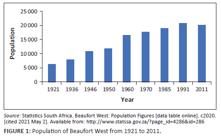
Field research by Holloway et al.6Figures 2 and 3.
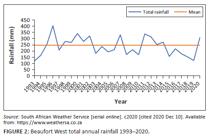
In addition to the declining precipitation figures, Rose who conducted groundwater exploration for the Beaufort West Municipality between 2005 and 20081913
1.A meteorological drought that is defined as a lack of precipitation over a region for a period of time.
2.A hydrological drought that is related to a period with inadequate surface and subsurface water resources (lakes, reservoirs, rivers, streams and groundwater) for established water uses of a given water resources management system. It affects non-agricultural activities such as urban water consumption, ecosystem preservation, tourism and recreation.
3.An agricultural drought that refers to a period with declining soil moisture and consequent crop failure.
4.A socio-economic drought that is associated with the failure of water resources stems to meet water demands and thus associating droughts with a supply of and demand for water as enonomic good. Socio-economic drought occurs when the demand for an economic good exceeds supply as a result of a weather-related shortfall in the water supply.
The combined effect of these manifestations of drought brought serious water famine to Beaufort West.
The drought of 2009-2011
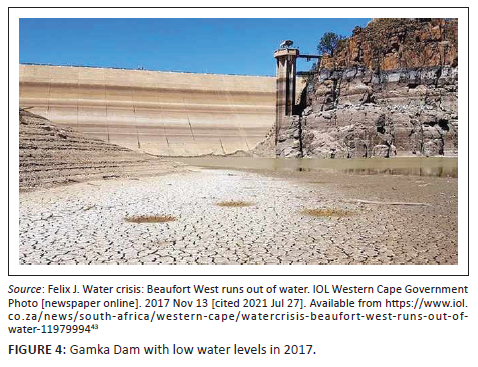
Between 2009 and 2011, lower than normal rainfall was partly responsible for falling reservoir levels across the Central Karoo as the region experienced its worst drought since 1944. Although the municipality had introduced new water tariffs as early as July 2008 to discourage high water consumption, restrictions became necessary in 2009. These austerity measures were gradually increased as the water crisis deepened, and the Gamka Dam level dropped significantly. By May 2010, the water levels of the Gamka Dam, Beaufort West's major water resource, fell faster than expected, resulting in the reservoir emptying completely by September 2010 (Figure 4).
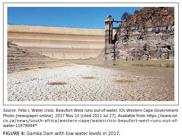
Consequently, 8500 households, representing approximately 36 000 inhabitants, had to rely on 36 boreholes that provided 3700 kL water per day. From November 2008 to December 2010, groundwater levels within the town's important North End aquifer, normally recognised for its rapid recharge capacity, dropped from 13 m to 36 m below the ground level. As a result of the extremely hot and dry conditions, the water demand increased.
The dire water situation called for emergency measures. Drastic domestic water restrictions were imposed since January 2010, and a local disaster declaration was issued for Beaufort-West. Each household was restricted to 12 kL per month. At first, if consumers exceeded 15 kL per day consumption, a 200% surcharge was applied to their water accounts. In order to force down reduced water consumption, fines of R1000 were issued to perpetrators of water quotas. The water-stressed conditions prompted severe water load shedding from September to November 2010 when both ground and surface water supplies failed. The town was divided into 12 wards staggered in 36-h water-shedding periods to allow for the recharge of the groundwater feeding the boreholes. Although the central business district, hospitals and industrial areas were not required to comply with water load shedding. Water was supplied through static and roaming tanks and even household-level distribution of 5 L bottled water every 48 h. This constituted a major logistics exercise, and 90 temporary municipal staff members were locally employed for the operation. In addition, a country-wide public appeal was launched via radio and newspapers to donate potable bottled water to Beaufort West.6,24,2526
In January 2011, Beaufort West received relief funding amounting to R24 million from the National Treasury for South Africa's first reclamation plant. The project was completed within 6 months and was the country's first direct potable reuse plant. Treated wastewater effluent is conveyed directly to a water treatment facility for further treatment to drinking water standards. Sludge from pit latrines is boiled to kill pathogens and generate water vapour, which passes through several filters for further treatment. This treatment includes processes such as phosphate removal, pre-disinfection, ultrafiltration, reverse osmosis and advanced oxidation. The plant can process 12.3 m317,27,28
Nine months later, in June 2011, the Gamka Dam began to refill after substantial rainfall in its catchment associated with a low cut-off weather system. Water restrictions were consequently lifted.6
The drought of 2017-2019
Beaufort West enjoyed a reprieve of five years before the next severe drought struck again, with dire consequences for its inhabitants. According to King and Karoly,293030,31,32,33,34
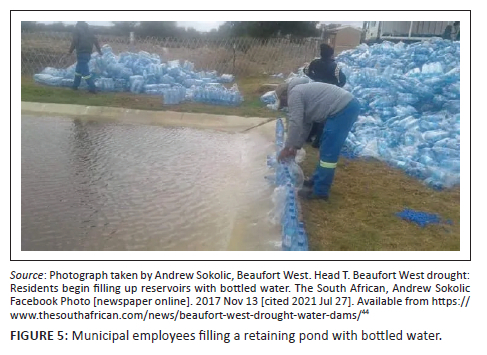
Since October and November 2017, the Council for Geoscience (CGS) drilled five percussion boreholes to the east and south of Beaufort West as part of the Karoo Deep Drilling Project to investigate the geology and distribution and properties of shallow groundwater in the deep zone down to a depth of 169 m. Two of these boreholes had the capacity to yield good-quality groundwater and were subsequently donated by the CGS to the Beaufort West Municipality. By 2018 and 2019, the municipality received a R23 m government financial grant, for example, to drill new boreholes and pipe water from the region south of the town. However, these boreholes proved inadequate to meet the pressing water needs. Additional water was supplied by passing tourists and non-governmental charity organisations such as Gift of the Givers, Cape Town Water Warriors, as well as private businesses who trucked in water (Figure 5). Eventually, the municipality distributed stocks of emergency water when each household received two 5 L containers of water per day.30,32,35,36,37,3839
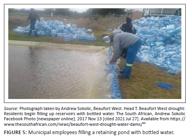
Fortunately, drought relief came for the inhabitants of Beaufort West when good rains returned in May 2019 and the Gamka Dam rapidly filled to 44% of its capacity. Water load shedding was rescinded, and water restrictions lowered to more tolerable levels. According to the municipality's new water distribution system, each household could utilise up to 15 kL water per month.40
Discussion: Lessons learnt and applied
There are many similarities between the Beaufort West droughts of 2009-2011 and 2017-2019 and how the municipal authority dealt with severe water-stressed situations. During both drought periods, austerity measures were imposed, such as water load shedding; local disaster declarations were issued; emergency distributions of bottled water took place and external public involvement were initiated through potable water donations to Beaufort West. Although the consequences of the 2017-2019 drought have not been investigated officially as yet, the findings of the report by Holloway et al.6
In fact, the emergency demand for water involved a tension between sustainable water resource management and basic service provision. The provision of housing and basic services to previously disadvantaged communities was identified as a key measurable municipal performance area. Therefore, factors such as a steady growth in the provision of state housing, together with an expansion in both the number of new and the size of existing informal settlements within the municipal boundaries of Beaufort West, all contributed to the critical water-stressed conditions during the droughts of 2009-2011 and 2017-2019. Overall, annual and seasonal rainfall patterns that became increasingly unpredictable were identified as a major drought risk driver. The depletion of both groundwater and surface water from the Gamka Dam resulted in the municipality drawing on water supplies from the Springfontein irrigation dam located in the town, with negative consequences for local small farmers who faced reduced supplies.6
Matthews27
Conclusions
In terms of its drought experiences in 2009-2011 and 2017-2019, Beaufort West faced the same problems that many of South Africa's other inland towns face in the new millennium.326
It is quite clear that equilibrium should be reached between the water expectations of the community and the water availability in water-stressed towns such as Beaufort-West. Klopper42
Preventative strategies could include the following: Adequate population development plans should be introduced to rural communities that will keep track with finite rural water resources because future water scarcity will have a major impact on the social and economic development on these communities. Water-awareness programmes should be implemented in these towns to increase water-wise practices and an understanding of the scarcity and fragility of water sources, especially among under-educated town dwellers. The DWS should also identify and prioritise rural towns with capacity deficiencies in water management. Firstly, relevant municipal functionaries, as well as environmental officers and water workers, should be adequately trained in water planning strategies, water infrastructure maintenance and drought management. Secondly, a compulsory environmental focus should be introduced in school curricula to sensitise the youth about water conservation. Finally, innovate water preservation solutions should be pursued by the state. Depending on the outcomes of the ongoing geoscientific exploration in the Karoo Basin on the water-bearing qualities of aquifers, the artificial recharge of suitable aquifers should be considered. This could, for example, involve the injection of excess floodwaters into boreholes or transferring water into spreading basins where the subsurface is infiltrated.
Competing interests
The author certifies that he has no financial or personal relationships that may have inappropriately influenced him in writing this article.
Author's contributions
Wessel P. Visser is the sole author of this research article.
Ethical considerations
This article followed all ethical standards for research without direct contact with human or animal subjects.
Funding information
This research received no specific grant from any funding agency in the public, commercial or not-for-profit sectors.
Data availability
There are no restrictions on any data availability in this article. Data were collected from the Department of Water and Sanitation. Rainfall Data: Beaufort West. [serial online] c2020. [cited 2020 Dec 10]. Available from: https://www.dws.gov.za/Hydrology/Unverified/DetailRainfall.aspx?Station=J2R004FW&Type=Flow&Rain=Y and from Statistics South Africa. Beaufort West: Population Figures. [serial online] c2020. [cited 2021 May 2]. Available from: http://www.statssa.gov.za/?page_id=4286&id=286
Disclaimer
The views and opinions expressed in this article are those of the author and do not necessarily reflect the official policy or position of any affiliated agency of the author.
Acknowledgements
The author would like to sincerely thank Mr Rouxan Rademan for collecting raw data rainfall and population figures.
References
- 1.Bodill TS. History of the Port Elizabeth water supply. Looking back, historical society of Port Elizabeth and Walmer. 1982;2:117.
- 2.Grant D. The politics of water supply: The history of Cape Town's water supply 1840-1920 [unpublished dissertation]. Cape Town: University of Cape Town; 1991.
- 3.Visser D, Jacobs A, Smit H. Water for Saldanha: War as an agent of change. Historia. 2008;53:130-161.
-
4.Musemwa M. Disciplining a dissident city: Hydropolitics in the city of Bulawayo, Matabeleland, Zimbabwe, 1980-1994. J South Afr Stud. 2006;32(2):239-254. https://doi.org/10.1080/03057070600656119
» https://doi.org/10.1080/03057070600656119 -
5.Le Maitre D, Colvin C, Maherry A. Water resources in the Klein Karoo: The challenge of sustainable development in a water-scarce area. SA J Sci. 2009;105(1-2):39-48. https://doi.org/10.1590/S0038-23532009000100019
» https://doi.org/10.1590/S0038-23532009000100019 -
6.Holloway A, Fortune G, Zweig P, et al. Eden & Central Karoo Drought Disaster 2009-2011: The scramble for water [homepage on the Internet]. Stellenbosch University; 2012 [cited 2021 Apr 8]. Available from: http://www.riskreductionafrica.org/assets/files/EDEN%20and%20CENTRAL%20KAROO%20DROUGHT%20DISASTER%202009.pdf
» http://www.riskreductionafrica.org/assets/files/EDEN%20and%20CENTRAL%20KAROO%20DROUGHT%20DISASTER%202009.pdf -
7.Meissner R, Jacobs-Mata I. South Africa's drought preparedness in the water sector: Too little too late? [homepage on the Internet]. SA Institute of International Affairs Policy Briefing; 2016 [cited 2021 Jul 20], vol. 155, p. 1-4. Available from: https://saiia.org.za/research/south-africas-drought-preparedness-in-the-water-sector-too-little-too-late/
» https://saiia.org.za/research/south-africas-drought-preparedness-in-the-water-sector-too-little-too-late/ -
8.Schreiner BG, Mungatana ED, Baleta H. Impacts of drought induced water shortages in South Africa: Economic analysis [homepage on the Internet]. Water Research Commission Report No. 2604/1/18. 2018 [cited 2021 Jun 22]. Available from: http://www.wrc.org.za/wp-content/uploads/mdocs/2604%20Vol%201.pdf
» http://www.wrc.org.za/wp-content/uploads/mdocs/2604%20Vol%201.pdf -
9.Tfwala CM, Van Rensburg LD, Schall R, Dlamini P. Drought dynamics and interannual rainfall variability on the Ghaap Plateau, South Africa, 1918-2014. Phys Chem Earth Parts A/B/C. 2018;107:1-7. https://doi.org/10.1016/j.pce.2018.09.003
» https://doi.org/10.1016/j.pce.2018.09.003 -
10.Zhang H, Xu Y, Kanyerere TA. Modelling approach to improving water security in a drought-prone area, West Coast, South Africa. Phys Chem Earth Parts A/B/C. 2019;114:102797. https://doi.org/10.1016/j.pce.2019.08.005
» https://doi.org/10.1016/j.pce.2019.08.005 -
11.Visser WP. A perfect storm: The ramifications of Cape Town's drought crisis. J Transdisc Res South Afr. 2018;14(1):1-10. https://doi.org/10.4102/td.v14i1.567
» https://doi.org/10.4102/td.v14i1.567 -
12.Statistics South Africa. Beaufort West: Population figures [homepage on the Internet]. c2020. [cited 2021 May 2]. Available from: http://www.statssa.gov.za/?page_id=4286&id=286
» http://www.statssa.gov.za/?page_id=4286& id=286 -
13.Mishra AK, Singh VP. A review of drought concepts. J Hydrol. 2010;391(1-2):202-216. https://doi.org/10.1016/j.jhydrol.2010.07.012
» https://doi.org/10.1016/j.jhydrol.2010.07.012 -
14.South African Weather Service. c2020. [cited 2020 Dec 10]. Available from: https://www.weathersa.co.za
» https://www.weathersa.co.za - 15.Vivier WGH, Vivier S. Hooyvlakte: Die Verhaal van Beaufort-Wes 1818-1968. Cape Town: Nasionale Boekhandel; 1970.
- 16.Erasmus GJ. Sub-streek: Die Sentrale Karoo: Gebied: Beaufort-Wes en Omgewing. Navorsingsverslag. Stellenbosch: Stellenbosch University; 1986.
-
17.Marais P, Von Durckheim F. Beaufort West Water Reclamation Plant: Project. Water Sanit Afr. 2012;7:20-25. https://doi.org/10.10520/EJC106532
» https://doi.org/10.10520/EJC106532 -
18.Xu Y, Mahed G, Van Wyk Y, et al. Towards a sampling and monitoring protocol of radioactive elements in fractured rock aquifers for groundwater re-source security in Beaufort West [homepage on the Internet]. Report to the Water Research Commission, Report No. 1694/1/12. 2012 [cited 2020 Nov 27]. Available from: https://www.researchgate.net/publication/272495076
» https://www.researchgate.net/publication/272495076 -
19.Rose RP. The characterisation of fractured Karoo Aquifers near Beaufort West [unpublished dissertation]. Pretoria: University of Pretoria; 2017 [cited 2021 Jul 22]. Available from: https://repository.up.ac.za/bitsream/handle/2263/68254/Rose_Characterisation_2018.pdf?sequence=1&isAllowed=y
» https://repository.up.ac.za/bitsream/handle/2263/68254/Rose_Characterisation_2018.pdf?sequence=1& isAllowed=y -
20.Visser WP. Between drought and deluge: A history of water provision to Beaufort West, ca. 1858-1955. New Contree [serial online]. 2020;85:1-21. Available from: http://hdl.handle.net/10394/36923
» http://hdl.handle.net/10394/36923 - 21.Western Cape Archives and Records Service, Cape Town (hereafter WCARS). Archives of the Town Clerk Beaufort West (hereafter 3/BFW), Vol. 1/1/1/23, Minutes of a Special Council Meeting, 1946: 401-402 and WCARS, 3/BFW, Vol. 1/1/1/23, Minutes of a Special Council Meeting. 1949, p. 970-971.
- 22.WCARS, 3/BFW Box 263, Vol. 5/1/14, CA. Louw. Munisipaliteit Beaufort-Wes Rioolskema Vorderingsverslag. 1977.
-
23.Nel E, Taylor B, Hill T, Atkinson D. Demographic and economic changes in small towns in South Africa's Karoo: Looking from the inside out. Urban Forum. 2011;22:395. https://doi.org/10.1007/s12132-011-9131-z
» https://doi.org/10.1007/s12132-011-9131-z -
24.Burger K. Gee jou water vir Beaufort. Rapport [newspaper online]. 2010 [cited 2021 Jun 20] Dec 12;5. Available from: https://www.news24.com/news24/nuus24/suid-afrika/nuus/gee-jou-water-vir-beaufort-20101212
» https://www.news24.com/news24/nuus24/suid-afrika/nuus/gee-jou-water-vir-beaufort-20101212 - 25.Steyn T. Beaufort-Wes het weer genoeg water. Die Burger [newspaper online]. 2011 [cited 2021 Jun 20] Feb 16;6.
-
26.Meyer W. Water from sewage for Karoo town. Weekend Argus [newspaper online]. 2011 [cited 2021 May 3] Jan 1. Available from: https://www.iol.co.za/news/south-africa/western-cape/water-from-sewage-for-karoo-town-1006911
» https://www.iol.co.za/news/south-africa/western-cape/water-from-sewage-for-karoo-town-1006911 -
27.Matthews S. Water - Precious resource to be used again, and again and again… Water Wheel [serial online]. 2015 [cited 2021 July 24]; 14:26-29. Available from: http://www.wrc.org.za/wp-content/uploads/mdocs/WaterWheel_2015_3_May.pdf
» http://www.wrc.org.za/wp-content/uploads/mdocs/WaterWheel_2015_3_May.pdf -
28.Sorensen P. The chronic water shortage in Cape Town and survival strategies. Int J Env Stud. 2017;74:515-527. https://doi.org/10.1080/00207233.2017.1335019
» https://doi.org/10.1080/00207233.2017.1335019 -
29.King A, Karoly D. 2017 is set to be among the three hottest years on record. The Conversation [serial online]. 2017 [cited 2021 May 17] Nov 6. Available from: https://theconversation.com/2017-is-set-to-be-among-the-three-hottest-years-on-record-86934
» https://theconversation.com/2017-is-set-to-be-among-the-three-hottest-years-on-record-86934 -
30.Lepule T. Beaufort West needs water after long drought. IOL [newspaper online]. 2018 [cited 2021 Apr 14] Nov 4. Available from: https://www.iol.co.za/weekend-argus/beaufort-west-needs-water-after-long-drought-17765948
» https://www.iol.co.za/weekend-argus/beaufort-west-needs-water-after-long-drought-17765948 - 31.Sonnekus S. Beaufort-Wes nog nie hééltemal droog. Die Burger 2017 Nov 14;10.
-
32.Kings S, Ritchie G. Beaufort West runs out of water. Mail & Guardian [newspaper online]. 2018 [cited 2021 Apr 14] Aug 24. Available from: https://mg.co.za/article/2018-08-24-00-beaufort-west-runs-out-of-water/
» https://mg.co.za/article/2018-08-24-00-beaufort-west-runs-out-of-water/ - 33.Kruger J. Beurtwater ingestel op Beaufort-Wes. Die Burger 2018 Sep 6;6.
- 34.Nienaber M. Wes-Kaap help dié dorpe, hospitale, skole eerste met boorgate. Die Burger 2017 Nov 25;11.
- 35.Kruger J. Dag Zero kán voorkom word. Die Burger 2017 Dec 30;7.
- 36.Kruger J. Beurtwater maak nog verskil in dorp. Die Burger 2018 Sep 7;7.
-
37.Mosavel H, Cole D, Musetsha M. Investigations of deep hydrogeological targets in the Beaufort West Municipal Commonage. Geoclips [serial online]. 2018 [cited 2021 Oct 11];52:1. Available from: https://www.geoscience.org.za/images/GeoClips/CGS2018-Geoclips-Vol52.pdf
» https://www.geoscience.org.za/images/GeoClips/CGS2018-Geoclips-Vol52.pdf -
38.Arnoldi M. Council for Geoscience starts deep drilling in Karoo basin. Mining Weekly [newspaper online]. 2020 [cited 2021 Oct 11] Sep 22;3. Available from: https://www.geoscience.org.za/images/council-for-geoscience-starts-deep-drilling-in-karoo-basin-2020-09-22
» https://www.geoscience.org.za/images/council-for-geoscience-starts-deep-drilling-in-karoo-basin-2020-09-22 -
39.Somdyala K. Beaufort West about to run out of emergency bottled water - Official. News24 [newspaper online]. 2019 [cited 2021 May 1] Jan 23. Available from: https://www.news24.com/SouthAfrica/News/beaufort-west-about-to-run-out-of-emergency-bottled-water-official-20190123
» https://www.news24.com/SouthAfrica/News/beaufort-west-about-to-run-out-of-emergency-bottled-water-official-20190123 - 40.Kruger J. Beurtwater in Beaufort-Wes opgehef en perke aangepas. Die Burger 2019 May 15;1.
-
41.Mahed G. Explainer: What there is to know about South Africa's aquifers. The Conversation [serial online]. 2018 Sep 5;1-3. [cited 2021 Jun 20]. Available from: https://theconversation.com/explainer-what-there-is-to-know-about-south-africas-aquifers-102660
» https://theconversation.com/explainer-what-there-is-to-know-about-south-africas-aquifers-102660 -
42.Klopper H. The organised expansion and permanent settlement of people in Boesmanland in correlation with accessible water sources, 1760-c.1960 [unpublished dissertation]. Stellenbosch: Stellenbosch University; 2020 [cited 2021 Jul 25]. Available from: http://hdl.handle.net/10019.1/108154
» http://hdl.handle.net/10019.1/108154 -
43.Felix J. Water crisis: Beaufort West runs out of water. IOL Western Cape Government Photo [newspaper online]. 2017 Nov 13 [cited 2021 Jul 27]. Available from: http://iol.co.za/news/south-africa/western-cape/watercrises-beaufort-west-runs-out-of-water-11979994
» http://iol.co.za/news/south-africa/western-cape/watercrises-beaufort-west-runs-out-of-water-11979994 -
44.Head T. Beaufort West drought: Residents begin filling up reservoirs with bottled water. The South African, Andrew Sokolic Facebook Photo [newspaper online]. 2017 Nov 13 [cited 2021 Jul 27]. Available from https://www.thesouthafrican.com/news/beaufort-west-drought-water-dams/
» https://www.thesouthafrican.com/news/beaufort-west-drought-water-dams/

Accepted: 17 Dec. 2021
Published: 28 Feb. 2022