Investigating groupings in pre-service accounting teachers' attitudes towards mathematics
Abstract
BACKGROUND: A distinct mathematics proficiency is required in the study of accounting. The students' success depends on attitudes towards mathematics that influence the participation rate of students in accounting modules. AIM: The main aim of the study was to investigate groupings in pre-service accounting teachers' attitudes towards mathematics. SETTING: The setting of the study was a higher education institution (HEI). This study was based on a survey of pre-service accounting teachers about their attitudes towards mathematics. METHODS: This study used Fennema-Sherman Mathematics Attitudes Scales (F-SMAS). A convenient sample of the study was 255 Bachelor of Education (Accounting) students (first year = 143, second year = 77 and third year = 35). Data were analysed using descriptive and inferential statistics with p < 0.050 level of significance. RESULTS: The study found that mathematical ability, family, home context and geographical location were significant factors in determining attitudes towards mathematics and subsequent study of accounting. CONCLUSION: The study offers practical insights to navigate attitudes towards mathematics of students with the aim of setting mathematics support interventions given the several challenge students encounter in mathematics.
investigating; groupings; attitudes towards mathematics; pre-service accounting teachers; mathematics; accounting
Introduction
Mathematics matters in commerce. There is a link between students' success in completing economic management modules and their mathematics competence.12,34567891011
A significantly larger percentage of pre-service teachers experience high levels of negative attitudes towards mathematics when compared to other undergraduate students.12,13141516
The main aim of the study was to investigate the groupings of students' attitudes towards mathematics in relation to demographic variables such as gender, age, race, mother tongue, Grade 12 mathematics, accounting module and location of the school. The research question for the study was formulated as follows: How do attitudes towards mathematics relate to demographic variables such as gender, age, race, mother tongue, Grade 12 mathematics, accounting module and location of the school? This study assisted in understanding demographic significant differences of attitudes towards mathematics to design appropriate interventions for students with less attitude towards mathematics. Teachers should be aware of students' attitudes towards mathematics and strive to improve them to positively influence their academic achievement.17
The tripartite theory
The tripartite theory of attitudes or ABC Model of attitudes is underpinning this study. Every attitude has three components: Affect, Behaviour and Cognition.18,19,2021,2220
Home environment and school environment play an important role in shaping students' attitudes towards mathematics20,2320
Differences in attitudes towards mathematics between student groupings
Males versus Females: A study conducted by Farooq and Shah4p > 0.050). They concluded that gender differential has no impact on the attitude towards mathematics in Pakistan. Kosgey et al.24p < 0.050). However, a study performed by Asante23p < 0.050). High school male students showed a more positive attitude towards mathematics than female students Woodard25p < 0.050). Correspondingly, a study by Yeo (2013)2627p < 0.050). Female students showed a positive attitude towards success in mathematics than male students. Younger students versus older students: Frazier-Kouassi28p < 0.050). The older students had a more positive male domain attitudes than the younger students. No further significant differences were found28p > 0.050). Rural students versus urban students: The results of a study conducted by Frazier-Kouassi28p < 0.050). No further differences were found on the other mathematics attitudes domains. Low-achieving students versus high-achieving students: Frazier-Kouassi28p < 0.050). No other significant differences were found.
Method and procedure
Research methods and procedures adopted in this study are explained in the next sub-sections.
Research design, paradigm and sampling
A quantitative research design in the form of surveys was adopted for this study. Research design is a plan or blueprint of how one plans to carry out the research.2930
Data collection method
The questionnaires were administered to the pre-service accounting teachers at a higher education institution in KwaZulu-Natal, South Africa. To facilitate maximum response and to analyse data with ease, I divided the questionnaire into two sections as follows: Section A: Biographical variables - This section enabled the researcher to obtain a personal profile of the participants such as age, gender, race, year of study, mother tongue, area of schooling, education level and previous education background and Section B: Fennema-Sherman Mathematics Attitude Scale (F-SMAS) - This section was divided into eight sections, each seeking to elicit pre-service accounting teachers' attitudes to an aspect of mathematics.
The F-SMAS, with established reliability and validity was used for the study. The F-SMAS used are as follows: The attitude towards success in mathematics subscale, the mother subscale, father subscales, the teacher subscale, the confidence in learning mathematics subscale, the mathematics anxiety subscale, the effectance motivation in mathematics subscale, and the mathematics usefulness subscale.203132
Data analysis and interpretation
Descriptive and inferential statistics were generated from the questionnaires with the assistance of the Statistical Package for Social Sciences (SPSS version 23). The results were interpreted by comparing the means with the domains and using t-test and analysis of variance (ANOVA) at p < 0.050, level of significance. The Cronbach's coefficient alpha was used to establish internal consistency reliability. The reliability for the overall questionnaire was 0.961. The Cronbach's alpha value of 0.961 is considered excellent. This study's Cronbach's alpha for each used domain of F-SMAS is as follows: The attitude towards success in mathematics (0.760), mother's mathematics attitude (0.842), father's mathematics attitude (0.913), mathematics anxiety (0.912), effectance motivation in doing mathematics (0.847), usefulness of mathematics (0.893), teacher's mathematics attitude (0.824) and confidence in learning mathematics (0.922).
Research results
Groupings of various students' attitudes towards mathematics
Gender differences in pre-service teachers' attitude towards mathematics
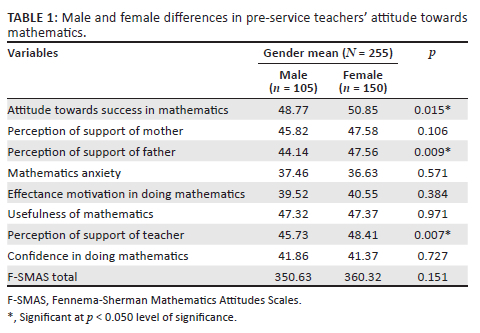
The results of the t-test showed significant differences between male and female respondents in some domains. In comparison with male respondents, female respondents reported a more positive attitude towards success in mathematics, a more positive perception of the father as a source of encouragement, support and affirmation of their efforts in mathematics and a more positive perception of the teacher as a source of encouragement, support and affirmation of their efforts in mathematics (p < 0.050). No further significant differences were found between male and female students for the remaining F-SMAS subscales (p > 0.050) (see Table 1).
Differences in attitudes towards mathematics between younger and older students
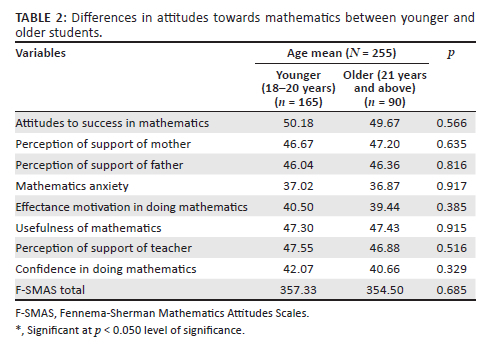
No significant differences were found between younger and older students (p > 0.050) (see Table 2).
Differences in attitudes towards mathematics between black students and Indian students
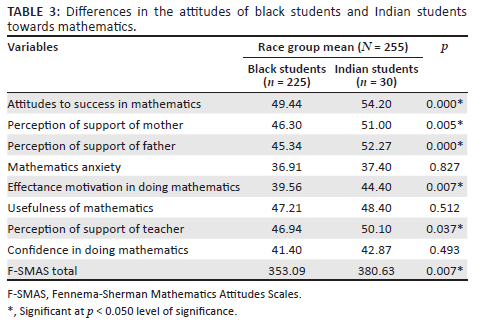
There were significant differences between black students and Indian students. Indian students reported a more positive attitude towards success in mathematics; a more positive perception of their mother and father as sources of encouragement, support and affirmation of their efforts in mathematics; a more positive attitude towards effectance motivation in doing mathematics; a more positive perception of their teacher as a source of encouragement, support and affirmation of their efforts in mathematics and a more positive overall (F-SMAS total) mean scores of black students and Indian students attitudes towards mathematics (p < 0.050). No additional differences amongst the black students and Indian respondents were found for the remaining F-SMAS subscales (p > 0.050) (see Table 3).
Differences in attitudes towards mathematics between English- and Zulu-speaking students
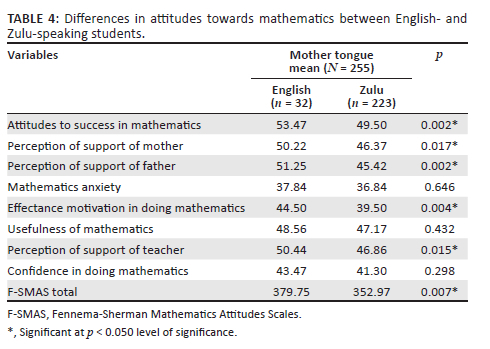
Significant differences were found between English- and Zulu-speaking students. Indian students, whose mother tongue is typically English, reported more positive attitudes to success in mathematics; a more positive perception of their mother and father as source of encouragement, support and affirmation of their efforts in mathematics; a more positive attitude to effectance motivation in doing mathematics; a more positive perception of their teacher as a source of encouragement, support and affirmation of their efforts in mathematics and a more positive overall (F-SMAS total) mean scores of English and Zulu students' attitudes towards mathematics (p < 0.050). No further significances were found amongst the two groups on remaining F-SMAS subscales (p > 0.050) (see Table 4).
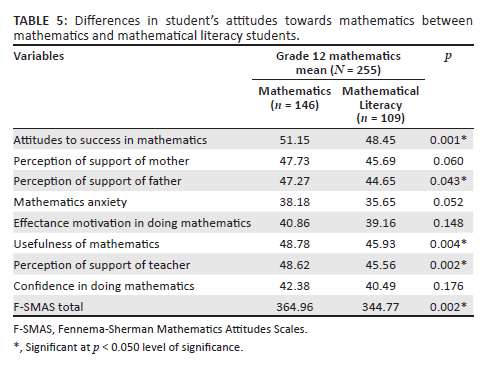
Differences in attitudes towards mathematics between mathematics and mathematical literacy students
There were significant differences between mathematics and mathematical literacy students. In comparison with mathematical literacy students, the mathematics students reported a more positive attitude towards success in mathematics; a more positive perception of their father as a source of encouragement, support and affirmation of their efforts in mathematics; a more positive attitude towards usefulness of mathematics; a more positive perception of their teacher as a source of encouragement, support and affirmation of their efforts in mathematics and a more positive overall (F-SMAS total) mean scores of mathematics and mathematical literacy students' attitudes towards mathematics (p < 0.050). No further significances were found amongst the two groups on remaining F-SMAS subscales (p > 0.050) (see Table 5).
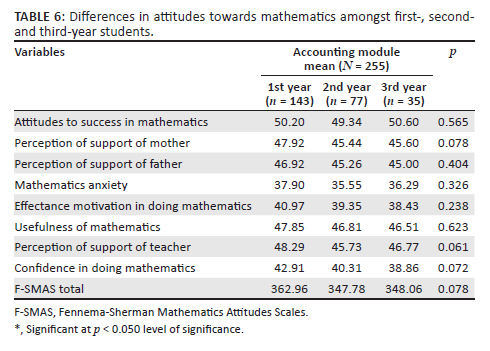
Differences in attitudes towards mathematics amongst first-, second- and third-year students
No significant differences were found amongst first-, second- and third-year students (p > 0.050) (see Table 6).
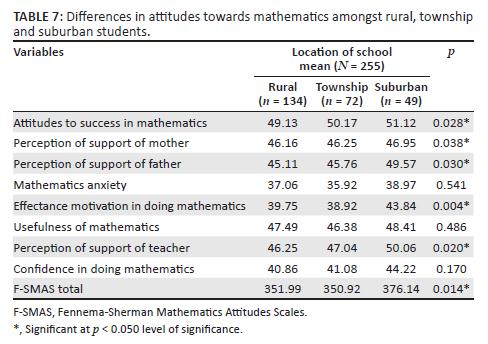
Differences in attitudes towards mathematics amongst rural, township and suburban students
The results of the ANOVA showed significant differences between rural, township and suburban students. The suburban students reported a more positive attitude towards success in mathematics; a more positive perception of their mother and father as sources of encouragement, support and affirmation of their efforts in mathematics; a more positive attitude towards effectance motivation in doing mathematics; a more positive perception of their teacher as a source of encouragement, support and affirmation of their efforts in mathematics; and a more positive overall mean scores of suburban area students attitudes towards mathematics than township and rural students (p < 0.050). No further significances were found amongst the two groups on remaining F-SMAS subscales (p > 0.050) (see Table 7).
Discussion of results
The results of the t-tests indicated significant differences between various student groupings in attitudes towards mathematics.
The female students reported more positive attitude towards success in mathematics; more positive perception of their father as a source of encouragement, support, and affirmation of their efforts in mathematics; and more positive perception of their teacher as a source of encouragement, support and affirmation of their efforts in mathematics than male students. The study findings are supported by Arslan et al,274,23,25
Indian students reported more positive attitude towards success in mathematics; more positive perception of their mother and father as sources of encouragement, support and affirmation of their efforts in mathematics; more positive attitude towards effectance motivation in doing mathematics, more positive perception of their teacher as a source of encouragement, support and affirmation of their efforts in mathematics and more positive overall attitudes towards mathematics than black students.
Mathematics students reported more positive attitude towards success in mathematics; more positive perception of their father and teacher as a source of encouragement, support and affirmation of their efforts in mathematics; more positive attitude towards usefulness of mathematics and more positive overall attitudes towards mathematics than mathematical literacy students. This is in contrast with a study by Frazier-Kouassi28
No significant differences were found in attitudes towards mathematics between younger and older students. This finding corresponds with a study by Woodard,2528
The results of the ANOVA showed a significant difference between suburban, township and rural students. Suburban students reported a more positive attitude towards success in mathematics; a more positive perception of their mother and father as sources of encouragement, support and affirmation of their efforts in mathematics; a more positive attitude towards effectance motivation in doing mathematics; a more positive perception of their teacher as a source of encouragement, support and affirmation of their efforts in mathematics; and more positive overall attitudes towards mathematics than township and rural students. This is in contrast with the finding by Frazier-Kouassi28
Conclusion and recommendations
In response to research the questions, the following claim is made:
'Differences in attitudes towards mathematics domains reflect a cultural racial split. The differences seem to fall into two camps, such as English, Indian and suburban students versus Zulu, black and township and rural students'.
In relation to differences between various student groupings in attitudes towards mathematics, female students reported more positive attitudes than male students to succeed in mathematics; more positive perception of their father as a source of encouragement, support and affirmation of their efforts in mathematics; and more positive perception of their teacher as a source of encouragement, support and affirmation of their efforts in mathematics. Indian, English and suburban students, compared to black, Zulu, township and rural students, reported a more positive attitude towards success in mathematics; a more positive perception of their mother and father as sources of encouragement, support and affirmation of their efforts in mathematics; a more positive attitude towards effectance motivation in doing mathematics; a more positive perception of their teacher as a source of encouragement, support and affirmation of their efforts in mathematics; and a more positive overall attitudes towards mathematics.
Mathematics students, compared with mathematical literacy students, reported a more positive attitude towards success in mathematics; a more positive perception of their father and teacher as sources of encouragement, support and affirmation of their efforts in mathematics; a more positive attitude towards usefulness of mathematics; and more positive overall attitudes towards mathematics.
No significant differences were found between younger and older students' attitudes towards mathematics. Therefore, no gap was found in attitudes towards mathematics amongst younger and older students. No significant differences were also found between first-, second- and third-year students' attitudes towards mathematics. It means that degree level differential has no impact on the attitude of students towards mathematics.
The study revealed that mathematical ability, family and home context as well geographical location were significant factors in determining attitudes towards mathematics and subsequent study of accounting. The F-SMAS used in this study could be applied by teachers and academics to navigate attitudes towards mathematics of students with the aim of setting one-on-one or group mathematics support interventions for students who depict less attitudes towards mathematics. Curriculum specialists are encouraged to devise strategies that could positively enhance students' attitudes towards mathematics.
The study is limited to pre-service accounting teachers (students) in the accounting education discipline. Results cannot be generalised to all South African higher education accounting students. This study could be conducted in other HEI (a large-scale study could be conducted) and in the Department of Basic Education. Researchers may further study other demographic variables that affect students' attitudes towards mathematics.
Competing interests
The author declares that he has no financial or personal relationships that may have inappropriately influenced him in writing this article.
Author's contributions
M.M. is the sole author of this article.
Ethical considerations
Ethical clearance to conduct this study was obtained from the University of KwaZulu-Natal Human Research Ethics Committee and the Higher Education Institution (reference number: HSS/0117/013D). Respondents signed an informed consent form and gave them assurance of confidentiality and anonymity.
Funding information
This research received no specific grant from any funding agency in the public, commercial, or not-for-profit sectors.
Data availability
The data that support the findings of this study are available on request from the corresponding author.
Disclaimer
The views and opinions expressed in this article are those of the author and do not necessarily reflect the official policy or position of any affiliated agency of the author, and the publisher.
References
Acknowledgements
Literature review
-
1.Pozo S, Stull CA. Requiring a math skills unit: Results of a randomized experiment, research on teaching innovation. Am Econ Rev. 2008;96(2):437-441. https://doi.org/10.1257/000282806777212486
» https://doi.org/10.1257/000282806777212486 -
2.Mkhize MV, Maistry SM. Pre-service accounting teachers' attitudes to mathematics. S Afr J Educ. 2017;37(2):1372. https://doi.org/10.15700/saje.v37n2a1372
» https://doi.org/10.15700/saje.v37n2a1372 -
3.Mkhize MV. Transdisciplinary relationship between mathematics and accounting. J Transdiscip Res S Afr. 2019;15(1):1-18. https://doi.org/10.4102/td.v15i1.451
» https://doi.org/10.4102/td.v15i1.451 - 4.Farooq MS, Shah SZU. Students' attitude towards mathematics. Pak Econ Soc Rev. 2008;46(1):75-83.
-
5.Cherry K. Attitudes and behaviour in psychology [homepage on the Internet]. 2021 [cited 2021 June 05]. Available from: https://www.verywellmind.com/attitudes-how-they-form-change-shape-behavior-2795897
» https://www.verywellmind.com/attitudes-how-they-form-change-shape-behavior-2795897 - 6.Nisbet S, Williams A. Improving students' attitudes to chance with games and activities. Aust Math Teach. 2009;65(3):25-37.
- 7.Tanveer MA, Rizwan M, Ali N, Arif M, Saleem U, Rizvi S. Examining the role of attitude towards mathematics in students of management sciences. IOSR J Bus Manag. 2015:67-73.
-
8.Neale DC. The role of attitudes in learning mathematics. Arithmetic Teach. 1969;16(8):631-640. https://doi.org/10.5951/AT.16.8.0631
» https://doi.org/10.5951/AT.16.8.0631 -
9.Yenilmez K, Girginer N, Uzun O. Mathematics anxiety and attitude level of students of the faculty of economics and business administrator. Int Math Forum. 2007;2(41):1997-2021. https://doi.org/10.12988/imf.2007.07181
» https://doi.org/10.12988/imf.2007.07181 -
10.Noffsinger D. How attitude towards mathematics impacts student achievement [homepage on the Internet]. 2019. [cited 2021 June 10]. Available from: https://www.prodigygame.com/main-en/blog/attitude-towards-math/
» https://www.prodigygame.com/main-en/blog/attitude-towards-math/ - 11.Lim-Teo SK, Ahiya OP, Lee PY. Tertiary and junior college students' attitude towards mathematics. Math Educ. 1999;4(1):15-33.
-
12.Gresham G. A study of mathematics anxiety in pre-service teachers. Early Child Educ J. 2007;35(2):181-189. https://doi.org/10.1007/s10643-007-0174-7
» https://doi.org/10.1007/s10643-007-0174-7 - 13.Trujillo KM, Hadfield OD. Tracing the roots of mathematics anxiety through in-depth interviews with preservice elementary teachers. Coll Stud J. 1999;33(2):219-232.
-
14.Evans BR. Content knowledge, attitudes, and self-efficacy in the mathematics New York City Teaching Fellows (NYCTF) Program. Sch Sci Math. 2011;111(5):225-235. https://doi.org/10.1111/j.1949-8594.2011.00081.x
» https://doi.org/10.1111/j.1949-8594.2011.00081.x - 15.Weissglass J. Inequity in mathematics education: Questions for educators. Math Educ. 2002;12(2):34-39.
- 16.Heck A, Van Gastel L. Mathematics on the threshold. Int Math Educ Sci Technol. 2006;37(8):1-24.
- 17.Michelli MP. The relationship between attitudes and achievement in mathematics among Fifth Grade Students. Mississippi: The University of Southern Mississippi; 2013.
- 18.Ajazen I. Attitude theory and the attitude behaviour relation. New directions in attitude measurement. 1993;3:41-57.
- 19.Triandis HC. Attitude and attitude change. New York, NY: Wiley & Sons Inc; 1971.
- 20.Fennema E, Sherman JA. Fennema-Sherman mathematics attitude scales, instruments designed to measure attitudes toward the learning of mathematics by males and females. JSAS Catalog Selected Documents Psychol. 1976;6(1):31-54.
-
21.McLeod S. Attitudes and behaviour 2018 [homepage on the Internet]. Available from: https://www.coursehero.com/file/22216814/Attitudes-and-Behavior/
» https://www.coursehero.com/file/22216814/Attitudes-and-Behavior/ -
22.Mazana MY, Montero CS, Casmir RO. Investigating students' attitude towards learning mathematics. Int Elec J Math Educ. 2019;14(1):207-231. https://doi.org/10.29333/iejme/3997
» https://doi.org/10.29333/iejme/3997 - 23.Asante KD. Secondary students' attitudes towards mathematics. Ife Psychol IA. 2012;20(a):121-133.
-
24.Kosgey AK, Manduku JG, Joseph B. Gender differences and attitudes towards learning of mathematics among secondary school students in Keiyo District, Kenya [homepage on the Internet]. 2015 [cited 2021 June 02]. Available from: https://su-plus.strathmore.edu/bitstream/handle/11071/3587/gender%20differences.pdf?sequence=1&isAllowed=y
» https://su-plus.strathmore.edu/bitstream/handle/11071/3587/gender%20differences.pdf?sequence=1& isAllowed=y - 25.Woodard T. The effects of math anxiety on post-secondary developmental students as related to achievement, gender, and age. From Inq. 2004;9(1):1-5.
- 26.Yeo KKJ. Do high ability students have mathematics anxiety? Journal of Science and Mathematics Education in S E Asia. 2013;27(2):135-152.
- 27.Arslan H, Çanlı M, Sabo HM. A research of the effect of attitude, achievement, and gender on mathematic education. Acta Didactica Napocensia. 2012;5(1):1-8.
- 28.Frazier-Kouassi S. A psychological study of mathematics attitudes and achievement among female Ivorian students. Michigan: University of Michigan; 1999. Contract No.: Working Paper # 268.
- 29.Mouton J. How to succeed in your Master's and Doctoral studies. Pretoria: Van Shaik Publishers; 2005.
- 30.Bougie R, Sekeran U. Research methods for business: A skill building approach. Hoboken: John Wiley & Sons Inc.; 2019.
- 31.Bless C, Higson-Smith C, Kagee A. Fundamentals of social research methods: An African perspective. Cape Town: Juta and Company Ltd; 2009.
- 32.De Vos AS, Strydom H, Fouchie CB, Delport CSL. Research at Grass roots; for the social sciences and human service professions. Pretoria: Van Schaik Publishers; 2011.

Accepted: 18 Nov. 2021
Published: 31 Mar. 2022