Gender mainstreaming in the urban space to promote inclusive cities
Abstract
The roles of urban spaces in promoting people's social experiences and interactions, and access to green spaces, are critical for long-term community building. While gender balance occurs in the use of metropolitan spaces, the urban environment can still be considered as a mostly masculine sphere. Women are still marginalised and unsafe in urban spaces. Gender mainstreaming is used to plan and design a gender inclusive city, which includes all women in decision-making processes and helps to achieve the Sustainable Development Goal 11. The exclusion of women and girls from the urban planning process generates a knowledge gap, resulting in public spaces that exclude them. There is a clear planning gap: women are excluded from urban planning and design procedures. The research study developed from the urge to examine if gender mainstreaming is used in the design of urban spaces. Data for the study were gathered using qualitative method. Primary data was through interview while secondary data includes policy and research focus documents. The study revealed that women's experience and understanding of urban spaces varied from men's, and that these differences must be considered when planning and developing urban spaces. The solutions to establishing inclusive urban public spaces that are accessible and safe for everyone in the community include good design and community dialogue. According to the research evidence, professionals in the built environment must be gender conscious when designing and creating urban spaces. Warwick Market, a public urban location in Durban, South Africa, was chosen for the study.
city; gender mainstreaming; inclusion; urban spaces; Warwick project; women
Introduction
A city that is inclusive appreciates all of its residents and their needs equally. The awareness of how urban spaces in developing and developed inclusive cities are gendered is tenuous with a small amount of data collected on how women and girls are affected by urban planning decisions. Understanding the meaning of urban or public spaces is critical for this research study because it necessitates the search for relationships between urban structures and space usage norms. There are three major difficulties that need to be addressed in this context: physical characteristics, such as the distribution, shape, and size of forms defining the space, as well as the distribution and behaviour of users, which indicate social order and flows of human mobility, and which are reflected in the perceived social layout of a specific site. Larsson and Jalakas123
Men have historically and extensively been conceptualised in urban and public spaces studies. Although both men and women now use public areas, the urban environment can still be regarded as a masculine realm in which women feel uneasy, undesired, or excluded.12
To create a safe and inclusive city, there is a requirement to reveal the gendered power relations in planning. Gender-friendly cities remain a 'utopian concept' as these sorts of cities are diversified, barrier-free, have well-developed infrastructure, are connected, and propose spaces that can be understood and employed according to different needs. South Africa needs a paradigm transformation towards gender equality in spatial planning concerning the visualisation, deconstruction, and redefinition of social values and norms in urban planning methods and management. Gough4
The need for this study stemmed from the necessity for a conceptual and project-linked gender balance in the advocacy for inclusive communities within urban planning to achieve Sustainable Development Goal (SDG) 11 (sustainable cities and communities). The view is that despite the existence of policies and initiatives aimed at urban gender mainstreaming, literature gives little indication of a sustainable transformation of the role and status of women and girls. This research aims to examine how gender mainstreaming strategies have been applied to achieve equality in urban spaces and uncover why they have failed - as women and girls still feel unsafe in many urban spaces.
Theorising city spaces through the feminist planning perspective
Globally, the importance of including women and girls in the architecture of urban spaces has been recognised. This study applied the feminist perspective and the women in development approach as one of the main theories that can be used to understand planning concerning gender mainstreaming of urban spaces. According to Meller,5
Many cities recognised the challenges that women were experiencing in the 19th century and proposed alternatives for women to live in cities that did not adhere to a strict interpretation of the two spheres.56
[A]ttempts to analyse the social platform of women, explain their apparent subsidiary role in history, and offer the basis for reform and the advancement of women in all areas of society.
Milward, Mukhopadhyay and Wong,1617
The South African perspective of gender mainstreaming
South Africa has a long history of gender inequality. Aside from the overall marginalisation of people, Akala18191820,21,22,23
The continued female negative exposure and shocks have been attributed to weak legislative implementation.24,2518
Setting: Warwick junction market project
The Warwick Precinct is the dominant public transport node within the eThekwini Municipality. The vigour of Warwick's trade, its variety in goods and presentation, its unique products, spaces, smells, and sounds combine to generate a vibrant multicultural space with an African heart. The development of the Warwick Junction as a public space is based on the Public Space Framework. The public spaces of the Warwick Junction area form part of a wider inner city public open space structure. The Warwick precinct supports and facilitates various functions such as the Berea Station, Market areas, bus and taxi ranks, etc. Since the majority of the precinct area serves the public, it is viewed and administered as a public space. Furthermore, the unique character of the area, the need to upgrade the precinct and the tourism value of Warwick necessitates the proper functional and aesthetic design and street scaping within the public key trade areas and intermodal transport facilities.
According to eThekwini Municipality,26
• Active open space - active recreation and sports facilities such as the Greyville Racecourse and the sports facilities attached to Durban University of Technology.
• Passive open space - parks, beach front areas, cemeteries including the Botanic Gardens, the West Street Cemetery, the Albert Park, the Old Fort, the beach front, the Victoria Embankment.
• Urban open space - paved hard open spaces such as the City Hall Square, the Warwick Junction and so on.
• The street as a public space - recognising that although streets may primarily be considered as corridors of movement, they accommodate a great variety of activities associated to movement, adjacent development, high visibility and so on and therefore represent probably the most significant public space area.
Following apartheid plans, Warwick Junction served as the black Africans' entry point into an all-white African metropolis. The Warwick neighbourhood was designed with the goal of discouraging free-flowing mobility, and black informal vendors faced intimidation and relocation. Asiye eTafuleni (AeT) has been at the forefront of improving public space at Warwick Junction and assisting markets in surviving redevelopment threats. According to Huber2727
Methods and material
The study examined as to how gender mainstreaming was implemented in a public urban space in Durban, South Africa. The study focused on gender mainstreaming in urban spaces and how it promoted inclusion. The research focused on examining theoretical assumptions behind gender mainstreaming. The thematic discussion was centred on global and national examples of gender mainstreaming, resulting in a discursive examination of gender mainstreaming challenges, legal frameworks, and strategies in each case. The study examined current gender mainstreaming national and international case study literature to identify issues and opportunities for women and girls. The literature identified successful gender mainstreaming implementation in urban spaces around the world and how South Africa can bridge the gap and have inclusive cities. Qualitative methods were used in the process of data collection. This method was chosen because it is well-known for providing a unique depth of information. Through this study approach, interviewees are free to openly discuss their experiences and feelings. As this study adopted a qualitative research design, all interviews took place synchronously using online platforms like ZOOM conferencing. Study respondents were selected purposively. The research study required the investigation of persons engaging in the Warwick upgrading and inclusive cities project's impressions of gender mainstreaming from the general community; consequently, a small sample size was adequate for this research study. Among those that were interviewed were Warwick Project Manager, Architect, two Town Planners and one representative from AeT (a non-profit making organisation focused on promoting and developing good practice and process around inclusive urban planning and design).
Findings
The solution to creating inclusive urban public spaces that are accessible and safe for all members of the community is good design and community dialogue. In order to promote inclusive cities, this study looked at gender mainstreaming in urban environments. The study was motivated by the need to comprehend the nature of gender mainstreaming, explore its implementation, and devise solutions to improve gender mainstreaming in South African urban settings. Literature confirms that while designing urban places, specialists in the built environment must recognise and accommodate the unique requirements and experiences of various demographic groups.
Women's experience and understanding of urban spaces varies from that of men, and these disparities must be considered when planning and designing areas. In the framework of the Warwick Junction Urban Renewal Project, the project's informal merchants, the majority of whom are women, were involved in the planning and design of the project. Using an intersectional gendered perspective, the market area's conception and design were informed by women's distinct experiences, needs, and concerns. Women's requests enabled the development of restrooms and storage facilities.
To establish gender equal spaces and cities, women must be included in the decisions about urban design. A gender balance is required to develop gender equality and establish inclusive, safe urban places that represent the needs and desires of not only women but the entire community.
Historical perspective and case studies to women in urban spaces
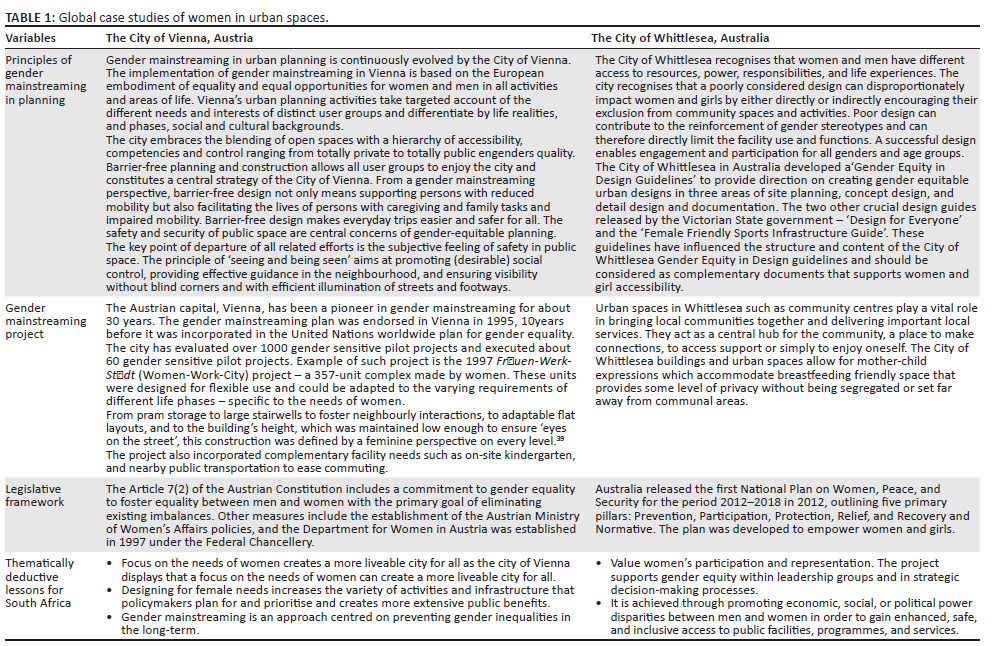
Urban spaces were designed incipiently through the contingent arrangement of buildings and homes. Women's freedom has been progressively expanding since the 1950s, yet deeply established gender norms continue to dictate how women and men go about their daily lives within the urban environment.2829,3031
Gender mainstreaming was created to directly address organisations' opposition to social change. It was viewed as a technique of correcting the uneven allocation of development resources by requiring development organisations' personnel to assess the effects of external programmes and projects, internal management structures, and policies for men and women. Studies32,33,34,35
Discussion: Warwick project-planning as an instrument
Conceptualising gender mainstreaming
The authors recognise the plurality in the definition of gender mainstreaming. The argument is along the project applicability. In summary, the interviewees recognised that gender mainstreaming entails the collective involvement, participation, and incorporation of gender (most especially women) in developmental planning projects and programmes. Iterating this, an interview reported that identifying with the needs of gender groups is crucial to space design. It was alluded that:
'[…E]nsuring that different genders are targeted within your development, understanding the different needs of each gender group… with the view that …understanding the sensitive nature of women and considering that some women have kids and will need creches or places to leave their kids when they are working… are essential to project designs (Warwick area) ….' (Interviewee, Project Manager, Warwick Urban Renewal Project)
Therefore, the perception is a technique that is aimed at achieving gender equality and to bring women's experiences and expertise and shape development accordingly. Thus, allowing for an equity-conscious planning said an interviewee.
Recognising the theme of conscious gender planning, the 'why' of women involvement in urban design ranges from the safety concerns, space demands and experience, social roles, capacity, and need for city rebranding away from the masculine dominancy. One of the respondents who is an architect responded that '… Architects have a tendency to look from the outside in rather than asking people, particularly women, what they want…' The proposition was that women have a wide range of themes, such as caregivers, mothers, sisters, and urbanists. Because women perceive and use cities differently, they must actively engage in urban planning design. This perception is embedded in the space safety, sense of comfort, security experience and accessibility. Recognising the importance of giving women a voice and incorporating their opinions into urban planning design gets us one step closer to attaining future equality. The advocacy is that professionals must face the urban future with all of humanity's capabilities, including the contributions and experiences of women.
The Warwick project: The ideology and basis
The Warwick Junction region is a relatively new occurrence. Warwick Junction Market is a one-of-a-kind location in Durban, South Africa, with significant economic importance. According to Huber,2727
This was supported by Huber,274040,4142
Aligning to citizen participation, the project manager mentioned that the need to incorporate informal traders in the renovation, renewal and reconstruction process was targeted at ensuring an inclusive urban area through the incorporation of traders' multiple spatial desires. It was recognised that the plurality of stakeholders necessitated integrated, area-based development with decentralised administration and planning. The initiative took a sector-by-sector approach, allowing residents from all sectors and stakeholders (such as street traders, tax collectors, landowners, religious groups, formal shops, storage firms, cardboard recyclers) to participate in all elements of development planning. The initiative attempted to establish a more participatory environment that worked with, rather than against, the interests of traders.
Success factors of the Warwick project
The study recognises contextual and organisation factor in project deliverable to be essential in the success of the Warwick project.
Contextual considerations include informal labourers at Warwick Junction who trusted AeT to defend their interests. Relationships with stakeholders were also mentioned as one of the most important contextual factors. Due to AeT's extensive understanding of Warwick's informal merchants, stakeholders were able to get credible information on an otherwise inaccessible section of the community, which eventually led to the acknowledgement of the requirements of informal workers in the development and planning process. The decision to cultivate connections with individual stakeholders rather than institutional ties meant that roadblocks in certain areas could be avoided; for example, barriers imposed by an official in one municipal department may be avoided or overcome by establishing as many positive connections with municipal authorities as possible. When development initiatives endangered portions of Warwick Junction, strong historical links and affiliation with built environment professionals and other community members or stakeholders bolstered lobbying efforts.
Organisational factors: Team dynamics - The team's integration in project work and the collaborative character of progress were identified as critical success factors. The plethora of professionals (planners, gender activists, architects, and other built environment professionals) allows for creative team thinking and viewpoints. This allows for the gender mainstreaming process to be done along an organisational culture that supports a rethinking process towards gender conscious planning. Cavaghan4344
Challenges experienced during the Warwick project
The view of an interviewee was that the work of advocating for a truly inclusive environment has never been easy. The interviewee noted that it is the joint responsibility of stakeholders to respond to project difficulties in the best way possible in order to achieve long-term success. The AeT,4542
'… When we first learned of some of the traders' needs, we attempted to plan for them without involving them in the planning and design process. The traders were dissatisfied and petitioned the city …' (Interviewee, Male, Town Planner)
'… Stakeholder relationships were also among the most important. For the project, better communication and gap analysis were required. Practitioners worked tirelessly to foster relationships and involve traders in decision-making. We build and maintain bridgeheads in a variety of communities and professions, and we use those bridgeheads to facilitate effective negotiations among the various key stakeholders …' (Interviewee, Project Manager, Urban Renewal Project)
Despite the challenges, an interviewee put that the key to achieving sustainable development in the project process is to establish an inclusive process.
Women involvement in the Warwick project: Efforts towards implementing gender mainstreaming
The authors recognised that women's involvement was achieved through communicative, collaborative, gender equality and empowerment and bottom-up planning approaches and process. The project manager iterates that communication with all stakeholders about the importance of creating a comfortable and welcoming public space to all, along with an effective communication strategy helped to support and raise awareness of our project's efforts. The need for the communication was to promote collaboration said an interviewee. It was argued that collaboration and knowledge sharing among stakeholders were critical to the success of our projects. The project practitioners anticipated collaboration within a gender focal point. This was done by planning with a gender focal point to build capacity in mainstreaming gender equality and to ensure that the traders' skills and knowledge fed into our design plans.
Towards gender mainstreaming: The concluding argument
Women's experience and knowledge of urban spaces are different to men. These differences need to be considered when planning and designing spaces. In the context of the Warwick Junction Urban Renewal Project, the project's informal merchants, the majority of whom are women, were involved in the project's development and design. The evidence of the involvement of women were the measures put in place to accommodate gender equality in the access to urban space. Responding, the interviewees stated thus:
'… The project team designed interconnected trading spaces to ensure that traders can move safely from one space to another. Plans and designs are solely for the benefit of the traders … To ensure space safety and ease of mobility, accessibility and usability, ramps and elevators were provided close to the elderly and women traders with children ….' (Interviewee, Project Manager, Urban Renewal Project)
The interviewed town planners stated that:
'… We were aware that we needed a broader understanding of different market segments to plan and achieve an inclusive public space. Our main planning tool was gender sensitive planning, which aided in creating positive experiences for female traders - it was recognized that female traders' experiences and needs were not homogeneous … We attempted to create an inclusive approach in which traders were included in the strategy formulation process. … We knew that women's capacity to fully utilize public places was reliant on their access to transportation and their perceptions of safety … We planners considered the readability of the area as well as the safety element, and we planned appropriately ….'
The interviewed gender advocate - Asiye eTafulweni representative asserted that the project approach was designed to be 'all-inclusive'. It state that:
'… We wanted the Warwick area to be a location that has been created in such a manner that it covers everyone - the traders agree, as when we met with one of the trade leaders, he stated that the site must be for everyone - the citizens, the visitors, and the traders ….'
This explained that along the intersectional gendered lens, women's specific experience, needs and concerns informed the development and design of the market area. The facilities (ablution and storage facilities) were constructed for women to be gender conscious. The Warwick Junction Urban Renewal Project combines adequate and appealing infrastructure with an innovative approach to urban management concerns, presenting a unique paradigm of how inclusion could be included into urban design. The initiative resulted in a sustained and continuing participation of informal merchants in conversations regarding their needs and priorities. To build an inclusive urban area, the Warwick project listened to informal merchants and included their demands into the design.
Evidence from the study emphasised space comfortability and safety to be key to gender mainstreaming. The view is that when creating spaces for women, the need to keep women safe, typically by crime-prevention design methods or by enabling women's usual patterns of mobility and utilisation of the city is considered important. Women's engagement in public life is contingent on these improvements. It was established that the fear for personal safety prevent women from travelling in public places, and innovations to keep women secure might 'paradoxically' make women feel less protected. Women form predicted mental images of hazardous areas based on current news; as a result, their perception of safety is dependent on visuals rather than statistical proof or ideas supported by evidence.
In summary, the study recognises that to create gender equitable city spaces, women's voice in decision-making and their involvement in the designing of urban spaces is critical - in order to promote gender equality, balance, and inclusive safe urban spaces that represent the needs and desires of all community genders. However, the authors, through field observation forwards improved space lighting towards achieving gendered 'safer' spaces. We also further iterate owing to the limited project success that, professionals in the built environment especially planners who design the use of spaces need to encourage social interaction in their designs.
Competing interests
The authors declare that they have no financial or personal relationships that may have inappropriately influenced them in writing this article.
Authors' contributions
K.R. was the project leader responsible for project design, data capture, and co-wrote the manuscript. H.M-C. performed the draft review, provided technical guidance, co-wrote the manuscript, and was involved in the conceptualisation of the study.
Ethical considerations
This study is approved under the Humanities and Social Sciences Research Ethics Committee (HSSREC) of the University of KwaZulu-Natal, South Africa, reference number: HSSREC/00002456/2021.
Funding information
This research was funded by the South African Research Chair for Inclusive Cities (SARCHI).
Data availability
Data sharing is not applicable to this article as no new data were created or analysed in this study.
Disclaimer
The views and opinions expressed in this article are those of the authors and do not necessarily reflect the official policy or position of any affiliated agency of the authors.
Acknowledgements
References
- 1.Larson A, Jalakas A. Gender equality next! Spatial strategic planning from a gender perspective (English). Stockholm: SNS förlag, 2008; p. 172.
-
2.Kneeshaw S. Gender sensitive public space? Placemaking and spatial justice through the perspective of gender, Integrated Urban Development [homepage on the Internet]. URBACT; 2018 [cited 2021 Oct 11]. Available at: https://urbact.eu/gender-sensitive-public-space-placemaking-and-spatial-justice-through-perspective-gender
» https://urbact.eu/gender-sensitive-public-space-placemaking-and-spatial-justice-through-perspective-gender -
3.Baboun V. Creating inclusive cities with gender policies [homepage on the Internet]. New Cities; 2018 [cited 2021 Oct 11]. Available from: https://newcities.org/the-big-picture-integration-of-gender-policies-and-the-creation-of-inclusive-cities/
» https://newcities.org/the-big-picture-integration-of-gender-policies-and-the-creation-of-inclusive-cities/ - 4.Gough A. The gendered city. In Horne R, Fien J, Beza B, Nelson A, editors. Sustainability citizenship in cities: Theory and practice. London: Routledge, 2016; p. 1-19.
-
5.Meller H. Planning theory and women's role in the city. Urban Hist. 1990;17:85-98. https://doi.org/10.1017/S096392680001436X
» https://doi.org/10.1017/S096392680001436X - 6.Harrison K, Boyd T. Understanding political ideas and movements. Manchester: Manchester University Press; 2003.
-
7.Burton A. Thinking beyond the boundaries: Empire, feminism and the domains of history. Soc Hist. 2001;26(1):60-71. https://doi.org/10.1080/03071020010004417
» https://doi.org/10.1080/03071020010004417 -
8.Andrews M. Introduction. J Roman Stud. 2007;7(1):1. https://doi.org/10.3828/jrs.7.1.1
» https://doi.org/10.3828/jrs.7.1.1 -
9.Aldana T. How can feminist urbanism help build more equal cities? Lessons from Latin America [homepage on the Internet]. [cited 2021 Oct 11]. Available from: https://www.citiestobe.com/feminist-urbanism-equal-cities-latin-america/
» https://www.citiestobe.com/feminist-urbanism-equal-cities-latin-america/ - 10.Levy J. Contemporary Urban Planning. 11th edn. Routledge; 2016.
- 11.Kuhlmann D. Raum, Macht & Differenz: Genderstudien in der Architecktur. Gender Studies in architecture: space, power and difference (English). Wien: Edition Selene. New York: Routledge; 2003.
- 12.De Graft-Johnson A. Gender, race and culture in the urban built environment. In Greed C, editor Social Town Planning. London: Routledge, 1999; p. 118-140.
- 13.Walker J. A view from the interior: Feminism, women and design. Women Arch. 2000;7(1):90-105.
-
14.Beall J. Participation in the city: Where do women fit in?. GendDev. 1996;4(1):9-16. https://doi.org/10.1080/741921946
» https://doi.org/10.1080/741921946 - 15.Daniel G. Designing for gender equality in the developing context: Developing a gender-integrated design process to support designers' seeing, process, and space making. Doctoral dissertation. Department of Landscape Architecture, College of Built Environments: University of Washington; 2013
-
16.Milward K, Mukhopadhyay M, Wong FF. Gender mainstreaming critiques: Signposts or dead ends?. IDS Bull. 2015;46(4):75-81. https://doi.org/10.1111/1759-5436.12160
» https://doi.org/10.1111/1759-5436.12160 -
17.Zapata MA, Bates LK. Equity planning revisited. J Plan Educ Res. 2015;35(3):245-248. https://doi.org/10.1177/0739456X15589967
» https://doi.org/10.1177/0739456X15589967 -
18.Akala BM. Challenging gender equality in South African transformation policies-A case of the white paper: A programme for the transformation of higher education. S Afr J High Educ. 2018;32(3):226-248. https://doi.org/10.20853/32-3-1521
» https://doi.org/10.20853/32-3-1521 - 19.Hassim S. Gender, social location and feminist politics in South Africa. Transformation. 1991;(15):65-82.
- 20.Nothling-Slabbert M. 'Till death us do part': Intimate femicide in South Africa. Codicillus. 2006;47(1):1-3.
-
21.Snodgrass L. The sins of the father: Gender-based violence in post-apartheid South Africa. Commonwealth Youth Dev. 2016;14(2):57-70. https://doi.org/10.25159/1727-7140/1798
» https://doi.org/10.25159/1727-7140/1798 -
22.Makou G. Femicide in South Africa: 3 numbers about the murdering of women investigated, Africa check [homepage on the Internet]. 2017 [cited 2021 Oct 11]. Available from: https://africacheck.org/reports/femicide-sa-3-numbers-murdering-women-investigated/
» https://africacheck.org/reports/femicide-sa-3-numbers-murdering-women-investigated/ -
23.Nduna M, Tshona SO. Domesticated poly-violence against women during the 2020 Covid-19 lockdown in South Africa. Psychol Stud. 2021;66:347-353. https://doi.org/10.1007/s12646-021-00616-9
» https://doi.org/10.1007/s12646-021-00616-9 -
24.Masweneng K. Femicide in South Africa: Why men kill women, South Africa. Times Live [serial online]. 2018 [cited 2021 Oct 11]. Available from: https://www.timeslive.co.za/news/south-africa/2018-05-29-femicide-in-south-africa-why-men-kill-women/
» https://www.timeslive.co.za/news/south-africa/2018-05-29-femicide-in-south-africa-why-men-kill-women/ -
25.William H. 3 issues South Africa needs to address for gender equality [homepage on the Internet]. 2018 [cited 2021 Oct 11]. Available from: https://www.globalcitizen.org/en/content/south-africa-womens-month-issues-to-address/
» https://www.globalcitizen.org/en/content/south-africa-womens-month-issues-to-address/ -
26.eThekwini Municipality. eThekwini inner city local area plan [homepage on the Internet]. Durban: eThekwini Municipality; 2016 [cited 2021 Oct 11]. Available from: http://www.durban.gov.za/City_Services/development_planning_management/Documents/Inner %20City%20LAP%20Nov%202016.pdf
» http://www.durban.gov.za/City_Services/development_planning_management/Documents/Inner %20City%20LAP%20Nov%202016.pdf -
27.Huber D. The informal economy of Warwick junction, The city at eye level [homepage on the Internet]. 2017 [cited 2021 Oct 11]. Available at: https://thecityateyelevel.com/stories/the-informal-economy-of-warwick-junction/
» https://thecityateyelevel.com/stories/the-informal-economy-of-warwick-junction/ -
28.Women's Health East. Creating safe and inclusive public spaces for women [homepage on the Internet]. 2020 [cited 2021 Oct 11]. Available from: https://whe.org.au/wp-content/uploads/WHE-Creating-Safe-and-Inclusive-Public-Spaces-for-Women-Report-V2-September-2021.pdf
» https://whe.org.au/wp-content/uploads/WHE-Creating-Safe-and-Inclusive-Public-Spaces-for-Women-Report-V2-September-2021.pdf -
29.Hafner-Burton E, Pollack MA. Gender mainstreaming and global governance. Feminist Legal Studies. 2002;10(3):285-298. https://doi.org/10.1023/A:1021232031081
» https://doi.org/10.1023/A:1021232031081 - 30.Tiessen R. Everywhere/nowhere: Gender mainstreaming in development agencies. West Hartford, CT: Kumarian Press; 2007.
-
31.Beijing Platform for Action (BPFA). Report on implementation of the Beiing platform for action presented by the Government of Chile to the United Nations Divisons for the Advancement of Women. United Nations, New York; 1995. Available from: https://www.un.org/womenwatch/daw/beijing/pdf/Beijing%20full%20report%20E.pdf
» https://www.un.org/womenwatch/daw/beijing/pdf/Beijing%20full%20report%20E.pdf -
32.Chant S. Cities through a 'gender lens': A golden 'urban age' for women in the global South?. Environ Urban. 2013;25(1):9-29. https://doi.org/10.1177/0956247813477809
» https://doi.org/10.1177/0956247813477809 - 33.Pozarny P. Gender roles and opportunities for women in urban environments. Governance and Social Development Resource Centre (GSDRC) Helpdesk Research Report. Birmingham: GSDRC and University of Birmingham; 2016.
- 34.Libertun de Duren N, Brassiolo P, et al. Gender inequalities in cities. IDB Monograph. Washington, DC: Inter-American Development Bank; 2020.
-
35.UN-Women. SDG 5: Achieve gender equality and empower all women and girls [homepage on the Internet]. n.d. [cited 2021 Oct 11]. Available from: https://www.unwomen.org/en/news/in-focus/women-and-the-sdgs/sdg-5-gender-equality
» https://www.unwomen.org/en/news/in-focus/women-and-the-sdgs/sdg-5-gender-equality -
36.World Bank. A new approach to cities: Everyone counts [document on the Internet]. 2015 [cited 2021 Oct 11]. Available from: https://www.worldbank.org/en/news/feature/2015/10/29/a-new-approach-to-cities-including-inclusion
» https://www.worldbank.org/en/news/feature/2015/10/29/a-new-approach-to-cities-including-inclusion -
37.European Institute for Gender Equality. European Institute for gender equality [homepage on the Internet]. European Institute for Gender Equality; 2020 [cited 2021 Oct 11]. Available from: https://eige.europa.eu/
» https://eige.europa.eu/ - 38.Damyanovic D, Reinwald F, Weikmann A. Gender mainstreaming in urban planning and urban development. Viena: Urban Development Vienna; 2013.
-
39.Kail E. City with a female face: How modern Vienna was shaped by women [homepage on the Internet]. 2019 [cited 2021 Oct 11]. Available from: https://www.theguardian.com/cities/2019/may/14/city-with-a-female-face-how-modern-vienna-was-shaped-by-women
» https://www.theguardian.com/cities/2019/may/14/city-with-a-female-face-how-modern-vienna-was-shaped-by-women - 40.Onyemenam P, Ayangbile O, Popoola A, Adeleye B. Towards transforming human settlements in urban fringes of delta state, Nigeria. In: Perry G, Ledwon S, editors. Proceedings of the 52nd ISOCARP Congress Durban, South Africa, 2016 Sept 12-16. Cities We Have vs. Cities We Need.
- 41.Africa E, Magwaza E, Patel Y, et al. Integrated development planning guide pack. Cape Town: Department of Provincial and Local Government; 2000.
-
42.Dobson R, Quazi T. Street trade at Warwick junction. In The city at eye level - Second and extended version [homepage on the Internet]. 2016 [cited 2021 Oct 11]. Available from: https://thecityateyelevel.com/app/uploads/2018/06/44.Street-Trade-at-Warwick-Junction.pdf
» https://thecityateyelevel.com/app/uploads/2018/06/44.Street-Trade-at-Warwick-Junction.pdf -
43.Cavaghan R. Gender mainstreaming in the DGR as a knowledge process: Epistemic barriers to eradicating gender bias. Crit Policy Stud. 2013;7(4):407-421. https://doi.org/10.1080/19460171.2013.804330
» https://doi.org/10.1080/19460171.2013.804330 -
44.Arora-Jonsson S, Sijapati BB. Disciplining gender in environmental organizations: The texts and practices of gender mainstreaming. Gend Work Organ. 2018;25(3):309-325. https://doi.org/10.1111/gwao.12195
» https://doi.org/10.1111/gwao.12195 -
45.AeT. The view from the streets - Asiye eTafuleni [homepage on the Internet]. 2014 [cited 2021 Oct 11]. Available from: https://aet.org.za/the-view-from-the-streets
» https://aet.org.za/the-view-from-the-streets - 46.Terraza H, Orlando M, Lakovits C, Janik V, Kalashyan A. Handbook for gender-inclusive urban planning and design. Washington, DC: The World Bank Group; 2020.
- 47.Fritz L. Gender equal cities - An empirical analysis of Vienna and Bratislava. Sweden: Lunds University; 2021.
-
48.Zachariassen HH. From the bottom up: Lessons about gender mainstreaming in the Andes from Digni's women empowerment and gender equality (WEGE) programme. Gend Dev. 2012;20(3):481-490. https://doi.org/10.1080/13552074.2012.731749
» https://doi.org/10.1080/13552074.2012.731749 - 49.Horelli L. Gender mainstreaming, urban planning and development-experiences of women's place based politics. Madrid: Escuela Tecnica Superior de Arquitectura; 2002.
- 50.Tandon I. 'We get nothing': An ethnography of participatory development and gender mainstreaming in a water project for the Bhil of Central India. Albany, NY: State University of New York at Albany; 2019.
-
51.Fihaki L, Fihaki E. Gender mainstreaming in Tuvalu [homepage on the Internet]. 2020 [cited 2021 Oct 11]. Available from: https://www.researchbank.ac.nz/bitstream/handle/10652/5012/Gender_Mainstreaming_in_Tuvalu_Lupeti_Eliala_ fihaki.pdf?sequence=1&isAllowed=y
» https://www.researchbank.ac.nz/bitstream/handle/10652/5012/Gender_Mainstreaming_in_Tuvalu_Lupeti_Eliala_ fihaki.pdf?sequence=1&isAllowed=y

Accepted: 10 Mar. 2022
Published: 15 Dec. 2022