Immigrant entrepreneurship in South Africa: A review and research agenda
Abstract
Immigrant entrepreneurship is a global phenomenon that has recently attracted the interest of South African academics. The goal of this article was to conduct a systematic review of the literature on immigrant entrepreneurship in South African (SA) between 2009 and 2021. This systematic review was especially important because it synthesised the current literature on immigrant entrepreneurship in SA as well as proposing new avenues for research. The review included 48 articles, with an emphasis on publication trends, methodological and theoretical approaches, provincial focus, networks used by immigrant entrepreneurs and the barriers faced by immigrant entrepreneurs in SA. The findings indicate that scholarly interest in the concept has increased in SA since 2016-2018, which recorded the highest number of publications (16). The majority of studies in the review employed a quantitative approach; thus, further theorisation of the concept is required, and immigrant entrepreneurs are encouraged to explore other networks such as family, business, managerial and interorganisational networks. This article contributes to immigrant entrepreneurship literature in the South African context by synthesising the findings on immigrant entrepreneurship published within the designated timeframe. In addition, the article also identifies areas of future research on immigrant entrepreneurship in SA.
entrepreneurship; immigrant entrepreneurs; immigrant entrepreneurship; systematic literature review; South Africa
Introduction
International migration has become a global phenomenon that shows no signs of slowing. Several scholars share a similar view,1,2,33,41,511,4,67
The last decades have recorded an increase in the influx of African immigrants into the different provinces in SA,89,10,11,12,13,1447,15,16,17
Street vending (trading) is a global phenomenon that is not limited to developing countries, as it exists in developed economies as well. South African street traders (including immigrants) sell everything from clothing, shoes and crafts to perishables (e.g. vegetables). Street trading is particularly prevalent in immigrant populations because, according to Moyo et al.,18151711,1313,1411,198
Immigrant entrepreneurship is the pursuit of entrepreneurial activities by immigrants just after arrival in their host country through personal initiatives or with assistance from acquaintances.20,21,228
South Africa has attracted a large number of immigrant entrepreneurs over the years. As there has been a decrease in the number of South African citizens who were involved in entrepreneurship, immigrant entrepreneurs have continuously tried to fill this vacuum.19232419
[T]he government has not fully recognised the impact that the growth being offered by immigrant entrepreneurship can have on the unemployed youth of SA, especially given the necessary support required.
As a result, immigrant entrepreneurs face numerous challenges in the South African economy, which may have a negative impact on their growth.
The past years have recorded an increase in publications on immigrant entrepreneurship in SA; however, much less has been done in synthesising the findings of these publications. Fatoki2525
In this article, the researchers intend to systematically review prior research on immigrant entrepreneurship and contribute to the available body of literature on immigrant entrepreneurship in SA between 2009 and 2021. The review will be guided by the following questions:
RQ1: How has immigrant entrepreneurship research in SA evolved?
RQ2: Which methodologies and theoretical frameworks are employed in the study of immigrant entrepreneurship in SA?
RQ3: Which provinces have been studied in terms of immigrant entrepreneurship in SA?
RQ4: What types of networks are used by immigrant entrepreneurs in SA?
RQ5: What are the barriers faced by immigrant entrepreneurs in SA?
The following section presents a review of the literature on immigrant entrepreneurs and entrepreneurship, barriers to immigrant entrepreneurship, networking and immigrant entrepreneurship, as well as the methodologies and theories used in immigrant entrepreneurship. This will be followed by the methodology, the findings, discussions of the findings and the conclusion.
Immigrant entrepreneurs and entrepreneurship
As previously stated, an immigrant entrepreneur is a person who has moved to a new country and started a business, with the primary goal of making money. Specifically, 'an entrepreneur is an individual who establishes and manages a business for profit and growth'.2619,27,28,293031,32
Immigrant entrepreneurship, as with mainstream entrepreneurship, lacks a unified definition. This is because of the different views and the multiplicity of definitions that have been proposed by scholars.21,333425,35,36
Challenges faced by immigrant entrepreneurs
Several studies have focused on the challenges, difficulties and barriers faced by entrepreneurs (both male and female entrepreneurs), including immigrants.37,38,39,40,41,423737,40384237
Another strand of literature asserts that the challenges that immigrant entrepreneurs face include unemployment, cultural and language barriers, lack of work experience and lack of required qualifications.22,43,444345,46391,14,19,25
The xenophobic attacks which took place in 2008 and 2015 stand out as one of the main barriers that are unique to immigrant entrepreneurs in SA.14,47,484950474814
Networking and immigrant entrepreneurship
Scholars have highlighted the important role of networks in the business success of entrepreneurs, including immigrants.11,25,51,52255354,55,565325
Different types of networks have been identified in prior literature; these include social, managerial, business, ethnic, family and interorganisational networks, among others.51,53,57,585759515160,616211
Methodologies and theoretical frameworks in immigrant entrepreneurship research
Scholars have used various methodologies to study immigrant entrepreneurship. These studies ranged from commentaries to conceptual write-ups and empirical studies (adopting a qualitative or a quantitative research method).21,6364636321
The human capital theory emphasises how value can be created for the individual through education and training.65664121
The disadvantage theory suggests that immigrants (upon arrival in their host countries) are usually faced with significant difficulties which sometimes influence their behaviours.646721,43,63
Methodology
This study used a systematic review method to answer the research questions and tables to synthesise the information related to the research questions. According to Snyder,6869
Eligibility criteria
The first step in the systematic literature review was deciding upon the eligibility criteria and selecting the relevant material.
The inclusion criteria
Evidence suggests that immigrants are more likely than locals to engage in entrepreneurial activities in countries such as the United States of America, the United Kingdom and Australia;70,71727213,19
Exclusion criteria
Articles that were not written in English or peer-reviewed were excluded from the review. In addition, articles not published within the designated period (January 2009 and August 2021) were excluded from the review. The review also excluded theses, dissertations, reports and conference papers. Similar systematic reviews in the same context were also excluded from this review.
The keywords and databases searched
An initial search was conducted to identify possible systematic reviews that have been published on immigrant entrepreneurship in SA. The rationale was to ensure that there was a need for a systematic review on the topic. Only one systematic literature review25'immigrant entrepreneurship*' OR 'immigrant entrepreneurs*' OR 'immigrant small and medium-sized enterprises*' OR 'immigrant enterprises*' OR 'immigrant-owned SMEs*' AND South Africa. The Boolean 'OR' was used in the search since the words (in italics) are often used interchangeably by scholars, and 'AND' was then used, since the focus of the search was on immigrant entrepreneurship in SA. The search was conducted on the Scopus database and Google Scholar between July and August 2021. Scopus and Google Scholar were chosen for the search as they have been widely used as search databases in academic research73,74,757677
The search strategy and data extraction
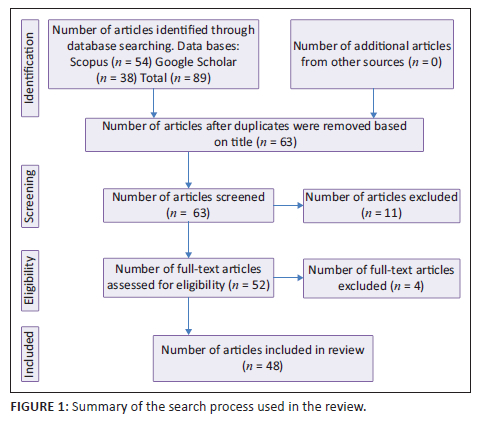
Following Moher et al.786878Figure 1 is formulated based on the PRISMA guidelines by Moher et al.78
As indicated in Figure 1, an initial search on Scopus yielded 54 articles, while a search on Google Scholar yielded 38 articles, for a total of 89 articles. After comparing the results, duplicates were removed, with 63 articles left for screening. During the screening process, 11 articles did not meet the inclusion criteria and were therefore excluded from the review. A total of 52 articles were then assessed for eligibility, and because the researchers were unable to locate four articles, the final review only included 48 articles.
Data analysis
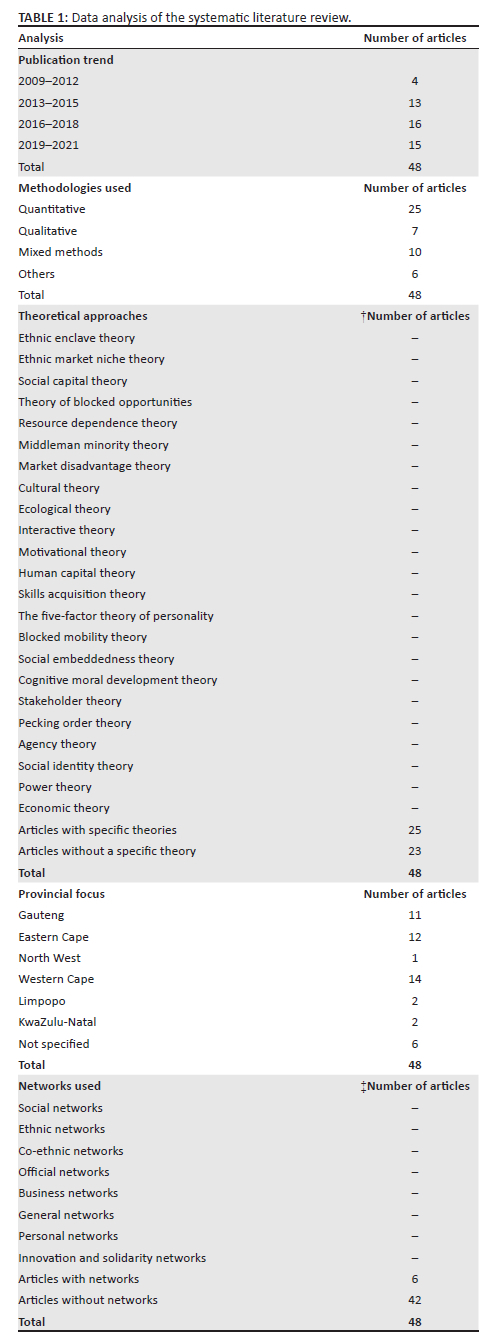
Data analysis for this article is presented in the following sections (see Table 1 and Online Appendix 1). The analysis is based on the guiding research questions, namely (1) what is the publication trend, (2) what research methods or theories have been explored, (3) which provinces in SA have received much scholarly attention, (4) what types of networks are used by immigrant entrepreneurs and (5) what are the barriers faced by immigrant entrepreneurs in SA?
Table 1 is organised according to the research questions and the number of articles (48) that were included in the review. The authors indicated the statistics based on the 48 articles by using numbers and the letter 'X'. In addition, some articles mentioned more than one network and multiple barriers. As a result, the authors decided to use the letter 'X' for repetition and instead separated the articles based on those that mentioned theories, networks or barriers and those that did not. For example, 25 articles specified which theories they employed, whereas 23 articles did not employ any theory at all. There were six articles that mentioned networks, while the remaining 42 articles did not. In addition, five articles focused on barriers, while the remaining 43 had nothing to do with barriers.
Publication trend
Table 1 shows that immigrant entrepreneurship was still in its infancy in SA between 2009 and 2012, with only four publications.11,23,79,809,12,13,15,16,48,58,81,82,83,84,85,8614,34,35,36,87,88,89,90,91,92,93,94,95,96,97,9819,30,99,100,101,102,103,104,105,106,107,108,109,110,111
Methodological approaches
Table 1 shows the various methodological approaches used in the review articles. According to the findings, the majority of studies on immigrant entrepreneurship in SA conducted between 2009 and 2021 used a quantitative research method (25 articles).9,11,14,15,16,30,79,81,83,85,87,89,90,91,92,93,94,95,98,104,105,106,107,108,10912,34,35,36,48,79,85,97,110,11113,19,58,81,88,96,10223,83,100,101,102,103
Theoretical approaches
Table 1 summarises the various theories that were used in the review articles. The review identified 25 articles that based their research on theories, and some of them mentioned more than one theory; however, 23 of the articles in the review did not specify any theory. The analysis indicated that the ethnic enclave theory was used to underpin the majority of research on immigrant entrepreneurship in SA.34,79,83,84,89,90,92,101,110
Market disadvantage theory,11,12,92,94,96,10812,85,89,94,10880,85,89,90,10158,82,8311,94,10879,83,901049392799613111
Provincial focus
The majority of the articles in the review focused on a specific province in SA, while five of the articles did not;89,90,91,99,101
Networking
The review identified some networks which are frequently mentioned in immigrant entrepreneurship research in SA by scholars. From Table 1, it is evident that the networks included social networks,88,90,104791158104
Barriers faced by immigrant entrepreneurs in South Africa
The analysis in Table 1 indicates that some articles on immigrant entrepreneurship in SA focused specifically on barriers, challenges and obstacles faced by immigrant entrepreneurs. These challenges and barriers include lack of access to finance, Afrophobia and xenophobic attacks,12,14,19,4811,19,5811,481411
Discussion
Publication trends
According to the review, immigrant entrepreneurship in SA is rapidly evolving, as evidenced by a significant increase in the number of peer-reviewed articles published between 2009 and 2012 and again between 2013 and 2021. It is important to note, however, that there is room to increase the number of publications on immigrant entrepreneurship on an annual basis as this would enable researchers to uncover new findings on the global phenomenon in the South African context.
Methodological focus
The review suggests that the majority of research on immigrant entrepreneurship in SA conducted between 2009 and 2021 deployed a quantitative research method, with the rest focusing on mixed methods, qualitative and other research methodologies. These various methodologies have been used depending on the scope, objective and parameters being tested in the research. In this light, scholars are constantly urging future research to use a different research method to confirm the findings of prior research. As a result, more research on immigrant entrepreneurship in SA is required, and any of the above research methods will provide additional insights into the global phenomenon. More specifically, Chimucheka et al.104
Theoretical approaches
Underpinning research on theories is important and gives a clear viewpoint on what the researcher is focusing on. Numerous theories can be used for understanding immigrant entrepreneurship research, such as those listed in Table 1. Other theories (e.g. agency theory, network theory and institutional theory) can also be borrowed from different fields and used in immigrant entrepreneurship research. However, there is a need for more research to focus on identifying the relevant theories that can be used to underpin immigrant entrepreneurship research in the South African context. Asoba et al.101
In addition, the analysis indicated that some studies79,89,91,108112
Provincial focus
Migration has become an important economic phenomenon, particularly in countries with enticing factors such as democracy, guaranteed human rights and favourable economic conditions.85Table 1 indicate that out of the nine provinces in SA, some (Western Cape, Eastern Cape and Gauteng provinces) have received much attention from immigrant entrepreneurship scholars, while others have received little (KwaZulu-Natal, Limpopo and North West provinces) or no attention (Mpumalanga, Northern Cape and Free State).
Networking
Despite the role that networks play in providing accessibility to scarce resources, which are vital for the business operations of immigrant entrepreneurs, Fatoki and Patswawairi111910458
Barriers faced by immigrant entrepreneurs in South Africa
Many studies in this review on immigrant entrepreneurship in SA have focused on or mentioned the barriers that are faced by immigrant entrepreneurs.8,14,1914
Financial difficulties have been identified as the major challenge that is faced by immigrant entrepreneurs in SA.8,10,35,4881484191111,1914
Managerial and financial skills are also crucial in running businesses - something which immigrant entrepreneurs may lack.14
Afrophobia, xenophobia and crime have also been identified by several scholars12,14,19,481414,4814,48,9519
Other minor challenges which are faced by immigrant entrepreneurs in SA are language barriers11,1219481919
Recommendations for future research
Methodological focus
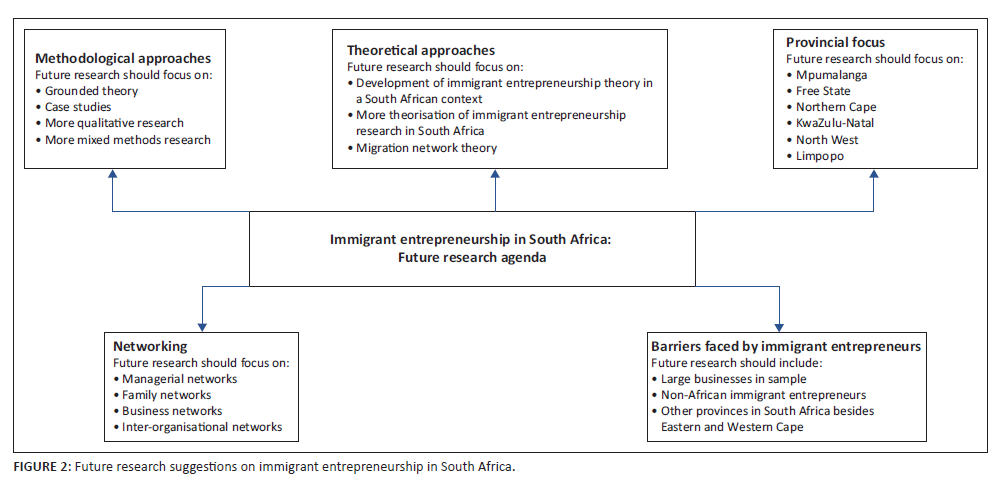
The review indicates that Chinomona et al.13ubuntu and xenophobia in SA. Although they achieved their research goal, they proposed that future research should use a mixed methods approach for more robust results. Mouelle et al.96Table 1, immigrant entrepreneurship research in SA was still in infancy between 2009 and 2012, but this is gradually growing, evidenced by the increase in the number of publications on the concept between 2013 and 2021. As the majority of research on immigrant entrepreneurship in SA has been quantitative, more research on immigrant entrepreneurship using a qualitative research method is encouraged. Qualitative methods like grounded theory are also encouraged as only one study100113
Theoretical focus
From the review, it is evident that immigrant entrepreneurship in SA has attracted the attention of scholars;25,30,82,100,102114
Provincial focus
Based on the fact that none of the studies in the review was conducted in Mpumalanga, Northern Cape and Free State, future studies on immigrant entrepreneurship in SA should focus on these three provinces. Also, research is encouraged in provinces like KwaZulu-Natal, Limpopo and North West that received much less attention from scholars. This is because scholars continually call on research conducted in one province to be replicated in the context of another province to confirm previous findings. In this direction, Chimucheka et al.104
Networking
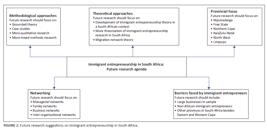
Despite their lack of resources, immigrant entrepreneurs do not use official networks to obtain such resources;585894Figure 2 summarises the above-mentioned future research suggestions on immigrant entrepreneurship in SA.
Barriers faced by immigrant entrepreneurs
Limitations of the review
This study, like most other studies, has its limitations. The study focused on the publication trends, methodological and theoretical approaches employed in immigrant entrepreneurship in SA, the provincial distribution of immigrant entrepreneurship research, the network types used by immigrant entrepreneurs and the barriers faced by immigrant entrepreneurs in SA.
Not all aspects of methodologies and research methods were considered; for example, sampling methods, measurement variables and data collection methods are interesting aspects that future research can focus on. In addition, work in progress, conference proceedings and edited books were not considered in the review. These sources could also have provided additional useful information. Furthermore, despite the authors' exhaustive Internet search, some studies regarding immigrant entrepreneurship may have been missed. This review only focused on publication trends, methodological and theoretical approaches, provincial focus, networking and the barriers faced by immigrant entrepreneurs. There are other aspects, such as industry focus, that were not captured in the review. It is also reasonable to conclude that the search method and key terms used may have excluded relevant articles that could have provided additional insights into the review.
Conclusion
Immigrant entrepreneurship is a global phenomenon, but it is a new and emerging concept in developing countries, including SA. This article presented a systematic review of immigrant entrepreneurship research in SA between 2009 and 2021. The article concentrated on publication trends, research methods, theoretical approaches, provincial focus, networking and the barriers faced by immigrant entrepreneurs; in addition, the article discussed and proposed areas of future research on the emergent concept. According to the findings, the concept drew more attention from academics between 2016 and 2018. Although the majority of the papers in the review based their research on theories, some studies did not mention any supporting theories. As a result, all research should be based on supporting theories. Most of the articles in the review adopted a quantitative research method. Some provinces have received extraordinarily little or no scholarly attention. Moreover, immigrant entrepreneurs limit themselves to co-ethnic networks and lament the lack of local networks. The researchers are confident that the future research avenues identified above will spark additional research on immigrant entrepreneurship in SA.
A wide variety of studies have contributed to the available body of knowledge on immigrant entrepreneurship. This article attempted to contribute to immigrant entrepreneurship literature in the South African context by synthesising the findings on immigrant entrepreneurship published between 2009 and 2021. The article offers a summary of immigrant entrepreneurship literature in SA that has been published in academic journals.
Competing interest
The authors have declared that no competing interests exist.
Authors' contributions
C.N.F. conceptualised the idea and wrote the first draft of the article. M.N.M. reviewed the first and final drafts of the article.
Ethical considerations
This article followed all ethical standards for a research without direct contact with human or animal subjects.
Funding information
The authors received no financial support for the research, authorship and/or publication of this article.
Data availability
The authors confirm that the data supporting the findings of this study are available at https://docs.google.com/document/d/1jC8x9SJeaO7HWMmHKD70x5DWZqJw_y3x/edit ?usp=sharing&ouid=104353174978392330220&rtpof=true&sd=true
Disclaimer
The views and opinions expressed in this article are those of the authors and do not necessarily reflect the official policy or position of any affiliated agency of the authors.
References
Acknowledgements
Literature review
-
1.Skinner C, Hunter N. Foreigners working on the streets of Durban: Local government policy challenges. Urban Forum. 2003;14(4):301-319. https://doi.org/10.1007/s12132-003-0016-7
» https://doi.org/10.1007/s12132-003-0016-7 -
2.Chamie J. International migration amid a world in crisis. J Migr Hum Secur. 2020;8(3):230-245. https://doi.org/10.1177/2331502420948796
» https://doi.org/10.1177/2331502420948796 -
3.De Haas H, Czaika M, Flahaux ML, et al. International migration: Trends, determinants, and policy effects. Popul Dev Rev. 2019;45(4):885-922. https://doi.org/10.1111/padr.12291
» https://doi.org/10.1111/padr.12291 -
4.Akintola OO, Akintola O. West Africans in the informal economy of South Africa: The case of low skilled Nigerian migrants. Rev Black Polit Econ. 2015;42(4):379-398. https://doi.org/10.1007/s12114-015-9211-8
» https://doi.org/10.1007/s12114-015-9211-8 - 5.Adepoju A. Migration in sub-Saharan Africa. Uppsala: Nordiska Afrikainstitutet; 2008.
-
6.Kanayo O, Anjofui P, Stiegler N. Push and pull factors of international migration: Evidence from migrants in South Africa. J Afr Union Stud. 2019;8(2):219-250. https://doi.org/10.31920/2050-4306/2019/8n2a12
» https://doi.org/10.31920/2050-4306/2019/8n2a12 - 7.Arias J. Informal vendors in Johannesburg, South Africa. Penn IUR Series on Informality. Informal Vendors in Johannesburg, South Africa. 2019.
-
8.Asoba SN, Tengeh RK. Challenges to the growth of African immigrant-owned businesses in selected craft markets in Cape Town, South Africa. Invest Manag Financ Innov. 2016;13(3):410-418. https://doi.org/10.21511/imfi.13(3-2).2016.14
» https://doi.org/10.21511/imfi.13(3-2).2016.14 -
9.Fatoki O. An investigation into the financial bootstrapping methods used by immigrant entrepreneurs in South Africa. J Econ. 2013;4(2):89-96. https://doi.org/10.1080/09765239.2013.11884968
» https://doi.org/10.1080/09765239.2013.11884968 -
10.Fatoki O. The determinants of immigrant entrepreneurs' growth expectations in South Africa. J Soc Sci. 2013;37(3):209-216. https://doi.org/10.1080/09718923.2013.11893219
» https://doi.org/10.1080/09718923.2013.11893219 -
11.Fatoki O, Patswawairi T. The motivations and obstacles to immigrant entrepreneurship in South Africa. J Soc Sci. 2012;32(2):133-142. https://doi.org/10.1080/09718923.2012.11893059
» https://doi.org/10.1080/09718923.2012.11893059 -
12.Khosa RM, Kalitanyi V. Migration reasons, traits and entrepreneurial motivation of African immigrant entrepreneurs: Towards an entrepreneurial migration progression. J Enterp Commun People Places Glob Econ. 2015;9(2):132-155. https://doi.org/10.1108/JEC-07-2014-0011
» https://doi.org/10.1108/JEC-07-2014-0011 - 13.Chinomona E, Maziriri E. Examining the phenomenon of xenophobia as experienced by African immigrant entrepreneurs in Johannesburg, South Africa: Intensifying the spirit of 'Ubuntu'. Int J Res. 2015;2(6):20-30.
-
14.Ngota BL, Mang'unyi EE, Rajkaran S. Factors impeding African immigrant entrepreneurs' progression in selected small and medium enterprises: Evidence from a local municipality in South Africa. S Afr J Bus Manag. 2018;49(1):1-9. https://doi.org/10.4102/sajbm.v49i1.10
» https://doi.org/10.4102/sajbm.v49i1.10 -
15.Tengeh R, Lapah CY. The socio-economic trajectories of migrant street vendors in urban South Africa. Mediterr J Soc Sci. 2013;4(2):109-127. https://doi.org/10.5901/mjss.2013.v4n2p109
» https://doi.org/10.5901/mjss.2013.v4n2p109 -
16.Lapah CY, Tengeh R. The migratory trajectories of the post 1994 generation of African immigrants to South Africa: An empirical study of street vendors in the Cape Town metropolitan area. Mediterr J Soc Sci. 2013;4(4):181-195. https://doi.org/10.5901/mjss.2013.v4n4p181
» https://doi.org/10.5901/mjss.2013.v4n4p181 - 17.Mudi-Okorodudu C. Immigrant street traders in South Africa: The economics, the struggle and the tensions. Helsinki: Annual Research Committee; 2011.
-
18.Moyo I, Gumbo T, Nicolau MD. African migrant traders' experiences in Johannesburg inner city: Towards the migrant calculated risk and adaptation framework. S Afr Rev Sociol. 2018;49(1):53-71. https://doi.org/10.1080/21528586.2018.1496030
» https://doi.org/10.1080/21528586.2018.1496030 -
19.Muchineripi J, Chinyamurindi W, Chimucheka T. A narrative analysis of barriers encountered by a sample of immigrant entrepreneurs in the Eastern Cape province of South Africa. J Transdiscipl Res S Afr. 2019;15(1):1-15. https://doi.org/10.4102/td.v15i1.556
» https://doi.org/10.4102/td.v15i1.556 - 20.Tengeh RK. A business framework for the effective start-up and operation of African immigrant-owned businesses in the Cape Town metropolitan area, Cape Town: Cape Peninsula University of Technology; 2011.
-
21.Dabić M, Vlačić B, Paul J, Dana L-P, Sahasranamam S, Glinka B. Immigrant entrepreneurship: A review and research agenda. J Bus Res. 2020;113:25-38. https://doi.org/10.1016/j.jbusres.2020.03.013
» https://doi.org/10.1016/j.jbusres.2020.03.013 - 22.Aaltonen S, Akola E. Lack of trust-the main obstacle for immigrant entrepreneurship. Turku: Turku School of Economics at the University of Turku; 2012, p. 1-12.
-
23.Kalitanyi V, Visser K. African immigrants in South Africa: Job takers or job creators? S Afr J Econ Manag Sci. 2010;13(4):376-390. https://doi.org/10.4102/sajems.v13i4.91
» https://doi.org/10.4102/sajems.v13i4.91 - 24.Torrington C, Borros G, Gwele S, et al. COVID-19: The impact on small businesses and gaps in current solutions: The case for better solutions to support entrepreneurs in townships. Johannesburg: Center for Development and Enterprise; 2020.
-
25.Fatoki O. Immigrant entrepreneurship in South Africa: Current literature and research opportunities. J Soc Sci. 2014;40(1):1-7. https://doi.org/10.1080/09718923.2014.11893297
» https://doi.org/10.1080/09718923.2014.11893297 - 26.Nieuwenhuizen C. The nature and development of entrepreneurship. In: Nieuwenhuizen C, Nieman G, editors. Entrepreneurship: A South African perspective. 4th ed. Hatfield: Van Schaiks; 2019, p. 3-23.
-
27.Syed Zaheer Abbas K, Andras N. New venture creation-the influence of entrepreneurship education on students' behavior (a literature review based study). Apstr Appl Stud Agribus Commer. 2017;11(1-2):147-154. https://doi.org/10.19041/APSTRACT/2017/1-2/18
» https://doi.org/10.19041/APSTRACT/2017/1-2/18 -
28.Donaldson C, Mateu G. New venture creation: A systematic review of associated literature. Tec Empresarial. 2021;15(1):56-79. https://doi.org/10.18845/te.v15i1.5399
» https://doi.org/10.18845/te.v15i1.5399 - 29.Herrington M, Kew J, Kew P. Tracking entrepreneurship in South Africa: A GEM perspective. Graduate School of Business, Cape Town: University of Cape Town South Africa; 2010.
-
30.Ezennia JC, Mutambara E. Entrepreneurial factors influencing the need for high achievement on African immigrant-owned micro businesses in Durban, South Africa. Acad Strateg Manag J. 2021;20(1):1-11. https://doi.org/10.9770/jesi.2020.8.1(65)
» https://doi.org/10.9770/jesi.2020.8.1(65) -
31.Shane S, Venkataraman S. The promise of entrepreneurship as a field of research. Acad Manag Rev. 2000;25(1):217-226. https://doi.org/10.5465/amr.2000.2791611
» https://doi.org/10.5465/amr.2000.2791611 -
32.Auerswald PE, Dani L. The adaptive life cycle of entrepreneurial ecosystems: The biotechnology cluster. Small Bus Econ. 2017;49(1):97-117. https://doi.org/10.1007/s11187-017-9869-3
» https://doi.org/10.1007/s11187-017-9869-3 -
33.Glinka B. Immigrant entrepreneurship as a field of research. Manag Issues. 2018;16(1[73]):25-39. https://doi.org/10.7172/1644-9584.73.2
» https://doi.org/10.7172/1644-9584.73.2 - 34.Ngota BL, Rajkaran S, Balkaran S, et al. Exploring the African immigrant entrepreneurship-job creation nexus: A South African case study. Int Rev Manag Mark. 2017;7(3):143-149.
- 35.Nkem L, Tengeh RK. Drivers for the Formation of Informal Financial Associations by Immigrant Entrepreneurs in South Africa: The Case of Cameroonians. Economica. 2017;13(5):107-122.
-
36.Tengeh RK, Nkem L. Sustaining immigrant entrepreneurship in South Africa: The role of informal financial associations. Sustainability. 2017;9(8):1-16. https://doi.org/10.3390/su9081396
» https://doi.org/10.3390/su9081396 -
37.Panda S. Constraints faced by women entrepreneurs in developing countries: Review and ranking. Gend Manag: Int J. 2018:315-331. https://doi.org/10.1108/GM-01-2017-0003
» https://doi.org/10.1108/GM-01-2017-0003 -
38.Cho E, Moon ZK, Bounkhong T. A qualitative study on motivators and barriers affecting entrepreneurship among Latinas. Gend Manag Int J. 2019;34(4):326-343. https://doi.org/10.1108/GM-07-2018-0096
» https://doi.org/10.1108/GM-07-2018-0096 -
39.Chreim S, Spence M, Crick D, et al. Review of female immigrant entrepreneurship research: Past findings, gaps and ways forward. Eur Manag J. 2018;36(2):210-222. https://doi.org/10.1016/j.emj.2018.02.001
» https://doi.org/10.1016/j.emj.2018.02.001 - 40.Rani J, Sinha SK. Barriers facing women entrepreneurs in rural India: A study in Haryana. Amity J Entrep. 2016;1(1):86-100.
-
41.Azmat F. Opportunities or obstacles? Understanding the challenges faced by migrant women entrepreneurs. Int J Gend Entrep. 2013;5(2):198-215. https://doi.org/10.1108/17566261311328855
» https://doi.org/10.1108/17566261311328855 - 42.Mehtap S, Caputo A, Pellegrini MM. Encouraging female entrepreneurship in Jordan: Environmental factors, obstacles and challenges. In: Ramadani V, Dana LP, Gerguri-Rashiti S, Ratten V, editors. Entrepreneurship and management in an Islamic context. Cham: Springer, 2017; p. 207-225.
- 43.Gautam S. Self-employment as a strategy for Indian immigrants' settlement in New Zealand. Christchurch: University of Canterbury; 2020.
- 44.Basu A. From 'break out' to 'breakthrough': Successful market strategies of immigrant entrepreneurs in the UK. Int J Entrep. 2011;15:59-81.
-
45.De Vries HP. Do Indian immigrant entrepreneurs residing in different host countries display the same behavioural patterns? J Enterp Commun People Places Glob Econ. 2012;6(2):138-153. https://doi.org/10.1108/17506201211228949
» https://doi.org/10.1108/17506201211228949 -
46.Omisakin OM. Economic contributions and challenges of immigrant entrepreneurs to their host country-case of African immigrants in Auckland, New Zealand. J Bus Adm Res. 2017;6(1):25-38. https://doi.org/10.5430/jbar.v6n1p25
» https://doi.org/10.5430/jbar.v6n1p25 -
47.Mothibi K, Roelofse C, Tshivhase T. Xenophobic attacks on foreign shop owners and street vendors in Louis Trichardt central business district, Limpopo province. J Transdiscipl Res South Afr. 2015;11(4):151-162. https://doi.org/10.4102/td.v11i4.51
» https://doi.org/10.4102/td.v11i4.51 -
48.Khosa RM, Kalitanyi V. Challenges in operating micro-enterprises by African foreign entrepreneurs in Cape Town, South Africa. Mediterr J Soc Sci. 2014;5(10):205. https://doi.org/10.5901/mjss.2014.v5n10p205
» https://doi.org/10.5901/mjss.2014.v5n10p205 - 49.Tevera D. African migrants, xenophobia and urban violence in post-apartheid South Africa. Alternation. 2013;7:9-26.
-
50.Zegeye A. Rehearsals of genocide in South Africa: Thinking with and beyond Francis Nyamnjoh and Michael Neocosmos. African Identities. 2012;10(3):329-47. https://doi.org/10.1080/14725843.2012.715459
» https://doi.org/10.1080/14725843.2012.715459 - 51.Desta NT. Networking as a growth initiative for small and medium enterprises in South Africa [MCom dissertation]. Bloemfontein: University of the Free State; 2015.
-
52.Mlotshwa SH, Msimango-Galawe J. The risk of overvaluing networking on small and medium enterprises performance in Gauteng province, South Africa. South Afr J Entrep Small Bus Manag. 2020;12(1):1-13. https://doi.org/10.4102/sajesbm.v12i1.294
» https://doi.org/10.4102/sajesbm.v12i1.294 -
53.Turkina E, Thai MTT. Social capital, networks, trust and immigrant entrepreneurship: A cross-country analysis. J Enterp Commun People Places Glob Econ. 2013;7(2):108-124. https://doi.org/10.1108/17506201311325779
» https://doi.org/10.1108/17506201311325779 -
54.De Klerk S. Establishing and developing business networks: The importance of trust. Afr J Bus Manag. 2012;6(18):5845-5856. https://doi.org/10.5897/AJBM11.2637
» https://doi.org/10.5897/AJBM11.2637 -
55.De Klerk S, Kroon J. Networking in South African businesses. Manag Decis. 2007;45(1):89-103. https://doi.org/10.1108/00251740710718980
» https://doi.org/10.1108/00251740710718980 -
56.De Klerk S, Kroon J. Business networking relationships for business success. S Afr J Bus Manag. 2008;39(2):25-35. https://doi.org/10.4102/sajbm.v39i2.558
» https://doi.org/10.4102/sajbm.v39i2.558 -
57.Le NT, Nguyen TV. The impact of networking on bank financing: The case of small and medium-sized enterprises in Vietnam. Entrep Theory Pract. 2009;33(4):867-887. https://doi.org/10.1111/j.1540-6520.2009.00330.x
» https://doi.org/10.1111/j.1540-6520.2009.00330.x -
58.Fatoki O, Oni O. The networking behaviour of immigrant entrepreneurs in South Africa. Mediterr J Soc Sci. 2014;5(20):284-290. https://doi.org/10.5901/mjss.2014.v5n20p284
» https://doi.org/10.5901/mjss.2014.v5n20p284 -
59.Kumar Panda D. Managerial network impacts firm performance. Perform Improv Q. 2014;27(1):5-32. https://doi.org/10.1002/piq.21164
» https://doi.org/10.1002/piq.21164 -
60.Sorenson O. Social networks and the geography of entrepreneurship. Small Bus Econ. 2018;51(3):527-537. https://doi.org/10.1007/s11187-018-0076-7
» https://doi.org/10.1007/s11187-018-0076-7 -
61.Mustafa M, Chen S. The strength of family networks in transnational immigrant entrepreneurship. Thunderbird In Bus Rev. 2010;52(2):97-106. https://doi.org/10.1002/tie.20317
» https://doi.org/10.1002/tie.20317 -
62.Klein LL, Pereira BAD. The survival of interorganizational networks: A proposal based on resource dependence theory. Rev Adm Mackenzie. 2016;17(4):153-175. https://doi.org/10.1590/1678-69712016/administracao.v17n4p153-175
» https://doi.org/10.1590/1678-69712016/administracao.v17n4p153-175 -
63.Aliaga-Isla R, Rialp A. Systematic review of immigrant entrepreneurship literature: Previous findings and ways forward. Entrep Region Dev. 2013;25(9-10):819-844. https://doi.org/10.1080/08985626.2013.845694
» https://doi.org/10.1080/08985626.2013.845694 - 64.Volery T. Ethnic entrepreneurship: A theoretical framework. In: Léo-Paul D, editor. Handbook of research on ethnic minority entrepreneurship. Vol. 1. Cheltenham: Edward Elgar Publishing Ltd., 2007; p. 30-41.
- 65.Becker GS. Human capital: A theoretical and empirical analysis, with special reference to education. 3rd ed. Chicago, IL: University of Chicago Press; 2009.
-
66.Nafukho FM, Hairston N, Brooks K. Human capital theory: Implications for human resource development. Hum Resour Dev Int. 2004;7(4):545-551. https://doi.org/10.1080/1367886042000299843
» https://doi.org/10.1080/1367886042000299843 -
67.Chrysostome E, Lin X. Immigrant entrepreneurship: Scrutinizing a promising type of business venture. Thunderbird Int Bus Rev. 2010;52(2):77-82. https://doi.org/10.1002/tie.20315
» https://doi.org/10.1002/tie.20315 -
68.Snyder H. Literature review as a research methodology: An overview and guidelines. J Bus Res. 2019;10(4):333-339. https://doi.org/10.1016/j.jbusres.2019.07.039
» https://doi.org/10.1016/j.jbusres.2019.07.039 -
69.Gopalakrishnan S, Ganeshkumar P. Systematic reviews and meta-analysis: Understanding the best evidence in primary healthcare. J Fam Med Prim Care. 2013;2(1):9-14. https://doi.org/10.4103/2249-4863.109934
» https://doi.org/10.4103/2249-4863.109934 -
70.Kerr SP, Kerr W. Immigrant entrepreneurship in America: Evidence from the survey of business owners 2007 & 2012. Res Policy. 2020;49(3):1-18. https://doi.org/10.1016/j.respol.2019.103918
» https://doi.org/10.1016/j.respol.2019.103918 - 71.Kerr SP, Kerr WR. Immigrant networking and collaboration: Survey evidence from CIC. Cambridge, MA: National Bureau of Economic Research; 2019.
- 72.Matunhu J. Re-visiting the May 2008 xenophobic attacks in South Africa. Afr J Crim Justice Stud. 2011;5(1&2):95-108.
-
73.Bozhikin I, Macke J, Da Costa LF. The role of government and key non-state actors in social entrepreneurship: A systematic literature review. J Clean Prod. 2019;226:730-47. https://doi.org/10.1016/j.jclepro.2019.04.076
» https://doi.org/10.1016/j.jclepro.2019.04.076 -
74.Saebi T, Foss NJ, Linder S. Social entrepreneurship research: Past achievements and future promises. J Manag. 2019;45(1):70-95. https://doi.org/10.1177/0149206318793196
» https://doi.org/10.1177/0149206318793196 -
75.Cobben D, Ooms W, Roijakkers N, Radziwon A. Ecosystem types: A systematic review on boundaries and goals. J Bus Res. 2022;142:138-164. https://doi.org/10.1016/j.jbusres.2021.12.046
» https://doi.org/10.1016/j.jbusres.2021.12.046 -
76.Malerba RC, Ferreira JJ. Immigrant entrepreneurship and strategy: A systematic literature review. J Small Bus Entrep. 2021;33(2):183-217. https://doi.org/10.1080/08276331.2020.1804714
» https://doi.org/10.1080/08276331.2020.1804714 -
77.Díaz-García C, González-Moreno Á, Sáez-Martínez FJ. Eco-innovation: Insights from a literature review. Innovation. 2015;17(1):6-23. https://doi.org/10.1080/14479338.2015.1011060
» https://doi.org/10.1080/14479338.2015.1011060 -
78.Moher D, Liberati A, Tetzlaff J, et al. Preferred reporting items for systematic reviews and meta-analyses: The PRISMA statement. Ann Intern Med. 2009;151(4):264-269. https://doi.org/10.7326/0003-4819-151-4-200908180-00135
» https://doi.org/10.7326/0003-4819-151-4-200908180-00135 -
79.Fatoki O, Chiliya W. An investigation into the attitudes toward business ethics and corporate social responsibility by local and immigrant SME owners in South Africa. J Soc Sci. 2012;32(1):13-21. https://doi.org/10.1080/09718923.2012.11893048
» https://doi.org/10.1080/09718923.2012.11893048 - 80.Tengeh RK, Ballard H, Slabbert A. A framework for acquiring the resources vital for the start-up of a business in South Africa: An African immigrant's perspective. Eur J Soc Sci. 2011;23(3):362-381.
-
81.Fatoki O. The entrepreneurial alertness of immigrant entrepreneurs in South Africa. Mediterr J Soc Sci. 2014;5(23):722-726. https://doi.org/10.5901/mjss.2014.v5n23p722
» https://doi.org/10.5901/mjss.2014.v5n23p722 -
82.Fatoki O. The financing preferences of immigrant small business owners in South Africa. Mediterr J Soc Sci. 2014;5(20):184-189. https://doi.org/10.5901/mjss.2014.v5n20p184
» https://doi.org/10.5901/mjss.2014.v5n20p184 -
83.Fatoki O. The impact of managerial competencies on the performance of immigrant-owned enterprises in South Africa. Mediterr J Soc Sci. 2014;5(6):141. https://doi.org/10.5901/mjss.2014.v5n6p141
» https://doi.org/10.5901/mjss.2014.v5n6p141 -
84.Fatoki O, Oni O. The entrepreneurial orientation of immigrant entrepreneurs in South Africa. Mediterr J Soc Sci. 2014;5(20):497. https://doi.org/10.5901/mjss.2014.v5n20p497
» https://doi.org/10.5901/mjss.2014.v5n20p497 - 85.Garg A, Phayane N. Impact of small businesses owned by immigrant entrepreneurs on the local community of Brits. J Small Bus Entrep Dev. 2014;2(2):57-85.
-
86.Kalitanyi V, Visser K. Migration and migrants entrepreneurial skills in South Africa: Assets or liabilities? Mediterr J Soc Sci. 2014;5(14):147. https://doi.org/10.5901/mjss.2014.v5n14p147
» https://doi.org/10.5901/mjss.2014.v5n14p147 - 87.Chimucheka T, Nicole D, Tafadzwa CW. The effect of the use of technology on the performance of immigrant-owned SMMEs in the Eastern Cape province, South Africa. Int J Entrep. 2018;22(3):1-12.
-
88.Cobbinah C, Chinyamurindi WT. Motivational factors for engaging in dirty work entrepreneurship among a sample of African immigrant entrepreneurs in South Africa. SA J Hum Resour Manag. 2018;16(1):1-9. https://doi.org/10.4102/sajhrm.v16i0.1025
» https://doi.org/10.4102/sajhrm.v16i0.1025 - 89.Dzomonda O, Fatoki O. Owners demographic factors and awareness of government support programmes by immigrant entrepreneurs in South Africa. Acad Entrep J. 2018;24(4):1-11.
-
90.Eresia-Eke C, Chijioke O. The nexus of social capital, coping ability and employment creation in African immigrant-owned small businesses. Probl Perspect Manag. 2018;16(3):311-323. https://doi.org/10.21511/ppm.16(3).2018.25
» https://doi.org/10.21511/ppm.16(3).2018.25 -
91.Eresia-Eke CE, Okerue C. Coping ability and employment growth in African immigrant-owned small businesses in Southern Africa. J Rev Glob Econ. 2018;7:890-900. https://doi.org/10.6000/1929-7092.2018.07.87
» https://doi.org/10.6000/1929-7092.2018.07.87 - 92.Fatoki O. Gender and the knowledge of financing options by immigrant entrepreneurs in South Africa. Gend Behav. 2016;14(3):7977-7992.
-
93.Fatoki O. Work-life conflict of native and immigrant entrepreneurs in South Africa. J Econ Behav Stud. 2018;10(4 (J)):174-184. https://doi.org/10.22610/jebs.v10i4(J).2419
» https://doi.org/10.22610/jebs.v10i4(J).2419 - 94.Mankgele KP, Fatoki O. An analysis of the business practices and work ethics of native and immigrant entrepreneurs in South Africa. Acad Entrep J. 2018;24(3):1-12.
-
95.Masocha R, Buso B, Fatoki O. Competitive marketing by immigrant SMMEs in South Africa. J Soc Sci. 2017;50(1-3):124-132. https://doi.org/10.1080/09718923.2017.1311727
» https://doi.org/10.1080/09718923.2017.1311727 - 96.Mouelle S, Barnes N. The determinants of success of female African immigrant entrepreneurs in South Africa. J Manage Admin. 2018;2018(1):1-29.
- 97.Nkem L, Tengeh R. Immigrant-operated informal financial associations in South Africa: Problems and solutions. Acta Univ Danub Oecon. 2018;14(1):84-98.
- 98.Toli L, Tengeh R. Sources of entrepreneurial opportunities explored by African immigrant entrepreneurs in South Africa. Acad Entrep J. 2017;23(2):1-15.
- 99.Asoba SN, Mefi N. Current literature on immigrant entrepreneurship in South Africa: Exploring growth drivers. Acad Entrep J. 2020;26(4):1-15.
- 100.Asoba SN, Mefi N, Yakobi K. Factors for the sustainability of immigrant-owned small craft businesses in Cape Town: A grounded theory study. Acad Entrep J. 2020;26(4):1-10.
- 101.Asoba SN, Mefi NP. Theories of immigrant entrepreneurship in the South African context. Acad Entrep. 2020;26(3):1-13.
- 102.Asoba SN, Patricia NM. Immigrant entrepreneurship as an opportunity for skills transfer among craft entrepreneurs at a selected craft market in Cape Town. Acad Entrep J. 2021;27(1):1-7.
- 103.Asoba SN, Patricia NM. Immigrant trade in woodcrafts, stones and beads in Cape Town's craft markets, South Africa: A critical review. Acad Entrep J. 2021;27(1):1-13.
- 104.Chimucheka T, Chinyamurindi WT, Dodd N. The effect of the use of social networks on the performance of immigrant entrepreneurs operating SMMEs in the Eastern Cape province, South Africa. Acad Entrep J. 2019;25(4):1-15.
- 105.Chimucheka T, Nicole D, Tafadzwa CW. The effect of entrepreneurial orientation on the performance of immigrant-owned SMMEs in the Eastern Cape province of South Africa. Afr J Hosp Tour Leis. 2019;8(1):1-17.
-
106.Ezennia JC, Mutambara E. Entrepreneurial innovation factors influencing African immigrant-owned micro businesses in Durban, South Africa. Acad Entrep J. 2020;26(2):1-13. https://doi.org/10.9770/jesi.2020.8.1(65)
» https://doi.org/10.9770/jesi.2020.8.1(65) - 107.Fatoki O. Emotional intelligence and success of immigrant-owned small businesses in South Africa. Acad Entrep J. 2019;25(4):1-14.
-
108.Fatoki O. Personality traits and performance of immigrant-owned small businesses. J Rev Glob Econ. 2020;9:321-330. https://doi.org/10.6000/1929-7092.2020.09.31
» https://doi.org/10.6000/1929-7092.2020.09.31 -
109.Kum PN, Tengeh RK, Iwu CG. Impact of awareness and knowledge on the financial bootstrapping strategies utilized by immigrant entrepreneurs in South Africa. Humanit Soc Sci Rev. 2020;8(3):574-588. https://doi.org/10.18510/hssr.2020.8362
» https://doi.org/10.18510/hssr.2020.8362 -
110.Ngota BL, Rajkaran S, Mang'unyi EE. African immigrant entrepreneurs in South Africa: Exploring their economic contributions. Entrep Bus Econ Rev. 2019;7(4):33-55. https://doi.org/10.15678/EBER.2019.070403
» https://doi.org/10.15678/EBER.2019.070403 - 111.Ngota BL, Rajkaran S, Mang'unyi EE. African immigrant entrepreneurship: A catalyst for skills transfer. Acad Entrep J. 2019;25(2):1-20.
-
112.Cairney P. Standing on the shoulders of giants: How do we combine the insights of multiple theories in public policy studies? Policy Stud J. 2013;41(1):1-21. https://doi.org/10.1111/psj.12000
» https://doi.org/10.1111/psj.12000 - 113.Charmaz K. Constructing grounded theory: A practical guide through qualitative analysis. London: Sage; 2006.
- 114.Light I, Bhachu P, Karageorgis S. Migration networks and immigrant entrepreneurship. In: Bhachu P, editor. Immigration and entrepreneurship: Culture, capital, and ethnic networks. New Brunswick, NJ: Routledge, 2017; p. 1-10.

Accepted: 27 June 2022
Published: 29 Sept. 2022