Technology and collaboration as strategic drivers shaping higher education
Abstract
Strategic drivers are the most powerful agents of change not only altering industries, but also the strategic landscape of South African Higher Education Institutions (HEIs). Within this volatile, uncertain, complex and ambiguous (VUCA) world, technology and collaboration and its interrelatedness seems most profound for HEIs. Therefore, exploring the impact of technology and collaboration as strategic drivers would allow South African HEIs to serve its socio-economic purpose more effectively. In support of this aim, an interpretive paradigm, employing qualitative methods, was pursued. A qualitative survey design was utilised whereby semi-structured interviews were conducted with 17 research participants occupying senior management positions at seven public and one private South African HEI. Data were analysed in applying conventional content analysis with the assistance of Atlas ti. The results confirmed technology and collaboration as strategic drivers and to be critical for South African HEIs. Especially the importance technology was emphasised by the coronavirus disease 2019 (COVID-19) pandemic, while technology also render collaboration more accessible for HEIs. To this end, South African HEIs have to rethink strategy post COVID-19 in using technology to enhance technology integrated teaching and learning practices within the realm of the fourth industrial revolution (4IR). Furthermore, to also collaborate nationally and internationally to ultimately develop the higher education sector.
collaboration; higher education institutions; strategic drivers; strategy; technology; 4IR
Introduction
It would seem as though the most powerful change agents in an industry's strategic landscape are so-called 'driving forces'.1,2,31,2452,3.4,5 When specifically looking at higher education, it would appear as though technological advances and the fourth industrial revolution (4IR) adaptation are crucial for the growth and positioning of Higher Education Institutions (HEIs) and investment in education technology is sorely needed.6,788,9
In conducting this study, an interpretivist paradigm with a qualitative research approach was used, followed by a qualitative survey10,1112
Review of relevant literature
The literature review commences by interrogating the concept of strategic drivers, where after the discussion will turn to the importance of technology, the 4IR and collaboration for HEIs, especially in the light of recent disruptive events that have occurred.
Strategic drivers
It is generally accepted that as industries pass through their life cycles, the transition from one phase to the next is accompanied by change. However, there seem to be more reasons for change than merely transitioning from one life cycle stage to the next. Change may also be caused by the presence of factors that influence different role players, competitors, buyers and suppliers to alter their course of action. The most powerful of these factors are described as 'driving forces' and exert influence on the industry environment to change.252,53
Similar to South African studies on strategic drivers in South African HEIs,4,515
Technology
Technology has long been seen as vitally important for the sustained existence and longevity of HEIs.161717618
Collaboration
To enhance collaboration, Universities South Africa (USAf) is assisting South African HEIs with various challenges that are present in their respective environments that are hindering collaboration. Universities South Africa is also assisting HEIs to develop effective partnerships with local, national and international stakeholders to transfer knowledge and expertise.23242514,252627
Conclusion
To remain relevant in the current higher education landscape, HEIs need to continually review and rethink how they fulfil their basic mandate of providing quality teaching and learning and generating new knowledge to advance society in general. Technological advances, the rise of 4IR and a proliferation in the adoption of information and communication technologies (ICTs) made it possible for HEIs to survive the massive disruptions brought about by COVID-19. Technology has afforded HEIs the ability to rise to the challenges posed by COVID-19 is also opening up new possibilities for both teaching and learning, as well as research. The 4IR world and the associated technologies within it have also opened up new possibilities for collaboration and collaborative arrangements between academics, HEIs and stakeholders and therefore enhancing teaching, learning, research and resource availability.
Rationale for conducting this study
Resultant from the perspectives presented in the literature review, it is apparent that uncertainty among HEIs occurs regarding technology and collaboration as strategic drivers. Derived from the research problem presented above, the research question for this study is stated as follows:
• Could technology and collaboration be viewed as strategic drivers for HEIs in South Africa?
Further to this research question, the primary objective of this study is thus:
• To explore how technology and collaboration, as strategic drivers within South African HEI landscape, play a role in defining the realities of higher education in South Africa.
Research methods and design
This study forms part of a PhD study embarked upon by the first author, D.R., and should be viewed in this context. The second author was the supervisor of the PhD and an active co-author of this article. This study was conducted from an interpretivist perspective, as the study sought to understand how technology, manifested in the 4IR and heightened collaboration, is impacting South African higher education as strategic drivers. The study is therefore in essence exploratory, focussing on context and aiming to illuminate gaps in understanding.2829
Furthermore, qualitative research methods were employed in this study. Not only are qualitative methods normally associated with studies of an interpretive nature,303111
From each of these institutions, three senior-level managers were purposively selected. These senior-level managers included Vice-Chancellors, Deputy Vice-Chancellors, Registrars, Executive Deans, Executive and Senior Directors, as well as Directors. Of the 24 potential interview subjects selected, interviews were conducted with 17 of them. The remaining seven targeted interview subjects' work commitments were of such a nature that no suitable time could be arranged for interviews to be conducted. It is important to note that when data collection commenced, Lockdown Level 5 was announced because of the COVID-19 pandemic in which people, with the exception of a few were homebound by government. By this stage, only one interview had been conducted. As a result, the remaining interviews had to be conducted via Zoom or MS-Teams.
The interviews took the form of semi-structured interviews that were informed by literature and previous research of the authors. Data forthcoming from the interviews were analysed by means of conventional content analysis,1212,29
Following transcription of the interviews, open coding was conducted aided by the 'content analysis' tool of Atlas.ti. A total of 987 codes emerged. This was reduced to 42 categories once initial codes were interrogated and combined into larger categories, and inter-relationships were explored between these categories. A second round of scrutiny followed. This time all the codes alluding to technology, 4IR and collaboration were re-organised and analysed to allow an essential narrative to develop concerning how the 4IR and technology driven collaboration are impacting higher education as strategic drivers. This narrative centres around four core themes, which will be elaborated upon in turn.
Ethical considerations
An application for full ethical approval of the greater PhD study was made to the College of Business and Economics Research Ethics Committee and ethics clearance was received on 03 February 2020 (No. CBEREC20SOM01). In addition, ethics clearance and informed written consent were also obtained from the institutions and research participants who constituted the sample for this study. Proof hereof is available on request from the first author.
Further to this, since humans were involved, all procedures performed in the study were in accordance with the ethical standards of the College Research Ethics Committee and with the 1964 Helsinki Declaration and its later amendments or comparable ethical standards.
Findings
From the interviews, it is clear that the 4IR world we find ourselves in laid the foundation for dealing with the sudden and disruptive change brought about by COVID-19. Therefore, within the context of higher education, technology is generating new avenues for teaching and learning and research by making collaborative arrangements possible. The narrative that follows postulates that a certain context exists within the higher education environment where technology and collaborative arrangements can be enhanced to the benefit of teaching and learning, as well as research activities.
Please note that in the interests of brevity, a limited number of excerpts from interviews are used as supporting evidence. More evidence is available upon request from the authors.
Theme one: The macro context of higher education
Research participants expressed views on the broader context within which higher education operates. The forces at play within this context can be seen as drivers of higher education in their own right. Two important forces emerged from interviews with research participants, these being globalisation and market forces and change. These shall now be discussed in turn.
Globalisation
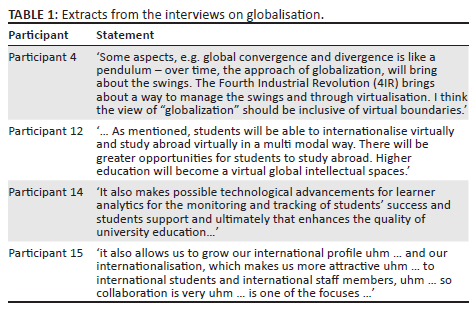
Globalisation is viewed by all research participants as an important and significant strategic driver for HEIs in South Africa. They describe globalisation as a much broader development than internationalisation, which aims to shift the competitive advantage of businesses and populations. This distinction is also encountered in literature.32
The interviews also revealed that COVID-19, global rankings, competition and inequality between HEIs, geopolitical risks, demographic differences between the global North and South, student migration within Africa and neoliberalist economic policies either create challenges or impact South African HEIs directly. These views are also echoed in studies by Kigotho,333435
A research participant, interestingly, suggested the term 'glocalisation', thereby staying locally relevant while remaining globally relevant. Other participants felt that globalisation could be pursued through phases of global convergence and divergence facilitated through 4IR-enabled platforms. As online teaching and learning platforms are transferring higher education into a virtual global intellectual space, the right combination of international staff and students is important to maintain stature as a world-class institution, a sentiment also encountered in literature.3637,38Table 1 for excerpts from the interviews.
Market forces and change
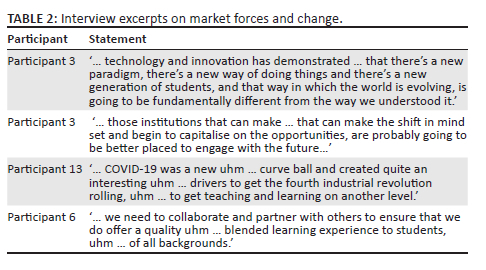
Most research participants are of the opinion that South African HEIs are subject to a VUCA environment, making higher education a particularly complex environment to operate within, a sentiment also forthcoming in literature.39,40
Although the reality of competition among HEIs was acknowledged by research participants, some opined that there should be less competition, as HEIs should complement one another and work together to take advantage of opportunities. Therefore, areas of collaboration should rather be pursued to the benefit of all HEIs. The reality of competition between HEIs is also cited by other scholars.41,42,43
The COVID-19 pandemic is regarded by research participants as driver of change for HEIs as it not only altered how HEIs went about the task of education, but it also forced HEIs to prepare students differently for the world of work. This is consistent with views from the literature44,4517Table 2 for excerpts from the interviews.
Theme two: The impact of technology
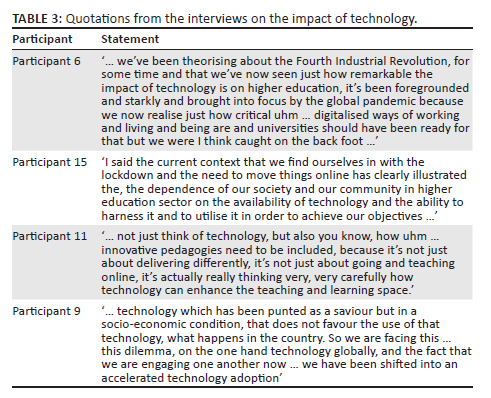
From the interviews, it is apparent that technological advances are critical and important strategic drivers, not only for South African HEIs, but for HEIs around the world. This is also consistent with sentiments from literature.9
Research participants all agreed that online or blended learning is an imperative for HEIs in South Africa, now and in the future. This sentiment was also affirmed in literature.17,4640
Some research participants emphasised that it is crucial for HEIs to become trendsetters in terms of technology, or producers of technology, rather than merely users of technology that rely or focus on the transformative nature of technology, as this is where institutions could find a basis for competitive advantage in future, by providing a superior online student experience.
Research participants also felt that technology is an enabler of internationalisation, as it provides an opportunity to study anywhere in the world, a sentiment shared by Xing et al.18
It is also commonly accepted by research participants that technology is there to make it all easier. However, within the South African context, there seem to be many challenges, as society is not prepared to encompass the shift to accelerated technological advancements in the higher education environment, as there are sentiments that it will lead to a widening of the social divide that is already quite vast in South Africa, a point emphasised in literature.17
Understanding the impact of technology, as well as the role of innovation in this process of technology adoption, will allow South African HEIs to better prepare themselves and to serve its social obligations more effectively, as the opposite may render an institution irrelevant as the world continues to move down a trajectory dictated by technology and 4IR.47Table 3 for excerpts from the interviews.
Theme three: Collaboration
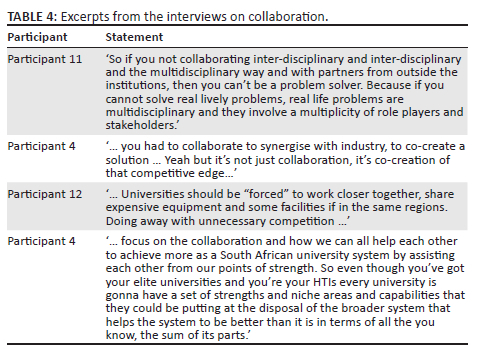
The interviews revealed that not only collaboration but also strategic partnerships were emerging as important issues for HEIs, which could not be ignored or marginalised. These collaborations centred mostly around intellectual, research, staff and student exchanges aimed at expanding knowledge creation and/or teaching and learning initiatives.
Research participants are of the opinion that collaborations with both the Global North and South need to be considered, as the Global South has a better understanding of the South African context. It is felt that such collaborations will not only enhance teaching and learning as well as research capabilities but also cultural experiences. Such sentiments are also encountered in literature.25
As research participants view cross-pollination of knowledge as a vital progression for the longevity of HEIs, transdisciplinary collaboration is regarded as a strategic driver for academic programmes and research, views also expressed in literature.4824
At the end of the day, however, the overwhelming feeling from research participants is that collaboration assists in developing people through collegiality, openness and forging networks in creating a collaborative space with less of a competitive focus, a view also purported in literature.498
Yet, what is painstakingly obvious from the interviews is that collaboration between academics can be taken to new heights by the application of technology. Rapid developments in digital technologies, coupled with exponential expansion in ICT usage, has affected companies' collaboration activities in many industries,505152Table 4 for excerpts from the interviews.
Theme four: Teaching, learning and research
This theme seems to address the level where collaboration, driven by technology in the context of higher education, impacts upon. From the interviews, it was evident that teaching and learning, as well as research were the areas that stood the most to benefit from collaborative opportunities made possible by technological advances.
In terms of teaching and learning, research participants feel that technology and collaborative arrangements are key to ensuring student success (as measured by the pass rate per module and the throughput rate per programme or qualification). With the outbreak of COVID-19 and the ensuing lockdowns, HEIs had no choice but to switch to digital platforms to keep operations going and to provide tuition to students. In the aftermath of COVID-19, these learning management systems are far more integrated into the teaching and learning 'fabric' of HEIs than they were before COVID-19 and blended learning is now almost taken for granted.
However, some research participants did mention that HEIs were not prepared and equipped at the time to switch over to, and engage in, full e-learning. To adjust to these challenges, these research participants are of the opinion that academics would need to adjust their pedagogies to meet the requirements of the online or blended classroom, a view also forthcoming in literature.53
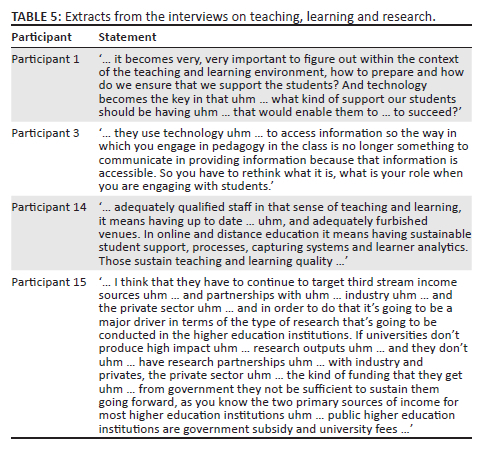
The research participants also reflected on research as a factor that impacts upon teaching and learning. They opined that without knowledge created through research, HEIs and teaching and learning will become irrelevant. Therefore, research needs to be of quality, of high impact and relevant to industry and societal needs. Some of the research participants were for the opinion that over and above academic research, which provides subsidy income for HEIs, contract research should also be considered as a potential source of revenue, as budget cuts for research seem inevitable. From literature, the notion of contract research is supported by Castree.5455Table 5 for excerpts from the interviews.
Discussion
Following from the findings presented in the previous section, the following discussion will attempt to elaborate upon technology and collaboration as strategic drivers for HEIs.
As globalisation and the VUCA environment are important and most prominent, it not only impacts the strategic intent of HEIs but also the manner in which institutions use technology and collaborative arrangements within a global or 'glocal' world. COVID-19 has forced HEIs to rethink their purpose as educators44,4537,38
Although HEIs have grappled with becoming more 4IR compliant,56,20179205719
Technology as a enabler of internationalisation provides students with opportunities to study from anywhere in the world.58172147
Collaboration, especially between the Global North and South, is seen as of paramount importance for HEIs.24,14,26142749
Technology and collaborative arrangements have the potential to put HEIs in a position where they can indulge in 'flights of fancy' and imagine possibilities, which were hereto unattainable. The COVID-19 pandemic has proven that HEIs are capable of far more than they themselves could have imagined. It is not possible for HEIs can share modules and qualifications, serve markets and students thought impossible or impractical to reach,5926
Recommendations and managerial implications
From what this study has brought to the fore, the following implications and recommendations are forthcoming:
•Higher education institutions should be careful not to operate in isolation, but to take advantage of increased knowledge bases that are created.
•Higher education institutions have to prioritise online and blended learning and in the process become more 4IR compliant.
•Higher education institutions have to instil innovative pedagogies and teaching and learning spaces which include virtual reality, augmented reality or mixed reality technologies and spaces. In so doing, HEIs should strive to be known as 'technology integrated teaching and learning' institutions.
•Higher education institutions should be producers of technology and leverage the transformative benefits of these technologies.
•Higher education institutions should consider to share the best online modules and qualifications that may not only to enhance teaching and learning but may also prove to be more cost effective by using pooled resources efficiently.
•South African HEIs have to prioritise collaboration with both the Global North and South to pursue multidisciplinary and transdisciplinary collaborative research opportunities. This can, in turn, enrich teaching and learning, innovation and the general student and staff experience.
•Higher education institutions should actively pursue collaborative arrangements with other institutions of higher learning and form strong partnerships to transfer knowledge, share resources and enhance research output.
•Higher education institutions have to consider joint appointments with industry but also to work closely with government to better serve all stakeholders.
•Higher education institutions have to act as collective and collaborate in support of the strategic goals for higher education in South Africa.
•Technology and collaboration should be viewed as interdependent as the one supports the other towards 4IR compliance and serving the broader socio-economic agenda of the country.
Limitations and avenues for future research
A possible limitation may lie in the relatively small sample size. Although 24 interviews were planned, 17 interviews were conducted because of the busy schedules of research participants. However, as this is within meaning saturation range,60
Taking this study further, it is recommended that the impact of these strategic drivers on HEIs are studied in the broader, South African and African contexts to contextualise the South African perspective better. Furthermore, future studies can be extended to include a more exhaustive list of drivers, to better understand the full impact of strategic drivers on HEIs. Thinking further than focussing on strategic drivers, future studies could also include the impact of these drivers on the business models of HEIs, especially in the wake of COVID-19.
Conclusion
South African HEIs need to rethink their strategies post-COVID-19, as COVID-19 has exposed the need for HEIs to adopt advanced technologies and become 4IR compliant to remain relevant in a 'post-COVID' world. The current environment of higher education also highlights the need for more and better collaboration, not only within institutions but also between HEIs, and with stakeholders in higher education. Both technology and collaboration are crucial in taking South African HEIs forward into a VUCA, 4IR world while still serving a pressing socio-economic national agenda.
Competing interests
The authors declare that they have no financial or personal relationships that may have inappropriately influenced them in writing this article.
Authors' contributions
All authors contributed equally to this work.
Funding information
This research received no specific grant from any funding agency in the public, commercial or not-for-profit sectors.
Data availability
The data that support the findings of this study are available on request from the corresponding author, D.R. The data are not publicly available as it could compromise the privacy of research participants.
Disclaimer
The views and opinions expressed in this article are those of the authors and do not necessarily reflect the official policy or position of any affiliated agency of the authors.
Acknowledgements
This article is based on the author's, D.R., PhD thesis in Business Management entitled: Strategic drivers for South African higher education institutions, with G.A.G. as the supervisor. D.R. would like to express appreciation to G.A.G. as supervisor of the PhD study and co-authoring this paper. D.R. would also like to thank his wife, Annalene, his children and grandchildren for their loving support.
References
- 1.Porter ME. Competitive strategy: Techniques for analyzing industries and competitors. New York, NY: The Free Press; 1980.
- 2.Thompson AA, Peteraf MA, Gamble JE, Strickland AJ. Crafting an executive strategy. The quest for competitive advantage: Concepts and cases. New York, NY: McGraw-Hill; 2020.
- 3.De Wit B. Strategy: An international perspective. Andover: Cengage; 2020.
- 4.Rossouw D, De Bruyn HEC. Drivers, forces and factors in the business environment. Paper presented at: SAIMS 2010. Proceedings of the 22nd South African Institute of Management Scientists Conference; 2010 Sept 13-15; Port Alfred: SAIMS; 2010.
- 5.Rossouw D, Goldman GA. Strategic drivers for higher education. Paper presented at SAIMS 2014. Proceedings of the 26th South African Institute of Management Scientists Conference; 2014 Sept 14-17; Vanderbijlpark: SAIMS; 2014.
-
6.David SA, Taleb H, Scatolini SS, Al-Qallaf A, Al-Shammari HS, George MA. An exploration into student learning mobility in higher education among the Arabian Gulf Cooperation Council countries. Int J Educ Dev. 2017;55(1):41-48. https://doi.org/10.1016/j.ijedudev.2017.05.001
» https://doi.org/10.1016/j.ijedudev.2017.05.001 -
7.Devi K, Rahmawan TDM, Ayu P. Development strategy of study programs in higher education to respond the Fourth Industrial Revolution: SWOT Analysis. Russ J Agric Soc-Econ Sci. 2019;85(1):53-61. https://doi.org/10.18551/rjoas.2019-01.06
» https://doi.org/10.18551/rjoas.2019-01.06 -
8.Lašáková A, Bajzíková L, Dedze I. Barriers and drivers of innovation in higher education: Case study-based evidence across ten European universities. Int J Educ Dev. 2017;55(1):69-79. https://doi.org/10.1016/j.ijedudev.2017.06.002
» https://doi.org/10.1016/j.ijedudev.2017.06.002 -
9.Yende SJ. A transition towards the Fourth Industrial Revolution (4IR) in the South African Education Sector: A perspective from rural-based higher education. Afr J Dev Stud. 2021;11(2):55-75. https://doi.org/10.31920/2634-3649/2021/v11n2a3
» https://doi.org/10.31920/2634-3649/2021/v11n2a3 -
10.Jansen H. The logic of qualitative survey research and its position in the field of social research methods. Forum Qualitative Sozialforschung/Forum: Qual Soc Res. 2010;11(2):Art 11. https://doi.org//10.17169/fqs-11.2.1450
» https://doi.org//10.17169/fqs-11.2.1450 - 11.Segares M. Qualitative online surveys: Lessons learned from covid-19. London: Sage; 2022.
-
12.Hsieh H, Shannon SE. Three approaches to qualitative content analysis. Qual Health Res. 2005;15(9):1277-1283. https://doi.org/10.1177/1049732305276687
» https://doi.org/10.1177/1049732305276687 - 13.Porter ME. On competition. Boston, MA: Harvard Business School Publishing; 1998.
- 14.Council on Higher Education. South African higher education reviewed: Two decades of democracy. Pretoria: CHE; 2016.
-
15.Bender B, Partlow C, Roth M. An examination of strategic drivers impacting U.S. multinational lodging corporations. Int J Hosp Tour Admin. 2008;9(3):219-243. https://doi.org/10.1080/15256480802095862
» https://doi.org/10.1080/15256480802095862 -
16.Van der Westhuizen D, Murdoch N, De Bruin GP. Teaching and technology: The traits and attitudes of highly rated lecturers. S Afr J High Educ. 2006;18(2):336-345. https://doi.org/10.4314/sajhe.v18i2.25473
» https://doi.org/10.4314/sajhe.v18i2.25473 -
17.Mhlanga D. The Fourth Industrial Revolution and COVID-19 pandemic in South Africa: The opportunities and challenges of introducing blended learning in education. J Afr Educ. 2021;2(2):15-42. https://doi.org/10.31920/2633-2930/2021/v2n2a1
» https://doi.org/10.31920/2633-2930/2021/v2n2a1 - 18.Xing B, Marwala L, Marwala T. Adopt fast, adapt quick: Adaptive approaches in the South African context. In: Gleason NW, editor. Higher education in the era of the Fourth Industrial Revolution. Singapore: Palgrave/Macmillan; 2018, p. 171-206.
- 19.Schwab K. The Fourth Industrial Revolution. Geneva: World Economic Forum; 2016.
-
20.Mashau P, Nyawo JC. The use of an online learning platform: A step towards e-learning. S Afr J High Educ. 2021;35(2):123-143. https://doi.org/10.20853/35-2-3985
» https://doi.org/10.20853/35-2-3985 -
21.Elayyan S. The future of education according to the fourth industrial revolution. J Educ Technol Online Learn. 2021;4(1):23-30. https://doi.org/10.31681/jetol.737193
» https://doi.org/10.31681/jetol.737193 -
22.Eckstrand N. Embracing the human in a world of robots. University World News: The Global Window on Higher Education [homepage on the Internet]. 2019 Sept 14 [cited 2019 Oct 10]. Available from: https://www.universityworldnews.com/post.php?story=20190910135823136
» https://www.universityworldnews.com/post.php?story=20190910135823136 - 23.Mouton J, Effah P, Sibuga KP. The context of HELM training in Africa. In leadership and management: Case studies. In: Mouton J, Wildschut L, editors. Training in higher education in South Africa. Cape Town: African Minds; 2015, p. 17-36.
- 24.Bergman R. Towards more effective collaboration by higher education institutions for greater regional development in the Gauteng City-Region. Johannesburg: Gauteng City-Region Observatory; 2014.
- 25.Bakuwa J, Mouton J. A review of the scholarship on HELM training in Africa. In leadership and management: Case studies. In: Mouton J, Wildschut L, editors. Training in higher education in South Africa. Cape Town: African Minds; 2015, p. 1-16.
-
26.Kwiek M. Internationalists and locals: International research collaboration in a resource-poor system. Scientometrics. 2020;124(1):57-105. https://doi.org/10.1007/s11192-020-03460-2
» https://doi.org/10.1007/s11192-020-03460-2 -
27.Porter D. Collaboration in hard times in higher education. University affairs [homepage on the Internet]. 2019 Dec 09 [cited 2022 Mar 7]. Available from: https://www.universityaffairs.ca/opinion/in-my-opinion/collaboration-in-hard-times-in-higher-education/.
» https://www.universityaffairs.ca/opinion/in-my-opinion/collaboration-in-hard-times-in-higher-education/ - 28.Saunders M, Lewis P, Thornhill A. Research methods for business students. Harlow: Pearson; 2019.
- 29.Neuman W. Social research methods: Qualitative and quantitative approaches. Essex: Pearson; 2014.
- 30.Creswell JW. 30 Essential skills for the qualitative researcher. Los Angeles, CA: Sage; 2016.
- 31.Denzin N, Lincoln YS. The Sage handbook of qualitative research. Los Angeles, CA: Sage; 2011.
- 32.Bateman TS, Snell SA, Konopaske R. Management: Leading & collaborating in the competitive world. New York, NY: McGraw-Hill; 2019.
-
33.Kigotho W. Demand for international study still remains strong. University World News [homepage on the Internet]. 2021 Sept 09 [cited 2021 Oct 09]. Available from: https://www.universityworldnews.com/post.php?story=20210908074611798
» https://www.universityworldnews.com/post.php?story=20210908074611798 -
34.Sabzalieva E, Moscovitz H, Brunner L. The new geopolitics of international higher education. University World News [homepage on the Internet]. 2021 June 26 [cited 2021 Oct 19]. Available from: https://www.universityworldnews.com/post.php?story=2021062508552823
» https://www.universityworldnews.com/post.php?story=2021062508552823 -
35.Maslen G. 50% drop in foreign student enrolment by 2021 predicted. University World News [homepage on the Internet]. 2020 Jun 01 [cited 2021 Oct 18]. Available from: https://www.universityworldnews.com/post.php?story=20200601150411139
» https://www.universityworldnews.com/post.php?story=20200601150411139 -
36.Gornitzka Å, Stølen S. Can universities have too much internationalisation? University World News: The Global Window on Higher Education [homepage on the Internet]. 2021 Oct 16 [cited 2021 Oct 21]. Available from: https://www.universityworldnews.com/post.php?story=20211013103911307
» https://www.universityworldnews.com/post.php?story=20211013103911307 - 37.Wangenge-Ouma G, Kupe T. Uncertain times: Re-imagining universities for new, sustainable futures. Pretoria: Universities South Africa; 2020.
-
38.Marinoni G, De Witt H. Is internationalisation creating inequality in higher education? University World News [homepage on the Internet]. 2019 Jan 11 [cited 2022 May 10]. Available from: https://www.universityworldnews.com/post.php?story=20190109100925536
» https://www.universityworldnews.com/post.php?story=20190109100925536 -
39.Persis DJ, Venkatesh VG, Sreedharan VR, Shi Y, Sankaranarayanan B. Modelling and analysing the impact of Circular Economy; Internet of Things and ethical business practices in the VUCA world: Evidence from the food processing industry. J Cleaner Prod. 2021;301:1-13. https://doi.org/10.1016/j.jclepro.2021.126871
» https://doi.org/10.1016/j.jclepro.2021.126871 -
40.Stein S. Reimagining global citizenship education for a volatile, uncertain, complex, and ambiguous (VUCA) world. Global Soc Educ. 2021;19(4):482-495. https://doi.org/10.1080/14767724.2021.1904212
» https://doi.org/10.1080/14767724.2021.1904212 - 41.Chen KH. Higher education under market forces: How the "transnational shadow education" industry emerged and persisted to help Taiwanese students to study in the U.S. [Unpublished Doctoral thesis]. Albany, NY: State University of New York; 2021.
-
42.Steynberg L, Liu B, Li Y, Grundling JP. Global and local co-operative higher education governance: Implications for South Africa. J Public Admin. 2020;55(2):158-178. https://doi.org/10.10520/EJC-20c78775a7
» https://doi.org/10.10520/EJC-20c78775a7 -
43.Musselin C. New forms of competition in higher education. Soc-Econ Rev. 2018;16(3):657-683. https://doi.org/10.1093/ser/mwy033
» https://doi.org/10.1093/ser/mwy033 -
44.Hedding DW, Greve M, Breetzke GD, Nel N, Jansen van Vuuren B. COVID-19 and the academe in South Africa: Not business as usual. S Afr J Sci. 2020;116(7):1-3. https://doi.org/10.17159/sajs.2020/8298
» https://doi.org/10.17159/sajs.2020/8298 -
45.Rashid S, Yadav SS. Impact of Covid-19 pandemic on higher education and research. Indian J Hum Dev. 2020;14(2):340-343. https://doi.org/10.1177/0973703020946700
» https://doi.org/10.1177/0973703020946700 - 46.Penprase BE. The Fourth Industrial Revolution and higher education. In: Gleason NW, editor. Higher education in the era of the Fourth Industrial Revolution. Singapore: Palgrave/Macmillan; 2018, p. 207-229.
-
47.Xu M, David JM, Kim SH. The Fourth Industrial Revolution: Opportunities and challenges. Int J Finan Res. 2018;9(2):90-95. https://doi.org/10.5430/ijfr.v9n2p90
» https://doi.org/10.5430/ijfr.v9n2p90 -
48.Van Baalen WM, De Groot T, Noordegraaf-Eelens L. Higher education, the arts, and transdisciplinarity: A systematic review of the literature. Res Educ. 2021;111(1):24-45. https://doi.org/10.1177/00345237211005799
» https://doi.org/10.1177/00345237211005799 -
49.Kauppi S, Muukkonen H, Suorsa T, Takala M. I still miss human contact, but this is more flexible - Paradoxes in virtual learning interaction and multidisciplinary collaboration. Br J Educ Technol. 2020;51(4):1101-1116. https://doi.org/10.1111/bjet.12929
» https://doi.org/10.1111/bjet.12929 -
50.Lozano R, Barreiro-Gen M, Zafar A. Collaboration for organizational sustainability limits to growth: Developing a factors, benefits, and challenges framework. Sustain Dev. 2021;29(4):728-737. https://doi.org/10.1002/sd.2170
» https://doi.org/10.1002/sd.2170 -
51.Yang Y, Yang B, Humphreys P, McIvor R, Cadden T. An investigation into E-business service in the UK telecommunication manufacturing industry. Prod Plan Contr. 2017;28(3):256-266. https://doi.org/10.1080/09537287.2017.1280622
» https://doi.org/10.1080/09537287.2017.1280622 -
52.Bals L, Laine J, Mugurusi G. Evolving purchasing and supply organizations: A contingency model for structural alternatives. J Purchasing Supply Manag. 2018;24(1):41-58. https://doi.org/10.1016/j.pursup.2017.10.001
» https://doi.org/10.1016/j.pursup.2017.10.001 -
53.Mbati L, Minnaar A. Guidelines towards the facilitation of interactive online learning programmes in higher education. Int Rev Res Open Distrib Learn. 2015;16(2):272-287. https://doi.org/10.19173/irrodl.v16i2.2019
» https://doi.org/10.19173/irrodl.v16i2.2019 - 54.Castree N. Contract research, universities and the 'knowledge society': Back to the future. In: Allen C, Imrie R, editors. The knowledge business: The commodification of urban and housing research. Farnham: Ashgate Publishing; 2010, p. 221-240.
-
55.Mok KH, Jiang J. Towards corporatized collaborative governance: The multiple networks model and entrepreneurial universities in Hong Kong. Stud High Educ. 2020;45(10):2110-2120. https://doi.org/10.1080/03075079.2020.1823647
» https://doi.org/10.1080/03075079.2020.1823647 - 56.Gleason NW. Introduction. In: Gleason NW, editor. Higher education in the era of the Fourth Industrial Revolution. Singapore: Palgrave/Macmillan; 2018, p. 1-11.
- 57.Schwab K. Foreword. In: Doorsamy W, Paul BS, Marwala T, editors. The disruptive Fourth Industrial Revolution: Technology, society and beyond. Cham: Springer; 2020, p. v-vi.
- 58.Müller E. Regenerative development in higher education: Costa Rica's perspective. In: Gleason NW, editor. Higher education in the era of the Fourth Industrial Revolution. Singapore: Palgrave/Macmillan; 2018, p. 121-144.
-
59.Orenstein EW, Yun K, Warden C, et al. Development and dissemination of clinical decision support across institutions: Standardization and sharing of refugee health screening modules. J Am Med Inform Assoc. 2019;26(12):1515-1524. https://doi.org/10.1093/jamia/ocz124
» https://doi.org/10.1093/jamia/ocz124 -
60.Hennink MM, Kaiser BN, Marconi VC. Code saturation versus meaning saturation: How many interviews are enough? Qual Health Res. 2017;27(4):591-608. https://doi.org/10.1177/1049732316665344
» https://doi.org/10.1177/1049732316665344

Accepted: 12 Apr. 2023
Published: 23 June 2023