Historical inquiry: Overcoming interdisciplinary methodological challenges in health sciences
Abstract
Historical inquiry is seldom used in South African nursing research and South African historians seldom conduct research into the historical contributions nurses made in South African healthcare, specifically the nursing discipline. In this article, the authors discuss the challenges of conducting historical inquiry within a South African nursing (health sciences) context and from nurses' perspectives. Several challenges relating to the compilation of the research report were identified, as the traditional nursing research format differs from the typical historical inquiry format. The authors explain how critical realism philosophy influenced the research objectives and deepened their understanding of historical inquiry as a research methodology and thus assisting them in gaining new insight into historical events in South African nursing and guiding the writing of the historical narrative. The authors concluded that an interdisciplinary approach to research that allows for flexibility in report writing is recommended to contribute to the historical inquiry of discipline-specific histories. Such flexibility encourages fresh viewpoints and insights into historical inquiry as a research method. TRANSDISCIPLINARY CONTRIBUTION: This article illustrates how historical inquiry as a methodology, informed by critical realism philosophy, was applied in the health sciences field of research.
critical realism; health sciences; historical inquiry; nursing history philosophy; research methodology; social studies; South Africa
Introduction
Historical inquiry is a neglected field in nursing research. The social nature of the profession enables nurse researchers to implement a range of qualitative and quantitative research methodologies, including mixed methods research, but, globally, there are very few nurse researchers who conduct historical inquiry. One author, being a professional nurse and nurse educator, but wishing to research and write about the history of the South African nursing profession, embarked on historical research with the other author, a professor teaching research methodology and an experienced qualitative researcher.
In the hope of being accepted for a postgraduate study with nursing history as the topic, one author studied basic history subjects for non-degree purposes. By 1995, feeling ready to start the postgraduate journey, she consulted the relevant department of a South African university that advised her to contact the History Department for assistance. Ironically, the History Department referred her back to the department offering degrees in Health Studies because of her nursing background. Straddling two scientific fields seemed insurmountable. A chance meeting with her future supervisor at a 2008 local nursing conference turned out to be the starting point of the formal research journey - two professional nurses conducting historical inquiry, one an emerging researcher with an avid interest in history and the other a seasoned qualitative researcher.
At the time of embarking on the research, conducting historical research in the field of nursing was a rare phenomenon in South Africa. Even now, very few historical inquiries are conducted in the South African nursing context. An initial historical study focusing on the professional development of black South African nurses in the period 1908-1994 resulted in rich data that were shared, nationally and internationally, in the form of a published article12
A cursory online search for the latest (published from 2010 to 2020) nursing history-themed publications revealed that, internationally, more than 20 books, book chapters and journal articles were published. Locally, approximately 10 South African healthcare-themed publications (not all dedicated to nursing history) were found. Of these, three historical inquiries with specific nursing history themes were conducted by South African professional nurses (two of the three being the authors' work).
Historians conduct vigorous, inquiry-based searches to find the historical truth.345N]o one theoretical framework exists for which to study history'. Therefore, various theoretical structures are used by historians to organise data. Herein lies the creative freedom and the conundrum.
Research methods and design
Analysing some history-themed theses published from 2015 to 2020 reveals that historical inquiries are generally written in narrative form with the researchers providing in-depth analysis and discussion of the historical data. Each researcher's voice and conclusions are interspersed throughout the chapters. A few researchers state specified research objectives, while some use a few paragraphs in their introductory chapters to explain the principles of historical inquiry. Seemingly, a dedicated chapter to explain the research methodology is not required. This absence of a comprehensive methodology chapter and, thus, a clarification of historical inquiry as a research method is in stark contrast with what is required of South African nurse researchers conducting research within a health and social studies context.
Historical inquiry versus nursing research: Methodological challenges
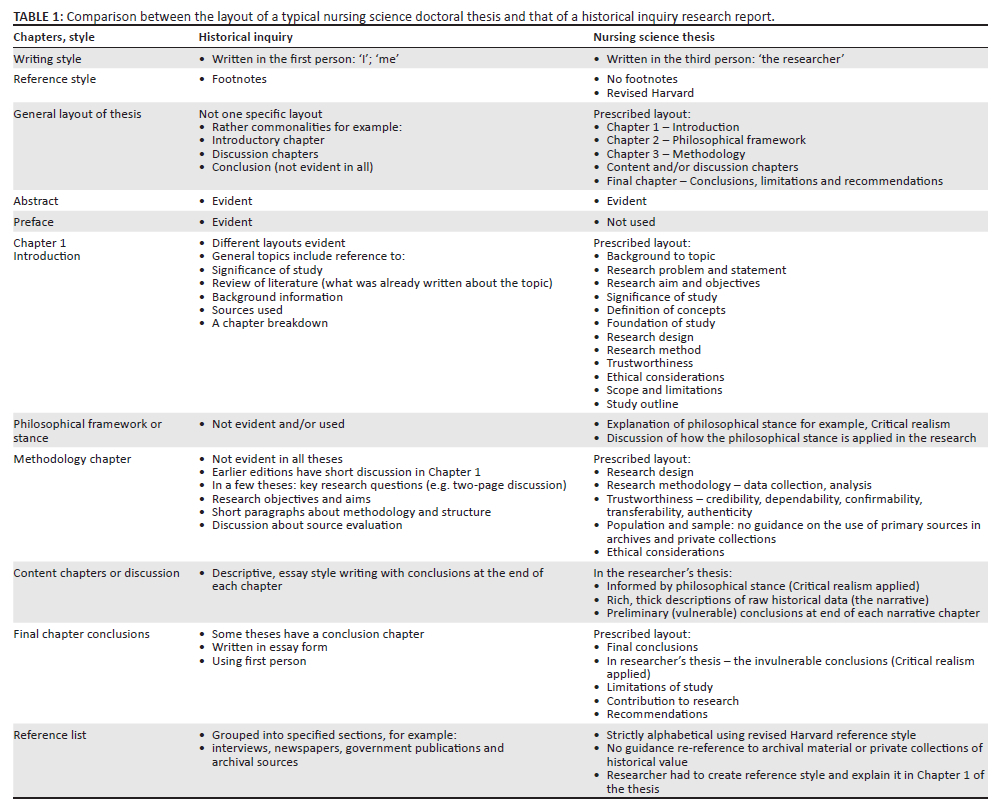
Nurse researchers wishing to submit a doctoral thesis to a South African university are required to adhere to a prescribed layout and format designed to accommodate either quantitative, qualitative or mixed methods research reports. The 'pure' historical research report as written by historians, therefore, had to be altered to accommodate certain requirements of the particular department within which the study was registered as a graduate programme. Yet, the study guide provided to doctoral candidates that stipulate these requirements (e.g. the format of the thesis) is silent about how this should be accomplished when conducting historical inquiry.
Methodological challenges experienced by the study supervisor
The first author, also the study supervisor, is an experienced and well-published researcher who teaches research methodology and has authored research methodology books. She has a special interest in qualitative research but has not conducted historical inquiry before. She had to draw from her knowledge as an educator and qualitative researcher. Furthermore, she engaged in academic and research discussions with historians, in preparation for the specific supervision role. It soon became clear that the historians and historical inquiry authors had less interest and focus on the methodology per se but rather focused on the content itself. This contributed to the debate on how to present a nursing study as a historical inquiry. On the one hand, there were discipline-specific practices and requirements, while, on the other hand, methodological specificities. Of importance for the first author was to not only guide the second author through her Master's and Doctoral degree programmes but also to provide the nursing discipline and/or profession with good historical facts that are indeed lacking in the nursing literature. As an educator, she also deemed it important to provide the best evidence for future researchers and students in the research methodology courses.
Methodological challenges experienced by the doctoral candidate
The study guide provided to doctoral candidates in the particular department prescribes the thesis format and chapter content required when conducting quantitative, qualitative or mixed methods research. Although the two researchers (authors) could adhere to most of these requirements, there were grey areas where they had to ignore convention to stay true to the principles of historical inquiry. In the following sub-sections, such methodological challenges and the authors' solutions to these challenges are discussed.
Layout and reference style: The layout of a typical doctoral thesis in nursing science is designed to accommodate both quantitative and qualitative researchers. A methodology chapter, in which the research problem, the research objectives and the aim of the research are comprehensively discussed, and a chapter dedicated to the clarification of the researcher's philosophical stance is required. Table 1 provides a basic comparison between the layout of a typical nursing science doctoral thesis and a historical inquiry research report, as published from 2015 to 2020 in South Africa.
The authors had to adhere to the department's prescribed style of reference, namely, revised Harvard style. This was a clear break from the historians' traditional use of footnotes. Furthermore, the provided study guide contained no guidance about how one must refer to archival sources or primary (historical) sources in private collections. The researchers had to study literature (online and in reference books) that explained the classic method of referencing archival material and then developed a reference style that was as close as possible to the nursing department's prescribed style. This was described in the introduction chapter of the doctoral thesis and applied throughout.
Results
According to Francis historians agree that multiple realities exist that inform the recording of the historical truth.32
Discussion
Epistemology
Critical realists challenge the two absolutes of objectivism or positivism (knowledge is independent of humans) and relativism or constructivism (scientific inquiry is fallible because it is socially embedded). Critical realism therefore provides researchers with the opportunity of using various research methodologies.678
Ontology
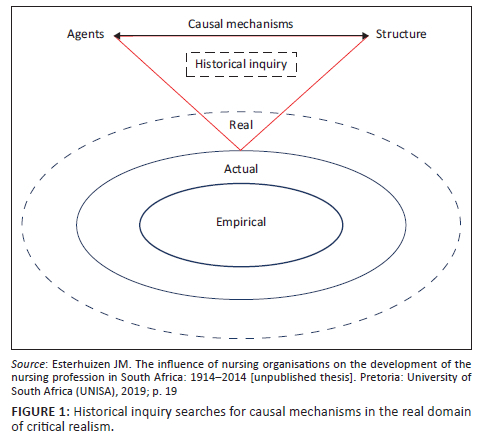
The three reality domains of critical realism comprise the real, the actual and the empirical. World events that occurred are represented by the actual domain, while the often-unobserved structures and relationships influencing it are found in the real domain. The real domain's veiled structures and relationships are the causal mechanisms that create unique effects (events) in certain instances.111278
Inspired by Schiller's6Figure 1.8
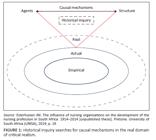
In the second author's doctoral thesis, the actual domain is represented by the professional activities of South African nursing organisations during the last century. The empirical domain is represented by the prevailing interpretation of the nursing organisations' history. By focussing on critical realism's real domain, the authors could offer an alternate perspective on the history of South Africa's nursing organisations. The emphasis moved away from generally accepted historical facts and what is known to identifying those causal mechanisms that historically exerted influence on South Africa's nursing organisations. By implication, the South African nursing profession was affected as well. In this way, a new truth about the history of South African nursing organisations emerged, as the emphasis moved to the causative mechanisms and not only a mere description of the occurrence of events.8
Application of Lonergan's cognition structure in historical inquiry
The philosopher Bernard Lonergan's Transcendental Method is a form of critical realism.912
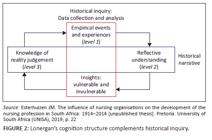
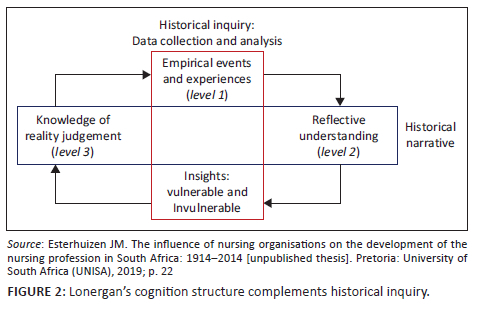
Walker explains Lonergan's assertion that there is more to knowledge than only the empirical (what can be observed with our senses).9what it is that they observed and why did it happen. They make attempts to acquire insight and to understand (level 2) the observed event. Researchers can judge (is it true?) the event and create a concept definition thereof once they attained insight. Researchers can assert that ideas and thoughts became knowledge only after a judgement (level 3) was made.
Application of Lonergan's cognition structure to the doctoral thesis implies that historical inquiry methodology demands more from researchers than simply the recording of historical events (experience - level 1).13why (understanding - level 2) historical events occurred.89
If researchers make correct judgements, they attain insight and a knowledge of reality. The researcher's preliminary insight might change during data collection and analysis because more questions are continuously asked and answered. At the beginning of a study, vulnerable (initial) insights are reached. Invulnerable insights are only obtained after all possible questions have been asked and answered.98
While the vulnerable insights are evident in the data analysis and reflection phases of the research, the invulnerable insights were attained (concluded) only at the end of the research when it became evident that new questions would not lead to new insights. A state of objectivity was reached. This critical realism concept aligns with the qualitative research principle of crystallisation, and this is where the nursing studies thesis differs from a 'classic' historical inquiry. The raw historical data were, firstly, presented in narrative form in five chapters; with only preliminary conclusions (vulnerable insights) being made at the end of each chapter. The final conclusions (invulnerable insights) were only stated in the last chapter of the thesis, the conclusions chapter.
It becomes evident that an open social system as proposed by critical realists elicits difficulties. Critics of the philosophy question the extent to which such a complex system, with its many influencing structures and relationships, can be examined.147815
Influenced by the philosophical stance: A deeper understanding of historical inquiry as research methodology
Qualitative research, a naturalistic approach, uses humans as research instruments.1614
Classified as a qualitative, non-traditional research design, historical inquiry features a range of methodological approaches that enable researchers to discover credible answers to historical questions.17,1884,11
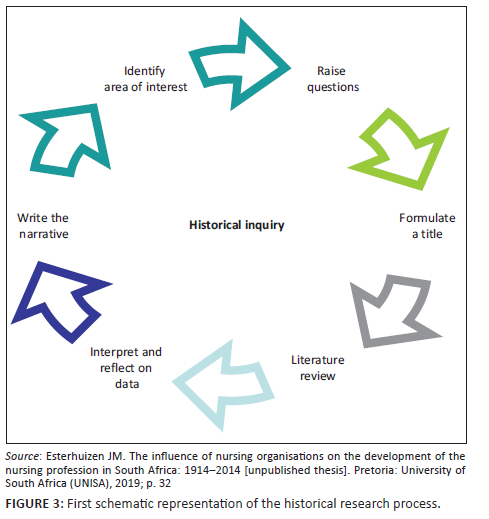
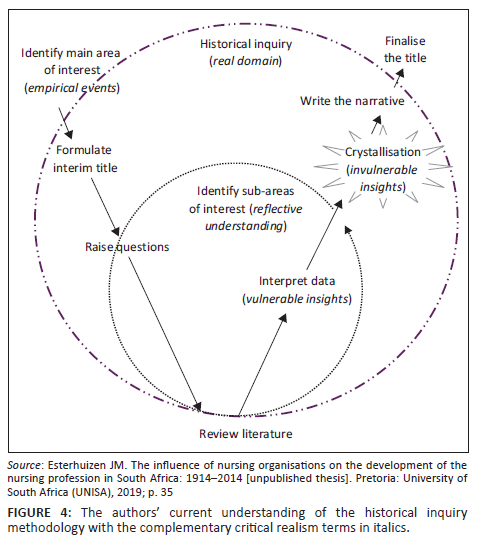
The apparent disorganised nature of historical inquiry as a research methodology is not without structure. It is a cyclical process of inquiry with particular phases that may be completed in any order.5Figure 3).8Figure 4)88
The initial understanding of historical inquiry
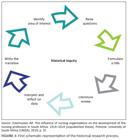
The historical inquiry process as it was understood and applied in the authors' first (2012) research report is illustrated in Figure 3.
The phases of historical inquiry as described by Lewenson and McAllister1920
The authors' current understanding of historical inquiry
The historical narrative depends on how researchers interpret data-rich sources. Thus, the historian's inquiry is simply an informed interpretation of the historical data that were accessed and read.21322
Hypothetically, historical inquiry is a prolonged, even lifelong, search for the historical truth. This is illustrated in the historical inquiry cycle with its continuous nature used in the earlier study (Figure 3). At the commencement of their latest research, the authors planned to use the initial historical inquiry cycle of the previous study but then comprehended that their research project must conclude when crystallisation was reached. It was, therefore, impractical to remain in the continual historical cycle as depicted in Figure 3.8
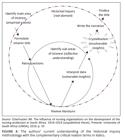
A formal doctoral thesis is limited in terms of scope, resources and academic time allowed to complete the research. Once sufficient time has been spent on data collection and analysis, the historical inquiry must conclude with a written narrative. The authors' first attempt to illustrate the historical inquiry process (Figure 3) had to be revised (illustrated in Figure 4) to accommodate the confining (limited instead of a lifelong search) structure of a thesis8
•Two steps were repositioned in the cyclical process: the first step (identifying the main topic of interest) was performed once only, and the last step (finalising the title) ended the research. The arrows in the diagram illustrate this process.
•For the duration of the research, historical inquiry's cyclical process only holds true within the main topic of interest: the main topic remained unchanged, but within it, new sub-areas of interest became apparent and became the thesis's narrative chapters. The smaller circle in the diagram illustrates this process.
•The finalisation of the data collection and analysis phases was signalled by inserting a crystallisation banner (thus illustrating its role in concluding specific phases of the research process).
•Finalising and submitting the thesis did not suggest that inquiry into the historical topic of interest was fait accompli. Questions about the research narrative, its conclusions and the implications thereof might lead to further research (thus the lifelong search). The larger circle in the diagram illustrates this aspect.
•The diagram's outer circle is characterised by a broken line to illustrate critical realism's real domain. The world is considered to be an open system, with knowledge, as yet, unknown (note Figure 1).
Critical realism informs historical inquiry
In this article, Figures 3 and 4 illustrate the authors' deeper understanding of historical inquiry methodology and the matching critical realism concepts.
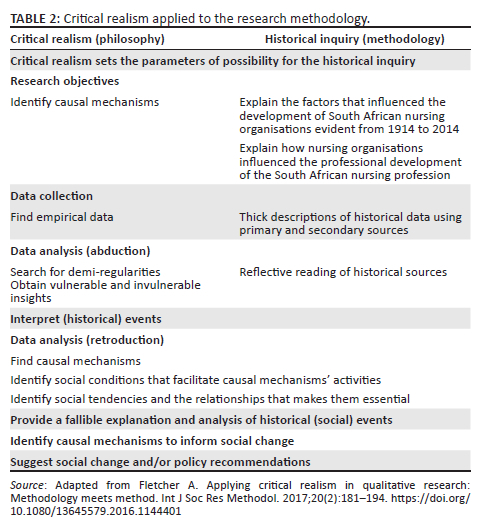
In Table 2, the authors illustrate how critical realism informed their historical inquiry.811
Visiting archives and convincing subject librarians that 'we are not lost'
Being nurse researchers attempting to enter historians' historical territory, created light-hearted moments. Writing about the history of South African nursing's professional organisations necessitated the authors to access and study legislative sources, such as nursing acts, commission reports and transcripts of court cases. Each department has dedicated librarians. When consulting the allocated librarian, the student (second author) was promptly referred to the history department librarian - who then promptly referred her to the law librarian. Three flights of stairs, three desks and numerous explanations later, the law librarian understood why it would not be helpful to send the student back to the nursing department librarian. She kindly assisted the out of breath (but by that time, well-exercised) professional nurse or student or budding historian to find the information needed. She also taught the student how to use the law department's data bases (LexisNexis - South African Law or Netlaw - SA legislation). A bit of legalese' and 'phone a friend working in the legal field' was required to understand and interpret the legal documents!
Conclusion
Globally and particularly in South Africa, historical inquiry is seldom used in nursing research. Those who attempt it, must contend with the demands of two academic research fields that view research methodology and the application thereof from quite different perspectives. The authors conducted two formal research projects using historical inquiry to explore the history of South African nursing. In the process, they gained a deeper understanding of the research methodology and dealt with challenges relating to the academic writing styles of two different disciplines. The primary focus of a typical historical research report is the historical narrative and the researcher's interpretation of historical events. In contrast, nurse researchers must demonstrate an in-depth understanding of the methodology and the philosophical stance guiding the research process: the application thereof influences the writing of the historical narrative and the research report's final conclusions. An interdisciplinary approach to research that allows for flexibility is recommended to contribute to the historical inquiry of discipline-specific histories.
Competing interests
The authors declare that they have no financial or personal relationships that may have inappropriately influenced them in writing this article.
Authors' contributions
G.H.R and J.M.E contributed equally to this work.
Ethical considerations
An important influencing factor (consideration) was that the main topic of interest was identified in the proposal phase of the research and approved by the Health Studies Research Ethics Committee (REC-012714-039). The topic of historical interest was therefore unalterable during the subsequent data collection and analysis phases. An interim title directed the review of historical literature and the questions asked, which led to sub-areas of interest being identified and subsequent crystallisation. After crystallisation was reached, the historical narrative was written, and the research title was finalised.
Funding information
This research received no specific grant from any funding agency in the public, commercial or not-for-profit sectors. The second author was granted a study bursary.
Data availability
The authors confirm that the data supporting the findings of this study are available within the article.
Disclaimer
The views and opinions expressed in this article are those of the authors and do necessarily reflect the official policy or position of any affiliated agency of the authors.
Acknowledgements
This article is based on the authors' works entitled 'A historical perspective on the professional development of black South African nurses: 1908-1994' and 'The influence of nursing organisations on the development of the nursing profession in South Africa: 1914-2014'.
References
- 1.Esterhuizen JM, Van Rensburg GH, Tjallinks JE. A historical perspective on the professional development of black South African nurses: 1908-1994. Afr J Nurs Midwif. 2013;15(2):16-29.
-
2.Esterhuizen JM, Van Rensburg GH. The influence of nursing organisations on the development of the nursing profession in South Africa. Int J Afr Nurs Sci. 2021;14:100290. https://doi.org/10.1016/j.ijans.2021.100290
» https://doi.org/10.1016/j.ijans.2021.100290 - 3.Francis K. Historical research. In: Taylor B, Francis K, editors. Qualitative research in the health sciences: Methodologies, methods and processes. New York, NY: Google Books, 2013; p. 57-64.
- 4.Lewenson SB. Doing historical research. In: Lewenson SB, Hermann EK, editors. Capturing nursing history. New York, NY: Springer, 2008; p. 25-44.
- 5.Streubert HJ, Rinaldi Carpenter D. Qualitative research in nursing. Philadelphia, PA: JB Lippincott Company; 1995.
-
6.Schiller CJ. Critical realism in nursing: An emerging approach. Nurs Philos. 2016; 17(2): 88-102. https://doi.org/10.1111/nup.12107
» https://doi.org/10.1111/nup.12107 - 7.Clark AM. Critical realism. In: Given LM, editor. The SAGE encyclopaedia of qualitative research methods. Thousand Oaks, CA: Sage, 2012; p. 168-170.
- 8.Esterhuizen JM. The influence of nursing organisations on the development of the nursing profession in South Africa: 1914-2014 [unpublished thesis]. Pretoria: University of South Africa (UNISA); 2019.
-
9.Walker T. Approaches to critical realism: Bhaskar and Lonergan. J Crit Real. 2017; 6(2):111-127. https://doi.org/10.1080/14767430.2017.1288062
» https://doi.org/10.1080/14767430.2017.1288062 -
10.Archer M, Sharp R, Stones R, Woodiwiss T. Critical realism and research methodology. Alethia. 1999; 2(1):12-16. https://doi.org/10.1558/aleth.v2i1.12
» https://doi.org/10.1558/aleth.v2i1.12 -
11.Fletcher A. Applying critical realism in qualitative research: Methodology meets method. Int J Soc Res Methodol. 2017;20(2):181-194. https://doi.org/10.1080/13645579.2016.1144401
» https://doi.org/10.1080/13645579.2016.1144401 - 12.Lonergan B. Collected works of Bernard Lonergan. Toronto: University of Toronto Press; 1980.
- 13.Lonergan B. Introducing the thought of Bernard Lonergan. London: Darton, Longman and Todd; 1973.
- 14.Benton T. Critical realism. In: Lewis-Beck MS, Bryman A, Futing Liao T, editors. The SAGE encyclopaedia of social science research methods. Thousand Oaks, CA: SAGE; 2011; p. 222-223.
- 15.Elger T. Critical realism. In: Mills AJ, Durepos G, Wiebe E, editors. Encyclopaedia of case study research. Thousand Oaks, CA: SAGE, 2012; p. 254-257.
- 16.Lincoln YS, Guba EG. Naturalistic inquiry. Newbury Park: Sage; 1985.
- 17.Polit DF, Beck CT. Essentials of nursing research. Philadelphia, PA: Wolters Kluwer/Lippincott Williams and Wilkins; 2014.
-
18.Fealy G, Kelly J, Watson R. Legitimacy in legacy: A discussion paper of historical scholarship published in the Journal of Advanced Nursing, 1976-2011. J Adv Nurs. 2013;69(8): 1881-1894. https://doi.org/10.1111/jan.12048
» https://doi.org/10.1111/jan.12048 - 19.Lewenson SB, McAllister A. Learning the historical method: Step by step. In: De Chesnay M, editor. Nursing research using historical methods. New York, NY: Springer, 2015; p. 1-22.
- 20.Barroso J. Qualitative approaches to research. In: LaBiondo-Wood G, Haber J, editors. Nursing Research: Methods and critical appraisal for evidence-based practice. St. Louis, MO: Mosby Elsevier, 2010; p. 114-115.
- 21.Taylor B, Francis K. Qualitative research in the health sciences: Methodologies, methods and processes. Google Books: New York, NY; 2013.
- 22.D'Antonio P. Conceptual and methodological issues in historical research. In: Lewenson SB, Hermann EK, editors. Capturing nursing history. New York, NY: Springer, 2008; p. 11-24.

Accepted: 12 June 2023
Published: 24 Aug. 2023