Religious Communication in the Digital Sphere: Framing Prophet Bushiri's YouTube Sermons
Abstract
One of the African Pentecostalism scholars, Mookgo Kgatle, has described Prophet Shepherd Bushiri as one who has mastered Pentecostal prophecies and is famous for 'Prophet-preneurship'. This study investigates that claim by examining Bushiri's YouTube sermons through the lens of Paul Gee's Critical Discourse Analysis (CDA) framework. The framing theory illumines this study while using ATLAS. ti to code texts into themes. It explores frames in Bushiri's sermons and his dependence on the new media's capacity to expand influence. While CDA is commonly applied to political texts, this research extends its reach to religious discourse, revealing the ideological dimensions embedded in Bushiri's rhetoric. Findings reveal frames such as cultic tendencies, self-promotion, prosperity gospel, and extra-biblical teachings. These frames and the themes that they generate enhance scholarly understandings of the dynamics of digital evangelism and the commodification of religion in the digital world, offering insights into the non-neutrality of some religious narratives. (The term 'non-neutrality' is used here to illustrate that religious narratives like every form of communication is designed to achieve a particular aim -intended or otherwise.) SIGNIFICANCE: The article contributes to religious communication by positioning sermons as valuable texts for identifying the theological orientations, traditions, and ideological leanings that shape a preacher's discourse, especially in the digital space
Prophet; critical discourse analysis; YouTube; sermons; religion; framing
Introduction
The work done by Prophet Shepherd Bushiri has been selected as the central case study for this research, given his prominence as an influential figure within the Neo-Prophetic Church (NPC) movement. Kgatle (2019) identifies Bushiri as emblematic of the contemporary prophetic phenomenon, which includes practices such as 'forensic prophecy, prophetic titles, prophetic objects, prophetic consultations, and prophetic miracles' (Kgatle, 2019, p. 1 of 7). These practices, while captivating large audiences, frequently raise critical questions regarding authenticity within religious contexts. This aligns with a broader observation that manipulation often permeates religion, paralleling its prevalence in domains such as advertising, politics, and personal relationships (Fischer, 2022).
The advent and proliferation of digital platforms such as YouTube have significantly transformed the landscape of religious communication. These platforms offer religious leaders an unprecedented global reach, enabling them to mobilize expansive audiences and disseminate their messages synchronously and asynchronously. Bushiri's online sermons have attracted notable attention for their ability to galvanize followers (Orogun and Pillay, 2023). Despite the increasing visibility of digital religious texts, scholarly attention to framing such narratives remains limited. Previous studies have predominantly focused on political speeches (Alenizi and AbuSa'aleek, 2022), the language of webinars and power relations (Mohamad and Al-Rubai'i, 2019), and multimodal analyses of non-religious digital content, such as video games (Setiawati et al., 2024). Similarly, Khan, Malik and Dar (2015) examine ideologies in print media advertisements using Paul Gee's Critical Discourse Analysis (CDA) perspectives. This study, therefore, aims to analyze the framing of digital religious texts, specifically focusing on Prophet Bushiri's select YouTube sermons. Employing Gee's seven Building Blocks of discourse analysis, this research investigates the construction of meaning and ideology within these sermons. Furthermore, the integration of the framing theory provides a complementary analytical perspective, enabling an exploration of how Bushiri strategically crafts his messages to shape perceptions and influence his audience. This aim of the dual-framework approach is to uncover the intricate interplay between language, power, and ideology within digital religious discourse.
Neo-Prophetic Churches, Prophet Bushiri, and Cultic Tendencies
The growth of neo-prophetic ministries has often been associated with the basic needs of individuals and a longing to find solutions to life's challenges (Khumalo, 2016). There are also instances of perceived poverty exacerbated by systemic failures (Agbiji and Swart, 2015; Forster, 2019), inadequate healthcare systems (Kgatle, 2017), beliefs in supernatural forces (Ramantswana and Sebetseli, 2021), and corruption-driven inequalities (Kgatle, 2020). These factors often enable the NPCs by promising solutions, prosperity, and supernatural interventions. It is worthy to note that many of these ministries also attract affluent individuals to offer their money, while others offer their time and energy - qualities that are in some ways congruent with cults (Frahm-Arp, 2019).
However, the idea of 'cult' can be elusive to define, as scholars like Dunbar (2017) describe it as often mystical and a threat to the integrity of doctrinal religion as they are often personal, emotional laden, and attractive. Chitando and Gunda (2014) as well as Kgatle (2021a) allude to cultic practices in NPCs, including patriarchal structures that could facilitate the abuse of women. Additionally, congregants are sometimes lured to donate by means of marketing strategies and by using scriptural references and celebrity tactics (Anderson, 2019; Kgatle, 2021a), whereby prophets leverage stage names, social media, and prophetic abilities to build status within a capitalist framework (Resane, 2017; Kgatle, 2019). These practices have been identified by some religious studies scholars as cult-like (Frahm-Arp, 2019; Kgatle, 2021a). Debatably, while these practices may not be inherently inappropriate, the intentionality, context, and choice of words can act as subjects of scrutiny.
Bushiri arguably exemplifies these dynamics as the founder and general overseer of the Enlightened Christian Gathering (ECG). He is known for his mastery of Pentecostal prophecy (Matshobane, 2023; Kgatle, 2019) and his strategic use of media (Manyowa, 2022). However, Bushiri's ministry has also faced allegations of fraud, sexual abuse, and money laundering (Timeslive, 2019; Dube, 2020). His entrepreneurial approach reflects the commodification of religion, where faith becomes transactional (Mzondi, 2021). Bushiri was one of the controversial prophets in South Africa1. Whereas his main tool is prophecy, Kgatle (2019) claims that he was the epitome of prophecy in South Africa. He is said to have the prowess of using the media to promote himself. His media aide, Maynard Manyowa has confirmed that Bushiri has a good grasp of media dynamics and mostly knows how to generate controversy (Manyowa, 2022). One of the websites of the Church reads:
Enlightened Christian Gathering Church (ECG) is a modern congregation of Christ-centered believers celebrating God through the prophetic Healing and Deliverance Ministries. It is a home to millions across the globe who seek to hear God speaking today. ECG is led by the founder and general overseer, Prophet Shepherd Bushiri - Major 1 (Jesus Nation, n.d.).
Even though NPC prophets might not have undergone formal or intensive theological training, they partake in some form of apprenticeship. Bushiri has been described as the spiritual son of Uebert Angel. Angel has since handed over his prophetic baton to Bushiri, calling himself an emeritus professor of prophecy (Matshobane, 2023; Kgatle, 2019). Bushiri and his wife Mary were faced with cases of fraud, sex abuse, and money laundering in South Africa, but eventually escaped to their home country, Malawi (Timeslive, 2019). They both infringed on their bail conditions and became fugitives (Dube, 2020; Ramantswana and Sebetseli, 2021). Bushiri has argued in an interview with the British Broadcasting Corporation (BBC) that people must learn to distinguish between Bushiri as a businessman and Bushiri as a prophet (Fihlani, 2018). Nevertheless, it is difficult to separate these two realities when they are identified in one individual. The Prophet is susceptible to deliberately or inadvertently confusing the two realities. He goes by the brand name Major 1 (Ramantswana, 2019), which indicates some level of interest in titles and stage names associated with celebrity cults, even when these titles are being ascribed by followers. He is emphatic that his prosperity comes from his private businesses (Fihlani, 2018). The various challenges in the NPCs caused Kgatle (2022) to recommend a basic doctrinal formation as an antidote to pastors and prophets having series of litigations. This will prepare ministers to function effectively, thus avoiding infringing the law.
The Framing Theory
Framing is branded as one of the critical means of understanding media and communication in the last decades (Falkheimer and Olsson, 2015). The point raised by Entman (1993) about the framing theory as a 'fractured paradigm' because it can be applied to different media contexts is important. According to Entman (1993), the framing theory emphasizes the selective salience of aspects of reality. This salience often reflects a problem, causal agent, the costs/benefits, judgment, and remedies. This is the reason why this study analyzes Bushiri's YouTube sermons. By focusing on the causal agent (Bushiri) and the message (sermons) - which might partly or wholly be problematic and equally open to costs or benefits - the researchers provide some judgments and remedies (evaluation). Essentially, the study investigates how frames are constructed to influence perception. As noted by Entman (1993) and D'Angelo (2002), the complexity of framing necessitates an integrative approach to critically examine the construction and impact of digital religious texts in NPCs.
Data and Method
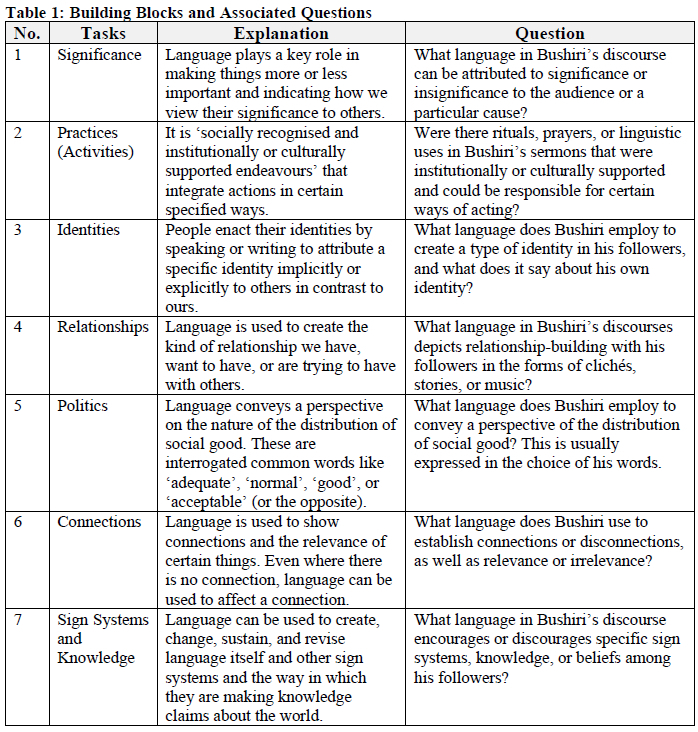
The CDA approach examines language's text and social uses (Hodges, Kuyper and Reeves, 2008). It also explores how ways of thinking and speaking shape specific institutions and roles. Gee's Building Block consist of the following: Significance, practice, identities, relationships, politics, connections, and sign systems/knowledge. These are appropriate for this study as they offer a holistic and methodical framework to analyze existing content, such as Prophet Bushiri's sermons. Gee (2011) avers that, when people speak or write, they are always and simultaneously building one of seven things or areas of reality. However, in this study, Gee's CDA is employed as a heuristic tool to guide the selection of relevant excerpts from the sermons. The framework is not applied to interpret every building block in detail, but rather to identify those sections most pertinent to the framing of Bushiri's sermons. Below is a graphical illustration of Gee's Building Blocks and associated questions that guided the researcher in the context of this research (Gee, 2011, pp. 23-26).
Sampling and Inclusion Criteria
This research employs purposive non-random sampling because the intention is not to generalize but to examine specific texts of Prophet Bushiri and their evolving nuances.
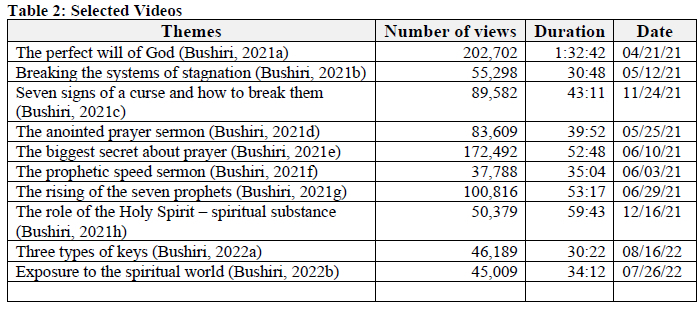
The following exclusion and inclusion criteria were constructed based on specific statistics on the video channels on May 24, 2024. These statistics include the number of views as well as the number of comments on each video. The channel provides an option between popular videos and the latest videos. The researcher chose the latest videos, which amounted to 490 units. Videos whose duration did not exceed 30 minutes were not considered capable of providing rich and extensive content for analysis. These did not include videos prepared in series, as it would create an imbalance with other units not in series. Moreover, videos in which the services/sermons were not performed by Bushiri himself were excluded. Content devoted exclusively to prayers was equally left out. In the end, 41 units were available for analysis. Subsequently, the researcher purposively chose the 10 most viewed videos of Bushiri in the selected category. This is similar to a study by Kelly, Fealy and Watson (2012) on Constructing nurses identity on YouTube, who sampled 10 out of 96 videos and also employed CDA to describe and analyze data. The videos selected are listed below:
Analysis and Discussion
ATLAS.ti, a qualitative analysis package effective for coding and identifying themes, was employed to code data from the selected YouTube videos (Kozinets, 2002; Ziskin, 2019). Paulus and Lester (2016, p. 424) allude that ATLAS.ti 'enables the analyst to engage through queries and networks, in deeper levels of analysis than is possible by hand'. This section examines the various themes and frames emerging from Bushiri's YouTube sermon excerpts derived from using Gee's Building Blocks, offering a comprehensive exploration of their underlying meanings and implications. The following themes emerged from the messages conveyed in the selected excerpts: Cultic tendencies, self-promotion, prosperity gospel/tithing, extrabiblical teachings, self-branding techniques, media use, and the politics of miracles and blessings, offering valuable insights into the sermonic content and its impact.
Cultic Tendencies
Some religious practices are often referred to as cult-like because they are strange to historical and institutional tenets of a particular religion (Mapula, 2018). Forster (2019) argues that NPC leaders display cult-like tendencies because they occasionally isolate their members from regular activities, families, and friends to achieve certain ends. These tendencies often create problems among families and groups. Meanwhile, some of these religious leaders and their adherents often dismiss people who disagree with them as being disconnected from the spiritual realities. They sometimes easily access biblical quotations to support such claims2. In this instance, they ignore the history and contexts of such passage. While it is not sufficient to use texts to decipher cultic tendencies, the idea of transcending traditional human senses to access a 'spiritual world' where followers can 'hear' and 'see' beyond normal capabilities tends toward the occultic that has been described by scholars like Mapula (2018) and Forster (2019). Bushiri suggests that, once one follows Jesus, one transcends the traditional five senses. This position implicitly reflects the cult system that the NPCs have been accused of. However, some people tend to view it as a form of spirituality that cannot be fully comprehended by those who are not in the spirit. In the Exposure to the spiritual world sermon, he states:
However, the moment you receive Jesus...If you receive Jesus immediately you change into the spiritual world, where you do not only have the five senses, but you develop even most spiritual senses that you may actually start hearing things which other people with the normal senses are not hearing. You may start seeing things which other people with the normal eyes cannot see because now you are exposed. You have an interface with the spiritual world. It is in this spiritual world where you begin to receive, where you begin to ask things from God. Now, we do have people who are waiting for miracles, for healings, for deliverance in the natural world, and they have never seen it because in the natural there is no deliverance because deliverance is spiritual. Healing is spiritual. You cannot see them; you cannot touch them (Building Block 7; Bushiri, 2022b)3.
Pastors who have such unusual engagements with their followers have also been classified as personality cults (Ramantswana and Sebetseli, 2021). Kgatle (2019) refers to personality cults as celebrity cults, evident in titles such as Major 1 in the case of Bushiri. Christians are expected to distinguish themselves through their living and conduct. However, suggesting that religious people must develop new spiritual senses can be misleading. According to Kgatle (2021a), a cult in a church setting entails pastors or prophets who perform religious activities such as prophecies and healings while contradicting religious institutions' traditional and doctrinal values. Kgatle proceeds to identify cultlike practices among NPC prophets, which sometimes manifest in sex abuse and money abuse. A typical illustration is a News24 report where a lady allegedly claimed that Pastor Timothy Omotoso made her believe rape was the will of God (Bezuidenhout, 2023). Therefore, luring people to hold such views are likened to thought reforms. This type of teaching, and many others, caused Kobo (2019) to propose that cult manifestations include 'indoctrination, initiation, rituals, brainwashing, coercion, intimidation, isolation, promises of utopia and salvation, disinformation, punishment and negative reinforcement' (Kobo, 2019, p. 2 of 7).
Self-Promotion
Bushiri positions himself as an indispensable intermediary between God and his followers. His assertion that the voice of God is embedded in the voice of the prophet (Bushiri, 2021f) suggests a divine endorsement of his ministry, reinforcing his authority. In contrast, listening to Bushiri's sermons does not give the impression that what he narrates is totally attributable to divine initiative. He is human and susceptible to errors like all mortals. In the Prophetic speed sermon, he claims that
[w]hen God raises men of God in your era, in your days...when they speak, listen attentively, listen to what they are saying because there is a voice of God in their message. There is a voice of God in their message. So as a prophetic ministry, we believe that God is still speaking today...That is why I am standing on this altar, the whole reason why I accepted the calling because God said I want you to go and prove to the people that I am still speaking (Building Block 2; Bushiri, 2021f).
Such a perceived indispensability of the man of God is what Kgatle (2019) describes as a 'celebrity cult'. In such a case, individuals position themselves above the mission with which they identify. These are sometimes expressed through titles, stage names, and social media presence. Ramantswana and Sebetseli (2021) prefer to term these unusual involvements as 'personality cults', considering their absolute control over their followers, which are natural consequences of unquestionable obedience. They state that personality cults are evident in using brand names such as Major 1 (Shepherd Bushiri) and Mboro (Pastor Paseka Motsoeneng).
Prosperity Gospel
Bushiri's emphasis on tithing as a prerequisite for unlocking blessings is a narrative consistent with the prosperity gospel (Anderson, 2019; Kgatle, 2021a). The lack of accountability raises concerns about potential financial exploitation. People tend to perceive religion as a commodity in the current consumption regime. They are willing to transact it, as they do with other products. Much ingenuity has also been constructed around this. For instance, Bushiri's church, the Jesus Nation Church (Enlightened Christian Gathering) has a dedicated website for donations titled 'Take up the cause of Christ ... through your donations and giving. You can make a one-time, monthly, or annual donation of between 5 and 10,000 dollars' (Jesus Nation, n.d.). The idea is laudable, suggesting that technology has significantly improved and transformed donation modes. However, the preoccupation of prophets and pastors to receive money from their followers without being accountable to them or the public is not plausible.
One way to introduce some balance is to set up similar mechanisms to help many of their followers in dire need.
Bushiri's disposition to the prosperity gospel is clear in his overemphasis on tithing4. The prophet avers that opportunities can cease in one's life, whether in business, marriage, or financial status, if they do not pay their tithe. According to Kgatle (2021a), such a process of wealth accumulation by the prophets can be regarded as a 'money cult'. It involves manipulating people's finances and wealth by luring them to give, even when they find it difficult to do so. He emphasizes paying tithes for a whole year, and for him, this can help to unblock opportunities. In his sermon titled Three types of keys of the kingdom, he states:
Giving can become your key of the kingdom. The Bible says what? It says bring your whole tithe. Not some of your tithe in a year but your whole tithe. So somebody has been giving tithe for January, February, March, April, May, and they are expecting to see the results. No, when the Bible says, 'the whole tithe', they mean your whole year. Your whole tithe and see ... So why some of you God has not opened your life after giving tithe, because God is waiting for the whole tithe. And he says, 'And see if I will not open...'. Meaning he is what? He is crossed. The doors of the heavens are closed. He says your giving shall make me open. So your giving, what you give, becomes a key in the Spirit. And God is even challenging you. He says, 'Give and see if I will not open the windows of heaven' (Building Block 2; Bushiri, 2022a).
This assertion confirms the position of Mzondi (2021, p. 7) that Bushiri 'does not do ministry outside of entrepreneurship'. Bushiri's 'tithe' illustration must have been inspired by the Book of Malachi5, which states, 'Bring the full tithe into the storehouse, that there may be food in my house...'. This passage needs to be interpreted in a fair and reasonable context. There are cases where food is already abundant in the house. On such occasions, the prophet or priest or custodian of the storehouse, in fairness, needs to share with the congregants, especially the less privileged ones.
Scholars have observed how invincible the modern-day 'prophets' have become, especially considering the colossal wealth and influence they wield (Dube, 2019). Moreover, Chitando (2017) argues that these theologies tactically approve of greed and rapaciousness. He has introduced the term 'white-collar prophets' as those prophets who are out to monetize the Word of God. This is a model that regards NPCs as triumphalist movements because they sometimes perceive themselves as wielding more power than other Christian denominations in general and other Pentecostal streams in particular (Kgatle, 2021b).
In contrast, Lephoko (2024) has advocated for a balanced approach to prosperity theology through the theology of sharing based on Ubuntu6. He recommends Nicholas Bhengu's theology of sharing. Bhengu was one of the leading African Pentecostal evangelists. He taught his people to work hard instead of simply exercising their faith in God alone to prosper. The keyword in Nicholas Bhengu's sermon is 'compassion'. He considers it essential for Christian leaders and followers to display this quality.
Extrabiblical Teachings
Bushiri claims that 'the Spirit of God is in your nostrils', depicting the incorporation of extrabiblical teachings. Nel (2023) warns that this can lead to abusive practices. By blending scientific language with spiritual concepts, Bushiri creates a veneer of credibility that resonates with followers seeking solace in complex theological ideas. However, this approach risks oversimplifying and misrepresenting spiritual truths, potentially misleading adherents.
Similarly, Nel (2023) asserts that, while the NPCs might have some good attributes, much of the prosperity message's content may lead to ' abusive practices'. Such elements include extra-biblical
revelations of knowledge, which are subjected to interpretations of the prophet's authority without a peer-review mechanism. Unfortunately, some people who follow prophets are often not perceived as critically minded due to the adverse impact of their socio-economic situation. Followers resonate more with such pastors' teachings as an alternative respite to their conditions. In the sermon titled Exposure to the spiritual world, Bushiri states:
The Bible says the Spirit of God is in your nostrils. Breathing out, that is where God's Spirit is. Have you wondered why the moment you are so sick you can't breathe? The first thing doctors rush to is your nostrils. Have you not wondered why? Not your mouth. Why can't they provide something that you can be breathing through your mouth? But they made a plan because that is where the Spirit of God is. Some of us, we know this secret. If I can breathe on you, you will see the power of God touch you (Building Block 3; Bushiri, 2022b).
Self-Branding Techniques
Bushiri's portrayal as a conduit for divine blessings, exemplified by his 'contract-winning touch', reinforces Marx's view of religion as the masses' opium (Marx and Engels, 1975). This technique elevates his status and creates a dependency among followers who view his 'touch' as a brand crucial to their success. In his sermon on The role of the Holy Spirit - spiritual substance, he claims:
I have international visitors saying, 'Papa touched me and the contract came'. The reason why I touch a person is so simple. I just need the substance. I just know for a fact, the moment I touch you, I have left the substance on you. The substance will begin to go and call contracts for you. Me I was like this and this thing happened. It is the substance (Building Block 7; Bushiri, 2021h).
The excerpt above could be interpreted in many ways. One such interpretation could be that the Prophet positions himself as a man with a special 'touch' capable of impacting what he describes as a 'substance'. A deeper evaluation of such a narrative underscores a prophet's positioning as one with a unique offering and agency that can attract extraordinary opportunities and favors, such as winning contract opportunities. What this kind of teaching often does is to make followers develop an attitude of over-dependency on their religious leaders, even for those needs that could have been accomplished without any human agency. This is still in line with celebrity cult practices (Resane, 2017; Kgatle, 2019). One of the characteristics of a spiritual leader should be to remain in the background, while allowing adherents to establish an enduring relationship with their divine being (God). This is well captured in the Gospel where John the Baptist states that he must continue to decrease, so that Jesus could increase7.
Media Use
Bushiri's strategic media use underscores his adaptability in maintaining a digital presence. The invocation of blessings through televised and online platforms highlights the evolving role of technology in modern religious practices. While this approach democratizes access to religious experiences, it raises concerns about the authenticity and ethical implications of media-mediated spiritual interactions. Witte's (2011) caution about the mystique of televised figures underscores the need for critical engagement with such portrayals. In his sermon on The perfect will of God, he suggests that location should not be a barrier to reaching him:
Stretch your hand towards me in the studio on the prophetic channel, wherever you are watching right now. We decree as I transfer the anointing, the power of God, to move where you are right in your direction. God said to Moses, 'Raise your hands towards the sea'. I raise my hand towards you; I raise my hands towards your direction. Let there be a move of God in the Name of Jesus; in the Name of Jesus, and miracle where you are, a testimony, where you are, receive now (Building Block 4; Bushiri, 2021a).
It is crucial to consider the view of Witte (2011) that media texts can cause things or people to appear more beautiful, attractive, truthful, and accessible than they are. Among religious figures, such attributes 'give them a mystical kind of authority that makes people desire or follow them' (Witte, 2011, p. 235). Ramantswana and Sebetseli (2021) highlight three main strategies that NPCs employ: Televising 'extraordinary' events, focusing on prosperity messages, and appearing to have powers over evil. NPC prophets have a good media presence. They use social media to popularize themselves and their activities (Kgatle, 2021a). Asamoah-Gyadu (2005) narrates that televised images of the NPCs are crafted to depict success and create impressions about pastors as mediators of extraordinary power -'anointing'. Therefore, involvement in para-social relationships with religious leaders must be taken cautiously. Orogun and Pillay (2023) assert that Bushiri has been active in the digital space for almost a decade. His legal crisis with the South African authorities arguably heightened this adaptation to the new media, in a bid to sustain his relationship with his online followers.
Politics of Miracles and Blessings
Bushiri's emphasis on 'desire' as a prerequisite for receiving miracles shifts the responsibility for outcomes onto followers. These narratives risk fostering feelings of inadequacy among those who fail to achieve their desired results. The portrayal of miracles as selective and contingent on faith perpetuates the allure of NPCs while obscuring the broader theological and ethical dimensions of divine intervention. In other words, whoever does not receive a miracle does not have a 'desire'. In his words:
So, Jesus went to this pool of Bethsaida, which was like a hospital. There were thousands of people when he went there; he only healed one person. Jesus can enter the hospital even now and only heal one person because the rest of the people in that place they did not have a desire. You may be on the prayer line, and I am praying for everybody, and only six people may come with the testimony because they desired (Building Block 6; Bushiri, 2021e).
It is a fact that desire and faith in oneself are critical qualities in achieving one's goals in life. However, in some instances, religious leaders, especially in the NPCs such as Prophet Bushiri, position themselves in their construction of meaning and ideology within their sermons as if to possess solutions to all kinds of problems afflicting the people, whether spiritual, physical, or psychological. They lure people by displaying images and messages in the media, portraying their immense power. After winning people over to their church, the narratives begin to change, while the unsuspecting followers continue to long for the day or time when they will receive their healing or miracle. Such a time may never be realized.
Conclusion
This study analyzed a selection of Prophet Bushiri's YouTube sermons. Bushiri and his church belong to the neo-prophetic brand of the Pentecostal movement, which is noted for its prophecies and what some might consider controversial teachings. The study employed Gee's CDA framework. The framing theory was also used to uncover his sermons' sociocultural, ideological, and communicative dimensions through selective salience of aspects of reality.
The theory emphasizes three dimensions: First, the causal agent which in this case is Bushiri -the individual pastor/prophet and his orientation has its impact on creating frames; second, the message - the causal agent (Bushiri) largely shapes the message and how it is communicated; and third, the judgment/remedy - this is what the audiences make of the messages. However, the place of the scholar will be to create remedies to ensure religious messages are ethically designed and appropriately communicated.
Nevertheless, findings reveal that Bushiri leverages the affordances of digital media platforms such as YouTube to construct frames that blend religious narratives with entrepreneurial strategies, expanding his influence and reshaping the practice of digital evangelism. By situating religious discourse within a CDA framework, this study has highlighted the commodification of faith in the digital age and its implications for identity formation and follower engagement. These insights contribute to the broader understanding of religious communication in the context of new media, offering a foundation for further exploration into the dynamics of digital evangelism and its impact on contemporary religious practices.
This study is significant as it demonstrates that sermons can be strategically or unintentionally framed to achieve certain ends, in some cases, potentially misleading audiences. It underscores the need for preachers to be mindful of the messages they convey and their possible interpretations. It also encourages congregations to engage sermons critically, while guiding scholars of religious communication to recognize sermons as valuable texts for identifying the theological orientations, traditions, and ideological leanings that shape a preacher's discourse and identity, especially in the digital space. However, this study has focused on religious texts and not the consumers. Future studies can benefit from an audience perception of sermons/texts by religious leaders within the NPC.
Possible limitations to this study may emanate from the authors' positioning as media and communication scholars rather than religious scholars. Again, they are not sufficiently attuned to the tenets of the NPC, which must have largely influenced Bushiri's sermons.
References
-
Agbiji, O. and Swart, I. (2015). 'Religion and social transformation in Africa: A critical and appreciative perspective', Scriptura, 114, pp. 1-20. https://doi.org/10.7833/114-0-1115
» https://doi.org/10.7833/114-0-1115 -
Alenizi, A.M. and AbuSa'aleek, A.O. (2022) 'Political discourse analysis: Analyzing building tasks in Trump's speech in Saudi Arabia', Arab World English Journal, 13(2), pp. 462-472. https://doi.org/10.24093/awei/vol13no2.32
» https://doi.org/10.24093/awei/vol13no2.32 - Anderson, G. (2019) 'Commercialisation of religion in Neo-Prophetic Pentecostal/Charismatic Churches in Ghana: Christian ethical analysis of their strategies', Journal of Philosophy, Culture and Religion,, 42(1), pp. 1-8.
-
Asamoah-Gyadu, J.K. (2005) 'Anointing through the screen: Neo-Pentecostalism and televised Christianity in Ghana', Studies in World Christianity,, 11(1), pp. 9-28. https://doi.org/10.3366/swc.2005.11.1.9
» https://doi.org/10.3366/swc.2005.11.1.9 -
Banda, C. (2020) '"Unsafe spaces?" An ecclesiological evaluation and response to recent controversial practices in some South African neo-Pentecostal churches,' Verbum et Ecclesia, 41(1). 10 pages. https://doi.org/10.4102/ve.v41i1.2108
» https://doi.org/10.4102/ve.v41i1.2108 -
Bezuidenhout, C. (2023) Pastor Timothy Omotoso made me believe rape was will of God, emotional victim tells court. News24. August 16, 2023. Available at: https://www.news24.com/southafrica/news/pastor-timothy-omotoso-made-me-believe-rape-was-will-of-god-emotional-victim-tells-court-20230816. (Accessed January 21, 2025).
» https://www.news24.com/southafrica/news/pastor-timothy-omotoso-made-me-believe-rape-was-will-of-god-emotional-victim-tells-court-20230816 -
Bushiri, S. (2021a) The perfect will of God. YouTube video. April 21, 2021. Available at: https://youtu.be/K5xkEPMhUs?si=XEdZpU4MoMtfptP. (Accessed January 5, 2025).
» https://youtu.be/K5xkEPMhUs?si=XEdZpU4MoMtfptP -
Bushiri, S. (2021b) Breaking the system of stagnation. YouTube video. May 12, 2021. Available at: https://youtu.be/zsLy_BKf3gY?si=nB9L2wIZ1tcZvK1o. (Accessed January 5, 2025).
» https://youtu.be/zsLy_BKf3gY?si=nB9L2wIZ1tcZvK1o -
Bushiri, S. (2021c) Seven signs of curses and how to break them. YouTube video. Available at: https://youtu.be/LZB8hC3kI8I?si=d95ys7tSMEfDw9it. (Accessed January 5, 2025).
» https://youtu.be/LZB8hC3kI8I?si=d95ys7tSMEfDw9it -
Bushiri, S. (2021d) The anointed prayer sermon. YouTube video. Available at: https://youtu.be/rsFLE3kNdXU?si=n2cBGPgyVxU1iOlC. (Accessed January 5, 2025).
» https://youtu.be/rsFLE3kNdXU?si=n2cBGPgyVxU1iOlC -
Bushiri, S. (2021e) The biggest secret about prayer. YouTube video. Available at: https://youtu.be/PuT__GLd55o?si=nJ-3vqLmJAPPhL7S. (Accessed January 5, 2025).
» https://youtu.be/PuT__GLd55o?si=nJ-3vqLmJAPPhL7S -
Bushiri, S. (2021f) The prophetic speed sermon: Available at: YouTube video. Available at: https://youtu.be/ScqacZAG7Nk?si=OzxxM4SN41jinv9H. (Accessed January 5, 2025).
» https://youtu.be/ScqacZAG7Nk?si=OzxxM4SN41jinv9H -
Bushiri, S. (2021g) The rising of the seven prophets. YouTube video. Available at: https://youtu.be/YT8EC81JIJw?si=dsyzRkKsbRMNbeFE. (Accessed January 5, 2025).
» https://youtu.be/YT8EC81JIJw?si=dsyzRkKsbRMNbeFE -
Bushiri, S. (2021h) The role of the Holy Spirit - spiritual substance. YouTube video. Available at: https://youtu.be/UnLIAF6Fixk?si=A95eRcUlXbC-74Hg. (Accessed January 5, 2025).
» https://youtu.be/UnLIAF6Fixk?si=A95eRcUlXbC-74Hg -
Bushiri, S. (2022a) Three types of keys. YouTube video. Available at: https://youtu.be/N0vueCzRJHY?si=BmcylPhhJmOo4Gps. (Accessed January 5, 2025).
» https://youtu.be/N0vueCzRJHY?si=BmcylPhhJmOo4Gps -
Bushiri, S. (2022b) Exposure to the spiritual world. YouTube video. Available at: https://youtu.be/QsZWDy3Aik?si=Aaxkla6iKge6hF44. (Accessed January 5, 2025).
» https://youtu.be/QsZWDy3Aik?si=Aaxkla6iKge6hF44 -
Chitando, E. (2017) 'Praying for courage: African religious leaders and climate change', Ecumenical Review, 69(3):425-435. https://doi.org/10.1111/erev.12304
» https://doi.org/10.1111/erev.12304 - Chitando E. and Gunda M.R. (2014) The rise of white collar prophecy in Zimbabwe. In Chitando, E., Gunda, M.R. and Kugler, J. eds.: Prophets, profits and the Bible in Zimbabwe. Bamberg: University of Bamberg, pp. 133-153.
-
D'Angelo, P. (2002) 'News framing as a multiparadigmatic research program: A response to entman', Journal of Communication, 52(4), pp. 870-888. https://doi.org/10.1093/ioc/52.4.870
» https://doi.org/10.1093/ioc/52.4.870 -
Dube, B. (2020) '"Go and prophesy in your own land": Foreign prophets and popularism in South Africa. Evoking the need of Jonathanic theology for peaceful resolution of difference', Religions, 11(1), pp. 1-12. https://doi.org/10.3390/rel11010042
» https://doi.org/10.3390/rel11010042 -
Dube, N.E. (2019) 'Desperation in an attempt to curb modern-day prophets: Pentecostalism and the church in South Africa and Zimbabwe', South African Theological Seminary, 27, pp. 25-34. https://doi.org/10.7176/JPCR
» https://doi.org/10.7176/JPCR -
Dunbar, R.I.M. (2017) 'What's missing from the scientific study of religion?' Religion, Brain and Behavior, 7(4):349-353. https://doi.org/10.1080/2153599X.2016.1249927
» https://doi.org/10.1080/2153599X.2016.1249927 -
Entman, R.M. (1993) 'Framing: Toward clarification of a fractured paradigm', Journal of Communication, 43(4), pp. 51-58. https://doi.org/10.1111/i.1460-2466.1993.tb01304.x
» https://doi.org/10.1111/i.1460-2466.1993.tb01304.x -
Falkheimer, J. and Olsson, E.K. (2015) 'Depoliticizing terror: The news framing of the terrorist attacks in Norway, 22 July 2011', Media, War and Conflict, 8(1), pp. 70-85. https://doi.org/10.1177/1750635214531109
» https://doi.org/10.1177/1750635214531109 -
Fihlani, P. (2018) Shepherd Bushiri: Meeting the man who 'walks on air'. BBC. Available at: https://www.bbc.com/news/world-africa-43245126. (Accessed January 22, 2025).
» https://www.bbc.com/news/world-africa-43245126 -
Fischer, A. (2022) 'Then again, What is manipulation? A broader view of a much-maligned concept', Philosophical Explorations, 25(2), pp. 170-188. https://doi.org/10.1080/13869795.2022.2042586
» https://doi.org/10.1080/13869795.2022.2042586 -
Forster, D.A. (2019) Why South Africans are prone to falling for charlatans in the church. The Conversation. March 10, 2019. Available at: https://theconversation.com/why-south-africans-are-prone-to-falling-for-charlatans-in-the-church-112879. (Accessed Janaury 11, 2025). https://doi.org/10.64628/AAJ.5dryrft36
» https://theconversation.com/why-south-africans-are-prone-to-falling-for-charlatans-in-the-church-112879 -
Frahm-Arp, M. (2019) 'A brief history of industrial revolutions: Why at the start of the fourth industrial revolution do we see a rise in cult-type Pentecostal churches in South Africa?' Thinker, 82, pp. 4-9. https://doi.org/10.36615/thethinker.v82i4.353
» https://doi.org/10.36615/thethinker.v82i4.353 - Gee, J.P. (2011) Discourse analysis: What makes it critical? In Rogers, R. ed.: An introduction to critical discourse analysis in education. 2nd ed. New York: Routledge, pp. 23-45.
-
Hodges, B.D., Kuyper, A. and Reeves, S. (2008) 'Discourse analysis', The BMJ, 337, pp. 570-572. https://doi.org/10.1136/bmi.a879
» https://doi.org/10.1136/bmi.a879 -
Jesus Nation. (n.d.) More than a church: We are one family. Available at: https://www.ecgchurch.org/. (Accessed January 11, 2025).
» https://www.ecgchurch.org/ -
Kelly, J., Fealy, G.M. and Watson, R. (2012) 'The image of you: Constructing nursing identities in YouTube', Journal of Advanced Nursing, 68(8), pp. 1804-1813. https://doi.org/10.1111/i.1365-2648.2011.05872.x
» https://doi.org/10.1111/i.1365-2648.2011.05872.x -
Kgatle, M.S. (2017) 'The unusual practices within some neo-Pentecostal churches in South Africa: Reflections and recommendations,' HTS Teologiese Studies/Theological Studies, 73(3). 8 pages. https://doi.org/10.4102/hts.v73i3.4656
» https://doi.org/10.4102/hts.v73i3.4656 -
Kgatle, M.S. (2019) 'Reimagining the practice of Pentecostal prophecy in Southern Africa: A critical engagement', HTS Teologiese Studies/Theological Studies, 75(4). 7 pages. https://doi.org/10.4102/hts.v75i4.5183
» https://doi.org/10.4102/hts.v75i4.5183 -
Kgatle, M.S. (2020) 'Towards a balancing act between the emergence of prophetic churches and organisational culture in South African Pentecostalism', Verbum et Ecclesia, 41(1). 7 pages. https://doi.org/10.4102/ve.v41i1.2118
» https://doi.org/10.4102/ve.v41i1.2118 -
Kgatle, M.S. (2021a) Pentecostalism and cultism in South Africa. Cham: Palgrave Macmillan. https://doi.org/10.1007/978-3-030-69724-2
» https://doi.org/10.1007/978-3-030-69724-2 -
Kgatle, M.S. (2021b) 'Triumphalist theology in the context of prophetic Pentecostalism in South Africa,' Journal of the European Pentecostal Theological Association, 41(2), pp. 141-152. https://doi.org/10.1080/18124461.2021.1954273
» https://doi.org/10.1080/18124461.2021.1954273 -
Kgatle, M.S. (2022) 'The newer non-denominational Pentecostal churches in South Africa: A critical approach to non-denominationalism in Pentecostalism', Studia Historiae Ecclesiasticae, 49(3). 14 pages. https://doi.org/10.25159/2412-4265/10997
» https://doi.org/10.25159/2412-4265/10997 -
Khan, M.A., Malik, M.R. and Dar, S.R. (2015) 'Deconstruction of ideological discursivity in Pakistani print media advertisements from CDA perspective', Journal of Linguistics and Literature, 1(1), pp. 57-79. https://doi.org/10.4102/hts.v80il.9544
» https://doi.org/10.4102/hts.v80il.9544 -
Khumalo, F. (2016) Prophets of doom prey on the poor. Sunday Times,, December 16, 2016. Available at: https://www.timeslive.co.za/sunday-times/news/2016-12-18-prophets-of-domm-prey-on-the-poor/. (Accessed February 2, 2025).
» https://www.timeslive.co.za/sunday-times/news/2016-12-18-prophets-of-domm-prey-on-the-poor/ -
Kobo, F.A. (2019) 'Spirituality trapped in androcentric celebrity cults in South Africa post-1994', HTS Teologiese Studies/Theological Studies, 75(3). 7 pages. https://doi.org/10.4102/hts.v75i3.5593
» https://doi.org/10.4102/hts.v75i3.5593 -
Kozinets, R.V. (2002) 'The field behind the screen: Using netnography for marketing research in online communities', Journal of Marketing Research, 39(1), pp. 61-72. https://doi.org/10.1509/imkr.39.1.61.18935
» https://doi.org/10.1509/imkr.39.1.61.18935 -
Lephoko, D.S. (2024) 'Prosperity theology versus theology of sharing approach', HTS Teologiese Studies/Theological Studies, 80(1). 7 pages. https://doi.org/10.4102/hts.v80i1.9544
» https://doi.org/10.4102/hts.v80i1.9544 - Mangaliso, M. (2018) 'Building competitive advantage from Ubuntu: Management lessons from South Africa', Academy of Management Executive, 15(2), pp. 25-34.
-
Manyowa, M. (2022) Inside Bushiri's world: How a Malawian cleric's media strategy took him to the top. News24. March 26, 2022. Available at: https://www.news24.com/news24/opinions/columnists/guestcolumn/opinion-inside-bushiris-world-how-a-malawian-clerics-media-strategy-took-him-to-the-top-20220326.
» https://www.news24.com/news24/opinions/columnists/guestcolumn/opinion-inside-bushiris-world-how-a-malawian-clerics-media-strategy-took-him-to-the-top-20220326 -
Mapula, N. (2018) Cults around the globe and the SA Link. Sowetan Live. March 7, 2018. Available at: https://www.sowetanlive.co.za/sundayworld/lifestyle/2018-03-07-cults-around-the-globe-and-the-sa-link/. (Accessed January 21, 2025).
» https://www.sowetanlive.co.za/sundayworld/lifestyle/2018-03-07-cults-around-the-globe-and-the-sa-link/ - Marx, K. and Engel, F. (1975) On religion. Moscow: Progress.
-
Matshobane, M. (2023) 'New prophetic churches and syncretism: A critical view', Religions, 14(11). 1383. 12 pages. https://doi.org/10.3390/rel14111383
» https://doi.org/10.3390/rel14111383 - Mohamad, M.S. and Al-Rubai'i, A.M.A. (2019) 'A critical discourse analysis of the language of webinars: Politics building task', Journal of Duhok University, 22(2), pp. 349-364.
-
Mzondi, M. (2021) 'Clements Kadalie, the trade unionist, and prophet Shepherd Bushiri', Stellenbosch Theological Journal, 7(2), pp. 1-15. https://doi.org/10.17570/sti.2021.v7n2.a3
» https://doi.org/10.17570/sti.2021.v7n2.a3 -
Ncube, L.B. (2010) 'Ubuntu: A transformative leadership philosophy', Journal of Leadership Studies, 4(3), pp. 77-82. https://doi.org/10.1002/ils.20182
» https://doi.org/10.1002/ils.20182 -
Nel, M. (2023) 'The prosperity message as a syncretistic deviation to the Gospel of Jesus', Religions, 14(3). 12 pages. https://doi.org/10.3390/rel14030346
» https://doi.org/10.3390/rel14030346 -
Orogun, D.O. and Pillay, J. (2023) 'A historical survey of the African Neo-Pentecostals' response to digital transformation', HTS Teologiese Studies/Theological Studies, 79(1). 12 pages. https://doi.org/10.4102/hts.v79i1.8040
» https://doi.org/10.4102/hts.v79i1.8040 -
Paulus, T.M. and Lester. J.N. (2016) 'ATLAS.Ti for conversation and discourse analysis studies', International Journal of Social Research Methodology, 19(4), pp. 405-428. https://doi.org/10.1080/13645579.2015.1021949
» https://doi.org/10.1080/13645579.2015.1021949 -
Ramantswana, H. (2019) 'Prophets praying for, or preying on people's faith: A reflection on prophetic ministry in the South African context', In Die Skriflig/In Luce Verbi, 53(4). 8 pages. https://doi.org/10.4102/ids.v53i4.2495
» https://doi.org/10.4102/ids.v53i4.2495 -
Ramantswana, H. and Sebetseli, I. (2021) 'Prophets competing against each other in a commercial age: Have some prophets or neoprohetic churches gone too far?' HTS Teologiese Studies/Thsological Studies, 77(4). 10 pages. https://doi.org/10.4102/hts.v77i4.6340
» https://doi.org/10.4102/hts.v77i4.6340 -
Resane, K.T. (2017) 'Commercialisation of theological education as a challenge in the Neo-Pentecostal charismatic churches', HTS Teologiese Studies/Theological Studies, 73(3). 7 pages. https://doi.org/10.4102/hts.v73i3.4548
» https://doi.org/10.4102/hts.v73i3.4548 -
Setiawati, E., Purba, R., Suwondo, T., Judijanto, L., Kencanawati, D., Herman, H., Fatmawati, E. and Saputra, N. (2024) 'An investigation on discourse structure of video games tutorials: A case in multimodal discourse analysis', Research Journal in Advanced Humanities, 5(3), pp. 1-12. https://doi.org/10.58256/c4h2qk76
» https://doi.org/10.58256/c4h2qk76 -
Timeslive. (2019) Bushiri money laundering case brought forward owing to 'security matters': NPA. Sunday Times. May 9, 2019. Available at: timeslive.co.za/news/south-africa/20s9-05-09-bushiri-money-laundering-case-brought-forward-owing-to-security-matters-npa/. (Accessed January 3, 2025).
» timeslive.co.za/news/south-africa/20s9-05-09-bushiri-money-laundering-case-brought-forward-owing-to-security-matters-npa/ -
Witte, M. (2011) 'Fans and followers: Marketing charisma, making religious celebrity in Ghana', Australian Religious Journal Review, 24(3), pp. 231-253. https://doi.org/10.1558/jasr.v24i3.231
» https://doi.org/10.1558/jasr.v24i3.231 -
Ziskin, M.B. (2019) 'Critical discourse analysis and critical qualitative inquiry: Data analysis strategies for enhanced understanding of inference and meaning', International Journal of Qualitative Studies in Education,, 32(6), pp. 606-631. https://doi.org/10.1080/09518398.2019.1609118
» https://doi.org/10.1080/09518398.2019.1609118

Revised: October 27, 2025
Accepted: November 17, 2025
Published: December 20, 2025
Editors
Dr. Nelly Mwale
Prof. Lee-Shae Salma Scharnick-Udemans
Funding
No funding was received for this article
1 This is because he has been accused of fraudulent prophetic miracles and money laundering charges (cf. Kgatle, 2019; Banda, 2020).
2 Cf. Luke 14:26: 'If anyone comes to me and does not hate his own father and mother and wife and children and brothers and sisters, yes, and even his own life, he cannot be my disciple' (Revised Standard Version).
3 Note that excerpts are cited based on an identified Building Block as indicated in Table 1 and their respective videos in the References.
4 Tithing is a Jewish tradition of paying 10% of one's earnings for the work of God. There are passages in the Bible that indicate the value of paying tithes (cf. Lev 27:30-34; Ex 35:5).
5 Malachi 3:10-12.
6 'Ubuntu' is a term derived from the Bantu Nguni languages of Zulu, Xhosa, Swati, and Ndebele (Ncube, 2010). 'It can be defined as humaneness - a pervasive spirit of caring, community, harmony and hospitality, respect and responsiveness - that individuals and groups display for one another' (Mangaliso, 2018, p. 25).
7 John 3:30.