Determination of the minimum protective dose for bluetongue virus serotype 2 and 8 vaccines in sheep
Abstract
Recent outbreaks of bluetongue virus (BTV) serotypes 2 and 8 in many European countries provided an opportunity to investigate the possibility of improving the safety of the modified live vaccines administered mainly in South Africa. Modified live vaccines (MLV) released at a titre of 5 x 10⁴ PFU/mL, raised concerns and prompted the need to determine the minimum titre which will still be protective and also safe. The BTV serotypes 2 and 8 vaccines were produced at the following titres: 102 PFU/mL, 103 PFU/mL and 104 PFU/mL, and were injected into 24 sheep which were then monitored. Blood was collected on days 0, 3, 6, 9, 12, 15, 18, 21, 25, 28 and 4 months post vaccination, for seroconversion and viraemia studies. These sheep were later challenged at 4 months post vaccination using BTV infected cell culture material, they were then observed and bled and again tested for viraemia. There was no viraemia post vaccination, however, a febrile reaction did occur and seroconversion was demonstrated at low titres for both BTV 2 and 8. Although viraemia was demonstrated post challenge, sheep vaccinated with the low titre BTV 2 vaccine showed more than a 90% protection index at a lower titre of 103 PFU/mL, compared with BTV 8 that showed a protection index above 90% at all the titres used. It is recommended that for BTV 2 vaccine, sheep should be vaccinated at a titre of 103 PFU/mL and at a titre of 102 PFU/mL with BTV 8 vaccine.
Introduction
Bluetongue (BT) is a non-contagious, insect-transmitted disease that infects certain domestic and wild ruminants that is caused by the bluetongue virus (BTV).1in vitro virus serum neutralising assay (SNT). In the late 1960's Howell applied this test in order to antigenically group 22 strains of bluetongue virus into 12 serotypes.23,4 Twenty two of these serotypes are known to occur in South Africa (SA)56,7 This disease is endemic in SA and Africa and since 1999 BTV serotypes 2, 4, 6, 8, 9 and 16 have also been prevalent in Europe.3,8,9
Bluetongue virus can infect a wide host range, and because of this the different BTV serotypes and the role played by Culicoides spp. as vector, the eradication of this disease in endemic areas such as in SA would be difficult to achieve.65,6,7,10 The economic impact of using other methods of control, such as slaughter, has led most countries to consider vaccination as the best tool available to control the spread of the disease.
Different types of vaccines have been developed to prevent BTV infection of ruminants. These include: modified live vaccines (MLV), inactivated whole (killed) virus preparations11,12 and virus like particles (VLPs). The latter allows the co-expression of three, four or five BTV genes from a single recombinant vector like the baculovirus multigene expression vector system. Other vector systems include vaccinia-, capripox- or canarypox viruses.13,14,15 Only MLV and inactivated vaccines are commercially available and have been administered in recent years.
An attenuated BTV blood vaccine, developed after serial passage in sheep, has been administered for almost 40 years.1,7 Subsequently, other serotypes of BTV were identified in outbreaks and, thus, a quadrivalent vaccine was developed in the early 1950's.16,17 Further attenuation of the vaccine strains was achieved through serial passage of the BTV in embryonated chicken eggs and tissue culture aided by plaque purification of the virus.6,18 Modified live attenuated vaccines are easy and economical to produce, administered once and have been administered successfully for 50 years.6,14 These vaccines replicate in the host without causing significant adverse clinical effects, and provide protection against challenge with virulent virus of the same serotype. 8,18,19,20,21,22
They are able to elicit both cellular and humoral immune responses, which are able to protect sheep against BT.23,24
Millions of doses of MLV are issued annually in South Africa to vaccinate sheep. Since 2000 Onderstepoort Biological Products (OBP) has also sold several million doses of monovalent BTV vaccines to different European countries.2526,27 Currently all the serotypes in the cell culture adapted vaccine are released at a titre of 5 x 10428,29 This prompted the need to investigate the possibility of producing low titre BTV 2 and 8 vaccines which would still be protective, more economical and without severe side effects.
Materials and methods
Animals
The experiment was conducted at OBP Ltd in SA (25°29'S, 28°.11 E, 1219 m a.s.1.). A total of 28 merino sheep that tested negative for antibodies to BTV (Indirect ELISA, Agriculture Research Council, Onderstepoort Research Institute [ARC-OVI]) were selected and ranged in age from 9-12 months. The sheep were kept in an insect free isolation stable, were fed daily according to a random schedule and had continuous access to clean water.
Vaccine development
Vaccines for BTV serotypes 2 and 8 were developed from field isolates obtained in SA and isolated at the ARC-OVI.
Production of the vaccines was implemented according to the current Standard Operating Procedure (SOP) of OBP (proprietary information). Prior to production, the identity of the working seed virus was firstly confirmed at the Biochemistry Section of the ARC-OVI using the SNT and a reverse transcriptase polymerase chain reaction (RT-PCR). Viruses were grown on baby hamster kidney cells and titres post freeze drying were 1.17 x1056234
Inoculation of sheep
Vaccines were injected into 12 sheep per serotype and subdivided to 4 sheep per titre. A total of 24 sheep were vaccinated using 1 mL of vaccine and injected subcutaneously on the inner side of the thigh. A positive control, which was not vaccinated but was challenged and a negative control, which was not vaccinated and not challenged for each BTV serotype, was included. The sheep were clinically monitored post vaccination, and temperature readings were recorded for 14 days. The sheep were post bled using 10 mL vacutubes containing lithium heparin as an anticoagulant and 10 mL vacu-tube for serum, without an anticoagulant. Blood was collected on days 0, 3, 6, 9, 12, 15, 18, 21, 25 and 4 weeks and also 4 months post vaccination. Heparin blood was tested for viraemia and the serum for neutralising antibodies indicating seroconversion.
Four months post vaccination, both heparin blood and serum were collected from the controls and vaccinated sheep, and, following this, the sheep were challenged (except the negative control sheep) with the homologous BTV serotype. They were then clinically monitored, temperature reactions were recorded for 14 days post challenge and were scored using the method of Huismans, Van der Walt, Cloete and Erasmus (1987).30
Challenge material preparation
The bluetongue virus serotype 2 challenge material was obtained from the ARC-OVI collection whilst serotype 8 was an isolate, BTV 8(G) 5/10A 2006/01KC 3BHK, that was obtained from the Institute for Animal Health (IAH) Pirbright, UK. The challenge material was prepared from cell cultures in which Vero cells were infected with infected sheep blood, observed for cytopathic effect (CPE) and the titre determined by viral plague assay and adjusted to a titre of 1 x 10⁶
Viraemia testing
Every 3rd day post vaccination and post challenge, 5 mL - 10 mL heparin blood was collected for virus isolation. The method applied was according to the SOP of OBP, as described in the OIE Terrestrial Manual 20083132
Serological assays
Pre-vaccination serum was collected and tested for the presence of antibodies to BTV. Post vaccination serum was collected and tested for seroconversion and to quantify the level of antibodies post vaccination. Serum samples were collected on days 0, 3, 6, 9, 12, 15, 18, 21, 28 and four months post vaccination and tested using a commercially available competitive ELISA (VMRD, Inc.). Serum samples collected 4 weeks and also 4 months post vaccination were tested by introducing the SNT on Vero cells in 96-well plates.31
Quality control and percentage protection index determination
Tests were conducted to confirm the titres of the freeze dried vaccine, the safety in laboratory animals and for sterility to confirm the absence of other organisms. All were performed as described in the OIE Terrestrial Manual.31,33 The determination of the clinical reaction index (CRI) and the percentage protection index were calculated using the method described by Huismans, Van der Walt, Cloete and Erasmus (1987).30
Ethical considerations
Vaccinated sheep showed a rise in temperature but no clinical disease. Some of the challenged sheep showed a rise in temperature but no clinical disease. One of the positive control sheep (challenged but not vaccinated) died 8 dpi.
Results
Temperature reactions post vaccination Bluetongue virus serotype 2
Sheep vaccinated with the BTV 2 vaccine titre of 10234
Bluetongue virus serotype 8
All sheep vaccinated with the low titre BTV 8 (1023
Viraemia post vaccination
No viraemia was detected in any of the sheep post vaccination.
Temperature reactions post challenge
Bluetongue virus serotype 2
Three sheep vaccinated with the BTV 2 vaccine titre of 10234
Bluetongue virus serotype 8
Two sheep vaccinated with low titre BTV 8 vaccines (10224
Viraemia post challenge
Viraemia was detected in two sheep post challenge, at 4 months post vaccination with both low titre BTV 2 vaccines (10234
Seroconversion
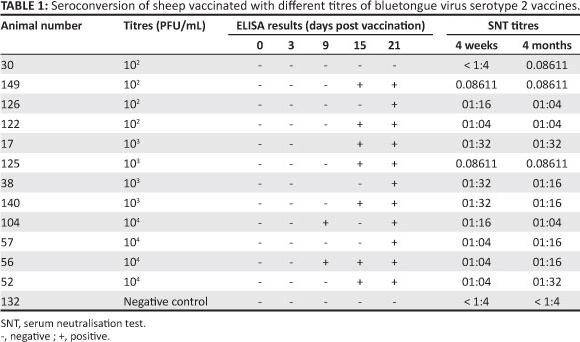
Bluetongue virus serotype 2
The sheep vaccinated with the low titre vaccine (1023Table 1).
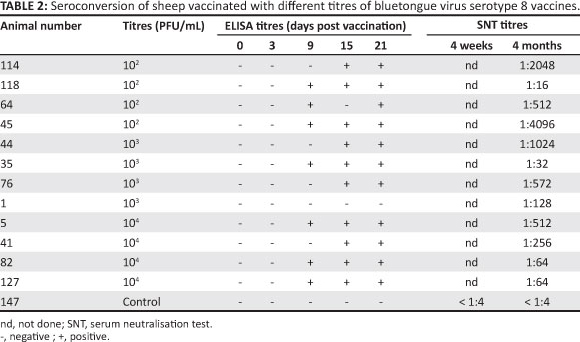
Bluetongue virus serotype 8
Two sheep seroconverted on day 9 post vaccination, whilst one sheep did not demonstrate detectable antibodies, even 4 weeks post vaccination. However, all sheep had neutralising antibody titres above 1:16 at 4 months post vaccination (Table 2).
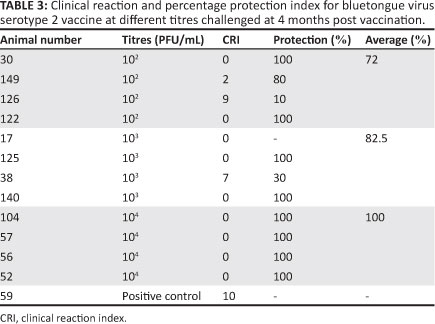
Percentage protection index Bluetongue virus serotype 2
At four months post challenge the sheep vaccinated with the low titre vaccine (102Table 3). The presence of BTV 2 was confirmed by viral isolation.
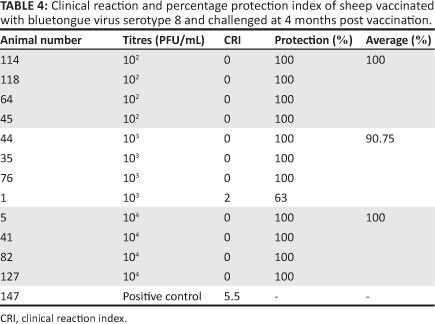
Bluetongue virus serotype 8
All sheep vaccinated with low titre vaccine (1023Table 4).
Trustworthiness
The relevant controls were used during the vaccination and challenge of the sheep as well as in all laboratory tests performed. Validated standard operating procedures were followed in the laboratory. Results obtained are trustworthy.
Discussion
In BT endemic areas, such as SA, the BTV MLV is predominantly applied to control BT disease in sheep,8,10 and this vaccine has successfully played a major role in controlling the spread of the virus in Europe.5,10,25 Virus titres induced by BTV MLV should be kept to an absolute minimum especially if transmission by vectors of viruses, included in the vaccine, is a concern.8Culicoides vectors and animal hosts in the life cycle of the virus.
The existence of at least 22 serotypes of BTV's in SA and the presence of vectors that can transmit the disease, to different susceptible hosts, make the administration of BTV MLV economical for sheep farmers. However, the European Union has decided not to administer BTV MLV on the grounds of various concerns. These include the possible reassortment of vaccine viruses with circulating field strains and the possible reversion to virulence,34,35,36 the transmission of these viruses by vectors and the lack of a DIVA test for these vaccines .3,27 Another concern is the presence of a long duration viraemia when BTV MLV, with titres of or above 1046,22 The administration of BTV MLV in Europe has, therefore, created concern and the need has arisen to investigate the use of reduced titres of 1023
Titres of 104323720,37 and this also confirms the results obtained by Dungu, Gerdes and Smit (2004).5
Cell culture material, and not blood, was selected as challenge material. From previous experience it was noted that the reaction to this in sheep is either late or poor when blood was used, as compared with cell culture material.8,38 The reason for this might be that BTV is a cell-associated virus and binds mainly to red blood cells, platelets and mononuclear cells.29,39,40 It is, however, important to realise that cell culture generated material might lead to the attenuation of the virus, which includes changes in virulence and antigenicity.8,36 Blood-cultured material should, therefore, rather be applied as challenge material.
Three sheep vaccinated with low titre 102
Viraemia was detected post challenge with BTV 2, except with the high titre 10427,40 It was noted previously that a strong antibody response correlates with the virus circulating and replicating in the host body and, thus, with the possibility of viraemia.8
Although the BTV 2 low titre vaccine (10210,18,20,25 There was also a good correlation between seroconversion and the protection index of sheep vaccinated with BTV 8 vaccines. The protection index of sheep vaccinated with BTV 8 was above 90% at all titres. It should also be noted that the positive control of sheep challenged with BTV 2 had a far higher CRI (10) compared with the vaccinated group. The results also confirm that BTV 2 challenge material was more pathogenic than BTV 8 challenge material if comparison is made of the two viruses (Tables 3 and Table 4).
It was clearly shown in this study that sheep vaccinated with the BTV 2 and 8 vaccines reacted differently. This confirms the results obtained by Howell (1969),18
Although at a low titre (10232
More work remains to be undertaken to quantify the duration and level of viraemia post vaccination and post challenge, especially when low titres of virus are administered. Low titre vaccines should also be tested when included in a polyvalent format, as opposed to monovalent vaccines, as was done in this study. The response of indigenous European sheep breeds, different from those in SA, to low titre BTV vaccines should be assessed. To evaluate this, other diagnostic tools, like PCR, should also be used. It will additionally be important to investigate and assess the cost benefit of using both polyvalent and movalent low titre modified live attenuated BTV vaccines, and compare the risk factors associated with their use in sheep.
Conclusion
Although viraemia was demonstrated post challenge, sheep vaccinated with the low titre BTV 2 vaccine showed more than a 90% protection index at a lower titre of 10332
Competing interests
No competing interests that the authors are aware of.
Authors' contributions
The research was done as part of a masters dissertation by J.M. (Onderstepoort Biological Products). The practical work was done by J.M. (Onderstepoort Biological Products) and supervised by E.V. (University of Pretoria). E.V. (University of Pretoria) wrote and submitted the manuscript.
Acknowledgements
Financial support as well as the preparation of the vaccines were undertaken by Onderstepoort Biological Products.
References
- 1. Theiler A. The inoculation of sheep against bluetongue and the results in practice. Onderstepoort J Vet Res. 1908;64:600-607.
- 2. Howell PG. A preliminary antigenic classification of strains of bluetongue virus. Onderstepoort J Vet Res. 1960;28:357-363.
-
3. Batten CA, Maan S, Shaw AE, Maan NS, Mertens PPC. A European field strain of bluetongue virus derived from two parental vaccine strains by genome reassortment. Virus Res. 2008;137:56-63. http://dx.doi.org/10.1016/j.virusres.2008.05.016, PMid:18598726
» http://dx.doi.org/10.1016/j.virusres.2008.05.016 -
4. Maan S, Maan NS, Nomikon K, et al. Novel bluetongue virus serotype from Kuwait. Emerging infect disease [serial online]. c2011 [cited 2011 May]. Available from http://dx.doi.org/10.3201/eid1705.101742
» http://dx.doi.org/10.3201/eid1705.101742 - 5. Dungu B, Gerdes T, Smit T. The use of vaccination in the control of bluetongue in Southern Africa. Vet Ital. 2004;40:616-622. PMid:20422597
-
6. Erasmus BJ. The control of bluetongue in an enzootic situation. Aust Vet J. 1975;51:209-210. http://dx.doi.org/10.1111/j.1751-0813.1975.tb00057.x, PMid:169794
» http://dx.doi.org/10.1111/j.1751-0813.1975.tb00057.x - 7. Verwoerd DG, Erasmus BJ. Bluetongue. In: Coetzer JAW, Tustin RC, editors. Infectious diseases of livestock with special reference to Southern Africa. Cape Town: Oxford University Press, 2004; p 1201-1220.
- 8. European food safety authority (EFSA). Scientific report of the scientific panel on animal health and welfare on request the commission (EFSA-Q-2006-311) and EFSA Selfmandate (EFSA-Q-2007-063) on bluetongue. Adopted by the AHAW panel on 27 April 2007. EFSA J. 2007;479:1-29.
-
9. Promed. Bluetongue 6 vaccine strain - International society for infectious disease [homepage on the Internet]. c2008 [updated 2008 Oct 28; cited 2012]. Available from http://www.promedmail.org
» http://www.promedmail.org - 10. Erasmus BJ. The epidemiology and control of bluetongue in South Africa. Bull Off Int Epizoot. 1980;92:461-467.
-
11. Campbell CH. Immunogenicity of bluetongue virus inactivated by gamma radiation. Vaccine. 1985;3:401-405. http://dx.doi.org/10.1016/0264-410X(85)90131-8
» http://dx.doi.org/10.1016/0264-410X(85)90131-8 - 12. Di Emidio B, Nicolussi P, Patta C, Ronchi GF, Monaco F, Savini G. Efficacy and safety studies on an inactivated vaccine against bluetongue virus serotype 2. Vet Ital. 2004;40:640-644. PMid:20422602
-
13. Boone DJ, Balasurija BU, Karaca K, et al. Recombinant canarypox virus vaccine co-expressing genes encoding the VP2 and VP5 outer capsid proteins of bluetongue virus induces high level protection in sheep. Vaccine. 2007;25:672-678. http://dx.doi.org/10.1016/j.vaccine.2006.08.025, PMid:17059856
» http://dx.doi.org/10.1016/j.vaccine.2006.08.025 -
14. Murray PK, Eaton BT. Vaccine for bluetongue. Aust Vet J. 1996;73:2007-2010. http://dx.doi.org/10.1111/j.1751-0813.1996.tb10036.x, PMid:8893989
» http://dx.doi.org/10.1111/j.1751-0813.1996.tb10036.x - 15. Perrin A, Breard E, Sailleau C, et al. Recombinant capripoxviruses expressing proteins of bluetongue virus: Evaluation of immune and protection in small ruminants. Vaccine 2007;25:6774-6783.
- 16. Alexander RA, Haig DA. The use of egg-attenuated bluetongue in the production of a polyvalent vaccine for sheep 1. Propagation of the virus in sheep. Onderstepoort J Vet Res. 1951;25:3-15.
- 17. Neitz WO. Immunological studies on Bluetongue in sheep. Onderstepoort J Vet Sci Animal Industry. 1948;23:93-136.
- 18. Howell PG. The antigenic classification of strains of bluetongue virus: Their significance and use in prophylactic immunization [unpublished DVSc thesis]. Pretoria: University of Pretoria; 1969.
- 19. Cherrington JM, Ghalid HW, Awyer MM, Osburn EI. Detection of viral antigens in bluetongue virus-infected ovine tissues using the peroxidise-antiperoxidase technique. Am J Vet Res. 1985;46:2356-2359. PMid:3000230
- 20. Hunter P, Modumo J. A monovalent attenuated serotypes 2 bluetongue virus vaccine confers homologous protection in sheep. Onderstepoort J Vet Res. 2001;68:331-333. PMid:12026066
- 21. Jeggo HM, Gummd ID, Taylor PW. Role of neutralising antibodies in passive immunity to bluetongue infection. Res Vet Sci. 1984;36:81-85. PMid:6324311
-
22. Wark MC, Shepherd-Clark MB, Smith HV, Collins WD. Laboratory evaluation of a living attenuated vaccine against bluetongue type 20 virus. Aust Vet J. 1982;59:6-10. http://dx.doi.org/10.1111/j.1751-0813.1982.tb02701.x, PMid:6293439
» http://dx.doi.org/10.1111/j.1751-0813.1982.tb02701.x -
23. Maclachlan NJ. The pathogenesis and immunology of bluetongue virus infections of ruminants. Comp Immunol Microbiol Infect Dis. 1994;17:197-206. http://dx.doi.org/10.1016/0147-9571(94)90043-4
» http://dx.doi.org/10.1016/0147-9571(94)90043-4 -
24. Schultz TK, Grieder BF. Immunobiology of bluetongue virus. Vet Immunol Immunopath. 1987;15:115-127. http://dx.doi.org/10.1016/0165-2427(87)90108-5
» http://dx.doi.org/10.1016/0165-2427(87)90108-5 - 25. Caporale V, Giovannini A, Patta C, Calistri P, Nannini D, Santucci U. Control of infectious diseases by vaccination. Dev Biol Stand J. 2004;119:113-127.
- 26. Patta C, Giovannini A, Rolesu S, et al. Bluetongue vaccination in Europe: Italian experience. Vet Ital. 2004;40:601-610. PMid:20422595
- 27. Savini G, Maclachlan NJ, Calistri P, Sanchez-Vizcaino JM, Zientara S. Vaccines against bluetongue in Europe. Comp Immunol Microbiol Infect Dis. 2007;31:101-120.
-
28. Breard E, Ross I, Calister P, Giovannini A. Transient effect of the attenuated bluetongue virus vaccine on the quality of the ram semen. Vet Rec. 2007;160:431-434. http://dx.doi.org/10.1136/vr.160.13.431, PMid:17400901
» http://dx.doi.org/10.1136/vr.160.13.431 -
29. Schwartz-Cornil I, Mertens PPC, Contreras V, et al. Bluetongue virus: Virology, pathogenesis and immunology. Vet Res. 2008;39:46. http://dx.doi.org/10.1051/vetres:2008023, PMid:18495078
» http://dx.doi.org/10.1051/vetres:2008023 -
30. Huismans H, Van der Walt NT, Cloete M, Erasmus BJ. Isolation of capsid protein of bluetongue virus that induces a protective immune response in sheep. Virology. 1987;157:172-179. http://dx.doi.org/10.1016/0042-6822(87)90326-6
» http://dx.doi.org/10.1016/0042-6822(87)90326-6 -
31. OIE. Manual of diagnostic tests and vaccines for terrestrial animals. 5th ed. Office International des Epizootics. Chapter 1.1.9; 2.1.3 [document on the Internet]. c2004 [updated 2008 July 17; cited 2012]. Available from http://www.oie.int/fr/eng/normes/mmanual/A_summary.htm
» http://www.oie.int/fr/eng/normes/mmanual/A_summary.htm -
32. Clavijo A, Hecket AR, Dulac CG, Afshar A. Isolation and identification of bluetongue virus. J Virol Methods. 2000;87:13-23. http://dx.doi.org/10.1016/S0166-0934(00)00150-6
» http://dx.doi.org/10.1016/S0166-0934(00)00150-6 -
33. OIE. Manual of diagnostic tests and vaccines for terrestrial animals. 4th ed. Office International des Epizootics. Chapter 2.1.9 [document on the Internet]. c2004 [updated 20-4 July 23; cited 2012]. Available from http://www.oie.int/fr/normes/manual/A_00032.htm
» http://www.oie.int/fr/normes/manual/A_00032.htm -
34. De Clercq K, Mertens P, De Leeuw I, et al. Emergence of Bluetongue Serotypes in Europe, Part 2: The Occurrence of a BTV-11 Strain in Belgium. Transboundry Emerging Dis. 2009;56:355-361. http://dx.doi.org/10.1111/j.1865-1682.2009.01092.x, PMid:19909474
» http://dx.doi.org/10.1111/j.1865-1682.2009.01092.x -
35. Maan S, Maan NS, Van Rijn PA, et al. Full genome characterisation of bluetongue virus serotype 6 from the Netherlands 2008 and comparison to other field and vaccine strains. PLoS One. 2010;5:e10323. http://dx.doi.org/10.1371/journal.pone.0010323, PMid:20428242
» http://dx.doi.org/10.1371/journal.pone.0010323 -
36. Veronesi E, Darpel KE, Hamblin C, et al. Viraemia and clinical disease in Dorset Poll sheep following vaccination with live attenuated bluetongue virus vaccines serotypes 16 and 4. Vaccine. 2010;28:1397-1403. http://dx.doi.org/10.1016/j.vaccine.2009.10.107, PMid:19895921
» http://dx.doi.org/10.1016/j.vaccine.2009.10.107 -
37. Hammoumi S, Breard E, Sailleau C. Studies on the safety and immunogenicity of the South African Bluetongue virus serotype 2 monovalent vaccine: Specific detection of the vaccine strain genome by RT-PCR. J Vet Med. 2003;50:316-321. http://dx.doi.org/10.1046/j.1439-0450.2003.00682.x, PMid:14535928
» http://dx.doi.org/10.1046/j.1439-0450.2003.00682.x - 38. Pini A. A study on the pathogenesis of bluetongue: Replication of the virus in the organs of infected sheep. Onderstepoort J Vet Res. 1976;43:159-164. PMid:191775
-
39. Forzan M, Marsh M, Roy P. Bluetongue virus entry into cells. J Virol. 2007;81:4819-4827. http://dx.doi.org/10.1128/JVI.02284-06, PMid:17267479
» http://dx.doi.org/10.1128/JVI.02284-06 - 40. Maclachlan NJ. Bluetongue: Pathogenesis and duration of viraemia. Vet Ital. 2004;40:462-467. PMid:20422570
 Correspondence to:
Estelle Venter
Department of Veterinary Tropical Disease
Faculty of Veterinary Science
University of Pretoria
Onderstepoort 0110
South Africa
Accepted: 20 Mar. 2012
Published: 03 Aug. 2012