Presidential Address: Beyond effort-driven operations: Building people-centric operating models for mining's future
Introduction
My journey to this perspective
I share this perspective as it is important to our young professionals as they are the future leaders and their career journey and choices along the way shape their experience and capabilities.
My career in mining began with an Anglo American scholarship in 1985, leading to a BSc in Civil Engineering in 1990. I started as a bright-eyed, bushy-tailed engineer with plenty of theory but little practical experience. For 10 years at Anglo American, I was fortunate to be involved in project management of multiple new mine developments across Africa, even building a multi-million dollar mine in Mali with only satellite phones and fax machines and no email. After a decade, I pursued an MBA, which broadened my understanding beyond engineering and led me to co-found a mining consulting start-up. This venture grew to over one hundred people and focused on mine optimisation, techno-economic modelling, BI dashboarding, and software development, aiming to add value through top-down and advanced scenario planning and economic modelling. However, I reached a point where I questioned if we were truly adding sustainable value. We saw value while our consultants were on site when we directly used the technology, but it was not sustainable. This prompted a critical question: ''What am I missing and what are other industries doing that we can learn from?''
My research in 2016 revealed that despite sophisticated solutions, global mining productivity (multi-factor productivity, or MFP) had declined by as much as 50% over the preceding decade, even with innovative technologies and sophisticated software systems. In contrast, the motor industry saw a 300% increase in MFP, with Toyota leading the way through its Total Productive Maintenance (TPM) methodology, which emphasises systems thinking and an integrated understanding of the value stream. This stark contrast was a pivotal point for me, leading me to delve deeper into skills development, systems thinking, Lean Six Sigma, Theory of Constraints, and the concept of integrated operating models.
Over the past decade, I have had the privilege to work across multiple industries globally, gaining insights into challenges that are not unique to mining.
The pervasive challenge: The effort-driven organisation
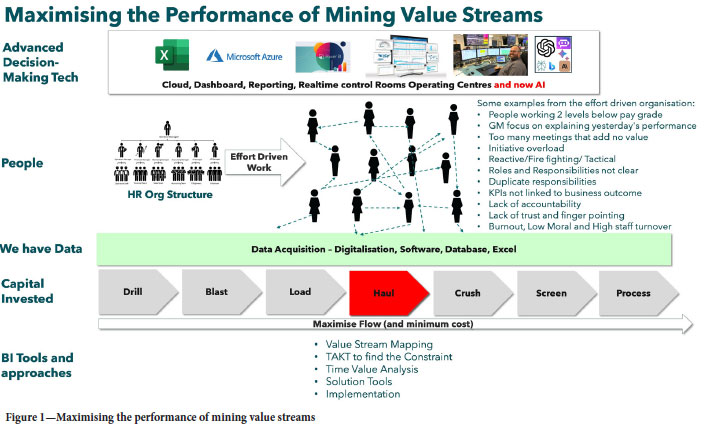
At its core, a mining operation, much like any other industry, is a value stream of interconnected activities, such as drill, blast, load, haul, crush, screen, and process. The goal is to maximise the flow of material through that value stream at the minimum cost. Despite the availability of vast amounts of data, advanced business improvement tools to identify the value stream constraint and improve performance, and sophisticated decision-making technologies, including AI, we often fail to achieve sustainable performance improvements. In fact, more real-time data can sometimes lead to increased data noise, greater indecision, and even lower performance. This is because technology alone cannot solve the fundamental challenges rooted in how people interact within the system (Figure 1).
Despite all this data, business improvement tools and sophisticated decision-making technology, we often find ourselves in what I call an "effort-driven organisation".
Common characteristics of an effort-driven organisation include:
> People working below their pay grade, where individuals across all levels of the operation are working tactically.
> General managers focusing on explaining yesterday's poor performance rather than looking forward to setting up the operation for success.
> Too many meetings that add no value, becoming a curse in all our organisations, with no clear purpose or outcomes.
> Initiative overload, where organisations pursue numerous projects and initiatives without prioritising those that address the true constraints of the system.
> A prevalent reactive/firefighting/tactical approach to managing daily operations with poor or no rigorous forward-looking planning.
> Unclear roles and responsibilities, often leading to duplication of efforts and a lack of clarity.
> Key performance indicators (KPIs) not linked to business outcomes.
> A lack of accountability management, which results in finger-pointing and obfuscation.
> Burnout, low morale, and high staff turnover.
My experience while consulting across various global industries over the past 10 years has revealed that these challenges are not unique to mining. They are identical across sectors like:
> Chocolate manufacturing: A connected set of activities where teams aim to maximise chocolate flow through the system.
> Tissue and toilet paper production: Similar interconnected activities with engineering and production efforts to maximise flow.
> High-tech equipment lifecycle management: From research and development through manufacture and support, often characterised by throwing prototypes directly into production without effective stage-gate reviews and pre-production processes.
> IT function of a multinational: Like an engineering function dealing with service requests, planned maintenance and capital project pipeline to improve capability.
While each industry demands unique technical/engineering expertise-be it metallurgical, mining, chemical, processing, or mechanical engineering-the process of managing these interconnected activities and the human challenges faced by engineers and production teams are remarkably similar. The maturity of digitisation, automation and robotics, and advanced process control does not change these fundamental people challenges; in some digital operations, they are even exacerbated by data overload.
The solution: A people-centric operating model
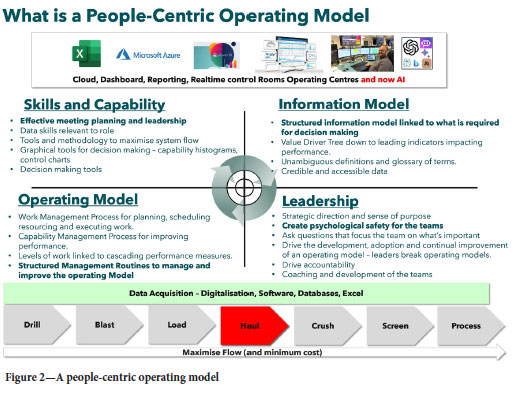
Since technology, data, and capital investment alone are not delivering sustainable value, we must recognise that people are at the heart of the system. It is people who make decisions and act on insights. Therefore, the focus must shift to building a people-centric operating model. An operating model is not just about the typical triad of people, process, and technology; it is about designing the entire organisational ecosystem so that all work is orchestrated to deliver the outcome consistently and confidently. Here are the fundamental building blocks and requirements of such a model (Figure 2):
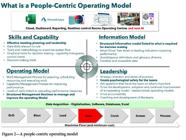
Leadership
> Strategic direction and sense of purpose: Leaders must clearly and consistently communicate the business objectives.
> Create psychological safety for the teams: This is most critical for fostering an environment where individuals can speak up, take accountability, continually learn, and perform without fear of blame. It is about clear 'rules of the game' where an individual can thrive and perform with a clear understanding of roles and responsibilities, and accountability.
> Ask questions that focus the team on what is important: Directing efforts toward the most impactful areas, such as the system's constraint.
> Drive the development, adoption, and continual improvement of an operating model: Co-creation and continual improvement of the operating model with the teams in the business drive the change management required.
> Drive accountability management.
> Coaching and development of the teams.
> Leaders in the organisation break operating models: By asking the wrong questions of teams breaks the consistent and deliberate ways of work in an operating model.
Information model
> A structured business-level information model: Linked directly to what is required for effective decision-making, owned by the business, not filled with IM jargon.
> Value driver trees: The organisation must develop a mental model of metrics and leading indicators that influence outcomes in their respective areas.
> Unambiguous definitions and a glossary of terms: Essential to prevent confusion and ensure data credibility.
> Credible and accessible data: Data easily accessible by business users and not IM only.
Skills and capability
> Effective meeting planning and leadership: This is a critical skill often overlooked and is why we all sit in many hours of meetings each week that add no value. Meetings must have a clear purpose, defined outcomes, and planned steps to achieve the outcomes.
> Data skills: Even in this digital age, with access to terabytes of data, the most basic data skills are lacking, and the ability to use data to 'tell a story' for decision-making is limited.
> System flow and impact of variability: Understanding system flow and the impact of variability is crucial, drawing from methodologies like Theory of Constraints, Lean Six Sigma, and systems thinking.
> Graphical tools for decision-making: Using tools like capability histograms and control charts, which simplify complex data and aid effective decisions, rather than basic bar or line charts.
> Decision-making tools: Employing structured tools within meetings to drive to a decision.
Operating model
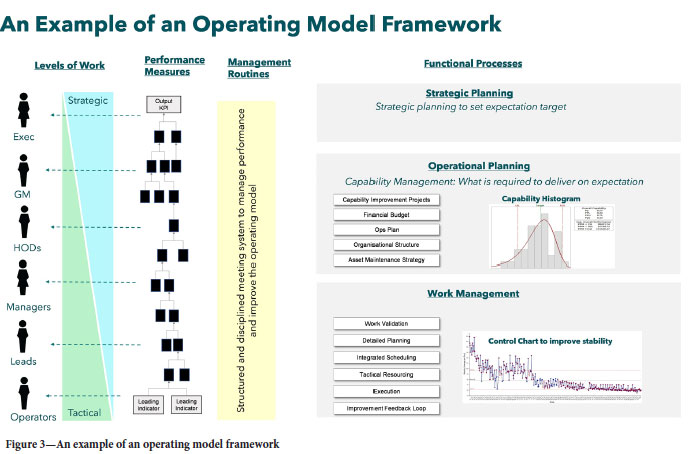
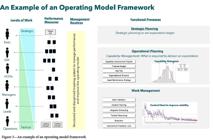
> Levels of work linked to cascading performance measures: This defines who is responsible for what, from strategic (years ahead) down to tactical (hourly achievement), with KPls and leading indicators mapped to each level.
> Structured management routines: An effectively designed meeting system is the tool for leaders to manage the system and drive continuous improvement.
> Functional processes:
- Strategic planning: An annual drumbeat and defined process for setting expectations and targets for the business.
- Operational planning (capability management): Focusing on what is required to deliver on expectations, understanding current performance versus target, and driving improvement projects using a structured BI approach and tools. This includes critical aspects like asset maintenance strategy to ensure equipment availability meets the required targets for net operating hours.
- Work management (stability management): A confident system for planning, scheduling, resourcing, and executing work with low variability and a feedback loop for improvement.
> Real-time escalation process and criteria: Clear processes for managing real-time emergent events and schedule adherence.
> Standard work procedures (SWP): Visual and easily accessible work procedures to ensure work is done consistently to the same quality, regardless of the team member.
> Tools and software: Eflective design, implementation and adoption of technology aligned to the people-centric operating model requirements and business objectives.
> Feedback loops: A structured and deliberate process for continuous improvement of the operating model and processes (Figure 3).
Does It give results? A case study
A compelling example from an international manufacturing facility demonstrates the power of a people-centric approach. A manufacturing facility had invested millions in a full manufacturing execution system (MES) implementation, digitising the shop floor to get all equipment data into a production database with Power Bl dashboards. Management had access to all dashboard metrics and held daily stand-up meetings, yet there was no improvement in total lead time (the time from when an order enters production until it leaves) over a two-year period. Sales orders that needed to be delivered in three days were taking 12 to 14 days. By adopting a people-centric approach, engaging shop floor personnel, identifying the value stream constraint, understanding the value stream capacity, and implementing a very simple work management system-including shift planning, capacity planning, simple production work order scheduling, and a performance review feedback loop-they achieved a significant improvement. Crucially, the management dashboards were rebuilt to measure leading indicators directly impactful to shop floor personnel. This resulted in average lead times dropping from 12 days to 2.8 days, a sustained improvement over a year with a simple, yet effective, people-centric work management process.
Walking our talk: Building the SAIMM operating model
The SAIMM is committed to practising what we preach. Our management team is actively building the SAIMM operating model. With numerous volunteers on our council and committees, and a secretariat handling events, membership, marketing, journal, and finance, it is vital to effectively integrate all these elements and roles, to deliver repeatable and reliable service to our members, our corporate partners, and the industry. This is not a one-year focus but will be a continuous process of improvement of our operating model as we learn and the needs of our members and industry change into the future. When issues arise, the focus shifts from ''who messed up'' to ''what in our system has resulted in this unwanted outcome,'' fostering a culture of learning.
Where to start: Reviewing your meetings
For any leader managing teams, businesses, or functions, the most impactful place to start is by reviewing all your meetings. Your meeting system is your primary management tool to effectively manage and continuously improve the performance of your operating model. The key is to:
> Define the purpose: Clearly state why the meeting is being held.
> Define the outcomes: What tangible results do you want to achieve from this meeting? This also helps determine who truly needs to attend.
> Define the results: What individual steps or items need to be covered to achieve the stated outcomes.
> Plan the approach: How will the meeting achieve its results (e.g., brainstorming, specific decision tools, presentations)?
> Incorporate ''plus delta'' feedback at the end of each meeting: This involves each participant briefly stating one positive aspect (''plus'') and one area for improvement (''delta''). This non-judgemental feedback mechanism allows both the meeting facilitator and participants to learn and improve for future meetings.
Planning an agenda effectively can take as much time as the meeting itself. This systematic approach to meetings, driving clear agendas with purpose, outcomes, results, and performance metrics, is a foundational step toward repeatable and reliable execution, supported by an appropriate technology stack and a capable workforce. This journey of continual learning and the systematic development of a people-centric operating model is how we will truly maximise the performance of our value streams in mining and beyond.
Final recommendation
To effectively transition from "effort-driven" operations to sustainable performance, organisations must prioritise the deliberate design and continuous improvement of a people-centric operating model. This model should be built upon four fundamental pillars, which are, empowering leadership to define business expectation and foster psychological safety, a structured information model that provides credible and accessible data for rigorous decision-making, robust skills and capability development (especially in data literacy, business improvement tools, and meeting effectiveness), and a clearly defined operating model framework with levels of work, cascading performance measures, structured management routines, and functional work processes with the supporting digital architecture and systems.
The most impactful starting point for any leader is to systematically review and reform the overload of existing meetings to free up leadership time through the organisation. This involves defining the purpose, desired outcomes, agenda results and approach for each meeting, and eliminating meetings that do not add value. Concurrently, invest in developing the human skills essential for optimising and managing complex value stream systems and interpreting data effectively for effective decision making, and cultivate an environment of psychological safety where teams are empowered to identify and resolve systemic issues without fear of blame. This foundational shift in how work is managed and decisions are made, rooted in a ''system-first'' rather than ''people-blaming'' mindset, will unlock sustained improvements in productivity and overall performance.
Correspondence:
G.R. Lane
Email:

Received: 31 Oct. 2024
Revised: 8 May 2025
Accepted: 21 Jul. 2025
Published: September 2025