
 Technical note: Mud rushes and water inflows in underground mines. A call to arms to save lives
Abstract
This technical note reviews the status quo of mud rushes and flooding, which have claimed the lives of many people in underground mines in South Africa and globally. Given that the causes are well known and can be managed, the note calls for the development of a national and global standard on flood and mud rush prevention in order to save lives.
Background and review
Mud rushes and flooding have claimed the lives of many people underground, yet it can be managed and prevented.
Mud rushes and water inflows have been documented since the 1800s. In 1815, Heaton Colliery in the Northeast of the United Kingdom faced an inflow that killed 75 men and boys, wiping out the villages entire male population. The inflow resulted from flooded, abandoned workings that burst into the active mine down the only shaft. Due to this disaster, mining regulations were drawn up to ensure that all mines would, from then on going forward, have an escape way. It is a truism that safety in mining advances on the graves of the fallen. Every time there is a major disaster, mine safety and regulations are improved to save lives. However, even with the application of the regulation requiring second shafts or escape ways, there have been over 86 flooding and mud rush disasters worldwide, resulting in the deaths of over 1 800 miners underground (Vutukuri, Singh, 1995; Butcher et al., 2000; Butcher et al., 2005; Morton et al., 2026; WMC, 2003).
In recent times, there have been several disasters in Southern Africa, including the Mufulira copper mine inrush in Zambia during1970, killing 89, Vaal Reefs gold mine No 5-shaft inrush in 1990, killing 21, Wesselton diamond mine Kimberley mud rush in 1992, killing 4, and now recently on 17 February 2026, the mud rush at Ekapa diamond mine Kimberley, killing 5 people. Internationally, an 800 000-tonne mud rush occurred at Freeport McMoran's copper and gold Grasberg Mine in Indonesia on 8 September 2025, killing 7. Grasberg has a history of mud rushes and collapsed ground with 28 fatalities recorded in 2013.
The Southern African Institute of Mining and Metallurgy (SAIMM) has a solid track record of reporting on mud rushes with published papers detailing methods of control (Butcher et al., 2005; Holder et al., 2013; Hilton et al., 2012; Morton, 2021), and the Safety in Mines and Research Advisory Committee (SIMRAC) booklet on methods of combating mudrushes in diamond and base metal mines by Butcher, Joughin, and Stacey (2000). Despite these publications, mud rushes are still considered inevitable, and fatalities continue to occur.
Water inflows and mud events are predictable; using modern automated monitoring methods combined with a better understanding of the role of water, risk can be mitigated (Morton, 2008; Morton et al., 2008). There is now an opportunity to create an international standard for the prevention of inflows and mud rushes.
In 2019, the Brumadinho tailings failure in Brazil, which killed 270 people, spurred international investors to create the Global Industry Standard for Tailings Management (GISTM). The GISTM was funded by the International Council on Mining and Metals (ICMM, representing major mining companies), the United Nations Environmental Programme (UNEP), and Principles for Responsible Investment (PRI), representing institutional investors. The initiative was heavily driven by the Investor Mining and Tailings Safety Initiative, led by the Church of England Pensions Board and the Swedish National Pension Funds' Council on Ethics, which brought together over 100 institutional investors with over USD25 trillion in assets under management to ensure the project was funded and implemented.
The GISTM has revolutionised the way in which Tailings Storage Facilities (TSF) are managed worldwide, has increased safety, and has enabled insurance companies to evaluate risks for each mine; thus, driving incentives to implement the standard. The Global Tailings Management Institute (GTMI) has been established in Johannesburg. It is an independent, non-profit organisation to oversee and drive the implementation of the GISTM. Its primary mission is to ensure "zero harm" to people and the environment from tailings facilities by holding mining companies accountable to the standard.
The recent Grasberg and Ekapa incidents have created a similar outcry from investors who would like to see better management of mud and water to prevent fatalities and injuries underground.
The work done in Southern Africa on combatting mud rushes and inflows can be expanded and developed using modern monitoring techniques to increase safety in mining. Early guidelines are available that can be improved on and amalgamated into a global standard (Butcher et al., 2000; Hilton et al., 2012; Morton, 2021). Figure 1 shows the anatomy of an imminent mud rush event in a kimberlite mine, which details the location of the contributing factors for a mud rush.
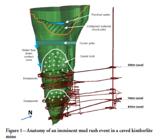
The causes of mud rushes are well known and comprise three contributing factors:
> Presence of mud-forming materials ('slippery' rock or fines).
> Head of water (phreatic surface above a specific maximum level).
>· Triggers including:
- Overdraw
- Seismic event (natural or man-made)
- Increase in head of water (natural or man-made).
Each of these can be monitored and controlled. The dominant factor (which can be controlled) is the weight of water (head) that drives a mud rush. This can be reduced by accurate management of the water drainage through a mine and monitored using a 3D distribution of pore pressure using monitoring devices that can be plotted in real time (Morton et al., 2008). Figure 2 shows the head distribution in a hypothetical mine being drained by small diameter drillholes and an improved, best practice water table, which can be achieved with a circular drainage gallery that lowers the head below the extraction level.
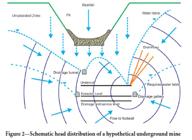
When water levels are maintained below the extraction level there is little risk of mud rush.
Structural geological mapping and modelling can be used to plot the routes that water can take to reach underground (Morton, Millsteed, 2023). Monitoring of the head distribution of water around block caves can be used to understand, and then reduce the water pressure, which drives mud rushes. The distribution of water can be managed by accurate diversion of stormwater and drainage of country rock surrounding the mining area. Flood control can be improved using satellite rainfall prediction techniques, satellite mapping, and catchment monitoring to design systems that prevent the inrush of water to underground mines.
The time is ripe to call for a global standard on flood and mud rush prevention. A similar strategy as used by the GISTM would enable the guideline to be developed very quickly and then implemented timeously to save lives and reduce risk.
References
- Butcher, R.J., Stacey, T.R., Joughin, WC. 2005. Mud rushes and methods of combating them. Journal of the Southern African Institute of Mining and Metallurgy, vol. 105, pp. 817-824.
- Butcher, R., Joughin, W., Stacey, T.R. 2000. A booklet on methods of combatting mudrushes in diamond and base metal mines. Johannesburg: Safety in Mines Research Advisory Committee (SIMRAC), 35 pp.
- Du Toit, C. 2005. Mud rush accident at Dutoitspan mine, 14 January 2005: Mining method recommendations to reduce/minimise risk of further mud rushes. Internal report. De Beers, South Africa.
- Hilton, G., Holder, A., Rogers, A.J., Bartlett, P. J., Keyter, G.J. 2012. Mudrush mitigation on Kimberley's old scraper drift block caves. In: Proceedings of the 2nd Southern Hemisphere International Rock Mechanics Symposium (SHIRMS 2012), Sun City, South Africa.
- Holder, A., Rogers, A.J., Bartlett, P.J., Keyter, G.J. 2013. Review of mud rush mitigation on Kimberley's old scraper drift block caves. Journal of the Southern African Institute of Mining and Metallurgy, 113 (July), pp.529-537.
- Morton, K.L. 2026. Summary of incidents of mud and flood fatalities in underground mines since 1815. In preparation.
- Morton, K.L., Millsteed, B.D. 2023. Structural logging and modelling for use in simulation of inflows in mines hosted in hard rock and well-indurated rock masses. In: Proceedings of the International Mine Water Association Conference, Newport, Wales, April 2023.
- Morton, K.L. 2021. Accurate diamond mine water control: A historical perspective and guidelines for modern deep underground diamond mines. In: Proceedings of the SAIMM Diamond Conference 2021.
- Morton, K.L., Muresan, M.C., Ramsden, F. 2008. Importance of pore pressure monitoring in slope stability in surface mining. In: Proceedings of the International Symposium on Slope Stability, Johannesburg: Southern African Institute of Mining and Metallurgy.
- Morton, K.L. 2008. The hydrogeology of kimberlite mines with specific reference to Finsch Mine. PhD thesis. Imperial College London.
- Vutukuri, V.S., Singh, R.N. 1995. Mine inundation: Case histories. Mine Water and the Environment, 14(Annual Issue, Paper 9), pp.107-130.
- WMC. 2003. Major hazard audit protocol: Inrushes and subsidence. SAFMHAP-09 Rev. 2, DOCS No. 57103. Australia.


