Functional Requirements for a Human Cyber-Physical System to Improve Mineworker Safety in Underground Mines
Abstract
The mining industry remains heavily reliant on mineworkers, whose working conditions are typically more arduous than in most industries. With recent technological developments in mining and other industries focusing on the digitalisation of workspaces, mineworker safety should be at the forefront of the digital transformation. Underground mines should be viewed - and developed - as human cyber-physical systems, where digital technologies are integrated with human roles to enhance safety and coordination. Contributing to this vision, this paper presents a set of functional requirements to guide the development of human cyber-physical systems that improve the safety of mineworkers in underground mines. The formulation of the functional requirements is informed by an analysis of the current context of underground mines and an exploration of opportunities for improved human-system integration within such environments. The functional requirements are related to the real underground mining context through an illustrative example, which demonstrates how a human cyber-physical system could monitor mineworker and environment states, perform predictive safety analyses, and coordinate operations. The proposed functional requirements serve as a starting point for the development of human cyber-physical systems within complex underground mining environments; however, further research (supported by real case studies) is required to refine and obtain specific target values for the functional requirements, and to formulate accompanying performance requirements.
Mining; safety; human cyber-physical systems; human-system integration
Introduction
The mining industry remains important globally, especially in South Africa. Mining in South Africa is the historic bedrock of the economy as it contributes over R300 billion to South Africa's GDP (Goodman et al., 2019). According to the Statista Research Department, in 2021, a total of 458 954 people were employed by the South African mining industry (Statista Research Department, 2023). It is thus evident that human workers in mines are still essential for the industry and, as such, improving the health and safety of mineworkers should be a priority.
Underground mines are complex systems, with many interconnected systems that work together with human workers to extract minerals from the earth. Mining systems are being transformed through an increased adoption of automation and digitalisation technologies, e.g., internet of things (IoT), artificial intelligence, and cloud computing, as driven by the fourth industrial revolution (or Industry 4.0 (I4.0). While these technologies promise benefits regarding the productivity and profitability of mines, they also offer opportunities to improve the safety of mineworkers.
The increased adoption of digital technologies in mining is transforming mines into cyber-physical systems (CPS) - physical systems that are controlled and monitored digitally using computer algorithms (Yilma et al., 2021). More specifically, considering the involvement of human workers in mining operations, underground mines should be viewed, and developed, as human cyber-physical systems (HCPS).
HCPSs aim to integrate both human and non-human elements of the physical system with digital systems. As such, humans can contribute to, and benefit from, the data and intelligence that are encapsulated by the digital system. In an underground mining context, HCPSs can provide advanced monitoring and coordination functions for mining operations. For mineworkers, these HCPS functions can offer greater and more personalised situational awareness, and support both reactive and proactive decision making (Kruger et al., 2023).
However, there are barriers to developing HCPSs and realising these promised benefits. As an emerging technology, the definition and scope of the functionality of HCPSs are still broad and vague. As such, even with the increased digitalisation of mines serving as the foundation upon which HCPSs can be developed, it may be difficult for mines to specify a clear starting point and plan for the development of an HCPS within their specific context. Further, the development of an HCPS that maintains digital representations of workers, offering personalised data and functions related to their real-time state and unique attributes, requires the integration of diverse interfaces, data streams, models, and software services.
To guide the development of human cyber-physical systems (HCPS) in underground mining environments, this paper presents a structured set of functional requirements, specifically aimed at enhancing mineworker safety. The primary objective is to define how an HCPS can support real-time monitoring, predictive analysis, and coordinated response to safety risks by integrating data from environmental and personal sensors. The methodology involves a detailed analysis of the roles and tasks of underground mineworkers, combined with the identification of opportunities for advanced human-system integration (HSI) in these environments. A novel contribution of this work is the formulation of functional requirements that are both context-aware and technology-agnostic, enabling their application across a range of underground mining scenarios. These requirements are further grounded through an illustrative example that demonstrates how an HCPS can be operationalised to monitor worker exposure, predict hazardous conditions, and coordinate safety interventions in a realistic mining context.
This paper first presents a brief overview of the related work on the topics of HSI, HCPSs and human-centric mining technology in Section 2. Thereafter, Section 3 provides an overview of the current roles of human workers and the technology used in underground mines, and Section 4 identifies opportunities for HSI in an underground mine. The formulated functional requirements for an HCPS that improves mineworker safety in underground mines are presented in Section 5, followed by a discussion of the implications, limitations, and the way forward in Section 6. The paper concludes with a summary of the key findings and recommendations for future work in Section 7.
Related work
Human-system integration
Dimensions of human-system Integration
As humans continue to play important roles in various complex industrial processes, the way they are integrated with operations and their environment can greatly affect their function. Sparrow et al. (2022) argue that when complex processes have ineffective human integration, the communication channels and logistic structures between humans and other physical entities will not match the requirements of effective I4.0 applications.
The field of HSI considers the broad and diverse integration of humans and systems. However, most relevant to the context of this paper is the aspect of HSI that focusses on the integration of humans with operational, technological systems, which leads to hardware and software developments that enhance operational activities of HCPSs (Defty, 2022).
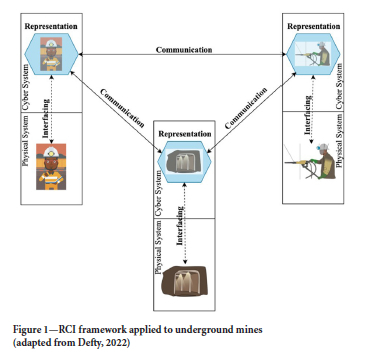
Defty (2022) developed the representation, communication, and interfacing (RCI) framework that aims to guide the design of systems that improve the integration of human operators with the surrounding interfacing technology (Defty, 2022). The RCI framework aims to capture both human and machine characteristics and can thus be used in the design of more effective HCPSs that support improved decision-making and productivity. Figure 1, adapted from Defty (2022), visualises the application of the RCI framework to the underground mining context.
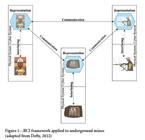
Representation, in the context of HCPSs, refers to establishing and maintaining a distinct presence in the cyber system for each entity present in the physical system. Communication refers to the exchange of data/information in the cyber system between the various representations associated with the entities in the physical system. The interfacing dimension of the framework considers the exchange of data between the entities in the physical system and their associated representations in the cyber system.
Ambient intelligence environments
In an ambient intelligence environment (AmIE), intelligent interfaces exist between the physical and cyber layers as supported by computing and embedded networking technology (Sparrow et al., 2021). There are two types of interfaces that can be utilised in an AmIE. The first type of interface is the personal interface. These are interfaces that belong to and are situated on a specific human. Personal interfaces can be customised and optimised to fit the specific user and could be directly accessible by the user's digital representation (Sparrow et al., 2021). The other type of interface is the environmental interface. These interfaces do not belong to a specific human being monitored and gather data from a specific environment instead.
Sparrow et al. (2021) highlight the importance of considering how information is displayed to humans in an AmIE. Interfaces can perform semiotic services - communicating information through different types of signs and symbols. Interfaces can also perform observation services, which capture information that supports the digital representation of human or environment state in near real-time.
The interfaces and services of an AmIE can be leveraged by an HCPS to mirror the state of the physical system/environment in the cyber layer, analyse and interpret the state information and, in turn, affect the operations or conditions of the physical system.
Human-cyber physical systems
Definition
CPSs, through the coupling of physical and digital systems, is a key enabler for I4.0 systems. Such systems can be developed to display intelligent behaviour, such as self-sensing, self-diagnosis, and connectedness (Sparrow et al., 2022). Most CPSs have humans performing operations and adding to the functionality of the system, leading to HCPSs.
HCPSs consider the holistic integration of humans in systems and are engineered to improve the ability of humans to interact with systems in the cyber and physical layers, while improving human physical, sensory, and cognitive capabilities within the system (Fantini et al., 2020). Humans are thus sensors, decision-makers, and actors at the same time, which provides a new layer to the typical CPS model.
Human properties considered in human cyber-physical systems
Human-centred design, in the context of Industry 4.0, is important when considering sustainable development (Pacaux-Lemoine et al., 2017). When looking at the human aspect in a systems context, human behaviour must be considered. Humans are independent and autonomous, which make them flexible. Compared to a non-human entity, such as a computer or controller, a human is much more adaptive due to their intelligence and the use of all their senses.
The specific function humans perform depends on the domain and system goal that they work for (Cimini et al., 2020). Humans perform various functions, including data acquisition using their senses and cognitive abilities. They also have the ability to interpret the system's properties and behaviours, which allows them to evaluate the system's characteristics and make decisions that can influence its behaviour.
Human operators in industry 4.0
The human-in-the-Loop (HITL) control model aims to supervise human operator performance during human-machine interaction (Munir et al., 2013). Pacaux-Lemoine et al. (2017) found that, in their specific case, the manufacturing system performed better when the human is in the loop and can cooperate. Adaptive automation is a concept that aims at optimising human-machine cooperation, which effectively allocates labour between humans and automated resources (Romero et al., 2020).
Romero et al. (2020) developed the Operator 4.0 model. The authors show how Operator 4.0 defines workers in I4.0 and compare these operators to operators in the 1st to 3rd industrial revolutions. Operator 4.0 brought rise to other concepts such as Miner 4.0 and Mariner 4.0. Taylor et al. (2023) explored potential solutions to facilitate human-machine interfaces in an I4.0 environment such as Maritime 4.0, and augment human ability by developing a human digital twin (HDT) (Taylor et al., 2023).
The human digital twin concept
A digital twin (DT) is a digital representation of a physical entity, aiming to mirror the real-world entity (Grieves, Vickers, 2016). An HDT is then a concept used to address the increased need for digitising human operators in I4.0 environments (Sparrow et al., 2019). To enable the development of an HDT, Sparrow et al. (2022) created a digital administration shell to provide humans with a digital presence. This digital administration shell enables humans to take part in communication with other digital entities with the same precision and speed as those digital entities can (Sparrow et al., 2021). The design of the digital administration shell is based on the biography-attributes-schedule-execution (BASE) architecture, which facilitates the interfacing, data processing, and connectivity of the digital administration shell to other I4.0 components (Sparrow et al., 2021).
Shengli (2021) outlined the differences between a DT and an HDT with challenges in developing an HDT lying in the complexity of a human being (Shengli, 2021). Balaji et al. (2023) developed an HDT that simulates a control operator's behaviour, even in abnormal situations. Wang et al. (2022) investigated HDT-driven HCPS to shift from a technology-driven approach to a more human-centred approach, which resulted in systems where humans and physical systems can share capabilities and intelligence.
Human-centric mining technology
I4.0 has brought about many applications of new technology and sensors in the equipment used in mining operations, with some applications focusing on and being applied to mineworkers. Singh et al. (2022) developed an IoT-enabled helmet, which improves the health and safety monitor. Ananth et al. (2022) developed a smart jacket, which monitors the miner's pulse rate, position, and the ambient temperature of their environment. Baek and Choi (2019) developed a low-cost proximity warning system for mineworkers using smartphones and beacons.
In the context of the mining industry's increasing digitisation, novel software technologies have emerged as the driving force behind technological advancements. Software systems often do not have the same limitations in the configuration of physical systems, with software argued to be infinitely modifiable (Lööw, 2022). Lööw (2022) states that technology interventions in mining should have larger scopes, as opposed to focusing on singular and isolated actions, in order to address a multitude of issues.
To achieve digital transformation in the mining sector, digital systems and technology must be effectively integrated with people (Ulewicz et al., 2022). In the context of I4.0, the modern mine would be an HCPS. Lööw et al. (2019) introduced the concept Mining 4.0, which is an I4.0 vision of mining with mineworkers based on Operator 4.0, called Miner 4.0. Mining 4.0 envisions an augmented miner that has their senses and memory extended using various technological devices. Mining 4.0 describes the benefits of using augmentations on workers, which include improved productivity and safety, reduced physical strain and enhancement of skills.
Kruger et al. (2023) presented an integration platform for smart, integrated mining. The paper addresses the challenges of data integration of systems with humans and non-human resources and operations involved in underground mining. The platform was designed using a holonic systems approach and the BASE architecture for digital administration shells. The platform is composed of many autonomous and cooperative entities that represent the physical resources and processes present in an underground mining context (Kruger et al., 2023).
Underground mining context
This section explores the activities of mineworkers in underground mines, delving into the safety issues they face and the measures in place to boost productivity. Insights from an interview with a miner from a South African underground mine shed light on exposure standards and the technology currently utilised in underground mines. Additionally, the section explores various other technologies employed within the industry and discusses the pace at which these technologies are being adopted across the mining sector.
Factors affecting the safety of underground mineworkers
Underground mineworker tasks
Mineworkers perform various tasks in a mine. The nature of these tasks can vary based on the type of rock mined, or the method used by the mine. Each worker in an underground mine has general tasks that they will perform regardless of the method used or the type of rock mined. These tasks include digging or breaking up ore, driving equipment and machinery, transporting ore, and building supports to prevent the tunnels from caving in. To improve the general safety of underground mineworkers, the factors that influence their safety in performing these tasks should be considered.
Risks for mineworkers in underground mines
There are various factors in an underground mine that affect mineworker safety:
> Dust and dangerous gas inhalation. Mineworkers tend to develop diseases or lung cancer due to gas inhalation. It is believed that even 20 years after a mineworker was exposed to this dust, they can still contract lung disease (Maseko, 2021).
> Exposure to noise. Over-exposure to excessive noise can lead to tinnitus, concentration problems, or hearing loss (Mining Review Africa, 2020).
> Exposure to whole-body vibration. Workers may be exposed to whole-body vibration during their operation of heavy machinery (Mining Review Africa, 2020).
> Falls, trips, and injuries due to heavy lifting (Mining Review Africa, 2020).
> Thermal stress. Thermal stress is also a safety risk due to the hot and humid conditions that the workers work in, while chemical hazards are a factor due to mineworkers being exposed to harmful chemicals and gases (Mining Review Africa, 2020).
An interview with a miner from a South African underground mine described the health and safety measures that exist in the mine that they work in. Some workers carry gas detection instruments (GDI ), which measure carbon monoxide and methane levels. The levels of these gasses, as well as the airflow measurement, are compared against predefined thresholds. Temperature and humidity are also monitored in underground mine environments.
When the ambient conditions exceed the predefined thresholds, the workplace is considered "not conducive" for mineworkers to work. However, the miner indicated that due to performance requirements, mineworkers often continue working despite the workplace not being conducive. Prolonged exposure to non-conducive conditions is a safety concern; however, this must also be analysed on an individual basis. This is because mineworkers have different levels of fitness and health. For example, some may be on chronic medication, which could make them more likely to collapse due to heat conditions.
Technology in underground mining
The rate of technological changes and improvements tends to be slower in the mining industry compared to other industries, due to high capital costs, long lifespans of equipment, and the cost of upgrading equipment (Bartos, 2007). Development is also slow due to the unique environmental challenges in mining (Lööw, 2022). Furthermore, it is critical for mining technology to consider the operator in its design. Without consideration of the operator and their use of the technology, the technology will likely not be used as intended and the gains in safety or productivity that a technology may promise may be lost.
The technology currently used in underground mines focuses on automation, collision avoidance, using sensor data to mitigate hazards, as well as improving communication throughout the mine. Where I4.0 technology has been used to improve the business and sustainability of the mine, the general focus has been on machine and equipment monitoring, in order to improve efficiency (Sishi, Telukdarie, 2020). However, there has been less focus on such monitoring for human workers using I4.0 technology, which could improve safety, productivity, and worker satisfaction.
In the interview with the miner, it was stated that currently the instruments, such as the GDI and temperature sensors used, are often disconnected from the wider digital system. This means the data is not automatically transmitted to the control room. Instead, the miner has a declaration book where values and readings are manually recorded. There is also typically little or no data flow between processes, such as blasting or drilling. Moreover, the acquired sensor readings and worker data is typically analysed on a managerial level instead of an operational level. The mineworker stated that in order to use this sensor data to improve safety, analysis needs to occur in near real-time and at an operational level.
Opportunities for improved human-system integration in underground mines
It is expected that the integration of mineworkers with the environment and technology in underground mines can provide benefits to the industry and the workers themselves. It is thus important to explore opportunities for achieving improved HSI in an underground mine. This exploration is guided by the RCI framework, which aims to support an effective and holistic integration of the human element in an HCPS. This section thus identifies the opportunities that arise for improved HSI in each dimension of the RCI framework.
Representation
At an implementation level, the representation of a mineworker in an HCPS can be achieved by creating a dedicated software process, or set of processes, in the cyber system that acts on data and information that are associated with that specific mineworker. These processes can then execute specific tasks and functions, in an automated and highly personalised manner, on behalf of the represented mineworker. Examples of these tasks or functions may include:
> Gathering data pertaining to the state or surrounding environment of a mineworker from data sources accessible in the cyber layer, e.g., the ambient temperature in the specific underground mine tunnel that the mineworker is working in.
> Monitoring the state or activity of a mineworker and reacting to detected events or conditions, e.g., sending an alert to the control room if the data from a mineworkers wearable heart rate monitor indicates that they are in distress.
> Performing analyses on the mineworker's data gathered over time, as triggered by specific events or time periods, e.g., performing a "fit for work" analysis prior to starting a new shift using the data on the exposure of the mineworker during their previous shift(s).
The tasks or functions listed in the aforementioned can be executed in a manner that is personalised to every individual mineworker. The representation of a mineworker can capture the attributes (e.g., age, medical conditions, etc.) and state (e.g., current activity, time since last break, etc.) specific to the individual. Instead of generalised models, thresholds, and policies, this personalisation would result in tasks, thresholds, and actions that are tailored to individuals. Furthermore, as the representation of a mineworker is maintained over time, the attributes of the mineworker can be updated through the analysis of gathered information. As such, the representation of mineworkers can evolve over time to remain accurate and reliable.
Communication
Communication, within the RCI framework, refers to the exchange of data or information in the cyber layer between the representations of physical entities. Since these representations are implemented by means of one or more software processes, communication can be achieved through the passing of data between these processes - typically by means of a messaging or data sharing mechanism. This exchange of data in the cyber layer poses several opportunities for improved HSI in the underground mine context.
Firstly, the mechanism to exchange data in the cyber layer allows for the enrichment of the representations maintained within this layer. The representation of a mineworker can proactively obtain data on the state of the mineworker (e.g., the temperature of the mine tunnel that the worker is currently working in) from the representations of the physical entities (e.g., sensors or the heating, ventilation and air conditioning (HVAC) system) that capture such data. As such, the tasks or functions delegated to the representations, as discussed in the aforementioned , can be performed with rich data obtained in near real-time.
The communication of data and information between representations is also a key enabler for the coordination of resources, since data pertaining to resource status, future availability, and capability can be shared. This exchange of data is thus needed for the planning and scheduling of future operations but is also essential to achieve the synchronisation of processes and resources during operation in near real-time. Since underground mining often entails integrated processes that employ different resources, as reflected in the blasting process described by Kruger et al. (2023), this coordination function is central to a mine's core operations.
Finally, when the mechanism for communication between representations in the cyber layer also supports discoverability, further opportunities arise. Discoverability, in this context, refers to the ability of the software system to allow representations to be discovered by others. Typically, this is achieved through a service directory or "yellow pages" mechanism, where all the representations in the cyber layer register their details (e.g., address or endpoint for receiving messages), the type of representation (e.g., mineworker or vehicle), and specific attributes or capabilities, etc. This directory can be searched by representations to discover other representations that can be communicated with. Discoverability, in the sense explained here, can allow for dynamic interactions within the cyber layer that may improve the resilience of the system - e.g., if the sensor that usually provides the temperature data to a mineworker representation fails, the data can be obtained from the representation of the HVAC system that also captures this temperature data.
Interfacing
The Interfacing dimension of the framework refers to the exchange of data between the physical entities and their associated cyber representations. This exchange of information is essential to ensure that the cyber layer can maintain accurate and updated representations of the entities in the physical layer. Opportunities for improving HSI in underground mining arise through the exploration of this Interfacing dimension - especially with regard to safety.
The exchange of data between the physical and cyber layers can be enriched using multi-modal technologies, i.e., technologies that generate or interpret different types of signals (e.g., text, audio, video, etc.). In the context of cyber-physical interaction, these technologies can be observation or semiotic technologies, or both.
Observation technologies capture information from the physical layer and provide this information to the cyber layer. These technologies employ sensors to capture information, e.g., accelerometers, cameras, or text input from a graphical user interface. Semiotic technologies produce and communicate information, through different types of signs and signals, from the cyber layer to the physical layer, e.g., warning lights, alarm sirens, or text on a graphical user interface.
These observation and semiotic technologies can be deployed either as environmental or personal technologies. As environmental technologies, the observation and semiotic technologies serve a specific environment, e.g., sensors installed in a mine tunnel - providing information to/from all entities present in that environment. In contrast, as personal technologies, these technologies are dedicated to a specific entity like a mineworker, e.g., wearable sensors.
Observation technologies, in both environmental and personal deployments, are essential to maintaining accurate, enriched and updated representations in the cyber layer, which in turn are prerequisites for effective monitoring, decision making and proactive/reactive functions. Semiotic technologies enable the representations in the cyber layer to affect their associated physical entities.
As an example, observation technologies may provide information on a mineworker's location and the gas level measurements in a mine tunnel. As these data streams are gathered, integrated, and monitored by the mineworker's representation, a safety risk to the mineworker is detected. Through semiotic technologies, the mineworker's representation can then alert the mineworker by triggering an alarm and flashing warning lights in the mine tunnel.
Integration with other information systems
To effectively exploit the opportunities for improved HSI in underground mines, the integration with existing information systems that could provide information for, or consume information from, the processes in the cyber layer of an HCPS should be considered. A mining enterprise will typically have several information systems that track and control the complex operations of the mine.
A common example of such an information system is an enterprise resource planning (ERP) system, which processes information and supports various business functions pertaining to resources and operations. However, ERP systems often do not effectively serve the management of shift supervisors and frontline workers (Xue, 2014), which presents a limitation that can be addressed through the implementation and integration of an HCPS.
Functional Requirements
Methodology
Through an analysis of the underground mining context and the opportunities for improved HSI in underground mine environments, a set of functional requirements is formulated to guide the development of an HCPS aimed at improving the safety of mineworkers. Using the definition of the systems engineering body of knowledge (SEBoK), a requirement is a "statement that identifies a process, operational, functional, or design characteristic or constraint that is unambiguous, testable or measurable for process acceptability" (SEBoK Editorial Board, 2024). Each system requirement leads to a set of technology-independent functions, which the system must perform.
The proposed overarching function of an HCPS for improving mineworker safety is to maintain accurate digital representations of mineworkers, which gather, integrate, monitor, and analyse data pertaining to individual workers and interact with the digital representations of other entities within the system. Within this scope, a set of functional requirements (FR) is formulated. The FRs aim to define the functionality of the HCPS, specifying the behaviours and actions that the HCPS must perform to meet its purpose.
Functional requirements
FR1. The HCPS is required to acquire data from diverse sources.
The HCPS is required to acquire data on, and from, human workers and physical components in the mine. The HCPS must thus obtain data from diverse data sources in the mine, including information systems, sensors, and user interfaces.
FR2. The HCPS must relate data to worker tasks and roles.
Once the data is acquired from different data sources, the HCPS must integrate the data by selecting the appropriate data for each worker based on the required task or event. This integration of data is necessary to support effective monitoring and analysis of mineworker tasks.
FR3. The HCPS must monitor various aspects of mineworkers and their environment. The HCPS is required to monitor the location of each worker across the underground, as well as the worker's exposure, e.g., harmful gases, dust, noise, heat stress, vibrations, and workload. By monitoring these metrics and the location of mineworkers, the exceedance of thresholds can be detected in near real-time, mineworkers can be alerted, and corrective measures can be applied to ensure mineworker safety.
FR4. The HCPS must record the state of the workers and the work environment. In order to maintain accurate and updated representations of the workers and work environment, the HCPS must acquire and integrate data on the current state of the workers and the environment in near real-time. The HCPS must also record this state data to support analysis of past states, actions, and events. As such, this FR also necessitates the storage of data on workers and the environment.
FR5. The HCPS must model the future state of workers.
The HCPS is required to model the potential future state of the workers and work environment, which enables the prediction of potentially dangerous situations in the future. This predictive capability supports the proactive coordination of workers and can be achieved through advanced analytics and modelling techniques that integrate data from various sensors, historical records, and domain knowledge.
FR6. The HCPS is required to perform analyses of the data.
The data that are gathered and integrated must be analysed within the HCPS. These analyses can be fully automatic, meaning the analyses are performed without external input, or done with external or manual input. The analyses should be framed around the safety of mineworkers, such that the analysis of past activity or event data can be used to inform decisions regarding mineworker safety in the future.
FR7. The HCPS must facilitate the flow of data between internal entities of the HCPS and external information systems. To effectively fulfil the functions of data acquisition, data integration, and coordination, the HCPS must support the bi-directional exchange of data among internal HCPS elements and between the internal HCPS elements and external information systems.
FR8. The HCPS should display user-specific and context-specific information. The HCPS should be able to display information to mineworkers, who are the primary users of the system, as well as control room operators and other stakeholders. The information, to be displayed on user interfaces, should be organised according to the specific user viewing the information and the context in which they are viewing the information.
FR9. The HCPS should be able to support the coordination of the operations of mineworkers and physical entities. Through the exchange of information with user interfaces and automation control systems, the HCPS should be able to coordinate the operations of human and non-human entities present in the physical layer of the underground mine.
Illustrative example
Context
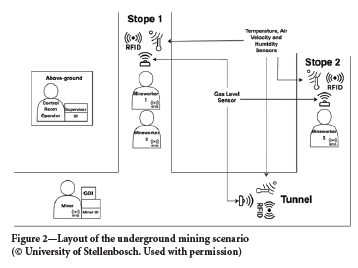
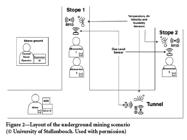
To illustrate the application of an HCPS in underground mining, we consider a representative scenario based on the Smart Integrated Mining Laboratory (SIMLAB) at Stellenbosch University. This environment replicates a typical underground mine layout, including a main tunnel and two stope tunnels. The physical system includes:
> Mineworkers: Individuals performing physically demanding tasks such as drilling, blasting, and loading.
> A miner: A supervisory figure responsible for coordinating operations and monitoring safety. The miner is also equipped with a handheld GDI to take frequent measurements of air quality and a rugged tablet device to view and input data.
> A control room operator: A supervisory figure responsible for monitoring underground activity via a UI in the above-ground control room.
> Sensors: Devices installed in tunnels and stopes to measure temperature, humidity, air velocity, and gas concentrations.
> RFID readers: Positioned at tunnel entrances to track worker movement.
> WiFi routers: Enable communication between underground devices and the HCPS.
For this example, the HCPS is conceptualised as a single, integrated cyber system that interfaces with all physical components and human actors. The HCPS collects and processes data in near real-time, performs predictive and retrospective analyses, and facilitates coordination and communication across the mine. The system is designed to improve safety, situational awareness, and operational efficiency. Figure 2 shows a schematic of the illustrative example.
Human cyber-physical system functions
The HCPS in this scenario is designed to satisfy the functional requirements formulated and discussed in the aforementioned. The section that follows here, describes how the HCPS would perform each of the required functions within the illustrative example.
FR1: Acquire data from diverse sources
The HCPS integrates data from multiple sources, including:
> Environmental sensors (temperature, humidity, gas levels).
> Personal devices (e.g., tablet used by the miner).
> RFID systems (for location tracking).
> Manual inputs from miner and control room operators.
This multi-source integration ensures a comprehensive
understanding of the operational context.
FR2: Relate data to worker tasks and roles
Each worker is associated with a digital representation that includes their role, current task, and location. The HCPS maps incoming data to these representations, enabling task- and worker-specific monitoring. For example, a worker performing a drilling operation in a high-temperature zone could be monitored differently than one performing inspections in a well-ventilated tunnel.
FR3: Monitor various aspects of mineworkers and their environment
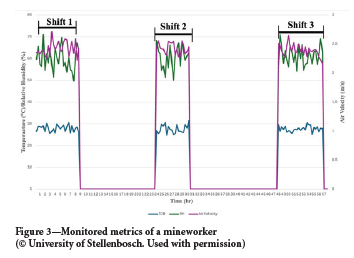
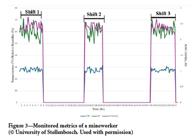
The system tracks each worker's location and exposure to environmental hazards. If thresholds are exceeded (e.g., high CO levels or excessive heat), the HCPS triggers alerts and recommends corrective actions, such as evacuation or task reassignment. Figure 3 presents an example of a mineworker's exposure data over three work shifts, as acquired and monitored by the HCPS in near real-time to assess the mineworker's safety.
FR4: Record the state of workers and the work environment
The HCPS continuously acquires data from environmental sensors (i.e., temperature, humidity, air velocity, and gas concentration level data) and RFID readers (i.e., identification and location data) to monitor the real-time state of the mine and its workers. This data is stored in a structured database, enabling both immediate decision-making and retrospective analysis of past events and conditions.
FR5: Model the future state of workers
Using historical data, real-time sensor data, and predictive models (e.g., for heat stress and harmful gas exposure), the HCPS forecasts potential safety risks. For instance, if a prediction indicates that a worker will exceed safe exposure limits within the next hour, the system can proactively adjust the environment (e.g., increase air flow in the tunnel) or reassign the worker's tasks and initiate evacuation procedures for the worker.
FR6: Perform analyses of the data
The HCPS executes automated analyses to assess safety risks. These include:
> Calculating wet-bulb globe temperature for heat stress (Anderson, De Souza, 2017).
> Computing a compressive scale index for harmful gas exposure (Li et al., 2023).
> Evaluating cumulative exposure over a shift.
The results from these analyses inform decisions about worker shift allocations and safety interventions.
FR7: Facilitate the flow of data between internal and external systems
The HCPS supports bi-directional data exchange with external platforms such as ERP systems and control room dashboards. Internally, the HCPS ensures seamless communication between its data acquisition, analysis, and coordination modules.
FR8: Display user-specific and context-specific information
User interfaces are tailored to different stakeholders:
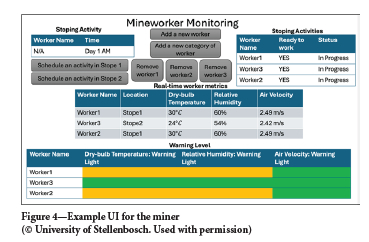
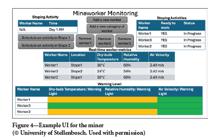
> Miners view dashboards showing worker status, environmental conditions, and safety metrics; this is shown in Figure 4.
> Control room operators access aggregated data for strategic oversight.
FR9: Support the coordination of operations
The HCPS coordinates both human and automated operations. For example, in the event of a gas leak in an underground tunnel, the HCPS:
> Detects the increase in gas levels through the acquisition and monitoring of data from the sensors in the tunnels.
> Notifies the affected miners by means of an alert displayed on their UI.
> Sends instructions to the miners to coordinate the evacuation process (e.g., specifying the sequence by which different environments should be evacuated based on the proximity to the gas leak).
> Notifies the HVAC system to increase ventilation in the affected environments.
> Confirms safe re-entry conditions before instructing miners that it is safe for their teams to return to work.
Discussion
The functional requirements formulated in the aforementioned aim to guide the development of an HCPS to improve the safety of mineworkers in underground mines. Specifically, the requirements outline the functionality of the software system to be developed as the cyber layer of the HCPS, which is necessary to unlock the promising capabilities of the technology in underground mining.
The illustrative example introduced in this paper demonstrates how these functional requirements can be realised in a realistic underground mining scenario. The example shows how the HCPS can acquire and integrate data from environmental sensors and RFID systems (FR1), monitor worker location and exposure to hazards such as heat and harmful gases (FR3), and perform automated analyses to assess safety risks (FR6). It also illustrates the HCPS's ability to model future worker states (FR5), enabling proactive coordination and decision-making.
The functional requirements flow from a consideration of the three dimensions of the RCI framework. FRs 2, 3, 4, 5, and 6 are essential for creating and maintaining representations of mineworkers (and other physical entities), which serve as the key mechanism for implementing the automated and personalised functions of the HCPS. These functions are exemplified in the illustrative example, where the HCPS maintains real-time and historical data on worker exposure and readiness, and uses predictive models to assess future safety risks.
FR 7 points to the essential capability of the HCPS to facilitate the exchange of data and information between the physical entities and their cyber counterparts. This was demonstrated in the example through the bi-directional communication between the HCPS and user interfaces, enabling miners and mineworkers to receive alerts and status updates in real time.
FRs 8 and 9 reflect functions of the HCPS that are realised at the union of the three dimensions of the RCI framework. Only through the implementation of mechanisms that serve each of the RCI dimensions can user-specific and context-specific information be provided and the operations of physical entities be coordinated effectively. The illustrative example highlights these capabilities, showing how the HCPS coordinates mineworker activities and emergency responses, and displays tailored information to different users based on their roles and context.
Each FR is also tailored to the specific nature of underground mines. The functions to be performed by an HCPS to ensure mineworker safety are derived from a consideration of the typical tasks that mineworkers perform and the safety risks that they face. Furthermore, the increased adoption of technology in underground mining has, and will continue to lead to more and diverse data sources - the proposed FRs aim to leverage these data sources to improve mineworker safety and general situational awareness.
The FRs are thus proposed as a starting point for executives, managers, and engineers in the mining sector to develop implementation strategies for unlocking the benefits of the HCPSs in terms of mineworker safety. As such, the FRs are posed in a sufficiently generalised form such that they can be translated into the specific digital and production contexts of different underground mines. It should be noted that this work represents one of the first attempts at formulating requirements to guide the deployment of HCPSs, an emerging technology, within the complex and sensitive underground mining context. As such, the shortcomings of the presented work must also be acknowledged.
Firstly, since the FRs are generalised, they are not accompanied by specific target values. As such, the FRs would require further refinement and specification to a given application context before they could be used to effectively inform system design and technology selection decisions. Secondly, as the name indicates, the FRs only aim to specify what the HCPS should do and do not provide guidance on how or how well it should perform these functions. The formulation of non-functional or performance requirements will be necessary for the evaluation of system design and technology alternatives.
Both the contributions and shortcomings of the paper point to opportunities that should be explored in future work on the topic. Case studies for the development and deployment of HCPSs for mineworker safety in underground mines should be performed, where the proposed set of FRs could serve as the starting point. Through the detailed design and selection of technology for the HCPS in the specific case study context, the FRs can be further refined, and non-functional requirements can be identified. Such case studies will also demonstrate the benefits of HCPS deployment in real operational environments, as well as explore the mechanisms and challenges for integrating with existing physical and information systems in underground mines.
As a starting point, future work should aim to build on the recent research and development supported by the South African mining sector. Supported by the Real-Time Information Management Systems programme of the Mandela Mining Precinct, Kruger et al. (2023) developed an integration platform that can enable the development of HCPSs in underground mines. This platform applied principles of holonic systems (Koestler, 1967) to manage complexity in its design and utilised the BASE architecture (Sparrow et al., 2022) in its implementation.
Conclusion
With the increasing adoption of digital technology and the key role that human workers continue to perform in mining operations, underground mines should be viewed, and developed, as HCPSs. Specifically, the development of HCPSs promises significant improvements in the safety of mineworkers in underground mines. As a starting point for this development, this paper formulates a set of FRs for HCPSs to improve the safety of mineworkers.
The formulation of the FRs is informed by the analysis of the underground mining context and the exploration of opportunities for improved HSI in underground mine environments. The analysis of the underground mining context focused on the tasks typically performed by mineworkers, the safety risks that mineworkers are exposed to, and adopted and emerging technology. The opportunities for improved HSI in underground mines are explored according to the three dimensions of the RCI framework.
The functional requirements proposed in this paper provide a starting point for developing implementation strategies for HCPSs in underground mines. Future work should focus on the development of relevant case studies, which would serve to refine the FRs, inform the formulation of non-functional requirements, and demonstrate the benefits of HCPSs for mineworker safety in underground mines.
Credit author statement
SF: Conceptualisation, methodology, writing - original draft preparation, investigation, and visualisation.
KK: Supervision, writing - reviewing and editing, funding, and project administration.
NCT: Supervision, writing - reviewing and editing.
AHB: Supervision, writing - reviewing and editing.
Acknowledgements
This research is supported by the Real Time Information Management Systems programme of the Mandela Mining Precinct.
References
- Ananth, C., Revathi, B.S., Poonguzhali, I., Anitha, A., Ananth Kumar, T. 2022. Wearable Smart Jacket for Coal Miners Using IoT, in Proceedings of International Conference on Technological Advancements in Computational Sciences, ICTACS 2022, Institute of Electrical and Electronics Engineers Inc. pp. 669-672. DOI: 10.1109/ICTACS56270.2022.9987834.
-
Anderson, R., De Souza, E. 2017. Heat stress management in underground mines. International Journal of Mining Science and Technology. vol. 27, no. 4, pp. 651-655. DOI: 10.1016/j. ijmst.2017.05.020.
» https://doi.org/10.1016/j. ijmst.2017.05.020 - Baek, J., Choi, Y. 2019. Development of a low-cost Proximity Warning System for mine equipment using smartphone and bluetooth beacons, in Mining Goes Digital, London: CRC Press. pp. 715-719. DOI: 10.1201/9780429320774-84
-
Balaji, B., Shahab, M.A., Srinivasan, B., Srinivasan, R. 2023. ACT-R based human digital twin to enhance operators' performance in process industries. Frontiers in Human Neuroscience. 17. DOI: 10.3389/fnhum.2023.1038060
» https://doi.org/10.3389/fnhum.2023.1038060 -
Bartos, P.J. 2007. Is mining a high-tech industry?: Investigations into innovation and productivity advance. Resources Policy. vol. 32, no. 4, pp.149-158. DOI: 10.1016/J.RESOURPOL.2007.07.001
» https://doi.org/10.1016/J.RESOURPOL.2007.07.001 -
Cimini, C., Pirola, F., Pinto, R., Cavalieri, S. 2020. A human-in-the-loop manufacturing control architecture for the next generation of production systems. Journal of Manufacturing Systems. vol. 54, pp. 258-271. DOI: 10.1016/j.jmsy.2020.01.002
» https://doi.org/10.1016/j.jmsy.2020.01.002 - Defty, T.W. 2022. A Holonic Human Cyber-Physical System in Healthcare. MEng (Mechatronic Eng) Thesis. Stellenbosch University.
-
Fantini, P., Pinzone, M., Taisch, M. 2020. Placing the operator at the centre of Industry 4.0 design: Modelling and assessing human activities within cyber-physical systems. Computers and Industrial Engineering, vol. 139. DOI: 10.1016/j.cie.2018.01.025
» https://doi.org/10.1016/j.cie.2018.01.025 -
Goodman, S., Rajagopaul, A., Cassim, Z. 2019. Putting the shine back into South African mining A path to competitiveness and growth. Available: https://www.mckinsey.com/featured-insights/middle-east-and-africa/putting-the-shine-back-into-south-african-mining-a-path-to-competitiveness-and-growth [2024,May 20].
» https://www.mckinsey.com/featured-insights/middle-east-and-africa/putting-the-shine-back-into-south-african-mining-a-path-to-competitiveness-and-growth - Grieves, M., Vickers, J. 2016. Digital twin: Mitigating unpredictable, undesirable emergent behavior in complex systems, in Transdisciplinary Perspectives on Complex Systems: New Findings and Approaches, Springer International Publishing. pp. 85-113. DOI: 10.1007/978-3-319-38756-7 4
- Koestler, A. 1967. The Ghost in the Machine. New York: Macmillan.
- Kruger, K., Sparrow, D., Defty, T. 2023. An Integration Platform for Smart, Integrated Mining, in Digital Transformation in Mining 2023: Putting Digital Technologies to Work, The Southern African Institute of Mining and Metallurgy, vol.1, 95-106.
-
Li, S., Chen, X., Peng, G., Han, M., Guo, Q., Hou, J., Gao, B. 2023.[BP1.1] Research on the Evaluation of Air Quality in Underground Coal Mines Based on a Generalized Contrastive Weighted Comprehensive Scale Index Method. Atmosphere. 14(6). DOI: 10.3390/atmos14061021
» https://doi.org/10.3390/atmos14061021 -
Lööw, J. 2022. Understanding technology in mining and its effect on the work environment. Mineral Economics. vol. 35, no. 1 pp. 143-154. DOI: 10.1007/s13563-021-00279-y
» https://doi.org/10.1007/s13563-021-00279-y -
Lööw, J., Abrahamsson, L., Johansson, J. 2019. [BP2.1]Mining 4.0- the Impact of New Technology from a Work Place Perspective. Mining, Metallurgy and Exploration. vol. 36, no. 4, pp. 701-707. DOI: 10.1007/s42461-019-00104-9
» https://doi.org/10.1007/s42461-019-00104-9 -
Maseko, R. 2021. Being a Mineworker In a Post-Apartheid South Africa: A Decolonial Perspective, in Decolonising the Human: Reflections from Africa on difference and oppression. pp. 109-129. Accessed 9 Feb 2025. https://doi.org/10.18772/22021036512.9
» https://doi.org/10.18772/22021036512.9 -
Mining Review Africa. 2020. Mining health and safety: 7 common risks to protect yourself against. Available: https://www.miningreview.com/health-and-safety/mining-health-safety-7-common-risks-to-protect-yourself-against/ [2023, August 30].
» https://www.miningreview.com/health-and-safety/mining-health-safety-7-common-risks-to-protect-yourself-against/ - Munir, S., Stankovic, J., Lin, S., Stankovic, J.A., Liang, C.-J.M. 2013. Cyber Physical System Challenges for Human-in-the-Loop Control, International Workshop on Feedback Computing. June. San Jose, California. USENIX.
-
Pacaux-Lemoine, M.P., Trentesaux, D., Zambrano Rey, G., Millot, P. 2017. Designing intelligent manufacturing systems through Human-Machine Cooperation principles: A human-centered approach. Computers and Industrial Engineering. vol. 111, pp. 581-595. DOI: 10.1016/j.cie.2017.05.014
» https://doi.org/10.1016/j.cie.2017.05.014 - Romero, D., Stahre, J., Taisch, M. 2020. The Operator 4.0: Towards socially sustainable factories of the future. Elsevier Ltd. DOI:10.1016/j.cie.2019.106128
-
SEBoK Editorial Board. 2024. The Guide to the Systems Engineering Body of Knowledge (SEBoK), v. 2.11, N. Hutchison (Editor in Chief). Hoboken, NJ: The Trustees of the Stevens Institute of Technology. Accessed 9 Feb 2025. www.sebokwiki.org
» www.sebokwiki.org -
Shengli, W. 2021. Is Human Digital Twin possible? Computer Methods and Programs in Biomedicine Update. 1:100014. DOI: 10.1016/j.cmpbup.2021.100014
» https://doi.org/10.1016/j.cmpbup.2021.100014 -
Singh, N., Gunjan, V.K., Chaudhary, G., Kaluri, R., Victor, N., Lakshmanna, K. 2022. IoT enabled HELMET to safeguard the health of mine workers. Computer Communications. vol. 193, pp. 1-9. DOI: 10.1016/j.comcom.2022.06.032
» https://doi.org/10.1016/j.comcom.2022.06.032 -
Sishi, M., Telukdarie, A. 2020. Implementation of Industry 4.0 technologies in the mining industry - a case study. International Journal of Mining and Mineral Engineering. vol. 11, no. 1, pp. 1.DOI: 10.1504/IJMME.2020.105852
» https://doi.org/10.1504/IJMME.2020.105852 - Sparrow, D., Kruger, K., Basson, A.H. 2019. Human Digital Twin for integrating human workers in Industry 4.0, International Conference on Competitive Manufacturing. January. Stellenbosch, South Africa.
-
Sparrow, D., Taylor, N., Kruger, K., Basson, A., Bekker, A. 2021. Interfacing with Humans in Factories of the Future: Holonic Interface Services for Ambient Intelligence Environments, in Studies in Computational Intelligence: Service Oriented, Holonic and Multi-Agent Manufacturing Systems for Industry of the Future. vol. 952, pp. 299-312. DOI: 10.1007/978-3-030-69373-2 21
» https://doi.org/10.1007/978-3-030-69373-2 21 -
Sparrow, D.E., Kruger, K., Basson, A.H. 2022. An architecture to facilitate the integration of human workers in Industry 4.0 environments. International Journal of Production Research. vol. 60, no. 15, pp. 4778-4796. DOI: 10.1080/00207543.2021.1937747
» https://doi.org/10.1080/00207543.2021.1937747 -
Statista Research Department. 2023. Number of mining employees in South Africa from 2011 to 2022. Available: https://www.statista.com/statistics/1312267/south-africa-mining-employment/ [2024, June 05].
» https://www.statista.com/statistics/1312267/south-africa-mining-employment/ -
Taylor, N.C., Kruger, K., Bekker, A. 2023. A human cyber-physical system for human-centered computing in seafaring. Journal of Ambient Intelligence and Humanized Computing. vol. 14, no. 6, pp. 7871-7884. DOI: 10.1007/s12652-023-04598-6
» https://doi.org/10.1007/s12652-023-04598-6 -
Ulewicz, R., Krstic, B., Ingaldi, Manuela. 2022. Mining Industry 4.0 - Opportunities and Barriers. Acta Montanistica Slovaca. no. 27, pp. 291-305. DOI: 10.46544/AMS.v27i2.02
» https://doi.org/10.46544/AMS.v27i2.02 -
Wang, B., Zhou, H., Yang, G., Li, X., Yang, H. 2022. Human Digital Twin (HDT) Driven Human-Cyber-Physical Systems: Key Technologies and Applications. Chinese Journal of Mechanical Engineering (English Edition). vol. 35, no. 1. DOI: 10.1186/s10033-022-00680-w
» https://doi.org/10.1186/s10033-022-00680-w - Xue, J. 2014. Research on ERP enterprise management information system in the cloud computing model. BioTechnology: An Indian Journal. vol. 10, no. 20, pp. 12556-12562.
-
Yilma, B.A., Panetto, H., Naudet, Y. 2021. Systemic formalisation of Cyber-Physical-Social System (CPSS): A systematic literature review. Computers in Industry. 129:103458. DOI: 10.1016/j.compind.2021.103458
» https://doi.org/10.1016/j.compind.2021.103458

Revised: 19 May. 2025
Accepted: 3 Jun. 2026
Published: Jun. 2026