The effect of retention time in mineral sands recovery
Abstract
Ore quality is declining, and the current spirals in mineral sands extraction is deemed inadequate to efficiently extract the valuable minerals. A new spiral was developed, the 117HM with the aim to extract the total heavy minerals in the order of 4.0% - 6.0% and the economic heavy minerals in the range 1.0% - 2.2% from the feed. An important measurable in the gravity concentration of mineral sands is recovery. Recovery measures how effectively the separator has extracted the valuable mineral contained in the input stream. The number of turns on the spiral trough influences the residence time of the feed slurry. A further optimisation followed with the development of the twelve-turn 117HM spiral. Four more turns were added for better recovery. The paper quantifies the effect of residence time on recovery.
gravity concentration; trough length; heavy mineral sands; recovery
Introduction
Gravity concentration is a technology with its roots in antiquity and is based on the differential movement of mineral particles in water due to their different specific gravity and hydraulic properties. As with classification separations, the separation is carried out in a fluid, rendering fluid dynamics also an important aspect. Techniques of gravity concentration have been around for millennia. In recent years, mining companies have re-evaluated gravity systems due to the increasing costs of flotation reagents, the relative simplicity of gravity processes, and the fact that they produce comparatively little environmental impact.
Gravity separation methods
Spirals
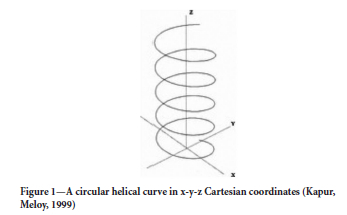
The spiral is basically a helix wrapped around a central column. It is an open channel in the form of a vertical circular helix, with roughly five loops (Kapur, Meloy, 1999). For a given feed, a spiral's performance depends on its channel configuration, diameter, height, number of turns, pitch, slope, as well as the trough's radial profile. Geometrically, the deck of the spiral channel may be visualised as comprising an infinitely large number of axially adjacent non-interacting helical curves. Refer to Figure 1.
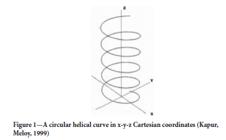
The parametric equations of a helix in x-y-z Cartesian coordinates are given by (Kapur, Meloy, 1999):

Which implies that, for loops to be complete, N should be an even integer.
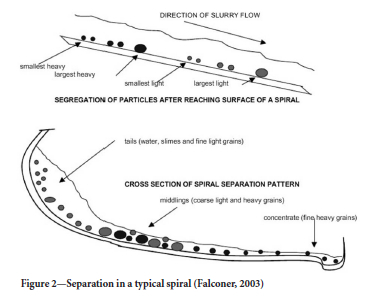
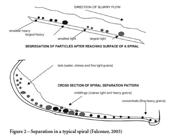
The principle is that a combination of gravitational and centrifugal forces, acting upon particles of different specific gravities, cause fine heavies and coarse lights to segregate. Figure 2 shows the separation mechanism on the spiral trough.
Holland-Batt (1995) believed that a basic design problem for both sluices and spirals is to determine the required trough length. Separation continues down the full length of the trough, though at a diminishing rate. Therefore, mineral separations can be revitalised by employing repulpers.
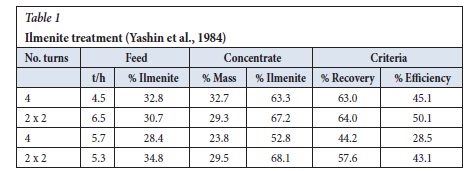
Yashin et al. (1984) have claimed that effective separation is at an end after two turns on mineral spirals. Most modern spirals employ four or five turns and occasionally six or seven turns to achieve the required levels of performance, yet many years ago spirals with 2 and 3.5 turns were common in Australia (Pullar, 1963). Particles that have already been recovered can be predicted to move out again and be lost, leading to an apparent reduction in recovery as the slurry moves further down the trough.
The definition of efficiency is shown in Equation 6. (Holland-Batt, 1995)

It is clear from the relationship that an increase in efficiency (E) translates directly into increased mineral recovery (R) at a fixed mass take (C) when the feed grade (f) is low and is directly proportional to the recovery, even at high feed grades.
The first Humphreys spiral had 4 turns (Thompson, Welker, 1990) but was increased in length to 5 turns comparatively quickly. The question of spiral length has been considered in detail by Yashin et al. (1984). The results for the treatment of ilmenite are shown in Table 1. Ilmenite recovery was measured on spirals of 500 mm and 1000 mm diameter and ranging in length from 1 to 4 turns. A plateau is reached after 3 turns.
Reaveley and Ritchie (1986), compared 5 and 7 turn spirals on rougher duty, treating mineral sand, and concluded that there was a considerable improvement in performance with the seven-turn unit, with equivalent recoveries being attained in much lower mass takes. Apart from a few specialist applications, the spiral manufacturers have abided to 5 or more turns for roughing, cleaning, and scavenging duties.
Studies of mineral spirals have shown that the diminishing rate of separation evident on the lower turns of the trough can be improved by removing finished grade material and redistributing the slurry across the trough. While this can be achieved by fitting sequential shorter troughs on one column with interstage feed boxes and product transfer systems, the introduction of repulpers after the auxiliary splitters achieved the same end in a simple and more cost-effective manner. In mineral separations, current spirals equipped with repulpers at appropriate locations can meet the process requirements of providing flexible operation and high upgrading capability at acceptable recoveries.
Recent advances in gravity concentration
Operations are sometimes limited by existing infrastructure and equipment must be custom fit into the space available. A basic design problem for spirals is to determine the required trough length. Spiral length is more important for the separation of fine particles of any density than for coarse particles. Spiral length is also more important for the separation of coarse dense particles than for coarse light particles. This suggests the existence of drag forces, coarse-light particles can be carried by the pulp more easily than coarse-dense particles.
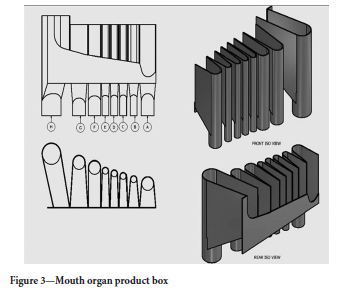
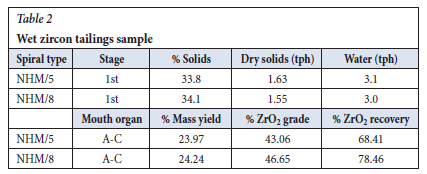
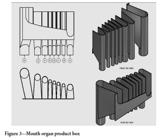
A five-turn heavy mineral sands spiral was developed and compared to the existing eight-turn spiral. The five-turn was developed due to infrastructure height limitations. The NHM/5 and the NHM/8 have the same profile but differ in the number of turns, with the NHM/5 being a shorter version of the NHM/8 spiral. The results are summarised in Table 2. Wet zircon tailings were run on the five- and eight-turn spiral to compare performance in terms of recovery. The test work was conducted on a single start spiral. The spirals were fed at 1.55-1.63 dry solids per ton. The solids concentration by mass was 33.8%-34.1%. Mouth organ fractions A-C were collected as product. Figure 3 illustrates the mouth organ product box.
Results
Table 2 compares the results of the wet zircon tailings sample processed on the five- and eight-turn spiral. The target solids concentration was 35% by mass. The ZrO2 in the feed was 15.0% for the NHM/5 turn spiral and 14.4% for the NHM/8 turn, respectively.
The ZrO2 recovery on the eight-turn spiral turned out to be 10% higher in comparison to the shorter five-turn spiral.
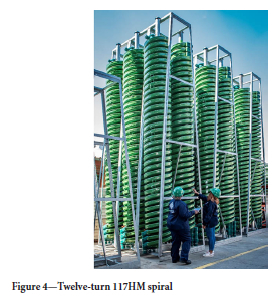
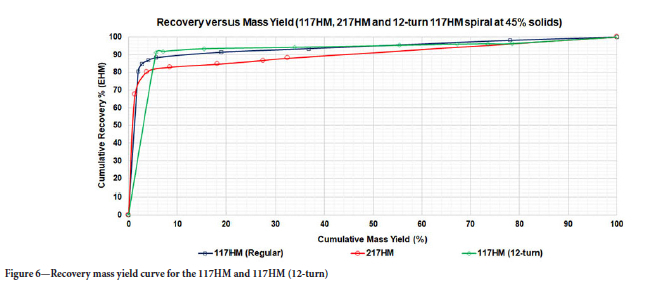
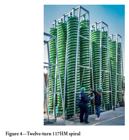
The 117HM spiral was developed to treat low grade ore. The 117HM is an eight-turn spiral. The aforementioned results were promising in terms of recovery, hence a further extension of the 117HM eight-turn spiral was implemented whereby a twelve-turn spiral was developed. The twelve-turn was then compared to the existing eight-turn spiral. Figure 4 shows the twelve-turn spiral. The twelve-turn spiral has four product off-takes.
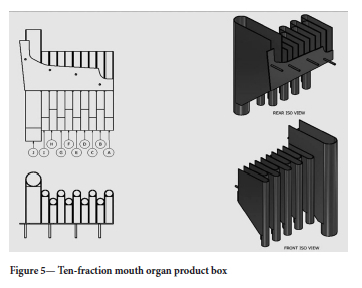
A special ten-fraction mouth organ product box was used for the test work. Figure 5 shows the ten-fraction mouth organ product box.
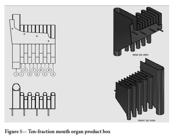
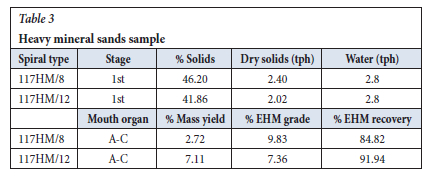
Table 3 shows the results on a heavy minerals sands sample. The feed THM was 8.06%-8.63%. The EHM feed grade was 0.31%. The aim was to run at 45% solids by mass. The planned feed rate was at 2.1 t/h.
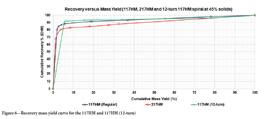
Figure 6 shows the grade recovery curve for the 117HM twelve-turn spiral. At 10% mass yield the recovery was more than 92%.
Conclusions
Spiral separators have undergone continuous development over the past 40 years. A broad range of spiral separator designs are available for various applications, including different density minerals, varying particle sizes, and a range of feed grades. Depending on the application, each spiral separator model has a unique profile, pitch, and features to ensure it performs efficiently.
Trough length is a basic design problem for both sluices and spirals. Reaveley and Richie (1986), concluded that for mineral sands there was a considerable improvement in performance with a seven-turn unit, with equivalent recoveries being attained in much lower mass takes. Studies have shown the rate of separation can be improved by removing finished grade material and redistributing the slurry across the trough. Spiral length is more important for separating fine particles of any density than for coarse particles. Spiral length is also more important for the separation of coarse dense particles than for coarse light particles.
The test work results show an increase in recovery when there is an increase in residence time. The recovery difference between the NHM/5 and NHM/8 for zircon tailings was ±10%.
The 117HM spiral was developed to treat low grade ore. Further development was done on the spiral by adding more turns and sliding splitters for product off-take. The twelve-turn 117HM also shows better recovery of mineral sands in comparison to the standard eight-turn 117HM. Taking product off and giving the remaining material the opportunity to separate again is benefiting the recovery. The longer trough ensures longer retention time and another opportunity for material to gravity concentrate.
References
Literature
- Falconer, A. 2003. Gravity separation: old technique/new methods. Physical Separation, vol. 12, no. 1, pp. 31-48.
- Kapur, P.C., Meloy, T.P. 1999. Industrial modelling of spirals for optimal configuration and design: spiral geometry, fluid flow and forces on particles. Powder Technology, vol. 102, pp. 244-252.
- Holland-Batt, A.B. 1995. The dynamics of sluice and spiral separations. Minerals Engineering, vol. 8, nos. 1½, pp. 3-21.
- Pullar, S.S. 1963. Metallurgical practice in the beach sands industry. Proc. Aust. Instn. Min. Metall., vol. 205, pp. 77-104.
- Pullar, S.S. 1965. Development in separating equipment in the Australian heavy mineral sands industry. In Proceedings of the eighth CMMC, Melbourne, vol. 6, pp. 1343-1357.
- Reaveley, B.J., Ritchie, I.C. 1986. The development of high efficiency spiral separators. In Australia: a World Source of Ilmenite, Rutile and Zircon. AusIMM (Perth Branch) Conference, pp. 87-97.
- Thompson, J.V., Welker, M. 1990. The Humphreys Companies: Development and application of Humphreys Spiral Concentrator. Skillings' Mining Review, pp. 4-15.
- Yashin, A.V., Aniken, M.F., Skrpko, V.A. 1984. Spiral Separators. Nedra Press (Moscow), Part III, Chapter 6.
Published: March 2026