Improving compressed air network efficiency in South African PGM mines through continual monitoring and reporting
Abstract
The South African platinum group metals mining industry faces considerable operational costs, with compressed air networks' annual costs accounting for up to 35% of total electricity consumption. Amidst escalating electricity tariffs and volatile commodity prices, enhancing energy efficiency has become critical for economic sustainability. This study addresses the prevalent issues of mismanagement and inefficient use of compressed air on the demand side, such as leakages and unauthorised use for ventilation. While previous research has identified these inefficiencies, a gap exists in the continual monitoring and reporting of network performance to drive sustained improvements. This paper presents a practical solution developed and applied within a major South African platinum group metals mining group. The methodology focuses on a continual monitoring and reporting framework to improve demand-side management. The implementation of this solution has demonstrated significant financial and energy-saving potential. Key findings from case studies include: 1) the mitigation of R150,000 in costs over five days by rectifying a single instrumentation fault, 2) a potential annual energy saving of up to 5.6 GWh (R10.6 million) by enforcing valve closures during non-productive periods, and 3) an annual reduction of 3.7 GWh (R7.2 million) through improved underground ventilation controls. These outcomes underscore the value of a systematic, data-driven approach to managing compressed air consumption, offering a viable strategy for cost reduction and enhanced efficiency across the platinum group metals industry.
South African PGM mining industry; continual monitoring and reporting; energy management; compressed air management; energy savings; costs savings
Introduction
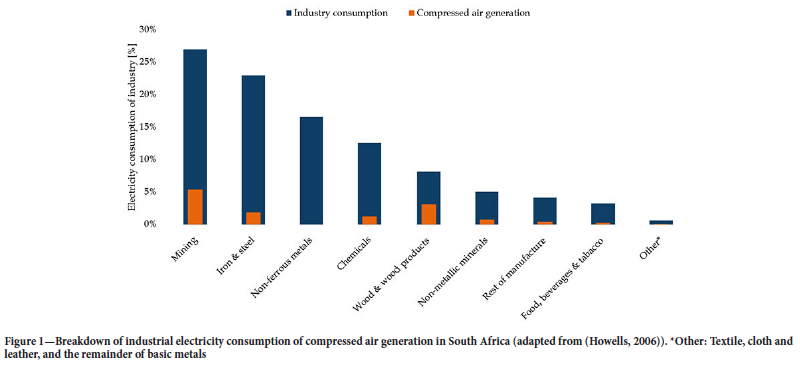
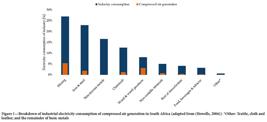
Compressed air is an essential utility in the South African mining sector, often termed the fourth utility (Yuan et al., 2006). Its generation, however, is notoriously energy-intensive and inefficient. Within the South African industrial sector, compressed air generation accounts for approximately 13% of electricity usage, with the mining industry being the most significant consumer (Howells, 2006). As illustrated in Figure 1, the mining sector's consumption dwarfs that of other industries. Within the energy-intensive environment, the platinum group metals (PGM) mining industry is a particularly high consumer, dedicating on average approximately 21% (in some cases up to 35%) of its electrical energy specifically to the generation of compressed air for use in mineshafts (Van der Walt, 2024). On an annual basis, this consumption translates to a staggering figure of over 12,000 GWh for the entire PGM mining industry. Such a high level of energy use results in a substantial operational expenditure, a financial burden that is magnified by the context of consistently rising electricity tariffs in South Africa (Eskom, 2025). The scale of this expenditure also represents a significant opportunity; it is estimated that a potential annual cost saving of R1.6 billion could be realised across the industry through targeted interventions. This immense financial prize underscores the critical and urgent need for developing and implementing effective efficiency improvements (Van der Walt, 2024; Zietsman, 2020).
The primary sources of inefficiency exist on the demand side of the compressed air networks. These sources include extensive leakages, the use of compressed air for cooling and ventilation in deep-level mines, and the supply of air to inactive mining sections (Du Plooy et al., 2019; Van der Walt, 2024; Van Gruting et al., 2022; Zietsman, 2020). While numerous studies have benchmarked and identified these inefficiencies (Cilliers, 2016; Du Plooy et al., 2019; Zietsman, 2020), a significant gap remains in the literature concerning sustainable, long-term management solutions driven by real-time data.
This study aims to bridge this gap by developing and implementing a solution for improving the demand-side efficiency of compressed air networks through a framework of continual monitoring and reporting. The aim is to create a systematic approach that identifies, validates, and analyses performance data, creates automated hierarchical reports for various stakeholders, and establishes a procedural workflow for acting on inefficiencies. This research presents a validated, practical methodology applied to a South African PGM mining group, demonstrating its effectiveness in achieving significant energy savings.
Methodology
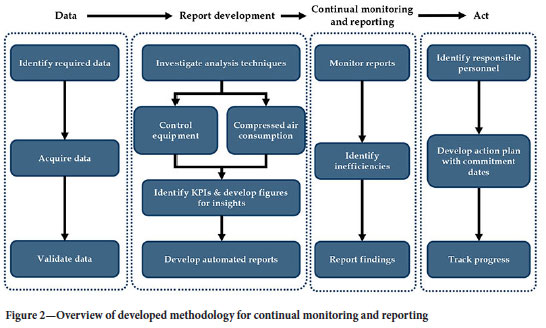
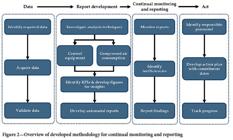
The research methodology followed a case study approach (Crowe et al., 2011), which allowed for an in-depth application and validation of a theoretical framework in a real-world industrial setting. The developed solution encompasses four key stages, as illustrated in Figure 2.
Phase 1: Data identification, acquisition, and validation
The first phase of the methodology entails the identification, acquisition, and validation of the data that were later used in the reports developed in this study. The required data is summarised as:
> Process and electricity data
> Production data
> Organisational hierarchy
> Mineshaft layouts
The required process and electricity data were identified and sourced from Supervisory Control and Data Acquisition (SCADA) systems, and third-party data providers. This typically involves data related to volumetric compressed air consumption (both mineshaft total and sections within), electricity consumption data (of the compressors used to generate compressed air), and process variables related to a control valve typically used to reduce pressure during non-drilling periods (Van den Berg, 2022). The frequency required for this data was determined to be at least hourly to align with the Eskom time-of-use (TOU) tariffs.
Production data, typically tonnes of ore produced, were acquired from the mineral resources management (MRM) or survey department, with the most frequently available data being daily.
Production data can typically be used in conjunction with process and electricity data to conduct an intensity analysis. Intensity analyses are useful comparative indicators of performance.
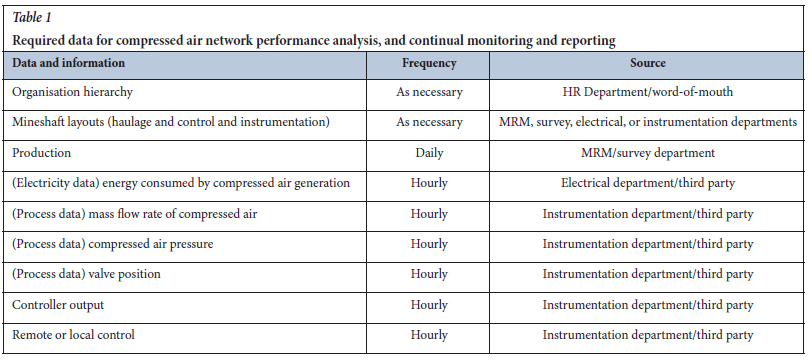
The organisational hierarchy, obtained from the Human Resources (HR) Department in the form of an organogram is essential for identifying key stakeholders within the organisation. Changes in this data type occur infrequently and was updated as changes occurred during the study. In the same sense, mineshaft layouts were acquired from multiple different sources, with each being responsible for a specific type, whether it be physical or Piping and Instrumentation Diagrams (P&ID). The required data were identified from various sources within the mining operation, as summarised in Table 1.
All acquired process data underwent a rigorous validation procedure to ensure accuracy and completeness. The multi-step process included checks for constant values, correct measurement units, sensor range conformity, system boundary logic, redundancy, and correlation between related variables (Van der Walt, 2024). This procedure proved crucial for identifying instrumentation faults, which, as will be shown in Case Study A, can be a significant source of inefficiency.
Phase 2: Analysis techniques and report development
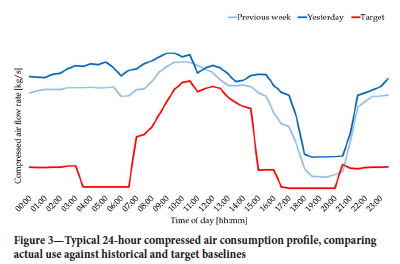
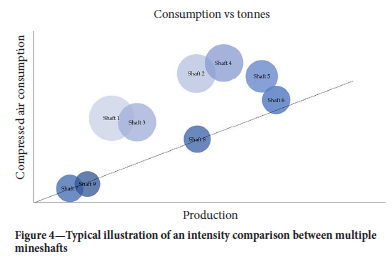
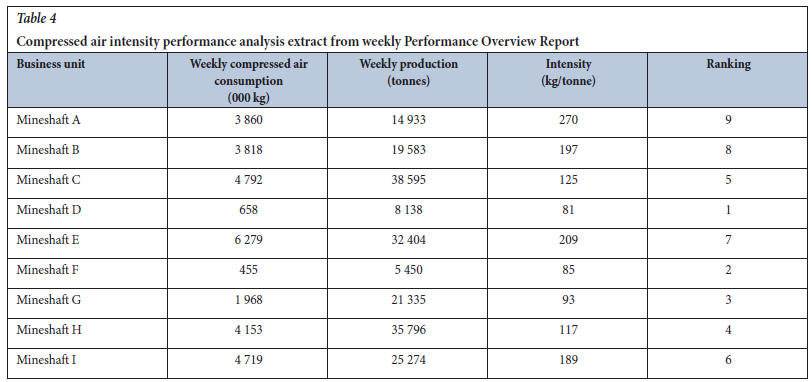
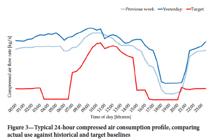
To translate raw data into actionable insights, several analysis techniques were employed. Daily consumption profiles were compared against historical averages and theoretical zero-waste targets (Van Der Merwe et al., 2022) to quantify wastage and identify anomalous consumption patterns (Figure 3). Intensity analysis (consumption per tonne of ore produced) (Du Plooy et al., 2019) was used for benchmarking performance (Figure 4) between different mineshafts and sections. For detailed diagnostics, step-testing (Zietsman, 2020) was employed to localise wastage within specific underground areas.
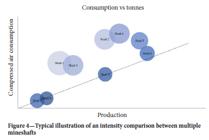
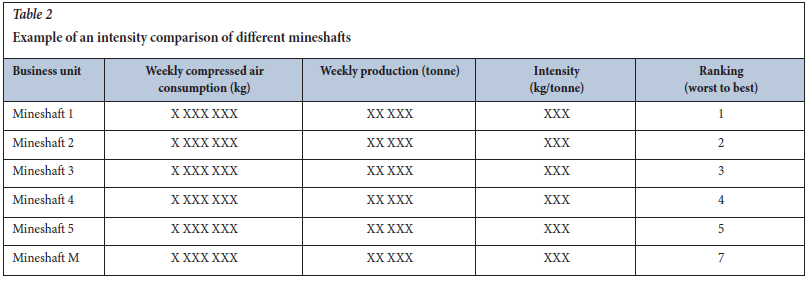
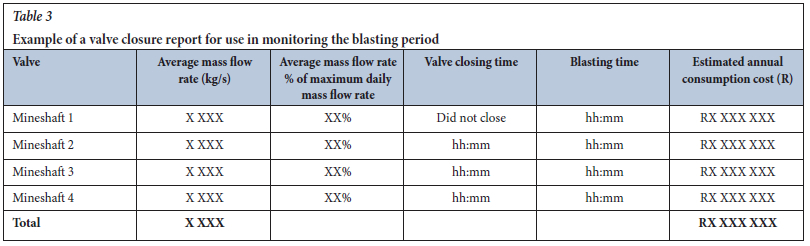
Based on these analyses, three automated reports were developed to cater to different levels of the operational hierarchy: a daily Section Performance Report for mine overseers, a weekly Performance Overview Report for management (Table 2), and a daily Control Valve Performance Report (Table 3) for engineers and technicians.
Phases 3 and 4: Continual monitoring and acting on inefficiencies
A structured procedure was established for the daily and weekly review of these reports. The workflow begins with a weekly overview to prioritise efforts, followed by daily monitoring to detect new inefficiencies or track progress on existing issues. When an inefficiency had been identified, a formal process was initiated to identify responsible personnel, develop a formal action plan with commitment dates, and monitor the implementation of the plan, escalating when necessary to ensure accountability (Jordaan et al., 2024).
Results
The developed solution was implemented and validated through three distinct case studies at a large PGM mining group. Each case study was selected to test the solution's effectiveness in addressing different types of common inefficiencies found in compressed air networks (Van der Walt, 2024). The studies focused on reactive problem solving for equipment malfunctions, proactive management of operational schedules to reduce costs, and systematic improvement of underground infrastructure to combat wastage.
Case study A: Control valve philosophy change
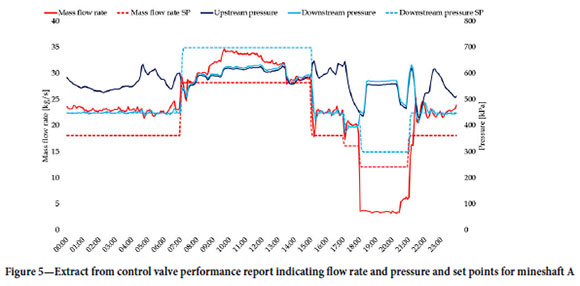
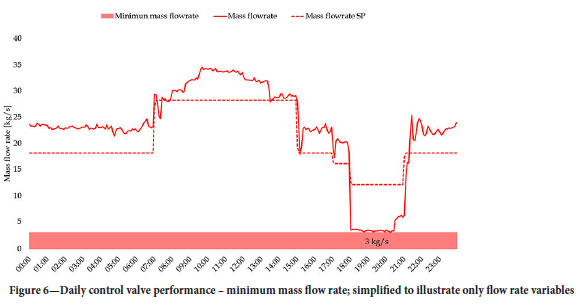
The value of the monitoring system as a reactive tool was demonstrated in this case study. Daily reviewing of the Control Valve Performance Report revealed a critical anomaly at one mineshaft: The mass flowmeter registered a constant, non-zero flow rate even during periods when the control valve was fully closed (Figure 5 and Figure 6). This erroneous data prevented the PLC from executing its standard control logic, which relied on both flow and pressure inputs. As a result, the system defaulted to a fail-safe state that left the control valve fully open, thereby failing to reduce compressed air during non-drilling periods and wasting a significant amount of energy.
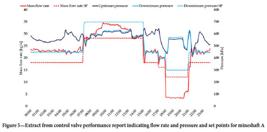
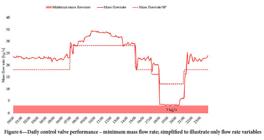
Upon identifying this discrepancy, the issue was immediately escalated to the mineshaft's engineering and instrumentation departments. While awaiting the replacement of the faulty instrument, a temporary control philosophy was implemented that bypassed the faulty flowmeter data, allowing the system to operate using only downstream pressure readings. This swift intervention restored automated control and, by preventing five days of sustained energy waste, averted a potential cost increase of R150,000: an equivalent energy loss of 116 MWh.
Case study B: Blasting period valve closure
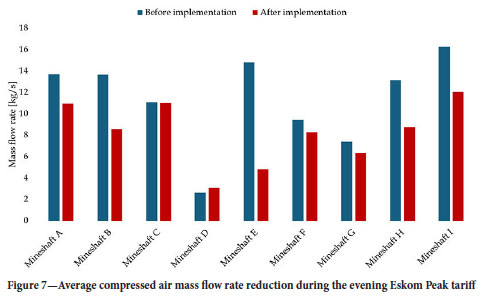
This initiative focused on enforcing the closure of control valves during the evening blasting period, which coincides with Eskom's peak electricity tariff (Eskom, 2025). The daily reports created visibility and accountability, which drove a coordinated effort between engineering and mining departments. Over an 18-month period, this initiative led to a 21% reduction in the average compressed air mass flow during the blasting period across nine mineshafts (Figure 7). This equates to a verified annual saving of 5.6 GWh in energy, which translates to R10.6 million in operational costs.
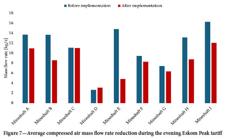
On Mineshaft D, this initiative was prohibited from being implemented due to pneumatic pumps being supplied from the main pipeline. At the time of evaluation, another initiative to replace the pneumatic pumps with electrical pumps was still underway. The significant improvement at Mineshaft E was due to a project that allowed the underground loading box to be supplied from the surface. As a result, the total reduction in consumption did not include this improvement.
Case study C: Underground ventilation controls improvement
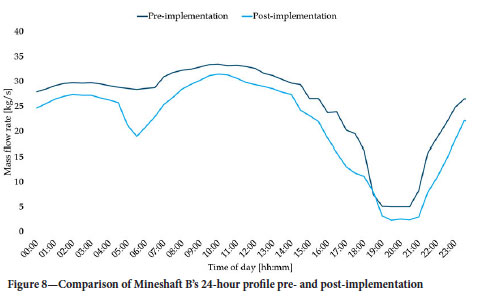
This case study targeted the common but inefficient practice of using compressed air for ventilation (Van Gruting et al., 2022). The performance reports were used to identify and prioritise underground sections with high, non-productive baseload consumption (Table 4). Mineshaft B was selected instead of Mineshaft A and Mineshaft E for two reasons, namely, because half-level flow meters were already installed, and that the initiative was approved by management.
Subsequent underground audits confirmed that this consumption was due to substandard ventilation controls, such as missing brattices and damaged ducting. A 15-month sustained focus on rectifying these issues at one mineshaft results in a significant reduction in baseload consumption (Figure 8) and an annual saving of 3.7 GWh, an equivalent cost reduction of R7.2 million.
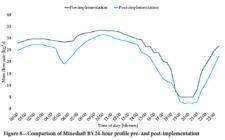
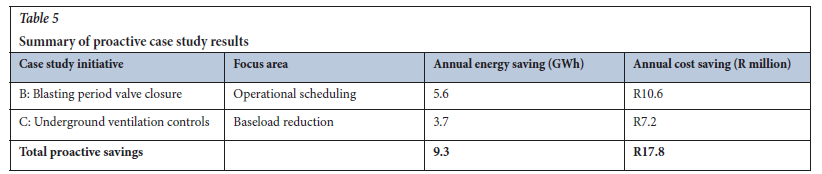
The cumulative impact of these initiatives demonstrates the significant potential for cost savings across different operational scenarios. Table 5 provides a consolidated summary of the proactive case studies (B and C). The energy and cost saving of these initiatives totalled 9.3 GWh and R17.8 million, annually.
Discussion
The results from the three case studies validate the efficacy of a continual monitoring and reporting framework. The financial-and energy savings achieved are substantial and demonstrate that such a system provides a clear return on investment. Case Study A highlights the importance of data validation and monitoring of control systems themselves. Without such monitoring, costly inefficiencies can go unnoticed. The reactive nature of this case study prevented significant losses, which underscores the system's value as a defensive tool.
Case studies B and C demonstrate the proactive power of the solution. By providing clear, quantifiable data on wastage, the reports facilitate communication between different operational departments and motivate action. The developed reports served as a crucial tool for management to drive this change and hold teams accountable.
The findings align with the principles of the ISO 50001 energy management standard (ISO 50001: Energy Management Standard, 2018), particularly the 'Plan-Do-Check-Act' cycle. This solution provides a robust 'Check' and Act' mechanism that was previously lacking in a systematic form for compressed air management on the demand side. The ability to attribute costs to wastage at a sectional level empowers managers to make informed decisions and justifies expenditure on maintenance and upgrades.
Conclusion and recommendations
The PGM mining industry in South Africa faces immense pressure to reduce operational costs. This study has demonstrated that improving the efficiency of the compressed air networks through continual monitoring and reporting offers a significant and sustainable opportunity for cost savings. The developed solution, integrating data validation, targeted analysis, and a structured reporting and action workflow, has proven to be highly effective in a real-world mining environment.
The key contribution of this work is a practical, scalable framework that moves beyond ad hoc audits to a continuous improvement model. It empowers mine management with the visibility needed to manage compressed air with the same rigor as other major cost drivers. The substantial savings realised in the case studies confirm that a systematic, data-driven approach is critical to unlocking the full efficiency of these complex utility networks.
Based on the findings and limitations observed during this study, future work should focus on extending the methodology presented here, which could be adapted and applied to other energy-intensive systems within mining, such as ventilation, cooling and dewatering systems. Given the similar need for data-driven management, significant efficiency improvement could likely be realised.
References
- Cilliers, C. 2016. Benchmarking electricity use of deep-level mines (PhD). North-West University, Potchefstroom, South Africa.
-
Crowe, S., Cresswell, K., Robertson, A., Huby, G., Avery, A., Sheikh, A. 2011. The case study approach. BMC Med. Res. Methodol, vol. 11, no. 100. https://doi.org/10.1186/1471-2288-11-100
» https://doi.org/10.1186/1471-2288-11-100 -
Du Plooy, D., Maré, P., Marais, J., Mathews, M.J. 2019. Local benchmarking in mines to locate inefficient compressed air usage. Sustain. Prod. Consum, vol. 17, pp. 126-135. https://doi.org/10.1016/i.spc.2018.09.010
» https://doi.org/10.1016/i.spc.2018.09.010 -
Eskom, Tariff History: Historical Average Price Increase. Accessed: Jul. 23, 20205. [Online]. Available: https://www.eskom.co.za/distribution/wp-content/uploads/2025/01/Historical-average-prices-and-increase_v20250114_no-links External.xlsx
» https://www.eskom.co.za/distribution/wp-content/uploads/2025/01/Historical-average-prices-and-increase_v20250114_no-links External.xlsx -
Howells, M.I. 2006. The targeting of industrial energy audits for DSM planning. Journal of Energy in Southern Africa, vol. 17, pp. 58-65. https://doi.org/10.17159/2413-3051/2006/v17i1a3313
» https://doi.org/10.17159/2413-3051/2006/v17i1a3313 -
Energy Management, ISO 50001:2018, International Organization for Standardization, 2018. Accessed: Jul. 23, 2025. [Online]. Available: https://www.iso.org/iso-50001-energy-management.html
» https://www.iso.org/iso-50001-energy-management.html -
Jordaan, E.G., Van Rensburg, J., Du Preez, J. 2024. New Accountability Approach: Utilising Dynamic Zero-Waste Baselines to Mitigate Water Wastage in Gold Mines. Mining 4, 943-965. https://doi.org/10.3390/mining4040053
» https://doi.org/10.3390/mining4040053 - Van den Berg, J.D. 2022. Expanding compressed air demand side management through selective level control (Master's). NorthWest University, Potchefstroom, South Africa.
-
Van Der Merwe, A., Gous, A., Schutte, C. 2022. Using zero-wastage baselines to identify compressed air system inefficiencies in deep-level mines. The South African Journal of Industrial Engineering, vol. 32. https://doi.org/10.7166/33-3-2803
» https://doi.org/10.7166/33-3-2803 - Van der Walt, C.M. 2024. Improving compressed air networks on PGM mines in South Africa through continual monitoring and reporting (Master's). North-West University, Potchefstroom, South Africa.
-
Van Gruting, U., Schutte, C., Pelser, W., Van Laar, J. 2022. Investigating the link between compressed air wastage and ventilation shortfalls in deep-level mines. The South African Journal of Industrial Engineering, vol. 32. https://doi.org/10.7166/33-3-2786
» https://doi.org/10.7166/33-3-2786 -
Yuan, C.Y., Zhang, T., Rangarajan, A., Dornfeld, D., Ziemba, B., Whitbeck, R. 2006. A decision-based analysis of compressed air usage patterns in automotive manufacturing. Journal of Manufacturing Systems, vol. 25, pp. 293-300. https://doi.org/10.1016/s0278-6125(06)80241-4
» https://doi.org/10.1016/s0278-6125(06)80241-4 - Zietsman, L.N. 2020. Novel solutions for compressed air demand management on deep-level mines (PhD). North-West University, Potchefstroom, South Africa.

Published: February 2026