Embedding equity-centred, proactive academic advising in first-year orientation: A case study of the College of Humanities, University of KwaZulu-Natal
Abstract
The transition from high school to university presents significant challenges, particularly for students from historically marginalised communities and under-resourced schools, heightening risks of attrition and delayed progression. This affirms the value of integrated, intentional, equity-focused proactive early support, which the University of KwaZulu-Natal's (UKZN) Academic Monitoring and Support (AMS) Policy promotes. This study examines first-year students' experiences of equity-focused academic advising within orientation at the College of Humanities (CHUM), which enrols up to 60% of first-year students from quintile one to three schools. The article contributes to scholarship in two ways. First, through a case-study approach, it demonstrates how proactive academic advising promotes social justice. Second, it draws on two complementary frameworks - Nancy Fraser's social justice framework assesses whether interventions address recognition, representation, and redistribution. Alf Lizzio's Five Senses of Student Success frames students' experiences across the domains of successful transition (capability, connectedness, purpose, resourcefulness, and academic culture). Data were collected from the student feedback survey, with 531 of the approximately 1,000 first-year students who participated in the intervention in 2025 responding. Findings indicate students' enhanced sense of capability, resourcefulness, connectedness, purpose, and engagement with academic culture. Challenges with digital literacy, connectivity, and timing of data rollout contributed to low participation, highlighting barriers to achieving participatory parity. Implications for academic advising practice and approaches are discussed, and areas for further research are proposed.
Academic advising; equity; first-year orientation; just practices; student experience
Abstract
Ushintsho lokusuka esikoleni samabanga aphakeme uya enyuvesi luza nezinselelo eziningi kakhulu ikakhulukazi kubafundi abasuka emiphakathini ehlwempu kanye nasezikoleni ezintula izinsizakusebenza. Lokhu kuphazamisa inqubekela phambili yomfundi. Lokhu kufakazela ukubaluleka kohlelo oluhlosiwe nolusheshayo lokwesekwa kwabafundi kusanesikhathi. Nokuyinto ekhuthazwa inqubomgomo yeNyuvesi yaKwaZulu- Natali ngaphansi kohlelo olubizwa ngokuthi yi-Academic Monitoring and Support (AMS). Lolu cwaningo lucubungula ulwazi lwabafundi abenza unyaka wokuqala mayelana nokwelulekwa ngokwezemfundo okugxile osukwini lokwamukelwa kwabenza unyaka wokuqala enyuvesi, ngaphansi kweKolishi leZoluntu. Nebhalisa inani labafundi abangafika ku-60% abenza unyaka wokuqala abasuka ezikoleni ezithathwa njengezikole ezintulayo. Lolu cwaningo luqhutshwe ngezindlela ezimbili. Indlela yokuqala indlela yocwaningonto. Le ndlela ikhombisa ukuthi ukwelulekwa kwezemfundo ukuthuthukisa kanjani ubulungiswa bezenhlalakahle. Indlela yesibili isebenzisa izinhlaka ezimbili ezihambisanayo. Nokuwuhlaka lukaNancy Fraser lwezobulungiswa bezenhlalakahle noluhlola ukuthi ingabe ukungenelela kusanesikhathi kuyazixazulula yini izinkinga. Ngokuka-Alf Lizzio izinzwa ezinhlanu zempumulelo yomfundi zifaka ulwazi lomfundi kuzona zonke izizinda zoshintsho oluyimpumelelo nokufaka phakathi indlela yokwenza komfundi, ukuxhumana, inhloso, ubuhlakani kanye nenqubo yasenyuvesi. Imininingo yaqoqwa kwizimpendulo zesaveyi yabafundi. Kwaphendula abafundi abangama-531 kubafundi abayi-1000 abenza unyaka wokuqala ababamba iqhaza locwaningo ngonyaka wezi-2025. Okutholakele ocwaningweni kuveza ukuthi izinzwa zabafundi zithuthukisiwe nokufaka phakathi ukwenza kwabo, ubuhlakani, ukuxhumana, izinhloso kanye nokuzibandakanya nenqubo yokwenza enyuvesi. Izingqinamba zezobuchwepheshe, ubuxihixi bezokuxhumana kanye nesikhathi sokunikwa kwedatha kubafundi kube nomthelela omkhulu ekubambeni iqhaza okuphansi kubafundi. Lokhu kugqamisa izinselelo zokuhlanganyela ocwaningweni ngokulinganayo. Kulolu cwaningo kuxoxwe ngemiphumela kanye nezindlela zokwelulekwa ngokwezemfundo. Kuphinde kwahlongozwa nolunye ucwaningo olungenziwa ngomuso.
Ukwelulekwa ngokwezemfundo; ukulingana; ukwamukelwa kwabenza unyaka wokuqala enyuvesi; inqubo yasenyuvesi; ulwazi lwabafundi
Introduction
Students' transition from high school into university is widely recognised as one of the most critical and challenging periods in their academic journey. First-year students face heightened risks of attrition and delayed progression, with the first semester often determining success and retention. These challenges are particularly acute in South Africa, where structural inequalities intersect with issues such as under-preparedness, undecidedness, first-generation status, and socio-economic disadvantage. For students from under-resourced schools and historically marginalised communities, navigating course selection, degree choices, and unfamiliar institutional processes and systems often compounds feelings of exclusion and inadequacy. This stresses the need for integrated, intentional, socially just equity-focused support that promotes early engagement with first-year students.
This study aims to examine first-year students' experiences and perceptions of the equity-centred, proactive academic advising initiative embedded within orientation. A quantitatively designed student feedback survey enabled first-year students to rate their experiences and perceptions of and engagement with the interventions. The findings provided a basis for reflecting on students' engagement and experiences in these interventions, both in terms of the domains of successful transition and the implications for social justice and equity. This article is structured in three main sections. First, it reviews the literature on orientation and academic advising as mechanisms of transition, retention, and student success, establishing the theoretical and conceptual foundation for the study. Second, it presents the context and setting of the case study and the methods. Third, the results and findings are followed by a concluding discussion on the implications for practice.
Literature review and conceptual frameworks
High attrition, dropout, and low throughput rates during the first year of study, particularly in the first semester, remain persistent challenges in higher education globally (Pitkethly & Prosser, 2001; Barefoot, 2000). Although reasons vary across contexts and geographies, there is a broad consensus that multiple, intersecting factors contribute to these patterns. These include a mismatch between students' identities and university sociocultural norms, misaligned expectations and goals, first-generation status, familial habitus, and academic under-preparedness (Naudé & Breshears, 2024; Motsabi et al., 2020; Council on Higher Education, 2023). These circumstances, and their limited social and cultural capital, impact students' ability to navigate university life successfully. Students' academic vulnerability (Miller & Harrell, 2017, p. 85) places them at heightened risk of attrition and delayed progression (Tinto & Pusser, 2006).
In South Africa, post-apartheid reforms have justly prioritised equity of access and widening participation of historically disadvantaged communities (Department of Education, 2001, 1997). The highly diverse first-year student cohort often confronts overlapping challenges such as under-preparedness, undecidedness, socio-economic inequality, and first-generation status. African students, in particular, constitute the majority of first-generation students from low-income households. National data show trends in progression, throughput, and retention are problematic among African, Coloured, and Indian students, as well as male students (Department of Higher Education and Training, 2020).
As Tinto (2014) observes, students, particularly those from marginalised backgrounds, struggle to conceptualise academic pathways, select appropriate courses, or articulate career goals - sometimes concealing their uncertainty due to the pressure to choose a field. Access alone is insufficient - without systematic and intentional support structures, students have to navigate unfamiliar institutional terrains independently. Timely and contextualised academic and social support during students' admission, transition, and acclimation is critical (Tinto, 2017). The early first-year experience is recognised as critical to students' academic success across their student journeys (Wilson et al., 2016). Patterns of disengagement, such as limited participation in orientation, moderate online involvement, and low-class attendance do occur during the first few weeks of the semester. The first week and semester of university are crucial, though transition is a sustained process throughout the entire first-year rather than a single event (Moosa & Langford, 2021; Kift et al., 2010).
Muraskin (1997) identifies key features of effective student support: a structured and well-designed first-year experience, academic support, proactive advising, deliberate engagement strategies, and dedicated staff with strong institutional ties. Gardner (2001, as cited in Miller & Harrell, 2017) similarly emphasizes the integration of various interventions such as orientation, first-year seminars, learning communities, service-learning, academic support services, health education, and peer mentoring. The idea of proactively including academic advising sessions during orientation to guide students to make informed choices about courses and major selection is well documented (Fox & Martin, 2017; Greenfield et al., 2013). The early and proactive engagement with students through academic advising normalises help-seeking practices and connects first-year students to a knowledgeable academic advisor. In contexts with students from under-resourced schools and historically marginalised communities responsive, timely, integrated, and effective student support exemplifies socially just equity-centred practices.
Just and equity-centred academic advising and orientation practices
This article conceptualises student support interventions such as orientation and academic advising as just practices. Finn and Jacobson's (2003) Just Practice Framework enables an understanding of first-year student support through a justice-oriented lens. It centres on five interwoven dimensions - (1) meaning, (2) context, (3) power, (4) history, and (5) possibility - which invite critical reflection on how people's experiences are understood and acted upon. Within the higher education context, this framework prompts us to examine the socio-historical and political conditions underpinning first-year students' challenges, such as under-preparedness or undecidedness. It also encourages interrogating the power relations and knowledge hierarchies that shape institutional responses. Notably, the framework enables us to conceptualise why academic advising and orientation are pivotal socially just, equity-centred student support practices within South African higher education post 1994.
Orientation programmes, first-year seminars, and academic advising are crucial just practices that enhance academic and social integration and readiness, especially during the first year of study (Keup & Young, 2021; Schmidt & Graziano, 2016; Kuh, 2008). Intentional just practices that facilitate early engagement with first-year students are particularly transformative for historically marginalised students from low-income households, and first-generation families (Finley & McNair, 2013). As such, they reflect a university's commitment to social justice and equity by advancing "just social arrangements and just ways of relating and access" (Hölscher & Bozalek, 2020, p. 4). When implemented with care, these practices foster belonging, integration, meaningful participation and engagement in university life.
Orientation, typically conducted before the academic year begins, assists students' transition to university. Anderson and Williams (2000, cited in Wilson et al., 2016) describe this early phase and period as a 'window of maximal risk' for students with limited academic and cultural capital, who often feel like outsiders. Purposefully designed orientation programmes reduce this risk by building students' sense of capability and resourcefulness - key domains for a successful student transition (Lizzio, 2006). Orientation also helps students navigate university structures and form social connections (Jacobs, 2010, cited in Greenfield et al., 2013).
Farrell et al. (2020) highlight two key components relevant to orientation programmes: academic readiness and social readiness. Academic readiness includes clear expectations regarding workload, responsibilities, and support. Social readiness promotes belonging and encourages engagement with peers, senior students, and staff. Peer mentorship further supports connectedness. A well-structured, intentional orientation programme introduces students to essential academic skills, resources, and expectations, which reinforce the key domains of successful transition and, academic and social readiness.
When integrated into orientation, academic advising enhances this just practice by supporting students' successful transition. Timely, structured, and compassionate academic advising can significantly improve student retention and success (Grafe et al., 2025; Tiroyabone & Strydom, 2021; Fox & Martin, 2017). Kuhn et al. (2006, p. 24) describe advisors as the "institutionalised front line" of support. Delivered by faculty, professional staff, peer mentors, and support personnel, advising often involves identifying student needs and referring them to appropriate services (Troxel et al., 2021). Strong cross-institutional collaboration, and strong leadership and coordination are among the factors that will facilitate the effectiveness of integrated, intentional support.
NACADA, The Global Community for Academic Advising, defines advising as an intentional teaching practice that includes curriculum (content), pedagogy (delivery), and student learning outcomes (Damminger & Rakes, 2017). It encompasses curriculum planning, mentoring, orientation, and performance monitoring (De Klerk, 2022; Robbins, 2012). Whether in person or online, individually or in groups, academic advising is key to advancing equity and inclusion in higher education.
Similarly in South Africa, ELETSA (Academic Advising South Africa) positions advising as an intentional, relational, and equity-focused practice that supports students academically, personally, and professionally. Rooted in transformation, ubuntu, and reflective practice, ELETSA frames advising as a humanising and just approach (ELETSA, 2023). Ubuntu, a philosophy of empathy and community, complements Fraser's social justice lens by affirming lived experiences and interdependence (Museka & Madondo, 2012).
Advising approaches include prescriptive, developmental, proactive, appreciative, and strengths-based models (Drak et al., 2013). This study focuses on prescriptive and proactive models, particularly relevant during orientation and registration (Robbins, 2012). These models are effective for underprepared or undecided students who may not seek help or know about available services (Upcraft & Kramer, 1995, as cited in Elliott, 2020). Varney (2013) explains that proactive advising equips students with essential information, enhancing their confidence and direction before they realise they need it. Prescriptive advising provides clear guidance, especially useful during course selection and registration. These models and approaches align with Fraser's social justice framework, enabling advisors to recognise and respond to structural barriers with practical support.
Rust and Willey (2024) draw a comparison between decentralised and centralised proactive academic advising models, arguing that a centralised model consolidates advising into one unit and this correlates positively with coordination and advising effectiveness. In integrating support and seeking to strengthen cross-institutional collaboration with a range of key actors and stakeholders who deliver academic advising, centralised models of advising, in terms of locus of control and accountability, are preferred. The authors provide this definition for proactive advising, which takes into account a range of key observations from their study:
Proactive advising is an advisor-initiated, institutionally empowered approach that includes coordinated, collaborative, personalised, and intentional outreach strategies and practices designed to anticipate potential barriers to students' learning goals, to provide timely interventions based in the students' strengths and identities, to make meaningful engagement between advisors and students a standard student experience, and to achieve the institution's student success goals. (Rust & Willey, 2024, p. 101)
These core ideas on practices and approaches also emphasize that academic advising must be institutionally contextualised. It should align with each university's mission, institutional approach, pedagogical approach, academic advising staffing, and student demographics (Emekako & van der Westhuizen, 2021; Campbell & McWilliams, 2016). South Africa's diverse and unequal higher education landscape calls for differentiated, equity-centred approaches that respond to students' academic, social, and cultural positionalities.
Conceptual frameworks
This study draws on two complementary frameworks: Lizzio's Five Senses of Student Success (2006) and Fraser's social justice (Hölscher & Bozalek, 2020). Together, they provide conceptual lenses for understanding how psychosocial dimensions of student experience and transition intersect with structural and systemic transformation to shape student support interventions and practices. Whereas Fraser highlights the redress of systemic and structural inequities embedded in higher education, Lizzio provides a practice-oriented guide for designing interventions that enhance students' successful transition and their academic and social readiness.
Fraser's social justice framework comprises three interrelated dimensions. First, redistribution concerns the equitable allocation of resources and opportunities; second, recognition involves respecting and valuing diverse cultural and social identities; and third, representation ensures meaningful participation and engagement in academic and social life (Hölscher & Bozalek, 2020; Vincent, 2019). Applied to higher education, the framework illuminates how institutional structures and practices can either reproduce or disrupt and address inequality and inequity. Khan (2022), for example, employed Fraser's concepts of maldistribution and misrecognition to examine whether institutional arrangements at the University of the Western Cape during COVID-19 enabled equitable access to online academic and psychosocial support. While affirmative strategies such as student support interventions addressed immediate needs, the study also underscored the importance of transformative approaches that acknowledge students' varied positionalities and contexts. The use of student feedback surveys demonstrated how students' experiences, voices and agency are integral to identifying student needs and gaps in the intervention and for achieving participatory parity.
Lizzio's (2006) Five Senses of Student Success framework complements Fraser's framework by outlining the key domains of successful student transition into higher education. The five domains - capability (academic skills and responsibilities), connectedness (peer and staff relationships), purpose (personal and career alignment), resourcefulness (ability to navigate challenges and access support), and academic culture (familiarity with institutional norms and expectations) - offer a holistic guide for first-year support. Research highlights the importance of the early weeks of university in shaping student engagement and persistence. Building on this, Wilson et al. (2016) applied the Five Senses framework to design a commencing student survey that identified students' needs and concerns. The authors (Wilson et al., 2016, p. 1024) explain that the five senses provide an operational description of the first-year student's academic, personal and social transition process and provides a focused guide for the university in its designing of practical interventions to facilitate student transition and success. This study highlights the value of developing theoretically informed surveys that direct the design and development of contextually relevant, responsive, and practical interventions to support first-year students.
The following section presents the case study of the UKZN's College of Humanities (CHUM) support intervention and details on the student feedback survey.
Method
Organisational context
UKZN is a multi-campus university with four academic colleges across five campuses in eThekwini and uMsunduzi. CHUM is the largest, enrolling over 17,000 undergraduates, including more than 4,500 first-years. Around 50-60% of these students come from historically disadvantaged socio-economic contexts, often from quintile one to three schools, and with first-generation status. Many are funded by the National Student Financial Aid Scheme (NSFAS) and reside in university residence. The majority are African, with a relatively equal distribution between urban and rural areas and a higher proportion of female students. This profile shapes CHUM's integrated, equity-centred, proactive, and just approach to first-year advising and orientation.
Grounded in the institution's transformation agenda and commitment to participatory parity, CHUM's student support approach is framed by the Academic Monitoring and Support (AMS) Policy (UKZN, 2023a). This framework emphasizes structured, responsive, integrated, and targeted quality student support interventions to promote student transition, retention, and success. UKZN is currently developing an academic advising framework.
The AMS Policy, notably, outlines a three-tiered student support model. Category One covers core academic activities (lectures, tutorials, practicals); Category Three covers psychosocial and wellness services; and Category Two - central to this case study - focuses on early and sustained additional academic interventions such as tutoring, mentoring, advising, and other prescribed support for all students but in particular students at risk. Category Two support interventions are coordinated by and devolved to the College Deans of Teaching and Learning. Within the College the centralised model predominates key support interventions such as orientation and academic advising, which are coordinated by the College Deans of Teaching and Learning. CHUM employs senior postgraduate students as Academic Development Officers (ADOs), coordinators, peer mentors, and tutors who reflect the diversity of the student body in race, language, nationality, gender, and qualification.
Context and setting of the study
CHUM delivers a college-based online orientation programme beginning the weekend after the University-wide online Parents' Day. Since COVID-19, orientation and registration have been conducted online at UKZN, with students gaining campus access only after successfully completing their registration. At CHUM, the online orientation and academic advising spans two weeks at the beginning of February, given the large number of first-year students we enrol. The online orientation and academic advising programme are delivered daily across three campuses (Edgewood, Pietermaritzburg, and Howard College) where our students register. The AMS staff oversee and present the orientation programme, while the ADOs focus on the academic advising component, and both components are supported by professional and academic staff.
The CHUM orientation programme has two components. The first component, the orientation, follows a structured curriculum aligned with the institutional culture, and CHUM's diverse degrees and its students' academic and social readiness needs. Its six aims are to: (1) formally welcome students, (2) provide an institutional and college overview, (3) support online registration, (4) introduce support services, (5) present the UKZN mandatory year-long First-Year Experience Programme (FYEP), and (6) offer curriculum and academic advising. This transitional intervention creates an enabling pedagogical space that affirms acclimation, integration, representation, and belonging. The orientation design is aligned to Lizzio's five domains, for example: connectedness is fostered through senior peer mentor support and coordination of these key interventions, and interactive dialogue; resourcefulness is strengthened by introducing university systems and support structures; purpose is cultivated through curriculum and career advising; and academic culture is reinforced by familiarising students with institutional values and policies.
Following the orientation component of the session, ADOs will lead the online group academic advising consultation session. The group discussions and engagements are organised by degree programmes. While English is the main medium, multilingualism is supported to promote inclusion and engagement. To ensure consistency and quality, ADOs receive training each semester. Training, led by the CHUM Dean of Teaching and Learning and College Academic Affairs staff, equips ADOs to provide accurate guidance, identify students in distress, and make appropriate referrals. The training includes referral protocols for students in distress, degree structures, progression rules, curriculum planning, and compliance with institutional policies. After the session, ADOs are also available to provide individual consultations in person or via email, Zoom, or MS Teams. Their work operationalises equity-centred academic advising, ensuring that first-year support is not a once-off intervention, but a sustained, socially just, equity-centred practice informed by care, ubuntu, and participatory parity.
At the end of each orientation and academic advising session, first-year students were informed about the student feedback survey's purpose and invited to participate voluntarily, with confidentiality and anonymity assured. Students received a QR code and URL to complete the survey, and the orientation coordinator/administrator also emailed the survey link to all first-year students who completed the orientation attendance register. The survey, hosted on an anonymised Microsoft Form, enables first-year students to rate their experiences and perceptions of the orientation and advising programme.
Materials and study sample
The South African Council on Higher Education's Good Practice Guide on Student Engagement (2023) defines student voice as the expression of student perspectives on matters affecting their education. Student voice and experience are increasingly embedded in higher education quality assurance processes (Strydom & Loots, 2020; Shah & Nair, 2009; Lizzio et al., 2007). Students are requested to assess various aspects of their university experience and institutional practices through feedback surveys. This includes students' perceptions of institutional support interventions and services, and their engagement with these (Choi et al., 2024). Using student feedback to assess students' experiences and perceptions exemplifies Fraser's principle of representation - positioning students as active contributors with agentic potential.
Additionally, UKZN's (2023b), Goal 2 of the Strategic Plan 2023-2032, 'Excellent Student Experience,' explicitly links the quality of support services and interventions that students receive to their participation, and engagement in these. The student feedback surveys undertaken in CHUM during the orientation programme are, in response to the University Capacity Development Programme's (UCDP's) monitoring and evaluation requirements, compliance driven. At UKZN, Project 2 of the UCDP is called, Academic Monitoring Support (UKZN, 2025). This covers the Category Two range of integrated support interventions offered within the AMS programmes located in the Offices of the Deans of Teaching and Learning.
This article reports on data from the online student feedback survey administered by CHUM at the end of each daily orientation and academic advising session in 2025. The quantitative items were developed so first-year students could systematically assess or rate their experience and engagement with the orientation and academic advising programme. The questionnaire included closed-ended items, Likert scales, and open-ended questions (Yorke, 2009). All Likert scale items were rated on a five-point scale, for example, ranging from strongly disagree (1), disagree (2), neutral (neither agree nor disagree) (3), agree (4), to strongly agree (5). The two open-ended questions asked first-year students to provide any comments on ". . . how the overall orientation programme could be improved?" and ". . . how the facilitation of the advising session can be improved?" The short qualitative responses were thematically coded.
In 2025, 531 of approximately 1,000 first-year students responded to the survey. This represents just over half of the students who participated in the orientation and academic advising programme. CHUM, however, enrols over 4,500 first-year students annually. UKZN has affirmative strategies to encourage participation such as data allocation and assigning a First-Year Experience (FYE) mentor to first-year students. During the early first weeks of onboarding, registration and orientation, each student who accepts an offer is assigned one-month of data and an FYE mentor. The FYE mentor communicates with the first-year student primarily via WhatsApp to share schedules, registration guidance, and links to online events, including doing referrals such as providing the ADOs' contact and consultation details. This peer mentoring model humanises the transition process during the 'window of maximal risk.'
Despite these, barriers, such as the timing of data roll out and limited access to or ownership of devices and mobile numbers, prohibit participation and engagement during these early interventions. These challenges disproportionately affect students from under-resourced and historically marginalised contexts. Further affirmative strategies such as the UKZN's mandatory year-long First-Year Experience Programme (FYEP) mitigate this. The assigned FYE mentor continues to work with the student across the semester to support them in completing the four units of the FYEP. The four units are also grounded in Fraser and Lizzio's frameworks. Unit One of the FYEP, which is completed in the first half of the semester, covers elements of the orientation programme in-depth. Unit One, titled "Transition, Adjustment, and Integration to University", includes the following topics: Introduction to UKZN; digital literacy training; The College Handbook; transition and adjustment; UKZN resources for students; Gender-based violence; being a student at UKZN, and policies, procedures and rules.
Results and discussion
This section presents two broad themes: rating of overall satisfaction with the orientation programme and with the academic advising session.
Overall satisfaction with the orientation programme
First-year students expressed positive views of the intervention. The orientation programme was rated at 4.19 out of 5. The high score indicates a generally positive student experience.
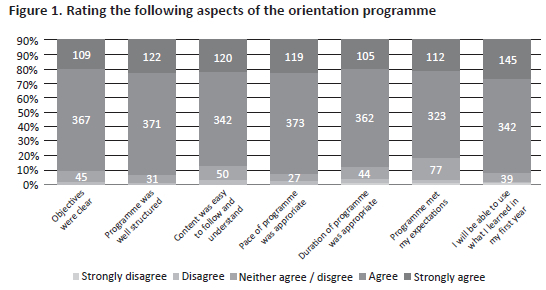
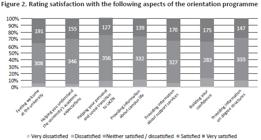
Survey responses show in Figure 1 that students overwhelmingly agreed that the structured, intentional design of the orientation programme met their expectations and equipped them with relevant knowledge. The programme's structure and pacing were also positively received, with 70% (n = 373) agreeing and 22% (n = 119) strongly agreeing that the pace was appropriate. Students felt that they would be able to use what they learned in the programme. These results highlight the value of a well-organised and responsive orientation process and programme.
Viewed through Lizzio's Five Senses of Student Success, the orientation programme supported several key domains of successful transition.
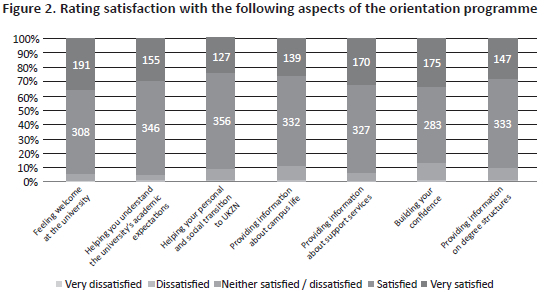
Student responses indicated a strong sense of capability: 65% (n = 346) were satisfied and 29% (n = 155) very satisfied that the programme helped them understand university expectations. Regarding confidence building, 53% (n = 283) were satisfied and 33% (n = 175) very satisfied that the programme enhanced their academic confidence and readiness. Moreover, 67% (n = 356) were satisfied and 24% (n = 127) very satisfied that the orientation helped them transition from high school to university. These responses suggest that the content covered in the programme played a key role in helping students develop a sense of self-efficacy and academic readiness.
The programme also supported students' resourcefulness by clearly presenting institutional support services, university procedures, and help-seeking strategies. This was reinforced by the group and individual advising sessions, which introduced students to key systems and clarified degree structures.
As shown in Figure 2, students reported high satisfaction with the information on student support services and campus life, demonstrating that the orientation successfully demystified university operations and encouraged early engagement. The structure of the programme - its integrated delivery across advising, registration, support services, and online learning - helped to build a foundational sense of academic culture. The inclusion of peer mentors, accessible online formats, and guided academic advising reflects an intentional effort to make institutional practices legible and navigable for students entering a complex university environment.
Responses to an open-ended question about potential improvements revealed that 77% (n = 412) of students had no suggestions for improvement. Among those who did provide comments on how to improve, feedback focused on issues related to Wi-Fi access, data availability, and the overall accessibility of the online format (n = 10). One student noted, "They must first provide data to all students since some were facing challenges in joining the meetings," another commented, "Try and minimise the time spent at the program since some of us don't have Wi-Fi or sufficient data." While technology is a valuable tool, participation and meaningful engagement can be hampered by accessibility, availability and affordability issues, particularly for students from disadvantaged and resource-poor settings.
These comments underscore Fraser's principle of redistribution (maldistribution and misrecognition), drawing attention to persistent digital inequities that affect participation in online learning environments. Despite UKZN's affirmative strategies to support students through mobile data allocation and roll out, structural challenges - such as students registering with the contact details of guardians or relatives, and not owning a device also limited access to essential communication - disproportionately affect students from under-resourced contexts. As noted in the previous section, the timing of the data roll out did not always coincide with when the student needed it to access the online orientation and academic advising session, and registration. Insufficient personal data also impacted on the amount of time a first-year student might have been able to stay online.
A small number of students (n = 13) reported challenges with digital literacy and using platforms like Zoom. Comments such as "People should mute themselves when authorised people are speaking" and "Follow basic rules like writing questions in the comments section" reflected frustration with others' lack of online etiquette and familiarity with digital platforms. While the orientation programme includes an introduction to online etiquette, students unfamiliar with the devices or engaging on Zoom for the first time struggled to navigate the platform. These responses highlight the importance of scaffolding digital learning to support varied prior exposure and competence levels. Digital and information literacy are addressed in Unit 1 of the mandatory FYEP, but additional support may be required at the outset. The FYE mentors were provided with short WhatsApp messages guiding students on how to access Zoom, but lack of familiarity will impact how a student can participate and engage online.
Language proficiency emerged as another barrier. Seven students commented on the complexity of the language used in presentations, requesting simpler explanations: "It needs to be more simple" and "Please use simplicity on packages so that one can understand." These comments highlight Fraser's recognition dimension, emphasizing the need to affirm cultural and linguistic diversity. The predominance of English as the medium of instruction may marginalise students who are more proficient in other languages. While real-time translation is logistically challenging, initiatives like bilingual training for orientation coordinators and academic advisors within the AMS programme represent a movement towards inclusive practices.
Overall satisfaction with the academic advising session
The academic advising component also received high ratings, averaging 4.18 out of 5. Qualitative feedback affirmed this impression, with comments such as, "The advising session was great and really helpful and does not need to be improved," and "The session was well managed; no improvements needed."
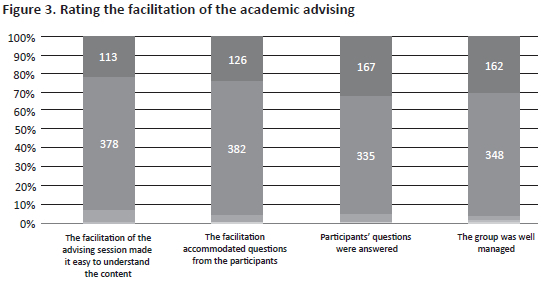
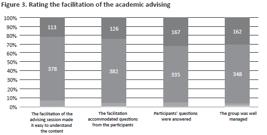
Most students - 31% (n = 167) strongly agreed and 63% (n = 335) agreed - that their questions were adequately addressed. These data indicate that students felt supported and confident in group sessions. First-year students' ability to ask questions and for these to be answered exemplifies Fraser's principle of representation - positioning students as active contributors through their engagement.
Although the sessions focused on general information about degree structures, majors, and modules, they contributed meaningfully to a sense of purpose, as articulated in Lizzio's framework. As seen in Figure 3, 62% (n = 333) were satisfied and 28% (n = 147) strongly satisfied with the information provided on degree structures, suggesting that early advising helps foster a coherent academic identity. The findings suggest that the proactive, prescriptive approaches to academic advising did enhance students' sense of purpose (personal and career alignment) through addressing their undecidedness by providing information to support decisions on degree choices, majors, and subject selection.
Based on the question on ways to improve the academic advising, some students (n = 15) requested more discipline-specific information. Comments such as "Just have more visual examples" and "Have references to module assistance" suggest that first-year students need more applied and contextualised curriculum advice. These responses point to the value of involving academic staff, postgraduate mentors, or discipline tutors in future iterations of the orientation programme to support more granular and field-specific advising. This shows that the collaboration and engagement with academic and disciplinary staff during the orientation week needs to be strengthened.
From a social justice perspective, this feedback also engages with Fraser's concept of representation - the extent to which students can influence institutional practices. While the advising sessions were largely well received, this feedback shows that opportunities for dialogue and responsiveness to student needs must be deepened. Incorporating student feedback as an iterative, dialogic process is key to creating just and participatory institutional cultures.
Building on these findings, the following conclusion synthesizes the implications for practice in higher education.
Conclusion
This study examined first-year students' experiences and perceptions of the College's proactive, equity-centred orientation and academic advising programme. Drawing on Lizzio's student success framework, the findings demonstrate that students received the intentional, structured, and focused design of the programme well. They reported an enhanced sense of capability, resourcefulness, connectedness, purpose, and engagement with academic culture. The positive reception of academic advising suggests that proactive and prescriptive early interventions supported students in clarifying their academic goals by providing timely guidance on degree choices and subject selection, thereby enabling them to conceptualise academic pathways. At the same time, the study highlighted persistent structural barriers to achieving participatory parity within the intervention.
The findings point to several key implications for academic advising practices that are transferable to similar programmes and institutions. First-year students benefit from proactive and prescriptive academic advising embedded in structured orientation activities during the opening weeks of the semester. Such approaches normalise help-seeking and foster trust and rapport between students and advisors. Effective advising in this transitional phase also requires strong collaboration between advisors, teaching staff, and student support units to ensure coherence and consistency. Importantly, valuing student voice must extend beyond compliance or routine quality assurance. When carefully designed, feedback mechanisms contribute not only to programme improvement but also to students' sense of belonging, agency, and representation. The development of student feedback tools should therefore be theoretically and conceptually grounded to inform the design of responsive, contextually relevant, and transition-sensitive interventions. Frameworks such as Lizzio's Five Senses of Success do not only provide a valuable lens for interpreting student experiences, but also for assessing the academic advising, orientation and FYEP curriculum, and for designing student feedback surveys for academic advising and orientation. This suggests the wide applicability of such a lens for strengthening academic advising and other support interventions across higher education institutions.
Further research is needed to deepen theoretical, conceptual, and practical understandings of diverse models and approaches to academic advising in the early stages of student transition in South Africa. Such work could also strengthen the evidence base and contribute to the development of best practices for advancing student success across varied higher education contexts.
Ethics statement
The University of KwaZulu-Natal Humanities and Social Sciences Research Ethics Committee (HSSREC) research and ethics committee (REC) granted ethical clearance for the study. Gatekeeper permission was obtained from the Registrar of the University of KwaZulu-Natal.
Potential conflict of interests
The author declares that there are no competing interests.
Funding acknowledgementNo funding was required to complete this study.
Acknowledgements
The authors thank the participants for their contributions and the peer reviewers for their insightful comments.
References
- Barefoot, B. O. (2000). The first-year experience: Are we making it any better? About Campus, 4(6), 12-18. https://doi.org/10.1177/108648220000400604
- Campbell, S. M., & McWilliams, S. (2016). Defining academic advising: Concepts and contexts for practice. In T. J. Grites, M. A. Miller, & J. G. Voler (Eds.), Beyond foundations: Developing as a master academic advisor. The National Academic Advising Association & John Wiley & Sons.
- Council on Higher Education (CHE). (2023). Good practice guide on student engagement in quality assurance and promotion in higher education. CHE.
- Damminger, J., & Rakes, M. (2017). The role of the academic advisor in the first year. In J. R. Fox, & H. E. Martin (Eds.), Academic advising and the first college year (pp. 19-44). University of South Carolina, National Resource Center for The First-Year Experience & Students in Transition and NACADA: The Global Community for Academic Advising.
- De Klerk, D. (2022). Academic advising and ethic of care: Enabling belonging to enhance higher education students' prospects of success. South African Journal of Higher Education, 36(6), 152‒168. https://doi.org/10.20853/36-6-5485
- Department of Education. (1997). Quality of education for all: Overcoming barriers to learning and development. DoE.
- Department of Education. (2001). National plan for higher education. DoE.
- Department of Higher Education and Training (DHET). (2020). Ministerial statement on the implementation of the university capacity development programme 2021 - 2023: Transforming teaching, learning, researching and leading towards enhanced quality. DHET.
- Drake, J. K., Jordan, P., & Miller, M. A. (Eds.). (2013). Academic advising approaches: Strategies that teach students to make the most of college. Jossey-Bass & Wiley
- ELETSA. (2023). Code of conduct and ethical standards: Guiding the professional conduct of academic advisors. ELETSA. Retrieved from https://eletsa.org.za/wp-content/uploads/2025/05/ELETSA-CODE-OF-CONDUCT_compressed.pdf
- Farrell, O., Brunton, J., & Trevaskis, S. (2020). 'If I had missed it I would have been the lost little sheep': Exploring student narratives on orientation to first year. Journal of Further and Higher Education, 44(7), 865-876. https://doi.org/10.1080/0309877X.2019.1614543
- Finley, A., & McNair, T. (2013). Assessing underserved students' engagement in high-impact practices. Association of American Colleges & Universities.
- Fox, J. R., & Martin, H. E. (2017). Academic advising and the first college year. University of South Carolina, National Resource Center for The First-Year Experience & Students in Transition and NACADA: The Global Community for Academic Advising.
- Grafe, C., Balls, D., Taylor, M. a., & Worthen, K. (2025). Does that extra email make a difference? Using early-semester targeted outreach to increase academic advising visits. Evaluation and Program Planning, (111), 1-6, Article 102594.
- Greenfield, G. M., Keup, J. R., & Gardner, J. N. (2013). Developing and sustaining successful first-year programs: A guide for practitioners. John Wiley & Sons.
- Hölscher, D., & Bozalek, V. (2020). Nancy Fraser's work and its relevance to higher education. In V. Bozalek, D. Hölscher, & M. Zembylas (Eds.), Nancy Fraser and participatory parity (pp. 3-19). Routledge.
- Keup, J. R., & Young, D. G. (2021). Being HIP: Advising as an emerging high‐impact practice. New Directions for Higher Education (195-196), 91-99. https://doi.org/10.1002/he.20411
- Kuh, G. D. (2008). High-impact educational practices: What they are, who has access to them, and why they matter. Association of American Colleges & Universities.
- Lizzio, A. (2006). Designing an orientation and transition strategy for commencing students: Applying the five senses model. Griffith University: First Year Experience Project.
- Lizzio, A., & Wilson, K. (2010). Strengthening commencing students' sense of purpose: Integrating theory and practice [Conference session]. 13th Pacific Rim first year in higher education conference, Adelaide, Australia.
- Miller, M. A., & Harrell, C. (2017). Advising academically underprepared students. In J. R. Fox, & H. E. Martin (Eds.), Academic advising and the first college year (pp. 85-106). University of South Carolina, National Resource Center for The First-Year Experience & Students in Transition and NACADA: The Global Community for Academic Advising.
- Moosa, M., & Langsford, D. (2021). "I haven't had the fun that is portrayed": First-year student expectations and experiences of starting at university. Journal of Education, (83). https://doi.org/10.17159/2520-9868/i83a07
- Motsabi, S., Diale, B. M., & van Zyl, A. (2020). The role of social support in the persistence of first-year first-generation African students in a higher education institution in South Africa. South African Journal of Higher Education, 34(4), 189‒210. https://doi.org/10.20853/34-4-3486
- Muraskin, L. (1997). "Best practices" in student support services: A study of five exemplary sites. follow-up study of student support services programs. U.S. Dept. of Education, Planning and Evaluation Office: Office of Educational Research and Improvement, Educational Resources Information Center.
- Museka, G., & Madondo, M. M. (2012). The quest for a relevant environmental pedagogy in the African context: Insights from unhu/ubuntu philosophy. Journal of Ecology and the Natural Environment, 4(10), 258-265. https://internationalscholarsjournals.org/articles/9853430504042019
- Naudé, L., & Breshears, D. (2024). It has given us a title: Identity-transitions in first-generation students at a South African university. Journal of Education, (97), 86-108. https://doi.org/10.17159/2520-9868/i97a05%20
- Pitkethly, A., & Prosser, M. (2001). The First Year Experience Project: A model for university-wide change. Higher Education Research & Development, 20(2), 185-198. https://doi.org/10.1080/758483470
- Rust, M. A., & Willey, A. E. (2024). Defining and institutionalizing proactive advising: Insights from a national survey. NACADA Journal, 44(2), 83-109. https://doi.org/10.12930/NACADA-23-11
- Schmidt, L. C., & Graziano, J. (2016). Building synergy for high-impact educational initiatives: First-year seminars and learning communities. University of South Carolina.
- Tinto, V. (2017, November 28). Re-imagining the university: Putting student outcomes [Keynote]. Code of good practice workshop, Centurion, South Africa. https://www.che.ac.za/file/3242/download?token=Mb5wF8JZ
- Tinto, V., & Pusser, B. (2006). Moving from theory to action: Building a model of institutional action for student success. National Postsecondary Education Cooperative, Issue 51.
- Troxel, W. G., Bridgen, S., Hutt, C., & Sullivan‐Vance, K. A. (2021). Transformations in academic advising as a profession. New Directions for Higher Education, 23-33. https://doi.org/10.1002/he.20406
- University of KwaZulu-Natal. (2023a). Academic monitoring and support policy.
- University of KwaZulu-Natal. (2023b). UKZN Strategic plan: 2023-2032 - At a glance. UKZN.
- University of KwaZulu-Natal. (2025). Project 2 - Academic monitoring support. UKZN University Capacity Development Programme. https://ucdp.ukzn.ac.za/ucdp-projects/project-2-academic-monitoring-support/
- Varney, J. (2013). Proactive advising. In J. K. Drake, P. Jordan, & M. A. Miller (Eds.), Academic advising approaches: Strategies that teach students to make the most of college (pp. 137-154). Jossey-Bass & Wiley.
- Vincent, C. (2019). Introduction. In C. Vincent (Ed.), Nancy Fraser, social justice and education. Routledge.
- Yorke, M. (2009). 'Student experience' surveys: Some methodological considerations and an empirical investigation. Assessment & Evaluation in Higher Education, 34(6), 721-739. https://doi.org/10.1080/02602930802474219
Accepted 16 October 2025
Published 18 August 2026