The professionalisation of academic advising practices in South Africa: A competency framework for professional academic advisors
Abstract
Owing to the high attrition rates faced by South African higher education institutions, academic advising has become a crucial strategy for enhancing student success and retention. Institutions committed to improving student learning, persistence and graduation must ensure that academic advisors receive targeted training and professional development. Such initiatives should focus on building competencies tailored to the South African higher education context and its unique challenges. However, existing literature on advising competencies in South Africa remains limited and some still regard the field as being in the early stages of development. This qualitative study aims to propose a competency framework for academic advisors in South Africa, highlighting the knowledge, skills, attitudes, and behaviours associated with professional advising from a developmental perspective. The researcher used the six steps outlined by Dalton to draft a competency framework for advisors at the University of the Free State. Dalton's steps included a literature review of existing advising frameworks, a job analysis of advisors in various roles, and a qualitative content analysis of the data. As the primary outcome of this competency modelling process, the article presents a contextually relevant competency framework for academic advisors at a South African institution.
Academic advising; competency modelling; industrial psychology; South Africa; professional advisors; professional development; training and development
Abstract
Weens die hoë uitvloeikoerse wat Suid-Afrikaanse hoëronderwysinstellings ervaar, het akademiese advies 'n kernstrategie geword om student sukses en retensie te bevorder. Instellings wat toegewyd is tot die verbetering van studenteleer, volharding en graduering, moet verseker dat akademiese adviseurs geteikende opleiding en professionele ontwikkeling ontvang. Sodanige inisiatiewe behoort te fokus op die ontwikkeling van bevoegdhede wat aangepas is vir die Suid-Afrikaanse hoëronderwyskonteks en sy unieke uitdagings. Nietemin, bly bestaande literatuur oor akademiese advies verwante bevoegdhede in Suid-Afrika beperk, en sommige beskou die veld steeds as in 'n vroeë ontwikkelingsfase. Hierdie kwalitatiewe studie het ten doel om 'n bevoegdheidsraamwerk vir akademiese adviseurs in Suid-Afrika voor te stel, met klem op die kennis, vaardighede, gesindhede en gedrag wat met professionele advies vanuit 'n ontwikkelingsperspektief geassosieer word. Die navorser het die ses stappe wat deur Dalton uiteengesit is vir kompetensiemodellering gebruik om 'n kompetensieraamwerk vir adviseurs aan die Universiteit van die Vrystaat te ontwikkel. Dalton se stappe sluit 'n literatuuroorsig van bestaande akademiese advies raamwerke, 'n werksontleding van adviseurs in verskeie rolle, en 'n kwalitatiewe inhoudsontleding van die data in. As die primêre uitkoms van hierdie kompetensiemodelleringproses, bied die artikel 'n kontekstueel relevante kompetensieraamwerk vir akademiese adviseurs aan 'n Suid-Afrikaanse hoëronderwysinstelling.
Akademiese advies; kompetensiemodellering; kompetensieraamwerk; bedryfsielkunde; Suid-Afrika; professionele adviseurs; professionele ontwikkeling; opleiding en ontwikkeling
Background and introduction
Despite various student support interventions, South Africa continues to face low retention and graduation rates, primarily due to systemic factors such as poor school education, limited resources, and misaligned curricula that leave many first-year students underprepared for university (Tiroyabone & Strydom, 2021; De Klerk, 2021). Additionally, many students are first generation, commute daily, and often feel overwhelmed, disconnected, and lack a sense of belonging (CTL, 2019). These challenges contribute to high dropout rates, which carry significant cost implications for the state, students, and their families (Tswanya, 2017).
In response to these challenges, academic advising has been increasingly recognised as a key institutional function for improving student retention and success (Tiroyabone & Strydom, 2021; Strydom & Loots, 2020; De Klerk, 2022). Therefore, higher learning institutions must prioritise providing high-quality academic advising (Emekako & Van der Westhuizen, 2020), as quality advising is also recognised as central to the successful implementation of institutional strategy (Voller, 2013). This emphasizes the growing need for the professionalisation of academic advising in the South African higher education sector.
Various initiatives have been implemented to support the professionalisation of academic advising in South Africa. National efforts have focused on building institutional capacity for academic advising, sharing best practices nationally, training professional and peer advisors, and developing academic advising as a scholarly discipline (ELETSA, n.d.; Siyaphumelela Advising Workstream, 2017). The Department of Higher Education and Training (DHET) has played a critical role in reaching these objectives through the collaborative grant. The grant focuses on establishing a structured approach to student development and identifying academic advising as essential to improving student success (Khanye, 2024). The DHET grant was based on the effort of the advising workstream, which formed part of the Siyaphumelela initiative, and has already played a key role in establishing advising structures in South African universities.
Furthermore, the formation of ELETSA, the first academic advising association for South Africa, followed in 2021. ELETSA, which means 'advising' in Sesotho, aims to position academic advising as a practice that enhances coordination and effectiveness to ultimately improve student success in South Africa (Tiroyabone & Strydom, 2021).
The University of the Free State (UFS) further facilitates the development of advising as a profession in South Africa through the Academic Advising Professional Development (AAPD) short learning programme. As of 2018, more than 500 professional advisors have completed the AAPD. This programme is currently the only academic advising training programme in the country, making a significant contribution to the professionalisation of academic advising in South Africa (Schoeman et al., 2021). However, Khanye (2024, p. 20) states that although the potential of academic advising to advance student success has been recognised in South Africa in recent years, the "profession has not been solidified conceptually and professionally in South African policy and practice," leaving room for further exploration of what the professionalisation of academic advising means.
Aucamp (2022) notes that higher education institutions committed to student learning, persistence, and graduation must provide their academic advisors with structured training and ongoing professional development. In addition, training and development initiatives should focus on developing competencies associated with high-quality advising unique to the South African context. Competencies for professional advising practices can be identified by creating a competency framework for South African advisors. No formal competency framework has been developed for the South African context; national training and development programmes rely heavily on international influences such as the National Academic Advising Association (NACADA) in the United States. Therefore, the field remains underdeveloped (Khanye, 2024) and recruitment practices may be inconsistent (De Klerk et al., 2024).
NACADA developed a competency model for academic advisors in 2017 to address the lack of clarity regarding the role boundaries and responsibilities of advisors internationally. The NACADA competency model focuses on competencies within the conceptual, informational, and relational components of advising (NACADA, 2017b). These competencies have largely influenced the development of advisor competencies in South Africa. However, South Africa has unique contextual factors that necessitate a competency framework which includes the professional competencies required to address the South African advising context.
This study aimed to develop a contextualised competency framework for academic advisors at the UFS, serving as a starting point for investigating professional advising competencies responsive to the needs of students in the South African context. Discoveries from this study could help guide advisor selection, recruitment, training and professional development (Aucamp, 2022; De Klerk, 2024). Furthermore, the competency framework could help analyse and improve advising practices, provide deeper insight into institutional expectations of academic advising in various roles to distinguish top and average performers, and help promote scholarship in the field (Aucamp, 2022). Lastly, advisors could use this framework for self-assessment and evaluation to guide the advisors' learning, career development, training, and evaluation (NACADA, 2017c).
South African literature has noted a growing research interest in professional competencies in academic advising. Khanye (2024) notes that the AAPD contextualises core advising competencies to South African advisors. The AAPD focuses on building an understanding of advising and knowledge systems associated with professional advising. Furthermore, it focuses on competencies related to the advisor-student relationship such as rapport-building, record-keeping, referral skills, and ethical decision-making. The AAPD further focuses on the professional development of advisors, emphasizing competencies such as cultural awareness, managing stress and burnout, and establishing a professional scholarly practice in advising.
De Klerk et al. (2024) investigated competencies for advisors. They proposed a model viewing advising competencies across multiple dimensions, including emotional support, socio-economic factors, scholarly activities, skills development, and teaching and learning. Following a phenomenological approach, these authors integrated advising themes and personal experience into the findings of their model. This study includes a literature review of specific competencies related to advising, which forms part of Dalton's competency modelling process. The discussion section of this article elaborates on these competencies.
The researcher views advisor competencies from an organisational psychology perspective. From this viewpoint, competencies are defined as a combination of observable and measurable knowledge, skills, abilities, and personal attributes that enhance employee performance, ultimately resulting in organisational success (University of Nebraska, 2022). Furthermore, the researcher employed a competency modelling approach, utilising a wide range of datasets to develop a competency framework for the UFS. The researcher derived this framework from existing literature and frameworks, as well as a job analysis that shares the employee's viewpoint. In addition, the current competency model of NACADA (2017c), the primary influence on competency development in South African institutions, was also considered in the research process.
Methodology
Research design
This qualitative study was conducted within the framework of the constructivist research paradigm (Patel, 2015). The ontology of this study is based on the notion that no single reality exists about the competencies necessary for academic advisors; instead, reality is created by the individuals who work in academic advising. In this research paradigm, the purpose of this study was to contribute to the body of knowledge regarding academic advisors. An inductive research approach was followed, with the competency framework as the end goal.
Research context and participants
The study was was conducted at the University of the Free State; it aimed to develop a competency framework tailored to this institutional context. The goal was not to generalise findings to the broader South African context but rather to include the lived experiences of advisors across diverse faculties and roles.
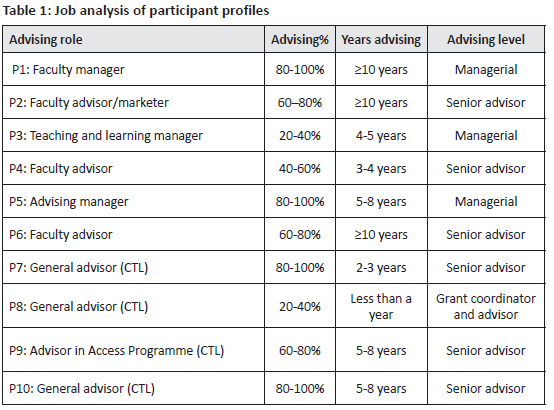
Purposive sampling was used to select 10 participants, including academic advisors and management staff from various departments and roles. Inclusion criteria considered years of advising experience, the proportion of advising responsibilities in the job profile, departmental context, and advising level. This ensured a representative range of perspectives. Data saturation was reached after the ninth interview as no new themes emerged in the tenth interview. Participant profiles were as follows:
Data collection methods
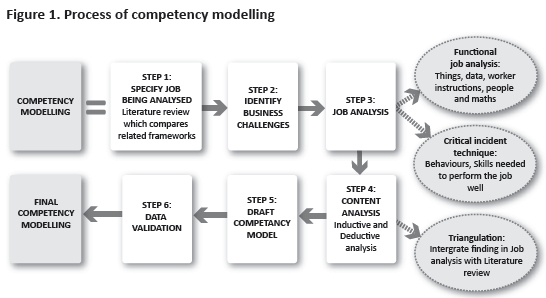
The competency framework shared in this study was developed through competency modelling. Drawing from industrial psychology, Campion et al. (2011) state that competency modelling is an important innovation that helps organisations focus on job-related information and employee skills. Figure 1 presents the competency modelling process in the six steps identified by Dalton (1997, as cited in Keller, 2016).
Step 1: Specifying the job being analysed
Step 1 involved a literature review to explore and compare advisor job profiles, existing literature, competency models and frameworks relevant to academic advising. The study examined existing competency frameworks that could be a point of reference in the South African advising space, such as the competency framework of NACADA (NACADA, 2017b), the competency model presented by Educor (a South African Education group) in 2022, and the South African career development framework (DHET, 2016). The latter has relevance because career advising is an essential function of advising (Schoeman, 2021). The three competency frameworks studied increased the validity of the literature review through triangulation.
Step 2: Identifying business challenges
The second step involved researching academic advising trends in South Africa and the evolution of the advising role. This was completed through the literature review. A competency framework for South African academic advisors must include specific knowledge, skills, attitudes, and behaviours needed to address student concerns and help students overcome financial and social barriers to success (Branson & Whitelaw, 2023; De Klerk et al., 2024).
Step 3: Job analysis
A job analysis identifies key knowledge, skills, and attitudes associated with good job performance in a particular job (academic advising). A functional job analysis investigates tasks, duties, responsibilities, and the knowledge, skills, abilities, experience, and personal characteristics to perform them (Dalton, 1997; Landy & Conte, 2010). Step 3 consisted of a functional job analysis and critical incident interviews with 10 academic advisors at the UFS. The functional job analysis and critical incident techniques comprised a semi-structured interview protocol of 24 questions. Examples of questions included: "What values do you associate with a good academic advisor?" Alternatively, "What type of reasoning does an academic advisor need to be able to do?". The critical incident technique provides deeper insight into behaviours associated with delivering quality advising versus providing advising that is below the required standards. For example: "What behaviours could you get a reward for in advising?" Or "What kind of behaviours might lead to negative consequences?".
Step 4: Content analysis
Step 4 involved a qualitative content analysis to compare competencies identified in the literature with those emerging from participants' lived experiences at the UFS (Elo & Kyngäs, 2008). This process facilitated the identification of recurring patterns, themes, and deeper insights into the competencies essential for professional advising (Creswell, 2014).
Both inductive and deductive approaches were used. Initially, an inductive coding process of the interview transcripts yielded 64 codes. These were then deductively sorted into competency elements - skills, attitudes, behaviours, and values - and further categorised according to five advising components: (1) conceptual, (2) informational, (3) relational, (4) technological, and (5) professional, as defined by NACADA, the AAPD, and institutional guidelines.
Step 5: Drafting a competency model
After completing the content analysis, the researcher triangulated data gathered from the literature review and job analysis. The researcher collected data from advisors in multiple contexts (such as faculty advisors, general advisors, advising managers, and access programme advisors), used various methods (literature study, job analysis, and critical incidents) to gather data, and studied multiple competency models from a variety of perspectives (Fielding & Fielding, 1986, as cited in Lune & Berg, 2017). Dalton (1977, as cited in Keller, 2017) notes that this helped corroborate the findings during a competency modelling process. The researcher drafted a single competency model for the UFS.
Step 6: Validating the competency model
The researcher shared the competency model with academic advisors at the UFS to validate the data and integrated advisor feedback into the model. The validated and finalised model appears in Annexure A.
Main findings
Developing a professional competency framework for academic advisors at the UFS
The main findings of this study present and discuss the researcher's competency framework for the academic advisors at the UFS. Unlike typical frameworks that focus on a limited set of critical competencies for a specific role, this framework is deliberately detailed to support the ongoing training and professional development of academic advisors at the UFS. The competency framework encompasses knowledge systems relevant to professional advising, the skills required for this job, relational competencies, technical abilities, professional competencies related to the practice, and value systems associated with professional academic advising. Annexure A presents the competency framework for UFS advisors.
The competency model was designed to inform professional advisor competencies within the five components of academic advising: conceptual, informational, relational, technological and professional. Each component is briefly described, followed by core competencies identified in the particular component. A narrative description of each component, including main findings, follows.
Discussion of professional competencies
The conceptual knowledge of advising
The conceptual component of advising includes elements related to advising as a construct and practice, as well as theories and models, and outlines how advising forms part of the organisational structure (NACADA, 2017c; UFS, 2018; Khanye, 2024).
Advisors form part of the organisational strategy and should be familiar with the institutional vision, mission, objectives, and operational plans. In addition, universities must establish which institutional advising model best integrates academic advisors into the student support network and higher education system (NACADA, 2017c; McClellan, 2007) and support the organisational strategy. Furthermore, advisors should be familiar with the history and concept of advising, its elements, and its core competencies (NACADA, 2017a; UFS, 2018). Theories, approaches, models, and practices that form the foundation of the advising profession encompass advising. In the South African context, advisors must understand the challenges faced by students, including developmental and financial barriers (McClellan, 2007; UFS, 2018; DHET, 2016; De Klerk et al., 2024), and be familiar with relevant studies and reports, such as data on student engagement and higher education analyses.
Additionally, South African advisors must create equitable and inclusive environments for students from various cultures, languages, genders, races, sexual orientations, ethnicities, physical and mental capacities, and socio-economic backgrounds (NACADA, 2017b; DHET, 2016).
Prominent in this framework, is the UFS advisors' developmental approach to academic advising. Even faculty advisors referred to the advising relationship as "close to coaching" and indicated that advising interactions are about forming a trusting relationship focused on student success.
The informational component
The informational component reflects information that advisors should be aware of, both internal and external to the institution, and information that contextualises their advising role, such as student needs (NACADA, 2017c; UFS, 2018).
First, advisors should be competent in developing and maintaining an institutional support network for students as key role players in promoting student success (McGill et al., 2020). This often requires the competencies in relationship building, negotiation, and marketing skills, as well as networking among advisors.
In addition, academic advisors should be able to identify which key stakeholders will form part of the advising network and support strategic objectives for advising at the institution (DHET, 2016; Educor, 2022; De Klerk et al., 2024).
Other important aspects mentioned in the framework include the rules, regulations, and policies of the university and the faculties in which the advisors operate (NACADA, 2017c; Educor, 2022). These aspects were also confirmed by advisors in the job analysis as crucial; they comprise the informational elements most frequently mentioned during the interviews. Alongside the most important aspects are the admission requirements, curriculum, and knowledge of the field in which the advisor is advising. Academic advisors further identified curriculum and educational planning as the most critical functions of academic advisors at the UFS. Advisors who held various roles in different faculties shared this view. Although faculty advisors only emphasized curriculum planning as a job function, both faculty advisors and advisors in the Centre for Teaching and Learning (CTL) indicated the importance of understanding the curriculum and related academic requirements.
An interesting element which has emerged, is how different sources view being academically qualified for advising. While the literature on advising and advisors generally agrees that advisors should hold an appropriate bachelor's degree, the job analysis identified a social sciences or psychology background as particularly helpful for academic advisors. Interestingly, the advisors mentioned the social sciences 22 times during the job analysis as potentially beneficial for advisors. This argument is rooted in academic advising, which aims to help students gain social and academic capital, connect them to support services, and provide holistic support. Advising, therefore, requires skills such as empathy, active listening, effective questioning, and rapport building, which are developed in these professions.
Moreover, advisors should be knowledgeable about providing career advice. Career advisors should be aware of career-related resources, including career websites, funding opportunities, financial aid, and educational opportunities (DHET, 2016). UFS advisors mentioned knowledge of career advising but did not elaborate during the job analysis. Further exploring how this practice fits into the advising structure may be beneficial. Schoeman (2021) agrees that career advising is not always formalised and consciously integrated into assisting students.
Advisors should understand their students' contexts and unique characteristics, needs, and experiences (NACADA, 2017b). These include physical and mental capacity, as well as understanding the role that disabilities play in the academic journey of students (DHET, 2016).
During the job analysis, UFS advisors expressed their belief that academic advisors should also know student success skills and be able to transfer them to students. With 70% of South African students being the first in their families to enter university, students require guidance and support in navigating higher education successfully (Universities South Africa (USAf), 2018, as cited in Tiroyabone & Strydom, 2021). Therefore, competence in developing and transferring skills will become an increasingly required competency for advisors in the South African context; this competency framework has been uniquely added to address this need.
Service orientation is another competency relevant to the South African context and the UFS. UFS advisors must possess a strong service orientation to address the everyday challenges faced by UFS students as basic needs are often at the core of advising. Student engagement data can help inform this understanding and encourage strong collaboration with student support units, such as counselling, food schemes, and social work services. One faculty advisor mentioned: "Whatever they do, they must know that it's not for [ourselves]; it is giving back to the community and society whatever you have gained from the organisation." This comment reflects the spirit of ubuntu, which means 'humanity to others' and true to South Africa.
Relational component
The relational component includes the knowledge, skills, and attitudes needed to plan and conduct advising sessions effectively, build and maintain trusting relationships with advisees, and act ethically (NACADA, 2017b; UFS, 2018). The competency mentioned most during the interviews was problem-solving, with 39 references. Advisors alluded to how important it is for advisors to "be able to assist students with finding solutions to their problems" and "adapting and dealing with problems themselves". A manager in advising stressed this by commenting, "Advisors are literally solving problem after problem and trying to reason with the student.". The National Framework for Career Development also refers to this skill (DHET, 2016). Furthermore, advisors need to be able to plan and conduct practical advising sessions. This includes scheduling and planning sessions. It also includes applying advising models (NACADA, 2017c; Educor, 2022), record-keeping, and managing data during advising interactions.
Aside from planning, including an advising philosophy in the competency framework remains debatable, although the findings showed agreement on its importance. Although NACADA (2017b) identifies this competency as a relational element, the UFS (2018) has included it in its professional advising component.
Notably, a significant portion of advising involves providing information and communicating with students and university stakeholders. Therefore, the Career Development Framework (DHET, 2016) indicates that advisors should be aware of ethical issues related to telephonic, email, and chatroom communication, as well as advice, guidance, information sharing, and matters concerning career information for individuals and groups. Regarding this, communication skills encompassing both written and oral, were mentioned 28 times by the UFS advisors. Advisors often communicate with various stakeholders, including students, parents, departmental staff, and external stakeholders. One advising manager referred to this skill as being "critical" to academic advising. Additionally, delivering bad news is a specific aspect of advising that requires advanced communication skills (Hammond, 2017).
Another measurable attribute linked to dealing with sensitive information is assertiveness, which was also mentioned by faculty and many general academic advisors. One faculty manager commented: "Sometimes you have to be firm, but not rude," while another indicated that you need to be "firm in whatever decision [you] take." These comments suggest that advisors need to communicate in an authoritative yet sensitive manner (Aucamp, 2022).
Building trusting relationships is a key component of the foundation for advising interactions in line with the developmental approach (Masengeni, 2019). A manager emphasized that "critical skills should be used to build relationships." Notably, the literature emphasizes specific listening, questioning, summarising, rapport-building, and referral skills. However, advisors highlighted the importance of attitudes such as patience, tolerance, empathy, caring for students, a willingness to go the extra mile, and unconditional positive outlook. Therefore, academic advisors' attitudes and values are regarded as essential to individuals in the advising profession.
The competency frameworks studied highlighted essential values, such as trustworthiness, respect, teamwork and collaboration, assertiveness, compassion, and empathy. The job analysis highlighted the importance of work ethic, patience, and tolerance. Some values (such as trustworthiness and respect) can be related to ethical principles in any helping profession. This might indicate the importance of the ethical principles of teaching advisors and how to apply them in their advising. The literature alludes to the extent of moral codes and the conduct of academic advisors. This aspect is discussed under the professional advising component in this framework, as ethics form part of professional practice.
Technological component
The technological advising component includes the skills, knowledge, and attitudes needed to advise students effectively using the technological tools available (McClellan, 2007; UFS, 2018). The results did not deliver as many elements in the technological component as in the first three mentioned. However, data management and analytics are becoming increasingly crucial as proactive and intrusive advising approaches become more prevalent. Thus, technology is foregrounded in advising to help address academic challenges during the massification in South African institutions of higher learning. To implement these approaches, academic advisors will need both an understanding of how university systems and data management work and a technological aptitude to implement proactive, intrusive interventions (McClellan, 2007).
Nevertheless, the studied frameworks identified that advisors must be innovative and clearly understand informal and formal institutional systems. Advisors agreed and added that basic computer literacy is needed to manage these systems effectively. Interestingly, innovation is mentioned as an essential value at the UFS (2016) and advisors who want to develop in line with the latest advising trends will need to display this value in their everyday work. As South African higher education institutions increasingly adopt proactive and data-driven advising models, the technological component will become central to effective advising practices.
The professional component
The professional advising component refers to the competencies that allow advisors to maintain excellence in their advising practice and help them specialise and grow in their profession (UFS, 2018).
Two professional competencies identified by advisors that are not currently addressed in any existing advising framework, include research and project management skills. One advising manager emphasized: "[w]ith the developments of the field, research and scholarly work [are] also critical within this field." With advising being situated in an institution of higher learning and as a scholarly practice still evolving in South Africa, it makes sense that these skills are also needed for academic advisors in the South African context. In addition, advising is also a data-driven practice and with proactive-intrusive advising approaches becoming more prominent, advisors will follow a research-based approach to advising initiatives.
Furthermore, academic advisors must follow an evidence-based approach to manage projects that promote student success. This is where basic project management skills are required. One advisor stated that the advising role involves "implementing, monitoring and evaluating advising projects and initiatives," and that it is about "developing, managing and evaluating projects to assist students in succeeding."
Additionally, the professionalism of academic advisors stands out as a notable competency. The data referred to professionalism in comments such as "you need to keep your professional distance"; "you should have self-respect", and "you need to honour your appointment with your student." In addition, understanding professional scope, ethical standards, and professional behaviours is typically associated with professional careers.
Competencies associated with advising leadership
Leadership was mentioned once as a necessary skill for advising. Therefore, it is essential to identify whether this competency applies to all academic advisors or only to advisors in leadership positions. An advising manager indicated that an element of leadership is needed for all advisors, as an advisor "[is] always at the head of everything." In addition to leadership, specific codes identified in the data can also be associated with managerial positions in advising. Competencies linked to advising managers may include reasoning skills, conflict management, strategic thinking, and strategic planning. Future studies should clarify the distinctions between leadership competencies required of all advisors and those specific to managerial roles.
Abilities related to academic advising competencies
An interesting addition to this framework was the abilities associated with good advising. Through inductive data analysis, it became apparent that some of the codes identified by advisors were not only associated with skills, knowledge, attitudes, and behaviours as viewed as competencies in this study, but they also form part of specific abilities such as emotional intelligence, language ability, and reasoning ability. Psychometric tests can measure abilities and the identification of abilities related to a particular position can help recruit, select, and place individuals who display a high job fit. The abilities identified in this study are discussed below.
Emotional intelligence (EI). Emotional intelligence (EI) refers to the capacity to perceive, understand, regulate, and manage one's own emotions, as well as to recognise and respond appropriately to the feelings of others (Goleman, 1995). In academic advising, EI supports the development of empathetic relationships, enhances communication, and enables advisors to respond effectively to students' emotional and developmental needs.
The literature review, frameworks, and interviews in this study emphasized the importance of advisors displaying empathy and caring for students. Additionally, the results have shown that advisors must establish rapport, manage relationships with students, parents, and colleagues, build a student support network, and communicate effectively in both written and oral formats. Maintaining relationships and understanding others is an essential element of EI. Advisors further identified elements of personal competence such as self-awareness, self-control, initiative, and optimism as crucial competencies for effective advising. In addition, social competencies, such as awareness of others, empathy, service orientation, conflict management, teamwork, and collaboration, were also identified in the results as crucial for advising. Manz (2020) suggests that very little research has been conducted on EI and academic advising; however, EI is essential for building relationships that form the foundation of good advising, and best practices in advising require a significant aptitude for emotional intelligence (Haley, 2016).
Language ability. There is consensus among sources that academic advisors should possess good communication skills and communicate effectively in both verbal and non-verbal forms (DHET, 2016; Haley, 2016; Keller, 2016). Language ability in education is often defined as listening, speaking, reading, and writing (Linde, 2015). The study results addressed most of these aspects, including multilingualism, as critical for academic advisors. In-basket tests that assess proficiency in language can aid in advisor recruitment and selection, as well as inform professional development plans.
Reasoning ability. With problem-solving identified and highlighted as the most critical skill for advising and conflict management, it seems that reasoning ability is another key ability for academic advisors. A deeper investigation into the prevalence of these three abilities in South African advisors could help unfold how psychometric tests related to these abilities can enhance the recruitment and selection of academic advisors in the South African milieu.
The comprehensive competency framework presented in Annexure A and discussed in this article captures a broad spectrum of knowledge, skills, attitudes, values, and abilities essential for professional academic advising at the UFS. The overlap of competencies across components underscores the interconnected nature of advising practice. Further research is recommended to refine these competencies and explore their applicability in broader South African contexts.
Concluding remarks
Academic advising is a rapidly evolving and emerging professional field in South Africa. Recent national initiatives to establish advising networks and promote professionalisation have highlighted the need to identify the core competencies required for effective advising practice. These initiatives focus on strengthening institutional capacity by recruiting, training, and developing professional academic advisors equipped to respond to the unique challenges of the South African higher education context.
This study contributes to these national efforts by proposing a contextually grounded competency framework for academic advisors at the UFS (see Annexure A). The framework reflects a broad and developmental understanding of the competencies required for professional academic advising, including knowledge, skills, values, and behaviours, which could be relevant to advising in other local higher education settings with adaptations to their specific contexts.
While this framework is based on research conducted at the University of the Free State, it offers a valuable reference point for other institutions seeking to formalise or enhance their advising practices. As a starting point, it can inform future efforts related to advisor recruitment, selection (De Klerk et al., 2024), and professional development (Aucamp, 2022).
The study acknowledges its limitations in scope and transferability. Nonetheless, it encourages the development of additional institution-based studies to support the creation of a national competency framework. Such a framework would help professionalise academic advising across the sector and contribute to more standardised, developmental and effective advising practices in South African higher education.
Ethics statement
Ethical clearance was obtained from the Faculty of Economic and Management Sciences at the University of the Free State. Informed consent was obtained from all participants, who were assured of voluntary participation and the right to withdraw at any time. Anonymity and confidentiality were maintained throughout, with identifying details removed. All data were stored securely on a password-protected device.
Potential conflict of interests
The author has no conflict of interests to disclose.
Aucamp, J. J. (2022). A competency framework for academic advisors at the University of the Free State [Unpublished master's dissertation]. University of the Free State.
Funding acknowledgement
No funding was received.
References
- Branson, N., & Whitelaw, E. (2023). South African student retention during 2020: Evidence from system-wide higher education institutional data. South African Journal of Economics, 92(1), 1-22. https://doi.org/10.1111/saje.12361
- Campion, M. A., Fink, A. A., Ruggeberg, B. J., Carr, L., Phillips, G. M., & Odman, R. B. (2011). Doing competencies well: Best practices in competency modelling. Personnel Psychology, 64(1), 225-262. https://doi.org/10.1111/j.1744-6570.2010.01207.x
- CTL (Centre for Teaching and Learning). (2019). Access and success report. University of the Free State.
- Creswell, J. W. (2014). Research design: Qualitative, quantitative, and mixed methods approach (4th ed.). SAGE.
- De Klerk, D. (2022). Academic advising during emergency remote teaching and learning: A South African higher education perspective. Scholarship of Teaching and Learning in the South, 6(1), 95-111. https://doi.org/10.36615/sotls.v6i1.210
- De Klerk, D., Jadhav, A., & Hundermark, G. (2024). Enhancing student success through professionalised academic advising: A model for identifying academic advisors for South African higher education contexts. South African Journal of Higher Education, 38(5), 210-229. https://doi.org/10.20853/38-5-5219
- Department of Higher Education and Training (DHET). (2016). Competency framework for career development practitioners in South Africa. DHET.
- Educor. (2022). Academic advising centre's role. https://educor.co.za/academicadvisingcentre
- ELETSA. (n.d.). About. https://eletsa.org.za/about/
- Elo, S., & Kyngäs, H. (2008). The qualitative content analysis process. Journal of Advanced Nursing, 62(1), 107-115. https://doi.org/10.1111/j.1365-2648.2007.04569.x
- Emekako, R., & van der Westhuizen, D. (2020). Progressive and developmental pathways for student retention and academic success: Lessons from one-on-one student academic advising. South African Journal of Higher Education, 34(6), 139-154. https://doi.org/10.20853/35-6-4208
- Goleman, D. (1995). Emotional intelligence: Why it can matter more than IQ. Bantam Books.
- Haley, L. (2016, March). The role of emotional intelligence in quality academic advising. Academic Advising Today, 39(1). https://nacada.ksu.edu/Resources/Academic-Advising-Today/View-Articles/The-Role-of-Emotional-Intelligence-in-Quality-Academic-Advising
- Keller, S. J. (2016). Competencies for the community college advisor: A crucial job in the student success mission [Doctoral dissertation, University of Nevada]. UNLV Theses, Dissertations, Professional Papers, and Capstones (2690). http://dx.doi.org/10.34917/9112092
- Keller, S. J. (2017, June 26). Competency-based advisor hiring & preparation: Introducing 3 key competency clusters. Educause Review. https://er.educause.edu/blogs/2017/6/competency-based-advisor-hiring-and-preparation-introducing-3-key-competency-clusters
- Landy, F. J., & Conte, J. M. (2010). Work in the 21st century: An introduction to industrial and organisational psychology. (3rd ed.). John Wiley & Sons.
- Linde, S. (2015). Building on students' current language skills. OAE Elementary Education Study Guide and Test Prep. https://study.com/academy/lesson/building-on-students-current-language-skills.html
- Lune, H., & Berg, B. L. (2017). Qualitative research methods for the social sciences (9th ed.). Pearson.
- Manz, M. N. (2020). A mixed methods study of the relationship between emotional intelligence and academic advisor's influence on student engagement and persistence [Unpublished doctoral dissertation]. University of Pennsylvania.
- McClellan, J. L. (2007). Content components for advisor training: Revisited. NACADA Clearinghouse of Academic Advising. http://www.nacada.ksu.edu/Resources/Clearinghouse/View-Articles/Advisor-TrainingComponents.aspx
- McGill, C. M., Ali, M., & Barton, D. (2020). Skills and competencies for effective academic advising and personal tutoring. Frontiers in Education, 5(1), 135. https://doi.org/10.3389/feduc.2020.00135
- NACADA. (2017a). NACADA core values of academic advising. NACADA. https://nacada.ksu.edu/Resources/Pillars/CoreValues.aspx
- NACADA. (2017b). Academic advising core competencies guide. NACADA.
- NACADA. (2017c). NACADA academic advising core competencies model. NACADA. https://www.nacada.ksu.edu/Resources/Pillars/CoreCompetencies.aspx
- Nutt, C. L. (2003). Creating advisor training and development programs. In NACADA (Ed.), Advisor training: Exemplary practices in the development of advisor skills (pp. 9-16). NACADA.
- Obaje, T. A., & Jeawon, R. (2021). A critical review of the adopted academic advising approaches at the Durban University of Technology: Unpacking its strengths and challenges. Journal of Student Affairs in Africa, 9(2), 17-29.
- Patel, S. (2015, July 15). The research paradigm - methodology epistemology, and ontology - Explained in simple language [Blog]. Dr Salma Patel. http://salmapatel.co.uk/academia/the-research-paradigm-methodology-epistemology-and-ontology-explained-in-simple-language/
- Schoeman, M. (2021). Integrating African academic and career advising in higher education institutions [Unpublished master's dissertation]. University of the Free State.
- Siyaphumelela Advising Workstream. (2017). Developing academic advisers [PowerPoint slides]. Siyaphumelela.
- Strydom, J. F. (2016). Academic advising: A 'missing link' between access and success in South African higher education? [Conference session]. Siyaphumelela Conference 2016, Durban.
- Strydom, J. F., & Loots, S. (2020). The student voice as contributor to quality education through institutional design. South African Journal of Higher Education, 34(5), 20-34. https://doi.org/10.20853/34-5-4263
- Tinto, V. (2009). Taking student retention seriously: Rethinking the first year of university [Keynote speech]. ALTC FYE Curriculum design symposium, Queensland University of Technology, Brisbane, Australian, 5 February. https://www.researchgate.net
- Tiroyabone, G. W., & Strydom, F. (2021). The development of academic advising to enable student success in South Africa. Journal of Student Affairs in Africa, 9(2), 1-16. https://doi.org/10.24085/jsaa.v9i2.3656
Accepted 13 October 2025
Published 18 August 2026