Prescriptive or developmental advising? A situational approach to first-year students in a mathematics course at a South African university
Owing to the history of South Africa, the challenges associated with new students entering institutions of higher learning each year are well established in the academic discourse and civil society circles. The quality of mathematics education is a particular cause for concern. South Africa, considered as a developing country, requires a student population with skills relevant to Science, Technology, Engineering, and Mathematics (STEM). In this article, we draw from personal experience by challenging the implicit assumption that 'at risk' students fall in line and seek available support for their benefit. Based on personal experience, we argue that students do not arrive at university tabula rasa; they draw on their worldviews and personal experiences as frames of reference. Therefore, they sometimes reject what they perceive as 'intruding' university interventions. It is to address this challenge that student advisors and all other stakeholders dedicated to student support must find creative and innovative approaches. Drawing on the Dunning-Kruger effect, we demonstrate that, at times, students suffer from inflated self-images. This is a metacognitive deficit that accounts for inflated self-appraisals and, as such, necessitates the interchangeable use of prescriptive and developmental advising.
Developmental advising; prescriptive advising; self-concept; Calculus Readiness Test; student support
Ka lebaka la histori ya Afrika Borwa, ditlhohlo tšeo di amanago le baithuti ba bafsa bao ba tsenago dihlongwa tša thuto ya godimo ngwaga o mongwe le o mongwe di hlomilwe gabotse ka gare ga dipolelo tša thuto le didiko tša setšhaba sa badudi. Se se tshwenyago ke boleng bja thuto ya dipalo ka mo go kgethegilego. Ka ge e le naga ye e hlabologago, Afrika Borwa e nyaka palo ya baithuti bao ba nago le bokgoni bjo bo lebanego le Saense, Theknolotši, Boentšenere, le Dipalo (STEM). Go ya ka tše di boletšwego ka mo godimo, re tšea go tšwa maitemogelong a motho ka noši mo seabeng sa bjale ka go hlohla kakanyo ye e sa kwagalego ya gore baithuti bao ba lemogilwego bao ba lego 'kotsing' ba wela mothalong gomme ba nyaka thekgo ye e lego gona bakeng sa go ba hola. Go ya ka maitemogelo a motho ka noši, re phega kgang matlakaleng a gore baithuti ga ba fihle tabula rasa ya yunibesithi; ka fao, ba tšea dipono tša bona tša lefase le maitemogelo a bona ka noši bjalo ka foreime ya tšhupetšo gomme ka go realo ka dinako tše dingwe ba gana seo ba se bonago bjalo ka ditsenogare tša yunibesithi tšeo di 'tsenago gare'. Ke tlhohlo ye moo baeletši ba baithuti le bakgathatema ba bangwe ka moka bao ba ineeetšego thekgong ya baithuti ba swanetšego go hwetša mekgwa ye bothlajana le ya boitlhamelo. Ka go diriša mafelelo a Dunning-Kruger, re bontšha gore, ka dinako tše dingwe, baithuti ba tlaišwa ke diswantšho tša go ipona tše di buduletšwego. Ye ke tlhaelelo ya kgopolo-tšhomo yeo e ikarabelago ka ditlhahlobo tša go itlhahloba tše di phagamišitšwego gomme ka ge go le bjalo, e nyaka tšhomišo ye e fapantšhwago ya keletšo ya taelo le ya tlhabollo.
Go eletša ka tlhabollo; go eletša ka taelo; kgopolo ya go ipona; Teko ya go itokišetša ga calculus; thekgo ya baithuti
Prescriptive or developmental advising? A situational approach to first-year students in a mathematics course at a South African university
Keletšo ya taelo goba ya tlhabollo? Mokgwa wa maemo go moithuti khosong ya dipalo ya ngwaga wa mathomo yunibesithing ya Afrika Borwa
Mpho MmadiI; Baphumelele NxalaII
IAcademic Success Coach: Faculty of Natural and Agricultural Sciences, University of Pretoria, South Africa. Email:
IISenior Technical Assistant: Department of Mathematics, University of Pretoria, South Africa. Email:
Owing to the history of South Africa, the challenges associated with new students entering institutions of higher learning each year are well established in the academic discourse and civil society circles. The quality of mathematics education is a particular cause for concern. South Africa, considered as a developing country, requires a student population with skills relevant to Science, Technology, Engineering, and Mathematics (STEM). In this article, we draw from personal experience by challenging the implicit assumption that 'at risk' students fall in line and seek available support for their benefit. Based on personal experience, we argue that students do not arrive at university tabula rasa; they draw on their worldviews and personal experiences as frames of reference. Therefore, they sometimes reject what they perceive as 'intruding' university interventions. It is to address this challenge that student advisors and all other stakeholders dedicated to student support must find creative and innovative approaches. Drawing on the Dunning-Kruger effect, we demonstrate that, at times, students suffer from inflated self-images. This is a metacognitive deficit that accounts for inflated self-appraisals and, as such, necessitates the interchangeable use of prescriptive and developmental advising.
Keywords: Developmental advising, prescriptive advising, self-concept, Calculus Readiness Test, student support
KGOPOLO KAKARETŠO
Ka lebaka la histori ya Afrika Borwa, ditlhohlo tšeo di amanago le baithuti ba bafsa bao ba tsenago dihlongwa tša thuto ya godimo ngwaga o mongwe le o mongwe di hlomilwe gabotse ka gare ga dipolelo tša thuto le didiko tša setšhaba sa badudi. Se se tshwenyago ke boleng bja thuto ya dipalo ka mo go kgethegilego. Ka ge e le naga ye e hlabologago, Afrika Borwa e nyaka palo ya baithuti bao ba nago le bokgoni bjo bo lebanego le Saense, Theknolotši, Boentšenere, le Dipalo (STEM). Go ya ka tše di boletšwego ka mo godimo, re tšea go tšwa maitemogelong a motho ka noši mo seabeng sa bjale ka go hlohla kakanyo ye e sa kwagalego ya gore baithuti bao ba lemogilwego bao ba lego 'kotsing' ba wela mothalong gomme ba nyaka thekgo ye e lego gona bakeng sa go ba hola. Go ya ka maitemogelo a motho ka noši, re phega kgang matlakaleng a gore baithuti ga ba fihle tabula rasa ya yunibesithi; ka fao, ba tšea dipono tša bona tša lefase le maitemogelo a bona ka noši bjalo ka foreime ya tšhupetšo gomme ka go realo ka dinako tše dingwe ba gana seo ba se bonago bjalo ka ditsenogare tša yunibesithi tšeo di 'tsenago gare'. Ke tlhohlo ye moo baeletši ba baithuti le bakgathatema ba bangwe ka moka bao ba ineeetšego thekgong ya baithuti ba swanetšego go hwetša mekgwa ye bothlajana le ya boitlhamelo. Ka go diriša mafelelo a Dunning-Kruger, re bontšha gore, ka dinako tše dingwe, baithuti ba tlaišwa ke diswantšho tša go ipona tše di buduletšwego. Ye ke tlhaelelo ya kgopolo-tšhomo yeo e ikarabelago ka ditlhahlobo tša go itlhahloba tše di phagamišitšwego gomme ka ge go le bjalo, e nyaka tšhomišo ye e fapantšhwago ya keletšo ya taelo le ya tlhabollo.
Mantšu a bohlokwa: Go eletša ka tlhabollo, go eletša ka taelo, kgopolo ya go ipona, Teko ya go itokišetša ga calculus, thekgo ya baithuti
Introduction and methodological considerations
The challenges faced by the higher education sector in South Africa are well documented and therefore need not be repeated here (Maree, 2015; Moodley & Singh, 2015; Staff Writer, 2019). Generally, our first-year students demonstrate under-preparedness, poor language proficiency, rural-urban divide, lack of suitable accommodation, and poor adjustment. Considering these, several South African universities, following examples from American and European universities and colleges, have put in place measures to support students who are likely to struggle at higher learning institutions. These institutions have seen a rise in new centres and units dedicated to student support, championing various programmes such as tutoring, mentoring, and academic advising (Schreiber et al., 2024; Versfeld & Vinson, 2024; Tiroyabone & Strydom, 2021; De Klerk, 2021; Pillay & Ngcobo, 2010; Engelbrecht et al., 2014; De Klerk et al., 2017). These programmes use early warning systems (EWSs) that flag individual students as 'at risk' of failure based on certain competencies (Jokhan et al., 2019).
The current reflective contribution challenges the implicit assumption that identified 'at-risk' students fall in line and seek available support for their own benefit. Based on our personal experience, we argue that students do not arrive at university tabula rasa; they draw on their worldviews and personal experiences as frames of reference. Therefore, they sometimes reject what they perceive as 'intruding' university interventions.
This article builds on more recent work with a similar focus in the South African higher education context (Tiroyabone & Strydom, 2021; De Klerk et al., 2017). The contributions in the following pages present our experiences as advisory practitioners to first-year students in a mathematics course at the University of Pretoria (UP); therefore, the input does not follow any specific methodological orientation. These are observations based on daily interactions with students that take place through one-on-one consultations, group sessions, class visits, and email communications following their participation in the Calculus Readiness Test (CRT). It is important to note that these interactions are not framed or carried out as a research project; they simply form part of our crucial daily practitioner duties. Put differently, this reflective contribution does not necessarily portray students as research subjects; rather, it is a response to what Bensimon (2007, p. 443) refers to as "the invisibility of practitioners in the discourse on student success". Consequently, our participation has focused on participant observation; however, it is not carried out in the form of a traditional ethnographic investigation (Van Maanen, 1995).
By sharing our experiences, we hope to contribute meaningfully to efforts aimed at achieving student success. It is to this challenge that student advisers and all stakeholders who are dedicated to student support must channel their strategies and energies. Below, we discuss how interventions should get buy-in from whom they aim to assist. In employing both prescriptive and developmental advising approaches (Crookston, 1972), we demonstrate how the two, when used interchangeably, can effectively 'empower' students to make the right choices about modules and programmes for their academic futures.
The article is structured as follows: first, we offer a brief historical discussion of the mathematics challenge in South African institutions of higher learning. Second, we explore how the problem is currently tackled at UP - a large higher education institution in the Gauteng province of South Africa. Third, we delve into the theoretical framework. Fourth, in demonstrating how we have had to adapt our approach, we share our experiences as an academic success coach (first author) and as a senior technical assistant (second author) in the Department of Mathematics. Finally, our concluding remarks end our reflection as practitioners.
The history of mathematics challenges in South African higher learning institutions
Owing to the history of South Africa, the challenges associated with new students entering institutions of higher learning each year are well established in academic discourse and civil society circles (Scott et al., 2007; Schreiber et al., 2018). The quality of mathematics education presents a particular cause for concern. South Africa, as a developing country, requires a student population with skills relevant to Science, Technology, Engineering, and Mathematics (STEM). As a gateway subject, mathematics plays a critical role in the careers and degree programmes at university to which students have access. In the era of the fourth industrial revolution (4IR) and its related emphasis on competent graduates in the areas already mentioned, the mathematics challenge is of national concern (Shay, 2020; Fricke et al., 2008; Mahlaba, 2020).
The majority of learners arrive ill-prepared for the rigours of university mathematics and, often, university education in general. The reasons for this are of little interest here, except to say that research has pointed out the mathematics teaching abilities of teachers, often compounded by poorly resourced schools, as a foundational weakness (Tachie, 2020; Fricke et al., 2008). Challenges such as these have placed institutions of higher learning under pressure to come up with interventions aimed at ameliorating the impact of poorly prepared students who arrive on campuses every year. Below, we reflect on some of the EWSs at UP and demonstrate how they shape the work of practitioners in terms of how we intervene meaningfully.
Dealing with the problem: Calculus Readiness Test and other early warning systems
First-year students at UP are measured for readiness through several other measuring instruments such as the Student Academic Readiness Survey (STARS). "STARS is a baseline test that identifies students with a need for academic, psycho-social (for integration into the university environment) and/or financial support" (Department for Education Innovation, 2019, p. 62). STARS is important in identifying students who are more likely to find the university setting challenging in terms of language proficiency, adaptation, and financial needs. However, the STARS-identified challenges assist very little in determining the quality of students' skills in mathematics, who are registered in intensive mathematics programmes. It is in this context that the Calculus Readiness Test (CRT) becomes important in bridging the gap and clarifying the picture.
Since 2016, the Department of Mathematics at UP has encouraged first-time entering students registered for intensive mathematics and engineering degree programmes to write the CRT during their orientation week. The Online Preparatory Mathematics (OPM) course has been designed to support all students in being better prepared for their first-year mathematics modules. The course has incorporated the already existing CRT in the Department of Mathematics that was developed as an early warning diagnostic test to students who were identified as high-failure risks. The course is meant to assist students in advancing their knowledge and skills in mathematics and to provide an adequate foundation for studying university mathematics. The content includes a preliminary CRT, designed to help students determine whether they are adequately prepared to study mathematics at university level. This consists of questions on topics that are covered in the high school curriculum, such as algebra, functions, trigonometry, exponents and logarithms, differential calculus as well as some analytical geometry. Each question in the test is taken from a pool of questions ranging from easy to difficult.
The OPM course is not compulsory. However, it is highly recommended, particularly for students who have scored below 65% in the CRT. Extensive statistical research conducted by the Department of Mathematics at UP shows that these are students who have a high risk of failing the first-year module. In addition, the CRT is arguably a better predictor of success in university mathematics than the matriculation mathematics mark.
After taking the CRT, students need to complete the OPM course, which is divided into six themes: (1) The Real number system, (2) Algebraic expressions, (3) Exponents and (4) Logarithms, (5) Functions and graphs, as well as (6) Trigonometry. This course includes reading content and watching videos explaining the requisite knowledge on the selected topics that provide an essential foundation for mathematics at university level. Students must work through the exercises provided in each section/theme in order to acquire the required level of technical skills; they are also able to monitor their own progress, since there is a final test at the end of each theme that informs them of their achievement level. If they do not show proficiency in a topic, they can revisit it.
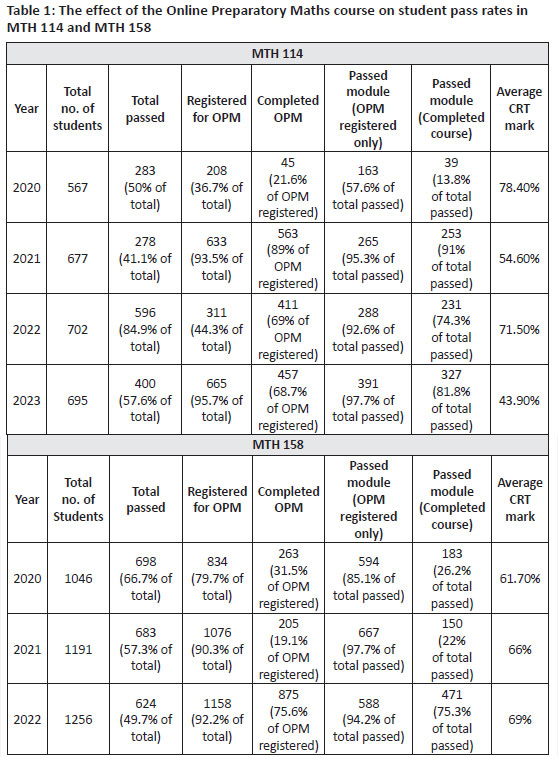
Thereafter, they write another test, called the 'Final Test' or 'post-CRT', with questions that are again drawn from a pool of questions on each topic, also ranging from easy to difficult. The scores that they get from this test will then count towards their final semester mark. The OPM course is open to students in the engineering streams as well as in maths-intensive STEM programmes. The modules under consideration are MTH 158 (engineering) and MTH 114 (other maths-intensive degree programmes). The statistics in Table 1 depict the performance of students who were registered for the OPM between 2020 and 2023, as well as students who had completed the course and written the final CRT.
In Table 1, the average pass mark for students who have registered for and taken the final CRT differs for both modules; the engineering students' averages are more or less in line with the national average of 53.8% to 69.1% between the years 2020-2024, whereas there are fluctuations in the years 2020-2023 for MTH 114. This is partially due to the fact that both the course content and final CRT questions are reviewed and updated yearly, based on student performance during the semester.
We suggest that the CRT intervention suffers from the same weakness as most other university-based interventions that take place at the start of the academic year. In our experience, generally, most students are non-responsive to information about their capabilities and talents or lack thereof. This can be attributed to the human psychological nature to reject everything and anything that is non-affirming of our sense of identity, strength and talents (Demo, 1992). A more plausible explanation is that first-year students generally tend to mediate any new university information through personal experiences from high school. Thus, a piece of information from a test written for a minute, when measured against obtaining a distinction in Grade 12 mathematics and being top of the class in most grades in high school, simply does not make sense to a first-year student. Therefore, rather than accept and use the information as an opportunity for introspection, most first-year students offer reasons that justify their incongruous experiences. The most common explanation offered is also the most fatal, "I was not prepared for the test" (private one-on-one conversation with a student in 2023). As it turns out, the test requires no preparation because the assessment is an evaluation of skills supposedly already mastered in high school years. For those categorised as at risk, this is the basis to reject the outcome. The above, according to Kruger and Dunning (1999), is a metacognitive deficit that accounts for inflated self-appraisals. Metacognition refers to the ability to measure how one is performing when one is likely to be accurate in judgement and when one is likely to be in error.
As the aforementioned shows, even the most well-intentioned interventions, informed by the most reliable data sources, can fall short. Arguably, then, the packaging of the messages and the timing of feedback should take centre stage. Well-timed intervention and messaging can be empowering to students because it can affect how they think about their study choices and decisions; for this reason, it is important to balance support and empowerment in student-support services. Student support, however, does not take place in a vacuum. Students' perceptions of themselves and their abilities play a crucial role in how messages of support or intervention initiatives are received. In measuring the academic maturity of students registered in the four-year programme (FYP), Yani et al. (2019) have found that students tended to reach academic maturity about six months after their entry into university, and only then become realistic about their own abilities. Therefore, it is not surprising that those in the more demanding mainstream programmes and even in the more challenging first-year mathematics modules tend to reject advice outright at the onset. Our experiences converge with the findings of Yani et al. (2019) in that it is only after the results of the first semester test that students are willing to engage with their abilities more honestly and open to possible programme change. This, as they have started to develop a more realistic view of their own maturity.
Crookston (1972) contrasts prescriptive and developmental advising. Arguably, an interchangeable use of the two can be helpful to foster a nuanced appreciation and unravel the intricacies of the advisor-advisee relationship (Fielstein, 1994). Drawing on the work of Crookston (1972) and employing the notion of self-concept and the Dunning-Kruger effect (Dunning, 2011; Kruger & Dunning, 1999), we motivate and discuss the interchangeable use of developmental and prescriptive advising in daily practice in the section below. Self-concept relates to reflexive individual processes of change and adaptation as individuals encounter new life situations and transitions. The realisation that students (especially in their first year of university) are still maturing (Yani et al., 2019), renders them more likely to make mistakes in their choice of courses or ignore advice based on inflated self-assurance. Making mistakes is part of growing-up; the crux is when self-incompetence robs one of the ability to recognise one's mistake(s) (Kruger & Dunning, 1999).
Theoretical framework
Crookston (1972) distinguishes between a prescriptive and a developmental approach to advising. The former is a top-down approach in which the advisor is the source of all knowledge in a doctor-patient type of relationship. As such, the advisor makes all the diagnoses, gives directives and, if followed religiously, all problems will be solved. In this mode, the advisor teaches and the student learns (Crookston, 1972). The responsibilities are clear and straightforward in that the advisor, as a source of information, provides guidance and leadership and the student is expected to follow. Accordingly, the advisor's responsibility is fulfilled as and when teaching is complete; the ball is in the student's court to follow through on what has been taught. This regimented manner shapes the relationships between student and advisor in such a way that there is no shared responsibility to each other. It is not surprising that the student views the advisor as the authoritative figure with all the answers and, therefore, when suggestions and teachings fail to bear results, the student accordingly refuses to shoulder any responsibility for their failure (Crookston, 1972).
Unlike the prescriptive approach, the developmental approach departs from the premise that the advisor and the student "differentially engage in a series of developmental tasks, the successful completion of which results in varying degrees of learning by both parties" (Crookston, 1972, p. 6). This is a buy-in and consensus-building approach aimed at achieving a certain level of rapport between the advisor and the student. As such, both parties' task includes an agreement on responsibilities, about who takes the initiative and supplies the knowledge and skills demanded by the task.
The use of self-concept and the Dunning-Kruger effect - cognitive bias (Dunning, 2011) - in this reflective piece is informed by the weakness in Crookston's (1972) approach as discussed above. His approach is useful for understanding why a prescriptive approach might be undesirable. However, it falls short in explaining why, at times, students might reject or are reluctant to seek out support, irrespective of whether a prescriptive or developmental approach is utilised. Furthermore, the dichotomous approach fails to appreciate individual student needs (Fielstein, 1994). Most students who make it into the mainstream programmes at UP, do so on merit and with high grades for both mathematics and physics. For example, the BSc Actuarial and Financial Mathematics degree requires mathematics achievement level 7. This translates into an achievement grade of between 80-100%. BSc Applied Math, BSc Mathematical Statistics and BSc Mathematics require level 6 with a slightly lower BSc Physics achievement level 5. Unquestionably, these are likely to be a group of self-assured students with little need for additional support. Their view of themselves and their academic abilities is well established because it is based on their matric results.
The bias in students' self-evaluation of their academic abilities when they transition to university is well supported by other scholars (Yani et al., 2019). Therefore, this fits the distinction made by Turner (1968), as cited in Demo (1992), between 'self-image' or 'self-concept', which refers to how individuals perceive themselves at a given moment and 'self-conception' which represents one's relatively enduring stable sense of the real me. According to Burke (1980), as cited in Demo (1992), the 'self-image' is nothing more than a 'working copy'; thus, subject to constant change, revision, and editing as and when the situation so demands. Unlike self-concept, self-conception is likely to resist external changes such as those brought about by the outcome of the mathematics readiness test and enforced through the top-down prescriptive advising approach. This self-conception comes up against its own blind spot in the first semester test results; consequently, a process of editing, revisions, and updating begins. This is to be expected because the 'working self-concept' or 'self-image' is considered an active and shifting array of accessible self-knowledge (Markus et al., 1987, as cited in Demo, 1992). This 'self-knowledge' is critical to how our students view themselves; therefore, having obtained certain grades in matric informs perceptions such as: "I am very good with Mathematics, the only reason I did not do well in the Math readiness test is because I wasn't prepared for it" (private email conversation with students 2020).
Encountering certain situations triggers a process of modification in attitudes and prevailing self-images. This occurs, despite the tendency to view oneself as the same person every day (Demo, 1992). As already alluded to, it is only when this self-knowledge is seriously challenged in weekly activities and semester tests that adjustments are made and openness to seek out support begins.
Drawing on a developmental advising approach, we demonstrate how we have shifted the timing in mathematics advising to achieve maximum impact and empower students to think differently. To do this, we deliberately avoid the artificial and unhelpful dichotomy between prescriptive and developmental approaches because both serve a purpose at various stages in the student's learning cycle (Grites & Gordon, 2000).
Advising as developmental
According to Crookston (1972, p. 5), a developmental advising approach departs from the following premise:
. . . that developmental . . . advising is concerned not only with a specific personal or vocational decision but also with facilitating the student's rational processes, environmental and interpersonal interactions, behavioural awareness, and problem-solving, decision-making, and evaluation skills. Not only are these advising functions but, deriving from the above assumptions, they are essentially teaching functions as well.
Importantly, the approach posits that the student cannot be a passive recipient of knowledge during this but must share equal responsibility in how the process unfolds. This, therefore, demands that the student actively seeks support and avoids being a victim of circumstances. Crookston (1972) is against placing too much responsibility on the student and advocates a balanced approach in how the relationship is nurtured. He lists ten central components that guide the relationship between advisor and student and distinguishes prescriptive advising from developmental advising (Crookston, 1972). These are: abilities, motivation, rewards, maturity, initiative, control, responsibility, learning output, evaluation, and the relationship. For our purpose and as it relates to this discussion, we focus on the first eight only, which we describe below and demonstrate how each dovetails with our approach to advising. To be clear, prescriptive and developmental advising approaches are used interchangeably as guided by context and the different learning stages.
Intervening on first contact
The first four of the eight identified dimensions, namely (i) abilities, (ii) motivation, (iii) rewards and (iv) maturity are key components of the largely impersonal and data-driven prescriptive, top-down approach employed on first contact (Crookston, 1972). During orientation week, first-year students are required to write the maths readiness test to assess the level of knowledge required to succeed in maths-intensive programmes. Ability plays a central role in how students perform in the assessment. Therefore, a student is arguably certified fit to continue with mathematics-intensive degrees according to their ability to demonstrate the required level of competence or advised to consider a different degree programme. Put differently, ability is assumed to be a key indicator of intelligence, achievement, and interests (Crookston, 1972). Therefore, ability serves as an indicator to assist the prescriptive advisor in reaching a conclusion about what the student is not. The student has failed to demonstrate the basic level of competence in this area; therefore, the student is not this or that.
Contrary to Crookston (1972), however, measurable traits such as ability are not designed or intended to be punitive in nature. University studies are relatively expensive and time sensitive (i.e. period to completion). For this reason, advisors and universities carry a moral obligation to direct students accordingly. This is done without taking away the student's choice to decide how to proceed. Viewed from this angle, prescriptive advising, when buttressed by recognition of choice and self-determination, can arguably be a valuable form of development and empowerment (Fielstein, 1994). The data-driven maths readiness assessment encourages, if not forces, introspection in those affected and this is empowering. We consider it empowering to the extent that students are confronted with uncertainty about their future. This can happen irrespective of whether students have passed or failed the assessments. The assessment is an opportunity for students to interrogate what they know about themselves or what they thought they were capable of (self-concept). In turn, this sparks a chain reaction, activating as it does, notions of motivation, rewards, and maturity.
The outcome of the assessments can reinforce pre-existing beliefs about having chosen the right career path and natural abilities in this or that. The opposite can also happen, however, motivation to continue or go in search of a new career path may come into play as a core component of the decision to remain in the intended degree programme or to change. This, according to Crookston (1972), must be a self-committed process rather than imposed by others. Self-driven or imposed, tapping into this inbuilt human condition can be the difference between dropout or completion in the minimum time. Of the prescriptive advisor and their view on rewards, Crookston (1972) says, and here we quote at length:
. . . [the prescriptive advisor v]iews the student's motivation to produce as limited largely to achieving a high grade, gaining credit for the course, or obtaining a degree in order to realize a certain level of income, or as avoidance of parental censure or withdrawal of privileges . . . developmental advisors recognize that in the current [university] generation there is a tendency to reject the economic security and social mobility goals of their parents in favor of the rewards of personal growth, self-fulfilment, and human commitment. Moreover, there is a tendency to gain intrinsic satisfaction from goal accomplishment, rather than being motivated to achieve for status or prestige. (Crookston, 1972, pp. 6-7)
It is an exercise in futility to debate students' drive for achievement; what cannot be gainsaid is students' ability to flourish when their passions meet their talents. Students, as is our human condition, want different things at different stages of life; therefore, we eschew the dichotomous presentation of prescriptive and developmental advising (Grites & Gordon, 2000).
Humans tend to ignore, avoid, or wish away things that make us feel inadequate. It is in instances like these that prescriptive advising is required. According to Fielstein (1994) some aspects of prescriptive advising are informational and didactic; therefore, there are prerequisites for developmental advising. Many students reject outcomes that contradict a view that they are knowledgeable, smart, or intelligent. Without a university experience, most students frame their abilities through what they know - high school experience. Often, first-year university experiences tend to be incongruous and jarring; they can lead to disengagement and uncomfortable feelings. Therefore, the prescriptive approach is not so much informed by a view that students are immature or irresponsible; rather, by recognising that, at times, students can become victims of what they do not know (Kruger & Dunning, 1999). Arguably, not knowing has consequences for our actions and non-actions. For most, this unknown is, for the first time, revealed by impersonal data-driven math readiness test results. The results are not ahistorical; they have been packaged through years of students' experiences in first-year mathematics at UP. This is to say, students are nudged into a mature consideration of whether they belong to their chosen programme of study, which is most important at their age, given the fact that many students are still trying to find themselves and, as such, decisions are informed by self-image as opposed to self-conception (Turner, 1968, as cited in Demo, 1992). Further, Kruger and Dunning (1999, p. 112) argue,
when people are incompetent in the strategies they utilise to achieve success, they suffer a dual burden; not only do they reach erroneous conclusions and make unfortunate choices but in addition to this, their incompetence robs them of the ability to realise it.
First-year students, owing to a variety of reasons such as schooling, being first-generation university entrants, etc. can suffer from inflated self-assessments due to insufficient metacognitive abilities.
Conclusion
As the foregoing accounts demonstrate, both descriptive and developmental approaches are critical to advising. However, they require a contextually sensitive deployment in order to cater for students' academic needs. To do this, the two approaches must be theoretically enriched, for example, by drawing on the various theoretical frameworks that attempt to make sense of student behaviour. This allows for a proper appraisal of the student population and its attitudes to support (both top-down and bottom-up) interventions. While the Dunning-Kruger effect goes some way in explaining why students at times reject support, what is required is research on how to disarm and breakdown barriers to inflated self-images.
The foregoing is critical to ensuring that students engage and do not wait until it is too late in the semester to seek help. As research from Australia has started to suggest, student support should not be optional (Kift et al., 2010). As such, support should be incorporated into the curriculum regardless of students' socio-economic and educational backgrounds. For example, this can be achieved through concrete partnerships between academics and support practitioners in which visits by support practitioners to lecture halls become a key component of teaching and learning. Lecture halls provide a captive audience and thus afford a wider reach, especially when supported and actively encouraged by the academics concerned. Such regular integration of support services may also serve to destigmatise help-seeking behaviours.
Ethics statement
The UP granted permission for this study to be conducted. The study did not involve human subjects, only aggregated data of student grades participation in an online preparatory course. Identifying information such as module/course names have been changed.
Potential conflict of interests
The authors declare that they have no financial or non-financial interest emanating from this study.
Funding acknowledgement
No funding was provided in order to carry out the study.
References
- Bensimon, E. M. (2007). The underestimated significance of practitioner knowledge in the scholarship on student success. The Review of Higher Education, 30(4), 441-469. https://dx.doi.org/10.1353/rhe.2007.0032
- Crookston, B. B. (1972 [2009]). A developmental view of academic advising as teaching. NACADA Journal, 29(1), 78-82. https://doi.org/10.12930/0271-9517-29.1.78
- De Klerk, D. (2021). Making known the real: An exploration of academic advising practices in a South African higher education context. Journal of Student Affairs in Africa, 9(2), 101-121. https://doi.org/10.24085/jsaa.v9i2.3702
- De Klerk, D., Spark, L., Jones, A., & Maleswena, T. (2017). Paving the road to success: Reflecting critically on year one of an undergraduate student support programme at a large South African university. Journal of Student Affairs in Africa, 5(1), 1-13. https://doi.org/10.14426/jsaa.v5i1.2478
- Demo, D. H., (1992). The self-concept overtime: Research issues and directions. Annual Review of Sociology, 18, 303-326. https://www.jstor.org/stable/2083456
- Department for Education Innovation. (2019). Annual report 2019. University of Pretoria. Retrieved from http://drupalwebprod-files.up.ac.za/Public/media/303/documents/inline/2868301/Report%25202019.pdf?VersionId=ms9Y_JRgsmhNeY_naq1nOSg.I.mwqMSo
- Engelbrecht, J., Harding, A., & Potgieter, M. (2014). Evaluating the success of a science academic development programme at a research-intensive university. African Journal of Research in Mathematics, Science and Technology Education, 18(3), 287-298. https://doi.org/10.1080/10288457.2014.962726
- Fielstein, L. (1994). Developmental versus prescriptive advising: Must it be one or the other? NACADA Journal, 14(2), 76-79. https://doi.org/10.12930/0271-9517-14.2.76
- Fricke, I., Horak, E., Meyer, L., & Van Lingen, N. (2008). Lessons from a mathematics and science intervention programme in Tshwane township schools. South African Journal of Higher Education, 22(1), 64-77. https://doi.org/10.4314/sajhe.v22i1.25774
- Grites, T., & Gordon, V. N. (2000). Developmental academic advising revisited. NACADA Journal, 20(1), 12-15. https://doi.org/10.12930/0271-9517-20.1.12
- Jokhan, A., Sharma, B., & Singh, S. (2019). Early warning system as a predictor for student performance in higher education blended courses. Studies in Higher Education, 44(11), 1900-1911. https://doi.org/10.1080/03075079.2018.1466872
- Kift, S., Nelson, K., & Clarke, J. (2010). Transition pedagogy: A third generation approach to FYE - A case study of policy and practice for the higher education sector. The International Journal of the First Year in Higher Education, 1(1), 1-20. https://doi.org/10.5204/intjfyhe.v1i1.13
- Kruger, J., & Dunning, D. (1999). Unskilled and unaware of it: How difficulties in recognizing one's own incompetence lead to inflated self-assessments. Journal of Personality and Social Psychology, 77(6), 1121-1134. https://doi.org/10.1037/0022-3514.77.6.1121
- Mahlaba, S. C. (2020). The state of South African mathematics education: Situating the hidden promise of multiple-solution tasks. EURASIA Journal of Mathematics, Science and Technology Education, 16(12), em1921. https://doi.org/10.29333/ejmste/9279
- Maree, J. G. (2015). Barriers to access and success in higher education: Intervention guidelines. South African Journal of Higher Education, 29(1), 390-411. https://hdl.handle.net/10520/EJC172780
- Moodley, P., & Singh., R. J. (2015). Addressing dropout rate at South African universities. Alternations, Special Edition 17, 91-115. https://hdl.handle.net/10321/1648
- Pillay, A. L., & Ngcobo, H. S. B. (2010). Sources of stress and support among rural-based first-year university students: An exploratory study. South African Journal of Psychology, 40(3), 234-240. https://hdl.handle.net/10520/EJC98601
- Schreiber, B., Luescher, T. M., & Moja, T. (2018). Articulation and continuities: First-year experience in higher education. Journal of Student Affairs in Africa, 6(1), v-vii. https://doi.org/10.24085/jsaa.v6i1.3098
- Schreiber, B., Luescher, T. M., & Moja, T. (2024). Supportive contexts for student success. Journal of Student Affairs in Africa, 12(1), v-viii. https://doi.org/10.24085/jsaa.v12i1.5297
- Scott, I., Yeld, N., & Hendry, J. (2007). A case for improving teaching and learning in South African higher education. Higher Education Monitor No. 6. Council on Higher Education.
- Shay, S. (2020, January 9). Why South Africa's declining maths performance is a worry. The Conversation. https://theconversation.com/why-south-africas-declining-maths-performance-is-a-worry-129563
- Staff Writer. (2019, November 13). South Africa's university pass rate shocker [Government newsletter]. BusinessTech. https://businesstech.co.za/news/government/353575/south-africas-university-pass-rate-shocker/
- Tachie, S. A., (2020). The challenges of South African teachers in teaching Euclidean geometry. International Journal of Learning, Teaching and Educational Research, 19(8), 297-312. Retrieved from https://www.ijlter.org/index.php/ijlter/article/viewFile/2507/pdf
- Van Maanen, J. (1995). An end to innocence: The ethnography of ethnography. In J. Van Maanen (Ed.), Representation in ethnography (pp. 1-35). Sage Publications.
Accepted 21 September 2025
Published 18 August 2026