A reflective overview: European vocational education and training reform: The Copenhagen process 2002 to 2024
The European Union's (EU) Copenhagen Process on cooperation in vocational education and training (VET), initiated in 2002, is a voluntary method that coordinates VET reform in Europe. In terms of this process, EU Member States, the European Commission and the social partners agree, at ministerial level, on common VET-related objectives, priorities and statistical targets to be met over a five- to ten-year period. Progress is monitored and political momentum maintained through regular reporting, exchanges of experience and periodic revisions of reform objectives, priorities and statistical targets. This article outlines the origins of the Copenhagen Process and discusses its evolution and influence on European VET policy since 2002. The writer argues that the process has proved to be an effective working method. It has strengthened European cooperation in VET, provided the basis for common European instruments and principles, influenced national reforms and raised the profile of VET in other policy areas. The writer also argues that, while the Copenhagen Process has operated at a multinational, trans-European level, its principles of partnership, resources and momentum can be used to create effective partnerships and networks at national, sectoral and local levels in order to bring about VET reform.
European Union (EU); vocational education and training (VET); educational reform; Copenhagen Process; open method of coordination
A reflective overview: European vocational education and training reform: The Copenhagen process 2002 to 2024
Steven Bainbridge
Formerly Of The European Centre For The Development Of Vocational Training (cedefop) (retired), Thessaloniki, Greece. Orcid Link Https://orcid.org/0009-0006-7106-8936 (
ABSTRACTThe European Union's (EU) Copenhagen Process on cooperation in vocational education and training (VET), initiated in 2002, is a voluntary method that coordinates VET reform in Europe. In terms of this process, EU Member States, the European Commission and the social partners agree, at ministerial level, on common VET-related objectives, priorities and statistical targets to be met over a five- to ten-year period. Progress is monitored and political momentum maintained through regular reporting, exchanges of experience and periodic revisions of reform objectives, priorities and statistical targets. This article outlines the origins of the Copenhagen Process and discusses its evolution and influence on European VET policy since 2002. The writer argues that the process has proved to be an effective working method. It has strengthened European cooperation in VET, provided the basis for common European instruments and principles, influenced national reforms and raised the profile of VET in other policy areas. The writer also argues that, while the Copenhagen Process has operated at a multinational, trans-European level, its principles of partnership, resources and momentum can be used to create effective partnerships and networks at national, sectoral and local levels in order to bring about VET reform.
Keywords: European Union (EU), vocational education and training (VET), educational reform, Copenhagen Process, open method of coordination
Origins of the Copenhagen Process
The Lisbon Strategy, 2000
In March 2000, the European Union (EU), then comprising 15 Member States, launched its Lisbon Strategy, named after the city in which the EU's European Council (the heads of state and government of the EU Member States) met. The aim of this strategy was to improve Europe's competitiveness, create more jobs and strengthen social cohesion through a programme of economic and social reforms (Council of the EU, 2000). The strategy was launched as a response to the economic and social changes stemming from globalisation and the shift to the 'knowledge-driven economy' in which services, not manufacturing, would be the main driver of European economic growth.
At the time, Europe's economy was in good shape. Inflation and interest rates were low and public debt was falling as a proportion of national gross domestic product (GDP). The euro (the EU's single currency) had just been introduced, while the EU's single market was supporting economic growth as the world's largest and most sophisticated free-trade area. Prospective EU enlargement to take in 12 Eastern European countries was also expected to bring further stimulus to economic growth.
Despite these strengths and the best economic outlook in a generation, the EU had serious structural problems - unemployment remained persistently high. More than 15 million Europeans across the 15 Member States were out of work, that is, around 10% of the labour force (Council of the EU, 2000; Cedefop, 2004). The European employment rate, at around 61% of the working population, was considered to be too low. The EU was also concerned about remaining globally competitive with China preparing to join the World Trade Organisation (WTO).
Following the Lisbon meeting, European Council meetings in Stockholm (Council of the EU, 2001), Barcelona (Council of the EU, 2002a) and Brussels (Council of the EU, 2003) developed a clear policy agenda for economic and social reform. The agenda brought together policies related to employment and social affairs, information and communications technology (ICT), infrastructure, financial markets and research.
In order to implement its strategy, the EU introduced a new Open Method of Coordination (OMC), defined as a 'means of spreading best practice and achieving greater convergence towards the main EU goals' (Council of the EU, 2000). The OMC would operate at all ministerial and technical levels. At the highest level, the European Council would guide and coordinate the strategy, which comprised policy objectives complemented by several statistical targets (also known as 'benchmarks'). These would help to measure progress, 'identify best practice and ... ensure efficient and effective investment in human resources' (Council of the EU, 2003). To maintain the political momentum necessary for reform, the European Council would meet each spring to monitor progress, mandate action and ensure follow-up.
Vocational education and training reform: The Copenhagen Process, 2002
Improving education and training was central to the Lisbon Strategy because of concerns that accelerating social and economic change would overtake the skills of Europe's ageing workforce (Council of the EU, 2000). The forecasts were that most new jobs would be in advanced services and managerial and technical professions, and Europe's workforce seemed ill-equipped for them. In 2001, almost 40% of the EU's population aged 25 to 64 -comprising some 75 million people - did not have qualifications beyond those obtained as a result of compulsory schooling (Cedefop, 2004).
This dual need, to develop skills for economic excellence in the emerging 'knowledge' society and to bring marginalised people into the labour market to increase the employment rate, placed a high priority on reforming vocational education and training (VET). Consequently, on 30 November 2002, the Copenhagen Process on enhanced cooperation in VET (Council of the EU, 2002b), was launched (see box).
The Copenhagen Process on enhanced cooperation in VET
On the basis of these priorities we aim to increase voluntary cooperation in vocational education and training in order to promote mutual trust, transparency and recognition of competences and qualifications and thereby establishing a basis for increasing mobility and facilitating access to lifelong learning. (Copenhagen Declaration, 2002)
A method, not a new strategy
Policy framework
The Copenhagen Process applies the OMC to VET policy in Europe, establishing cooperation at the European level to support the modernisation of VET systems in Member States. It promotes mutual goal-setting, collaborative action and shared accountability for results. It also comprises periodic reporting on, and peer review of, progress in implementing VET-related common objectives, priorities and statistical benchmarks.
The Copenhagen Process is based on voluntary cooperation because the Treaty on European Union1 limits the role of the EU to supporting and supplementing action by Member States. The treaty specifies that Member States are responsible for the content and organisation of national VET systems and explicitly rules out any harmonisation of them by the EU.
Although the Copenhagen Process incorporates priorities and objectives, it is a working method that coordinates existing strategy and monitors implementation. It is not a new strategy. The objectives of the process reflect VET reform priorities that Member States share at a European level. The Copenhagen Process is also a partnership. In addition to Member States, it includes the European Commission and the European social partners.
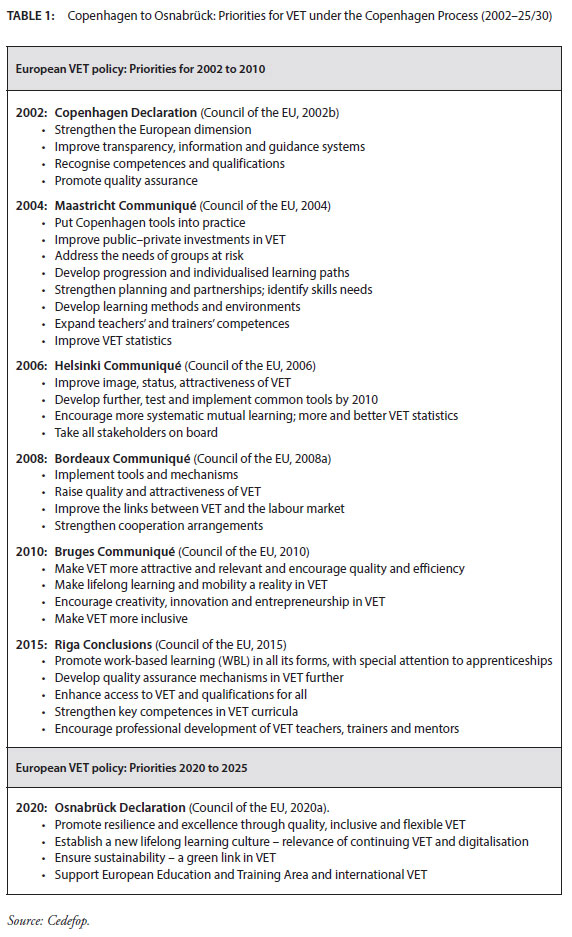
The Copenhagen Process has provided a framework for European VET policy since 2002. When the process was launched, Member States agreed on several policy objectives to be achieved by 2010. Subsequently, the plan was to reinforce, develop and revise during the period 2010 to 2025, as stated in various policy documents agreed at the European level. Table 1 summarises the VET reform priorities set out in each document.
As part of the Copenhagen Process, the European Commission has provided policy and position papers to complement, direct and progress the broader European VET policy framework. European social partners have similarly contributed to the debate on VET priorities and their implementation. The European social partners are EU-level organisations representing employers and employees that participate in the European social dialogue. Specifically, employers are represented by the Confederation of European Business (BUSINESSEUROPE) and by SME United (which represents small and medium enterprises). Employees are represented by the European Trade Union Confederation (ETUC) and SGI Europe (mainly public-sector employees).
The European social dialogue is provided for in the EU Treaty and discussions between the social partners can shape working conditions and influence social policy. Social partnership is a multilevel system operating at European, national, sectoral, regional (provincial or local), company and establishment levels. European social partners do not negotiate collective bargaining agreements over pay and conditions, which are agreed within countries at national and sector levels. Rather, they comment on, suggest amendments to and can propose action at European level and can help progress and implement European policies.
The European Commission plays an essential role in supporting the technical aspects of the Copenhagen Process. It has set up technical working groups of experts from Member States to explore ways to implement policies, for example improving the understanding of qualifications across Member States, improving the quality of VET and strengthening the systems of vocational guidance.
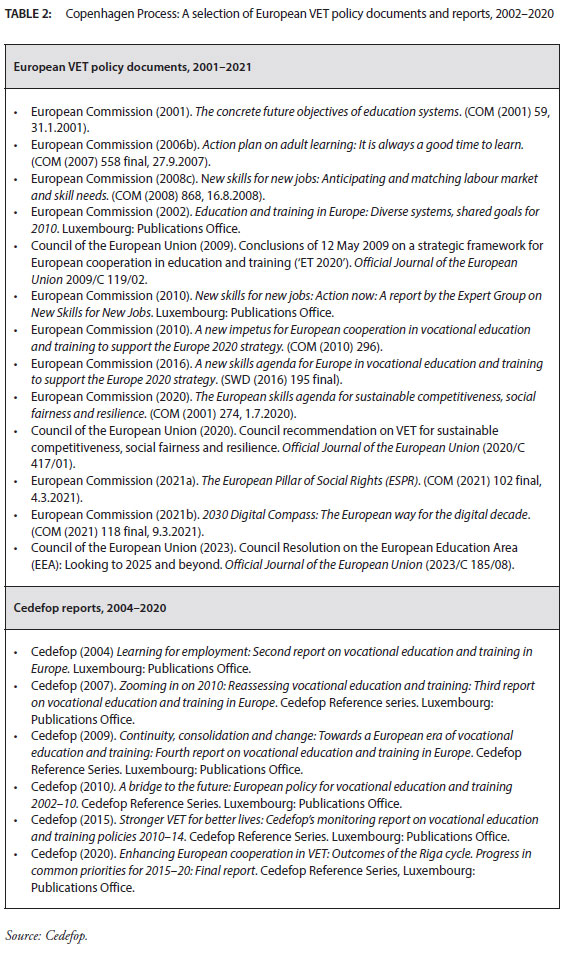
Cedefop2 (the European Centre for the Development of Vocational Training), a European agency, has also provided technical expertise to develop policy, including the European Qualifications Framework (EQF), VET credit systems, the VET quality assurance framework, and skill forecasts. Cedefop has also monitored and reported on progress by Member States. Some key policy and reporting documents outlining European VET policy under the Copenhagen Process are shown in Table 2.
Measurable statistical targets
Policy objectives were complemented by VET and VET-related statistical targets to be reached by 2010. Following the Brussels Communiqué (Council of the EU, 2010) and the Riga Conclusions (Council of the European Union, 2015), some of these targets were carried over and others introduced for the period 2010 to 2020. Post-2020 European VET policy comprises a more comprehensive set of statistical targets, set out in several VET and VET-related policy documents, which are discussed below under the heading: 'Where next? Post-2020 VET reform: Policy and targets'. Statistical targets and progress towards them are also discussed below, under the heading: 'European VET policy statistical targets'.
Throughout the Copenhagen Process, raising the level of education in the European workforce featured strongly in the statistical benchmarks. Increasing the number of graduates from upper-secondary and tertiary education and reducing the number of people leaving school with no qualifications were seen as a proxy for higher skills levels. The view was that higher skills would improve employment prospects for individuals by providing a better alignment with the changing needs of the labour market. These changes would translate into a more qualified workforce and higher employment rates. Increasing participation by adults (those aged 25-64) in lifelong learning is also a consistent theme included in the statistical targets.
Achievements of the Copenhagen Process, 2002-2020: Successes and setbacks
Assessment of the Copenhagen Process and the European VET policy it underpins should consider two distinct but related aspects: first, the policy outcomes of European cooperation in VET and, second, its effects on the performance of VET systems, as measured by the VET and VET-related statistical targets that the EU set for itself.
Policy outcomes
Developing and managing VET policy at the European level is highly complex. As discussed above, the European Union Treaty limits the EU's role to supporting and complementing policies in Member States, whose individual VET systems are very different. Within Member States, the responsibility for VET is usually shared between governments and social partners, but to varying degrees. For example, in Germany, the federal government has responsibility for VET in close cooperation with companies and social partners (Cedefop; BIBB, 2022). In Belgium, responsibility lies with the Flemish, French and German language communities (Cedefop; Bruxelles Formation, 2022); and in Italy, multiple institutional actors at the national and regional levels have responsibility for VET (Cedefop; INAPP, 2022).
Despite this complexity, the outcomes of European cooperation in VET provide strong evidence that the Copenhagen Process has proved to be an effective working method. By coordinating voluntary technical and political cooperation across the EU, the process has given VET a clear policy voice at the European level (Cedefop, 2010).
Actions at the European level have sought to implement the overall European VET policy objective, namely to develop modern VET systems closely aligned to labour market needs which are comprehensive and inclusive (by being tailored to the needs of the best and brightest students and those at risk of social exclusion) and which also encourage and enable lifelong learning. Less central, but also important, is the aim to make European VET more transnational by providing opportunities for VET students to learn in other countries.
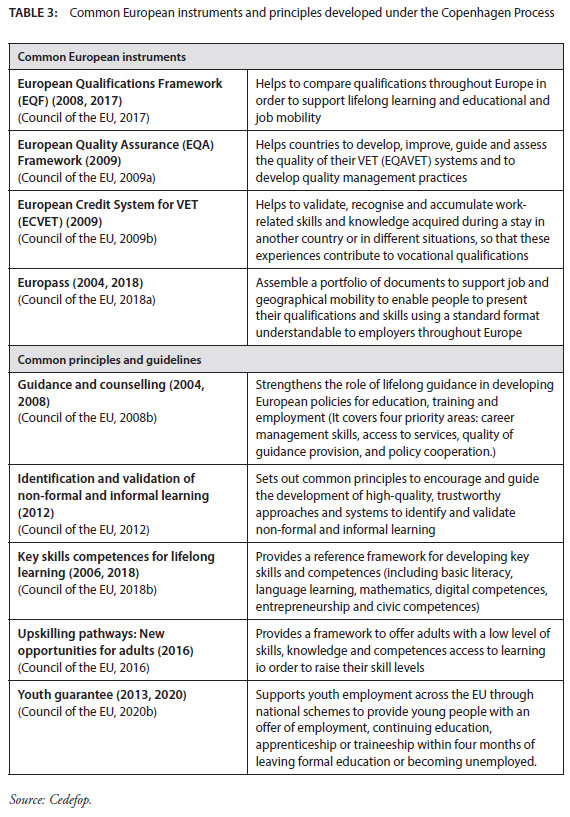
The Copenhagen Process has supported the development of several common European instruments and principles (see Table 3). Overall, these aim to ensure that VET graduates across the EU have a good grounding in key competences to enable them to perform well at work and to learn new skills in the future. They also aim to make VET systems more open, flexible and inclusive by providing different pathways for young people and adults to obtain qualifications through validation of previous non-formal and informal learning. European-level initiatives also supported cross-border mobility through the easier recognition of qualifications, both within and between Member States. These changes were underpinned by trust in the quality of the different systems in Member States provided by a common quality assurance framework.
European action has influenced and helped to align national policies (Cedefop, 2010; Cedefop, 2015a; Cedefop, 2020a). Common European instruments and principles developed through the Copenhagen Process were based on learning outcomes (statements of what an individual learner can do and understand after completing any type of learning process).
Member States used learning outcomes to reform VET standards and curricula - for example, to develop modular courses and partial qualifications. For some Member States, who had traditionally based qualifications on learning inputs (place and duration of learning), this was an important change (Cedefop, 2016).
Learning outcomes were also important for systems to validate prior non-formal and informal learning (Cedefop, 2020b). Crises in the labour market showed a need for people to be able demonstrate their skills and competences both to find work and to receive training tailored to their needs in order to improve their job prospects. Member States have used validation to promote social inclusion by keeping people in the labour market and bringing them back to it. The European Qualifications Framework (EQF) has also encouraged Member States to develop national qualification frameworks (NQFs) that link to it (Cedefop, 2015a).
Commitments by Member States at the European level have also influenced national policies. A pillar of European VET training policy from 2002 to 2020 was to improve the attractiveness of VET as a learning option by making access to VET easier and improving opportunities for VET graduates to go on to further and higher education (Cedefop, 2020c; Cedefop 2021). Participation in initial VET in the EU overall has remained stable at almost half (48.7% in 2021) of all enrolments in upper-secondary education3 and, in 2021, some 70% of students in upper-secondary VET were enrolled in programmes that grant direct access to tertiary education.
European VET policy has also strengthened apprenticeship (Cedefop, 2015b) and other forms of work-based and workplace learning for young people and adults. Estimates are that, in 2020, around 29.6% of students in upper-secondary VET were enrolled in combined work- and school-based programmes, where the work-based component was above 25% and below 90%. Regarding alignment between VET and the labour market, employment prospects for VET graduates in the EU have improved. In 2022, the employment rates of recent VET graduates aged 20 to 344 were, on average in the EU, 13.3 percentage points higher than the employment rates for similar general-education graduates.
VET in the EU also makes a significant contribution to developing skills in science-, technology-, engineering- and mathematics-related (STEM) subjects, which are in demand in the labour market. In 2020, in the EU, 37.4% of upper-secondary VET graduates obtained a qualification in STEM-related subjects. Member States have also recognised the importance of quality VET teachers and trainers and of providing them with opportunities for their continuing professional development (Cedefop, 2020a).
Statistical targets in respect of European VET policy
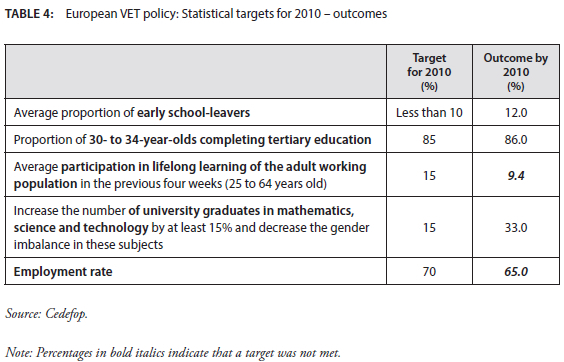
Between 2002 and 2010, despite their extent, VET reforms supported by the Copenhagen Process had a limited impact on the performance of education and training systems, as measured against the statistical targets that European VET policy set out to achieve. Many 2010 targets were not reached (see Table 4). In 2010, the proportion of early leavers from education and training was around 12%, compared with a target of less than 10%. Only around 9.5% of adults (aged 25 to 64) participated in lifelong learning in the four weeks prior to being surveyed compared with an original target of 15%. In addition, during the same period, Europe's employment rate reached around 65%, below the target of 70%.
More positively, the EU achieved its target of at least 85% of 22-year-olds completing upper-secondary education and increased the number of graduates in mathematics, science and technology by 33% compared with a target of 15%. However, despite the disappointing performance compared with the targets, all the indicators showed an improvement, not only across the EU average but also in all Member States.
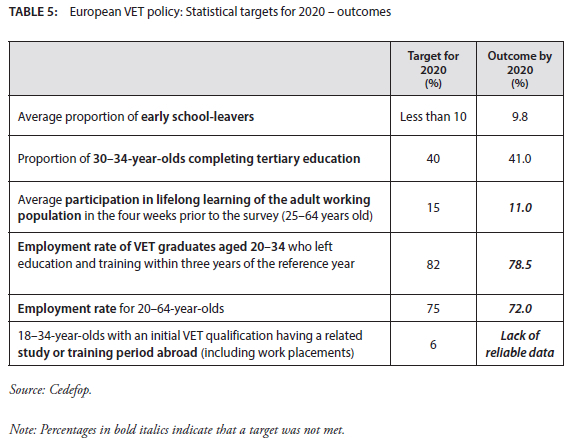
During the period 2010 to 2020, the EU's record regarding its statistical targets was better. This perhaps reflects the long-term nature of VET reform. Change takes time; there is no quick fix. Data paint a picture of mixed achievement in terms of reaching the statistical targets for 2020 (see Table 5). However, progress was made in many areas and in many countries, even if the targets were not met.
The data show that, in statistical terms, the EU made substantial progress in raising educational attainment and reducing the proportion of young people leaving education and training early and with low or no qualifications. Regarding alignment, VET graduates seem to have good employment prospects.
The target group for the employment rate was redefined as those aged 20 to 24, excluding those aged 16 to 19, many of whom were, technically, in the labour force but not actually looking for work because they were in full-time education. The target was also raised from 70% to 75%. Employment rates, generally, improved and failure to reach the target rates had more to do with overall economic growth than specific education and training policy. Notwithstanding the COVID-19 pandemic being a major economic setback in 2020, based on pre-pandemic trends, the EU was in any event unlikely to have reached the targets it missed. Even after 20 years, the participation by adults, particularly older adults, in lifelong learning remains stubbornly low. The planned increase in mobility proved to be a challenge to measure and reliable data are still lacking.
Where next? Post-2020 VET reform: Policy and targets
The EU's overall strategy now focuses on a successful 'twin transition' to a 'digital' and 'green' economy and society (European Commission, 2022). Post-2020 European VET policy is seen as being central to this strategy's success.
Post-2020 European VET policy, as outlined in the documents that define it, reflects a balance of continuity and new directions. It reiterates the aim of 'excellent and inclusive VET', underlining VET's dual role of providing skills both for economic excellence and for improving the employment prospects of marginalised people to bring them back into the labour market. The route to 'excellent and inclusive VET' is familiar: high-quality apprenticeships and work-based learning (WBL), embedded in a real-life work environment, are seen as ways of helping to align VET with labour market needs and of improving people's employment and career prospects. Post-2020 European VET policy also emphasises the right of all people regardless of their personal and economic background and place of residence, to have access to, and benefit from, high-quality VET and lifelong learning -stated as a first principle of the European Pillar of Social Rights (European Commission, 2021a, 2021b).
Post-2020 European VET policy is also seeking the closer integration of initial and continuing VET to ensure re-skilling and upskilling throughout working life. Retaining continuing training and developing a 'lifelong learning culture' as priorities for European VET policy reflect continuing concerns over Europe's demographic trends according to the Osnabruck Declaration (Council of the European Union, 2020a). The EU's old-age dependency ratio increased from 27.7% in 2013 to 33.4% in 2023, meaning that there are now just over three persons of working age for every person aged 65 years and over. Currently, more than one in five (21.3%) of the EU's estimated population of 448.8 million people is aged 65 years and above.5 Furthermore, in 2023, the median age of the EU's population was 44.5 years, compared with 38.9 years in the United States and only 18.8 years in Africa.6 The development of a European dimension to VET, including by integrating periods of learning abroad into VET curricula, is another continuing theme.
However, there are some differences. Importantly, post-2020 European VET policy places greater emphasis on VET's role in making Europe more resilient. VET aligned with economic cycles, evolving jobs and working methods that provides key competences -including digital, green and other life skills - is seen as a way of strengthening resilience (European Commission, 2020). It is also viewed as enabling Europe to better withstand any economic 'shocks' caused by events such as the 2008 financial crisis, the COVID-19 pandemic and Russia's invasion of Ukraine.
Consistent with the Copenhagen Process, post-2020 European VET policy continues to be built on strong partnerships with stakeholders, including social partners, companies, employers' organisations, chambers, branch associations, VET providers, learners' representatives, national, regional and local public administrations, employment services and social economy organisations. Through apprenticeships and WBL, companies are regarded as learning venues and as being crucial to modern and excellent VET (Council of the European Union, 2020a).
The VET and VET-related targets demonstrated the value of using statistical data to provide information on trends as ways of monitoring and developing European VET policy. Trends revealed by the data and improvements in VET statistical data collections (a long-standing aim of European VET policy, highlighted in the Maastricht Communiqué (Council of the EU, 2004)) over the past 20 years have influenced what is measured, and how. The statistical targets for the post-2020 European VET policy cycle are the most comprehensive ever set for monitoring progress. The downside is that statistical changes make comparisons over time difficult owing to breaks in time series and changes to data-collection methods in Member States.
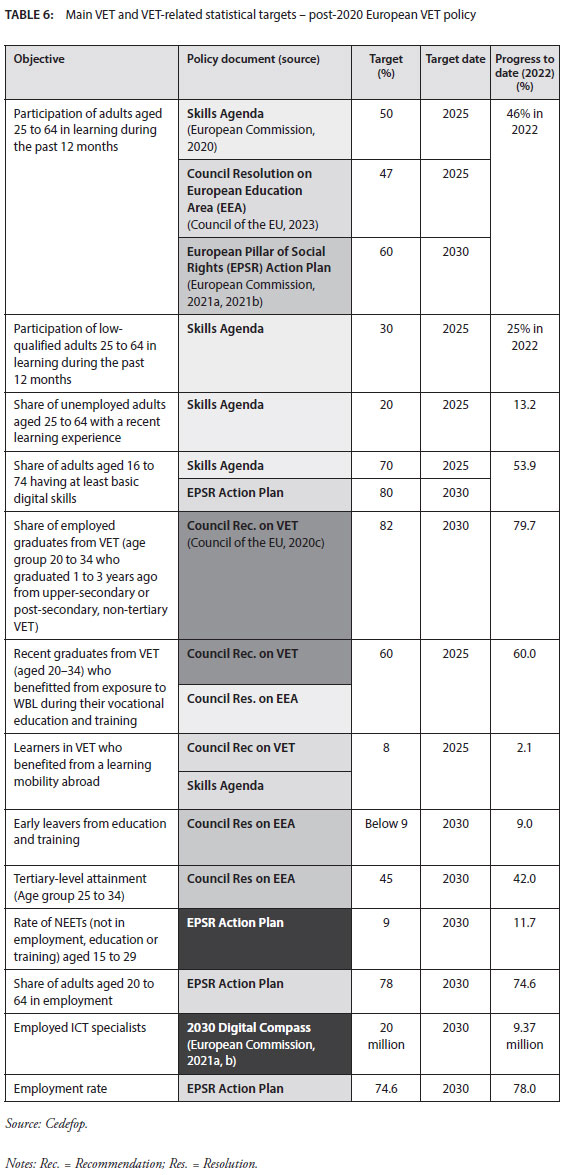
In addition, different policy documents set different targets and deadlines, but all of them should be achieved by 2025 or 2030. Table 6 summarises the main statistical targets, their deadlines, source documents and progress to date.
The targets cover areas where the EU underperformed in the period from 2010 to 2020, notably participation by adults in lifelong learning and mobility. An overall target for adult participation in lifelong learning has been complemented by targets for specific groups of adults in the workforce and a new method of counting participation has been devised.7 The targets also continue to seek improvements in the levels of educational attainment by continuing to reduce early school-leaving to less than 9% by 2030. Linked to this is a target to reduce the share of young people, aged 15 to 29 years, who are not in employment, education or training (NEETs). The EU also wants 45% of 25- to 34-year-olds to be tertiary education8 graduates by 2030.
New targets for the EU employment rate and, for the first time for recent VET graduates, have been added to the targets. The new targets also monitor new priorities, such as the extent of WBL, the employment of ICT specialists and the extent of digital skills among the adult population. To an extent, the targets reflect a desire to monitor the VET contribution to the 'supply' of skills, measured in terms of levels of educational attainment, and the 'demand' for skills as reflected in the employment rate.
Copenhagen Process: Not limited to Europe or the international sphere
The Copenhagen Process as an example of the EU's open method of coordination (OMC) applies at the European level, but its principles can be used to create effective partnerships and networks at national, sectoral and local levels. These principles can be found in various frameworks for improving policy coordination, including that developed by the University of the Witwatersrand, Johannesburg,9 which focuses on four key elements: why, who, how and what.
Why: Understanding the real objectives of skill engagements
Many engagements fail because they try to do too many things. The key is to tackle specific problems in the context of the specific skills system. The Copenhagen Process does this through a pooling of Member States' VET policy objectives and underpinning them with measurable statistical targets.
Who: Who should be involved and what should they do?
In the EU, this is more easily defined as it involves all Members States, the European Commission and the European social partners. However, Member States have different institutional mixes for developing VET policy. Such mixes may include any combinations of, for example, national and regional governments, social partners, sector bodies, chambers of commerce, qualifications authorities, research and various learning institutions, and training providers. Not all organisations need to be involved in everything. However, there needs to be a clear political capacity to provide policy direction and decide priorities, and a technical capacity to provide expertise to develop and propose action in order to implement policy and policy changes and to monitor and report on progress. This implies a capacity to provide research, labour market analyses and statistical data.
How: finding ways to engage
Opportunities are needed (structured meetings, forums, technical working groups, conferences, etc.) to exchange and share information and proposals, review progress and revise objectives. Dialogue is needed to discuss challenges openly.
In the Copenhagen Process, various timescales are applied by which certain milestones should be met. These comprise both technical and policy initiatives. There is also scope for bottom-up and top-down initiatives. Currently, European VET policy works on a 10-year cycle with a midpoint review. There are also various types of work that can be done jointly to strengthen cooperation and engagement - for example, research, labour market analyses, developing and collecting statistical data, and monitoring, reporting and peer-reviewing progress.
What: What is needed to succeed?
The Copenhagen Process operates around three key elements: partnership, resources and momentum. Partnership is needed to agree on common priorities. Different interests have to be reconciled and solutions found. This takes time, willingness, determination, goodwill and compromise. Resources are necessary, too. High-quality VET that keeps pace with technological and organisational change is not cheap and this reality will necessitate tough choices about the priorities for resources. Momentum must be maintained because VET reform takes time and the results of implementing policies and decisions are not immediately visible.
Maintaining momentum requires an unequivocal understanding of the purpose and benefits of VET reform. Under the Copenhagen Process, political leadership has proved invaluable in maintaining the momentum for VET reform. This has entailed responsible ministers providing direction through periodic mandates that combine short-term objectives in order to be able to measure progress towards the long-term vision.
Conclusions
The case for the EU's continuing VET reform and the Copenhagen Process is compelling. The incentive for European cooperation in VET has grown stronger. Broadly, Europe continues to face similar challenges to those that launched the Lisbon Strategy in 2000 and the Copenhagen Process in 2002. The rapid and accelerating pace of change risks overtaking the skills of Europe's ageing workforce, threatening jobs and social cohesion. The major difference between the year 2000 and now, though, is that change is now faster and more far-reaching. The skills required by employers and people alike are being transformed by technology, more diverse working conditions, times, locations and behavioural norms. Consequently, people need increasingly complex combinations ofinterpersonal, organisational and problem-solving skills, in addition to specific job-related skills, across all types of job, including those traditionally regarded as low-skilled, such as care workers and security guards.
Has the Copenhagen Process worked? The past 20 or so years provide clear evidence of both successes and setbacks.
It has provided, and continues to provide, VET with a policy voice, which matters, because - unlike for education - the responsibility for VET is often divided and devolved. It has promoted mutual goal-setting, collaborative action and shared accountability for results. This has strengthened the alignment between the VET system and economic and industrial policy, employment strategies, sector priorities and labour market needs. Consequently, it is fair to say that the Copenhagen Process has provided a basis for partnership and cooperation, without which European VET reform would not have been so comprehensive. It is also fair to say that Member States' VET systems have benefited from the European cooperation that the Copenhagen Process has underpinned.
The setbacks referred to in this article reflect the fact that modernising VET will probably always be a work in progress. But this underlines the case for having a process that provides a point of reference through time which sets out the changes and the reforms needed.
The final word should go to Member States, the European Commission and social partners, who assess the process positively. In the Osnabrück Declaration (Council of the EU, 2020a), they described the Copenhagen Process as a catalyst for modernising VET in many EU Member States, which has 'supported work towards Europe's strategic goals and targets'. [It] provides a 'platform to intensify, complement and operationalise European VET policy and for strengthening cooperation with social partners, chambers, VET providers and learners' organisations . supporting a just transition towards the digital and green economy'.
Cedefop. 2004. Learning for employment: Second report on vocational education and training in Europe. Luxembourg: Publications Office.
Cedefop. 2010. A bridge to the future: European policy for vocational education and training2002- 10. Cedefop Reference Series. Luxembourg: Publications Office.
Cedefop. 2015a. Stronger VET for better lives: Cedefop's monitoring report on vocational education and training policies 2010-14. Cedefop Reference Series. Luxembourg: Publications Office.
Cedefop. 2015b. Work-based learning in continuing vocational education and training: Policies and practices in Europe. Cedefop Reference Series. Luxembourg: Publications Office.
Cedefop. 2016. Application of learning outcomes approaches across Europe. Cedefop Reference Series, Luxembourg: Publications Office.
Cedefop. 2020a. Enhancing European cooperation in VET: Outcomes of the Riga Cycle. Progress in common priorities for 2015-20: Final report. Cedefop Reference Series, Luxembourg: Publications Office.
Cedefop. 2020b. European inventory on validation of non-formal and informal learning: 2018 update: Final synthesis report: Executive summary. Luxembourg: Publications Office. Available at: <http://data.europa.eu/doi/10.2801/76420>.
Cedefop. 2020c. Perceptions on adult learning and continuing vocational education and training in Europe: Second opinion survey: Vol 1 Member States. Luxembourg: Publications Office. Cedefop Reference Series, No. 117. Available at: <http://data.europa.eu/doi/10.2801/6647>.
Cedefop. 2021. More perceptions: Opinion survey on adult learning and continuing vocational education and training in Europe. Volume 2: Views of adults in Europe. Luxembourg: Publications Office. Cedefop Reference Series, No. 119. Available at: <http://data.europa.eu/doi/10.2801/55767>.
Cedefop; Bruxelles Formation. 2022. Vocational education and training in Europe - Belgium: System description. Available at: <https://www.cedefop.europa.eu/en/tools/vet-in-europe/systems/belgium-u2>.
Cedefop; BIBB - Federal Institute for Vocational Education and Training. 2022. Vocational education and training in Europe - Germany: System description. Available at: <https://www.cedefop.europa.eu/en/tools/vet-in-europe/systems/germany-u2>.
Cedefop; INAPP - National Institute for Public Policy Analysis. 2022. Vocational education and training in Europe - Italy: System description. Available at: <https://www.cedefop.europa.eu/en/tools/vet-in-europe/systems/italy-u2>.
Council of the European Union. 2000. Presidency Conclusions Lisbon European Council, 23-24 March 2000. Available at: <https://www.consilium.europa.eu/uedocs/cms_data/docs/pressdata/en/ec/00100-r1.en0.htm>.
Council of the European Union. 2001. Presidency Conclusions Stockholm European Council, 3-24 March 2001. Available at: <https://www.consilium.europa.eu/uedocs/cms_data/docs/pressdata/en/ec/00100-r1.%20ann-r1.en1.html>.
Council of the European Union. 2002a. Presidency Conclusions Barcelona European Council, 5-16 March 2002. Available at: <https://aei.pitt.edu/43345/>.
Council of the European Union. 2002b. Council Resolution of19 December 2002 on the promotion of enhanced European cooperation in vocational education and training. Available at: <https://www.cedefop.europa.eu/files/copenahagen_declaration_en.pdf>.
Council of the European Union. 2003. Presidency Conclusions Brussels European Council, 12-13 December2003. Available at: <https://www.consilium.europa.eu/media/20825/78364.pdf>.
Council of the European Union. 2004. Maastricht Communiqué on the future priorities ofenhanced European cooperation in vocational education and training(VET). Available at: <https://www.cedefop.europa.eu/files/communique_maastricht_priorities_vet.pdf>.
Council of the European Union. 2006. The Helsinki Communiquéon enhanced European cooperation in vocational education and training. Available at: <https://www.cedefop.europa.eu/files/helsinkicom_en.pdf>.
Council of the European Union. 2008a. The Bordeaux Communiqué on enhanced European cooperation in vocational education and training. Available at: <https://www.cedefop.europa.eu/files/3972-att1-1-The_Bordeaux_Communique.pdf>.
REFERENCES
- Council of the European Union. 2008b. Resolution of the Council and of the Representatives of the Governments of the Member States, meeting within the Council of 21 November 2008 on better integrating lifelong guidance into lifelong learning strategies. OJ C 319, 13.12.2008, 4-7.
- Council of the European Union. 2009a. Recommendation of the European Parliament and of the Council of 18 June 2009 on the establishment of a European Quality Assurance Reference Framework for Vocational Education and Training(Text with EEA relevance). OJ C 155, 8.7.2009, 1-10.
- Council of the European Union. 2009b. Recommendation of the European Parliament and of the Council of 18 June 2009 on the establishment of a European Credit System for Vocational Education and Training (ECVET) (Text with EEA relevance). OJ C 155, 8.7.2009, 11-18.
- Council of the European Union. 2010. The Bruges Communiqué on enhanced European cooperation in vocational education and training for the period 2011-20. Available at: <http://ec.europa.eu/dgs/education_culture/repository/education/policy/vocational-policy/doc/brugescom_en.pdf>.
- Council of the European Union. 2012. Council Recommendation of 20 December 2012 on the validation of non-formal and informal learning. OJ C 398, 22.12.2012, 1-5.
- Council of the European Union. 2015. Riga Conclusions 2015 on a new set of medium-term deliverables in the field of VET for the period 2015-20. Available at : <https://education.ec.europa.eu/sites/default/files/document-library-docs/riga-conclusions.pdf>.
- Council of the European Union. 2016. Council Recommendation of 19 December 2016 on Upskilling Pathways: New Opportunities for Adults. OJ C 484, 24.12.1016, 1-6.
- Council of the European Union. 2017. Council Recommendation of 22 May 2017 on the European Qualifications Framework for lifelong learning and repealing the recommendation of the European Parliament andof the Council of 23 April2008 on the establishment of the European Qualifications Framework for lifelong learning. OJ C 189, 16.6.2017, 15-19.
- Council of the European Union. 2018b. Council Recommendation of 22 May 2018 on key competences for lifelong learning (Text with EEA relevance). OJ C 189, 4.6.2018, 1-6.
- Council of the European Union. 2020a. Osnabrück Declaration on vocational education and training as an enabler of recovery and just transitions to digital and green economies, 30 November 2020. Available at: <https://www.cedefop.europa.eu/files/osnabrueck_declaration_eu2020.pdf>.
- Council of the European Union. 2020b. Council Recommendation of 30 October 2020 on Bridge to Jobs - Reinforcing the Youth Guarantee and replacing the Council Recommendation of 22 April 2013 on establishing a Youth Guarantee. OJ C 372, 4.11.2020, 1-9.
2 <https://www.cedefop.europa.eu/en>.
3 See Cedefop's key indicators on VET at: <https://www.cedefop.europa.eu/en/tools/key-indicators-on-vet>.
4 The employment rate of 20- to 34-year-olds who had obtained a medium-level vocational qualification (ISCED 3 or 4) one to three years before the survey as their highest educational attainment and who were not in further (either formal or non-formal) education and training during the four weeks prior to the survey. See Cedefop's key indicators on VET at: <https://www.cedefop.europa.eu/en/tools/key-indicators-on-vet>.
5 <https://ec.europa.eu/eurostat/statistics-explained/>.
6 <https://www.worldometers.info/>.
7 The post-2020 European VET policy cycle bases the targets for adult participation in lifelong learning on new measuring methodology that counts participation learning which took place in the past 12 months rather than during the four weeks prior to measurement. Data using this new methodology as collected by the EU Labour Force Survey (LFS) were not available at the time of writing. The latest available estimate is that from the Adult Education Survey (AES), which was carried out in 2016.
8 Qualifications classified ISCED 5-8.
9 See: A framework for improving skills coordination: Insights from the Skills Dialogue Series. Dialogue 5, 2022. University of the Witwatersrand, Johannesburg. Available at: <https://issuu.com/witsmarketing/docs/skills_dialogues>.