Violence against queer students: Experiences of black lesbian students at a technical and vocational education and training college
Abstract
There is an apparent dearth of research on the experiences of black lesbian students in technical and vocational education and training (TVET) colleges, especially regarding their academic success and social interactions. This study therefore aimed to bridge the knowledge gap by examining the experiences of six black lesbian students at a TVET college in the province of KwaZulu-Natal, South Africa. By pursuing a decolonial feminist perspective, the research focused on the legacy of colonial and apartheid effects in a TVET college. This qualitative study elicited data through narrative interviewing and photovoice techniques. Data analysis combined both visual narrative analysis and analysis of the narratives. The participants reported that they experienced sexual, emotional, physical and verbal violence while studying at the TVET college. It is recommended that the government integrate intentional and consistent interventions into higher education spaces in order to support the psychological, emotional and social well-being of lesbian, gay, bisexual, transgender, queer and other sexual orientations and gender identities (LGBTQ+) in students.
Violence; black lesbian students; decolonial feminism; heterosexism; technical and vocational education and training (TVET) college
Introduction and background
Violence defined
Violence comprises attributes such as physical, psychological and sexual viciousness (United Nations Children's Fund (UNICEF), 2019):
• Physical violence can be in the form of physical attacks, verbal abuse, emotional abuse, social exclusion, physical fights and destroying property.
• Psychological violence includes verbal abuse, emotional abuse and social exclusion.
• Sexual violence may be in the form of unwanted sexual touching, sexual comments and jokes, sexual harassment, coercion, and bullying and rape, including attempted rape.
Types of violence inflicted on lesbian, gay, bisexual, transgender and queer students in post-school education and training institutions
In general, studies conducted in tertiary institutions in South Africa have found that LGBTQ+ students experience various forms ofviolence based on their sexual orientation (Van Vollenhoven & Els, 2013; Mavhandu-Mudzusi et al., 2017; Naidu & Mutambara, 2017; Kosciw et al., 2020). These acts include being assaulted and stripped naked, being stabbed and being raped. In addition, McBride (2020) adds stalking, name-calling, teasing, mocking, slander, damage to property, threatening behaviour and sustained bullying as lived experiences of LGBTQ+ students in post-school education institutions. Furthermore, homophobic acts such as invisibilisation (i.e. hiding from view, airbrushing out of existence), rejection and intolerance of sharing a public space with sexual minorities have been discussed by gender scholars (Bhana, 2012; Kiekel, 2012; Jagessar & Msibi, 2015). Because these acts caused students to be reluctant to attend classes and to fear for their safety in the higher education environment, they consequently dropped out of their courses (Mavhandu-Mudzusi & Sandy, 2015). Similarly, rejection and social exclusion - for example, being ignored by classmates and educators - were also reported as being reasons for the termination of their studies (Msibi, 2011; Van Vollenhoven & Els, 2013). Moreover, Matthyse (2017) noted that public spaces were coded to be heterosexual; therefore, gender non-conforming students were alienated from facilities such as recreational establishments and cloakroom facilities.
Lamentably, some research studies have revealed the prevalence of hate crimes such as students' property being stolen or deliberately damaged, persecution and threats to murder them (Kiguwa & Langa, 2017; Prado-Castro & Graham, 2017). Derogatory labelling (Jagessar & Msibi, 2015), macro-aggressions (Kiekel, 2012), 'corrective' rape and even the murder of lesbian women (Nela et al., 2017), are incidents that have been described by gender scholars. Understandably, Mkhize et al. (2010) judge South Africa as a misogynist society that uses tradition and culture to justify prejudice and the need for power to control vulnerable groups.
Global context
Globally, LGBTQ+ people continually face extensive stigmatisation and maltreatment. In some countries, the penalty for same-sex relationships is prison or even death (Hutt, 2018). For example, in a study of homophobic bullying among LGBTQ+ university students in Nigeria, the findings revealed evidence of severe homophobic bullying coupled with non-existent protective educational policies for lesbian, gay, bisexual and transgender students (Okanlawon, 2017). Moreover, Thoreson (2016) recorded that some students from the LGBTQ+ community at educational institutions in the United States were being shoved into lockers, pushed or checked by heterosexual students to determine whether or not they had breasts. In addition, in 2016, Walsh explored the challenges faced by black lesbians living in North Central Florida, where it was revealed that heterosexism and homophobia1 were experienced by LGBTQ+ students; this was aggravated by social isolation and loneliness. Furthermore, malicious gossip was reported to tarnish the status of LGBTQ+ students. This form of social maligning can be psychologically debilitating to students, as it creates feelings of loneliness, depression and anxiety which lead to such students' withdrawal from social and academic engagement. Other negative experiences that were reported in the study included 'intimidation, rejection, marginalisation and bullying to acts of violence and sexual assault' (Walsh, 2016:1237).
Disturbingly, global electronic or cyberbullying has been reported as being rife. The Gay, Lesbian and Straight Education Network (GLSEN) in the United States reported that 32% of LGBTQ+ students are absent from school for at least one day a month because they feel unsafe or uncomfortable (Kosciw et al., 2012). The GLSEN organisation also reported that LGBTQ+ students experience electronic or cyberbullying, which raises questions about their safety and feeling less welcome in higher education; hence, many drop out of college (Kosciw et al., 2020). In addition, a study conducted in Ireland found that 'students experienced name-calling, teasing and bullying in their everyday lives' (Minton et al., 2008:177). Finally, a Spanish study revealed that 'violence against LGBT people is especially silenced in higher education' (Rios et al., 2023:2685).
Policy context in South Africa
Policies and Acts for transformation in post-school education
Soon after the demise of apartheid in 1994, several laws and policies were introduced to transform the historically unequal and inequitable post-school education and training system. These Acts specifically included 'sexual orientation' as a concern in post-school educational institutions (Constitution of the Republic of South Africa, 1996). The transformation agenda stipulated in the legislative framework held the promise of equity for disadvantaged students, including LGBTQ+ students in post-apartheid South Africa (Maringe & Osman, 2016).
The Constitution of the Republic of South Africa has an equality clause in the Bill of Rights that protects the rights of lesbians. In section 9(3) of the Constitution, in particular, it is stipulated that the state may not unfairly discriminate against anyone on the grounds of sexual orientation, which means that the private life and sexual activities of all people should be respected.
In addition, section 13 of the Promotion of Equality and Prevention of Unfair Discrimination Act 4 of 2000 (PEPUDA) stipulates that discrimination based on sex and gender is considered unfair. Section 8 of PEPUDA outlaws gender-based violence (as a form of homophobia), the systemic inequality of participation and the lack of access to education by homosexuals because of their sexual orientation. The Act further outlaws the unequal structures, hierarchies and power relationships that plague our society. Section 3, which is the most applicable to this study, also promulgates the principles of the National Education Policy to achieve equitable education opportunities and the redress of past inequalities in the provision of education. This includes the promotion of gender equality and the advancement of the status of women.
In addition, the White Paper for Post-School Education and Training (Department of Higher Education and Training (DHET), 2013) is a vital policy document that highlights key principles to be adopted in the TVET system by 2030. Its intention is to transform institutional cultures of exclusion by redressing inequity. It sets out a vision for a 'post-school system that can assist in building a fair, equitable, non-racial, non-sexist and democratic South Africa' and which enables 'expanded access, improved quality and increased diversity of provision' (DHET, 2013:4). However, research in the education sector reveals that, despite promises of equality, inclusion and non-discrimination being entrenched in legislation and policies, many educational institutions continue to repeat patterns of heterosexism (Reygan & Francis, 2015; De Wet, 2017). For instance, non-normative sexualities are labelled as the 'deviant other' for not conforming to the heterosexual culture of these educational institutions.
In addition, in 2016, the policy framework for realising social inclusion in the post-school education and training system was introduced by the Ministry of Higher Education and Training. Its main aim was to deal with the exclusion of access and to enable the participation of black women from marginalised backgrounds in institutions of higher learning. This policy acknowledged the horrific incidence of homophobic violence at educational institutions and therefore advocated the transformation of cultures at these educational institutions (DHET, 2013). Despite this policy, human rights violations against LGBTQ+ students frequently occur in post-school education and training institutions, which indicates continuing social intolerance and disrespect for the law (De Wet, 2017).
Researchers note that not much has been done to respond to continuing heterosexist patterns, homophobia and gender-based violence in post-school education in South Africa (Rolfe & Peters, 2014; Naidu & Mutambara, 2017). Despite a watertight legislative framework being in place in South Africa, black lesbian students are still subjected to gross discrimination, including marginalisation and invisibilisation (Akala & Divala, 2016; Matthyse, 2017; Mavhandu-Mudzusi et al., 2017). Many studies in South Africa report that discrimination still exists, despite the increasing acceptance and participation of sexual minorities (Msibi, 2013; Munyuki & Vincent, 2018; Nela et al., 2017; Bhana, 2012). According to Munyuki and Vincent (2018), the focus of transformative processes in higher education in South Africa has been to redress the historical injustices linked to race and class, with little attention being paid to sexuality and heterosexism. This study therefore sought to investigate violence levelled against black lesbian TVET college students. This was also considered necessary because most studies have focused on universities (Leschet al., 2017; Prado-Castro & Graham, 2017), with only a few studies having focused on TVET colleges (Ngidi & Dlamini, 2017). The limited research on LGBTQ+ students' experiences of violence in the TVET college sector (Rolfe & Peters, 2014) was also a key factor that motivated the writing of this article.
African perspectives on homosexuality
Traditional, cultural and religious beliefs hold that same-sex relationships are unacceptable - a notion held by segments of the population in South Africa and also around the world (Lesch et al., 2017; Prado-Castro & Graham, 2017). Studies have exposed the challenges faced by LGBTQ+ communities, challenges that are created and sustained by the cultural beliefs in certain societies. In many of the traditional South African cultures, manhood is culturally defined in terms of dominance, toughness, masculine behaviour and the defence of male privilege - all of which promote an ideology of patriarchy and male superiority (Mkhize et al., 2010). Many scholars have linked violence against black lesbian students to advancing the patriarchal order (Msibi, 2013). Msibi (2013) adds that homophobia is directly linked to patriarchal systems which believe that women's bodies belong to men. This entrenched cultural and societal norm contributes to higher rates of violence against lesbians, as violence is seen as a tool to be used by men to exert their authority over women (Jagessar & Msibi, 2015). In South Africa, some view homosexuality as a colonially imported idea and hold discriminatory beliefs and prejudices towards all homosexuals (Nela et al., 2017). However, same-sex attraction has indigenous origins and is not exclusively a Western import; homosexuality is accordingly not a product of Western influence but rather a natural aspect of human diversity that predates colonialism (Msibi, 2011). Koraan (2015:1935) defines heteronormativity as 'the institutions, structures of understanding, and practical orientations that make heterosexuality not only seem coherent - that is organised as a sexuality - but also privileged'.
Conceptual framework
Decolonial feminism aims to create a plurality of knowledge where all cultures are regarded as being equal and, as a result, all people have the right to be unique. And although individuals will differ, it avers, everyone is nevertheless equal. The decolonial feminist theory challenges masculine Western epistemologies that dominate African culture and ways of life; in this way, these epistemologies encourage heterosexism and the silencing of the voices of indigenous women to become agents in the production of knowledge from the perspective of gendered differences.
Moreover, South African tertiary education institutions continue to uphold gender binaries that were established during the colonial and apartheid eras (Breshears & Beer, 2016). It is argued that the prevailing gender norms that emphasise heterosexuality enable homophobic bullying and harassment to be performed (Mogotsi et al., 2017).
Fortunately, decolonial feminism (Oyèwümí, 1997; Lugones, 2010) encourages indigenous women to confront and disrupt oppressive, normative gender binaries and, in so doing, contribute to social change. This study also sought to encourage the participants to identify and reflect on their experiences of violence by engaging in critical dialogue to identify any opportunities, tools and strategies for social change. By exploring the experiences of black lesbian students through these conceptual lenses, the researcher was able to comprehensively understand the social, cultural, historical and political time and place that reflect the contextual features of their lived experiences.
Methodology
The study employed a feminist paradigm to facilitate the process of participants telling their stories. A qualitative research approach was adopted which elicited incisive information about a range of experiences articulated by a small sample of six students (Patton, 2002). A visual narrative enquiry methodology was adopted so that the students' stories could describe their experiences in detail. The participants were selected through a purposeful homogenous sampling procedure, which led to a diverse sample that was representative of the lesbian population in post-school education and training institutions. To identify the participants, snowball sampling was used. Moreover, the data-collection methods, which included narrative interviewing and photovoice, assisted in generating real-life narratives from the participants in the form of verbatim accounts.
Ethical clearance was obtained from the Humanities and Social Sciences Research Ethics Committee of the University of KwaZulu-Natal to proceed with the study. Confidentiality was maintained by using pseudonyms rather than the participants' real names. Permission was sought from the participants to use their photovoice images and the cropping of photo images was used to anonymise them. Care has been taken to ensure that the descriptions are offered in ways that will not enable the participants to be identified. A brief synopsis of the information on each individual's experiences of violence is given below.
Synopsis of the experiences of violence
Nosipho's story:
My name is Nosipho and I am a 19-year-old student in the NCV programme (Education and Development). I like drinking in taverns during weekends. I was seen by some college guys courting other ladies at the tavern. They warned me against doing that, but l did not listen to them. One day, l was walking home with my girlfriend from college when they followed us and stripped us naked and proceeded to burn our clothes. We went to report the matter to the police, but they teased, mocked and laughed at us and said that the perpetrators should have hit us harder. My classmates mock and tease me when I am walking with my girlfriend. I think it is because I get all the nice girls. They also call me a 'drama queen'.
Nandi's story:
My name is Nandi. I did not pass at school and enrolled in the NCV (Engineering and Related Design) programme at the TVET college, specialising in Fitting and Turning.
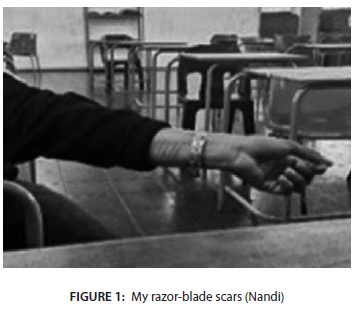
I am sexually attracted to other women. I see myself as ('umjita') a guy. Well, I was once attacked by some guys at the campus. They followed me inside the toilet. They pinned me down and took off my pants and molested me. They told me to stop dating other girls and come and date them instead. I do not tolerate being harassed and discriminated against. (Frowning) I get very angry and cut myself with a razor blade.
Neli's story:
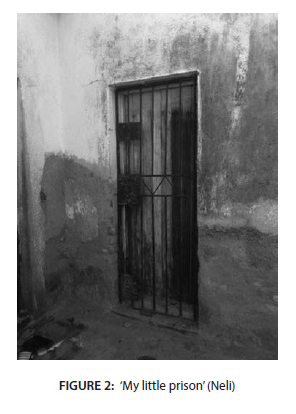
My name is Neli and I am a 19-year-old black bisexual Zulu student who is registered for the National Certificate (Vocational), specialising in Engineering Fabrication. I'm bisexual - I have feelings for both males and females. My college boyfriend noticed that I also date other girls. He then started abusing me: he was hitting me and locking me in the house to keep me away from my girlfriend. He even raped me and I fell pregnant. He would say he is trying to correct my behaviour of loving another woman. He burnt my clothes and books. He said he will tell people that I am bisexual and social workers will take my child away because of my promiscuous behaviour. I would even spend days without food and locked up in the room.
Noxolo's story:
My name is Noxolo and I'm currently studying at college, doing my second year in Engineering Fitting. I was attacked by a mob of male students from the college with sticks and stones. They claimed that I was taking their girls. One of them said that his girlfriend had dumped him because of me. They said they were going to show me what real guys do. They hit me badly and started stripping off my clothes in an attempt to rape me. A taxi stopped by and the driver pulled a gun and promised to shoot them if they continued with what they were doing. They ran off, leaving me naked and shaken. I never reported the incident to the police or college campus management. I was convinced that no one was going to believe me. I do not feel respected as an LGBT student on campus. Students around the campus have a mindset that is very judgemental towards me. They pass unnecessary comments that are directed towards me. They call me a loser, attention-seeker and drama queen.
Nompilo's story:
My name is Nompilo and I am studying Automotive Repair & Maintenance at the college. It was during lunchtime that some male students asked to talk to me privately. We went to a secluded corner. One of the guys pulled a knife and threatened to cut my throat if I ever date any of their girls on campus. I reported them to a male lecturer, but he did not take the story seriously. The same male students once followed my girlfriend while she was walking home alone. They tried to court her and she refused. They asked her to take off her underwear and show them her male private parts if she had them. At college, l like kissing and cuddling other ladies. As a result, I often experience criticism for my behaviour. I am disliked by my peers, who use a derogatory label when referring to me as 'sis boy'. They tell tales about my sexuality and say l have both female and male sexual organs.
Nomsa's story:
I am Nomsa and I am 20 years old. I came to this college to study Motor Mechanics. I am strong and like fixing cars. I am a black female butch and I have never dated men before. On experiences of harassment, discrimination, and violence, I have only experienced name-calling. Physically, they can't touch me. I fight like a bull; most guys fear me. I told them that I will stab them if they dare to come near me. However, I make sure that I am home early because they can kill me at night. I have only had threats that they will catch me one day but I haven't had anything so far.
Data analysis
The narrative analysis approach was used to dissect the collected data, while a visual narrative analysis method was adopted as a broad approach that included both words and images (Butina, 2015). This was executed by repetitively reading the transcriptions of the data. The key text was highlighted while in-text comments assisted with grouping issues and experiences which were common among the participants, and this led to the formation of three themes. The codes that were initially generated were reduced during a second coding cycle to identify the major categories of analysis that would be useful in reporting the findings. In their narratives, the participants spoke about their experiences regarding violence committed by other students while they were at the TVET college.
The following experiences of violence impeded their participation and success at the college:
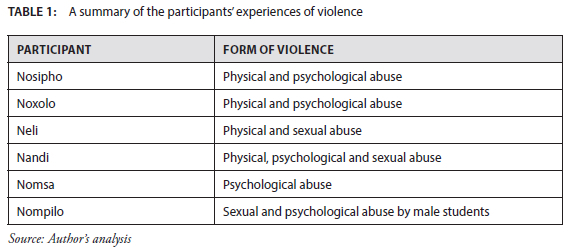
According to Table 1, four participants experienced physical violence, five experienced psychological violence and two experienced sexual violence. These negative experiences impeded their social and educational access and success at the college.
Findings and discussion
This section presents and discusses the findings generated from the narratives of the participants. The participants' responses were organised according to three broad themes, physical, sexual and psychological violence, which were aligned with the research question in the following heading:
What factors impede black lesbian students' participation and success at a technical and vocational education and training college?
The factors that impeded the participants' participation and success included physical, sexual and psychological violence. These negative responses resulted from name-calling, bullying, derogatory labelling, verbal abuse, mockery, molestation and rape by heterosexists. This resulted in a lack of social acceptance and reduced access to an education. These incidents occurred in lecture rooms, on the way to and from college, and in toilets or cloakrooms. Such negative and often violent experiences affected these students' physical and psychological health, leading to absenteeism and failure in their examinations.
The following quotations illustrate these experiences:
Some of my classmates often say that they don't want anything to do with 'izitabane' or homosexuals. They sometimes even try to give me artificial hair (bonding), hoping that I will look like a proper girl. I feel unwanted by what they say. They don't want to choose me during group work. [Nosipho]
Some guys from college hit me and even tried to rape me to prove to me that I am not a man. [Nandi]
They giggle behind my back or whisper in each other's ears and laugh, and I feel it in my bones that it has to do with my sexual orientation. Others say I am just an attention-seeker. [Nandi]
The atmosphere at this college is hostile to us lesbians. Most guys feel uncomfortable around us. They follow us, make fun of us and bully us. Nothing is being done to them. [Neli]
One of the guys pulled a knife and threatened to cut my throat if I ever date any of their girls on campus. I reported them to a male lecturer, but he did not take the story seriously. [Noxolo]
They mock me and say hurtful things about me. They call me a loser. At some point, I lost confidence in myself and even doubted my intellectual capabilities. I was often absent from college and failed most of my modules. I tried killing myself twice, since I felt like a loser. [Nompilo]
I don't want to be social with heterosexuals on campus, since they make jokes and ask silly questions about my sexual orientation. [Nomsa]
Physical and sexual violence
Gender-based violence and 'corrective' rape
Gender-based violence (GBV) refers to any harmful act that is executed explicitly against another person's will and which is based on socially ascribed gender (McBride, 2020). It includes acts that inflict physical, mental, emotional or sexual harm, such as 'corrective' rape or suffering that includes deprivations of liberty or freedom of movement - for example, stalking. Other forms of GBV may include name-calling, teasing and mocking, slander, damage to property, threatening behaviour and sustained bullying (McBride, 2020).
Neli experienced GBV. During the photovoice workshop, she displayed a photo and described how her boyfriend had hit her and raped her to 'correct' her sexual orientation, and he had also locked her in a room to keep her away from her girlfriend. 'Corrective' rape entails the abuse of any member of a sexual minority to 'correct' them towards a heterosexual orientation (Bhana, 2012). Scholars have reported a rise in the incidence of cases of 'corrective' rape taking place in South Africa, where lesbians are raped, the perpetrator holding the distorted view that such rape could convert the lesbian victim to heterosexuality (Nela et al., 2017). She described the room she was incarcerated in as 'my little prison' (see Figure 2).

Homophobic violence
Nosipho experienced homophobic violence, as male students stripped her naked and proceeded to burn her clothes. Moreover, she was teased, mocked and laughed at even more by these perpetrators at the college. Moreover, the police defended the perpetrators' actions by implying that they should have 'hit her harder' for her 'crime of courting other women'. The above incident is a form of GBV referred to as homophobia, which is a specific form of violence and, consequently, an act of gender oppression (Francis, 2017). Homophobia is described as the fear, hatred or intolerance of sharing a public space with sexual minorities. Heterosexuality is considered to be the only natural practice of sexuality that is acceptable and any non-conformity with heteronormativity is viewed as deviant, unnatural and perverse (Bhana, 2012).
Psychological violence
Rejection
Nosipho also experienced rejection by her classmates because of her sexual orientation, as they openly expressed that they did not want anything to do with 'izitabane', which is a derogatory Zulu term for homosexuals. Homosexual individuals are rejected by homophobic individuals as being outside the heteronormative schema of sexual orientation (Francis, 2017). Homophobic individuals experience dislike of, distaste for or even fear of same-sex sexual partnerships. Such hostility towards LGBTQ+ youths, based on peer victimisation and rejection, increases the likelihood of their experiencing emotional and psychological distress and suicidal ideation (McBride, 2020).
Sexual violence
Hate crimes
Nandi was subjected to hate crimes by some black males on campus. She was molested and attacked in a toilet at the college, as they saw her as a theat. None of these violations were reported to the police or to the college authorities. She felt that she 'had no voice to tell the tale' and she also feared being judged by others. In South Africa, Breen and Nel (2011:34) define a hate crime as 'an act that constitutes a criminal offence and is motivated in part or whole by bias or hate'. Sometimes, the victim's actual or perceived sexual orientation may be an influencing factor in such crimes. Hate crimes may lead to social isolation, which may result in withdrawal from social and academic engagement.
Sexual harassment, stalking, coercion and unwanted sexual touching
Noxolo experienced disapproval from her heterosexual peers for holding hands and kissing her girlfriend during the recesses. In addition to the disapproval that was openly displayed by the other students, she was not invited to religious gatherings such as prayers at the college. Moreover, Noxolo was threatened with a bread knife by some black male students, who accused her of taking their girlfriends away from them. After this incident, these students began to stalk her. They followed her while she was walking home from college on a secluded road. They tried to talk her into going out with them but she refused. They forced her to take off her underwear to see whether she was anatomically male.
Stalking includes deprivations of liberty or freedom of movement (McBride, 2020). Such criminal assaults make LGBTQ+ students feel unsafe in educational institutions, and this ongoing sense of insecurity interferes with their ability to succeed in their studies (Jaklitsch, 2017). This may even result in the termination of their education or training because of their anxiety about their safety in the higher education environment.
Psychological and sexual violence
Name-calling, bullying, mocking and sexual harassment
Nompilo was mocked by her classmates, who often passed unnecessary and hurtful comments about her lifestyle as a lesbian. She also experienced name-calling: she was called a 'loser', an 'attention-seeker' and a 'drama queen'. The mocking and name-calling she experienced from her peers made her dislike going to the college and studying. She was often absent from college and failed most of her modules. She tried to kill herself twice, convinced by the negative comments that she truly was a 'loser'. In class, she experienced bullying. Her classmates did not like working with her in group work. She was also molested by some black male students in the college toilet. These male students felt between her legs to check whether she was male or female, thus criminally violating her human right to privacy. They also pulled off her bra to check if she had breasts. Similarly, a study conducted by Van Vollenhoven and Els (2013) recorded students being assaulted and stripped naked, stabbed and raped because of their sexual orientation.
Hostile attitudes and name-calling
In this study, hostile attitudes by heterosexual individuals and especially by black male students formed barriers to social access and also to meaningful participation and success in the TVET environment for black lesbian students. Nomsa experienced hostile attitudes for kissing and cuddling other women. Peers called her derogatory terms such as 'sissy boy' and ostracised her. She always made sure that she was home early after college lectures because of the threats that some black male students had made to her, indicating that they were going to rape and kill her. In the same vein, in a study conducted by Mavhandu-Mudzusi and Sandy (2015), the threat of rape led many students to conceal their sexual identity, not to attend specific classes, to terminate their studies and even to attempt suicide. Nomsa also experienced name-calling, bullying, derogatory labelling and verbal abuse, which resulted in her lack of attendance at college. South African researchers found that hostile attitudes hindered effective participation at tertiary education institutions and academic success among sexual minorities because of the oppression and discrimination they had to experience (Jagessar & Msibi, 2015).
Environmental barriers as a risk of physical and sexual violence
The findings also reveal that environmental barriers were experienced by black lesbian students. Some students felt that they should be allowed to use the male toilets because they identify as being masculine. However, they believed that this practice could expose them to further discrimination in the form of their not being accepted, and that they would be at risk of being targeted for assault and rape.
Psychosocial impact of violence on LGBTQ+ students
Various forms of violence - for example, physical 'corrective' rape and verbal abuse, including hate speech and labelling in homophobic academic learning environments - violate individuals' rights (Msibi, 2013; Rothmann, 2018). The findings in this study also reveal that negative experiences resulting from physical, sexual and psychological violence, based on an individual's sexual orientation, can result in LGBTQ+ students' experiencing chronic emotional distress, heightened feelings of insecurity at the institution, academic underperformance, the abuse of substances and an increase in the symptoms associated with depression.
'Decolonial turn to end violence
This conceptual framework centred on decolonial feminism regarding the interpretation of sexuality and gender, since it challenges coloniality, modernity and the patriarchy of Western, gendered systems (Oyèwùmí, 1997; Lugones, 2010). This approach facilitated an epistemic break from colonial Eurocentric knowledge which led to the rewriting, exclusion and domination of indigenous ways of knowing (Oyèwümí, 1997; Lugones, 2010). As a result, gender theorists have proposed a 'decolonial turn' as a solution to delink from Western knowledge and relink with indigenous ways of knowing to end violence in tertiary institutions.
Recommendations
As a result of this study, the author regards it as necessary to make the following recommendations:
• The government should implement intentional and consistent interventions in higher education spaces to support the psychological, emotional and social well-being of LGBTQ+ students, such as the black African lesbian students who formed the present cohort.
• TVET colleges should develop clear and inclusive policies for admitting and supporting lesbian students.
• Perpetrators who violate the rights of LGBTQ+ students should be severely sanctioned and appropriate consequences should ensue.
• TVET colleges should fund programmes involving LGBTQ+ coordinators to lead awareness programmes to deal with the stigma and discrimination against LGBTQ+ individuals on all their campuses.
• LGBTQ+ students should be encouraged to seek assistance from supportive college staff members.
• College counsellors should be appointed to focus on working with LGBTQ+ students and their families to assist in embracing the principles of individuality and respect for difference, thereby encouraging transparency and societal inclusivity.
• Importantly, new college buildings should always include three to five individual toilets (such as those provided for differently abled individuals or for families at shopping malls) as an alternative for individuals who feel uncomfortable entering the main cloakrooms for personal reasons.
Limitations of the study
Although this study contributes to the literature that deals with violence in tertiary education colleges, it is characterised by some limitations. Because sexuality is a sensitive subject to discuss, it is important to recognise that the pre-established relationships among the participants and the researcher may have affected the participants' level of comfort to discuss their lesbian identities. This could have influenced the findings. As I was their lecturer, they may not have felt that they could disclose sensitive and personal information to me which could have benefited the study. In fact, they may have felt pressurised to tell me what they thought l wanted to hear, possibly fearing that I would victimise them or besmirch their characters to other lecturers.
These power issues were taken into consideration at the beginning of the data-collection stage, when I assured the cohort that I would maintain the utmost confidentiality, which I did throughout the study. As the sample size was small, consisting of six black lesbian students, the findings cannot be generalised to encompass the social and academic experiences of all black South African lesbian students at TVET colleges. The study was also limited to black African lesbian students at an urban TVET college, although some of the students came from rural areas. This could compromise the transferability of the study's findings to urban settings.
Conclusion
The present study explored the participants' experiences from a feminist standpoint which recognises the structural and cultural forces that can constrain women's access to education. The data revealed that these young black lesbians were confronted with a wide range of challenges, including gender-based violence, sexism and discrimination. Patriarchal cultural traditions are still used to discriminate against women instead of protecting them. Although, as enshrined in the Bill of Rights, the Constitution of the Republic of South Africa (1996) prohibits discrimination based on sex and gender and protects the equal rights of individuals, this group of students nevertheless remain exposed to discrimination and victimisation.
The themes that emerged from the participants' narratives also indicate that Western and colonial influences and structures, forced upon us during the oppressive apartheid era, entrench patriarchy and exacerbate the inequalities between heterosexual individuals and black lesbians in South Africa, unlike the ideologies of decolonial feminism. This practice of discriminating against and using GBV against LGBTQ+ community members requires urgent intervention by all role players, lest we become a country known to turn a blind eye to communities who are different.
REFERENCES
Literature review
- Akala, B & Divala, JJ. 2016. Gender equity tensions in South Africa's post-apartheid higher education: In defence of differentiation. South African Journal of Higher Education, 30(1):116.
- Bhana, D. 2012. Understanding and addressing homophobia in schools: A view from teachers. South African Journal of Education, 32(3):307-318.
- Breen, D & Nel, JA. 2011. South Africa - a home for all: The need for hate crime legislation. South African Crime Quarterly, 38, 33-43.
- Breshears, D & Beer, LD. 2016. Creating supportive learning environments: Experiences of lesbian and gay-parented families in South African schools. Education as Change, 20(2):86-105.
- Butina, M. 2015. A narrative approach to qualitative inquiry. Clinical Laboratory Science, 28(3):190-196.
- De Wet, A. 2017. Human rights and sexuality - reimagining the language of equality towards transformation in and through education. South African Journal ofHigher Education, 31(6):113-132.
- DHET (Department of Higher Education and Training). 2013. White Paper for Post-School Education and Training: Building an Expanded, Effective and Integrated Post-School System. Pretoria: Government Printer.
- Francis, DA. 2017. Homophobia and sexuality diversity in South African schools: A review. Journal of LGBT Youth, 14(4):359-379.
- Hutt, R. 2018 (June). This is the state of LGBTI rights around the world in 2018. In: World Economic Forum (Volume 1).
- Jagessar, V & Msibi, T. 2015. 'It's not that bad': Homophobia in the residences of a university in KwaZulu-Natal, Durban, South Africa. Agenda, 29(1):63-73.
- Jaklitsch, D. 2017. Factors affecting the experiences of LGBT students in physical education and sport: A synthesis of the research literature. Kinesiology, sport studies, and physical education synthesis projects. In partial fulfilment of the requirements for the degree of Master of Science in Education (Physical Education). Available at: <https://soar.suny.edu/bitstream/handle/20.500.12648/4048/pes_synthesis/27/fulltext%20%281%29.pdf?sequence=1&isAllowed=y>.
- Kiekel, CR. 2012. Perceptions of climate and engagement for LGBTQ community college students. Doctoral thesis, California State University.
- Kiguwa, P & Langa, M. 2017. 'So I decided not to invade straight black men's space': Exploring heteronormative spaces on campus. South African Journal of Higher Education, 31(4):53-71.
- Koraan, R. 2015. 'Corrective rape' of lesbians in the era of transformative constitutionalism in South Africa. Potchefstroom Electronic Law Journal, 18(5):1930-1952.
- Kosciw, JG, Clark, CM, Truong, NL & Zongrone, AD. 2020. The 2019 National School Climate Survey: The experiences of lesbian, gay, bisexual, transgender, and queer youth in our nation's schools. A report from GLSEN. New York: Gay, Lesbian and Straight Education Network (GLSEN).
- Kosciw, JG, Greytak, EA, Bartkiewicz, MJ, Boesen, MJ & Palmer, NA. 2012. The 2011 National School Climate Survey: The experiences of lesbian, gay, bisexual and transgender youth in our nations schools. Gay, Lesbian and Straight Education Network (GLSEN). New York: GLSEN.
- Lesch, E, Brits, S & Naidoo, NT. 2017. 'Walking on eggshells to not offend people': Experiences of same-sex student couples at a South African university. South African Journal of Higher Education, 31(4):127-149.
- Lugones, M. 2010. Toward a decolonial feminism. Hypatia, 25(4):742-759.
- Matthyse, G. 2017. Heteronormative higher education: Challenging this status quo through LGBTIQ awareness-raising. South African Journal of Higher Education, 31(4):112-126.
- Mavhandu-Mudzusi, AH, Netshandama, VO & Matshidze, P. 2017. Deconstructing matula (taboo): A multi-stakeholder narrative about LGBTI. South African Journal of Higher Education, 31(4):307-324.
- McBride, A. 2020. The extradition ofJulian Assange: A human rights perspective. Looking beyond. Vienna Master of Arts in Human Rights. Selected theses. Generation 6, 7 and 8. Class of 2019, 2020 and 2021. Verlag Österreich.
- Minton, SJ, Dahl, T, O'Moore, AM & Tuck, D. 2008. An exploratory survey of the experiences of homophobic bullying among lesbian, gay, bisexual and transgendered young people in Ireland. Irish Educational Studies, 27(2):177-191.
- Mkhize, N, Bennett, J, Reddy, V & Moletsane, R. 2010. The country we want to live in: Hate crimes and homophobia in the lives of black lesbian South Africans. Cape Town: HSRC Press.
- Mogotsi, I, Nduna, M, Mavhandu-Mudzusi, AH & Mthombeni, A. 2017. Studying sexuality: LGBTI experiences in institutions of higher education in southern Africa. South African Journal of Higher Education, 31(4):1-13.
- Msibi, T. 2011. The lies we have been told: On (homo)sexuality in Africa. Africa Today, 58(1):55-77.
- Msibi, T. 2013. Queering transformation in higher education. Perspectives in Education, 31(2): 65-73.
- Munyuki, C & Vincent, L. 2018. Strangers 'at home': Gay, lesbian and bisexual students' strategies for resisting heteronormativity in university residence life. South African Journal of Higher Education, 32(3):64-80.
- Naidu, M & Mutambara, V. 2017. Questioning heteronormative higher education spaces: Experiences of lesbian women at a South African university. South African Journal of Higher Education, 31(4):34-52.
- Nela, K, Vawdab, N, Mbokodoc, L & Govender, S. 2017. The lived experiences of black undergraduate lesbian students at a rural South African university. Gender and Behaviour, 15(3):9708-9721.
- Ngidi, ND & Dlamini, MAC. 2017. Challenging heteronormative scripts through film and transformative pedagogy among TVET college students. South African Journal of Higher Education, 31(4):267-285.
- Okanlawon, K. 2017. Homophobic bullying in Nigerian schools: The experiences of LGBT university students. Journal of LGBT Youth, 14(1):51-70.
- Oyèwùmí, O. 1997. The invention of women: Making an African sense of Western gender discourses. Minneapolis, MN: University of Minnesota Press.
- Patton, MQ. 2002. Two decades of developments in qualitative inquiry: A personal, experiential perspective. Qualitative SocialWork, 1(3):261-283.
- Prado-Castro, DM & Graham, TM. 2017. Constructing our identities: Identity expression amongst lesbian women attending university. South African Journal of Higher Education, 31(4):94-111.
- Republic of South Africa. 2000. Promotion of Equality and Prevention of Unfair Discrimination Act (PEPUDA) 4 of 2000.
- Reygan, F & Francis, D. 2015. Emotions and pedagogies of discomfort: Teachers' responses to sexual and gender diversity in the Free State, South Africa. Education as Change, 19(1):101-119. Available at: <https://doi.org/10.1080/16823206.2014.943259>
- Rios, O, Font-Palomar, M, Flecha, A & Valls, R. 2023. Violence against LGBTIQ+ people at universities: The need to uncover a silent reality. Trauma, Violence, & Abuse, 24(4):2680-2690.
- Rolfe, L & Peters, S. 2014. Through the rainbow lens: A participatory photovoice study of LGB students at UCT. Research Paper, University of Cape Town Psychology Department.
- Rothmann, J. 2018. A social constructionist approach to resilience for lesbian, gay, bisexual, transgender, intersex, queer and/or questioning academics and students in South African universities. Transformation in Higher Education, 3(1):1-8.
- Thoreson, R. 2016. Like walking through a hailstorm: Discrimination against LGBT youth in US schools. Human Rights Watch [HRW].
- United Nations Children's Fund (UNICEF). 2019. Behind the numbers: Ending school violence and bullying. Paris: UNICEF.
- Van Vollenhoven, WJ & Els, CJ. 2013. The human rights paradox of lesbian, gay, bisexual and transgender students in South African education. De Jure, 46(1):263-284.
- Walsh, CF. 2016. 'It really is not just gay, but African American gay': The impact of community and church on the experiences of black lesbians living in north central Florida. Journal of Homosexuality, 63(9):1236-1252.