Geography teachers' preparedness for ESD integration: Insights from Gauteng, South Africa
Abstract
This study examined the preparedness of grade 10 to 12 Geography teachers at selected schools in Gauteng, South Africa, to integrate Education for Sustainable Development (ESD) into the Geography curriculum. Data were collected by questionnaires with 120 Further Education and Training Geography teachers in Gauteng Province, South Africa. Results show that only 38% of respondents had ESD training, influencing their content knowledge and integration of ESD into the curriculum. However, respondents with a high level of knowledge of the Sustainable Development Goals (SDGs) and ESD concepts like climate change, renewable energy and the just energy transition were more likely to integrate ESD (r=0.444, p=0.001). University courses were identified as common sources of content knowledge for in-service teachers. Barriers to ESD integration include limited resources, time constraints, large class sizes, the abstract nature of the SDGs, and competing curriculum demands. Further Education and Training research projects were identified as a valuable entry-point for ESD. The study recommends ESD-training, expert-guest teachers, embedding ESD within annual teaching plans, and adequate resources.
Education for sustainable development; Sustainable Development Goals; Geography teachers; Gauteng; South Africa
INTRODUCTION
Global efforts to address climate change require educational strategies aligned with Sustainable Development Goals (SDGs), and thus the need for Education for Sustainable Development (ESD) (UNESCO, 2017). In southern Africa, the Regional Strategic Framework supports both the SDGs and Africa's Agenda 2063 commitments to ESD (UNESCO, 2020). Since the mid-1990s, ESD has been developed in schools and universities globally (Riess et al., 2022) and this empowers student teachers to understand sustainable development in various contexts and to pass this information on to school learners (UNESCO, 2018; Wynes & Nicholas, 2019; Riess et al., 2022). However, the readiness of teachers to integrate ESD into the Geography school curriculum remains unclear. For example, a study with primary school teachers in Nigeria found that they face barriers such as insufficient funding, poor stakeholder involvement, and a lack of motivation when implementing educational change for ESD (Babajide & Smith, 2022). Furthermore, studies in Nigeria and South Africa found that large class sizes, inappropriate teaching strategies, and inadequate content knowledge also hinder ESD integration (Aladejebi, 2020; Tsotetsi, 2021; Ntuli et al., 2022). On the other hand, the South African Curriculum Assessment Policy Statement (CAPS) document provides limited guidelines on how ESD should be integrated into teaching and learning. For example, while sustainability-related topics are referenced in the policy aims, CAPS does not indicate which ESD competencies are to be taught and how teachers are to assess ESD-related learning outcomes. Therefore, teachers are compelled to do this independently, given the inconsistency and absence of clear guidelines on ESD integration (Damoah, 2019; Bopape, 2022). Against this backdrop, this study considers the level of preparedness that in-service teachers display for ESD, and to what extent ESD is integrated into the Geography curriculum. This study situates ESD within the framework of three of the SDGs, which are SDG 4 (Quality Education), SDG 7 (Affordable and Clean Energy), and SDG 13 (Climate Action). In this study, these are framed as education in the context of climate change, renewable and non-renewable energy, and the just energy transition, respectively. These concepts are also central to the Geography CAPS curriculum, covering topics such as climate, weather, and ecosystem, resources and sustainability (Grade 10), climate and weather systems, human environment interactions (Grade 11), and environmental geography and global issues (Grade 12) (DBE, 2011).
METHODOLOGY
The study primarily employed a qualitative research design, complemented by quantitative analysis. Participants in the study were 120 practising Further Education and Training (FET) (grades 10 to 12) Geography teachers from schools in Gauteng Province, South Africa. The research participants were sampled through purposive and snowball strategies. Some of the participants came from in-service teachers who attended the short learning program for FET Geography teachers at the University of Johannesburg; others came from existing contacts. Data were collected using an anonymous questionnaire; 93 respondents completed an online questionnaire and 27 completed a hard copy questionnaire. Data saturation was reached when no new information was coming from the surveys, and the responses from the 120 respondents were enough to identify recurring themes and patterns.
The questionnaire was organised into four sections: a general section that gathered demographic data and three additional sections for knowledge, process, and application. These sections included closed-ended questions (5-point Likert scale, multiple-choice, and single-type questions) that provided the quantitative data. The qualitative data were imported into ATLAS.ti for thematic analysis. This was done by initial coding from which themes were identified (Braun & Clarke, 2006). Quantitative data were analysed using SPSS. Descriptive and inferential statistics were produced, including frequencies, percentages, and measures of central tendency. For Likert scale items, the mean was used to determine the central tendency and the standard deviation to capture variability. Reliability analysis yielded a Cronbach's alpha value of α=0.9, which demonstrates high internal consistency.
The study obtained ethics clearance through the University of Johannesburg (reference number 2024-09-02). Permission was also obtained from the Gauteng Department of Education (reference number 2024/163A). Respondents received an information sheet and gave their informed consent before participation. Anonymity and confidentiality were guaranteed during data collection; data were stored on a password-protected laptop.
RESULTS
Demographics
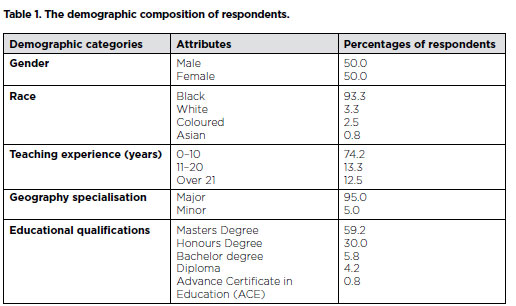
All racial groups were represented, albeit in unequal proportions; however, black people had the highest proportion at 93.3%. The respondents were all well-qualified, with the majority having a Master's degree (59.2%), and only one with an Advanced Certificate (Table 1). The respondents were specialised teachers who either had Geography as a major (95%), or minor subject (5%). The majority had up to 10 years of teaching experience in Geography (74%).
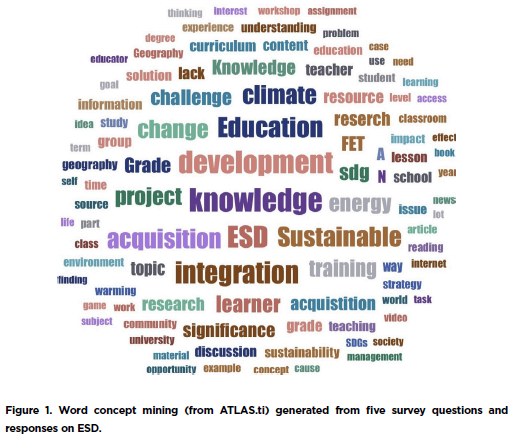
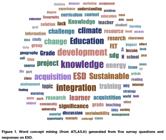
The level of preparedness the teachers show for ESD within the Geography curriculum was evaluated based on their self-assessed content knowledge, knowledge acquisition, and knowledge integration. Figure 1 presents a concept map in which larger text indicates higher frequencies in survey responses. Knowledge (354 mentions) is linked to the acquisition and integration of ESD knowledge. Development (325 mentions) reflects sustainable development issues. ESD (124 mentions) is associated with challenges in integrating sustainability into the Geography curriculum. Other prominent terms mentioned include climate change, energy, SDGs, sustainable development, the FET research project, and resource challenges.
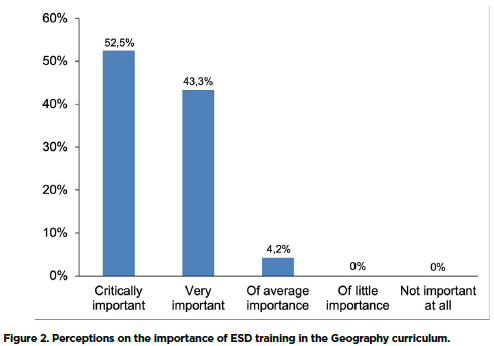
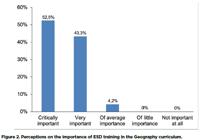
Findings show that 38% of the teachers had received training on ESD, and 62% had not. Despite this, over 95% of teachers viewed it as critically important (53%), followed by very important (43%) and of average importance (4%); none viewed it as of little importance or not important at all (Figure 2).
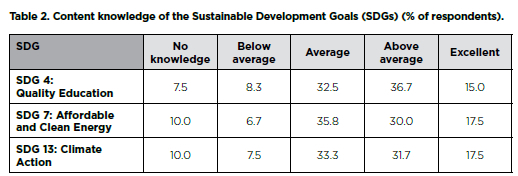
With regards to content knowledge of SDGs, most respondents rated it between average and above average (Table 2). These three SDGs were chosen as they feed into current ESD debates and related topics on energy resources, sustainability and climate change are implicitly covered within the Geography CAPS grades 10 to 12 curriculum (DBE, 2011).
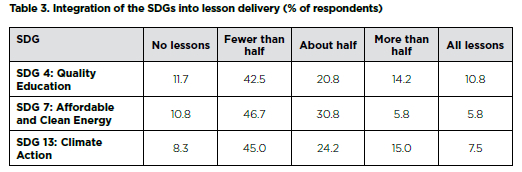
With respect to how often the different SDGs are integrated into lesson delivery, there was greater integration of SDG 4 (Quality Education) than the rest, followed by SDG 13 (Table 3). A gap in content knowledge and pedagogical knowledge in ESD integration in lesson delivery for SDG 7 was noted.
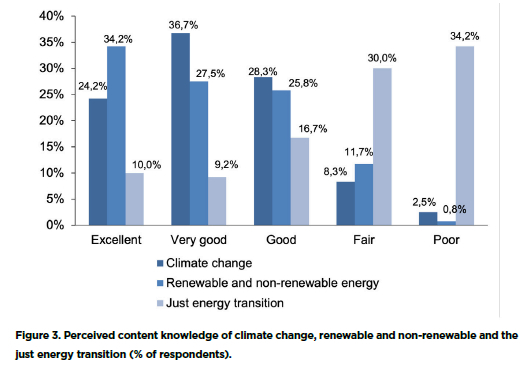
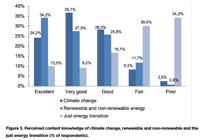
Regarding respondents' perceptions of their level of content knowledge of climate change, renewable and non-renewable energy, and the just energy transition, there was much greater confidence in content knowledge of climate change compared to the just energy transition (Figure 3). Addressing this gap will be necessary for fostering a solid understanding of energy issues and their implications for sustainability, hence ESD in the Geography curriculum.
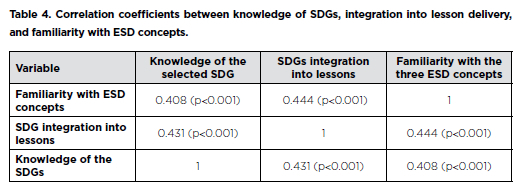
Pearson's correlation analysis was undertaken to examine statistical relationships between knowledge of the SDGs, the extent of SDG integration in lesson delivery, and familiarity with the ESD concepts within the Geography curriculum (Table 4). This shows moderate, positive and statistically significant correlations throughout. Since the p-values were less than the 0.05 significance level, the null hypothesis of no association was rejected. Collectively, these results suggest that higher levels of SDG knowledge are positively associated with both the integration of SDGs into teaching practice and familiarity with broader ESD concepts.
Knowledge acquisition
Participants indicated how they acquired knowledge of the ESD components of the curriculum. Items mentioned include: through research tasks done by learners (respondent 25); through current affairs, YouTube, and reading widely (respondent 34); and through teacher development training provided at the school (respondent 56).
With regards to climate change, respondents mentioned: that they develop the knowledge as they teach it (respondent 4); that they are pursuing a Master's degree in the same field (respondent 45); and through training development and workshops (respondent 109). Another participant stated:
'I'm an avid reader and follower of current trends In the endeavour for a 'greener' world, and various sources have helped me with insight, e.g., Via Afrika, C. Africa app, NatGeo, plus various other documentaries (written, filmed, blogged, vlogged), etc.' (respondent 59).
For renewable and non-renewable energy, respondents mentioned that they develop knowledge: 'through modules at the University of Johannesburg, internet news, and books' (respondent 106); 'through Grade 9 content in the topic of resources and sustainability' (respondent 103); and because it is a topic in Grade 11 Geography (respondent 67). Another participant said:
'As a teacher, I built my knowledge on renewable and non-renewable resources through a mix of academic training, professional development courses, and real-world examples.' (respondent 66).
With respect to knowledge on the just energy transition, respondents said they get information from several online sources: 'National Geographic and other channels. I also love reading newly published articles on these geographic topics and online articles' (respondent 83); and YouTube, mostly, where I would watch TED talks' (respondent 115). However, several respondents said that they have no prior knowledge of the just energy transition (respondents 56, 76).
The integration of ESD into the Geography curriculum
Most respondents reported integrating ESD into more than half their lessons (Table 3), and the most frequently chosen strategy was discussion (70%), followed by project-based learning (66%) and group work (48%). Among the seven strategies specified, role play was the least preferred. Examples stated by participants include: 'create games that will incorporate sustainability, e.g., a treasure hunt. Discussions. Let learners create posters, present on the topic' (respondent 67); and 'group learners and have them create sustainable models as solutions to challenges such as climate change' (respondent 85). Most respondents set assessment questions on sustainable development issues (86%). Respondent 53 said:
'The research exposes learners to issues caused by unsustainable development, which, to an extent, gives them an opportunity to explore alternative options which can be sustainable. However, a lot still needs to change in terms of the scope and focus of the research because, in most cases, it's copy and paste for the learners with no engagement with the sources.'
Another respondent said: 'Every year, the projects administered to the FET phase have topics that deal with climate change and sustainable development issues (e.g., loadshedding, global warming, impacts of climate change, and annual cyclonic patterns, etc)' (respondent 59). Research projects done at FET level allow the in-service teachers to engage with ESD and real-life issues in the curriculum, depending on the question or topic chosen.
Challenges for ESD integration
Three overarching themes emerge from participant responses on the challenges for ESD integration into the Geography curriculum.
1. Classroom management, time, and resource constraints
Respondents highlighted several issues related to learners' attitudes, availability of resources and how these can be deployed in the classroom. Responses on these topics included: 'Learners do not relate [to ESD concepts], and honestly speaking, most learners are not interested' (respondent 112); 'Lack of resources to visualise the impact of climate change on communities, especially underdeveloped communities'(respondent 82); 'Lack of teaching resources in the classroom and overcrowding^ more specifically underprivileged schools that lack resources such as smart boards and projectors for playing videos for learners' (respondent 23); and 'Time and assessment pressures: teachers often face pressures related to standardised testing, which may not include SDGs or sustainability topics, as the content is a lot, so I don't know where the SDGs will be fitted' (respondent 14).
2. Curriculum and content challenges
Several respondents mentioned a disconnect or misalignment between the curriculum, ESD topics discussed in textbooks, and assessments. For example, respondents 46, 45 and 67 said that there are overlaps in the curriculum in some places, and gaps in others, such as regarding ESD and the SDGs. Textbooks are also out of date.
3. Training and development challenges
A number of respondents highlighted that they may not have sufficient training on ESD topics and the SDGs, which limits their ability to teach them effectively (respondents 32, 48, 51, 96). They also noted that older teachers may be reluctant to attend training. Weak policies and a lack of support from local authorities were also identified as an issue (respondents 50, 63).
DISCUSSION
Teacher preparedness for ESD integration into the Geography curriculum
Results of this study showed that 62% of respondents had not received any training on ESD, nevertheless most respondents believed ESD was critically important in the Geography curriculum. This underscores the need to empower educators through training to enhance their ESD competencies, as identified by UNESCO (2014). This study found that there was a much high integration of SDG 4 (Quality Education) into the curriculum compared to SDG 13 (Climate Action) and SDG 7 (Affordable and Clean Energy) (Table 3). This is significant since progress in other SDGs is closely linked to progress in education (ASDR, 2024).
The finding that SDG 7 is less often integrated into teaching aligns with the fact that it is linked to the just energy transition, a concept that is not explicitly stated as a standalone concept in the CAPS (DBE, 2011). However, related topics such as energy resources, climate change, and sustainable resource use are stated in the grades 10 to 12 Geography curriculum (DBE, 2011). Notably, the curriculum does not explicitly link these to coal dependency and energy transition. This is evident in the low level of content knowledge on the just energy transition, with 34% self-ratings of respondent content knowledge being 'poor' and only 19% as 'very good' or 'excellent'. As such, it appears that most respondents struggled with understanding the just energy transition, despite its central relevance to ESD debates. However, there was a positive correlation between knowledge of SDGs, integration of SDGs in lesson delivery, and familiarity with the core concepts of ESD (Table 4).
The analysis identified university courses as the primary sources for teachers' ESD knowledge. This supports earlier findings that higher education institutions contribute to ESD integration through research, teaching, and engagement with stakeholders and civil society (Leal Filho et al., 2019). However, their involvement requires a more proactive approach to support ESD knowledge acquisition by teachers (Leal Filho et al., 2019). This highlights the need for strong institutional support and coordinated strategies at the national, provincial, and departmental levels to embed ESD awareness and knowledge into the curriculum. The results also showed that ESD knowledge was obtained by teachers through current affairs (news), YouTube, and wider reading. This aligns with Araneo (2023) who found that university students connected their ESD learning to real-world examples through assessments involving current events. Organisations in South Africa such as Fundisa for Change, which works mostly with teacher education institutions (universities), are also proactive in promoting ESD through professional development programmes (Thenga et al., 2021). Involving different stakeholders ensures that the implementation of the SDGs addresses a wide spectrum of social, economic, and environmental challenges (Leal Filho et al., 2019).
Challenges for ESD integration in the curriculum
Results indicated that higher integration of SDGs in lesson delivery was associated with greater familiarity with the related sustainability concepts (Table 4). On the other hand, discussions, project-based strategies, and group work were the most preferred strategies used in ESD concept integration. In South Africa, the CAPS grades 10 to 12 research project assignment was highlighted as a key mechanism supporting ESD teaching and learning. Respondents mentioned topics such as climate change, cyclones, floods, and recycling being often included in the assessment questions. This finding aligns with work that found that university student teachers across several countries identify climate change and pollution as the most pressing environmental problems requiring integration of ESD into curricula (Yli-Panula et al., 2022).
Despite these examples, respondents in this study agreed that curriculum changes are needed and that, while ESD is present within the Geography curriculum, it remains imbued with challenges. Some respondents struggled to understand core ESD components such as the SDGs, climate change and energy, but that there was a lack of training in content knowledge and pedagogical skills in ESD. This is exacerbated by heavy workloads, time constraints, overcrowded curricula, and the complexity of ESD design (Munasi, 2024). The absence of explicit ESD guidelines in CAPS leaves teachers without clear direction (Bopape, 2022). Furthermore, inconsistencies between curriculum goals and classroom realities persist (Munasi, 2024). On curriculum integration, weak policy support, a rigid curriculum, and annual teaching plans that omit SDGs create barriers. However, the DBE (2011) maintains that CAPS provides an enabling framework for implementing ESD through the Geography curriculum.
CONCLUSIONS
The study examined the preparedness of in-service teachers to integrate ESD into the Geography curriculum. Results indicate that teachers with greater knowledge about the SDGs are significantly more likely to integrate ESD into their lessons (Table 4). In addition, knowledge of the SDGs shows a moderate, positive association with teachers' familiarity with three related ESD concepts of climate change, renewable and non-renewable energy, and the just energy transition. The strongest correlation is between the integration of ESD into teaching and familiarity with these ESD concepts (Table 4). It is notable that while 62% of respondents did not have any ESD training, most (93%) considered ESD critically important to the curriculum. While the CAPS curriculum in South Africa has made efforts to incorporate ESD, challenges such as limited resources, time constraints, overcrowded classrooms, heavy workloads, and competing curriculum demands hinder its integration. Discussion-based and project-based strategies are suggested by respondents to be an effective way to integration ESD into the classroom. The study recommends the following:
• Curriculum guidelines for teachers could include discussion prompts around sustainability, concrete lesson plans, and classroom activities;
• Teaching manuals can be provided on effective strategies to deal with time limitations, heavy workload, and other classroom constraints;
• Promote short learning programs on ESD through the education department or local universities;
• Ensure the education department provides the necessary ICT and related resources to support teachers in ESD teaching;
• Involve experts from industry, government, or universities as guest lecturers when teaching challenging ESD topics such as climate change and the just energy transition, which were unfamiliar to most respondents.
Aiadejebi, D. T. (2020). An exploration of the intended, enacted and achieved environmental education curriculum within the Social Studies teacher education programme at a Nigerian university. Unpublished PhD dissertation, University of KwaZulu-Natal.
Arab Sustainable Development Report (ASDR) (2024). Arab Sustainable Development Report 2024. UNESCO (ESCWA), Beirut.
ACKNOWLEDGEMENTS
We express our gratitude to all the in-service teachers who took part in the study.
REFERENCES
- Araneo, P. (2023). Exploring education for sustainable development (ESD) course content in higher education: A multiple case study including what students say they like. Environmental Education Research, 30(4), 631-660.
- Babajide, O. P., & Smith, C. (2022). Teachers' challenges in the introduction and implementation of systemic change in the Nigerian primary school system. SAGE Open, 12(2). https://doi.org/10.1177/21582440221093033
- Bopape, J. (2022). SWOT analysis of selected schools involved in greening and sustainable development programmes. Southern African Journal of Environmental Education, 38(1), 36-59.
- Braun, V., & Clarke, V. (2006). Using thematic analysis in psychology. Qualitative Research in Psychology, 3, 77-101.
- Damoah, B. (2019). Teachers' perception of the integration of environmental education into the Grade 12 curriculum in the East London Education District. Unpublished Masters Dissertation, University of Fort Hare.
- Department of Basic Education (DBE) (2011). National curriculum statement (NCS): Geography further education and training phase grades 10-12. Department of Education, Pretoria.
- Leal Filho, W., Shiel, C., Paço, A., Mifsud, M., Ávila, L. V., Brandli, L. L., Molthan-Hill, P., Pace, P., Azeiteiro, U. M., Vargas, V. R., & Caeiro, S. (2019). Sustainable Development Goals and sustainability teaching at universities: Falling behind or getting ahead of the pack? Journal of Cleaner Production, 232, 285-294.
- Munasi, K. R. (2024). Evaluating the integration of education for sustainable development in the life sciences curriculum: A case study of Grade 11 teachers in Vhembe East District. Sustainability, 16(24), 10918. https://doi.org/10.3390/su162410918
- Ntuli, T. G., Nkanyani, T. E., Sikhosana, L., & Mudau, A. V. (2022). Exploring teacher knowledge in natural sciences. International E-Journal of Educational Studies, 6(12), 235-245.
- Tsotesi, N. (2021). Assessing the implementation of environmental education in selected Vosloorus township schools. Unpublished Masters dissertation, University of South Africa.
- UNESCO (2014). Shaping the future we want: UN Decade of Education for Sustainable Development (2005-2014): Final global monitoring report. UNESCO, Paris.
- UNESCO (2017). Education for Sustainable Development Goals: Learning objectives. UNESCO, Paris.
- UNESCO (2018). Education for sustainable development: A roadmap. UNESCO, Paris.
- Wynes, S., & Nicholas, K. A. (2019). Climate science curricula in Canadian secondary schools focus on human warming, not scientific consensus, impacts or solutions. PLoS ONE, 14(7), e0218305. https://doi.org/10.1371/journal.pone.0218305
- Yli-Panula, E., Jeronen, E., Koskinen, S., & Mâki, S. (2022). Finnish university students' views on climate change education and their own ability to act as climate educators. Education Sciences, 12(3), 169. https://doi.org/10.3390/educsci12030169
Accepted 27 January 2026
Published 9 February 2026