The Lesotho basic education system in the era of polycrisis: A critical policy analysis of the LBECP 2021
Abstract
Following the global shifts towards competency-based education during a polycrisis, the Lesotho Basic Education Curriculum Policy (Ministry of Education and Training, 2021) aims to equip learners with competences for a rapidly changing world. However, there is a lack of clarity on how the policy establishes internal coherence, risking the fragmented implementation that characterised the previous education reform. Using qualitative document analysis, this study adopts critical policy analysis to examine the policy's internal logic through the lenses of Habermas's knowledge interests and Biesta's educational functions. The findings reveal a critical tension: pedagogy emphasises practical paradigm, while curriculum structure and assessment prioritise technical rationalities. This tension can lead to policy practice gaps, highlighting the need to revise the policy to ensure internal coherence within it. Although limited to deductive document analysis, this study introduces a novel critical policy approach to Lesotho's educational landscape. Further research, using an inductive approach, could investigate how teachers navigate these systemic tensions.
nature of knowledge; critical policy analysis; curriculum policy; learner-centred pedagogy; holistic education; polycrisis
Introduction
Education systems worldwide are undergoing transformation in response to the complex challenges of the 21st century, often described as a "polycrisis"-a concept coined by Morin and Kern (1999). As defined by Le Grange (2024), polycrisis refers to simultaneous multiple, interconnected crises that collectively amplify one another, causing widespread disruptions. The phenomenon involves multiple overlapping stressors including environmental, technological, economic, and health-related issues, which all require a critical reflection on the purpose of education (Moss, 2025). Although the term has gained prominence in policy and scholarly discourse, different authors emphasise different dimensions of the phenomenon. Innerarity (2022) highlights the governance challenge created by multiple crises that interact in unpredictable ways, making conventional policy responses increasingly inadequate. Reimers (2020) approaches polycrisis from an educational perspective, arguing that education systems must prepare learners to navigate rapidly changing and interconnected global realities. UNESCO (2023) similarly frames contemporary educational reform within the context of overlapping global challenges, including climate change, technological transformation, inequality, and democratic fragility, all of which require new educational responses.
In Lesotho, as a Global South country, challenges such as poverty, educational inequality, climate vulnerability, youth unemployment, and demands for economic competitiveness are not isolated problems but interconnected pressures that increasingly shape educational priorities (International Monetary Fund, 2025; United Nations, 2024; World Bank, 2024, 2026). However, it should be noted that in this paper, polycrisis does not simply refer to the coexistence of many of the aforementioned crises; instead, it is conceptualised from a curriculum policy perspective as an imbalance in curriculum knowledge, skills, and values to grasp the complexity of overlapping crises.
These overlapping crises have intensified debates about the purposes of education and, more specifically, what forms of knowledge are most worth developing (Biesta, 2009, 2015). In this context, international organisations such as the Organisation for Economic Cooperation and Development (OECD) and UNESCO have promoted competency-based education as a framework for preparing future-ready learners equipped with transferable skills (OECD, 2018, 2020). Even though this agenda emphasises adaptability and innovation, critics argue that it risks narrowing education to instrumental outcomes, privileging technical rationality and measurable behaviours over broader democratic and emancipatory purposes (Biesta, 2013, 2015; Foster & Piacentini, 2023). This suggests that curriculum reforms in the 21st century need to move beyond instrumentalist logics to ask the normative question of what knowledge matters.
Out of the dissatisfaction with traditional education, earlier critical curriculum scholars argued for emancipation, emphasising dialogue, critical consciousness, and democratic struggle (Freire, 1970; Giroux, 1988; Spencer, 1860). Inspired by these critics, Biesta (2015) proposes that curriculum reforms need to balance three functions of education: qualification, socialisation, and subjectification. He argues for a normative stance, echoing Spencer's critical question: "What knowledge is of most worth?" This question highlights the need to view curriculum policy development as a complex philosophical and political process of selecting knowledge that serves the prioritised purpose or function of education. Collectively, these perspectives highlight curriculum as a contested site where technical, practical, and emancipatory interests intersect. In a time of polycrisis-which is marked by overlapping ecological, social, and political disruptions-the challenge is to move beyond narrow instrumentalism and ensure that curriculum equips learners with disciplinary insight, ethical agency, and collective resilience to navigate uncertainty and shape just futures.
These philosophical debates provide a normative foundation for analysing curriculum policy reforms. Global empirical literature highlights a shift towards competency-based education that emphasises transferable skills, values, and dispositions alongside traditional knowledge (Tahirsylaj & Sundberg, 2020; UNESCO, 2023). This trend, championed by international organisations such as OECD and UNESCO, reflects global interest in prioritising labour market-ready capabilities over disciplinary depth and emancipatory functions of education. This tension is particularly evident in prioritised standardised assessments that focus on measurable and quantifiable outcomes (Ariovich & Robinson, 2019), and fail to capture the holistic development of learners, particularly in relation to values, ethical reasoning, and democratic participation (Broadfoot, 2007). The misalignment therefore, reflects the prevalence of technical rationality, which is orientated towards efficiency, control, and accountability (Ewert, 1991) at the expense of the broader purposes of subjectification and democratic formation.
These tensions are particularly salient in sub-Saharan Africa, where curriculum reforms inspired by global models often collide with systemic constraints, including cultural contexts and entrenched assessment practices (Heleta & Chasi, 2023; Sayed & Kanjee, 2013). Countries such as Ghana, Rwanda, Kenya, Botswana, and South Africa have adopted competency-based curricula, seeking to move away from traditional, content-heavy models towards learner-centred approaches (Cheptoo, 2020; Kurasa, 2025; Sayed & Kanjee, 2013), despite implementation challenges emanating from shortage of resources such as textbooks, overcrowded classrooms, and limited infrastructure. Reliance on standardised assessments further undermines holistic aims, privileging quantifiable results over values, ethical reasoning, and democratic participation (Foster & Piacentini, 2023).
Critics observe that these implementation hurdles and tensions are rooted in the mismatch between the importation of global curriculum models and the local socioeconomic realities (Heleta & Chasi, 2023; Kassaye, 2025; Tabulawa,1998; Thiam, 2024). The drive for international benchmarks and future-ready learners can marginalise Indigenous knowledge and community priorities, creating a disconnect between curriculum design and lived experiences (Comaroff & Comaroff, 2012; Mignolo & Walsh, 2018).
Lesotho's curriculum reform landscape reflects these broader regional dynamics, illustrating conflict between progressive global curriculum ideals and local contextual factors. For instance, the Curriculum and Assessment Policy (CAP; Ministry of Education and Training [MOET], 2009) sought to promote holistic development of learners and align with global trends, but its implementation faced challenges including limited teacher training and tensions between traditional disciplinary structures and integrated pedagogical approaches (Rakolobe & Teise, 2024; Ralebese & Ralebese, 2023; Raselimo & Mahao, 2015; Selepe, 2016). A recent study confirms that the primary cause of implementation failure lies with emphasis on academic and technical ideologies, privileging examination-oriented knowledge transmission over more emancipatory or learner-centred orientations (Moea, 2024). To address the shortcomings of CAP, the MOET introduced the Lesotho Basic Education Curriculum Policy (LBECP) in 2021. The policy redefines the basic education system as comprising primary (Grades R-7) and secondary education (Grades 8-12). It organises upper secondary into three-tier streams: academic, technical, and vocational. Mirroring global trends in curriculum reforms, the policy envisages a "curriculum that is geared towards nurturing and developing 21st century skills at all levels" (MOET, 2021, p. 5).
However, while the LBECP aims to address the limitations and contradictory messages of its predecessor CAP, and promote development of the 21st century skills, there is paucity of research on how it establishes internal coherence among key aspects of the curriculum. Much published research focused on implementation challenges of curriculum reforms (Rakolobe & Teise, 2024; Ralebese & Ralebese, 2023; Selepe, 2016; Tafai, 2017; Tiela, 2023). Beyond Moea's (2024) study on curriculum ideologies, little is known about the underlying purposes of education reforms in Lesotho. This lack of clarity regarding the nature of knowledge and internal coherence within the policy may lead to a fragmented implementation, risking the same policy-practice gap that characterised its predecessor (Rakolobe & Teise, 2024).
The purpose of this study, therefore, is to critically examine the LBECP by interrogating the nature of knowledge, skills, and values it privileges, and the rationalities that underpin its vision of education to prepare learners for a volatile and unstable future. The focus is on curriculum aims, curriculum structure, pedagogy, and assessment provisions. Specifically, the study addresses the following two research questions:
• What forms of knowledge, skills and values are prioritised in the selected sections of the LBECP 2021, and what contradictions are evident in these priorities?
• How do these priorities manifest as conflicting purposes of education within the policy?
By asking these questions, the study goes beyond descriptive analysis to interrogate policy text to expose underlying contradictions, utilising analytical tools drawn from Habermas's theory of knowledge interests and Biesta's functions of education. This dual approach overcomes the limitation of a single theory by linking underlying rationalities directly to contradictory educational outcomes.
Theoretical framework
As previously indicated, this study draws on Habermas's theory of knowledge interests to analyse the forms of knowledge, skills, and values embedded in the LBECP 2021. In his book, Knowledge and Human Interests, Habermas (1971) argues that all knowledge is shaped by three underlying human interests: the technical, practical, and emancipatory. The technical interest is oriented towards prediction and control, supporting the instrumental goal of education. It aligns with the principle of behaviourism, which foregrounds behavioural objectives in curriculum design. An education policy underpinned by this knowledge interest emphasises disciplinary knowledge, measurable competencies, accountability, and standardised assessment (Gore & Zeichner, 1991; Mezirow, 1981). Such emphasis risks narrowing education to instrumental outcomes at the expense of its other purposes such as understanding and emancipation (Freire, 1970; Stenhouse, 1982), which are essential for preparing learners for modern polycrisis.
In contrast, the practical interest is grounded in mutual understanding and democratic dialogue, highlighting co-construction of knowledge, cultural relevance, and teacher agency, underlining the need for policies that resonate with local contexts (Ewert, 1991; Habermas, 1971). Guided by constructivism, the practical interest is oriented towards the process model of curriculum, which believes in social interactions in meaning-making (Grundy, 1987). From this perspective, curriculum is not the end product driven by pre-determined objectives but, rather, it is a means to an end (Stenhouse, 1975) that needs to be understood in its specific context. Thus, an education policy emphasising this knowledge interest prioritises an integrated curriculum designed around themes reflecting real-life challenges. It also values learner-centred pedagogy and formative assessment focused on students' learning.
The emancipatory interest, concerned with critical reflection and freedom from domination, underscores the curriculum's potential to foster equity, justice, and democratic subjectivity, moving beyond compliance to cultivate learners as autonomous and responsible actors (Gore & Zeichner, 1991; Habermas, 1971). Central to this knowledge interest is a critical agenda, pursuing the vision of emancipation from oppressive structures (Ewert, 1991; Freire, 1970), such as compliance to assessment regimes ensured through high-stake testing. Curriculum is seen as a praxis, developing through critical reflection in the process of co-construction of knowledge to respond to the real societal issues and challenges. Related to this interest, Freire (1970) advocated for a critical pedagogy, emphasising democratic participation in resolving community problems. The underlying values include freedom, democracy, and social justice, which are forms of tacit knowledge in curriculum documents.
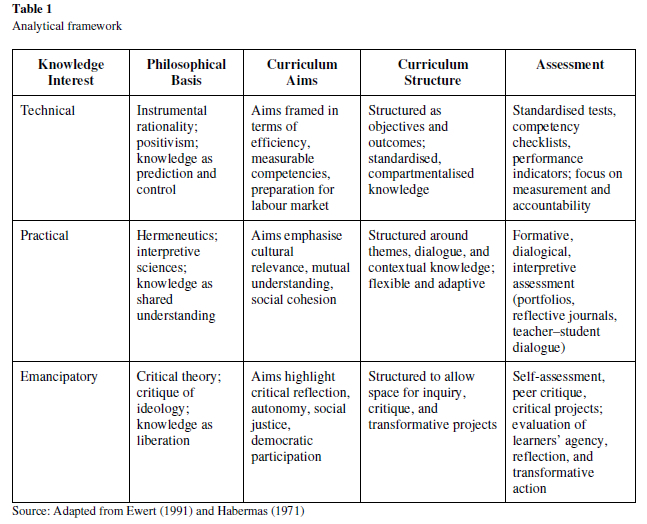
Ewert (1991) provides a comprehensive interpretation of the knowledge interests to education, demonstrating how they can be used to interrogate curriculum and policy. He posits that technical orientations often dominate through measurable outcomes, while practical and emancipatory orientations are frequently marginalised. Taken together, Habermas's original theory and Ewert's educational application provide a robust analytical framework for this study (see Table 1), enabling a critical examination of the LBECP and the orientations of knowledge it privileges or neglects.
However, while this theory provides a useful lens for interrogating educational policy, it has been critiqued for its rigidity and Eurocentrism. The neat categorisation tends to oversimplify the complex, overlapping rationalities that shape educational practice, where efficiency, dialogue and critical reflection often coexist (Carr & Kemmis, 1986). The framework also reflects Western philosophical traditions, privileging abstract rationality, and potentially marginalising non-Western epistemologies and local knowledge systems. Applied uncritically, the theory may therefore abstract away from contextual educational realities. In this study, we adopt the framework as a heuristic device rather than a fixed categorisation, using it critically to analyse the rationalities embedded in the LBECP while remaining attentive to contextual specificities and alternative knowledge traditions.
To complement this framework, this study draws on Biesta's (2009, 2013, 2015) three functions of education-qualification, socialisation, and subjectification-as a complementary framework. Biesta's framework situates educational purposes more concretely within schooling and policy contexts. The function of qualification resonates with Habermas's technical interest, but extends it by emphasising not only efficiency and competencies but also the broader role of knowledge in enabling participation in society (Biesta, 2009). Socialisation parallels Habermas's practical interest, highlighting education's role in inducting learners into cultural traditions and democratic communities through dialogue and mutual understanding (Biesta, 2013). Subjectification, Biesta's (2015) distinctive contribution, deepens Habermas's emancipatory interest by foregrounding the formation of learners as autonomous subjects capable of responsibility and freedom.
Notably, Biesta (2009, 2015) insists that these functions must be held in balance, with none dominating, and that teachers exercise professional discretion in navigating them. Consequently, the emphasis accommodates local contexts, recognising that educational purposes cannot be prescribed in the abstract but must be interpreted and enacted by educators in consideration of their communities. Moreover, it is worth emphasising that Biesta's framework is inherently evaluative, requiring ongoing judgement about educational practices and the ability of policies to achieve a meaningful balance among the three functions of education. Therefore, Biesta complements Habermas by grounding abstract knowledge interests in the lived realities of curriculum practice, while also providing a normative basis for evaluating whether policies such as the LBECP enable or constrain the pursuit of good education in a time of polycrisis.
Methodological framework
This is a critical policy analysis (CPA) study, operating within a qualitative research approach underpinned by the interpretive paradigm to interrogate the forms of knowledge, skills, and values LBECP privileges, and the rationalities that underpin its vision of education. Unlike traditional policy analysis, which focuses on technical efficiency, CPA seeks to uncover the underlying assumptions, values, and ideologies that shape education policies, and examines tensions between the policy rhetoric and practice (Young & Diem, 2018). The CPA enabled the research team to conceptualise the study as analysis of policy, rather than analysis for policy (Olssen et al., 2004) to interrogate forms of knowledge, skills, and values emphasised in LBECP 2021. Achieving the goal of CPA requires a qualitative approach because it allows for a deep critical interrogation of the meanings, ideologies, and underlying rationalities embedded within the policy (Creswell & Poth, 2018; Koro-Ljungberg & Cannella, 2017). Our assumption is that education policy, as a text, is an epitome of contradictory and implicit messages about value positions that need to be unpacked for a deeper understanding of the reform (Bowe et al.,1992).
To move beyond descriptive analysis, the study employs Habermas's (1971) theory of knowledge-constitutive interests, as interpreted by Ewert (1991), as an analytical tool for interrogating LBECP. By operationalising the three categories of technical, practical, and emancipatory interests, the study systematically codes policy statements relating to the aims, curriculum structure, and assessment provisions, which represent the major pillars of the policy: what it promises, how curriculum is organised, and how learning is assessed, respectively. The process allows for a systematic mapping of the forms of knowledge, skills, and values that the policy prioritises, and for identifying the rationalities that underpin them. The analysis proceeds by coding policy statements against the three knowledge interests. For example, references to measurable competencies and accountability are read as technical; emphasis on cultural relevance and dialogue, as practical; and commitments to critical reflection, equity, or social justice as emancipatory. This step ensures that the analysis is not merely descriptive but grounded in a critical framework that reveals the underlying knowledge-constitutive interests embedded in the policy.
Biesta's (2009, 2013, 2015) work provides the normative anchor for the study. His insistence on asking "What knowledge is worth developing?" in the era of systemic shocks, and his critique of the learnification of education frame the evaluative dimension of the analysis. Learnification, as Biesta argues, reflects a shift towards viewing education as a process of individual learning, often stripped of its social, ethical, and political dimensions. By engaging with this critique, the study assesses whether the LBECP reinforces a technocratic logic of learning or supports a richer conception of education as a democratic and subjectifying practice. Consequently, Habermas/Ewert supply the analytical categories for systematic interrogation, while Biesta provides the normative provocation that ensures the analysis engages with the deeper question of educational purpose and integrity in the context of polycrisis.
Data sources and analytical approach
The primary source for this study is the LBECP, which is treated as a policy text for critical analysis (Ball, 1994). This document was chosen because it represents the current official curriculum/mandated curriculum. The focus was primarily on aims of basic education, curriculum structure, pedagogy, and assessment-which are key elements of the intended curriculum. These sections of the policy document were examined not only for their explicit messages, but also for their implicit assumptions and rationalities that underpin the intended curriculum. This means we view the LBECP not as a neutral blueprint, but a text embedded in power, ideology, and competing rationalities (Bowe et al., 1992). For a more evaluative analysis of the tensions within the identified knowledge orientations of the policy, Biesta's functions of education was used as complementary theory to reveal how the policy intentions manifest as competing functions of education. Combining the two theories positions the study within the tradition of CPA, which challenges instrumentalist tendencies and foregrounds the democratic and subjectifying dimensions of education.
The approach to data analysis and coding was essentially deductive, guided by theoretical constructs of Habermas's theory of constitutive interests. This involved a close reading of the LBECP to identify relevant statements, focusing on its stated aims, curriculum structure, and assessment provisions. The statements were coded and interpreted against Habermas's three knowledge-constitutive interests: technical, practical, and emancipatory, using the analytical tool depicted in Table 1. The framework enabled a critical examination of the LBECP and the orientations of knowledge it privileges or neglects. As indicated in the tool, the analysis involved identifying language that emphasises efficiency, measurement, and control (technical); dialogue, cultural relevance, and shared understanding (practical); or critical reflection, autonomy, and social justice (emancipatory). Once categorised, these interests were compared across the three curriculum elements to reveal patterns of emphasis and potential contradictions. Finally, the findings were evaluated against Biesta's (2009, 2013, 2015) normative question of "What knowledge is worth developing?" to assess whether the policy's orientations align with, or fall short of, broader educational purposes.
Findings and discussion
The findings are presented in two themes, reflecting the research questions: knowledge interests in LBECP and contradictions, and manifestation of knowledge interests as conflicting purposes of education. Where appropriate, excerpts are used to provide evidence for the interpretation and the claims made about specific statements.
Knowledge interests in LBECP and contradictions
This section examines the forms of knowledge, skills, and values prioritised in the policy aims, curriculum structure, pedagogy, and assessment through the lens of Habermas's knowledge interests. The findings reveal that while the technical, practical, and emancipatory knowledge interests are all represented in the policy, there is a noticeable imbalance in how they are emphasised.
Technical knowledge interests in the aims of basic education
The analysis of curriculum aims reveals that out of eight aims of basic education, three (Aims 1, 2, and 5) foreground technical interests, emphasising measurable competencies and labour-market readiness. For example, Aim 1 commits to "developing advanced linguistic and mathematical skills to bolster creative and critical thinking for effective communication and life-long learning." The phrase "advanced . . . skills" reflects a technical orientation towards testing and grading learners against standardised benchmarks, while "effective communication" signals a functional, outcome-based logic that prioritises foundational language and numeracy skills, situated in empirical-analytics science. These skills are a means to achieving creative and critical thinking for effective communication and life-long learning, which shifts the focus to practical and emancipatory knowledge interests.
Aim 2 is on "equipping learners with knowledge, skills, values and attitudes which enable them to respond to socioeconomic and technological changes." By foregrounding knowledge, this aim reflects technical interest in promoting an understanding of theoretical concepts and facts within subject areas as the primary purpose of basic education in Lesotho. While achieving this aim may require practical application of knowledge as learners adapt to changes in society, juxtaposing knowledge, skills, and attitudes with the need to respond to market shifts and technological changes reflects efficiency and control, which are the interests of the technical paradigm. The inclusion of "values and attitudes " acknowledges contextual relevance as a secondary practical interest, but prioritises the instrumental goal of education as the hallmark of technical knowledge interests.
Aim 5 seeks to promote "advanced vocational, technical, scientific, entrepreneurial and technological knowledge and skills to promote digital literacy [and] financial literacy." These words "vocational," "technical," "scientific," and "technological" privilege quantifiable competencies aligned with employability and accountability, reinforcing an instrumental orientation. Practical interest is subordinate in this aim as illustrated by only one construct- the inclusion of "entrepreneurial skills"-which are only important to the extent they advance technical business interests.
Further, the competencies envisaged in this aim align with the 4th Industrial Revolution (4IR), serving the technical knowledge interests of education and seeking to update curriculum to include competences required in the workplace (Rudzani, 2025). The emphasis is on training learners in "digital literacy," which is considered a foundational skill in the 4IR. However, within the polycrisis landscape, digital literacy anchored solely in technical rationality is inadequate in preparing learners for an unpredictable future, especially in Lesotho where overlapping climate shocks threaten rural livelihoods and destabilise the economy.
Practical knowledge interests in the aims of basic education
While there are traces of practical orientation across all the eight aims as highlighted in the foregoing analysis, Aims 4, 6, and 7 are explicitly grounded in this knowledge orientation. For instance, Aim 4 commits to "developing understanding, appreciation as well as awareness of environmental interactions and issues of climate change in ensuring sustainable development." The words "appreciation" and "awareness" reflect a practical interest in cultivating values, attitudes, and environmental consciousness that cannot be easily measured. In addition, the words signal a concern with caring and shared understanding, even though the phrase "ensuring sustainable development" introduces a secondary technical dimension by implying measurable outcomes.
The practical orientation is further evident in Aim 6: "Promoting aesthetic and creative skills through different forms of literary work." Although there is an indication of emancipatory interest in promoting "aesthetic skills," learners-at the classroom operational level-are expected to interpret meanings and express ideas as they engage with literary works. This shifts the curriculum beyond simply controlling technical interest towards interpreting and understanding, which lays a foundation for dealing with the socioeconomic crises-such as chronic poverty and unemployment-the country is facing.
Similarly, Aim 7 reflects practical knowledge interest by emphasising the need for active involvement of learners in practical activities aimed at solving real-life problems. The aim states: "providing suitable opportunities for a variety of practical and creative skills aimed at improving health and healthy living styles." The emphasis on "practical and creative skills " reflects a learner-centred orientation, encouraging adaptability and lifestyle change through contextual application. Here, the practical logic lies in embedding knowledge within everyday realities of health and wellbeing, while the outcome-oriented phrase "improving health" introduces a technical undertone. Thus, the policy values interdisciplinary knowledge integrating topics drawn from different subjects and daily experiences of learners, which is a characteristic feature of a process-oriented curriculum situated within the practical paradigm (Grundy, 1987).
Although practical orientations position the LBECP as socially embedded and responsive to learners' contexts, they frequently appear as supportive elements rather than the dominant logic. In many cases, phrases such as "ensuring sustainable development" (Aim 4) or "improving health" (Aim 7) introduce measurable outcomes that shift the emphasis towards technical rationality. This shows that while practical interests are consistently present, they often function as a secondary layer beneath stronger technical imperatives.
Emancipatory knowledge interests in the aims of basic education
The analysis reveals that two aims prioritise a critical agenda to empower learners to act autonomously and participate in activities aimed at addressing societal problems and issues. Specifically, the curriculum aims to provide "learners with a moral and religious/spiritual foundation for the development of a socially and culturally acceptable character, embracing diversity" (Aim 3). This aim is explicit about the moral and cultural values required for a transformative education, characterised by a critique of ideas rather than simple acceptance of the status quo (Freire, 1970; Giroux, 1988). The aim also calls for "embracing diversity," which aligns with emancipatory curriculum expectation for learners to critically reflect and evaluate their own value positions that might exclude the perspectives of others.
Habermas (1971) argued for a deliberative democracy: freedom from oppressive structures. Aim 8 responds directly to this call by "providing opportunities for learners to participate in activities promoting democratic principles, human rights and responsibilities for national contribution." Through this aim, learners can engage in action-oriented learning and voluntarily participate in social justice as opposed to just learning about societal problems. Through the process of learning, learners can develop critical self-reflection, critical thinking, and problem-solving skills, as well as core values such as democratic participation, citizenship, and life-long learning, which all reflect emancipatory knowledge interests. The interest in life-long learning is expressed in Aim 1 as the goal of education requiring learners to engage in continuous learning and self-transformation in pursuit of new learning responsive to the current needs of society. In the context of Lesotho, life-long learning serves as a crucial tool for survival, transforming education from a rigid technical orientation into an empowering mechanism for climate adaptation and economic resilience.
Knowledge interests prioritised in curriculum structure
The LBECP 2021 primarily adopts a technical approach in organising curriculum. The section dealing with curriculum structure, which is relatively short, begins with a list of eight curriculum objectives that are aligned to the aims of basic education. These objectives are followed by core competences, which define the kind of attributes expected of learners. By foregrounding objectives and competences, the policy prioritises technical knowledge interests, treating education as a controlled activity aimed at achieving pre-defined measurable outcomes. Although the policy explicitly identifies literary and effective communication skills, social skills and personal skills as core competences, the curriculum structure does not align with this practical interest. From the intermediate phase (Grades 4-7), the curriculum shifts from integration to compartmentalisation where knowledge is to be acquired through a long list of discrete subjects. This fragmentation reflects a technical view of knowledge as something that can be categorised and delivered in silos (Harvey & Tree, 2025).
At secondary level, the policy adopts a three-tier model, where subjects are grouped into academic, technical, and vocational streams, with Sesotho, English, and mathematics being compulsory subjects in each of the streams. The adoption of streaming curriculum into vocational, technical, and academic pathways, and designating certain subjects as compulsory, reflects a focus on utilitarian goal of education and economic efficiency, both of which align with technical interest in preparing learners for specific roles in society. While prioritising Sesotho may be seen as serving the socialisation function of education, aimed at preserving cultural heritage (Biesta, 2013), enforcing it through curriculum mandate reflects a technical interest in standardisation. Thus, the policy creates a tension that contradicts the flexible and adaptive educational framework required to navigate an era of global and national crises (Le Grange, 2024).
Furthermore, although such a structured and sequential approach to organising curriculum is valuable in ensuring efficiency in education (Grundy, 1987), it narrows the curriculum towards utilitarian purposes and neglects broader educational aims required to respond to modern polycrisis. The findings therefore suggest that the LBECP privileges instrumental rationality at the expense of more holistic orientations, limiting opportunities for democratic participation, ethical reflection, and learner agency. From a critical perspective, a curriculum dominated by technical interest is inadequate for building learners' resilience and adaptive capacity to navigate complex real-life challenges in the era of polycrisis. Ultimately, by treating education as a technical exercise, the LBECP 2021 risks producing learners who are unprepared for an unpredictable future, making them vulnerable to global and local environmental and socioeconomic shocks.
Knowledge interests in the intended pedagogy
In contrast to the curriculum structure, the intended pedagogy prioritises practical knowledge interest. Although the section on pedagogy lacks detailed instructional guidelines, it reinforces the core messages of its predecessor, the CAP. Specifically, the policy mandates a shift towards a learner-centred approach that "acknowledges learners are different," and stresses that "instruction should be prepared accordingly." The policy's insistence that "instruction should be prepared according to learners' differences" reflects a practical interest in tailoring education to diverse backgrounds and promoting autonomy. Similarly, the statement that "learners interact with the teacher and their peers to build new knowledge, values, and 21st century skills" highlights dialogical processes that foreground practical interests in co-constructed meaning. Thus, in the process of learning, learners develop critical thinking, negotiation skills, collaboration, and team work which are part of the 21st century skills (OECD, 2018) necessary for understanding and navigating the complex multiple environmental and socioeconomic stressors that society is confronted with.
Furthermore, the policy envisions an optimum teacher-pupil ratio (1:30) to "enable the teacher to guide learners, as individuals or a collective, make interpretation of concepts." This statement reflects a focus on learner-centred education, where learners can be assisted as individuals, given their specific learning needs. Furthermore, the phrase "make interpretation" shifts the focus from technical knowledge of facts to practical interest of understanding the meaning behind content. Other phrases such as "what learners know," "teacher facilitates lessons," and "respond to prevailing life challenges" reinforce practical orientation that values learners' prior knowledge, guidance over control and application of knowledge in real-world situations. While the practical knowledge interest is the dominant value in the mandated pedagogy, there are signs of emancipatory interest. For example, envisioning "life-long learners" and "think critically in collaboration with their peers," reflects interest in a learner empowered through continuous learning and critical reflection on different ideas and volatile situations. In this way, the pedagogy shifts from the rigid "factory model" of schooling to an active crisis response approach which is essential for building learners' resilience to the polycrisis of the modern world.
The analysis presented in this section highlights the tension between the technical curriculum structure and its practical pedagogy. While the curriculum structure prioritises fragmented knowledge taught through discrete subjects, the pedagogy shifts the focus to integrated learning that is learner-centred in nature. How this tension plays a role in assessment provision is explored in the next section.
Knowledge interests in the intended assessment practice
The policy prescribes various forms of formative assessment adapting to a shift from examination-oriented system to competence-based model prioritising continuous assessment, portfolio, and checkpoints, especially at primary and lower secondary levels. However, the language used to describe these forms of continuous assessment reflects technical knowledge interest focusing primarily on foundational skills. At Grade 3, checkpoints would focus on literacy and numeracy, serving the purpose of assessing learners' "readiness to proceed to the next academic phase." The technical interest is further evident in the upper grades (Grade 7-9), where the focus is on competences in English, mathematics, and science. The focus on measurable foundational skills contradicts the policy's aspirations to "empower learners to make informed decisions and to continue learning." While making these foundational subjects the priority for "checkpoints," the Ministry implicitly devalues non-technical forms of knowledge and skills acquired through subjects such as life skills-based and sexuality education, social studies, and creativity and entrepreneurship. The omission of Sesotho, as a mother tongue, from the list of national checkpoints risks alienating learners from their own cultural identity, which contradicts the policy's intention of fostering holistic and culturally relevant education.
Furthermore, although the policy espouses an assessment framework that is "participative, interactive and constructive"-representing a shift from high-stake examinations-its design remains anchored in technical rationality. While the policy promotes continuous assessment for holistic development of learners, its tools-such as quarterly tests-serve the purpose of measuring foundational competencies to ensure learners meet certain pre-determined standards. This devalues continuous assessment to mini-examinations, prioritising assessment of learning over assessment for learning (Raselimo & Mahao, 2015). Such a practice can easily create a systemic pressure to comply with measurable syllabus requirements at the expense of creativity and exploration which the policy originally intended to promote. Previous research shows how the demand to cover content-heavy syllabus undermines practical and emancipatory visions of curriculum reforms in Lesotho (Moea, 2024; Raselimo & Wilmot, 2013).
At upper secondary level (Grades 10-12), the policy emphasises summative assessment through "public examinations that are used for selection of learners to higher education levels," which reflects a shift towards technical rationality aimed at sorting learners according to the specialised areas serving the interest of the labour market. The policy further states that "examination can be in the form of paper and pencil tests; objective tests." These statements reflect a control-oriented logic of accountability and comparability, achieved through administering measurable tests. These rigid assessment tools are not appropriate for measuring competences required for a response to the modern polycrisis, which require more advanced skills including problem solving, critical thinking, and community-based action.
Furthermore, the use of objective tests at the senior level of basic education reflects a "product" view curriculum, treating knowledge as a stable commodity that can be transmitted, acquired, and verified through objective means (Grundy, 1987). It also treats learners as passive recipients of objective knowledge that can be regurgitated during standardised examinations. Freire (1970) criticised this traditional education, arguing that it constrains efforts aimed at realising the emancipatory goal of education, which is also central to the LBECP 2021. This may suggest that Lesotho's basic education is experiencing an implementation crisis wherein its aspiration for humanistic, emancipatory, and holistic education is stifled by the narrow technical requirements of assessment tools. The anticipated implementation crisis leaves the educational system ill-equipped for the contemporary polycrisis. By prioritising technical approaches to assessment, the policy fails to cultivate the adaptive resilience and critical agency that learners urgently need to navigate Lesotho's overlapping economic, social, and climate disruptions.
Manifestation of knowledge interests as conflicting purposes of education
The analysis in this section addresses Biesta's (2013) critical question: "What knowledge is worth developing?" Looking at the data from this angle operationalises the Habermasian analysis by demonstrating how the three knowledge interests manifest as concrete education functions of qualification, socialisation, and subjectification within the policy text. This dual approach shifts the focus from broad motives underlying basic education to a nuanced evaluation of how the knowledge interests are balanced or prioritised in the specific context of education policy in Lesotho.
The findings point to the dominance of qualification, which aligns with technical knowledge interests seeking to exercise control in education. From this perspective, the curriculum clearly privileges employable competencies, which are evident in two curriculum aims (1 & 5) of basic education, curriculum structure, and the prescribed assessment models. Aim 1, for instance, reads: "developing advanced linguistic and mathematical skills." This aim, along with Aim 5: "Advanced vocational, technical, scientific, entrepreneurial and technological knowledge and skills to promote digital literacy [and] financial literacy" foreground measurable skills aligned with labour-market readiness. Specifically, the first aim reflects the intention for learners to develop foundational literacy and numeracy skills, while Aim 5 sets the tone for preparing learners for the world of work by equipping them with advanced doing, technical and scientific skills. Expressions such as "vocational," "technical" and "financial literacy" reflect a product-oriented educational purpose of training learners for the job market. Biesta (2013) describes such a purpose as learnification, which reduces education to discrete, measurable, and certifiable skills. Within the critical paradigm, this dominance must be interrogated as an ideological choice to engage with the famous critical question: "Whose interests are served when education is framed primarily as preparation for the labour market?" By privileging technical rationality, the policy risks subordinating education to economic imperatives, echoing Foster and Piacentini's (2023) warning that global reforms often privilege technical rationality at the expense of democratic and emancipatory purposes.
The learnification is also evident in the curriculum structure-especially from upper primary level-which shifts from the previous integrated model to a subject-centred approach prioritising specialised knowledge for learners to qualify in professional fields. At upper secondary level, the curriculum prioritises languages (English and Sesotho) and mathematics as compulsory, which aligns with the global labour market. English is an official international language that represents qualification for the global economy (Koothrapalli, 2023), while mathematics is often used to qualify learners for entry into highly esteemed specialised areas (Stinson, 2004) such as medicine, finance, and engineering. Although Sesotho may be deemed to serve the socialisation purpose of education, making it mandatory for all learners at upper secondary level reflects the intention to standardise learning; shifting from using it as a functional language to making it a formal school subject.
The qualification function of the curriculum structure is reinforced by the assessment provisions prioritised in the policy, which foregrounds tests and public examinations, ensuring compliance with the prescribed content. Although it is rhetoric, the policy recognises the importance of formative and summative assessment. There is emphasis on formal testing through quarterly tests and checkpoints, with the latter administered in Grades 7 and 9 focusing on English, mathematics, and science, as though monitoring progress in other subjects is not important. Additionally, high-stake public examinations at the end of Grade 12 dominate assessment. In providing guidance to public examinations, the policy states: "The examination can be in the form of paper and pencil tests; objective tests; coursework or alternative to coursework papers; practical tests or projects or alternative to practical tests." As highlighted in the literature, while qualification is important in the context of Lesotho as a developing country seeking to develop its labour force for economic development, it risks narrowing the curriculum and constraining innovation (Ariovich & Robinson, 2019; Broadfoot, 2007). As Biesta (2013) argues, the qualification purpose of education must be balanced with other purposes for it to serve emancipatory interests of societies. In this case, good education needs to serve the interest of the Basotho nation rather than neoliberal economic interests.
However, as demonstrated earlier in this article, the policy in its pedagogy emphasises the practical interest, which works in tandem with the socialisation function of education. By placing value on learner-centred pedagogy and the 21st century skills for life-long learning, the policy reflects the intention to serve the interests of social reproduction; learners are prepared to locate themselves in existing norms, cultures, and practices (Biesta, 2022). The following two curriculum objectives, which embed moral, cultural, civic, and democratic values, provide evidence for presence of the socialisation function in the policy text: "Providing learners with a moral and religious/spiritual foundation . . . embracing diversity" (Aim 3); and "activities promoting democratic principles, human rights and responsibilities for national contribution" (Aim 8). However, such statements are not well represented in the policy text, and thus can easily be overshadowed by accountability regimes inherent in the Lesotho education system.
The function of subjectification, which Biesta associates with democratic agency and learner autonomy, is the least represented. While emancipatory strands appear in Aim 8's reference to "democratic principles" and Aim 6's promotion of "aesthetic and creative skills," they remain marginal and fragmented. Opportunities for learners to become subjects of their own learning-capable of critical reflection, ethical judgement, and civic participation-are constrained by the dominance of qualification and technical imperatives. The same can be said with the emancipatory undertones and values such as life-long learning and democratic participation as they appear in Aims 1 and 8, respectively. Life-long learning is mentioned as a subordinate goal of developing linguistics and mathematical skills, suggesting that it is only valuable to the extent that it supports the demands of the labour market, which requires individuals to constantly improve their skills to remain relevant. Based on this observation, it can be argued that the policy reflects a tension between its stated goal of empowering learners and the underlying tendency to socialise them into maintaining the status quo (Biesta, 2013; Freire, 1970).
In summary, the analysis shows that while the LBECP aspires to breadth, it privileges qualification, leaving socialisation and subjectification secondary. This imbalance raises critical questions about what knowledge is worth developing in the era of global polycrisis. If education is reduced to measurable competencies, rather than broader aims of democratic participation and ethical reflection, it risks creating functional, at the expense of active, citizens. It also fails to build the adaptive resilience required to navigate overlapping unprecedented environmental, socioeconomic, and technological shocks. Thus, the findings highlight the need to strengthen the emancipatory strand to ensure that education fosters the critical agency needed to withstand global crises rather than instrumental conformity.
Conclusion
This study interrogated the LBECP through Habermas's knowledge-constitutive interests and Biesta's normative provocation, revealing that while the policy prioritises practical knowledge interests-particularly within its intended pedagogy, the curriculum structure and assessment provisions remain heavily weighted towards technical rationality. This represents a tension between what the policy says, and how it is built. The greatest contradiction lies in assessment, where summative examinations undermine broader competencies and reflect ideological choices, privileging technocratic logics over subjectification and socialisation purposes. The disconnect between curriculum aims, curriculum structure, pedagogy and assessment may undermine the policy's practical interest in meaningful social interactions. Furthermore, the prominence of qualification risks the policy intention to prepare learners for diverse pathways through the three-tier secondary curriculum.
Thus, the findings suggest that Lesotho's basic education is experiencing a systemic crisis, caught between global market imperatives and the national need for building a democratic society. To realise its transformative potential, the LBECP needs to mainstream emancipatory aims, elevate practical orientations, and reimagine assessment as a site of agency and dialogue. Ultimately, what is worth cultivating in Lesotho's classrooms is not only market-relevant skills but also capacities for ethical judgement, critical reflection, and democratic participation, so that the policy can move beyond compliance with global agendas towards a genuinely empowering basic education.
By synthesising Habermas's theory of knowledge-constitutive interests and Biesta's normative functions to expose the highlighted tensions, the study provides a robust interdisciplinary lens for analysing curriculum policies in the specific national context of Lesotho. For researchers in comparable Global South contexts, this dual framework provides an approach to decoding education policy documents, influenced by borrowed global progressive ideas such as learner-centred education and competence-based curriculum. The study is, however, limited to documentary evidence generated from a policy text that represents intentions about provision of education rather than the actual practice. Additionally, the deductive coding approach followed in this study may have compromised the depth of the analysis, which was essentially based on predetermined data categories derived from Habermas and Biesta. Further research utilising an inductive approach to explore how teachers navigate the identified tensions in the classroom could shed more light on the policy-practice gap and on understanding the role of education in the face of the global polycrisis.
Ariovich, L., & Robinson, C. (2019). Grand challenges in assessment. ERIC. https://files.eric.ed.gov/fulltext/ED612032.pdf
Ball, S. J. (1994). Education reform: A critical and post-structural approach. Open University Press.
Biesta, G. (2009). Good education in an age of measurement: Ethics, politics, democracy. Paradigm. https://doi.org/10.4324/9781315634319
Biesta, G. (2013). The beautiful risk of education. Paradigm.
Biesta, G. (2015). What is education for? On good education, teacher judgement, and educational professionalism. European Journal of Education, 50(1), 75-87. https://doi.org/10.1111/ejed.12109
Biesta, G. (2022). World-centred education: A view for the present. Routledge. https://doi.org/10.4324/9781003098331
Bowe, R., Ball, S. J., & Gold, A. (1992). Reforming education and changing schools: Case studies in policy sociology. Routledge. https://doi.org/10.4324/9781315412122
Broadfoot, P. (2007). An introduction to assessment. Continuum. https://openlibrary.org/books/OL1145_5025M/An_Introduction_to_Assessment
Carr, W., & Kemmis, S. (1986). Becoming critical: Education, knowledge and action research. Routledge. https://doi.org/10.4324/9780203496626
References
- Cheptoo, R. (2020). The "Africanized" competency-based curriculum: The twenty-first century shift. Journal of Education and Practice, 11(4), 1-9. https://files.eric.ed.gov/fulltext/EJ1245141.pdf
- Comaroff, J., & Comaroff, J. (2012). Theory from the South: Or, how Europe is evolving toward Africa. Anthropological Forum, 22(2), 113-131. https://doi.org/10.1080/00664677.2012.694169
- Creswell, J. W., & Poth, C. N. (2018). Qualitative inquiry and research design: Choosing among five approaches (4th ed.). SAGE.
- Foster, M., & Piacentini, M. (2023). The role of assessment in improving education and promoting educational equity. Education Sciences, 15(2), 224. https://www.mdpi.com/2227-7102/15/2/224
- Freire, P. (1970). Pedagogy of the oppressed. Herder & Herder.
- Giroux, H. A. (1988). Teachers as intellectuals: Toward a critical pedagogy of learning. Bergin & Garvey.
- Gore, J. M., & Zeichner, K. M. (1991). Action research and reflective teaching in preservice teacher education: A case study from the United States. Teaching and Teacher Education, 7(2), 119-136. https://doi.org/10.1016/0742-051X(91)90054-S
- Grundy, S. (1987). Curriculum: Product or praxis? Falmer Press.
- Habermas, J. (1971). Knowledge and human interests. Beacon Press.
- Innerarity, D. (2022). La sociedad del desconocimiento [The society of ignorance]. Galaxia Gutenberg.
- International Monetary Fund. (2025). Kingdom of Lesotho: 2025 Article IV Consultation- Press Release; and Staff Report (IMF Country Report No. 25/267). https://doi.org/10.5089/9798229023092.002
- Kassaye, W. (2025). Conceptualization of curriculum in Africa. In Modern education in Africa (Vol. 2, pp. 187-284). Springer. https://doi.org/10.1007/978-3-031-68290-2_3
- Koothrapalli, R. R. (2023). The crucial role of education and the English language in foreign countries. Educational Research, 14(4). https://doi:10.14303/2141-5161.2023.277
- Kurasa. (2025, May 20). Cultivating continuous growth: Why African competency-based education reforms must embrace a culture of perpetual improvement. https://mykurasa.com/2025/05/cultivating-continuous-growth-why-african-competency-based-education-reforms-must-embrace-a-culture-of-perpetual-improvement/
- Le Grange, L. (2024). The many sides to performativity. Journal of Education, 96. http://dx.doi.org/10.17159/2520-9868/i96a02
- Mignolo, W., & Walsh, C. (2018). On decoloniality: Concepts, analytics, praxis. Duke University Press. https://doi.org/10.1215/9780822371779
- Ministry of Education and Training. (2009). Curriculum and assessment policy. http://www.education.gov.ls
- Ministry of Education and Training. (2021). Lesotho basic education curriculum policy. http://www.education.gov.ls
- Moea, K. (2024). Analysis of Lesotho secondary education aims for curriculum ideologies integration. Journal of Effective Teaching Methods, 2(1), 1-15. https://doi.org/10.59652/jetm.v2i1.167
- Morin, E., & Kern, A. B. (1999). Homeland earth: A manifesto for the new millennium: Advances in systems theory, complexity, and the human sciences. Hampton Press.
- Moss, P. (2025). What is education for in the polycrisis? Forum, 67(3), 10-20. https://doi.org/10.3898/forum.2025.67.3.02
- Olssen, M., Codd. J. A. & O'Neil, l. A. M. (2004). Education policy: Globalisation, citizenship and democracy. SAGE.
- Organisation for Economic Cooperation and Development. (2018). The future of education and skills: Education 2030. https://doi.org/10.1787/54ac7020-en
- Organisation for Economic Cooperation and Development. (2020). Curriculum reform: A literature review to support effective implementation. https://doi.org/10.1787/9229d24c-en
- Raselimo, M., & Wilmot, D. (2013). Geography teachers' interpretation of a new curriculum initiative: The case of the Lesotho Environmental Education Support Project (LEESP), South African Journal of Education, 33(1), 1-15. https://doi.org/10.15700/saje.v33n1a681
- Reimers, F. M. (2020). Educating students to improve the world. Springer. https://doi.org/10.1007/978-981-15-3887-2
- Rudzani, I. L. (2025). Reimagining education systems for curriculum justice in the Fourth and Fifth Industrial Revolutions. Africa Education Review, 21(3), 30-45. https://doi.org/10.1080/18146627.2025.2578356
- Sayed, Y., & Kanjee, A. (2013). Curriculum and assessment policy reform in South Africa: A research agenda. HSRC Press.
- Spencer, H. (1860). Essays on education and kindred subjects. J. M. Dent & Sons; E. P. Dutton. https://www.gutenberg.org/files/16510/16510-h/16510-h.htm
- Stenhouse, L. (1975). An introduction to curriculum research and development. Heinemann.
- Stenhouse, L. (1982). Authority, education and emancipation. Heinemann.
- Tabulawa, R. (1998). Teachers' perspectives on classroom practice in Botswana: Implications for pedagogical change. International Journal of Qualitative Studies in Education, 11(2), 249-268. https://doi.org/10.1080/095183998236746
- Thiam, O. (2024, May 20). A call for the transformation of education for all in Africa through curricula. International Bureau of Education, UNESCO. https://www.ibe.unesco.org/en/articles/call-transformation-education-all-africa-through-curricula
Accepted: 4 August 2026