Game on! Improving reading habits: Using gamification to enhance learner motivation and participation
Abstract
Regarded as a potential remedy for poor educational outcomes in second language learning, gamification has been widely recognised as offering a novel way of increasing learner motivation and engagement by incorporating game elements into classroom activities. In this paper, part of a larger study, I examine the impact of non-digital gamification on language learning among Grade 8 and 9 second language learners in a South African high school. Specifically, I explore how incorporating gamified reading activities, namely "Reading for Treasure!" (individual treasure hunt) and "Rearrange the short sentence!" (collaborative reading challenge) can increase learner motivation and participation and enhance reading habits. The research focuses on encouraging second language learners who initially displayed fear and reluctance in relation to reading in their overcrowded English classrooms. Findings indicate that gamified activities foster a more engaging and interactive learning environment, encouraging second language learners to take an active role in improving their reading habits. Through competitive and collaborative games, learners demonstrated increased enthusiasm and developed confidence in their reading journeys. In this paper, I highlight the potential of gamification as a tool in language education and advocate for its broader implementation in curriculum design to create a more dynamic and effective reading experience. By addressing the specific needs of second language learners in this study, I provide practical insights for teachers aiming to adopt gamified approaches in their teaching.
non-digital gamification; second language learning; reading habits; game elements
Introduction
South Africa's consistently low Progress in International Reading Literacy Study (PIRLS) scores highlight the ongoing literacy challenges faced by learners and emphasise the need for innovative strategies, such as gamified activities, to enhance reading motivation and proficiency among second language learners. The 2016 PIRLS results indicated that Grade 4 learners in South Africa had significantly low achievement scores, ranking the country as the lowest performer among the 50 participating nations (Howie et al., 2017). The PIRLS 2021 results revealed that the percentages of learners who were very confident in reading varied across countries, with only 18% of South African learners reporting high reading confidence, and 47% indicating that they were not confident in reading (Mullis et al., 2023). In 2016, the PIRLS reported that 78% of South African Grade 4-6 learners were unable to read for meaning, and by 2021, this figure had increased to 81%, affirming South Africa's deteriorating position as the lowest-performing country in the world where reading proficiency is concerned (Fraser, 2023; Mojapelo, 2023). Considering that the PIRLS 2021 was conducted in 57 countries (Mullis et al., 2023), this exposes the persistent literacy challenges in South Africa that extend beyond primary school and into high school and that require intervention.
In this paper, based entirely on my PhD research (see Sheokarah, 2022), I explore gamification as an intervention to develop learner motivation and reading habits and encourage participation in reading activities among Grades 8 and 9 English second language learners. Globally, gamification has proven effective in capturing the attention of youth, with Adipat et al. (2021) estimating that 94% to 99% of youths spend 7 to 15 hours weekly playing games. In this paper, I examine how such interest in gaming can be harnessed for educational purposes, specifically in fostering reading participation and motivation and enhancing reading habits among second language learners.
As teachers increasingly explore the integration of gamified learning in language classrooms because of the youths' interest, it becomes beneficial to consider how gamification can encourage learners and transform the traditional teaching and learning process (Arip & Hashim, 2024). While learners are often captivated by digital games, the challenges of limited access to technology in many South African classrooms remains a challenge, so here I explore how non-digital games can also attract learners' interest, and result in enhanced motivation and participation in reading activities. Having incorporated game elements into reading tasks, even without digital tools, I consider how non-digital games offer a practical solution that works within the constraints of limited access to technology.
I consider the use of two non-digital game-based activities in a co-curricular English Language Club (ELC), namely "Reading for Treasure!", a treasure hunt activity designed to enhance reading habits, and "Rearrange the short sentence!", a team-based reading challenge.
Understanding gamification
Gamification refers to incorporating game design elements into non-game environments like the classroom (Gil-Aciron, 2022; Shoubashy et al., 2020; Wulantari et al., 2023). It uses various methods to encourage engagement (Landers, 2015). To gamify classroom activities, different elements may be used such as scoring points, having different levels, earning badges, and using leaderboards, challenges, and gifts (Edwards, 2022; Gil-Aciron, 2022; Kaya & Sagnak, 2022). A fundamental aspect of gaming is the reward system, which usually includes points, badges, and leaderboards that serve to motivate players by providing a sense of achievement, competition, and progress (Cuario et al., 2021). Competition, an element of game design, fosters a stimulating environment that also motivates learners and keeps them engaged (Udeani & Akhigbe, 2020). In this paper I consider these elements of gamified activities.
Since its emergence in about 2010, gamification has been extensively implemented across various subjects, including mathematics, science and English (particularly in language teaching and learning), because of its positive impact on motivation (Cuario et al., 2021) and its being the favoured innovative method to support the development of various language skills (Yaccob & Yunus, 2019). This can be attributed to the fact that "unlike studying, games are primarily designed to be enjoyable and to encourage players to continue playing" (Adipat et al. 2021, p. 545).
Cuario et al. (2021, p. 2) referred to learners as "digital natives" who are increasingly disengaging from learning because traditional teaching methods do not address their learning needs. This has led to teachers' exploration of alternative methods that stimulate learners' interest. Teachers have a significant role to play in learners' academic development, and this can be carried out effectively in their using creative methods, updating outdated strategies, and focusing on the needs of the learners in the teaching and learning process (Luthuli et al., 2024). Implementing game-based activities in the English classroom has proven to be a good strategy for keeping learners interested and motivated to keep trying until they are successful.
Homer et al. (2018) examined the use of digital badges and points via ClassDojo, a free classroom management tool, in rewarding learners for achieving behavioural and learning goals. They compared this to a traditional, non-digital token system in elementary English as a Second Language classes. The English teacher found classroom management easier in the experimental group since learners became more engaged by earning points and upgrading badges. ClassDojo incentivized participation by awarding points for specific behaviours, with high achievers receiving physical prizes like stationery. The teacher noted increased involvement from quieter learners. The study also found improved post-test scores in Grades 3 and 4.
Building on this idea of gamification in language learning, Purgina et al. (2019) explored the mobile application WordBricks, which focuses on English grammar. In the app, users build syntactically correct sentences by arranging colour-coded blocks and receive instant feedback on whether the blocks are compatible, thus suggesting the correctness of the sentence. The study highlighted how gamification can enhance second language acquisition and confirmed that WordBricks improved English grammar test scores in engaging young learners with low motivation through its enjoyable game-like elements.
Reinforcing the potential of gamified strategies, Abrams and Walsh (2014) examined the impact of online vocabulary platforms such as Dictionary.com and The Challenge on adolescent language learners. Their study focused on features like status upgrades and digital badges, which were used to incentivize vocabulary development. Through interactive word engagement, enriched by images, sound, and detailed explanations, Grade 11 learners experienced meaningful vocabulary growth. Moreover, the gamified elements influenced positively these learners' attitudes toward learning new words.
The study by Zaric et al. (2021) focused on 69 Computer Science learners and investigated whether gamification enhances learning outcomes compared to traditional methods, as well as its effects on motivation and participation. The study, employing the Interactive Gamification Analytics Tool (IGAT), a Moodle plugin that promotes engagement through badges and levels, used a control group and two gamified courses. Learners earned tradeable items like coins, puzzle pieces, and food items by participating in course activities. For example, collecting six puzzle pieces allowed learners to skip a test and earn bonus points. On average, learners in the control group spent seven hours on the course, while those in the gamified groups spent 11 to 12 hours, indicating higher engagement (Zaric et al., 2021).
In a different subject area, Udeani and Akhigbe (2020) used a Biology Mobile Learning Application (BMLA) to compare a control group receiving traditional instruction with an experimental group exposed to different gaming strategies. After lessons, experimental group learners completed quiz challenges in the BMLA, earning points for correct answers. Teachers awarded badges to top performers, which could be redeemed for educational stationery and souvenirs. The study reported that game elements like leaderboards, points, and badges significantly enhanced engagement, achievement, and attitudes toward learning biology.
From these studies, it is evident that gamification is a supportive pedagogy that enhances participation and learning. The interactive and goal-driven nature of gamified tasks allows learners the opportunity to immerse themselves in the teaching and learning process, thus sustaining their interest. Furthermore, competitions, leaderboards, and rewards encourage active participation and keep learners motivated.
While many researchers (Abrams & Walsh, 2014; Homer et al., 2018; Purgina et al. (2019); Udeani & Akhigbe, 2020; Zaric et al., 2021) reported on digital or technology-based gamification, I consider the use of non-digital gamification using elements of game design to enhance learner motivation and engagement. While there are studies that focus on the use of gamification in education, there is a need for more targeted research to examine gamification in language learning specifically, especially in the context of learning English as a Second Language (Arip & Hashim, 2024). This focus would help explore how gamified strategies can be applied effectively to improve second language learners' motivation and participation.
Challenges of gamification in education
While gamification proves useful for learner engagement, key challenges arise while one is integrating gamified activities in the teaching and learning process. Not all learners will find gamified activities appealing given the many different learning styles that suggest that individuals have varying preferences for the instructional methods or learning strategies that best suit them (Sabornido et al., 2022). Although in this paper I focus on two gamified activities in the reading cycle, both gamified reading activities and traditional reading activities were incorporated in the ELC. While gamified reading tasks, such as the treasure hunt and the collaborative reading challenge, encouraged engagement and motivation, the ELC also adopted traditional reading exercises, including comprehension questions and structured texts for reading aloud activities to align with formal classroom assessment expectations. This combination ensured that learners experienced both innovative and conventional methods that catered for different learning styles. Furthermore, individual gamified activities along with pair and group activities were used. I discuss more about these learning styles in the data analysis section of this paper. Teachers should consider learners' learning preferences and adapt their teaching approaches to align with the gamification design to ensure that the approach is effective in reaching specific learning outcomes (Sabornido et al., 2022).
The use of gamified activities tests learners' character (Sailer et al., 2017). In the ELC, fair play was encouraged, and I reminded learners of the importance of positive interactions and respect. However, the competitive nature of gamified activities sometimes led to frustration and conflict, which will be discussed in detail later to highlight challenges that can arise when learners do not win in a team activity. In these instances, it is important to focus on teamwork, reflection, and personal growth that goes beyond just winning a game.
Rural schools face various challenges such as limited resources, overcrowded classrooms, inadequate funding and remote locations that significantly affect the quality of education (Mncube et al., 2023). Contextual challenges such as limited digital infrastructure, resource constraints, and varying levels of technological literacy prevail in some South African classrooms, making non-digital gamification a more feasible and inclusive method. Exploring how using non-digital gamified strategies impacts learner motivation and participation could provide valuable insights into how gamification can be adapted to diverse educational settings.
Landers' theory of gamified learning
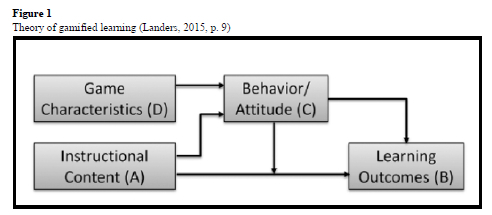
Landers' (2015) Theory of Gamified Learning provides an instructional framework for integrating gamification into educational contexts, suggesting that incorporating game elements into non-game settings, like the classroom, influences learning-related behaviours and attitudes; in turn, this enhances learning and reinforces the relationship between instructional design and learner achievement (Udeani & Akhigbe, 2020). Fundamentally, Landers argues that gamification influences mediator variables, such as motivation and participation, that lead to desired learning outcomes. Landers (2015) also noted that the goal of gamification is to improve instruction and not to replace it.
Figure 1 below is a representation of Landers' (2015) theory that describes gamification as being able to influence learning behaviours through two causal pathways-moderation and mediation. First, in terms of moderation, gamification impacts learning when game elements are integrated meaningfully into instructional content, leading to improved learning outcomes. Second, gamification affects learning through mediation when combined game elements directly encourage behaviours or attitudes that result in the enhancement of learning outcomes (Udeani & Akhigbe, 2020). However, for gamification to improve learning, "the instructor must ensure that the game elements lead to the behavior and also that the behavior leads to learning" (Landers, 2015, p. 12).
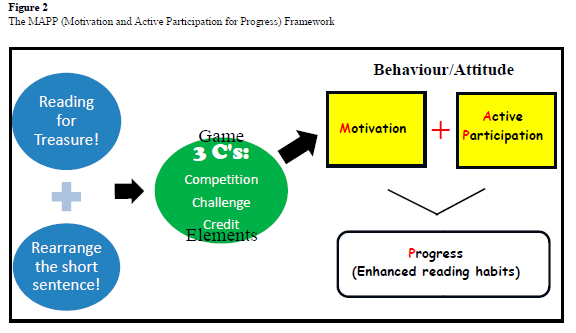
Here I focus on the concept of mediation in referring to how two gamified activities increase participation in and motivation for reading activities, thus enhancing learners' reading habits. To elucidate this key argument, I developed the following conceptual framework (adapted from Landers' (2015) Theory of Gamified Learning).
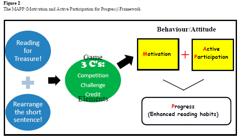
In this paper, the MAPP Framework illustrates how two gamified reading activities with the gamification elements of competition, challenge, and credit enhanced Motivation (M) and Active Participation (AP). These mediators drove Progress (P), which is, in this case, enhanced reading habits thus supporting Landers' theory that gamification improves outcomes through behavioural change.
Methodology
Research design
This paper is part of a larger qualitative study that focused on spelling and vocabulary, listening and speaking, reading, and writing skills in a co-curricular ELC that I founded in response to the dire need to improve the school's English pass rates. The ELC was part of the research design of the larger study with a focus on using gamified activities and sometimes outdoor teaching and learning strategies in providing a unique space for learners to improve English skills outside of their crowded classrooms.
While the larger study was that of participatory action research with four cycles, the focus of this paper is to explore how two gamified activities in the Reading cycle enhanced learner motivation and participation, and ultimately improved reading skills.
Data generation strategies
While the larger action research study employed many data generation strategies in each cycle, in this paper I focus specifically on three in relation to the Reading cycle: pre- and post-questionnaires assessing learners' reading habits; posters as learners' reflective visual representations; and detailed fieldnotes capturing observations of participation and interaction during the gamified activities. One poster is highlighted in this paper since it conveys a learner's perspective on his reading habits prior to the interventions in the cycle.
Participants
Grade 8 and 9 learners in a public high school in KwaZulu-Natal, South Africa, participated voluntarily in activities in the ELC. The number of participants varied in each cycle of the larger study, depending on learners' needs. In total, 43 participants were involved in the ELC.
Eight participants reported that they spoke English at home, one spoke isiXhosa, while the other 34 learners indicated that isiZulu was their home language. The linguistic diversity in home languages appeared to be a contributing factor to the poor English results since learners may have faced challenges mastering the language because of their limited use of English outside the classroom, as revealed by the questionnaire on reading habits, which will be discussed later in this paper.
In terms of this paper, ten learners participated in the treasure hunt activity and the collaborative reading challenge.
Ethical considerations
This study was conducted with full regard for ethical principles. Learners' participation was voluntary, and their identities are kept confidential in my using pseudonyms. Informed consent was obtained from all participants (and their parents/guardians since they were below the age of 18). The study ensured that no harm came to participants and that the data generated was handled with privacy and respect.
Gamified activities to enhance reading
1. Reading for Treasure!
This was an individual treasure hunt activity. After learners reflected on the need for more physical activities in the ELC, I designed a treasure hunt on the school premises that allowed for their running around to look for clue cards to improve reading.
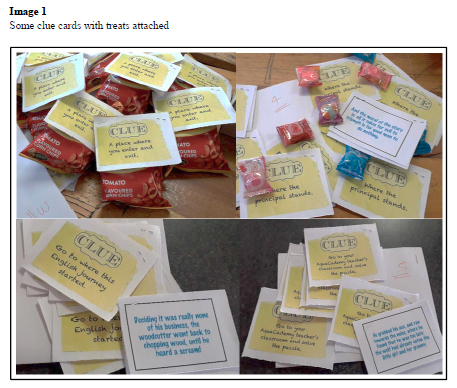
There were five clue cards in total with each clue card having a sentence on one side that would make up a five-sentence story, if all five clue cards were found. On the reverse side of the clue card was a riddle that learners needed to solve to discover where to head next.
The treasure hunt began by providing learners with an envelope that included a preparatory instruction sheet that outlined the steps for the treasure hunt that they were required to read before starting. It also included the first clue card which had a sentence on one side and a clue on the other, which, once figured out, would instruct their next move to where they would find the next clue card.
Some clues had sweets or chips attached to them to encourage learners' participation and motivate them to read carefully enough to find as many clues as they could. If all five clue cards were in a learners' possession, they would be able to tell the destination of the treasure hunt where they needed to unscramble the five-sentence story.
The first learner to complete the task successfully won a box of snacks. If all the clue cards were not found, the learners would not have been able to find all the treats or complete the activity and would therefore not be eligible to be crowned the winner of the treasure hunt.
The treasure hunt included the following game elements.
•• Competition: Participants competed to see which learner could get to the final check point first and complete the short story using the five clue cards they had found.
•• Challenge: "Reading for Treasure!" was a timed activity that required careful reading, following written instructions, and solving clues. If learners were unable to locate all the clue cards, they would have been unable to complete the five-sentence story.
•• Credit: Each clue card was attached to a snack treasure and the winner of the treasure hunt received a snack box.

2. Rearrange the short sentence!
This was a collaborative task for which learners were divided into two teams. Parts of a sentence were pinned to the front and back of learners' t-shirts. They had to work collaboratively to figure out what was pinned on them before unscrambling the sentence correctly. Thereafter, they had to unscramble themselves to put the words of the sentence in the correct order by standing in that specific order. The group to complete the task first and to be titled winners of the challenge involved having each learner read their part of the sentence out loud.
The collaborative reading challenge included the following game elements:
•• Competition: The first team to put themselves in order, with each learner reading their part aloud, wins the challenge.
•• Challenge: Timed activity that requires concentration and teamwork, using a leader to co-ordinate team members, and the urgency to finish first.
•• Credit: Team victory
Presentation of data
Before the introduction of gamification: Learners' reading habits and attitudes towards reading
Prior to the commencement of Cycle Three (Reading) in the larger participatory action research study, a pre-reading questionnaire was administered to explore learners' reading habits and experiences. Of the 26 respondents who completed the initial reading questionnaire at the start of the cycle, 24 expressed feelings of anxiety about reading aloud in class. Learners, including Hamed, Luyi, and Sibu described their emotions using the term "nervous", while "shy" was the choice of Zee, Jola, and Wethu, while "ashamed" was how Yanda felt. Noku described feeling "scared" and "frightened" because she struggled with reading. Baseline data (mind maps that reflected the challenges of learners in learning English) also revealed a similar notion: 12 of the 27 learners who completed the mind maps at the time referred to how they felt about reading in the presence of their classmates, expressing that they were either afraid of being laughed at or were just shy.
Thandi, who had the lowest reading aloud score (4/15), according to field notes, showed signs of low confidence and reluctance to read in class; she had poor audibility, she blocked her face while reading, and expressed frustration, using numerous fillers like "Jesus!", "Oh ja", and "Uhm." On the other hand, while Andy could recognise and pronounce words well and scored 8/15, he showed signs of anxiety while reading out loud in class, such as taking deep breaths and reading very softly. In his response to the question, "How do you feel when you are asked to read out loud to the class?", he wrote, "I fan myself" while reading, which relates to feelings of anxiety. Furthermore, in his visual representation, he presented himself as a wanted criminal.

Fieldnotes revealed that Andy felt that it was a crime to be "bad at reading." He explained that he does not feel confident reading in the presence of his peers and did not enjoy participating in reading activities in class.
In the pre-reading questionnaire, Hamed stated in his responses to two different questions that reading is "a waste of time." Negative attitudes toward reading were also reflected in learners' responses to a question about how they would feel if they received a book as a birthday present. Their answers revealed their initial perceptions of reading, before gamified activities were introduced. For instance, Hamed admitted he would feel "really bad and annoyed," while Macy expressed that she "would have rather received something more exciting." Similarly, Jola stated he "would be embarrassed" because he would expect "something big." These responses imply that learners did not view books as valuable or sought-after gifts, reinforcing their lack of motivation for reading.
Learners' lack of confidence, low reading scores, and low motivation for reading activities can be attributed to their reading habits outside of the school context. The pre-reading questionnaire revealed that only six learners read outside the classroom or school. Of the learners, 11 noted that they '"never" read aloud to their parents, and 18 expressed that their parents "never" read to them. This suggests that limited exposure to reading outside the classroom may contribute to their reading challenges, their confidence while reading, and their overall motivation for reading.
Since none of the respondents recorded having a problem with reading on their own, it was evident that their peers in their English classrooms were responsible for a significant decrease in reading confidence and motivation, and therefore participation in reading activities. This was evident in the responses by Yanda and Sam, for example, who indicated in their questionnaires that others laugh at them while they read.
The above challenges called for a more encouraging, fun environment to help mitigate reading anxiety and the need for a more respectful peer relationship to enhance reading confidence and motivation, resulting in the gamified activities in the ELC.
Learner responses during gamified reading
The "Reading for Treasure!" gamified activity revealed various reading habits of which learners were not conscious in the classroom setting that employed traditional reading activities. Specifically, it appeared that some of the learners did not read instructions carefully. This was discovered during the treasure hunt in revealing that learners' engagement with reading materials in a game-based context was different from their approach in traditional classroom activities. For example, field notes revealed that during the verbal discussion at the end of the activity, Sammy, Minnie, Hamed, and Jabu mentioned that they had only skimmed through the instructions, which led to confusion as they progressed. Contrary to this, Lolo, who was crowned winner of the treasure hunt said that the reason the others did not win was because "instead of rushing off and running around aimlessly" she took time to read the instructions of the game before attempting to find the next clue and she read each clue card carefully. This insight connects to participation and motivation since the gamified context helped learners recognise how their reading habits (such as skipping instructions) influenced their ability to complete the treasure hunt successfully.
By participating in the game, learners were more actively involved in running around and being playful. This gamified experience made them more conscious of their reading habits, on which they had not reflected in the classroom during the more conventional textbook-based reading activities. This finding is in keeping with Landers' (2015) notion that if gamification is incorporated into the learning process in a meaningful way, it will be effective in allowing learners to think about their learning habits. In this instance, while the treasure hunt activity was a gamified version of reading, it provided the platform for learners to become aware of the habits that caused them to misinterpret what they were reading. This is something on which they did not reflect during the classroom-based, conventional text-based reading activities. Ultimately, the gamified activity, when meaningfully integrated with instructional content made learning fun and encouraged learners to engage with their learning.
The treasure hunt activity highlights the potential of gamification that extends reading outside of the classroom where learners, who like to play, can learn more effectively. Thus, gamification of the reading experience through a treasure hunt increased motivation to improve their reading habits and engage more thoughtfully in future reading activities in the English classroom.
During the team-based gamified reading activity during which learners had to unscramble a jumbled sentence pinned onto them, teamwork played a key role in how quickly they arranged themselves in the correct order and read the sentence aloud. According to fieldnotes, Team A excelled because they recognised the need for a team leader to organise their sequence before reading the sentence out loud, thus successfully completing the game and winning the challenge. Their collaboration and respectful interactions contributed to their success, and this collaborative approach also helped develop the confidence of learners who struggled previously with individual reading tasks. This aligns with the argument that "game-based education is the most effective method of ensuring collaborative learning" among learners, which is essential for the learning process (Dichev & Dicheva, 2017, as cited in Adipat et al., 2022, p. 544).
The co-operative nature of these activities not only enhanced learners' motivation but also encouraged them to help one another, thus reinforcing key reading skills in a low-anxiety environment. This was particularly evident in Jola's case. He had had difficulty unscrambling sentences independently in an earlier individual activity in the Reading cycle and appeared discouraged and demotivated. However, when working as part of a team, he contributed actively to figuring out how to unscramble the sentence and gained confidence upon realising that he was part of the winning group. It was for this outcome that in the ELC I adopted individual, pair, and team-based tasks.
Andy, from Team B, expressed extreme frustration by stamping his feet and shouting because of his team's defeat. Fieldnotes revealed that he blamed his teammates for their loss saying that they could not even do a simple task. When prompted to reflect on how he could have assisted his peers since it was a group activity, he acknowledged, "I should have helped them instead of shouting." Moreover, Team B recognised that their loss was not an indication of their reading ability, since they figured out the sentence, but rather of a lack of teamwork and communication. This moment underscored the importance of self-awareness and accountability in the reading process. Although Team B lost because of a lack of co-operation, the experience was proven valuable. Their loss motivated them to perform better in future reading activities. This is in keeping with the idea Taub et al. (2017) put forward that games not only maintain learners' interest but also keep them committed to the task since the gamified activities are enjoyable in keeping learners positive even through challenges during which they might be unsuccessful. What is important is that learners identify their progress and try again to improve (Adipat et al., 2021).
Results following gamified reading activities
After various game-based activities in the ELC, a post-questionnaire was administered. Thirty-seven learners responded to this questionnaire. One of the questions, "Do you think your reading has improved?" prompted learners' reflection on the reading activities.
Yes, I used to always read in a rush forgetting about commas and full stops, but now I'm able to see them. . . (Lee)
Yes, I didn't express myself before but now I can. (Jabu)
Yes, because I joined the [ELC]. (Macy)
Ever since I joined [the ELC] my English and reading have improved so far. (Phili)
These responses highlight the effect of gamified activities on learners' awareness of their reading habits. For instance, the collaborative "Rearrange the short sentence!" activity required careful reading, spotting punctuation and parts of a sentence, along with collaboration and communication. This could have helped learners like Lee become more attentive to punctuation, as reflected in the above data, while Jabu's increased confidence in expression aligns with the interactive and performance-based elements of the gamified reading task. In addition, Macy and Phili, in explicitly crediting the ELC for their improvement, indicated that the gamified reading activities, different to activities completed in their English classrooms, played a role in motivating them to practise and develop their reading skills.
The question about receiving a book as a birthday gift was repeated in the post-reading questionnaire. Of 37 respondents, 34 showed positive attitudes toward receiving a book as a birthday present. For example, Minnie wrote she would be "very happy" since she "loves books." Sammy said, "I actually asked my granny to buy one for me for my birthday" and Yanda agreed that a book is "a precious thing." It can be deduced that the change in learners' attitudes was a result of the gamified reading activities in the ELC which resulted in their viewing reading differently since they engaged in the task in fun ways and were motivated to participate and to recognise the value of the skill. This finding is in line with Landers' (2015) theory of gamified learning which postulates that this not only keeps learners engaged but also results in changed learning behaviours that result, in turn, in achieving the learning outcome. In other words, the fact that learners were inclined to reflect on how their feelings about reading changed indicates self-directed learning and the awareness of reading habits.
Discussion of findings
The two game-based reading activities, "Reading for Treasure!" and "Rearrange the Short Sentence!"' in the study, appeared to be effective strategies for enhancing learners' motivation for reading. By integrating game elements such as competition, challenge, and credit, learners showed increased participation in reading tasks.
The target behaviour/attitude here is motivation for reading activities and increased participation, which was achieved through game elements. Beyond simply increasing learner participation and engagement, the findings indicate that in the gamified environment, learners gained a deeper awareness of their reading habits that enabled them to identify areas for improvement and take more effective steps toward enhancing their reading skills. The treasure hunt activity required learners to interpret clues, thus requiring a deeper level of reading and increased attention to detail. In the collaborative reading challenge, they also demonstrated positive shifts in reading habits in terms of paying careful attention to punctuation and sentence structure to unscramble the sentence successfully. As a result, they displayed a greater willingness to participate in reading-related tasks in the classroom afterwards since they were more confident in their reading skills and associated habits. These results are in keeping with Landers's (2014) work that underscores the importance of gamified elements in supporting instructional goals to make them effective in the teaching and learning process.
Additionally, the collaborative gamified activity, "Rearrange the short sentence!" encouraged teamwork, shared responsibility, and problem-solving, showing learners that reading can be an enjoyable and interactive experience. Thus, these learners' reading habits inside and outside the classroom improved. The positive shift in attitudes toward reading suggests that gamification can serve as an effective tool for fostering a more enthusiastic and confident approach, eventually supporting the development of stronger reading habits, and cultivating long-term reading engagement rather than just classroom participation. This is in keeping with Landers' (2014) theory which indicates that rather than serving as a mere engagement strategy, gamification is effective in facilitating behavioural change.
Thes findings of the study suggest that gamification, when thoughtfully integrated with clear instructional goals, can promote both motivation and participation effectively along with meaningful improvements in reading habits. Ultimately, such approaches have the potential to foster long-term engagement and confidence in learners' reading skills beyond the classroom context.
Concluding remarks
In this paper, I explored how two outdoor, non-digital game-based activities supported the development of learners' reading habits and increased their participation and motivation. The findings demonstrate that when learners are engaged in playful, interactive, and collaborative tasks outside the classroom, their enthusiasm and willingness to read noticeably increases. These activities helped foster a more dynamic learning environment, particularly benefiting second language learners who formerly displayed a lack of confidence or a lack of interest during conventional reading activities.
I recommend that teachers adopt gamified activities alongside traditional classroom approaches to enhance the learning of English. Higher education institutions with a focus on teacher education may also incorporate these points on how to implement effectively gamified activities in classrooms. While this study focused on my former classroom practice, the insights gained have important implications for teacher education. In my current role as a lecturer working with student teachers, I see value in exposing future teachers to creative strategies such as gamification, particularly non-digital gamified activities that are suitable for South African classrooms in under-resourced schools that may not have access to digital platforms or other forms of technology.
Moreover, as lifelong learners, the more teachers participate in designing and implementing playful teaching and learning strategies, the more professional insights are gained (Luthuli et al., 2024). This enables them to broaden their understanding of their teaching strategies while engaging learners in activities that can be transformed into gamified learning.
Future research might explore how student teachers engage with gamified strategies during their training and how these experiences influence their teaching practices. Ultimately, this study underscores the potential of outdoor gamified learning to enhance second language acquisition and invites both schoolteachers and teacher education lecturers to embrace teaching methods that are motivating and create an environment that addresses second language learners' fear of learning and speaking English.
References
- Abrams, S. S., & Walsh, S. (2014). Gamified vocabulary. Journal of Adolescent & Adult Literacy, 58(1), 49-58. http://onlinelibrary.wiley.com/doi/10.1002/jaal.315/pdf
- Adipat, S., Laksana, K., Busayanon, K., Asawasowan, A., & Adipat, B. (2021). Engaging students in the learning process with game-based learning: The fundamental concepts. International Journal of Technology in Education, 4(3), 542-552. https://doi.org/10.46328/ijte.169
- Arip, A. J., & Hashim, H. (2024). Gamification in English as Second Language (ESL) learning: A systematic review. International Journal of Academic Research in Progressive Education and Development, 13(4), 2837-2863. https://doi.org/10.6007/IJARPED/v13-i4/24069
- Cuario, M. E. D., Baracena, M. K. L., Redrico, M. L. A., & Fajardo S. B. (2021). Students' perception on the use of gamification for English as a Second Language (ESL) learning. University of Makati. https://doi.org/10.13140/RG.2.2.15313.04964
- Fraser, L. (2023, May 16). South Africa's massive reading problem. BusinessTech. https://businesstech.co.za/news/government/688439/south-africas-massive-reading-problem/
- Gil-Acirón, L. A. (2022). Benefits of gamification in Second Language Learning. Epos: Revista de Filologia, 38, 103-126. https://doi.org/10.5944/epos.38.2022.33785
- Howie, S. J., Combrinck, C., Roux, K., Tshele, M., Mokoena, G.M., & McLeod Palane, N. (2017). PIRLS Literacy 2016 progress in international reading literacy study 2016: South African children's literacy achievement. Centre for Evaluation and Assessment.
- Kaya, G., & Sagnak, C.H. (2022). Gamification in English as second language learning in secondary education aged between 11-18: A systematic review between 2013-2020. International Journal of Game-Based Learning, 12(1), 1-14. https://doi.org/10.4018/ijgbl.294010
- Landers, R. N. (2015). Developing a theory of gamified learning: Linking serious games and gamification of learning. Simulation & Gaming, 46(6), 752-768. https://doi.org/10.1177/1046878114563660
- Luthuli, K., Phewa, N., & Mkhize-Mthembu, N. S. (2024). Playful pedagogy as a tool through memory work to enhance professional learning and teaching practice. Journal of Education, 97, 67-85. https://doi.org/10.17159/2520-9868/i97a04
- Mojapelo, S. M. (2023). Whopping low reading literacies in South Africa. South African Journal of Libraries and Information Science, 89 (1), 1-14. https://sajlis.journals.ac.za/pub/article/view/2308
- Mullis, I. V. S., von Davier, M., Foy, P., Fishbein, B., Reynolds, K. A., & Wry, E. (2023). PIRLS 2021 international results in reading. Boston College, TIMSS & PIRLS International Study Center. https://doi.org/10.6017/lse.tpisc.tr2103.kb5342
- Purgina, M., Mozgovoy, M., & Blake, J. (2019). WordBricks: Mobile technology and visual grammar formalism for gamification of natural language grammar acquisition. Journal of Educational Computing Research, 58(1), 126-159. https://doi.org/10.1177/0735633119833010
- Sabornido, E. B., Garma, V. A., Niepes, G. L., & Cabria, F. M. N. (2022). Key challenges and barriers in gamification: A systematic review. APJAET - Journal Ay Asia Pacific Journal of Advanced Education and Technology., 1(1), 13-19. https://doi.org/10.54476/apjaetv1i1mar20221054
- Sailer, M., Hense, J. U., Mayr, S. K., & Mandl, H. (2017). How gamification motivates: An experimental study of the effects of specific game design elements on psychological need satisfaction. Computers in Human Behavior, 69, 371-380. https://doi.org/10.1016/jxhb.2016.12.033
- Sheokarah, J. (2022). Using an English language club to enhance the learning of English at a high school in South Africa [Doctoral dissertation, University of KwaZulu-Natal]. https://researchspace.ukzn.ac.za/handle/10413/22375
- Taub, M., Mudrick, N. V., Azevedo, R., Millar, G. C., Rowe, J., & Lester, J. (2017). Using multi-channel data with multi-level modeling to assess in-game performance during gameplay with Crystal Island. Computers in Human Behavior, 76, 641-655. http://doi.org/10.1016/j.chb.2017.01.038
- Udeani, U., & Akhigbe, J. N. (2020). Gamification as an instructional approach under collaborative and competitive modes: An analysis of students' learning outcomes in Biology. International Journal of Innovative Technology Integration in Education (IJITIE), 4(1), 42-61.
- Wulantari, N. P., Rachman, A., Sari, M. N., Uktolseja, L. J., & Rofi'i, A. (2023). The role of gamification in English language teaching: A literature review. Journal on Education, 6(1), 2847-2856.
- Yaccob, N. S., & Yunus, M. M. (2019). Language games in teaching and learning English grammar: A literature review. Arab World English Journal, 10(1), 209-217. https://dx.doi.org/10.24093/awej/vol10no1.18
- Zaric, N., Roepke, R., Lukarov, V., & Schroeder, U. (2021). Gamified learning theory: The moderating role of learners' learning tendencies. International Journal of Serious Games, 8(3), 71-91. https://doi.org/10.17083/ijsg.v8i3.438
Accepted: 2 June 2025