Embracing technology: Teachers' readiness to integrate emerging technologies into the curriculum
Abstract
The implementation of the intended curriculum in schools is continually evolving due to rapid technological advancements that are reshaping teaching and learning processes. While emerging technologies such as virtual reality and artificial intelligence hold transformative potential, South African schools predominantly rely on low-threshold, accessible technologies including digital and offline resources, mobile learning tools, and basic learning management systems. We conducted this qualitative case study to explore primary school teachers' readiness to integrate emerging technologies into the curriculum. Guided by an interpretive paradigm, we purposively sampled three teachers as participants. Data were generated through semi-structured interviews and reflective activity, and analysed using the Technological Pedagogical Content Knowledge framework. Findings indicate that teachers rely more on hardware and ideological resources than on software resources, reflecting strong pedagogical and content knowledge but lower confidence in technological knowledge. Furthermore, we found that teachers' practices are influenced by professional identity, societal norms, and informal knowledge rather than prescribed curriculum documents. The study concludes that meaningful curriculum transformation requires strengthening teachers' technological competence through continuing professional development and innovation-focused teacher education programmes. To achieve this, we recommend that teacher training programmes focus on digital competence to strengthen the integration of emerging technologies into the curriculum.
curriculum; emerging technologies; integration; readiness; teachers
Introduction
Given that education systems require teachers to prepare learners for the 21st century, integrating emerging technologies into education has become both a necessity and a challenge encompassing hardware, software, and ideological-ware resources (Mpungose, 2025; Sokhulu, 2023). As classrooms increasingly integrate these technologies, the role of teachers is being met halfway because they are no longer only conveyors of knowledge, but also facilitators of a technologically enriched learning environment (Ahiaku et al., 2025). Sari & Rugaiyah (2024) argued that the successful integration of these technologies largely depends on teachers' readiness in terms of their pedagogical, content, and technological knowledge and their willingness to adapt. Moreover, the rapid and continuous evolution of technology poses significant challenges for teachers' professional development because they are expected to continually adapt to emerging technologies without adequate time, training, or institutional support (Makumane & Mpungose, 2022; Mpungose, 2025; Sari & Rugaiyah, 2024).
Ongoing, collaborative, and personalised learning opportunities are essential (Hutahaean et al., 2024; Sokhulu, 2021). Schools and education systems must prioritise building a culture of continuous digital learning where teachers are encouraged to experiment and reflect on the integration of technology within their curriculum (Sun et al., 2025). As the Department of Basic Education strives to prepare learners for the demands of the 21st-century workforce, the importance of equipping teachers to use emerging technologies effectively cannot be overstated (Sun et al., 2025). Moreover, the South African primary school education system continues to struggle with the meaningful integration of emerging technologies because technology use is often driven by availability rather than by coherent pedagogical frameworks, curriculum alignment, or teacher readiness. As a result, teachers and learners are not adequately supported to leverage technologies in ways that enhance learning, develop digital competencies, and respond to the demands of a rapidly evolving digital society. In this study, we explored teachers' readiness to integrate emerging technologies into the curriculum to understand how they embrace these technologies in the educational context. This study is significant in that it demonstrates a contextual understanding of how teachers navigate curriculum implementation whilst integrating accessible technologies. It further provides a realistic account of teachers' integration of technologies in primary school setting, which is often ignored in South African literature because the focus is on secondary and higher education (Jhurree, 2005; Mahlo & Waghid, 2023; Makgato, 2014). In this study we respond to the following research questions:
1. What emerging technologies do primary school teachers integrate into the curriculum?
2. To what extent are primary school teachers ready to integrate emerging technologies into the curriculum?
Defining emerging technologies
Veletsianos (2010) defined emerging technologies as virtual and evolving technologies that may be entirely new, or existing technologies that have been significantly updated or repurposed. In this sense, emerging technologies are characterised not only by novelty but also by their continuous development and adaptation over time. These technologies evolve through ongoing updates to their functions, applications, and services, enabling new possibilities for use in educational contexts (Veletsianos, 2010). Likewise, emerging technologies can be defined as rapidly growing technologies that have the potential to bring about transformative digital impact, as well as existing technologies that have been enhanced through extended or advanced features, enabling new and expanded forms of use (Rotolo et al., 2015). In other words, emerging technologies refer to new and existing technologies that are continuously evolving to incorporate more advanced features and capabilities. Similarly, in the context of this study, the concept of emerging technologies is used to refer to evolving and continuously developing technologies that, through updated and extended features, are integrated into the Curriculum and Assessment Policy Statement (CAPS) curricula through teaching and learning practices, particularly in primary school educational contexts. These emerging technologies can be either hardware or software resources (Khoza & Mpungose, 2022; Nene & Sokhulu, 2025)
The integration of hardware technologies into the curriculum
Hardware resources refer to physical, tangible technologies that support curriculum implementation, teaching, and learning (Khoza, 2021b). These technologies provide teachers with direct access to digital and technological processes, enabling more interactive, experiential, and hands-on learning experiences (Laschou et al., 2018). Maphalala et al. (2021) argued that the integration of hardware resources as emerging technologies into school curricula indicates that digital tools designed to enhance interactive and experiential learning are expanding rapidly. Numerous studies (Maphalala et al., 2021; Mbhele, 2018; Mhlongo et al., 2023; Mlaba, 2020) have indicated that teachers are increasingly integrating hardware resources technologies such as tablets, interactive whiteboards, robotics kits, microcontrollers, and 3D printers, into teaching and learning across various subject areas. As result, these tools support modern curriculum goals that emphasise collaboration, critical thinking, authentic, and real-world learning experiences (Ahiaku et al., 2025). Likewise, Sun et al. (2025) argued that tablets and other handheld devices such as robotics kits effectively support formal teaching and learning by fostering collaboration and solving problems during hands-on activities. This was also supported by a recent study conducted by Nene and Sokhulu (2025), who argued that hardware technological resources support curriculum goals by serving as tools that facilitate pedagogical activities, assessment, and learner engagement. However, the effective use of these technologies requires teachers to be digitally competent so that hardware resources are used appropriately and aligned with curriculum objectives. For example, a qualitative case study by Mahlo and Waghid (2023) found that teachers relied primarily on their initial teacher training and informal understandings of technology to deliver the CAPS Grades 2-6 curricula digitally. As a result, they integrated hardware technologies such as smartboards despite having limited experience and conceptual understanding of these tools. Thus, the integration of such hardware technologies into the intended curriculum reflects a broader shift toward more technologically advanced and future-oriented educational practices (Sari & Rugaiyah, 2024).
Nonetheless, teachers' readiness to include digital technologies in their teaching is essential for the successful integration of these tools into the curriculum (Siyam et al., 2025). This is because teachers play a central role in selecting, implementing, and facilitating digital tools in meaningful ways that align with curriculum goals. Without adequate skills, confidence, and an understanding of how technology enhances learning, even well-designed digital resources cannot be effectively used. Teachers' readiness therefore directly affects the quality of integration, learner engagement, and the overall success of technology-enhanced teaching and learning (Ahiaku et al., 2025). In current education contexts, hardware resources can help ensure that the goals of the prescribed curricula are implemented smoothly and effectively (Sokhulu, 2023). However, the educational function of hardware tools only becomes apparent when they are integrated with software, creating an interconnected sociotechnical system that mediates teaching and learning processes.
The integration of software technologies into the curriculum
Software resources are technologies that can display information on hardware resources (Khoza, 2021a). Emerging software technologies such as artificial intelligence learning platforms, virtual reality apps, digital simulations, and collaborative cloud-based systems are also being integrated more into the curriculum (Ali et al., 2025). In addition, software technologies are designed to operate on hardware and can only be seen on digital screens (Mpungose, 2023). These include email systems, internet browsers, presentation software, and antivirus software; these resources are shaped by human beliefs and societal needs, and are based on teachers' professional judgment and contextual demands when integrated educationally(Khoza, 2021a). Laschou et al. (2018) and Mpungose (2025) also noted that software resources enable teachers to share information, express ideas creatively, and work together with learners to create knowledge. This allows the intended curriculum to be implemented digitally and spark engagement during classroom activities. Therefore, digitally competent teachers can use their skills to successfully integrate hardware and software resources into their teaching. This was evidenced in studies by Nene and Sokhulu (2025), Ramorola (2013), and Mahlo and Waghid (2023), which showed that teachers integrate both software and hardware resources in their teaching. However, these studies also highlight persistent challenges, including insufficient technological equipment, poorly defined digital technology policy frameworks, and ongoing technology maintenance and licensing issues (Ramorola, 2013).
These challenges speak directly to teachers' readiness to integrate emerging technologies into the curriculum given that such readiness is shaped by multiple factors, including digital competence, the availability of resources, and access to continuous professional development, among others (Mlaba, 2020). Thus, limited access to digital resources and training, coupled with unclear policy frameworks and software licensing constraints, restricts opportunities for innovation and impedes meaningful curriculum transformation (Mlilo, 2019; Sokhulu et al., 2025).
The integration of ideological-ware into the digital curriculum
The integrating of ideological-ware technologies into the curriculum entails the application of theories, frameworks, and teaching and learning policies that guide the implementation of emerging technologies (Semerci & Aydin, 2018). Mpungose (2023) and Selwyn (2020) asserted that ideological-ware are belief systems, worldviews, and conceptual understanding of how teachers integrate or should integrate emerging technologies. Therefore, ideological-ware is essential in supporting teachers to understand how to integrate emerging technologies effectively into the curriculum (Sari & Rugaiyah, 2024). Technology availability is only one aspect of the integration process. Equally important is aligning technologies with relevant teaching theories, frameworks, and policies to enhance learning outcomes and successfully transform the curriculum into a digital one that prepares learners for participation in the digital society (Sahala et al., 2025). Moreover, ideological-ware encourages teachers to critically reflect on their instructional decisions, classroom interactions, and overall professional practices (Makumane & Khoza, 2020) However, awareness and understanding of ideological-ware have been found to be lacking in the integration of emerging technologies into the curriculum (Sari & Rugaiyah, 2024). There is a dearth of studies that explore the aspect of ideological-ware in shaping and influencing teacher's integration of emerging technologies in the curriculum (Fomunyam, 2017; Zuma et al., 2022; Zuma & Mthembu, 2023). Thus, this study is important because it sought to deepen understanding of the ideological-ware that guides teachers' integration of emerging technologies into the curriculum, thereby addressing a critical gap in how such integration is conceptually informed and implemented in practice.
Theoretical framework
In the field of educational research, Koehler & Mishra (2013) further developed the Technological Pedagogical Content Knowledge (TPACK) framework for considering, analysing, and assessing the knowledge that teachers require to integrate technology into their lessons (see Figure 1).
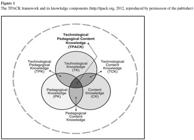
We adopted the TPACK framework because it encompasses three fundamental knowledge domains-content knowledge, pedagogical knowledge, and technological knowledge-that are useful in understanding how emerging technologies are integrated into the curriculum. Teachers can integrate technologies in ways that are both pedagogically sound and technologically appropriate when teaching subject content as prescribed by the curriculum.
Teachers' understanding of the hardware resources needed for integration within a particular subject area is an application of content knowledge to the technological context. It's not only knowing the content, but knowing what tools, devices, or hardware are relevant and how they can support learning that content effectively (Khoza & Fomunyam, 2020). Likewise, in this study, content knowledge involves teachers' expertise in the content they teach. Pedagogical knowledge relates teaching methods teachers employ to effectively represent concepts (Zuma et al., 2022). Pedagogical knowledge is used in this study to determine methods that teachers used when integrating technology in the classroom. Technological knowledge involves a wide range hardware and software technologies that are integrated by teachers as digital tools for teaching and learning (Mlaba, 2020). In this study, technological knowledge supports teachers in becoming facilitators of knowledge during curriculum delivery, allowing them to integrate technology resources to meet lesson objectives. TPACK is suitable for this study because it provides an integrated framework for understanding how teachers' technological, pedagogical, and content knowledge intersect to inform effective technology integration within the curriculum.
Methodology
Research approach, design, and paradigm
In this study we employed qualitative case study research methodology to explore primary school teachers' integration of emerging technologies across the foundation, intermediate, and senior phase curriculum. The purpose of adopting a qualitative case study approach was to generate rich and in-depth findings that unpack teachers' technology integration into the curriculum (Creswell, 2017). According to Creswell, qualitative case study research seeks to explore individuals' views, interpretations, and opinions within specific contexts. In line with this perspective, we further employed an interpretivist methodological paradigm, which places more emphasis on understanding participants realities in order to derive meaning. Our goal was to explore and explain how teachers integrate these resources and make sense of them in their teaching practices.
Sampling methods
We employed purposive sampling in this study to select three teachers from one school in KwaZulu-Natal, Pinetown education district. Purposive sampling involves finding participants with qualities that are relevant for responding to a particular research question (Cohen et al., 2013). In this study, we purposively selected three teachers who proactively integrated emerging technology into the curriculum, making them suitable participants for addressing the study's research question. These three teachers represented the three phases of primary education. The selection of one teacher per phase enabled the study to capture phase-specific perspectives on teachers' readiness to integrate emerging technologies into the curriculum. Qualitative case studies prioritise rich, detailed understanding generated from a small sample size; therefore, we sampled three participants deemed sufficient for achieving depth and insight. Refer to Table 1.1 below for participants' profiles.
Data generation processes
Prior to data generation, we sought and obtained ethical approval and all three participants signed informed consent forms confirming their participation in the study. One-on-one semi-structured interviews and an emailed reflective exercise were used to generate data. Interviews lasted 35 to 40 minutes and participants responded to open-ended questions, which we used to examine teachers' readiness and integration of emerging technologies into the curriculum (Cohen et al., 2013). Participants were able to freely share their experiences during these interviews, and follow-up questions were asked probing participants to produce detailed, descriptive accounts of their technology integration practices. To obtain a deeper understanding, reflective activities were emailed to participants to gain more insight into emerging technological resources. This activity consisted of three main questions, designed to generate rich and detailed data. Participants returned the reflective activities three weeks later for analysis.
Trustworthiness
According to Guba and Lincoln (1994), confirmability, dependability, credibility, and transferability are the factors that establish the reliability of qualitative research. Semi-structured interviews were used in this study to ensure credibility by allowing participants to share detailed information about how prepared they were for integrating emerging technologies into the curriculum. The verbatim transcriptions of the interview data were given back to the participants for member verification, which improved confirmability by ensuring that the transcripts accurately represented their viewpoints and experiences. By giving a clear and thorough explanation of the research procedure, and presenting results backed up by direct quotes from participants, dependability was maintained. In order ensure transferability, the study's concepts, contexts, and findings were narrated in detail so readers could assess how well the findings fit into corresponding settings in education.
Data analysis
In this study, we made of deductive thematic analysis to arrange and analyse the data. Cohen et al. (2013) stated that deductive thematic analysis entails the arrangement of qualitative data using existing themes from literature or theoretical framework. There were four phases to the thematic data analysis process. Through repeated reading of interview transcripts and participants' responses, we became acquainted with the data during the first phase. In the second phase, meaningful data excerpts were identified. In the third phase, themes were developed from the theoretical framework to align with study findings. The themes were examined, improved, and interpreted in light of the research questions and pertinent literature during the fourth phase.
Findings
The findings of the study are presented according to three main themes. Together, the themes offer a comprehensive understanding of how emerging technologies are embraced and applied in primary school settings by capturing teachers' integration practices. The data excerpts presented are drawn from both the semi-structured interview and reflective activity data.
Integration of hardware technologies into the curriculum
The findings show that the integration of emerging hardware resources among the participating teachers was uneven. While participants showed enthusiasm by integrating emerging technologies like electronic tablets, laptops, and projectors into their lessons, others had limited exposure to such resources. The data presented below originates teacher interviews:
The hardware that I use includes tablets, computers, and projectors. But, as a natural science and technology teacher it also depends on the content and topic. . . when I'm teaching a topic that deals with the electrical circuit I normally use a battery as input because it provides the energy for the whole circuit and connecting wire that conducts energy from the battery . . . I also use objects like a light bulb that is considered as an output. Further to this, when I am teaching a topic that needs a demonstration of these elements moon, earth, and sun then I normally use projectors to demonstrate for learners, and the model called planet earth and also use my laptop. (Teacher 1)
Teacher 2 integrated similar technologies as Teacher 1 even though they taught different subject. She said:
Hardware resources that are available in the school are globes that I integrate when teaching geography. I also use Mr Smook's laptop to watch videos with learners and to type the test and examination and use my USB to print my work. The school has wi-fi, projector, tablets, and laptops but some of us as teachers have limited access to it because we are not trusted with these resources.
Teacher 3 shared:
I have the whiteboard and I sometimes bring a model for my learners, for example, if we learn surface area. Further to this, I also bring my projector and tablets from home but it is difficult to use them because I have go to different classrooms with these resources.
The findings indicate all three teachers integrate emerging hardware resources such as projectors, laptops, and tablets during teaching and learning. However, even though Teacher 2 makes use of emerging hardware, she has limited access to them due to school regulations. Moreover, unlike Teacher 1 and 3, she does not make use of personally owned technologies but makes an initiative to use the school's limited resources and borrow from others. This suggests that the participating teachers demonstrated readiness to use emerging technologies through their active integration of these tools into the curriculum. They facilitated this integration by utilising their own readily available technologies, with one teacher going further by borrowing additional technological resources. This intentional effort, particularly by Teacher 2, highlights a strong commitment to integrating emerging technologies into teaching practice. Moreover, the use of personal technologies reflects a clear willingness and preparedness to engage with emerging technologies, indicating an important dimension of teacher readiness. Nonetheless, the findings show that although participating teachers actively integrate emerging hardware resources, newer technologies are not integrated into the curriculum.
Integration of software technologies into the curriculum
Teaching and learning are increasingly taking place in environments enhanced by digital devices and innovative software intended to revolutionise classroom experiences in today's quickly changing educational landscape. Teacher 2 emphasised the application of computers for research purposes, the sharing of video links, and the successful execution of a Zoom meeting involving parents and colleagues. Teacher 1, on the other hand, used very little software other than videos and showed interest in PowerPoint but was limited by inadequate computer access. A pattern among all participants is that, they were also integrating newer emerging software technologies such as Zoom and WhatsApp into their teaching. The data presented below originates from teachers' reflective journal responses:
We share links with learners using WhatsApp to watch videos. Last week, we had a Zoom meeting discussing one of the topics and I was so amazed by the support I received from parents ensuring that learners log into the Zoom meeting. (Teacher 2)
Usually, when I am teaching English I use softcopies, Google search, and online videos to ensure that teaching is effective. We also communicate with our learners and other teachers using WhatsApp and learners received work such as classwork and homework using WhatsApp. (Teacher 3)
Both Teachers 2 and 3 used emerging software technology such as WhatsApp for teaching and learning even though this software was originally created for social communication. It seems to be a useful tool for expanding learning opportunities for learners where teachers can share content videos and homework activities. Both teachers also integrated videos to support their teaching, with Teacher 3 citing its use as "effective teaching." They further integrated Zoom for online meetings, and Google search for information retrieval. The integration of newer emerging software technologies reflects teachers' eagerness to engage with digital innovation. Furthermore, rather than being confined to the original use of some of this software, they became creative in how they integrated them. For example, the use of WhatsApp for formal teaching and learning activities is transformative because it repurposes a social communication platform into a pedagogical tool that supports learner interaction, content sharing, and extended learning beyond the classroom.
Teacher 1 integrated different software resources than Teacher 2 and Teacher 3. She said:
I play digital games with them watching television in the library. But I would like to use PowerPoint in my class but the problem is computers are only in the computer room and not enough. I sometimes ask them to watch videos on social media platforms to learn more about math.
Teacher 1 appeared to use digital games, social media videos, and television purposefully to support teaching and learning; however, the specific social media platforms used with learners were not clearly identified. In contrast, Teachers 2 and 3 explicitly indicated the use of WhatsApp as the primary platform for engaging with learners.
Integration of ideological-ware technologies into the curriculum
Ideological-ware resources in the context of this study include the theories, policy frameworks, and philosophical stances that influence how teachers integrate emerging technologies in curriculum. These data excerpts were drawn from the interviews:
I connect a lot with connectivism theory recently because this theory suggests that we need to look at learning differently, particularly the use of technology. Thus, I use my cell phones and laptops to search for information. (Teacher 2)
I strongly believe in humanistic learning theory [which] says that learning is a way for us to fulfil our full potential. Therefore, when I teach my children currently, for example when I teach maths, I use the multimedia projector to download pictures of objects and show that maths is not about multiplication and division. But I want them to understand maths very well because when you go to the shop and lack the basics of maths you will not get the right change at the shop. (Teacher 3)
The findings indicate that teachers use different learning theories to inform their integration of emerging technologies into the curriculum. Teacher 2 highlighted the value of digital networks and technology, in line with connectivism. To connect learning to real-life needs and foster learner growth, Teacher 3 integrated technologies informed by the humanistic theory. Teachers' theoretical beliefs have a significant impact on their classroom decisions and attitudes toward technology, according to a common trend among these responses. There is, however, an evident gap between theoretical comprehension and technological application; although the teachers cited different learning theories, there is little correspondence between these ideologies and useful integration of technology in the classroom.
Discussion of findings
Our aim in this study was to identify the emerging technologies integrated into the primary school curriculum and to examine the extent to which primary school teachers are ready to integrate them. The findings indicate that, although teachers are engaging with emerging technologies, their integration of hardware resources remains largely basic. The teachers did demonstrate innovation and creativity in their integration of software technologies; however, they did not clearly articulate the connection between their technological worldviews and their classroom practices. Prior studies (Khoza, 2021a; Khoza & Mpungose, 2018; Makumane & Khoza, 2020) have argued that integrating hardware resources into the curriculum require teachers to possess content knowledge to use them effectively.
Likewise, Zulu (2020) and Sari & Rugaiyah (2024) asserted that the effective integration of both hardware and software technologies requires a sound understanding of content and pedagogical knowledge. This view aligns with Koehler and Mishra's (2013) TPACK framework, which emphasises the interplay between content knowledge, pedagogical knowledge, and technological knowledge in meaningful technology integration. In this study, teachers were able to identify the hardware and software technologies they integrate into the curriculum and the specific content areas taught using these technologies. For example, Teacher 1 reported using globes and batteries to teach electric circuits in natural sciences. While evidence of content knowledge and technological knowledge is apparent in teachers' responses, pedagogical knowledge is not clearly articulated across the findings. Teachers did not sufficiently explain how the selected technologies were pedagogically employed to support learning, indicating a gap in the integration of emerging technologies in relation to pedagogical knowledge.
For ideological-ware, the findings revealed that teachers understood the theories that informed their practice but did not entirely link them to technology integration. The CAPS document emphasises that technologies should be integrated into teaching and learning to support curriculum delivery by enhancing access to knowledge, and improving the quality of teaching and learning. In the context of this study, educational policies are conceptualised as ideological-ware; however, none of the three teachers made reference to the White Paper on e-Education or to the CAPS documents, both of which are intended to inform and guide their digital teaching practices.
Conclusion and educational implications
The study shows that even though educators embrace new technologies, the integration of hardware resources is still largely simplistic and lacks pedagogical depth. Although teachers' responses demonstrated evidence of both technological and content knowledge, pedagogical knowledge was not clearly expressed because they did not adequately describe how particular technologies were used pedagogically to enhance learning. This points to a gap in the effective integration of emerging technologies-the use of technology is not sufficiently matched with educational methods or learning objectives. Additionally, teachers did not explicitly explain how their technological worldviews relate to their classroom practices, nor did they cite guiding policy documents like the CAPS. To improve the efficient and intentional use of emerging technologies in teaching and learning, these findings suggest the need for professional development programmes that emphasise improving pedagogical approaches to technology integration, and more assistance in aligning teaching practices with national curriculum and policy frameworks. This study recommends the Department of Basic Education provide professional development programmes that explicitly link learning theories with practical, technology-supported teaching strategies. In addition, teacher education and in-service training programmes should prioritise the development of digital competence in order to strengthen the effective integration of emerging technologies into the curriculum. Lastly, future research could explore how ideological-ware informs digital practice in schools.
Data availability
The data presented in this study are available on request from the authors.
Declarations conflict of interest
The authors declare that they have no conflict of interest.
References
- Ahiaku, P. K. A., Uleanya, C., & Muyambi, G. C. (2025). Rural schools and tech use for sustainability: The challenge of disconnection. Education and Information Technologies, 30(9), 12557-12571. https://doi.org/10.1007/s10639-024-13311-9
-
Ali, Z., Younis, S., Ahmad, N., Saba, F., & Ullah, N. (2025). Teachers' perspective of technology integration effects on students' learning at university level. Journal of Rehabilitation Research and Current Updates, 1(1), 1-6. 10.17605/OSF.IO/93STM
» https://doi.org/10.17605/OSF.IO/93STM - Cohen, L., Manion, L., & Morrison, K. (2013). Research methods in education (7th ed.). Routledge.
- Creswell, J. (2017). Qualitative inquiry and research design: Choosing among five approaches (3rd ed.). SAGE.
- Guba, E. G., & Lincoln, Y. S. (1994). Competing paradigms in qualitative research. In N. K. Denzin & Y. S. Lincoln (Eds.), Handbook of qualitative research (pp. 105-117). SAGE.
- Jhurree, V. (2005). Technology integration in education in developing countries: Guidelines to policy makers. International Education Journal, 6(4), 467-483. https://www.researchgate.net/publication/255657856_Technology_integration_in_education_in_developing_countries_Guidelines_to_policy_makers1
- Khoza, S. B. (2021b). Exploring the migration to a digitalised curriculum at UKZN. Education Sciences, 11(6), Article 682. https://doi.org/10.3390/educsci11110682
- Khoza, S. J., & Fomunyam, K. G. (2020). Can alignment of digital resources with needs produce a new curriculum theory for teaching? In K. G. Fomunyam & S. J. Khoza (Eds.), Curriculum theory, curriculum theorising, and the theoriser: The African theorising perspective (pp. 219-236). Brill Sense. https://doi.org/10.1163/9789004447943_012
- Khoza, S. J., & Mpungose, C. B. (2018). Use of the Moodle curriculum by lecturers at a South African university. In Proceedings of the 13th International Conference on e-Learning (pp. 171-178). Academic Conferences and Publishing.
- Khoza, S. B., & Mpungose, C. B. (2022). Digitalised curriculum to the rescue of a higher education institution. African Identities, 20(4), 310-330. https://doi.org/10.1080/14725843.2020.1815517
- Koehler, M. J., & Mishra, P. (2013). What is technological pedagogical content knowledge (TPACK)? Journal of Education, 193(3), 13-19. https://doi.org/10.1177/002205741319300303
- Laschou, S., Kollias, V., & Karasavvidis, I. (2018). How do transformational principals view ICT as a means for promoting educational innovations? A descriptive case study focusing on twenty-first century skills. In A. T. Mikropoulos (Ed.), Research on e-learning and ICT in education: Technological, pedagogical and instructional perspectives (pp. 43-67). Springer. https://doi.org/10.1007/978-3-319-95059-4_3
- Mahlo, L., & Waghid, Z. (2023). Exploring information and communication technology integration among teachers in township public primary schools. South African Journal of Education, 43(1), Article 2160. https://doi.org/10.15700/saje.v43n1a2160
- Makumane, M. A., & Mpungose, C. B. (2022). Digital divide: Secondary school learners' experiences of using educational technologies. Alternation: Interdisciplinary Journal for the Study of the Arts and Humanities in Southern Africa, 39(Special Edition), 214-238. https://doi.org/10.29086/2519-5476/2022/sp39a10
- Maphalala, M. C., Mkhasibe, R. G., & Mncube, D. W. (2021). Online learning as a catalyst for self-directed learning in universities during the COVID-19 pandemic. Research in Social Sciences and Technology, 6(2), 233-248. https://doi.org/10.46303/ressat.2021.25
- Mhlongo, S., Mbatha, K., Ramatsetse, B., & Dlamini, R. (2023). Challenges, opportunities, and prospects of adopting and using smart digital technologies in learning environments: An iterative review. Heliyon, 9(6), e16348. https://doi.org/10.1016/j.heliyon.2023.e16348
- Mlaba, S. M. (2020). An exploration of postgraduate lecturers' reflections on the use of Moodle in teaching business studies at the University of KwaZulu-Natal, South Africa [Doctoral dissertation, University of KwaZulu-Natal]. https://researchspace.ukzn.ac.za/items/8bd11fd0-0291-40ed-a325-5ec25c808114
- Mlilo, T. (2019). Exploring the integration of technology-based tools in intermediate mathematics classrooms [Master's thesis, University of KwaZulu-Natal]. https://researchspace.ukzn.ac.za/handle/10413/19133
- Mpungose, C. B. (2023). Lecturers' reflections on use of Zoom video conferencing technology for e-learning at a South African university in the context of coronavirus. African Identities, 21(2), 266-282. https://doi.org/10.1080/14725843.2021.1902268
- Mpungose, C. B. (2025). E-learning platforms at ODeL institutions of higher education: Creating a real-world learning. Education and Information Technologies, 30, 17207-17223. https://doi.org/10.1007/s10639-025-13447-2
- Nene, L. G., & Sokhulu, L. H. (2025). Digitalising the curriculum: Teachers' integration of technological resources into the CAPS framework. African Perspectives of Research in Teaching and Learning Journal, 9(4). https://doi.org/10.70875/v9i8article5
- Ramorola, M. Z. (2013). Challenge of effective technology integration into teaching and learning. Africa Education Review, 10(4), 654-670. https://doi.org/10.1080/18146627.2013.853559
- Rotolo, D., Hicks, D., & Martin, B. R. (2015). What is an emerging technology? Research Policy, 44(10), 1827-1843. https://doi.org/10.1016/j.respol.2015.08.008
- Sahala, R. A., Narindra, R., José, R. A. D., Zo, R. H., Razanamiarisoa, R. N., Daniel, R. A., & Baholy, R. R. (2025). Integrating ICT to enhance school functioning: A case study of Lutheran schools in Fianarantsoa, Madagascar. Matondang Journal, 4(1), 63-70. https://doi.org/10.33258/matondang.v4i1.1256
- Sari, F. D., & Rugaiyah, R. (2024). Implementation of the school curriculum to empower education in the digital era 4.0 for quality human resources. International Journal of Recent Educational Research, 5(3), 765-778. https://doi.org/10.46245/ijorer.v5i3.607
- Selwyn, N. (2020). Telling tales on technology: Qualitative studies of technology and education. Routledge.
- Semerci, A., & Aydin, M. K. (2018). Examining high school teachers' attitudes towards ICT use in education. International Journal of Progressive Education, 14(2), 93-105. https://doi.org/10.29329/ijpe.2018.139.7
- Siyam, Y., Siyam, N., Hussain, M., & Alqaryouti, O. (2025). Evaluating technology integration in education: A framework for professional development. Discover Education, 4(1), Article 53. https://doi.org/10.1007/s44217-025-00448-z
- Sokhulu, L. H. (2021). Students' experiences of using digital technologies to address their personal research needs during the COVID-19 lockdown. African Identities, 19(4), 436-452. https://doi.org/10.1080/14725843.2020.1801384
- Sokhulu, L. H. (2023). Postgraduate student experiences of using YouTube as a research tool for learning: A case study. In M. C. Maphalala & D. W. Mncube (Eds.), Advancing self-directed learning in higher education (pp. 120-133). IGI Global.
- Sokhulu, L. H., Zulu, M. W., & Lott-Naidoo, D. (2025). Artificial intelligence in higher education South Africa: The role of ChatGPT in students' learning. Journal of Education, 99, 142-166. https://doi.org/10.17159/2520-9868/i99a08
- Sun, D., Zhan, Y., Wan, Z. H., Yang, Y., & Looi, C.-K. (2025). Identifying the roles of technology: A systematic review of STEM education in primary and secondary schools from 2015 to 2023. Research in Science & Technological Education, 43(1), 145-169. https://doi.org/10.1080/02635143.2023.2251902
- Veletsianos, G. (2010). A definition of emerging technologies for education. In G. Veletsianos (Ed.), Emerging technologies in distance education (pp. 3-22). Athabasca University Press.
- Zulu, M. W. (2020). An exploration of the integration of technology by mathematics teachers: The case of 10 schools in KwaZulu-Natal under Umlazi District [Master's thesis, University of KwaZulu-Natal]. https://researchspace.ukzn.ac.za/items/fb191236-62db-4c1e-9541-cfbc69d99907
- Zuma, S., & Mthembu, B. (2023). Exploring ideological-ware as a resource in the use of Moodle in higher education: Analysing Covid-19 publications. South African Computer Journal, 35(1), 164-183. https://doi.org/10.18489/sacj.v35i1.1110
Accepted: 23 February 2026