Emergent number sense: A blended learning approach to supporting first year pre-service teachers
Abstract
In this paper we explore how initial teacher education can strengthen pre-service teachers' capacity to promote number sense in early mathematics. Situated in the Maths4Primary Teachers Intervention Project, the study investigates the development of mathematical fluency and understanding of emergent number sense in first-year Bachelor of Foundation Phase pre-service teachers (PSTs). The research design draws on a blended-learning intervention and is framed conceptually through the CABLS framework as a way of understanding learning across many interacting contexts. A cohort of 250 PSTs at a comprehensive university participated in a pre-test prior to the intervention, followed by a structured three-month programme comprising weekly contact sessions, online mental fluency tasks, task-based activities, and engagement with an emergent number sense booklet. A post-test was administered to evaluate shifts in knowledge and skills. Findings indicate that pre-service teachers entered the programme with varied and often limited number sense but demonstrated measurable improvements in mathematical fluency and in their capacity to engage with emergent mathematical thinking. The data further highlights how engagement across many different platforms supported the development of more flexible and connected understandings of number. The study points to the potential of blended-learning approaches, informed by the CABLS framework, to strengthen initial teacher education. It underscores the importance of integrating active classroom engagement, hands-on resources, and interactive digital tools in supporting pre-service teachers to develop the knowledge and practices necessary for teaching early mathematics effectively.
emergent number sense; initial teacher education; blended-learning; Maths4Primary Teachers; CABLS framework
Introduction
Building strong foundations in mathematics is necessary to prepare learners for later mathematical achievement. South Africa requires teachers in its primary schools who have the mathematical knowledge essential to teaching mathematics well. How South Africa's teachers are equipped for this role as primary mathematics teachers is therefore important. Motivated by these objectives, a group of mathematics lecturers from six tertiary education institutions in South Africa formed the group called Maths4Primary Teachers to focus on Foundation Phase (FP), pre-service teacher training in early number work. The Maths4Primary Teachers project was initiated in response to the findings from the Primary Teacher Education (PrimTEd) project's assessment stream that found that primary school pre-service teachers (PSTs) have poor mathematical knowledge and that the programmes offered at faculties of education were not improving significantly their knowledge of how to teach mathematics (Roberts & Moloi, 2021).
The common objective was to create relevant and suitable coursework and materials informed by theoretical principles, curricular standards, and empirical knowledge. The South African initial teacher education community developed PrimTEd knowledge and practice standards for mathematics as common curriculum standards including the domains of number sense, geometry and measurement, as well as mathematical acting and thinking, for use across universities.
This study forms part of a larger one that includes having Maths4Primary Teachers adopt a design-based research collective to design, trial, and improve materials for Bachelor of Education programmes that are aligned to the PrimTed standards. Each design trial was framed as an intervention enacted in a particular university context. The common standards-based materials were designed and developed through cycles of presentation, observation, analysis, feedback, and adaptation.
In this study we describe the implementation of a blended approach to providing first year Foundation Phase (FP) PSTs in a Bachelor of Education (B. Ed) program at a public tertiary institution with an intensive introduction to the Maths4Primary Teachers Emergent Number Sense course module. Emergent number sense encompasses the early stages of developing an understanding of numbers and their relationships observed typically in young children. It involves the initial recognition of quantities, basic counting skills, an awareness of the notions of more and less, and the ability to make simple comparisons and estimations. Emergent number sense forms the foundation for more advanced mathematical thinking and problem-solving skills (Anghileri, 2006; Graven et al., 2013).
The pilot design cycle of the Emergent Number Sense module commenced in 2022 with a full cohort of 138 first year PSTs. Following further edits and refinement, a second design cycle was conducted in 2023, with a cohort of 149 first year PSTs using a blended learning approach for instruction to support the contents of the manual. The blended approach consisted of weekly class contact sessions, PowerPoint presentations, online videos, tutorials, and peer-marking.
The piloting included a pre- and post-test and the marking of the PSTs' completed manual to gauge the effectiveness of the blended approach.
In this paper we reflect on the second design cycle at this university in the Western Cape. We reflect on the extent to which the blended approach to Emergent Number Sense enhanced the understanding of the first year B. Ed PSTs. In doing so, we document the growth in the PSTs' understanding of emergent number sense and the extent to which they adapted their thinking to take on mathematically sound ways of understanding emergent number sense. Thus, we sought to explore how best to support PSTs who are required to develop the strong sense of number that leads to later mathematical fluency.
Providing quality teacher education, particularly in the field of mathematics in primary schools, remains an ongoing challenge and priority in Initial Teacher Education (ITE) (Roberts & Porteus, 2023). Faced with many challenges given the remnants of Apartheid, candidates entering their studies and embarking on their training exhibit poor number sense and a limited connection to suitable instructional pathways. This is exacerbated by limited access to appropriate resources, and, in many cases, is complicated because most of the PSTs deliver instruction in their second language (Venkat & Roberts, 2022).
Porteus and Mostert (2022) critiqued global literature on early-grade mathematics for presuming that every teacher has a solid understanding of numbers. Additionally, they questioned the presumption that, upon completing their studies, all teachers are proficient in organizing instructional materials and can use a pedagogical approach beyond whole-class instruction and embrace the concept and practice of collaborative, learner-centred environments. They describe how, on the contrary, in South Africa, many teachers have experienced poor delivery of instruction in their education and are, subsequently products of an unstable educational background.
What is number sense?
Competing theories exist on how number sense is acquired; these include: (1) the cognitivist scientists' theory, which argues for an innate numerical understanding; the constructivist theory, particularly Piagetian, which suggests that number sense develops through stages of cognitive growth and hands-on experiences; (2) the socio-cultural theory, based on Vygotsky's ideas, that emphasizes social interactions and cultural tools; (3) the information processing theory that focuses on cognitive mechanisms like memory and attention; (4) the empiricist theory, which claims that number sense arises from sensory experiences and environmental interactions; and (5) the neuroscientific perspective that explores the brain's role in processing numerical information and the development of neural pathways. For example, Spelke (2022) explored the innate foundations of number sense in investigating how infants and young children perceive and understand numerical quantities. Her work emphasized the role of core knowledge systems, believed to be evolutionarily ancient, that form the basis for more complex mathematical abilities. In contrast, McIntosh et al. (2005) described number sense as the overall comprehension of numbers and mathematical operations, paired with the capacity and willingness to apply this comprehension in various ways to make mathematical calculations and devise effective approaches for dealing with numbers and operations. Furthermore, they argued that a number sense shows a capability to use numbers and quantitative techniques to convey, process, and understand information. Berch (2005) provided a useful high-level analysis of the nature, origins, and pedagogical implications of the differing conceptions of number sense.
This paper is about an ITE module designed to engage PSTs to support the development of number sense among very young children (from birth to 6 years of age). Supporting the development of a young child's number sense is a complex process that involves an intricate interplay between innate abilities and environmental influences. While there is evidence that supports the existence of core knowledge systems that provide a foundation for numerical understanding, the development and refinement of number sense are both heavily dependent on experiences, interactions, and cognitive processes nurtured throughout an individual's life.
Do pre-service teachers have number sense?
Research shows that teachers entering the profession do not necessarily possess the deep and flexible understanding of number that is required to foster and promote number sense in their learners (Bowie et al., 2019). Askew (2015) maintained that, while it is widely acknowledged that schools and educators should prioritize emergent numeracy there is a lack of consensus on how this should be implemented in teaching methods. Notably, Askew and Brown (2003) based in the UK, emphasized that studies indicate that training PSTs in primary numeracy can effectively boost their confidence in teaching mathematics. Additionally, they described how the training of primary PSTs can enhance their understanding of mathematics as a dynamic social construct that evolves and incorporates various aspects, rather than perceiving mathematics as a fixed set of procedures that must be executed correctly. In the context of Askew and Brown's description, a social construct refers to the idea that mathematics is not merely a rigid set of rules and procedures but is, rather, something that is developed and understood through social interactions and cultural contexts. This view suggests that the understanding and learning of mathematics are shaped by interactions among PSTs, teachers, and the wider community and that discussions, collaborations, and shared experiences contribute to mathematical knowledge. Additionally, Alex and Roberts (2019), based in South Africa, argued that PSTs require a significant amount of time to grasp fully the complexities of mathematical content. Aside from ample time, they require specialised instructional guidance to understand the underlying logic of mathematical processes and learn to articulate solutions through various representations that are both suitable and contextually relevant.
The gap in literature suggests a lack of comprehensive research on the specific strategies and resources needed to develop deep, flexible numerical understanding in PSTs, particularly in the context of South Africa's unique educational challenges. Additionally, there is insufficient evidence of the long-term impact of ITE programmes on improving number sense among PSTs.
Theoretical framework
Blended learning in tertiary education has been on the rise, driven by various factors and trends such as the occurrence of Massive Open Online Source (MOOC) and flipped classrooms (Wang et al., 2015). The concept of blended learning has often been synonymous with terms like mixed mode learning hybrid instruction, and technology-mediated/enhanced learning. Wang et al. (2015) maintained that while numerous studies have attempted to define and redefine it, none have presented a comprehensive understanding of what truly encompasses blended learning and how its various components synergize over time to form a cohesive whole. Additionally, COVID-19 restrictions resulted in a surge in online learning with the continual development of technology, including high-speed internet, video conferencing tools, learning management systems, and collaborative platforms, making it easier for educational institutions to adopt online blended learning (Mhlanga & Moloi, 2020).
Blended learning allows for a mix of synchronous and asynchronous activities that incorporate multimedia resources, interactive simulations, and virtual laboratories (Graham, 2006). Blended learning allows for a more personalized approach to education with adaptive learning technologies and data analytics enabling educators to tailor content to PST's needs, thus providing a more effective and engaging learning experience (Kaur, 2013). Blended learning studies show a shift from passive to active participation in learning where teachers work and importantly, also co-evolve with their students in acquiring new identities and multi-disciplined professional skills. Various labels, such as e-moderators, facilitators, and advisors, describe this generation of teachers (Wang et al., 2015).
This study uses the Complex Adaptive Blended Learning Systems (CABLS) theoretical framework to guide the analysis of the data that emerged from this study. CABLS was designed to "facilitate a deeper and more accurate understanding of the dynamic and adaptive nature of blended learning" (Wang et al., 2015, p. 390).
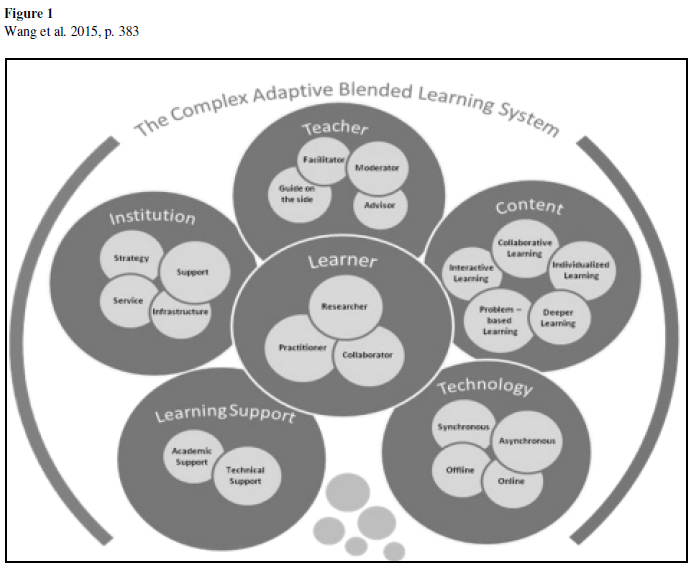
CABLS positions the novice (a PST in this case) at the centre of the framework surrounded by six supportive elements which collectively constitute the CABLS framework: teacher, content, institution, technology, and learning support. The following coding applies: L = Learner; T = Teacher; TY = Technology; C = Content; LS = Learning Support; I = Institution. With CABLS, the novice is positioned in a dynamic, adaptive process of transformation, co-evolving with the supportive elements in a multimodal learning environment. Content knowledge is enriched through constant interaction with teachers, lecturers, technology, learning support, and institutions, all of which leads to diverse learning experiences (see Figure 1).
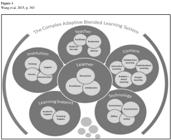
Each of the six elements is associated with specific characteristics underpinning the essence of CABLS, and by identifying these characteristics, analysis can be deepened (Wang et al., 2015). The characteristics in CABLS are Complexity; Adaptability; Self-organisation; Dynamism and Co-evolution.
Complexity refers to the intricate structure of a system in which several subsystems interact in a nonlinear manner. This structure is characterized by layers of integration, where each system is a component of a larger entity, which, in turn, forms part of an even larger system, and so forth. At every layer, each system operates independently while remaining interconnected with other systems at its level, as well as those above and below it.
Adaptability is the ability of a system to adjust and respond to changes in its environment. It involves the capacity to generate new rules based on a combination of pre-existing rules and new information from the surroundings. This process allows the system to learn and evolve, enabling it to cope with changing conditions effectively (Mhlanga & Moloi, 2020; Wang et al., 2015).
Self-organization encompasses two distinct concepts: it involves the interaction between subsystems within a system, which leads to the emergence of novel structures or patterns of relationships among their constituent elements, facilitated by feedback and iteration. This process of spontaneous emergence of order is not directed or imposed upon by external forces.
Dynamism refers to the characteristics of complex adaptive systems that exist in a state that balances between order and chaos. These systems are stable enough to maintain their structure but also sensitive to external changes, which can lead to rapid and unpredictable shifts. This dynamic state is considered the optimal condition for a living system since it maintains stability while being transformative and adaptable.
The ability to co-evolve refers to the phenomenon of subsystems within a system interacting with each other, thus creating a constantly changing model. The concept of co-evolution emphasizes the reciprocal and multifaceted influence between subsystems and their surrounding systems, leading to mutual adaptation (Wang et al., 2015). Blended learning in tertiary education has expanded significantly in response to developments MOOCs and flipped classroom models (Wang et al., 2015). Often used interchangeably with terms such as mixed-mode, hybrid, or technology-enhanced learning, blended learning remains conceptually diffuse, with limited consensus on how its components interact to form a cohesive learning experience over time. The rapid shift to online modalities during the COVID-19 pandemic further accelerated its uptake, supported by advances in high-speed internet, learning management systems, and collaborative digital platforms (Mhlanga & Moloi, 2020).
Blended learning environments typically integrate synchronous and asynchronous modes, combining face-to-face interaction with multimedia resources, simulations, and online engagement (Graham, 2006). These environments create opportunities for more personalised and adaptive learning, where data-informed practices allow educators to respond to their students' needs (Kaur, 2013). Importantly, such contexts also reconfigure the role of the teacher, who increasingly operates as a facilitator, mediator, and co-learner in a dynamic and evolving pedagogical space (Wang et al., 2015).
To make sense of this complexity, in this study we adopt the CABLS framework as a conceptual framework for analysing how different elements of the intervention interact and evolve. CABLS provides an analytic structure that foregrounds relationships rather than isolated components, thus enabling a more nuanced understanding of blended learning as a system in motion. The framework positions the learner (L) at the centre, in continual interaction with six interdependent elements: teacher (T), technology (TY), content (C), learning support (LS), and institution (I). These elements are not treated as static inputs, but as dynamically interacting subsystems that shape, and are shaped by, the learner's development.
In this study, CABLS is used as a coding and analytic framework to trace how learning emerges across many different platforms and contexts. The coding scheme (L, T, TY, C, LS, I) allows for the identification of patterns of interaction, highlighting how pre-service teachers engage with content through technology, how lecturers mediate learning experiences, and how institutional and support structures enable or constrain participation. In this way, CABLS makes visible the distributed and interconnected nature of learning in the blended intervention.
The analytic strength of CABLS is further enhanced through its five defining characteristics-complexity, adaptability, self-organisation, dynamism, and co-evolution-which provide ways of interpreting the data. Complexity directs attention to the layered and nonlinear interactions between elements of the blended environment, where learning cannot be reduced to single variables but must be understood as emerging from many interconnected influences. Adaptability enables analysis of how pre-service teachers and lecturers adjust their practices in response to feedback from tasks, digital tools, and classroom interactions. Self-organisation offers a way to examine how patterns of engagement and learning emerge organically, for example, through iterative task engagement, peer collaboration, or the increasing use of particular resources without explicit instruction. Dynamism foregrounds the fluid and often unpredictable nature of the learning environment, where stability (e.g., structured tasks) coexists with moments of rapid conceptual change or shifts in participation. Finally, co-evolution provides a perspective from which to analyse the reciprocal development of learners, teachers, and tools, illustrating how changes in one element (e.g., the introduction of online fluency tasks) reshape engagement across the system.
Additionally, Wang et al. (2015) adopted a systems approach to data analysis by examining the relationships among the different elements of the CABLS framework. While the learner-content (L-C) relationship is likely the most common interaction, it does not occur in isolation from the other elements. We also acknowledge that one-to-one as well as one-to-many relationships frequently occur in blended learning environments. Within this framework, blended learning is viewed as a dynamic and adaptive process in which learners and the various elements of the system continuously interact and co-evolve within a multimodal environment. These interactions enrich the learning experience and deepen learners' understanding of content knowledge.
Through these combined dimensions, CABLS enables a robust analysis of the blended learning approach by capturing not only what changes occur, but how and why these changes emerge within a complex, adaptive system. This positions the framework as particularly well suited to understanding the development of pre-service teachers' mathematical knowledge and practices in multimodal, evolving learning environments.
Research design
This study forms part of the design trial for the Maths4Primary Teachers research collective and used mixed methods of research design, a methodology endorsed by Cohen et al. (2018) as suitable for educational research, especially when one is integrating interventions. This approach facilitates the collection of both quantitative and qualitative data, thereby fostering a more thorough comprehension of the effectiveness of the blended approach. In this study, quantitative analysis was conducted first to identify patterns, and this was then followed by qualitative inquiry to explain and deepen understanding of these findings.
Quantitative analysis was conducted through item-level study of pre- and post-test scores to identify shifts in pre-service teachers' performance. This was complemented by a qualitative analysis of completed tasks from the Emergent Number Sense manual, guided by the coding structure derived from the CABLS framework. Importantly, the CABLS framework informed the interpretation of both data strands, enabling an integrated analysis that moves beyond surface-level outcomes to examine how learning developed within the blended approach. In addition, forms of online engagement-including PowerPoint-based instruction, video resources, and peer-marking practices-were analysed through the same CABLS lens to better understand how different elements of the learning environment interacted to support (or constrain) learning.
The project: Maths4Primary teachers
In 2021 a collective of primary mathematics education lecturers across six institutions of higher education came together to collaborate in mathematics education for primary teachers in the context of initial teacher education. As Roberts & Porteus (2023) explained,
The shared goal was to design and develop coursework informed by both theory and empirical experience, trial the coursework in different institutional settings and measure the impact through structured pre and post-tests. The goals combined building a community of practice amongst lecturers, improving both the mathematics relationships and the competency of student teachers, and deepening our understanding of how to teach mathematics in this moment in South African history.
They elaborated: "The collective purposefully sought to establish a dialectal engagement between the following influences: (1) current mathematics education theory; (2) the lecturer collective; and (3) the PrimTEd standards" (Roberts & Porteus, 2023, p. 388). The first module developed by Maths4Primary teachers was entitled Emergent Number Sense. This 8-week module was intended for use as the first module of the first-year mathematics course in the Bachelor of Education programmes. It is this module on which this study focuses.
The second design cycle: Emergent number sense module
The Emergent Number Sense module was designed to focus on the PrimTEd standards, drawing on Education theory (some of which is expounded upon in more detail in PRIMTED (2023) and the experiences and reflections by the lecturers involved in the Maths4Primary Teachers collective. In relation to the PrimTEd standards it was expected that PSTs would improve their Number and Algebra (NA) knowledge, with a particular focus on these curriculum standards:
NA Standard 1 Knowledge and use of the emergent number awareness of learners
NA 1.1. Demonstrate an understanding of learners' ability to subitize, approximate, compare and order (more and less) quantities.
NA 1.2 Explain how one-to-one correspondence underlies the concept of the natural numbers and is the basis for counting.
NA 1.3 Demonstrate an awareness of learning trajectories in counting
NA Standard 7: Overarching mathematical ideas for school arithmetic
NA 7.1 Understand and apply knowledge of relations and functions.
NA 7.3. Distinguish between types of quantity (discrete and continuous) and forms of quantification (counting and measure).
NA 7.4 Explain and identify sets, set membership, set relations, set operations, and set partitions.
NA 7.8 Awareness of different ways of representing quantities, how to connect between these representations and how to support moves between representations and towards increasingly efficient representational forms. (PrimTEd, 2022)
The Emergent Number Sense workbook designers outline six steps required for success with the course: (1) lectures (2) tutorials (3) submit written tasks (4) mark the tasks (5) online mental fluencies (adding and subtracting 1s, 10s, 100s, bridging 10 and re-ordering for addition and subtraction ) (6) a weekly online quiz (Roberts et.al 2024). The key item connecting all the elements of this blended approach to the module was a hard copy of the PST manual which included course materials, tasks, and mental fluencies. Steps 1 and 2 were expected to take place face to face and synchronously, steps 3 and 4 were presented in print (in the manual) and steps 5 and 6 were conducted online asynchronously.
The module commenced with a pre-test prior to handing out the manual and engaging with the topic. This was to ensure that the pre-test could establish effectively the level of prior knowledge that the PSTs brought with them upon commencement of their studies. Following the pre-test, weekly lectures commenced with content-related discussions from the Maths4Primary Teachers Emergent Number Sense (ENS) book, important key areas highlighted and supported with relevant YouTube videos and PowerPoint presentations. Additionally, the PSTs completed tasks from the book, they were encouraged to practice procedural fluency online tasks, and they were given practical homework activities linked to their ENS manuals to complete. These tasks required the learners to visit the stages of counting, subitizing, structuring numbers, counting pathways, cardinality and abstraction, number line work and ordinality. In the second design there were no tutorials (Step 2), and the written tasks were submitted at the end of the semester for marking so Steps 3 and 4 became summative. While their design intent was to provide formative assessment feedback to the PSTs, this was not logistically possible.
Research questions
There are three questions asked in this study:
1. What number sense, and understanding of developing young children's number sense, do first year PSTs possess at the start of their studies?
2. How effective was the Maths4Primary Teachers blended approach in improving this understanding?
3. How can the improved understanding (and instances of lack of improvement) be better understood using the CABLS framework for blended learning?
Sampling
This study used cohort sampling, drawing on the full group of first-year Bachelor of Foundation Phase pre-service teachers enrolled in the programme. Cohort sampling aligns with a select group of people sharing a defining characteristic or experience over a set time frame (Cohen et al., 2018). All PSTs in the cohort were invited to participate in both the pre-test, administered prior to the blended learning intervention, and the post-test, conducted upon its completion.
However, because of attrition across the two testing points, only a subset of participants completed both assessments. As a result, the final dataset comprised a matched (paired) sample of 70 pre-service teachers. This approach ensured that the analysis was based on comparable pre- and post-test data for the same individuals, allowing for a more reliable examination of changes in performance over time. While the reduced sample reflects participation constraints typical in longitudinal classroom-based studies, it nonetheless provides a focused and coherent dataset for analysing the impact of the intervention.
Data collection
In this section, we describe both the quantitative and qualitative data collection processes in alignment with the research design guiding this study. As outlined previously, before the manuals were distributed, the PSTs completed a pre-test to establish levels of proficiency in terms of their number sense and understanding of essential pedagogical content knowledge guided by the PrimTEd standards. The test items covered rapid recall skills in additive relations (AR), and multiplicative reasoning (MR); strategic thinking, and calculating of AR and MR. These tests were completed online, and each PST had a unique profile for both the pre and post-tests. Once the post-test was completed, testing the same levels of proficiency, the manuals were collected, and specific sections of the manual were marked by the mathematics lecturer. The sections for marking were selected on the basis that they encapsulated key ideas at the end of each section of the manual. For example, towards the end of the manual, the PSTs were required to perform an additional calculation task using a number picture and a number line to test whether the input on how to use these two representations could be used to support their calculations. In addition to the quantitative data, the mathematics lecturer made use of a logbook for recording lecture content, discussions and class observations, and levels of PST engagement. At the end of the module the PSTs were invited to fill out an anonymous reflection exercise detailing their experiences of the module. These qualitative sources enabled triangulation of the quantitative findings and allowed deeper interpretation of why certain constructs showed strong gains while others did not.
Test design
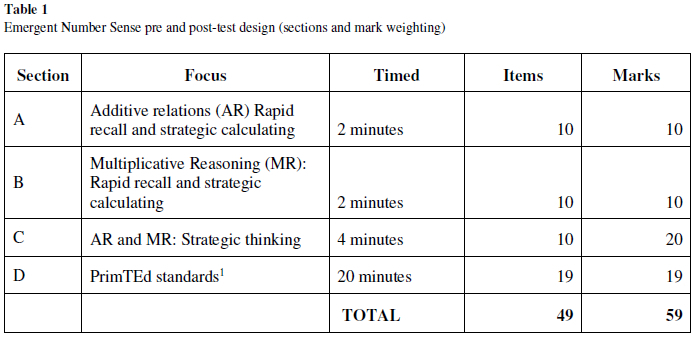
The pre-test administered at the outset of the intervention was comprised of four sections (refer to Table 1). Sections A to C each consisted of ten mental fluency calculations for rapid recall, strategic calculating, and strategic thinking (as defined by Venkat and Graven (2022)). All of these items were closed with a single correct answer.
Section D shifted to pedagogical content knowledge aligned to the PrimTEd knowledge and practice standards. All the items in Section D were multiple choice and were marked as correct or incorrect. Using the same assessment framework, a post-test was designed and administered at the conclusion of the Emergent Number Sense module. The items in the pre-test were matched to the items in the post test, ensuring that the same constructs were assessed in both tests.
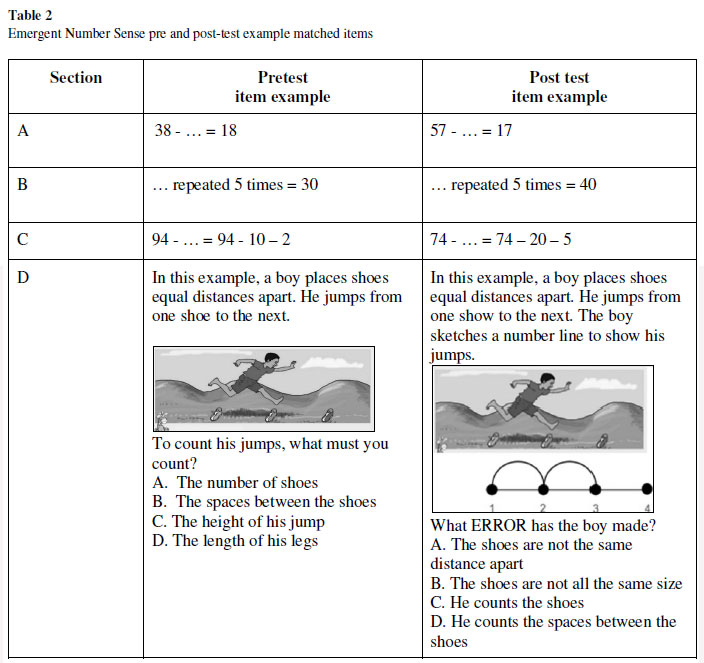
To illustrate, we include an example item from both tests, selected from each section in table 2 below.
Data analysis
Commencing with the quantitative aspect, the data from the pre-test and post-test was collected and analysed. The pre and post-tests were marked and attained scores were converted into percentages. As part of the analysis, a dependent t-test was conducted to compare the means of the PSTs' performance in a pre-test and post-test. The samples were paired because they involved the same group of participants before and after the intervention (i.e., the pre-test and post-test were administered to the same group of individuals). The PSTs who wrote the pre-test (n = 105) were matched to the PSTs teachers who wrote the post-test (n = 135), and the resulting data set of 74 paired scores was then used. The dependent t-test was used to assess whether there was a significant difference in the means of the pre-test and post-test scores. On finding a significant difference between the means, we calculated the effect size using Cohen's D, a commonly used effect size measure in quantitative data analysis, particularly in the context of comparing means between two groups or conditions (Cohen et al., 2018). Facility scores (percentage correct) were calculated for each test item, and colour coding (red to green) was used to show the biggest shifts (green) compared to the smallest shifts (red).
Then, in terms of the qualitative analysis, the lecturer (first author) analysed specific pertinent tasks completed in the manual to gauge the level of connection with the content covered to see whether the PSTs had taken the module content up and applied it to their workings. Importantly, the PSTs were not informed which tasks would be analysed and marked to ensure the reliability of the findings.
Additionally, the lecturer drew on the reflective pieces provided by the PSTs to add greater insight to the analysis. The reflective task asked the PSTs to summarize their overall experience with the Emergent Number Sense module, highlighting the most engaging and enjoyable aspects, as well as any specific activities or concepts that stood out. It also inquired about any challenging or frustrating aspects of the module and asked for elaboration on these challenges and how they were overcome. The PSTs were asked to share new insights or understandings about number sense gained from the module and to identify any specific skills or concepts improved upon. Additionally, the task sought feedback on the effectiveness of online fluency tasks, preparation for these tasks, and the impact of Timed Tango mental fluency practice in tracking progress. It also asked about the helpfulness of workbook activities, and specific activities that were particularly enjoyable or useful.
Finally, participants were asked for suggestions on how the module could be improved in the future, including any additional activities or resources that could be included. Finally, the lecturer consulted her weekly learning logbook to reflect on the institutional and technological aspects that influenced the rollout of the module.
Findings
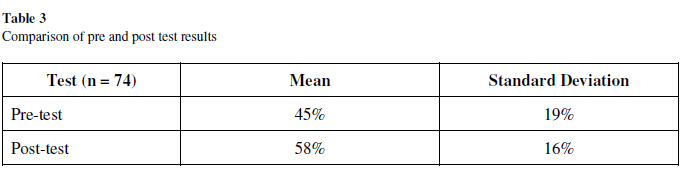
Reflecting on the efficacy of the Emergent Number Sense intervention, the pre and post test results are informative (refer to Table 3):
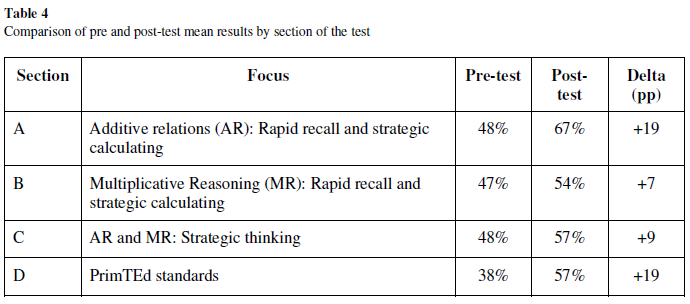
The results of the dependent t-test showed a significant difference (+13 pp) between the means of the pre-test (M = 44.6%, SD = 18.6%) and post-test (M = 58.4%, SD = 16.6%), t (73) = 6.92, p < 0.05. This indicates that the Maths4Primary Teachers' blended approach led to a statistically significant improvement in the PSTs' performance from the pre-test to the post-test. To further understand the magnitude of this effect, Cohen's D was calculated as 0.8, which is considered a large effect size (refer to table 4). This suggests that the intervention had a substantial impact on the PSTs' understanding of number sense and how to support young children's number sense, reinforcing the value of the Maths4Primary Teachers' approach in enhancing pedagogical growth in ITE.
Sections A, B, and C all related to mental fluencies and were timed aspects of the test. These assessed the PST's own number sense through mental fluency calculations. It was pleasing to see an improvement of +19 pp in Section A, and more modest improvements in Sections B and Section C. The pre-test scores findings PSTs entered the B. Ed programme with unstable mental fluencies for number sense, particularly concerning rapid recall of additive and multiplicative relations.
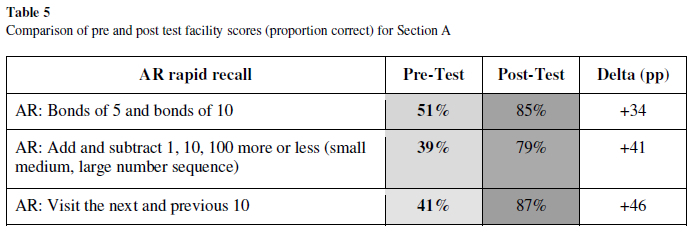
We considered the facility scores (percentage of PSTs getting the correct answer) for each construct assessed in the test. Table 5 reflects the percentage of PSTs who obtained the items by assessing a particular construct correctly. This is distinct from the average score obtained by section (reflected above).
Section A (which saw an increase of mean of +19 pp) shows substantial improvements in the proportions of items answered correctly for all three constructs. These mental fluencies were a major focus in the Emergent Number Sense course and supported by weekly practice of two minute tangoes.
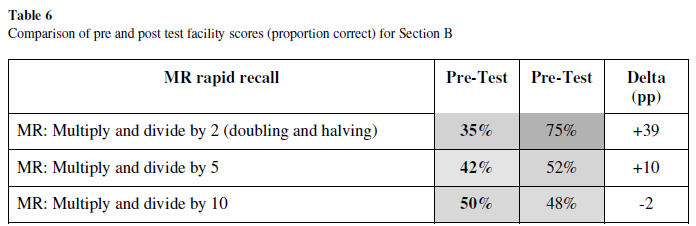
In table 6, Section B (which saw an increase of mean of +7 pp), reflected strong gains for doubling and halving, and more modest, and no gain for multiplication and division by 5 and by 10 respectively.
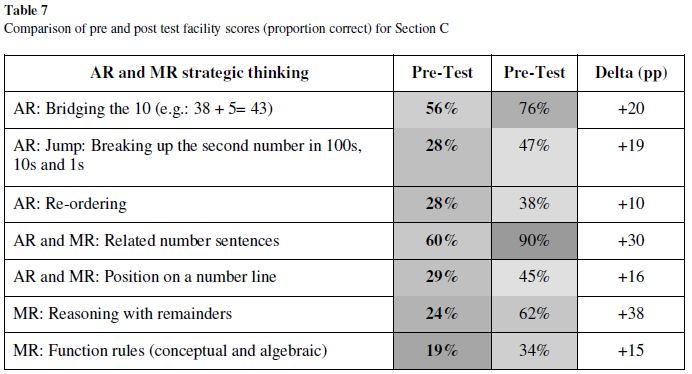
Similarly, in table 7, Section C, which focuses on AR and MR strategic thinking, there was a clear improvement in post-test scores across all items. The largest improvement was seen in reasoning with remainders (+38 pp), followed by related number sentences (+30 pp), and bridging the 10 (+20 pp). These tasks require a deeper understanding of the concepts being tested since they involve strategic thinking and reasoning rather than just rapid recall. They also seem to require the application of many skills and much knowledge since they cover a variety of topics in AR and MR. The smallest improvement was seen in re-ordering (+10 pp), function rules (+15 pp), and position on a number line (+16 pp).
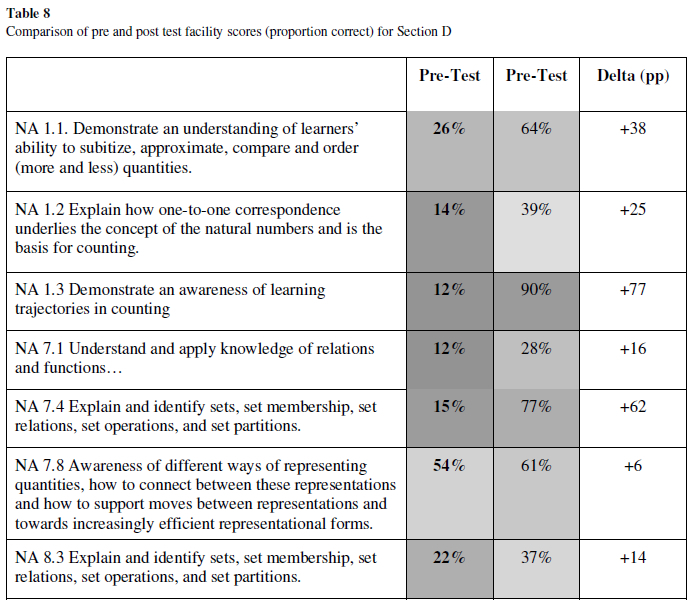
In Table 8, Section D, PSTs showed improvement across most PrimTEd standards from pre-test to post-test. The most significant gains were seen in NA 1.3, with a +77 pp increase, NA 7.4 with +62 pp and NA 1.1, with a +38 pp increase. NA 1.2 also displayed notable improvements of +25 pp. However, for NA 7.8 and NA 8.3, they showed smaller gains of + 6 pp and + 14 pp respectively. Overall, PSTs demonstrated positive progress in their understanding of the PrimTEd standards after instruction.
Discussion
This study set out to examine the prior number sense that first-year Bachelor of Foundation Phase PSTs bring with them on entry to university, and how the Maths4Primary Teachers intervention can build on these competencies to support the teaching of mathematics to very young children.
The pre-test results suggest a distinctive profile of incoming number sense. The PSTs demonstrated relatively strong procedural fluency in additive relations, particularly in rapid recall tasks. However, they showed weaker performance in multiplicative reasoning, especially multiplication and division by 5 and 10. More significantly, they entered the programme with limited pedagogical knowledge of how to develop number sense: few demonstrated awareness of learning trajectories in counting, and many showed restricted flexibility in the use of structured representations. In particular, their reliance on counting in ones and unstructured number pictures suggests a persistence of child-like strategies rather than mathematically efficient teacher-level reasoning.
This profile indicates that while foundational calculation skills were present, deeper conceptual understanding and pedagogical content knowledge related to the concepts in the Emergent Number Sense manual were underdeveloped. The Maths4Primary teachers intervention was therefore required not only to strengthen fluency, but to shift PSTs toward structured representation, trajectory awareness, and flexible reasoning.
In line with the project's intent for dialectical engagement between (1) mathematics education theory; (2) the lecturer collective across six tertiary institutions; and (3) the PrimTEd standards, we go on to reflect on the findings of the design trial using the CABLS framework for blended learning. Drawing on CABLS allowed us to examine how different elements of the system either strengthened or constrained the development of teacher-level number sense.
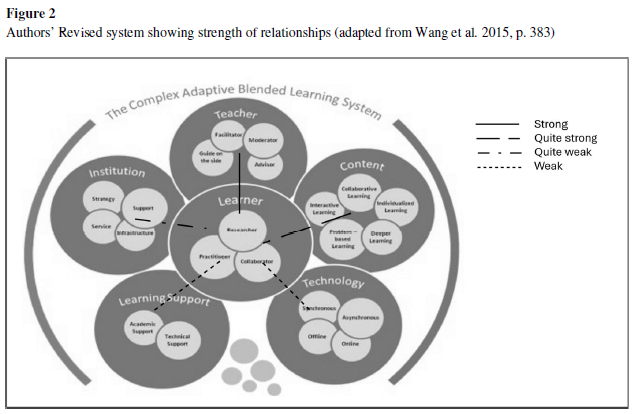
Starting with the Learners (PSTs in this case), we reflect on their connection with the course, in relation to the Content (C), Technology (T-y), Institution (I), the Teacher (T) (lecturer in this case) and Learning Support (LS) - (see figure 2).
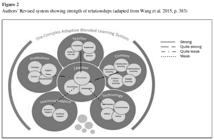
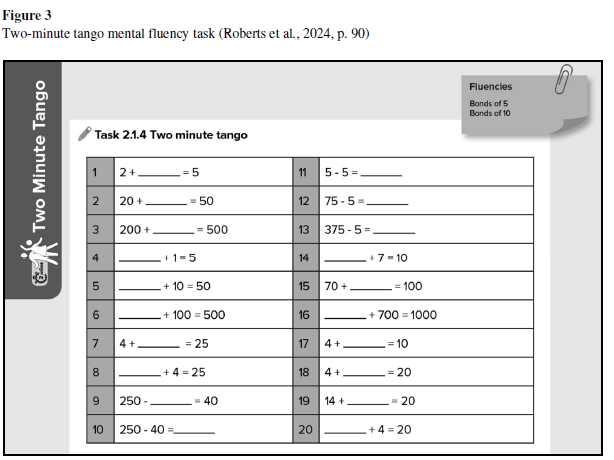
Considering the Learner-Content (L:C) relationship, we reflect first on mental fluencies (assessed in Sections A to C), before turning to the PrimTEd standards (Section D). All the PSTs received and submitted a printed manual which was the core item of the course. Among the PSTs there was a strong connection in the written fluency tasks associated with rapid recall for Additive Relations and Multiplicative Reasoning. The PSTs regularly completed the two-minute tangos in their printed workbooks (see figure 3). The printed manual included eight mental fluency tasks with five of these focusing on additive relations.
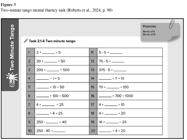
Only two of the two-minute tango tasks focused on 'doubling and halving' and 'multiplying and dividing by 10'. The final two-minute tango was a consolidation of the previous seven tangos. The results from Section A and B in the pre- and post-reflect the content emphasis on additive relations in the printed manual. Strong gains (of more than +30 pp) were evident for most of the mental fluencies. We can therefore infer a strong relationship between the Learner and Content (L-C) for the additive relations mental fluencies. Content covered in class supported routine engagement in rapid recall and this likely accounts for the strong gains made. The PSTs reported that they enjoyed the written two minute tangoes most of all the written tasks, citing increased confidence and enjoyment through active engagement. This was not the case for rapid recall of multiplication and division by 10 and by 5. Multiplication and division by 5, which was not an instructional focus in ENS, shows the weakest attainment. The lack of gain for multiplication and division by 10, points to the need for additional support on mental fluencies, particularly relating to multiplicative reasoning, in the next design cycle. We therefore infer a relatively strong relationship between the Learner and Content (L-C) for the mental fluencies.
The online mental fluency support (Learning Support) to allow for student-lead practice was in the form of How Numbers Work. This gamified fluency practice tool was designed for use on a mobile phone but was used by only 46 (64%) of the 74 PSTs, writing both tests. There was only a weak positive correlation (Pearson's correlation coefficient of 0.27) between the post test results, and engagement with How Numbers Work. Possible inhibiting factors to the online engagement are thought to be that PSTs did not prioritize practicing fluencies in hours outside class time, and limited access to data and Wi-Fi, which was exacerbated by load-shedding constraints. We consider there to be a weak relationship between the Learner and the Technology (L: Ty) in the complex adaptive activity system.
We now consider the Content components relating to the PrimTEd standards which were the intended learning outcomes. This content was presented primarily through printed manual and facilitated through the weekly lectures by the lecturer. The PSTs described appreciating a book that followed in sequential order, commenting on the fact that everything was in "one place." This suggests a strong relationship between the Learner and the Content in the printed book (L-C relationship was strong, in the complex adaptive learning system).
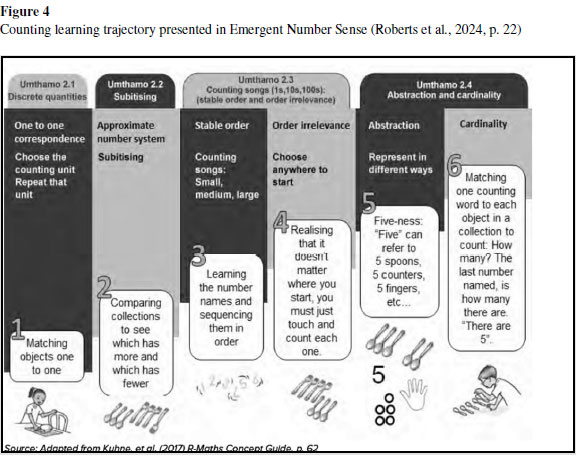
The greatest gain in facility score in Section D of the test was related to "NA 1.3 Demonstrate an awareness of learning trajectories in counting." Since this is a very specific aspect of mathematical knowledge for teaching, it is to be expected that very few PSTs (12%) correctly answered pre-test items on this notion. The learning trajectory in counting was a key content aspect in the printed manual and was in focus during the lecturers. The counting trajectory is a key feature of the printed manual, and each stage in the trajectory is attended to in subsequent Umathamo (sections) - (see figure 4).
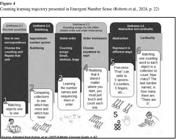
This may be considered the core pedagogical content knowledge that PSTs are expected to gain relating to Emergent Number Sense course. It is therefore very pleasing to see the substantial shift of +77 pp in the assessment of the construct from pre to post test. By the end of the second design trial, 90% of the PSTs were correctly responding to items relating to this counting trajectory. This shows a strong relationship between Learner and Content (L:C).
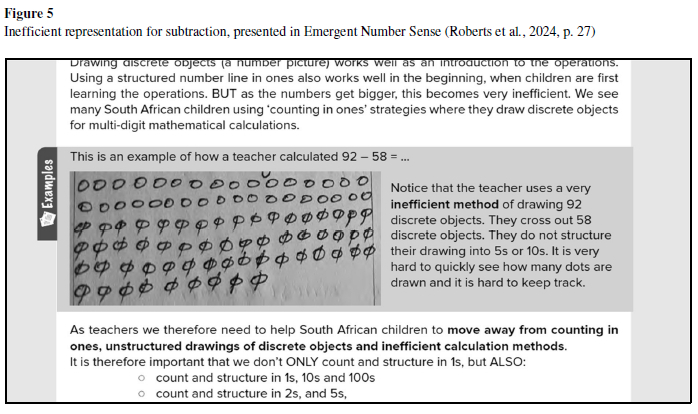
With this gain clear, we sought to explore the standard where there was the smallest gain, to see what we could infer from the lack of learning in this aspect. The PrimTEd standard where there was the smallest shift from pre-test to post-test was "NA 7.8 Awareness of different ways of representing quantities, how to connect between these representations and how to support moves between representations and towards increasingly efficient representational forms." This was supposed to be a core focus of the module. This concern is described in detail in Roberts and Porteus (2023) and will not be repeated here. Cognisant of the persistent use of counting in one's strategies, the Emergent Number Sense printed manual included examples of inappropriate unstructured representations (see figure 5).
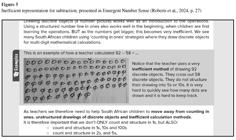
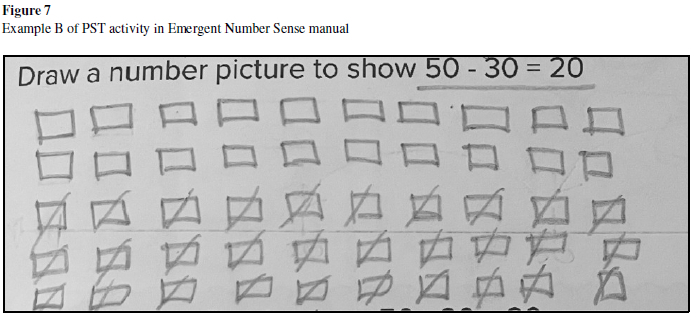
We were therefore concerned when this PrimTEd standard showed only a small gain (of +6 pp). We therefore turned to examine the PSTs' written work evident in their tasks from the printed manual. We were looking for evidence of errors in working with representations to express calculations. We selected a common error (Example A) as well as correct responses (Example B).
In example A (figure 6), the PST obtains the correct solution (34) but uses unstructured number pictures to show how to calculate 92 - 58 = ... There are several concerns evident: (1) They break up both numbers (not the more efficient: keep the first number in your head, and break up the second number); (2) they draw the number pictures in ones (not using the structured number pictures of symbolic tens); and (3) they depict no action to subtraction (neither take-away nor difference actions of removal or one-to one correspondence are evident. Essentially this is a replication of the error presented early on in the manual (and discussed as both erroneous and inefficient).

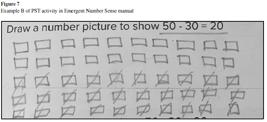
In example B (Figure 7), there are similar common errors as for example A: (1) They break up the first number (2) they draw the number pictures in ones (not using the structured number pictures of symbolic tens). They do manage to show a take-away action for subtraction by crossing out 30 (but again this is done in ones, not tens). The first two examples suggested that far more work and learner support is needed for the PSTs to make use of structured representations (and not repeat the common error among children of counting in ones).
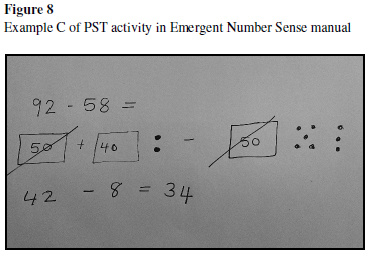
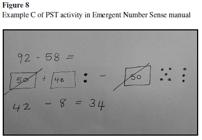
In example C (figure 8), the PST also correctly calculated (with an answer of 34) and depicted the calculation using structured number pictures. They break up both numbers, showing 92 as 50 and 40 and 2 ones, and 58 as 50 and 8 ones. They depict a different strategy, matching the 50 to the 50 and so eliminating that. This leave 42 - 8 = ..., which they correctly reason to be 34. They do not, however, show how this was calculated. This demonstrated partial progress towards the intended outcome of flexible use of structured representations to support explanations of additive relation calculations (in this case using number pictures). While the quantitative analysis of the pre and post test data for Section D (PrimTEd standards) shows strong learning gains, it is clear to us from PrimTEd standard NA 7.8 that there is much learning which was missed and far more which is needed. We therefore consider there to be a relatively strong relationship between the Learner and the Content (L: Ty) in the complex adaptive activity system.
Referring to Lecturer (Teacher in the adaptive learning system) the lecturer was present with the learners for all lectures and adapted the pace of the task completion accordingly to meet the needs of the individual PSTs. The lecture sessions were further enhanced by the classes being split into two, allowing more contact time with individual PSTs. This reflects an Institutional element pertaining to the relationship between Learner-Institution and Learner Support (L:I:LS). The institution's decision to reduce class size by repeating a face-to-face lecture, provided additional engagement between the lecturer and the PSTs. There were, however, numerous Institutional factors which disrupted the intended learning, and weakened the relationships between the Learner, Institution, and the Content (L:I:C). Forced closures related to protest action related to institutional issues impacted on the pace and progression of the module. A two-week delay (with campus closed) when institutional factors interrupted the module, the Lecturer re-visited content previously covered (L: LS), this learner support was conducted by the Lecturer (L:T). We consider the Lecturer and PST relationship to have been strong, good attendance recordings and active participation in the weekly lectures.
Additionally, given institutional constraints, no tutors were appointed and this could have further limited the PSTs' progress (L: I). In relation to the six steps, outlined by Roberts et. al (2024) as required for success with the course: (1) lectures (2) tutorials (3) submit written tasks (4) mark the tasks (5) online mental fluencies and (6) a weekly online quiz, there were several steps missing. Since no tutors were appointed, PSTs missed out on an intended key aspect of the module (step 2) namely, peer tutoring and consequently, the PSTs did not have the opportunities to learn from each other as well as share insights. This was further complicated by the institution not having generators or a stable Wi-Fi connection, which weakened the relationship between Learner and Technology (L:Ty). We consider there to be a quite weak relationship between the Learner and the Institution (L:I) in the complex adaptive activity system.
Finally, we reflect on the relationship between the Learner and Learner Support (L:LS). This is an area of considerable concern to us. This relationship cannot be viewed in isolation to the L:T, LI, L:TY and L:C relationships. Wang et al. (2015) considered Learner Support to be comprises of academic support and technical support. We see both aspects as fundamental to providing feedback to the PST on their learning. The intended module design had several elements which were intended as formative tasks which would provide PSTs to get feedback on their progress and put in additional effort in areas of weakness. There were no tutorials (step 2), and this was a result of Institutional constraints. With large class sizes, the absence of smaller tutorial groups meant weaker Learner Support. In addition, although written tasks were submitted (Step 3) and marked (Step 4), this was done only at the end of module, and the feedback on tasks was therefore not formative. The weekly online quiz (step 6) which would have allowed PSTs to get feedback on their learning through online marking, and the ability to retry the quizzes, was not used. This shows that the design elements intended to provide Learner Support for a large class were not optimally implemented. Considering the weak Learner to Learner Support relationship (L:LS), we are pleasantly surprised with the learning gains evident from the post test. We will focus on this characteristic to improve subsequent design cycles.
Conclusion
This study sought to investigate the prior number sense of first-year Foundation Phase pre-service teachers and to examine how the Maths4Primary Teachers intervention could build on these competencies to support effective teaching of emergent number sense.
The findings reveal that on entry into the programme, PSTs possessed reasonable procedural fluency in additive relations but demonstrated weaknesses in multiplicative reasoning, structured representation, and awareness of learning trajectories in counting. While they could often produce correct answers, their strategies frequently relied on counting in ones and unstructured representations, indicating limited flexibility and underdeveloped pedagogical number sense.
The intervention proved effective in strengthening several of these areas. Significant gains were evident in additive mental fluencies and, most notably, in awareness of counting trajectories (NA 1.3), where substantial improvement was achieved. These gains suggest a strong relationship between Learner and Content in the CABLS framework and demonstrate the potential of a carefully structured printed manual, supported by lectures, to build conceptual understanding.
However, improvement in representational flexibility (NA 7.8) was modest. The persistence of inefficient and unstructured representations in PSTs' written work indicates that shifting deeply ingrained counting-based strategies requires more sustained learner support and formative feedback. Analysis through the CABLS framework revealed that the weakest links in the system were Learner Support (L:LS), as well as institutional and technological constraints (L:I and L:Ty). The absence of tutorials limited formative feedback, unstable Wi-Fi, and institutional disruptions weakened the adaptive potential of the blended design.
Thus, while the second design cycle demonstrated clear efficacy in strengthening specific aspects of the emergent number sense module, it also revealed critical areas for refinement. The identification of weak system relationships has informed concrete design adaptations for the next implementation cycle, including enhanced formative assessment, structured peer feedback, improved online fluency practice, and more explicit emphasis on structured representations.
At a theoretical level, the application of the CABLS framework provided a powerful perspective from which to understand not only whether learning occurred, but why certain components were more or less effective. By situating number sense development in a complex adaptive blended system, this study contributes to a growing understanding of how initial teacher education can move pre-service teachers beyond procedural competence toward the pedagogical and representational fluency required for teaching emergent mathematics effectively.
References
Anghileri, J. (2006). Teaching number sense. Bloomsbury Publishing.
Literature review
- Askew, M. (2015). Numeracy for the 21st century: A commentary. ZDM, 47, 707-712.
- Askew, M., & Brown, M. (2003). How do we teach children to be numerate? British Educational Research Association Southwell.
- Berch, D. B. (2005), Making sense of number sense: Implications for children with mathematical disabilities. Of Learning Disabilities, 38(4), 333-339
- Cohen, L., Manion, L., & Morrison, K. (2018). Research methods in education (Eighth edition.). Routledge.
- Gallistel, C., & Gelman, R. (1986). The child's understanding of number. Harvard University Press.
- Graham, C. R. (2006). Blended learning systems: Definition, current trends, and future directions. In C. J. Bonk & C. R. Graham (Eds.), The handbook of blended learning: Global perspectives, local designs (pp. 3-21). Pfeiffer.
- Graven, M., Venkat, H., Westaway, L., & Tshesane, H. (2013). Place value without number sense: Exploring the need for mental mathematical skills assessment within the Annual National Assessments. South African Journal of Childhood Education, 3(2), 131-143. https://doi.org/10.4102/sajce.v3i2.45
- Kaur, M. (2013). Blended learning-its challenges and future. Procedia-social and behavioral sciences, 93, 612-617.
- McIntosh, A., Reys, B. J., & Reys, R. E. (2005). A proposed framework for examining basic number sense. In J. Bourne, M. Briggs, P. Murphy, & M. Selinger (Eds.), Subject learning in the primary curriculum: Issues in English, science and mathematics (pp. 209-221). Routledge.
- Porteus, K., & Mostert, I. (2022). Moving beyond counting in ones: A South African framework for number picture representations. In T. Mosiane, L. Mokotedi, D. Laubscher & S. Mahlab (Eds.), Proceedings of the 27th annual national congress of the Association for Mathematics Education of South Africa (pp. 177-198). Nelson Mandela Institute.
- Primary Teacher Education (PrimTEd). (2022). Mathematical Knowledge and Practice (MKP) Standards for Prospective Foundation Phase and Intermediate Phase Teachers. PrimTEd.
- Roberts, N., & Moloi, Q. (2021). Jumpstart programme impact on mathematics learning outcomes: A cross-sectional quasi experiment using the Early Grade Mathematics Assessment. In M. Qhobela, M. M. E. Ntsohi, & L. G. Mohafa (Eds.), Proceedings of the 29th annual conference of the Southern African Association for Research in Mathematics, Science and Technology Education (pp. 120-136). SAARMSTE.
- Roberts, N., & Moloi, Q. (2022). The quality of primary mathematics teacher preparation in South Africa: Findings from PrimTEd. Research on Socio-Economic Policy (RESEP), Stellenbosch University, Teacher Demographic Dividend Project.
- Roberts, N., & Porteus, K. (2023). Two pathways into number work for primary teachers: A counting pathway and a measurement pathway. African Journal of Research in Mathematics, Science and Technology Education, 335-349. https://doi.org/10.1080/18117295.2023.2236905
- Roberts, N., Porteus, K., Morrison, S. J., & Westaway, L. (2024). Emergent number sense: Maths 4 primary teachers. Kelelllo Consulting.
- Spelke, E. S. (2022). What babies know: Core knowledge and composition (Vol. 1). Oxford University Press.
- Venkat, H., & Roberts, N. (2022). Children doing mathematics with confidence in the early grades by 2030: What will it take? In H. Venkat & N. Roberts (Eds.), Early grade mathematics in South Africa (pp. 208-224). Oxford University Press Southern Africa.
Accepted: 15 May 2026