Braving educational research ideology in higher education: An arts-inspired collaborative self-study using visual artwork
Abstract
Traditional research often portrays the educational researcher as primarily recommending changes to others' educational practices. We have challenged this perspective by using a starting-with-ourselves approach to seek sustainable, achievable self-improvement in our professional practice. At a 2024 South African Education Research Association (SAERA) conference workshop, we individually created and reflected on self-created artworks, exploring how our art-making evoked new and alternative ways of thinking and understanding research. We were thus inspired to collaborate on a project using visual artwork co-creation for research purposes. Our data sources were our individual artworks and our collaboratively created artwork. Found pantoum research poems facilitated the analysis of our individual and collaborative reflections. We concluded that research art-work serves both novice and experienced artists; provides valuable, unconventional, unexpected reflexive opportunities; highlights the importance of transdisciplinary educational research in knowledge construction; and facilitates re-imagining, re-thinking, and re-defining our professional practices amidst social issues.
arts-inspired research; collaborative self-study; co-created visual artwork; educational research ideology; poetic inquiry
Introduction
In educational research, the depiction of the professional practice of academics and students often lacks deserving affirmation and concern. And, traditional educational research frequently portrays educators negatively, recommending changes to others' educational practices (van der Berg & Hofmeyr, 2018). Tripp (1990) noted that the hegemony of educational research interest results in the subjugation of teachers and teacher educators, and limits their agency. Thus, we, a duo of South African educational researchers, braved this hegemony using a "starting-with-ourselves" (van Manen, 1990, p. 43) approach. We aimed to address the power imbalance by making use of co-reflexive arts-inspired methods to find ways of understanding and learning from a collaborative self-study using our own professional research practice (Rousell & Fell, 2024).
We add to the growing conversation on arts-based inquiry that complements traditional academic research practices by re-imagining educational research possibilities. We embrace a holistic, integrative, positive, hopeful arts-based approach that utilises the expressive and imaginative power of art forms such as visual arts and poetry, amongst others, to explore complex ideas, emotions, and experiences. Our arts-inspired self-study research facilitated improvement visions in educational research as we considered ways of being agents of change using our embodied approach within our selected research interest areas.
Our interdisciplinary team of educational researchers consists of Linda, a mathematics teacher educator in the KwaZulu-Natal province of South Africa and Wendy, a postdoctoral research fellow in the Western Cape. Linda's research interests, for social justice reasons, lie in exploring strategies for the integration of HIV and AIDS (HIV&AIDS) education across disciplines to counteract social issues associated with this pandemic in the higher education context. Wendy's research focuses on arts-based interventions to promote equity, quality, and inclusive growth in post-school education by exploring the potential of innovative pedagogical approaches.
In the following two sections, we briefly summarise and explain pertinent elements of the South African context where we focus our educational research. Thereafter, we provide the purpose, aim, and motivation for this collaborative self-study.
Our South African research interests
As South African educational researchers, we know that the prevalence of HIV&AIDS affects everyone. A study that made use of mathematical modelling indicated that KwaZulu-Natal is the province with the highest HIV prevalence. In 2022, the prevalence in the 15- to 49-year-old age group was approximately 11,2% (Johnson & Dorrington, 2023, p. 3). In other words, out of every 10 people in this age group, approximately one person is HIV-positive. Students, both undergraduate and postgraduate, enrolled at universities fall within this age group. This means that HIV&AIDS remains a concern in South Africa despite biomedical and social sciences research commencing in the 1960s, after the identification of AIDS patients (Gilbert et al., 2007).
Almost four decades ago, Mann (1987) emphasised that there are different, yet connected, aspects of the HIV&AIDS pandemic, namely, the AIDS virus (HIV) epidemic, the AIDS disease epidemic, and the social aspects related to AIDS. In South Africa, major, significant advances in the first two aspects have been achieved because of resolute biomedical health achievements in the development and distribution of antiretroviral treatments (Buthelezi, 2023). However, at the 2022 International AIDS Conference, HIV&AIDS stigmatisation was named as a significant stumbling block to HIV treatment (Phillips, 2022). Attending to social issues are thus imperative in curbing the spread of HIV and reinforcing the need for multi-faceted biomedical and social pandemic responses.
Apart from health and well-being that impact students' ability to learn and attend school, South Africa, like many other countries worldwide, faces a significant challenge in youth unemployment (Naidoo, 2021, p. 19). Statistics show that 45,5% of young people aged 15 to 34 are unemployed, which is considerably higher than the national average unemployment rate of 32.9% estimated for the first quarter of 2024 (Statistics South Africa, 2024). Recent research has highlighted the urgent need for comprehensive policy solutions to tackle South Africa's complex unemployment challenges (Dunga & Maloma, 2024). To address the evolving needs of 21st-century education, Wendy's doctoral research (Smidt, 2023) explored the potential of a shortfilm-making project that supported the demands of project-based work where the focus was on equipping young adults with insights that could be applied to their personal and social lives.
For this study, we turned to the imaginative powers of visual arts and poetry for extending our professional learning in our research interests. At a 2024 educational conference workshop, we gained new knowledge about how visual art-work creation can serve as an alternative research method.
The purpose, aim, and motivation for this study
At the South African Education Research Association (SAERA) 2024 conference, we individually created and presented an artwork in response to a workshop opportunity, which offered scholarly conversation through arts-based discussion. The presenters invited workshop attendees to focus on the question: "How does art-making evoke new and alternate ways of thinking, understanding, and showcasing academic work?" After the workshop, we, a newly acquainted duo, engaged in dialogue to explore how our new workshop insights through art-making could enhance our professional learning using arts-inspired self-study methods.
Our post-workshop reflections of our SAERA art-making experiences, and our subsequent co-created visual artwork completed on 18 December 2024 after the SAERA conference, inspired us to extend and improve our professional learning via a collaborative poetic self-study. For this study we posed the research question, "How does art-making in collaborative self-study (re)-illuminate insights and inspire knowledge (re)-construction?" Instead of belabouring the disappointing, distressing, and discouraging concerns in our chosen educational research interests, this study focuses on hopeful, optimistic opportunities to improve our practice by using arts-inspired self-study methods within our professional contexts.
In the next section of this article, we first describe our chosen methodology, namely, collaborative self-study, embracing the inspiration and optimism expressed in the found poem entitled "The Self-Study Movement" (Samaras et al. 2015, p. 244). And then, we discuss arts-inspired research and describe the self-reflexive methods we selected to seek ways of enhancing our professional learning, namely, art-making, poetic inquiry (Cahnmann-Taylor & Zhang, 2020), and metaphor. Last, we explain our data source selection.
Methodology
Collaborative self-study
We used the poetically expressed inventiveness offered in the found poem (Butler-Kisber, 2010) entitled "The Self-Study Movement" (Samaras et al. 2015, p. 244). This poem captured the guiding principles of self-study research by highlighting how bringing about transformation as a self-study researcher facilitates and inspires making positive difference. In self-study, through offering, questioning, and reflecting on authentic self-narratives, the researcher is inspired to ethically self-improve in a whole-bodied-head, heart, and spirit- manner. The self-study research movement allows for simultaneous building on previous learning, and disrupting insights in a particular lived educational context, to create social change in higher education and beyond educational boundaries. Within self-study, traditional methodological notions of objectivity, generalisability, and replicability are replaced by other criteria; essentially, self-study deepens context-specific understandings of lived professional practice experiences. Alternative research qualities for research vigour (such as worth, ability, zeal, and robustness) serve as valued, preferred self-study criteria (Faulkner, 2019). In addition, this scholarly movement encourages engagement with other researchers in seeking improved research possibilities by allowing for "adding to others' learning" (Samaras et al. 2015, p. 244). Bearing in mind the far-reaching potential of this movement, we benefited by working collaboratively to respond to our research question.
Arts-inspired research
Arts-inspired research is becoming increasingly popular not only among artists who are skilled in specific fields of art, such as painting, sculpture, drawing, and poetry but also across most other disciplines including interdisciplinary and transdisciplinary research (Naicker et al., 2024). In arts-inspired self-study, educational researchers rely on artistic methods for insights to enhance and improve their professional practice-in particular, teaching and learning contexts. Naicker, et al. (2024) noted that arts-inspired methods' strength lies in the reflexive potential (Rousell & Fell, 2024) for educational research where social innovation is required to address complicated, entangled social realities.
Most people enjoy creating art using whatever medium is available. Even young toddlers around the age of three are willing to engage in conscious art creation to express themselves in various physical forms (Leigh, 2020). This means that technical artistic skills are not necessarily essential for telling the stories related to the ideas, emotions, and personal visions expressed in the artwork. The possibilities and opportunities offered by the physical artistic form, no matter how imperfect, support self-reflection and observer-reflection. In other words, artworks created by technically skilled and unskilled (naive) artists provide opportunities for visceral, emotional, or psychological research responses.
In addition to art creation being invaluable, White and Cooper (2022, p. 287) pointed out that arts-inspired research involves "systematic experimentation with the goal of gaining knowledge about life." Moreover, any artistic genre is adaptable for experimentation-for example, visual art, metaphorical inquiry, collage, and poetry reflection, to name but a few of the possible genres. There are also many beneficial permutations and combinations of these genres available to arts-inspired self-study researchers.
Visual art-work
Gadamer (2003, p. 86) provided an additional value of art in research by pointing out that encounters with artworks can provide authentic experiences with transformative potential, asserting that such experiences do "not leave him who has [experienced] it unchanged." Moreover, Müller argued that a researcher's awareness of the "not-knowing" (2020, p. 43), expressed as visual art, could fuel the creative and imaginative process. By embracing uncertainty and the power of personal experience, researchers can uncover new insights and contribute to a deeper understanding of the human experience whilst creating new knowledge. In our study, we distinguish between "artwork" and "art-work"-the artwork being the tangible created object, and art-work our engagement with materials, techniques, and the embodied experience of making the created piece.
Poetic inquiry
Poetic self-study is what Görlich (2023, p. 129) described as an "umbrella for various ways of using poetic and literary tools to produce qualitative analysis of life lived" for processing, analysing, symbolising, and developing new knowledge. Görlich further offered a detailed description of how she practised poetic self-study in the youth sociology research field, pointing out the importance of poetic studies for research where affect and emotions are key because poetry facilitates "freeing language" to connect senses by reactivating the "emotional body" for "social solidarity" (Görlich, 2023, p. 130). In poetic self-study, the researcher uses "literary devices such as rhythm, repetition, wording, [and] phrases" for analysis to uncover the "emotional context and touches the reader/listener affectively and emotionally" (Görlich, 2023, p. 131). To avoid "anaesthetic" social sciences research, Görlich reached out to poetic means for de-marginalising and making affect more significant and noticeable.
Metaphors for reflexivity
In addition to the aesthetic and other values of creating research artwork, self-created artistic artefacts may also, according to McIntosh (2010, p. 158) serve as metaphors to "argue, persuade and demonstrate analogy" and strengthen understanding and reasoning to imagine life experiences. Furthermore, Ware (2023) described metaphor as a means of understanding an abstract, target domain using supporting concepts from another more concrete, source domain. Ware indicated that metaphors facilitate the codifying of multiple aspects of abstract concepts onto more simple, re-callable source domains.
Data source selection
Drawing on our experience and learning about using art-work for research gleaned during the SAERA 2024 workshop (Müller et al., 2024), we started with ourselves to brave traditional education research hegemony. We used collaborative self-study and the reflexivity opportunities offered though self-created artwork to address research power imbalances where the recommendations of researchers are imposed upon their educational research participants. Instead of recommending what other educational researchers ought to do, we focused on improving our own research practices by seeking transformation within our respective areas of interests. We sought sustainable, achievable self-improvement in our professional practices within the South African context to strengthen our professional agency.
After the SAERA 2024 workshop where we considered our individual learning gained in artwork, we wanted to expand our learning collaboratively. So, for this study, we co-created an original visual artwork and reflected on it. To answer our research question, we connected our reflections on our co-created visual artwork through found poetry to analyse, develop, represent, and generate new knowledge. Our collaborative study thus developed in three steps, as explained below.
Step 1
At SAERA 2024, a workshop session entitled "Becoming, Thinking, Creating With Art: A Scholarly Conversation Through Arts-Based Discussion" was presented by Müller et al. (2024). We individually created an artwork and individually responded to the session prompt of how our own visual creation could evoke new and alternate ways of thinking, understanding, and showcasing our academic work.
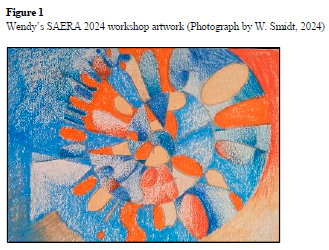
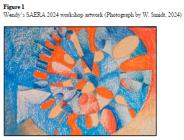
Wendy's artistic visual artwork created at that art-making workshop was titled "The Art of Standing Out and Crossing Boundaries" and included mixed media: colour pencils and crayons on white, textured A5 paper (see Figure 1). Starting in the centre of the page, she first drew a single grey pencil line, spiralling outwards over the edges of the page and back. The spiral shape, reminiscent of a nautilus shell, continues in an arrow shape-indicating ongoing action. She added letter work disguised by using colour to invite viewer interaction through piquing the viewer's curiosity. The words, "the ART of StAndinG OUt & CroSSing boundaries" are visible between the lines of the spiral shape when one zooms in on the design. Complementary blue and orange, in various tones and shades were used in the negative areas within and between the letters.
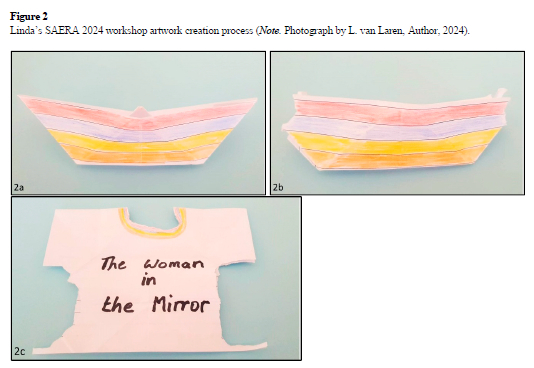
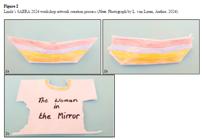
Linda's not-so-artistic artwork was made using paper (see Figure 2). She folded a rectangular two-dimensional A5 piece of lined notepaper to transform it into a sculptural boat. Thereafter she tore off the bow of the paper boat, then the stern, and lastly, the mast and discarded these three pieces of the boat. When the remaining piece of the boat was unfolded, it revealed a T-shirt shape. On the front of the T-shirt, Linda wrote "The Woman in the Mirror."
Step 2
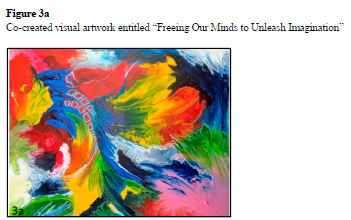
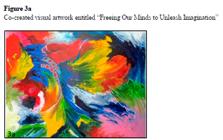
A few weeks after the conference, on 18 December 2024, we met for two and a half hours in Cape Town to collaboratively engage in art-work. We decided to engage in a spontaneous, free-form art-making experience without a predetermined topic or subject. We used basic art elements: colour, line, shape, texture, and space (see Figure 3). Wendy, who is an experienced arts and design teacher, assembled and set up all the necessary art materials- acrylic paints, brushes, and canvas. Before commencing with our art-work, Wendy carefully demonstrated the required skills and techniques. Linda started painting by dipping her finger into a paint pot that contained one of the three primary colours and applied the paint to the canvas. Then Wendy introduced a second primary colour using a paintbrush to partially blend the wet paint layers to create a secondary colour. We took turns in spontaneously adding primary colours, expanding the colour fields across the textured surface of the canvas. On the completed artwork, we used pastel crayons to individually outline selected shapes for emphasis. The intention was not to produce a realistic image. Bearing in mind our research question, we individually reflected on our co-created art-work process and on the completed artwork where we also found images that served as metaphors for reflection in our respective fields of research interest.
Step 3
On 22 January 2025, we had a Zoom meeting to display our reflection documents. We collaboratively highlighted words, phrases, and sentences that caught our attention as pertinent and meaningful for answering our research question. Our seven pages of reflection documents served as our primary data source.
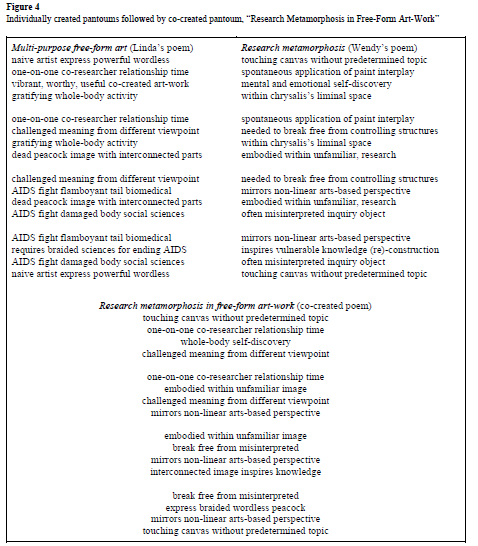
By highlighting items on our reflection document, we individually created a pantoum format found poem from our own reflections. We agreed to dedicate three of the pantoum lines to our art-work experience reflections, and the remaining lines to our final co-created artwork reflections. The French-Malaysian pantoum format we chose has four-line stanzas with given reiterated lines (poets.org, n.d.). These reiterations slow the poem's reading pace, which allows for deepened emphasis of line content. To inspire a concise selection of fundamental poem words, we limited the syllable counts in each line to between eight and 12 syllables.
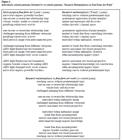
At a subsequent Zoom meeting (30 January 2025) we collaboratively created a research pantoum poem by selecting lines or phrases from our two individually created poems (see Figure 4). Thereafter, we met again via Zoom (21 February 2025) to analyse our co-created pantoum poem, which served as an analytical device. We magnified individual lines from our co-created pantoum to respond to our research question: "How does art-making in collaborative self-study (re)-illuminate insights and inspire knowledge (re)-construction?"- still keeping in mind our positive reactions to braving dominant educational research ideologies, our collaborative art-making process experiences, and how we had used our unique artwork for self-reflection in our respective areas of research interest. In the next section, we present our data in three steps.
Presentation of data
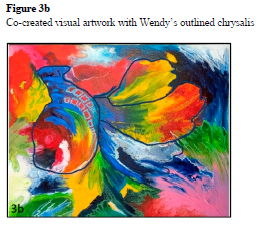
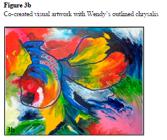
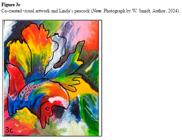
First, in Step 1, we present our individual artworks and their associated art-work reflections as presented at the SAERA 2024 workshop (Figures 1 and 2). These art-work experiences inspired us to initiate our collaborative self-study, so we included them in our current study. Next, in Step 2, we consider our collaborative art-work and our co-created artwork (Figure 3a) and show the found artwork images (Figures 3b and 3c) that we identified as metaphors for in-depth self-reflection. Finally, in Step 3, we present our individually created pantoums and our co-created research pantoum poem (Figure 4).
Step 1: Wendy and Linda's SAERA 2024 workshop artworks and associated art-work reflections
Wendy's artwork served as a visual metaphor because the negative areas within and between the characters provide spaces for the application of colour. The text, "the ART of StAndinG OUt & CroSSing boundaries" suggests that each new learning cycle requires a focused approach (one's attention), building upon previous knowledge and understandings. Additionally, there will always be overlapping areas (visually expressed by the overlapping colour areas and blurring lines of the characters (letters), allowing for continuous growth and refinement. The boundary-crossing concept (Akkerman & Bakker, 2011) suggested the possibility of working across language barriers and cultural, geographical, and disciplinary boundaries. The placement of the artwork by the SAERA 2024 session facilitator on a large frame, and literally extending over the frame, further strengthens the concepts of "standing out" by thinking differently, and "crossing boundaries" by working beyond the scope of the formal curriculum.
Linda made a three-dimensional contribution to the collaborative art-work created by the attendees at the SAERA 2024 art-making workshop. She created a paper boat (Figure 2a) to demonstrate to the workshop participants how using arts-inspired self-study methods for educational research is not always plain sailing. The rough journey of the boat is her research experience as the boat navigates the turbulent waters of traditional researcher criticisms. Some educational researchers consider self-study to be a navel-gazing exercise, and discredit the use of the unrefined artistic methods encouraged in self-study. These remarks and comments have damaged her boat, causing it to lose its bow, stern, and mast. Linda tore off the bow, stern, and mast (Figure 2b) and her boat came to a standstill and sank in the stormy ocean. When the shipwreck was washed up on the shore, it unfolded into a T-shirt shape. This wreckage revealed "The Woman in the Mirror" (Figure 2c). This indicates that rough, turbulent research experiences have not deterred Linda from using arts-inspired self-study methods because she continues to use self-reflexive methods in educational research to improve and transform her professional practice.
Step 2: The authors' art-work co-creation experiences
Our reflections on our co-created visual artwork
Two snippets of our art-work reflections follow, by way of example.
Wendy's reflection of found chrysalis and butterfly metaphor
Wendy discerned a powerful image, a butterfly, emerging from its chrysalis (Figure 3a). She connected the butterfly's transformation-from caterpillar, to chrysalis, to butterfly-to her own development. Wendy realised she needed to break free from this restrictive chrysalis. The shed skin mirrors the deliberate unlearning of established methods, leading her to take risks in unfamiliar territory-a vulnerable position. Wendy understood that her research into film literacy's transformative potential required (re)-construction within a research space free from controlling structures. She recognised that a post-qualitative approach (St. Pierre, 2014, 2023) to analysis, or reading the evidence, was a complex and evolving area within the chrysalis of qualitative research-requiring her to work beyond traditional methods and assumptions. Like the emerging butterfly, Wendy's break from established methodologies marked a vulnerable but necessary phase of her development.
Linda's reflection on found peacock metaphor
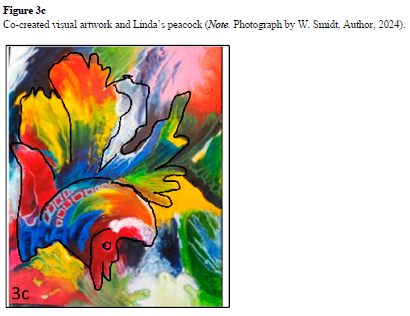
Linda noticed an image of a peacock, which she outlined in black (Figure 3). This peacock is in three parts: a tail, a body, and a head. The bent, contorted, limp neck of the peacock indicates that the bird is almost dead. This peacock depiction shows the progress that has been made in the interconnected, entangled challenges that face HIV&AIDS affected people. The perky, erect tail feathers are the progress that biomedical sciences have made in biochemical treatment interventions to reduce HIV consequences such as the HIV treatment for prevention. The peacock body is the progress that social sciences have made in contending with HIV&AIDS challenges. The damaged peacock body shows that much needs to be done to accelerate positive social progress. To resuscitate the peacock requires more than biomedical sciences progress. Both the biomedical sciences (tail) and social sciences progress (body) are important considerations for an all-inclusive revival approach in looking forward to the ending of AIDS.
Step 3: The authors' individual and co-created pantoums
We first used our reflections as data source to individually create pantoum format found poems (see Figure 4). Then, later, we collaboratively created a research pantoum from phrases from the two individually created poems.
Our co-created pantoum, "Research Metamorphosis in Free-Form Art-Work" not only crystallised our findings but also served as a means of analysing how art-work facilitated insight illumination and knowledge construction. In the following section, we share our analysis of our co-created pantoum.
Analysis of co-created pantoum
In the final analysis stage, we utilised and qualified individual line concepts from that poem to answer our research question. Dialogic interpretations were utilised for analysing our learning about the art-making creating process, and how our completed artwork inspired knowledge construction.
Linda
The first three lines of our co-created pantoum research poem focus on our experiences in relation to the process of creating our visual artwork. The first word of our poem uses "touching" to express how creating our free-form visual artwork as a newly acquainted duo facilitated the unlocking of our emotions for further fresh learning in our respective fields of educational research. At the commencement of our study, we were acquainted as educational researchers but the physical canvas touching and creating during the art-making process connected us as we moved towards becoming a team of educational researchers.
The second line of the first stanza, "one-on-one co-researcher relationship time" draws attention to how our unique art-work experience provided dedicated face-to-face time for building our connection as educational researchers to gain additional insights for collaborative knowledge production. In addition, "whole-body self-discovery" highlights how the novel art-work process incorporated sense making through thinking, feeling, and moving in different, unpredictable, risky, unfamiliar ways to seek ways of improving our professional learning as researchers. The line "challenged meaning from different viewpoint" is the first line of the pantoum dedicated to focusing on our completed artwork. This line links what we reflected on in relation to the art-work process, and emphasises that taking on our collaborative educational research adventure using art-work, as introduced to us during the SAERA 2024 conference workshop, disrupted our familiar research methods and inspired us to take on artwork making for research, differently.
Wendy
"Touching canvas without predetermined topic" and "whole-body self-discovery" indicate an exploratory, open-ended approach to art-work. It is about more than just the final product; it involves the physical engagement with the materials. By not starting with a fixed idea, the process allows for unexpected discoveries and deeper self-reflection. This freedom allows tacit knowledge and personal experiences that might not have surfaced through traditional research methods. "Whole-body self-discovery" also suggests that the (re)-constructed knowledge goes beyond just intellectual to also include emotional and kinaesthetic engagement that can lead to richer insights into personal thoughts and feelings.
"One-on-one co-researcher relationship time" relates to the collaborative aspect of the interaction/engagement-a dedicated, shared space for dialogue and the creation of new understandings. The "co-researcher relationship" itself became a site for knowledge production, within which the co-authors could challenge each other's perspectives and build onto each other's insights. "Challenged meaning from different viewpoint" addresses the idea of knowledge (re)-construction, (re)-considering viewpoints other than one's own. This can strengthen new ways of understanding.
Linda
The phrase "embodied within unfamiliar image," first mentioned in Stanza 2, signifies that our artwork spiked emotional and sensory responses that were connected to our lived research experiences. This means that by using our artwork that was not designed to represent a particular image we extended our learning from being purely a mental engagement to enabling our facilities as living beings. The later line, "mirrors non-linear arts-based perspective," highlights that our artwork did not define a particular cast-in-stone, universal, straight-forward response or view but rather, allowed for flexible views depending on the artwork observer's lived experiences. Individually, we were able to draw professional learning connections from the image as a metaphor in different, exciting, and unexpected ways.
Wendy
"Embodied within unfamiliar image," suggests a state of being in an unknown space, exploring beyond one's comfort zone. "Embodied" further connects to the earlier concept of "whole-body self-discovery." Placing oneself in such a position can challenge existing understandings, thereby creating space for new ideas. "Mirrors non-linear arts-based perspective" reflects the fundamental characteristic of arts-based research, and emphasises its radical departure from traditional scientific research.
Linda
"Break free from misinterpreted" (introduced in the third stanza) implies that using art-work to illuminate or learn new knowledge is subjective because connections and understandings through images are embodied and informed by particular lived research experiences. Artwork reflections thus provide unique, interesting reflexive opportunities that steer clear from "correct or incorrect" classifications. Similarly, "interconnected image inspires knowledge" suggests that free-form artistic images provide inspiration for many unique connections between what is seen in the image, and the knowledge gleaned through reflection.
Wendy
The desire to "break free from misinterpreted" motivates our exploring alternative research avenues, such as collaborative art-work, in investigations. This approach can unveil hidden possibilities in methodological thinking. Furthermore, art-work used as an inquiry method offers numerous possible interpretations that cannot be classified as being correct or incorrect. The concept of interconnectedness in "interconnected image inspires knowledge" acts as the primary link to the research question, both literally and figuratively (metaphorically). Our physical co-created artwork reflects creation, analysis, and discussion. Metaphorically, the co-created artwork becomes the catalyst for self-reflection, the re-illumination of insights, and the reconstruction of knowledge.
Linda
In the final stanza, the line "express braided wordless peacock" is an example of how the images of the peacock and a chrysalis and butterfly were found plaited into the maze of vibrant artwork colours to facilitate reflection. Using these found images as wordless text, we, as researchers, explored the images as metaphors to foresee improvements in our own fields of educational research.
Wendy
"Express" signifies communication through artistic elements, rather than words, and highlights the potential of art in facilitating communication beyond written and spoken language. "Braided" signifies the interwoven nature of diverse viewpoints within the intertwined multiple perspectives in lived experiences made possible through art-work. For example, apart from the peacock's beauty, its visual image used as a metaphor might reveal hidden or previously unknown/invisible ideas.
The above poetic analysis of our found pantoum poem, using art-work reflections, highlighted that, even though our poem was co-created by us, we attached similar, yet also different, meanings to the poem lines in our dialogic poem discussion. We did not intend the poem to have only one specific correct or incorrect interpretation. This means that readers of our poem may discern additional, similar, or alternative understandings and responses to the poem. Now, we conclude by looking forward and outwards to answer our research question.
Discussion and concluding remarks
By attending and actively, wholeheartedly engaging with presenters and attendees at the SAERA 2024 workshop opportunities, we learnt from other educational researchers about alternative research possibilities in art-work. These opportunities offered insights into how we could brave the hegemonic ideology in educational research that limits educators' agency. As higher education educator attendees, we nurtured the spark ignited by the workshop presenters. As attendee acquaintances, the two of us were inspired by the promising inventive playfulness offered by combining art-work with research for (re)-illumination and (re)-construction of new knowledge.
At the SAERA 2024 conference art-work workshop, Linda mentioned that she had endured unsettling research experiences because of harsh, critical comments directed at her use of self-reflexivity in arts-inspired self-study methodology. Thus, we decided to use collaborative self-study to find positive, optimistic, endogenous ways of confronting the educational research ideology in which superordinate researchers impose their recommendations and make comments that may be hurtful, uncaring, and critical of educators. We were motivated, and wished to extend our workshop art-making feelings of excitement, so agreed to co-create an artwork for a collaborative self-study research project as a means of increasing our professional agency within our respective areas of interest (HIV&AIDS social education integration, and multimodal literacy intervention in post-school education) within our South African context.
We sought sustainable, achievable self-improvement in our professional research practices using this novel method of co-creating a visual artwork. Through self-reflexive, endogenous, arts-inspired, poetic, research we sought ways of facing dominant educational research ideology. Despite the vastly different, unequal artistic talents in our team, we, as acquaintances from different distant South African provinces, made bold plans and devised ways and means of collaboratively taking on art-work to use for positive engagement in educational research. As a research team, we took the risk of creating something unfamiliar and novel to create a bold, flamboyant free-form artwork that served many purposes in our study. Both the creative process and the final co-created artwork provided interesting, surprising benefits.
The creation process evoked playful, enjoyable responses as we used our heads, hearts, and bodies. Our embodied (Venter et al., 2023) experience in art-making required thinking for effective engagement in the hands-on activity; emotional connections to the artwork occurred during the process, and learning about each other as team members whilst we alternately shared and created our artwork in the restricted space of a small 460 mm x 355 mm canvas.
The creation process facilitated the moving of a professional relationship as acquaintances to that of research colleagues. In addition, the final visual artwork provided opportunities for in-depth reflections into our areas of research interest.
We singled out two found images as metaphors (the peacock and the chrysalis) in our artwork but there may be many more different images hidden in our free-form artwork that could serve as metaphors for reflection or other research related purposes. The found peacock image in our artwork supported insight illumination and knowledge construction in Linda's area of research interest-HIV&AIDS social education integration. Her reflections noted that educational research into integration of HIV&AIDS education across education disciplines has not fared as well as biomedical science contributions. The progress that social sciences have made in contending with HIV&AIDS challenges requires additional, perhaps alternative, ways of encouraging, reinforcing, and extending dialogue around HIV&AIDS social issues. Both the biomedical sciences and social sciences progress are important considerations for an all-inclusive revival approach in looking forward to the ending of AIDS. Van Rooyen (2024, p. 226) noted that "social sciences and humanities [should] . . . take up its place alongside biomedical science." However, Linda has realised that the "alongside" association between social sciences and biomedical sciences should not mean "beside" or "near" but rather, integrated, interconnected, braided together for envisaging the end of AIDS. In other words, to improve her professional research practice Linda needs to seek ways of braiding HIV&AIDS biomedical science interventions and research with social science educational research.
Wendy's found image of a butterfly emerging from its chrysalis reflects the metamorphosis she experienced using arts-inspired collaborative self-study. Her unlearning and risk-taking involved exploring open methodology and multimodal language. The collaborative nature of the art-work process created an assemblage of diverse experiences. Fullagar and Taylor (2021, p. 32) argued that "assemblage thinking is an invitation to challenge humanist assumptions and ontoepistemologies." It moves away from traditional human-centrist knowledge production (Rousell & Fell, 2024), recognising that knowledge and agency are distributed among various human and non-human elements. Therefore, thinking with rather than about the butterfly's emergence supported the (re)-illumination of insights and inspires knowledge (re)-construction. From her experiences, the tangible, embodied art-work knowledge creation process became a suitable method for self-study, (re)-illuminating learning as a continuous process of becoming (Rousell & Fell, 2024) for transformation. Wendy recognises the necessity to work beyond conventional educational frameworks to critically engage with the social contexts influencing education researcher realities, as highlighted by Pomeroy and Herrmann (2024).
To conclude, our study using art-work, served us in braving hegemonic ideology to deregulate our agency as educational researchers in a number of ways. First, the free-form visual artwork expanded our insights and knowledge creation to encourage novel insights. This method suited both the naive and artistic educational researchers in our study. Second, our use of art-work in a transdisciplinary team enabled embracing knowledge creation possibilities across disciplinary boundaries, and highlighted the significance of transdisciplinary research. Third, our collaborative co-creation of an artwork facilitated valuable, unconventional, unexpected reflexive opportunities and engagement in embodied research. Fourth, whilst enjoying the art-work experiences, the reflexive opportunities for improving research practice occurred in a non-threatening, ethical manner that freed us to imagine, think, and define possibilities midst social issues. Finally, we offer our collaborative self-study art-work research adventure to inspire other researchers to consider similar (or different) research studies by individually or collaboratively making use of art-work as a means of braving educational research ideology.
References
- Akkerman, S. F., & Bakker, A. (2011). Boundary crossing and boundary objects. Review of Educational Research, 81(2), 132-169. https://doi.org/10.3102/0034654311404435
- Buthelezi, S. S. S. (2023). 2023 ART clinical guidelines for the management of HIV in adults, pregnancy and breastfeeding, adolescents, children, infants and neonates, June 2023, Version 4. Foreword. Republic of South Africa. https://tinyurl.com/2ycyvb85
- Butler-Kisber, L. (2010). Qualitative inquiry: Thematic, narrative and arts-informed perspectives. SAGE.
- Cahnmann-Taylor, M., & Zhang, K. (2020). Arts-based educational innovation and poetic inquiry. In M. Peters & R. Heraud (Eds.), Encyclopedia of educational innovation (pp. 1-6). Springer. https://doi.org/10.1007/978-981-13-2262-4_49-1
- Faulkner, S. L. (2019). Poetic inquiry: Craft, methodandpractice. Routledge.
- Fullagar, V., & Taylor, C. A. (2021). Assemblage. In K. Murris (Ed.), A glossary for doing postqualitative, new materialist and critical posthumanist research across disciplines (pp. 32-33). Routledge.
- Gadamer, H. G. (2003). Truth and method (G. Barden & J. Cumming, Trans.). Sheed & Ward. (Original work published 1975).
- Johnson, L. F., & Dorrington, R. E. (2023). Modelling the impact of HIV in South Africa's provinces: 2023 Update (Working paper). Centre for Infectious Disease Epidemiology and Research. https://tinyurl.com/5be3xy5y
- Leigh, J. (2020). Using creative research methods and movement to encourage reflection in children. Journal of Early Childhood Research, 18(2), 130-142. https://doi.org/10.1177/1476718X19885992
- Mann, J. M. (1987). Statement at an informal briefing on AIDS to the 42nd session of the United Nations General Assembly. World Health Organization. https://iris.who.int/handle/10665/61546
- Müller, M., Pillay, D., du Preez, P., Dick, L., & Chisale, P. (2024, October 30). Becoming, thinking, creating with art: A scholarly conversation through arts-based discussion. In Book of abstracts: South African Education Research Association (SAERA) 2024 Conference, Bloemfontein, South Africa. https://saeraconference.co.za/wp-content/uploads/2024/10/BOOK-OF-ABSTRACT-WIP-PDF-V1.pdf
- Naicker, I., Pillay, D., Pithouse-Morgan, K., Masinga, L., Chisanga, T., & Hiralaal, A. (2024). Arts-based educational research narratives of academic identities: Perspectives from higher education. Springer.
- Phillips, H. (2022). What works to reduce HIV-stigma? Be in the Know. https://www.beintheknow.org/news-and-blogs/what-works-reduce-hiv-stigma
- poets.org. (n.d.). Pantoum: Explore the glossary of poetic terms. https://poets.org/glossary/pantoum
- Pomeroy, E., & Herrmann, L. (2024). Social fields: Knowing the water we swim in. The Journal of Applied Behavioral Science, 60(4), 677-700. https://doi.org/10.1177/00218863231174957
- Rousell, D., & Fell, F. (2024). "Becoming a work of art" revisited: Ecologies of collaboration in tertiary visual arts education. International Journal of Education Through Art, 20, 27-49. https://doi.org/10.1386/eta_00150_1
- Samaras, A. P., Pithouse-Morgan, K., Chisanga, T., Conolly, J., Constantine, L. S., Meyiwa, T., Smith, L., & Timm, D. N. (2015). Breathing under water: A transcontinental conversation about the "why" of co-facilitating transdisciplinary self-study learning communities. In K. Pithouse-Morgan & A. P. Samaras (Eds.), Polyvocal professional learning through self-study research (pp. 231-252). Sense Publishers. https://doi.org/10.1007/978-94-6300-220-2_13
- Statistics South Africa. (2024). Unemployment in South Africa: A youth perspective. https://www.statssa.gov.za/?p=17266
- St. Pierre, E. A. (2014). A brief and personal history of post-qualitative research: Toward "post inquiry." Journal of Curriculum Theorizing, 30(2), 2-19. https://journal.jctonline.org/index.php/jct/article/view/521/stpierre.pdf
- Tripp, D. H. (1990). The ideology of educational research. Discourse: Studies in the Cultural Politics of Education, 10(2), 51-74. https://doi.org/10.1080/0159630900100204
- van der Berg, S., & Hofmeyr, H. (2018). Education in South Africa. World Bank. https://documents1.worldbank.org/curated/en/339291529320964248/pdf/127304-Education-in-South-Africa.pdf
- van Manen, M. (1990). Researching lived experience: Human science for an action sensitive pedagogy. SUNY Press. https://www.taylorfrancis.com/books/mono/10.4324/9781315421056/researching-lived-experience-max-van-manen
- van Rooyen, H. (2024). A poetic inquiry: The role of the social sciences and humanities in revitalising AIDS. AIDS Care, 36(S. 1), 223-227. https://doi.org/10.1080/09540121.2024.2319840
Accepted: 20 September 2025