The Artificial Intelligence Colour Wheel Framework to support ethical curriculum transformation in CODeL early childhood teacher education
Abstract
This research investigated how our Artificial Intelligence Colour Wheel Framework (AICWF) supports ethical and pedagogically responsible artificial intelligence (AI) integration within a comprehensive open distance e-learning (CODeL) Bachelor of Education (Foundation Phase) module. The purpose of the research was to explore how pre-service early childhood education teachers understand and apply structured AI guidance in their formative and summative assessment tasks. Positioned within an interpretivist paradigm, this research adopted a qualitative single-case design. Data were generated from 131 voluntary student responses and analysed using thematic analysis. Framed by the AICWF this research examined how AI mediation influences autonomy, dialogue, structure, and academic integrity in distance learning. The findings indicate that the AICWF clarified expectations, strengthened ethical awareness, reduced transactional distance, and supported reflective and accountable learning behaviours. However, the results also highlight ongoing tensions related to equity, digital readiness, and responsible AI adoption in historically unequal contexts. This article concludes that meaningful curriculum transformation in CODeL requires more than technological adoption; it demands structured ethical scaffolding, culturally responsive pedagogy, and intentional support for the development of pre-service teachers' professional identities.
artificial intelligence; curriculum transformation; early childhood education; comprehensive open distance e-learning (CODeL); fourth industrial revolution (4IR)
Introduction
The rapid integration of artificial intelligence (AI) into higher education has generated both opportunities and tensions for pre-service teachers learning within comprehensive open distance e-learning (CODeL) environments (Crompton & Burke, 2023; Perera & Lankathilake, 2023). Research by Chiu et al., (2024) defined AI as the capability of digital systems to perform tasks that typically require human intelligence. These tasks may include recognising patterns, interpreting language, making decisions, and solving problems. AI is supported by a range of underlying technologies, including computer vision, speech recognition (speech-to-text), and natural language processing, which enable machines to interpret visual information, understand spoken language, and process human communication. In addition, within the context of this research, literacy refers to the foundational knowledge and understanding of a concept, including awareness of relevant skills and principles (Ji et al., 2025). Competency, in contrast, refers to the ability to apply that knowledge effectively and responsibly in practice. It encompasses not only technical skill but also confidence, judgement, and the capacity to use knowledge in meaningful and beneficial ways within real-world contexts (Chee et al., 2025).
CODeL is an educational approach that combines open access to learning opportunities with distance and online delivery methods, enabling students to study flexibly across time and space. It relies on digital platforms, self-directed learning, and mediated communication between students and lecturers to support learning without the need for regular face-to-face interaction (Mphahlele, 2024). The findings from a student survey (n = 131) on the use of our Artificial Intelligence Colour Wheel Framework (AICWF) in an early childhood education (ECE) module reveal a complex interplay of empowerment and anxiety. While students valued AI as a supportive tool for learning and assessment, they also expressed concerns about over-reliance, academic dishonesty, and the erosion of originality (Crompton & Burke, 2023; Perera & Lankathilake, 2023). This duality highlights the pressing need for ethical guardrails that foster responsible engagement with AI technologies by aligning Moore's (1997) constructs of dialogue, structure, and autonomy with core ethical principles such as transparency, fairness, and integrity. Furthermore, this research argues that curriculum transformation must be both technologically innovative and morally grounded (Moore, 1997).
Equally crucial is the cultivation of soft skills and ethical dispositions that shape pre-service teachers' professional identities. Opportunities to practice academic honesty, exercise critical judgment, and reflect on responsible AI use extend beyond assessment tasks; they embed values of trustworthiness, responsibility, and ethical leadership that are foundational to teaching in complex and unequal educational contexts (Fowler, 2023). In South Africa, where ECE pre-service teachers often navigate disparities in access, preparedness, and resources, the AICWF provides developmental CODeL for balancing technological possibility with ethical responsibility. This article therefore positions the integration of AI within curriculum not merely as a matter of efficiency or innovation, but as part of broader debates on educational equity, professional ethics, and the moral purpose of teaching. Curriculum is approached as a dynamic, contested terrain that should respond to the demands of the fourth industrial revolution (4IR) while simultaneously addressing the ethical dilemmas it presents (Menon & Castrillón, 2019). In doing so, the article calls on scholars, practitioners, and policymakers to simultaneously embrace digital transformation and safeguard the values of honesty, inclusivity, and integrity that uphold education as a public good.
Problem statement
Despite the adoption of AI in higher education globally, there is limited empirical evidence on how students in CODeL use AI effectively in assessments, particularly in teacher education programmes. Most research focuses on the potential of AI to support student engagement, adaptive feedback, and AI-powered technology such as AI-tutors (Lalitha & Sreeja, 2020; Long et al., 2026). Although pre-service teachers recognise the potential of AI on their academics, they also report the absence of clear institutional policies and ethical guidelines as challenging (Ngoveni, 2025). The absence of clear AI policies and guidelines during assessment could lead to academic misconduct and plagiarism issues (Barnard & Cupido, 2025). In CODeL, supervision is limited and student autonomy is high, therefore, the absence of AI guidelines in assessment can present pedagogical challenges. This study addresses this gap by introducing and evaluating the AICWF as a guideline for ECE pre-service teachers during assessment in CODeL.
Rationale
The purpose of this study was to examine how pre-service teachers apply the knowledge gained from their coursework to real assessment tasks when guided by the AICWF. In this context, the research aimed to understand how students transfer theoretical understanding of AI literacy, academic integrity, and ethical decision-making into their actual academic practices. This objective was pursued by investigating how the framework supports students' ability to plan, structure, and complete assessments responsibly within a CODeL environment. The study, therefore, explored how the AICWF scaffolds students' academic decision-making across the Red, Yellow, and Green Zones, enhances their ability to think critically and express their own voices, and assists them in navigating appropriate AI use during assessment writing. The study addresses a gap in the literature regarding ECE teachers' experiences with AI in CODeL higher education. Although AI is increasingly present in educational contexts, limited empirical research examines how ECE teachers understand and pedagogically apply these tools in ethical and developmentally appropriate ways. There is a particular need for structured, intervention-based research that strengthens pre-service teachers' critical awareness and professional judgement in AI integration. By responding to this gap, the research contributes both theoretically and practically to responsible, context-sensitive AI implementation in ECE. Moreover, this research also transforms the curriculum by embedding AI literacy as a core professional competency for pre-service teachers. Rather than treating AI as an external technological tool, the AICWF positions AI literacy within the broader domains of critical thinking, ethical reasoning, and academic voice. This prepares future ECE teachers to navigate digital technologies responsibly, which is increasingly important as AI tools enter classrooms and educational resource development. Another curricular transformation component lies in the development of ethical digital pedagogies. The framework supports students in critically evaluating AI-generated content, maintaining academic integrity, and recognising the importance of authorship and intellectual responsibility. In doing so, the curriculum moves toward cultivating reflective practitioners who can critically engage with emerging technologies rather than passively consuming them.
AI student support in higher education
There has recently been a renewed interest in the integration of AI in higher education. AI is conceptualised as the simulation of human learning and intelligence processes by machines (Elsen-Rooney, 2023; Lin et. al., 2025). Consequently, these machines can both comprehend and solve problems and eventually make decisions. Devices and applications equipped with AI can see and understand, as well as respond to human communication or language, thereby replacing human intelligence and intervention, for example, self-driving cars (Simfa et al., 2025). The recent development of AI and its advantages therefore necessitate the need to explore how it can be used in teaching, learning, and assessment in higher education.
Recent studies demonstrate that AI is being utilised worldwide in higher education in spaces such as teaching, learning, assessment, and institutional management. A systematic review conducted by Crompton and Burke (2023), targeting places such as North America, Europe, Asia, and Africa, noted an increase in AI use in tutoring, automated assessment, and student support. Complementing this, studies in China, United States, and Spain indicated that AI integration increases student engagement when paired with active coaching from lecturers (Ji et al., 2025; Long et al., 2026). Studies from South Africa also revealed that AI holds pedagogical promise, but identified challenges such as digital divide, governance gaps, and lack of resources (Khoalenyane & Ajani 2024; Khoza & van der Walt, 2025). Studies collectively agreed that AI presents some benefits in higher education. However, universities are still grappling with how it can be implemented correctly and ethically-more so because this is a new technological advancement.
The increased adoption of AI in higher education also presents challenges such as ethical use, plagiarism, and academic misconduct. Research by Song (2024) revealed that AI tools are becoming more accessible to students, resulting in increased risk of plagiarism and increased deception, stressing the need for effective management guidelines in assessments. Slimi (2024) and Zhou et al. (2024) collectively suggested that institutions of higher learning can continue to enjoy advantages of AI while also implementing proper guidelines for its ethical use. To address this, Barnard and Cupido (2025) investigated lecturers' experiences of implementing the AI Traffic Light Model in assessments within a South African private higher education institution. Their findings revealed that the model enhanced transparency and reduced unethical behaviour during assessment. However, a vast research gap exists in the current literature regarding the perspectives and experiences of students in implementing AI-driven assessment student support in the CODeL educational setting (Maphalala, 2025). To address this gap, this study explored ECE pre-service teachers' experiences of using the AICWF in assessment.
AI literacy in higher education
A growing number of studies agree that the use of AI in higher education as well as in ECE has numerous advantages (Nikolopoulouet al., 2025; Önal et al., 2026). For example, Khoalenyane and Ajani (2024) revealed that an AI tool such as Oreate AI provides lecturers with new innovative ways of delivering the content to students while providing new ways for students to learn. Similarly, ChatGPT has been found to assist lecturers with creating lesson plans that fit a variety of students in classrooms (van den Berg, 2025). These findings suggest that AI tools are beneficial to both students and lecturers in higher education settings. Furthermore, Xu (2024) added that AI tools offer real-time feedback and personalised support, enhancing conceptual understanding while enabling differentiated instruction tailored to individual student needs. This is particularly important in CODeL institutions where students are geographically separated from their peers and lecturers and have multiple academic, professional, and family commitments.
Furthermore, studies are in consensus that AI holds potential for promoting good assessment practices in higher education. Such studies highlight that AI in assessment enhances student efficacy and provides personalised feedback as well as improving consistency during marking (Crompton & Burke, 2023; Madwe et al., 2025; Ngoveni, 2025). Although these studies demonstrate the potential of AI to transform assessment practices globally, they have focused more on technological outcomes of AI from lecturers' perspectives with limited attention given to students. Moreover, both international and local literature lacks focus on students' guidelines on the ethical use of AI in assessment, particularly in CODeL (Barnard & Cupido, 2025; Makumane et al., 2024). Although Barnard and Cupido proposed their AI Traffic Light Model for the ethical use of AI in assessment, the study focused on lecturers' perspectives and did not include students' voices, who are the primary stakeholders in assessment contexts. Thus, the present study captured students' voices on the use of the proposed AICWF as a guideline for ethical use of AI in assessment.
Challenges of AI in higher education
Recent studies have highlighted challenges associated with AI in higher education. Grassini (2023) found that AI tools such as ChatGPT often lack contextual understanding of the concepts they assist students with, highlighting their limited ability to address students' misconceptions. Another challenge noted in literature is the digital divide, particularly in CODeL institutions where some students are situated in rural areas and rely on smartphones, which are not always sufficient for the ever-evolving AI tools and usage (Gonçalves et al., 2025; Xu, 2024). In addition to these barriers, a recent study by Mphuthi et al. (2025) argued that the lack of clear AI guidelines and policies appears to be a significant challenge, in addition to widening the digital divide in CODeL. Van den Berg (2025) also cautioned that without proper guidelines, students tend to over-rely on AI tools such as ChatGPT to write essays for them, limiting their critical thinking. A mixed-method study by Mazaheriyan and Nourbakhsh (2025) in Iran contributed that only 36 per cent of pre-service teachers reported receiving training on the ethical use of AI, with the remainder being left out and feeling confused about how to use AI ethically. A systematic literature review conducted by Alfaleh (2026) involving regions such as Western, Gulf, South Asian, and East Asian higher education contexts, revealed that although AI is integrated in assessment, fewer than one third of sampled institutions had clear ethical AI usage guidelines on assessment.
Thus, the literature reviewed on challenges of AI in higher education suggests that there is a lack of clear guidelines on the ethical use of AI in assessment (Jafari & Keykha, 2024). To fill this gap, this study proposes the AICWF as ethical guidelines for students during AI-integrated assessment in CODeL. The framework is explained in the subsequent section.
Conceptual framework
This research sought to reimage curriculum transformation in CODeL by applying the AICWF in ECE teacher development higher education assessments.
Implementation of the AICWF in assessment
This research introduces the AICWF, developed by the authors of this article. The framework provides a structured, ethically oriented, and culturally responsive approach to guiding student engagement with AI in higher education, particularly within the context of CODeL. It functions as a metacognitive and integrity-focused tool that enables students to make informed decisions about when to use AI, how to use it, and why certain tasks require independent thinking.
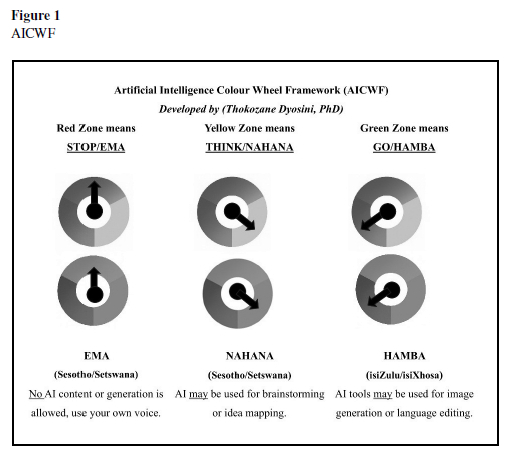
The framework is organised into three zones: Red (Stop), Yellow (Think), and Green (Go), as illustrated in Figure 1. Each of these zones is associated with specific expectations regarding the level of permissible AI involvement. They are intentionally aligned with African linguistic and philosophical concepts, represented through the terms ema (stop), nahana (think), and hamba (go), thereby embedding AI literacy within culturally meaningful epistemological traditions.
Research design and methodology
This research was situated within an interpretivist research paradigm, which assumes that reality is socially constructed, and that meaning is generated through human interaction and lived experience (Thanh & Thanh, 2015). Rather than measuring the effectiveness of the AICWF in a positivist sense, the study sought to understand how pre-service teachers experienced and interpreted the framework within a CODeL environment. The interpretivist stance enabled the researchers to foreground participants' subjective meanings and contextual realities within a South African teacher education setting shaped by particular demographic and social dynamics.
A qualitative research approach was adopted to explore the depth and complexity of students' experiences of integrating the AICWF into their formative and summative assessments. This approach was appropriate because the research aimed to capture rich, descriptive accounts of how students perceived AI-supported learning within a CODeL environment, particularly in relation to autonomy, dialogue, and structure. Rather than producing statistical generalisations, the research prioritised participants' narratives and reflections, allowing patterns and meanings to emerge inductively from their responses.
The research employed a single-case study design, focusing on a second-year module within the Bachelor of Education (Foundation Phase) programme offered at a South African CODeL institution in the Department of Early Childhood Education and Development. This bounded case allowed for an in-depth exploration of how the AICWF operated within a specific pedagogical and institutional context in which all participants were enrolled in the same module and engaged with similar curricular expectations. The target population comprised 5,629 students enrolled in the module.
A total of 131 students voluntarily responded to the study invitation. The demographic profile of participants reflected broader trends in South African ECE teacher education, with the majority (122) identifying as female and the largest racial group as Black, followed by White, Coloured, and Indian students. Purposive sampling was used to select participants who were enrolled in the module, had direct exposure to the AICWF, and were accessible through the institution's learning management system. Participation was voluntary, and the sampling approach prioritised information-rich participants who could provide insight into their lived experiences of AI integration in a CODeL context.
Data were generated through voluntary student responses collected via the institution's learning management system. Participants were invited to reflect on their experiences of using the AICWF in their assessments, and the open-ended nature of the responses enabled students to articulate their personal interpretations, challenges, perceptions of support, and ethical considerations regarding the use of AI in their learning. The data were analysed using thematic analysis as outlined by Braun and Clarke (2006, 2023). The analytical process involved familiarisation with the data, generating initial codes, identifying recurring patterns, developing and refining themes, and constructing a coherent thematic narrative. The analysis followed an inductive approach, allowing themes to emerge from participants' language rather than imposing predetermined categories.
Findings
The AICWF explained in context
The AICWF has been created by the authors as a tool to support the ethical and guided use of AI in a CODeL higher education institution during assessment writing. The Africanisation of this framework was intentionally created to speak to the context of students who are multilingual and multicultural, and also reflects the classrooms they will teach in when they move into the schooling systems as teachers.
The Red zone (Stop/Ema) prohibits the use of AI for generating or manipulating academic content. In this zone, students are required to rely solely on their own knowledge, understanding, and voice. This level prioritises academic honesty by ensuring that foundational competencies such as interpretation, comprehension, and reasoning remain human-centred. The Red zone also reflects the African principle of hlonipha, which emphasises respect, restraint, and wisdom. In this context, hlonipha signifies holding back from technological assistance and honouring the intellectual labour expected in academic tasks. Conceptually, the Red zone serves to strengthen academic integrity, deepen independent learning, and reinforce students' ownership of their academic identities.
The Yellow zone (Think/Nahana) represents a transitional space where students may use AI for brainstorming, refining ideas, clarifying concepts, or mapping out the structure of responses. Importantly, however, AI may not be used to generate final answers. This zone encourages students to engage critically with AI rather than relying on it. It embodies the philosophical tenets of Ubuntu/Botho, which foreground communal dialogue, shared meaning-making, and interdependence. Within this conceptual lens, AI becomes a conversational partner, an intellectual companion used to extend thinking rather than replace it. The Yellow zone thus conceptualises AI as a facilitator of reflective reasoning, promoting collaborative ideation while maintaining clear boundaries that protect originality and authenticity.
The Green Zone (Go/Hamba) permits, and in some cases, requires AI use, particularly for tasks involving image generation, language editing, multimodal design, and digital enhancement. In this zone, AI is positioned as a legitimate tool for creativity, accessibility, and innovation. The Green Zone draws on the African concept of ukwenza izinto ezintsha (creating new things), which connects technological creativity to longstanding traditions of resilience, adaptability, and inventive problem-solving in African communities. Here, AI supports students in producing polished, multimodal outputs and developing essential digital literacy skills aligned with the demands of the 4IR (Sokhulu et al., 2025). The Green zone conceptualises AI as an enabler of expressive capability, helping students transcend linguistic or technological limitations while maintaining ethical transparency through proper citation and acknowledgement.
Combined, the three zones form a coherent conceptual continuum through which students progress: stopping to think independently (Red), pausing to reflect collaboratively (Yellow), and moving forward creatively with AI support (Green). This progression mirrors established cognitive development CODeLs such as Bloom's taxonomy, where learners move from understanding to analysing to creating. The AICWF, therefore, positions learning as both human-centred and digitally enhanced, ensuring that technological tools augment rather than overshadow students' intellectual contributions. It provides a nuanced CODeL for balancing academic integrity with digital innovation, offering clear boundaries while promoting reflective and ethical decision-making.
Within the context of this research, the framework serves as a critical analytical lens for examining how pre-service teachers navigate AI use, assessment expectations, academic honesty, and their own developing professional identities. It illuminates how students interpret institutional guidelines, how they negotiate the tension between independence and technological assistance, and how their cultural contexts shape their engagement with AI tools (Barnard & Cupido, 2025). In addition, Barnard and Cupido highlighted the importance of sharing best practice among teacher educators in higher education in order to better support, understand, and provide epistemological access to students that is culturally responsive to the South African context. Lastly, the incorporation of African values and languages ensures that the framework is not merely a technological instrument but a culturally situated pedagogy that affirms local epistemologies. As such, the AICWF provides both the conceptual and practical structure through which student experiences, challenges, confidence levels, and learning behaviours are interpreted and understood in this research.
Responses to Research Question 1: How has the AI colour wheel framework guided you in completing your first two assessments?
Findings indicate overwhelmingly positive perceptions of the usefulness of the framework. Of the 131 participants, 127 pre-service teachers reported that it was helpful during assessment writing, while only four students indicated that it was not. In addition, 40 participants explicitly used the word "guided" in their open-ended responses, suggesting that students experienced the framework as a form of structured academic scaffolding rather than a compliance mechanism.
One participant explained:
It is an excellent guideline. I hope it will be used in more modules.
Another highlighted its role in structuring cognitive engagement:
To identify and address different aspects of the assessment.
These responses demonstrate that the framework functioned as a cognitive organiser, helping students break down assessment requirements into manageable components. Rather than replacing independent thinking, it clarified expectations and supported task interpretation. This is particularly important in a CODeL environment where ambiguity in assessment criteria may increase anxiety and widen the psychological gap between lecturer and student. Students reported feeling more confident about what was expected of them and how to integrate AI responsibly into their academic work. The framework, therefore, acted as a mediating tool between the lecturer's intention and the students' interpretations.
Importantly, the usefulness reported was not limited to technical AI instruction. Several responses suggested that the framework contributed to greater clarity in academic expectations and strengthened students' ethical awareness regarding the responsible use of AI. It also supported the logical organisation of ideas within assessment tasks and increased students' confidence in navigating academic assessments. Furthermore, it encouraged reflective engagement, prompting students to think more critically about their own learning processes and decision-making when using AI tools. Research by Ceallaigh et al. (2025) stated that there is limited research on higher education institutions' responses to generative AI and pre-service teachers' readiness to adopt these tools.
In this study, the AICWF moved beyond being a regulatory tool and instead became part of students' meaning-making processes. It supported what may be interpreted as emerging professional judgement, which is an essential competency for pre-service teachers who will later guide learners in increasingly digital classrooms (Kölemen & Yıldırım, 2025). The high level of endorsement also suggests that students did not experience the framework as restrictive. Instead, it offered boundaries that enabled responsible creativity. Within a South African higher education context marked by digital inequality and varying levels of AI literacy, such scaffolding appears to provide both structure and access.
Overall, the findings indicate that the AICWF was perceived as a practical assessment guide, a tool for ethical clarity, a scaffold for structured thinking, a mechanism for strengthening academic integrity and a bridge reducing distance in CODeL learning. Moreover, these insights support the argument that AI-enabled curriculum innovation becomes most meaningful when it is accompanied by intentional pedagogical framing, rather than left to informal or unguided student experimentation (Hsu et al., 2025).
Responses to Research Question 2: In what ways has the framework helped you maintain academic integrity in your work?
All 131 participants responded to this question, producing the richest section of data in the study. The findings demonstrate that the AICWF functioned not merely as a compliance mechanism, but as an ethical scaffold shaping students' decision-making, originality, accountability, and professional identity formation.
Clarifying boundaries: Knowing when and how to use AI
A dominant theme emerging directly from Research Question 2 was that the framework established visible and actionable boundaries for AI use. Students repeatedly emphasised that the colour-coded zones clarified when AI was permitted, how it could be used, and when it should not be used. Representative responses included:
It helped me understand when to use AI and when not.
The framework has helped me maintain academic integrity by reminding me to approach my work with honesty, originality, and responsibility.
The Red, Yellow, and Green zones made abstract integrity principles operational. One participant explained:
The questions that are Red Zone don't need AI; Yellow Zone, I could use it sparingly; Green Zone, AI is needed . . . it kept me honest.
These responses indicate that the framework translated institutional policy into pedagogical practice. Within a CODeL environment, where independent study may amplify ambiguity, the colour system provided structured ethical guidance.
Research by Laru et al. (2025) argued that the existing scholarship tends to emphasise the technical dimensions of AI or its practical applications, while comparatively little attention has been given to how AI literacy can be meaningfully integrated into ITE programmes. These findings highlight the research gap that calls for innovation in pedagogical approaches.
Encouraging originality and ownership of voice
A strong theme linked to Research Question 2 was the encouragement of originality and personal accountability. Students consistently described the framework as prompting them to rely on their own understanding rather than copying AI-generated responses, as shown below:
It helped me understand that I need to always use my own understanding.
It guided me to put things in my own words instead of copying.
It helped me keep my answers as original as I can make them.
Notably, one student described intentionally humanising their writing to demonstrate authenticity:
In some cases, intentionally making human mistakes to make it clear that I maintained integrity standards.
This response reveals a heightened awareness of authorship and ethical positioning. Rather than passive AI consumption, students demonstrated metacognitive monitoring of how their work would be perceived. The conceptual framework, therefore, repositioned students as active meaning-makers rather than passive users of generative tools. Integrity became a reflective practice rather than an externally imposed rule. This research examined the relationship between pre-service teachers' AI literacy competencies and their perceptions and attitudes after participating in an AI-focused assessment.
Framing pre-service teachers' digital competence and self-efficacy
According to Heine and König (2025, p. 937) "digital resources may be considered as an aspect of pre-service teachers' professional digital competence." The findings further indicate that students developed greater awareness and increased competence of academic integrity practices when working with AI-supported tools. They demonstrated improved ability to cite sources appropriately, acknowledge the use of AI in their work, paraphrase information responsibly, and clearly distinguish between their own ideas and content derived from external sources. These practices contributed to more transparent and ethically grounded academic writing. Illustrative responses included:
The framework helped me to ensure that my work is properly cited.
By allowing me to use AI, it has also prompted me to be honest about AI usage.
I used AI for brainstorming and guidance . . . and provide a list of references.
However, some students expressed technical uncertainty:
I still have a problem on referencing most of the alphabet tools like ChatGPT, Studocu, and Google as it is required that we use Harvard referencing style.
This reveals a critical implementation gap. While ethical intent was strong, procedural competence, particularly regarding citation of AI tools, remains uneven. The data suggest that explicit, practical referencing workshops may be required to consolidate confidence, which is often supported by ongoing AI awareness and use (Özenoğlu et al., 2026).
Reducing plagiarism and over-reliance on AI
A substantial number of students explicitly connected the framework to plagiarism avoidance and reduced AI dependency. Responses included:
By staying away from plagiarism.
It has helped me use AI responsibly and not depend too much on it.
I no longer rely on AI to do my assignments.
Some students reported moving away from AI almost entirely, while others adopted strategic usage patterns:
I used AI to brainstorm and for language editing not copying and pasting.
By helping me brainstorm ideas and add my thoughts without copying.
These findings indicate that the framework reshaped students' behavioural patterns. Rather than eliminating AI, it recalibrated usage from substitution (AI writing for the student) to augmentation (AI supporting student thinking). This behavioural shift is significant in the context of curriculum transformation. The framework did not function primarily as surveillance but as ethical literacy development.
Gaps and difficulties in application of AI
Although many students reported experiencing no significant challenges, a small number indicated areas of confusion related to the implementation of the framework. These difficulties primarily concerned the interpretation of the different AI Colour Wheel zones, understanding technical referencing conventions, developing advanced paraphrasing skills, and applying the framework consistently across their assessment tasks. These responses suggest that while the framework was generally accessible, some students required additional guidance to fully understand and apply its components effectively, as shown below:
I can include a lack of understanding.
I still have a problem on referencing.
I don't know.
These responses suggest that while the framework is broadly accessible, differentiated support remains necessary. These findings point towards a layered implementation model such as introductory explanation of zones, ongoing examples and modelling, technical referencing support, and feedback loops in early assessments. In addition, Laru et al. (2025) argued that without a strong foundation in AI literacy, teachers may struggle to confidently navigate and integrate emerging technologies into their teaching practices. This lack of preparedness may limit their ability to leverage AI tools effectively in the classroom and could inadvertently contribute to widening existing digital inequalities, thereby restricting learning opportunities for their students. For pre-service teachers, developing an understanding of AI is therefore essential-not only for their own professional growth, but also for equipping learners with the knowledge and skills needed to engage with a future increasingly shaped by AI.
Discussion
The findings of this research are in productive dialogue with the literature review and the conceptual framework. At a macro level, the strong endorsement of the AICWF by the majority of students (127 of 131) speaks directly to UNESCO's (2014) call for practical, context-responsive strategies that strengthen teacher preparation and professional learning in unequal systems. In a South African CODeL context marked by disparities in access, resources, and epistemological support (Fleisch, 2008; Le Grange et al., 2022), students' descriptions of the framework as a "guideline" that "gave direction" suggest that structured, ethically oriented tools could mediate some of the uncertainties and risks associated with AI integration in higher education (Crompton & Burke, 2023; Perera & Lankathilake, 2023). The emphasis students placed on honesty, originality, and responsible use of AI also resonates with literature on assessment and social justice, where what precedes and follows assessment is inseparable from questions of equity, opportunity, and integrity (Le Grange et al., 2022).
The colour zones and explicit instructions around AI use (Red/Yellow/Green) functioned as a form of course structure that reduced ambiguity around assessment expectations, while students' comments about feeling "guided" "reminded" and "kept accountable" demonstrate how the framework enhanced dialogic communication in an otherwise physically and temporally distant CODeL environment (Letsapa, 2025). At the same time, students' reported increases in confidence, their ability to "organise thoughts," and their selective, reflective use of AI indicate a growth in learner autonomy that is consistent with Moore's (1997) claim that well-calibrated structure and dialogue can narrow transactional distance and support self-directed learning.
Conceptually, the AICWF translated these theoretical and policy imperatives into a culturally grounded, metacognitive tool. The three zones: Ema (Stop), Nahana (Think), and Hamba (Go), not only clarified permissible levels of AI involvement, but also embedded African values such as hlonipha, Ubuntu/Botho, and inventive problem-solving into students' ethical reasoning about technology use. Students' reflections on "using my own understanding" "humanising my responses" and "not depending too much on AI" show how the Red and Yellow zones, in particular, supported the development of academic voice and integrity, aligning with calls for AI implementation that centres professional ethics and character formation rather than efficiency alone (Fowler, 2023; Menon & Castrillón, 2019). Simultaneously, students' use of the Green zone for language editing, multimodal design, and creativity echoes scholarship that positions AI as an enabler of digital literacy and multimodal expression when used transparently and critically (Barnard & Cupido, 2025; Sokhulu et al., 2025).
Attitudes towards digital technologies often manifest in observable teaching practices. This relationship is significant because prior experiences with technology frequently shape individuals' future engagement with digital tools (Carrillo et al., 2025). In this regard, the self-efficacy and attitudes of pre-service teachers are particularly important because their exposure to, and experiences with, digital technologies during their studies could strongly influence whether and how they integrate these tools into their future classroom practices (Heine & König, 2025).
Limitations
The low response rate was the main limitation of this research. Although 5,629 students were eligible to participate, only 131 responded. This limited the breadth of perspectives captured, and introduced the possibility of self-selection bias. Students who chose to respond may have been more engaged, more confident, or more positively disposed toward the AICWF.
Ethical considerations
In accordance with McMillan and Schumacher (2014), ethical clearance was obtained from the ethics committee of the selected institution (Ethics Ref #: 2025_RPC_043). Participants were given information letters detailing the purpose of the research, procedures, and their roles in it. They were informed that participation was voluntary, that withdrawal was possible at any time, and that all data would remain confidential and used solely for research purposes. Each participant signed an informed consent form to indicate willingness to participate.
Recommendations
Institutionalise ethical AI frameworks in CODeL and initial teacher education
Initial teacher education institutions should formally integrate structured AI guidance frameworks such as the AICWF into module design and assessment policies. Clear ethical parameters and transparent expectations reduce misuse, strengthen academic integrity, and support responsible AI engagement.
Embed AI within culturally responsive pedagogy
AI integration should be anchored in culturally responsive and contextually relevant teaching practices. Frameworks should reflect South African socio-economic realities and support multilingual, inclusive teacher preparation rather than reproducing digital inequalities.
Conclusion
Combined, the literature on AI in higher education, social justice in assessment, teacher professional development, Moore's (1997) Transactional Distance Theory, and the AICWF converge to demonstrate that meaningful curriculum transformation in CODeL requires more than the adoption of new technologies. The findings show that AI-enabled learning becomes most powerful when it is anchored in ethical responsibility, culturally responsive pedagogies, and intentional support for the development of pre-service teachers' professional identities (Barnard & Cupido, 2025; Carrillo et al., 2025). The AICWF could play a pivotal role in this process by clarifying expectations, strengthening academic integrity, reducing transactional distance, and fostering reflective, independent, and accountable learning behaviours among ECE pre-service teachers. As South African pre-service teachers navigate an increasingly digital and unequal educational landscape (Sokhulu et al., 2025), such frameworks provide both structure and opportunity, ensuring that technological innovation enhances rather than compromises the moral, pedagogical, and social purposes of teacher education. Finally, grounding this work in Ubuntu/Botho affirms that ethical, responsible, and communal ways of learning are central to teacher development, echoing Letseka's (2016) argument that education should honour collective humanity, shared responsibility, and moral purpose.
Disclosure statement
No potential conflict of interest was reported by the authors.
References
Literature review
- Alfaleh, M. (2026). Sustainable AI-driven assessment in higher education: A systematic review of fairness, transparency, pedagogical innovation, and governance. Sustainability, 18(2), 785. https://doi.org/10.3390/su18020785
- Barnard, A., & Cupido, N. (2025). Leveraging artificial intelligence in assessments: Good practices through the Traffic Light Model. Journal of Ethics in Higher Education, 6.1, 71-95. https://doi.org/10.26034/fr.jehe.2025.8334
- Bornschlegl, M., & Caltabiano, N. J. (2022). Increasing accessibility to academic support in higher education for diverse student cohorts. Teaching and Learning Inquiry, 10. https://doi.org/10.20343/teachlearninqu.10.13
- Braun, V., & Clarke, V. (2006). Using thematic analysis in psychology. Qualitative Research in Psychology, 3(2), 77-101. https://doi.org/10.1191/1478088706qp063oa
- Braun, V., & Clarke, V. (2023). Toward good practice in thematic analysis: Avoiding common problems and be(com)ing a knowing researcher. International Journal of Transgender Health, 24(1), 1-6. https://doi.org/10.1080/268952692022.2129597
- Carrillo, C., Flores, M. A., & Mena, J. (2025). Artificial intelligence in the context of teacher education: Emerging themes and critical issues. European Journal of Teacher Education, 48(5), 1143-1162. https://doi.org/10.1080/02619768.2025.2584283
- Ceallaigh, T. J. Ó., O' Brien, E., Tømte, C., Kulaksız, T., & Connolly, C. (2025). Rethinking teacher education in an AI world: Perceptions, readiness and institutional support for generative AI integration. European Journal of Teacher Education, 48(5), 914-933. https://doi.org/10.1080/02619768.2025.2563696
- Chiu, T. K., Z., Ahmad, M., Ismailov, M., & Sanusi, I. T. (2024). What are artificial intelligence literacy and competency? A comprehensive framework to support them. Computers and Education Open, 6:6. https://doi.org/10.1016/j.caeo.2024.100171
- Crompton, H., & Burke, D. (2023). Artificial intelligence in higher education: The state of the field. International Journal of Educational Technology in Higher Education, 20(1), 22. https://doi.org/10.1186/s41239-023-00426-1
- Elsen-Rooney, M. (2023, January 4). NYC education department blocks ChatGPT on school devices, networks. Chalkbeat. https://www.chalkbeat.org/newyork/2023/1/3/23537987/nyc-schools-ban-chatgpt-writing-artificial-intelligence/
- Fleisch, B. (2008). Primary education in crisis: Why South African schoolchildren underachieve in reading and mathematics. Juta & Co.
- Fowler, D. S. (2023). AI in higher education. Journal of Ethics in Higher Education, 3(3), 127-143. https://doi.org/10.26034/fr.jehe.2023.4657
- Gonçalves, B. F., Patrício, M. R., & Mesquita, E. (2025). Challenges of artificial intelligence in teacher training: Perceptions of future teachers. In W. Nong, J.-H. Ye, & X. Yang (Eds.), Construction of a learning society: Theories, experiences and future trends in lifelong learning (Working title). IntechOpen. https://www.intechopen.com/online-first/1239348
- Hsu, C. Y., Chai, C. S., & Liang, J. C. (2025). Assessing structural relationships in pre-service preschool teachers' perceived AI readiness: Do emotional and psychological aspects matter? Australasian Journal of Educational Technology, 41(4), 84-100. https://doi.org/10.14742/ajet.9831
- Ji, Y., Zhong, M., Lyu, S., Li, T., Niu, S., & Zhan, Z. (2025). How does AI literacy affect individual innovative behavior? The mediating role of psychological need satisfaction, creative self-efficacy, and self-regulated learning. Education and Information Technologies, 30(11), 16133-16162. https://doi.org/10.1007/s10639-025-13437-4
- Khoalenyane, N. B., & Ajani, O. A. (2024). A systematic review of artificial intelligence in higher education: South Africa. Social Sciences and Education Research Review, 11(1), 17-26. https://doi.org/10.5281/zenodo.15258127
- Khoza, N. G., & van der Walt, F. (2025). A systematic review on AI-enhanced pedagogies in higher education in the Global South. Frontiers in Education. https://doi.org/10.3389/feduc.2025.1667884
- Kölemen, E. B., & Yıldırım, B. (2025). A new era in early childhood education (ECE): Teachers' opinions on the application of artificial intelligence. Education and Information Technologies, 30(12), 17405-17446. https://doi.org/10.1007/s10639-025-13478-9
- Lalitha, T. B., & Sreeja, P. S. (2020). Personalised self-directed learning recommendation system. Procedia Computer Science, 171, 583-592. https://doi.org/10.1016/j.procs.2020.04.063
- Laru, J., Celik, I., Jokela, I., & Mäkitalo, K. (2025). The antecedents of pre-service teachers' AI literacy: Perceptions about own AI driven applications, attitude towards AI and knowledge in machine learning. European Journal of Teacher Education, 48(5), 964-986. https://doi.org/10.1080/02619768.2025.2535623
- Le Grange, L., Simmonds, S., Maistry, S. M., Blignaut, S., & Ramrathan, L. (2022). Assessment and social justice: Invigorating lines of articulation and lines of flight. Journal of Education, 87, 24-47. https://doi.org/10.17159/2520-9868/i87a02
- Letsapa, M. (2025). Bridging gaps in open distance e-learning: Applying Moore's Transactional Distance Theory to support early childhood care and education students. International Journal of Educational Development in Africa, 10(Supplementary Issue). https://doi.org/10.25159/2312-3540/17243
- Letseka, M. M. (2016). The nexus between open distance learning (ODL), African philosophy and Ubuntu. In M. Letseka (Ed.), Open distance learning (ODL) through the philosophy of Ubuntu (pp. 31-40). Nova Science.
- Madwe, M. C., Chonco, C., & Zungu, A. (2025). Artificial intelligence in higher education assessment: Opportunities, challenges and pedagogical considerations. International Journal of Applied Research in Business and Management, 6(2). https://doi.org/10.51137/wrp.ijarbm.2025.mmaa.45846
- Makumane, M. A., Nkohla, M. B., & Khoza, S. B. (2024). Decolonising educational technology in a pragmatic curriculum: A systematic review. South African Journal of Higher Education, 38(3), 131-149. https://doi.org/10.20853/38-3-6357
- Maphalala, M. C. (2025). Artificial intelligence as a catalyst for self-directed learning in an open and distance e-learning (ODeL) university in South Africa. South African Journal of Education, 45, 1-13. https://doi.org/10.15700/saje.v45ns1a2675
- Mazaherian, A., & Nourbakhsh, E. (2025). Unveiling user perceptions in the generative AI era: A sentiment-driven evaluation of AI educational apps' role in digital transformation of e-teaching. arXiv preprint:2512.11934. https://doi.org/10.48550/arXiv.2512.11934
- McMillan, J. H., & Schumacher, S. (2014). Research in education: Evidence-based inquiry (7th ed.). Pearson.
- Menon, K., & Castrillón, G. (2019). Reimagining curricula for the fourth industrial revolution. The Independent Journal of Teaching and Learning, 14(2), 6-19. https://www.researchgate.net/publication/378695786_Reimagining_curricula_for_the_Fourth_Industrial_Revolution
- Moore, M. G. (1997). Theory of transactional distance. In D. Keegan (Ed.), Theoretical principles of distance education (pp. 22-38). Routledge.
- Mphuthi, G. T., Ngoveni, M. A., & Mphahlele, R. S. (2025). Navigating the digital divide in open distance and e-learning: perspectives from urban and rural student teachers. Interdisciplinary Journal of Education Research, 7(s1), a15-a15. https://doi.org/10.38140/ijer-2025.vol7.s1.15
- Ngoveni, M. (2025). Bridging the AI knowledge gap: The urgent need for AI literacy and institutional support. The International Journal of Technologies in Learning, 32(2), 83. https://doi.org/10.18848/2327-0144/CGP/v32i02/83-100
- Nikolopoulou, K., Rigoutsou, E. -D., & Tzavella, M. -E. (2025). Artificial intelligence and young learners: Interviews with preschool and primary school teachers in Greece. Current Perspectives in Educational Research, 8(2), 43-56. https://doi.org/10.46303/cuper.2025.5
- Önal, N. T., Önal, N., & Ilhan, A. G. (2026). Artificial intelligence in early childhood classrooms: Insights from in-service and pre-service teachers. European Early Childhood Education Research Journal. https://doi.org/10.1080/1350293X.2025.2610619
- Özenoğlu, Y. E., Aydoğdu, F., & Gürsoy, F. (2026). Preschool teachers' artificial intelligence awareness: An experimental study. European Journal of Education, 61(1), e70473. https://doi.org/10.1111/ejed.70473
- Perera, P., & Lankathilaka, M. (2023). AI in higher education: A literature review of ChatGPT and guidelines for responsible implementation. International Journal of Research and Innovation in Social Science, 7(6), 306-314. https://doi.org/10.47772/IJRISS.2023.7623
- Simfa, E., Sprogis, D. K., & Melbardis, M. (2025). The role of human-like AI in effective human-machine communication. Discover Artificial Intelligence, 5(1), 341. https://doi.org/10.1007/s44163-025-00559-4
- Song, X. (2024, November). Exploration of the innovative application of artificial intelligence technology in ideological and political education in colleges and universities. In Proceeding of the 2024 International Conference on Artificial Intelligence and Future Education (pp. 24-28). https://doi.org/10.1145/3708394.3708399
- Thanh, N. C., & Thanh, T. L. (2015). The interconnection between interpretivist paradigm and qualitative methods in education. American Journal of Educational Science, 1(2), 24-27. http://files.aiscience.org/journal/article/html/70380008.html
- UNESCO. (2014). Wanted: Trained teachers to ensure every child's right to primary education (Policy Paper 15/Fact Sheet 30). http://unesdoc.unesco.org/images/0022/002299/229913 E.pdf
- Xu, Z. (2024). AI in education: Enhancing learning experiences and student outcomes. Applied and Computational Engineering, 51(1), 104-111. https://doi.org/10.54254/2755-2721/51/20241187
- Zhou, X., Zhang, J., & Chan, C. (2024). Unveiling students' experiences and perceptions of artificial intelligence usage in higher education. Journal of University Teaching and Learning Practice, 21(6), 126-145. https://doi.org/10.53761/xzjprb23
Accepted: 13 March 2026