Artificial Intelligence in Public Relations and Communication Management: Perspectives of Ghanaian Professionals
Abstract
Artificial intelligence (AI) is presently transforming society and industries with significant implications for the public relations and communication profession. However, scholarship on this subject in Africa is lacking. This paper addresses this gap by investigating AI in the public relations and communication management industry in Ghana. It focuses on the knowledge, adoption, and impact of AI, as well as the perceived risks and challenges associated with the application of AI. The study used the quantitative method to gather data from 275 professionals. Results revealed that professionals have a limited understanding of AI despite their knowledge of the concept. Communication professionals believe AI will impact the profession, their department, and how they work. However, they did not foresee any challenges or risks associated with applying AI (e.g. competency in using AI, motivation to use AI, and loss of jobs). The result points to the need for professionals to increase their knowledge and understanding of AI. There is also the need for public relations scholars in Ghana, and Africa for that matter, to begin having serious discussions on this issue.
Artificial Intelligence; AI opportunities; AI risks; digital technology; Ghana; public relations and communication management
INTRODUCTION
Artificial Intelligence (AI), defined as "a system's ability to correctly interpret external data, to learn from such data, and to use those learnings to achieve specific goals and tasks through flexible adaptation" (Kaplan & Haenlein 2019: 3), is rapidly becoming a critical tool for organisational decision-making and is steadily being incorporated into modern working life, sometimes without people realising it. AI is enhancing people's capacities while actively directing and moulding them in several industries, including healthcare, transportation, education, finance, research, and manufacturing. Presently, industries use AI and machine learning technology for varied reasons, including improving capabilities, increasing market share and revenues, maintaining sales records, gathering customer or product information, developing effective business strategies, and creating numerous news stories cheaply, efficiently, and most likely with fewer errors than a human journalist (Turksoy, 2022: 395). AI also plays fundamental roles in individual lives. AI virtual assistants such as Alexa, Siri, Google Assistant, and Cortana assist people with routine tasks such as setting reminders, making recommendations, placing events on their calendars, and booking tickets (Lopez & Ouariachi, 2021:249).
Like other disciplines, AI is transforming the public relations and communication profession (Cheng & Jiang, 2021; Soriano & Valdes, 2021). Globally, there has been growth in, and adoption of digital communication technologies for various applications and purposes. The public relations and communication industry already highlights several possible AI applications, ranging from analytics to targeting, from content creation to chatbots, and from evaluation routines to strategy development and crisis communication (Petrucci, 2018). Scholars assert that AI attributes like conversational tone, responsiveness, and social presence may affect user engagement or satisfaction (Cheng & Jiang, 2020 a,b; Jiang et al., 2022). These attributes may also have an impact on organisation-public relationships. According to Panda et al. (2019: 197), using AI tools to develop tailored messages could help public relations professionals to perform more efficiently. Brown-Devlin et al. (2022: 1) opine that AI is influencing PR and communication techniques, such as social media monitoring and posting during crises, and that these changes could result in successful outcomes such as increased measures of organisational reputation. Generative AI tools, such as ChatGPT, Jasper AI, Midjourney, and Synthesia, are a few examples of the ever-increasing number of AI technologies that can produce images and videos from written instructions and scripts. There are currently hundreds, if not thousands, of AI tools, services, browser extensions, and usage cases. This number is expected to increase in the upcoming years (Chartered Institute of Public Relations, CIPR, 2023: 12). Extant literature has highlighted the implications of AI on the public relations and communication profession, including the possible risks and challenges (Galloway & Swiatek, 2018; Liew, 2021; Moreno et al., 2015; Yaxley, 2018).
Although new technologies such as AI are transforming the public relations and communication profession, there is very little empirical research on AI's influence on the profession (Galloway & Swiateck, 2018: 735; Zerfass et al., 2020). Recent research has shown that professionals lack adequate knowledge about the concept and its application in communication (see Centre for Strategic Communication Excellence report, 2019; USC global report, 2019; Zerfass et al., 2020). Additionally, difficulties, including anxiety over AI, disinformation or misinformation, and privacy or risk concerns, have regularly surfaced (Prahl & Goh, 2021). The situation appears worse from an African, and specifically Ghanaian, perspective. Granted that recent years have seen a rapid growth of digital technology applications in Africa, but there is a lack of information on the knowledge and adoption of AI in public relations and communication management on the continent. In contrast, literature from the global north shows a change regarding AI scholarship (Pavilik, 2007; Tilson, 2017; Yaxley, 2018). This leaves a gap that needs to be filled if African public relations and communication professionals want to contribute meaningfully to the global discussion.
This paper contributes to the knowledge on the subject from the perspective of Ghana. It examines public relations practitioners' knowledge and understanding of AI, the extent to which they have adopted AI, and perceptions of the risks and challenges associated with using AI in PR.
Overview of artificial intelligence (AI)
Artificial Intelligence (AI) has been defined variously from different perspectives, especially since the concept was first mooted in 1956 (Press, 2016). Definitions of AI include "is concerned with intelligent behavior in artifacts" that consists of "perception, reasoning, learning, communicating, and acting in complex environments" (Nilsson, 1998:1); "computational agents that act intelligently" (Poole & Mackworth, 2017: 3); "a sophisticated application of technology whereby a machine demonstrates human cognitive functions such as learning, analysis and problem solving" (Valin, 2018: 5); "a branch of computer science that studies the phenomena that occur when computers perform tasks that, if performed by humans, would be regarded as requiring intelligence" (Maldonado, 2020:2); and "the replication of human intelligence by technologies intended to think and behave like humans" (CIPR, 2023:6).
Within the context of public relations, Galloway and Swiatek (2018:735) defined AI as "technologies showing humanoid cognitive abilities and performing humanoid functions in undertaking public relations activities, independently or together with public relations practitioners." In its simplest form, AI is conceptualised as the capability of computers to operate intelligently. In other words, AI can partly replicate the abilities of the human mind, such as learning and problem-solving. This means it partially copies the capabilities of the human mind, such as learning and solving problems. After reviewing various conceptualisations of AI, the definition provided by Zerfass et al. (2020:379) is adopted for this study:
Flexible decision-making processes and actions of software-driven agents. They adapt to changing goals and unpredictable situations, learn from experience, aim for rationality, but also carry on in spite of perceptual and computational limitations. AI is based on technologies like natural language processing, data retrieval and knowledge representation, semantic reasoning, and machine learning.
AI has a variety of classifications, including narrow or weak, designed to perform specific tasks, and general and strong, which can accomplish any intellectual assignment that humans can (Kaplan & Haenlein, 2019). There are various AI tools, from the simple to the complex, ranging from chatbots that reply to consumer enquiries to self-driving automobiles. The CIPR, for instance, identified over 120 AI tools and characterised them on a five-point scale based on their function and complexity: simplification (e.g. database, wire service), social listening and monitoring (e.g. Brandwatch, Talkwalker), automation of tasks (e.g. IFFT, open data formats), AI for structured data (e.g. Google Analytics, Newswhip), and AI for unstructured data (e.g. IQ Bot, Quid), ( Valin, 2018:5).
Research on AI aims to develop systems capable of executing activities that ordinarily require human intellect. But what does all this mean for public relations and communication management?
AI in public relations and communication management
AI is gradually gaining traction in the public relations and communication industry as communication professionals and scholars have begun to acknowledge its productive potential (Panda et al., 2019: 198). Despite this, the application of AI in public relations and communication has received little attention. Discussion on this subject can be found in a few industry magazine reports, blogs, and a handful of empirical studies (CIPR, 2023; Galloway & Swiatek, 2018; Maldonado, 2020; Panda et al., 2019; Valin, 2018; Wiesenberg & Tench, 2020; Zerfass et al., 2020). While most of the discussions have centred on the benefits of AI to the profession, others have looked at the potential challenges and risks associated with it. According to the CIPR (2023:11), whereas some view AI as an opportunity to enhance public relations practices, others have discarded it as nothing more than a gimmick.
Regardless of the disagreement, there is general consensus among professionals and scholars that AI will redefine and reshape the public relations and communication industry. Whitaker (2017), for example, acknowledges AI's relevance in assisting public relations organisations in processing data more quickly and enhancing the quality of their services. In other words, professionals can now process massive amounts of data much faster than before. Murr (2022) also posits that knowledge and usage of AI will enhance the ability of public relations professionals to fine-tune their messages for their target audience and gather audiences' digital footprints, i.e. summarise likes and dislikes, posts they like, websites they enjoy, and other personal characteristics.
Similarly, Penn (in Maldonado, 2020: 3) identified three main benefits of AI to the profession:
a. Automation: public relations professionals can now automate repetitive tasks like media monitoring. Aside from taking over some of the tasks on the busy schedules of practitioners, automation is also enhancing the ability of practitioners to gain insight in a matter of seconds.
b. Acceleration: practitioners can gain real-time information from the digital environment. For instance, when events occur quickly, AI can assist in gathering and sorting information in less time than it would usually take.
c. Accuracy: practitioners can now accurately measure consumers' opinions and sentiments about an organisation and juxtapose them with other measures such as stock price, engagement or sales.
According to Maldonado (2020: 3), new skills such as user experience, big data analytics, and predictive artificial intelligence are necessary for public relations to compete with advertising and marketing and demonstrate its worth and effectiveness. Conversely, having "cheaper, faster, and better access to relevant information is giving PR professionals the ability to focus on other activities such as creative thinking, strategic planning and instincts" which are all critical characteristics that a machine does not have. Other articles and studies have demonstrated the benefits of AI to public relations and communication (e.g. Arief & Gustomo, 2020; Brotman, 2020; Brown-Devlin et al., 2022; USC Global Communication Report, 2019; Lopez & Ouariachi, 2021; Liew, 2021). Brotman (2020), for instance, asserts that AI enhances productivity by optimising and automating repetitive processes, including monitoring news and social media, analysing trends, evaluating campaign performance, and reporting outcomes. Arief and Gustomo (2020) posit that AI enables users of big data to employ more advanced analytics, encompassing both predictive and descriptive skills, while also streamlining tasks.
Notwithstanding the supposed benefits, several concerns have emerged around the subject, in particular issues such as implicit prejudice, power shifts to those with the resources to use AI, exclusion, and job losses (CIPR, 2021; Liew, 2021; Galloway & Swiatek, 2018).
Valin (2018: 7) found that AI could complement or replace 12% (out of 52 skills) of a public relations professional's overall capabilities at the time of the study, with a projection that this is likely to increase to 38% by 2023. However, Tredinnick (2017) suggests that the biggest issue that AI may present in the next decades has less to do with the replacement of professional responsibilities and more to do with the threat to communication practitioners' roles, as the professional identities and existing professional bodies of knowledge are eroded.
Despite the threat of job losses, Valin (2018) found that 32% (out of 52 skills) did not require any technical support, while 27% could benefit from minor AI applications to help in decision-making or deep analysis. However, 59% of human skills, such as trust, empathy, humour, and relationship building, cannot be replaced by AI. In essence, "Humans [are] still needed" (Valin (2018: 3). Other discussions have corroborated this (e.g. Maldonado, 2020; Liew, 2021; Lopez & Ouariachi, 2021).
One key challenge that has often been raised is the lack of understanding about AI in the public relations and communication industry. According to the CIPR (2021:3), a substantial percentage (43%) of practitioners have insufficient knowledge of AI and lack confidence in employing it, with just a fraction (13.9%) feeling "very comfortable" with it. Niederhauser and Rosenberger (2018) also found that only 3% of chief communication officers in Switzerland used AI technologies. Other studies have reported similar results (Global Communications Report, 2019; Lopez & Ouariachi, 2021; Zerfass et al., 2020).
The application of AI tools is not without its hurdles and challenges. Ultimately, how AI is perceived and the implications for the public relations and communication industry in Ghana will depend on how well the concept and tools are understood. One can assume that professionals' lack of expertise and the scarcity of scholarship on the subject have resulted in a lack of knowledge and understanding among public relations professionals. It will, therefore, be essential to address the gap in the literature by exploring the knowledge and adoption of AI tools, as well as the perceived challenges and risks associated with AI. As the problem statement notes, there is a lack of empirical literature on AI and public relations in Africa. This paper, part of similar studies across Africa for this special edition of Communicare, will contribute to the body of knowledge on the subject from a Ghanaian perspective. The study will address these issues using the following research questions:
RQ1: What do public relations professionals in Ghana know about artificial ilntelligence (AI), and to what extent are they already using AI technologies in their daily lives?
RQ2: How do public relations professionals assess the impact of AI on the profession?
RQ3: What challenges do professionals perceive when applying AI to public relations and communication?
RQ4: What risks do professionals associate with AI in public relations and communication?
METHODOLOGY
The study used the quantitative survey method to gather data from 275 public relations and communication professionals. Two methods were followed in gathering the data: online and personal administration. For the online method, a link to a Google form was sent to professionals whose email addresses the authors had. Secondly, questionnaires were distributed in person to professionals who were given time to fill them in, after which the authors returned to pick them up. The online format allowed the researchers to gather data from many parts of the country. The reason for including the physical (in person) data gathering is that online data gathering in Ghana tends to be extremely difficult. Respondents tend to ignore such messages or requests; hence, in-person data administration was deemed essential to enable the researchers to gather as much data as possible. The data-gathering process used two sampling methods: the convenience sampling technique and the snowball sampling technique. Convenience sampling was used because the practitioners were readily available to the researchers (Bryman & Bell, 2019). Respondents were selected from a database of practitioners gathered by the researchers over the years. The snowball technique was also used because the database was inadequate. Practitioners known to the researchers assisted in recruiting other practitioners through recommendations (Bryman & Bell, 2019).
Instrument
The instrument used for the research was adopted from the literature and adapted to fit the context of the current study (European Communication Monitor, 2019; Zerfass et al., 2020). The survey instrument consisted of five questions covering AI, excluding the demographic questions. Assessment of the impact that AI will have on the profession, department or agency practitioners work in, and the way practitioners personally work was determined using a 5-point Likert scale ranging from 1 = very low impact to 5 = very high impact. Knowledge of AI was measured with a definitional question, which was presented using eight features of AI (four correct and four incorrect). Respondents were then asked to select those they perceived as being valid. The correct definition was later presented. Challenges professionals identify for implementing AI were measured with six items using a 5-point Likert scale (1 = not likely to 5 = very likely). Perceived risk for using AI was also measured with six items on a 5-point Likert scale (1 = not likely to 5 = very likely). Finally, respondents were asked about their usage of AI assistants and devices on their smartphones and in their workplaces and homes.
Respondents
The respondents were public relations and communication professionals with varied experience. Overall, 275 respondents completed the survey, consisting of 51% males (N = 141) and 49% females (N = 134). The average age of respondents was 35 years. Over half (N = 143, 52%) had a Master's degree, with 42% (N = 115) holding a Bachelor's degree, and the rest had a Diploma (N = 14, 5%) and a PhD (N = 3, 1%) respectively. Respondents worked in various sectors, including private/corporate organisations (N = 113, 41%), government/public service (N = 104, 38%), agency/consultancy (N = 36, 13%), and non-profit organisations (N = 22, 8%). Additionally, 51% (N = 141) served as team/unit heads in their organisations, with 25% (N = 68) and 24% (N = 66) being heads of public relations/communications and officers/team members, respectively. Respondents mentioned overall public relations/communication (N = 115, 96.2%), media relations/press spokesperson (N = 89, 81.7%), internal communication, change (N = 61, 56%), online communication (N = 57, 52.3%), marketing, brand, consumer communication (N = 46, 42.2%), and corporate media, public relations (N = 42, 38.5%) as their dominant areas of work (respondents were asked to select three among several activities).
Analysis
The data were analysed using the Statistical Package for the Social Sciences (SPSS version 24). The analysis consisted of both descriptive and inferential statistics.
RESULT
The findings are categorised based on the research questions.
RQ1: Knowledge and adoption of Artificial Intelligence
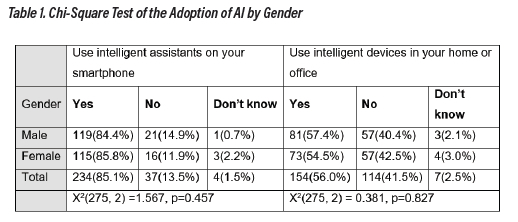
From the result, most respondents can be categorised as AI adopters, indicating that they use intelligent assistants on their smartphones (85%) and intelligent devices in their homes or offices (56%). A chi-square test was done to determine whether there was any significant link between gender and the adoption of AI. The result revealed that the use of intelligent assistants on smartphones and intelligent devices in the home or office was not dependent on the gender of participants. Expressly, the two had no significant link (Table 1).
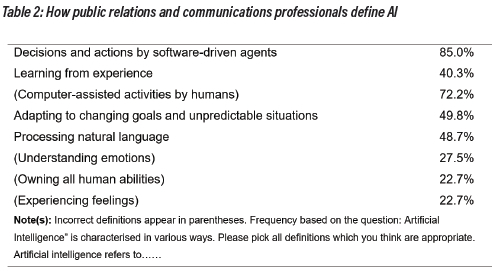
The respondents were asked to evaluate eight different statements to see if they understood what AI was about. Four were correct and four were incorrect. In total, 59.8% of the respondents accurately classified the definitions, while 40.2% selected the incorrect definitions (Table 2). From the result, it can be concluded that professionals do not fully understand the concept of AI.
RQ2: Impact of Al on public relations and communication management
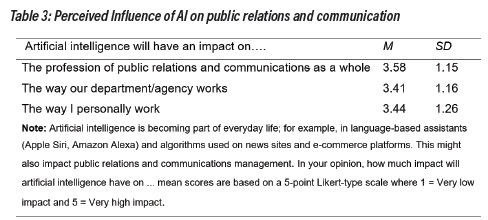
Professionals in Ghana believe that AI will influence the public relations and communication profession as a whole (M = 3.58, SD = 1.15), the way their department/agency works (M = 3.41, SD = 1.16) and the way they personally work (M = 3.44, SD 1.26) (Table 3). This means despite their limited understanding, professionals do realise the impact of AI on the industry.
RQ3: Challenges in implementing AI in public relations and communication
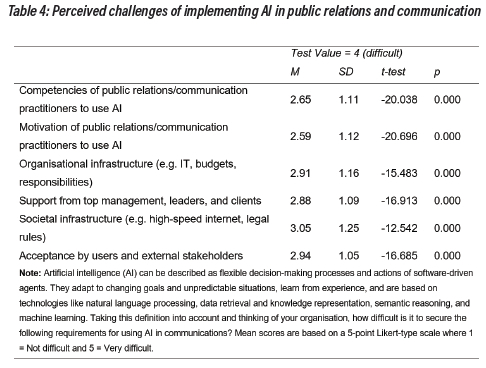
A key component of the research was to determine the perceived challenges when implementing AI in public relations and communication. A one-sample t-test showed that professionals did not feel that applying AI in public relations and communication would pose problems. In essence, professionals are aware of how AI is transforming industries and society as a whole but believe that requirements such as competencies/skills (76.7%), motivation (77.5%), organisational infrastructure (66.9%), management support (72.7%), societal infrastructure (61.1%), and user acceptance (72.7%) would not be difficult to obtain (Table 4). This is noteworthy and perhaps unsurprising given how the world is moving and the fact that AI is the present and the future.
RQ4: Risk of bringing AI into pubiic reiations and communication
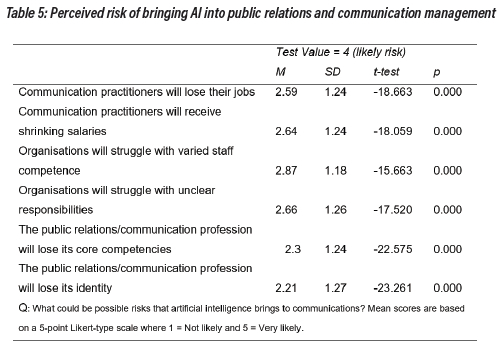
A one-sample t-test demonstrates that professionals do not believe AI poses any risk to their jobs (73.5%), salaries (73.5%), staff competence (69.5%), responsibilities (71.3%), core competencies (80%), and identity (80%). (Table 5). Respondents demonstrated confidence in their ability to remain relevant despite the ongoing technological evolution. The low mean ratings significantly differ from the test value of 4 and are quite remarkable.
DISCUSSION AND CONCLUSION
The impact of AI on the public relations and communication profession has been highlighted several times in literature. These have mostly been in terms of papers and essays. The few empirical studies available have examined professionals' knowledge and understanding, skills, challenges, and the adoption of AI (see literature review). Although public relations and communication professionals acknowledged awareness and some level of understanding of AI, the overall result, as depicted in the low mean scores, especially for the possible challenges and risks in the implementation and bringing of AI to public relations and communication, demonstrate that professionals do not fully understand AI and its implications. This is inconsistent with previous findings and literature (e.g., CIPR 2021; USC Global Communication Report, 2019; Lopez & Ouariachi, 2021; Zerfass et al., 2020). For example, whereas competencies of communication practitioners (M = 3.58, SD = 1.04) and organisational infrastructure (M = 3.54, SD = 1.15) were found to be key challenges for implementing AI in public relations activities by Zerfass et al. (2020), the present study demonstrated the opposite - (M = 2.65, SD= 1.11) and (M = 2.91, SD = 1.16) respectively. Regarding AI risks, responses also varied significantly from Zerfass et al. (2020).
Given that AI and its implications on public relations and communication in Ghana is a topic that is rarely discussed by the industry and even academia, one is inclined to believe that professionals and academics have not made an effort to examine the issue. Indeed, discussions by the corresponding author with some top public relations professionals (personal communication, March - April 2023) revealed that professionals are aware of AI and some of its implications for the industry. However, they do not fully comprehend AI's impact, challenges, and risks as they have not paid much attention to it. Again, some professionals believe it will take time before the impact of AI is truly felt in the industry in Ghana. Others were of the view that because of the interpersonal nature of communication in Ghana and Africa in general (see, e.g., Anani-Bossman & Tandoh, 2023), professionals will still be needed to interact with stakeholders - a view already postulated by Valin (2018) and Maldonado (2020). This view by the respondents aligns with the assertion by some that AI is nothing more than a "gimmick" (CIPR, 2023).
An essential aspect of the findings is the assertion by professionals that issues such as organisational infrastructure (e.g. IT, budgets) and societal infrastructure (e.g., high-speed internet) will not be a challenge. Even though information and communication technology (ICT) infrastructure has expanded rapidly (especially during and post-Covid 19) in Africa, there are still challenges with bandwidth/internet speed, data costs, and penetration (Gopaldas, 2021; International Telecommunication Union, 2021). The ability to use AI tools successfully will depend on several things, including organisational and societal infrastructure, which is clearly a problem in Ghana and Africa (ITU, 2021; Skinner, 2013). It must be pointed out that legal rules and, to some extent, internet speed may not necessarily be prerequisites for applying AI to PR successfully. This, nevertheless, does not mean that they are not needed, especially in an environment where internet usage is problematic.
Insight so far shows the need for public relations and communication professionals in Ghana to start familiarising themselves with AI. Clearly, professionals have not completely grasped the full implications of AI on their work and how the infrastructural challenges (organisational and societal) can negatively affect the successful deployment of AI tools. The limited knowledge means professionals must begin to pay attention to AI's disruption within the public relations environment by making a deliberate effort to educate themselves. There are several AI tools that can enhance the work of professionals. However, as Zerfass et al. (2020: 386) argued, the use of AI-based devices in daily life does not make one an expert; hence, one should carefully assess the "learning by doing" approach. This also aligns with Galloway and Swiatek (2018:734) advocating for professionals to gain sufficient knowledge and understanding of AI and its potential uses without necessarily becoming "expert technologists'! Although AI is unlikely to mimic every aspect of human behaviour, such as emotion and empathy, it does not prevent practitioners from becoming "masters of the data" (Zerfass et al., 2020: 386). The conversation can start with the national association, the Institute of Public Relations (IPR, Ghana). Through the association, practitioners are likely to start focusing on AI.
Education should not be limited only to professionals. Public relations and communication educators must also start focusing on how to engage their students on AI and its impact on the profession. For that to happen, educators must have adequate knowledge and understanding of AI. This means undertaking certificate courses to further understand the concept and how to apply it. The ability of educators to impart relevant knowledge to the next generation of professionals would depend on the systematic effort to learn about AI. Of course, this does not mean educators must necessarily become technological experts overnight.
LIMITATIONS AND IMPLICATIONS FOR FUTURE RESEARCHGiven that this research is the first of its kind in Ghana (at least as far as the authors of this article are aware), it has some limitations. First, the authors could not gather comprehensive data nationwide due to the lack of response from most professionals invited to participate in the study, leading to a smaller sample. The result can, therefore, not be seen as an accurate representation of public relations practice in Ghana. The study also did not fully analyse the extent of knowledge and understanding of AI, AI tools, programs, systems, and the most relevant skills.
Overall, the study presents an initial appreciation of the knowledge and adoption of AI in public relations and communication management in Ghana. Future research can, therefore, broaden this research and make it nationwide. A future study could also use a mixed-method approach to determine whether quantitative results align with qualitative results. This is especially essential in light of the outcome of informal interactions with communication professionals.
REFERENCES
LITERATURE REVIEW
- Anani-Bossman, A. & Tandoh, I. (2023). Towards a framework for public relations scholarship and practice in Africa: a globalisation perspective. Corporate Communications: An International Journal, 28(1): 48-67.
-
Arief, N. N., & Gustomo, A. (2020). Analyzing the Impact of Big Data and Artificial Intelligence on the Communications Profession: A Case Study on Public Relations (PR) Practitioners in Indonesia. International Journal on Advanced Science, Engineering and Information Technology, 10(3), 1066-1071. https://doi.org/10.18517/ijaseit.10.3.11821
» https://doi.org/10.18517/ijaseit.10.3.11821 -
Brotman, G. (2020). AI in PR - fact, fiction and the future. [online] 2020 Relevance Report. USC Annenberg Center for Public Relations, pp.52-53. Available from https://assets.uscannenberg.org/docs/relevance-report-2020.pdf
» https://assets.uscannenberg.org/docs/relevance-report-2020.pdf - Brown-Devlin, N., Lim, H. S., & Tao, J. (2022). Examining the influence of algorithmic message personalisation on source credibility and reputation. International Journal of Business Communication, 0(0):1-24
- Bryman, A. & Bell, E. (2019). Social Research Methods. 5th ed. Oxford University Press.
-
Chartered Institute of Public Relations (CIPR, 2023). Artificial Intelligence (AI) tools and the impact on public relations (PR) practice. Available from: https://www.cipr.co.uk/CIPR/Our_work/Policy/AI_in_PR_/AI_in_PR_guides.aspx
» https://www.cipr.co.uk/CIPR/Our_work/Policy/AI_in_PR_/AI_in_PR_guides.aspx -
Chartered Institute of Public Relations (CIPR, 2021). The AI and Big Data readiness report: Assess the public relations profession's preparedness for an AI future. Available from https://www.cipr.co.uk/CIPR/Our_work/Policy/AI_in_PR_/AI_in_PR_guides.aspx
» https://www.cipr.co.uk/CIPR/Our_work/Policy/AI_in_PR_/AI_in_PR_guides.aspx -
Centre for Strategic Communication Excellence (2019). Communicating AI: Building the Playbook 2019 - CSCE. [online] Available from https://thecsce.com/resources/communicating-ai-building-the-playbook-2019/
» https://thecsce.com/resources/communicating-ai-building-the-playbook-2019/ - Cheng, Y., & Jiang, H. (2021). Customer-brand relationship in the era of artificial intelligence: Understanding the role of chatbot marketing efforts. Journal of Product and Brand Management, 31(2): 252-264.
- Cheng, Y., & Jiang, H. (2020a). How do AI-driven chatbots impact user experience? Examining gratifications, perceived privacy risk, satisfaction, loyalty, and continued use. Journal of Broadcasting and Electronic Media, 65(4): 592-614.
- Cheng, Y., & Jiang, H. (2020b). AI-powered mental health chatbots: Examining users' motivations, active communicative action, and engagement after mass-shooting disasters. Journal of Contingencies and Crisis Management, 28, 339-354.
-
European Communication Monitor (2019). Exploring trust in the profession, transparency, artificial intelligence and new content strategies. Available from https://www.communicationmonitor.eu/2019/05/23/ecm-european-communication-monitor-2019/
» https://www.communicationmonitor.eu/2019/05/23/ecm-european-communication-monitor-2019/ - Galloway, C. & Swiatek, L. (2018)., Public relations and artificial intelligence: it's not (just) about robots, Public Relations Review, 44(5): 734-740.
-
Gopaldas, R. (2021). The challenges and opportunities of bridging Africa's digital divide.https://www.ntu.edu.sg/cas/news-events/news/details/the-challenges-and-opportunities-of-bridging-the-africa-s-digital-divide
» https://www.ntu.edu.sg/cas/news-events/news/details/the-challenges-and-opportunities-of-bridging-the-africa-s-digital-divide -
International Telecommunication Union (2021). Digital trends in Africa: Information and communication technology trends and developments in the Africa region 2017-2020. ITU publications -Africa. Available from:https://www.itu.int/dms_pub/itu-d/opb/ind/D-IND-DIG_TRENDS_AFR.01-2021-PDF-E.pdf
» https://www.itu.int/dms_pub/itu-d/opb/ind/D-IND-DIG_TRENDS_AFR.01-2021-PDF-E.pdf - Jiang, H., Cheng, Y., Park, K-Y., & Gao, S. B. (2022). AI-powered chatbot communication with customers: Dialogic interactions, satisfaction, engagement, and customer behavior. Computers in Human Behavior. 134 (3):107329
- Kaplan, A. & Haenlein, M. (2019). Siri, Siri, in my hand: Who's the fairest in the land? On the interpretations, illustrations, and implications of artificial intelligence. Business Horizons, 62(1), pp.1-11.
- Liew, F.E.E. (2021). Artificial intelligence disruption in public relations: A blessing or a challenge? Journal of Digital Marketing and Communication. 1(1): 24-28.
- López, E.A. & Ouariachi, T. (2020). An exploration of the impact of artificial intelligence (AI) and automation for communication professionals, Journal of Information, Communication and Ethics in Society, 19(2): 249-267.
-
Maldonado, M. (2020). AI in PR: The conversation has just begun. Available from https://instituteforpr.org/ai-in-pr-the-conversation-has-just-begun/
» https://instituteforpr.org/ai-in-pr-the-conversation-has-just-begun/ - Moreno, A., Navarro, C., Tench, R., & Zerfass, A. (2015). Does social media usage matter? An analysis of online practices and digital media perceptions of communication practitioners in Europe. Public Relations Review, 41(2): 242-253.
-
Murr, R. (2022). How artificial intelligence has been transforming public relations. Available from: https://www.prvalues.com/post/how-artificial-intelligence-has-been-transforming-public-relations
» https://www.prvalues.com/post/how-artificial-intelligence-has-been-transforming-public-relations - Niederhauser, M. & Rosenberger, N. (2018), ). Kommunikation in der digitalen Transformation:Bestandsaufnahme und Entwicklungsbedarf des strategischen Kommunikationsmanagements von Wirtschaftsunternehmen, Verwaltungen und Non-Profit-Organisationen in der Schweiz, Working Paper, ZHAW Zurcher Hochschule fur Angewandte Wissenschaften, Winterthur, CH
- Nilsson, N.J. (1998). Artificial Intelligence: A New Synthesis, San Francisco, Morgan Kaufmann.
- Panda, G., Upadhyay, A. K., & Khandelwal, K. (2019). Artificial intelligence: A strategic disruption in public relations. Journal of Creative Communications, 14(3): 196-213.
-
Pavlik, K. V. (2007). Mapping the consequences of technology on public relations. September. Available from: Institute for Public Relationshttp://citeseerx.ist.psu.edu/viewdoc/download?doi=10.1.1.129.6285&rep=rep1&type=pdf.
» http://citeseerx.ist.psu.edu/viewdoc/download?doi=10.1.1.129.6285&rep=rep1&type=pdf -
Petrucci, A. (2018). How artificial intelligence will impact corporate communications. Available from: https://www.forbes.com/sites/forbescommunicationscouncil/2018/04/20/how-artificial-intelligencewill-impact-corporate-communications/#2f69b54b1dc6
» https://www.forbes.com/sites/forbescommunicationscouncil/2018/04/20/how-artificial-intelligencewill-impact-corporate-communications/#2f69b54b1dc6 - Poole, D.L. & Mackworth, AK (2017). Artificial Intelligence: Foundations of Computational Agents, New York, Oxford University Press
- Prahl, A., & Goh, W. (2021). Rogue machines and crisis communication: When AI fails, how do companies publicly respond? Public Relations Review, 47(4).
-
Press, G. (2016). Artificial intelligence defined as a new research discipline: This week in tech history. Available from: https://www.forbes.com/sites/gilpress/2016/08/28/artificial-intelligence-defined-as-a-new-research-discipline-this-week-in-tech-history/#64ab9d656dd1.
» https://www.forbes.com/sites/gilpress/2016/08/28/artificial-intelligence-defined-as-a-new-research-discipline-this-week-in-tech-history/#64ab9d656dd1 - Skinner, C.J. (2013). Africa, Practice of Public Relations in. In: R.L. Heath, ed., Encyclopedia of Public Relations. Sage, pp.15-19.
- Soriano, A. & Valdés, R. (2021). Engaging universe 4.0: The case for forming a public relations-strategic intelligence hybrid. Public Relations Review, 47(2).
- Tilson, D.J. (2017). From the natural world to artificial intelligence: public relations as convenantal stewardship. In B.R. Brunner (ed). The moral compass of public relations, New York: Routledge. 206-222.
- Tredinnick, L. (2017). Artificial intelligence and professional roles, Business Information Review, 34(1)37-41.
- Turksoy, N. (2022). The future of public relations, advertising and journalism: How artificial intelligence may transform the communication profession and why society should care. Turkey Review of Communication Studies. 40: 394-410.
-
USC Annenberg Center for public relations Global Communication Report (2019). PR:Tech. The future of technology in communication. Available from: https://assets.uscannenberg.org/docs/2019-global-communications-report.pdf
» https://assets.uscannenberg.org/docs/2019-global-communications-report.pdf -
Valin, J. (2018), Humans Still Needed: An Analysis of Skills and Tools in Public Relations, Chartered Institute of Public Relations. https://www.cipr.co.uk/CIPR/Our_work/Policy/AI_in_PR_/AI_in_PR_guides.aspx
» https://www.cipr.co.uk/CIPR/Our_work/Policy/AI_in_PR_/AI_in_PR_guides.aspx -
Whitaker, A (2017). How advancements In artificial intelligence will impact public relations. Available from https://www.forbes.com/sites/theyec/2017/03/20/how-advancements-in-artificial-intelligence-will-impact-public-relations/?sh=2452eeeb41de
» https://www.forbes.com/sites/theyec/2017/03/20/how-advancements-in-artificial-intelligence-will-impact-public-relations/?sh=2452eeeb41de - Wiesenberg, M. and Tench, R. (2020). Deep strategic mediatisation: organisational leaders' knowledge and usage of social bots in an era of disinformation. International Journal of Information Management, 51: 102042,
- Yaxley, H. (2018). Outro. In A. Theaker & H. Yaxley (eds.), The public relations strategic toolkit: An essential guide to successful public relations practice. London: Routledge. 147-150.
- Zerfass, A., Hagelstein, J., & Tench, R. (2020). Artificial intelligence in communication management: A cross-national study on adoption and knowledge, impact, challenges and risks. Journal of Communication Management. 24(4), pp 377-389
Accepted February 2024