Theory vs Practice: Perceptions of Professionalisation in Strategic Communication Education
Abstract
This research examines the professionalisation of strategic communication as a teaching discipline by exploring perceived tensions within the subject. Higher education is a "battleground" for both professions and would-be professions, and the study offers a deeper understanding of the dynamic tensions shaping the professionalisation process of this discipline. However, there has been limited research in this area within strategic communication. This study is based on qualitative interviews with 25 programme directors of international master's programmes and leading academics from various parts of the world. The empirical findings show that the interviewees perceive the tension between theory and practice as crucial. Some educational programmes prioritise theory to provide students with a profound understanding of fundamental principles, whereas others emphasise practice to enhance employability and practical skills. The study shows that the perceived dichotomy theory and practice in master's programmes is oversimplified and involves several nuances and distinctions. The research provides greater insight into how tensions surrounding professionalism arise in emerging fields at the university level, particularly in disciplines that are still establishing their position and trajectory. Furthermore, it raises new questions about how university systems and traditions affect professionalisation processes.
Higher education; master's programmes; professionalisation; professionalisation processes; strategic communication; theory-practice tension
INTRODUCTION
Over the past 40 years, particularly since the publication of Schön's The Reflective Practitioner in 1983 and Abbott's A System of Professions in 1988, research on professionalisation has expanded significantly (see, for example, Collins, 1990). While medicine and law remain the classic models of professions, a comprehensive understanding of the subject must now also consider "semi-professional occupations", such as social work and nursing, as well as "would-be professions" (Hudson, 1978) that include managers, journalists, advertisers and communicators.
However, this broadening of the concept of professions also brings a critical aspect to light. As sociological perspectives on professionalisation have become more complex and open-ended, the very purpose of professional structures has come under scrutiny. In 2007, Noordegraaf observed that professionalisation had become an almost universal aspiration: "Nowadays, indeed, almost everyone wants to become professional, and professional associations have popped up everywhere" (2007:761-762). He provides numerous examples, which vary in plausibility, stating, "Financial planners, information technology workers, biotechnologists, architects, journalists, designers, translators - even cartoonists, body piercers, and pet sitters portray and organize themselves as professionals" (2007:762).
At the same time, Noordegraaf notes that traditional professions, such as medicine, are experiencing a decline in the substantial autonomy that once characterised them. For instance, many physicians are now employed by large bureaucratic organisations, and health insurance companies often control financial resources, resulting in the medical profession being increasingly subject to non-medical influences.
Echoing Abbott, Collins and other sceptical authors, critical management scholar Mats Alvesson (2022) suggests that occupations continue to imitate prestigious classic professions, even when unwarranted. The reason is quite simply that perception as a profession gives status regardless of whether it is warranted. "It is not so much a question of the work characteristics themselves or the knowledge base of a profession (or a wannabe profession); rather, the significant point is the ability to organize and mobilize a powerful political project to gain acceptance for claims to having special status" (Alvesson, 2022:266).
This article explores the professionalisation of strategic communication within the context of newer, more complex and often critical perspectives. We are particularly interested in how professionalisation serves as a strategy for our discipline in education, especially when considered against the backdrop of "credential inflation" (Collins, 2002). With a potential crisis in higher education on the horizon, we are focused on the role of higher education institutions (HEIs) in this discussion.
How does the discourse of strategic communication as an academic discipline integrate with the practitioner discourse of strategic communicators as highly skilled professionals with a distinct occupational culture, scientific knowledge base, unique code of ethics, etc.? The question is relevant in the context of strategic communication's disciplinary discourses. Since the 10-year anniversary of the inaugural issue of the International Journal of Strategic Communication, significant efforts have been made to clarify the scope and boundaries of the discipline - debating whether it even qualifies as a "discipline" (see, for example, Hallahan et al., 2007; Nothhaft et al., 2018; Overton-de Klerk, 2023; Werder et al., 2018; Zerfass et al., 2018). Despite substantial reflection on disciplinary matters, empirical studies focusing on strategic communication as an applied communication discipline and its place in higher education remain limited. While bibliometric analyses of journal publications have addressed the research aspect (see, for example, Werder et al. 2018), the teaching dimension is still not well understood. In essence, we need more knowledge about what is taught, how it is taught and by whom within the headline "Strategic Communication".
Studies focusing on professionalisation have been conducted in the subfields that strategic communication seeks to unite, that is, in public relations, organisational communication, marketing, political communication, public diplomacy and crisis communication (cf. Falkheimer & Heide, 2018). Interestingly, given the ridicule heaped on body piercers and pet sitters, some public relations authors treat their occupations self-evidently as professions. Perhaps with some justification, due to the status of the Chartered Institute of Public Relations (CIPR) in the United Kingdom, Anne Gregory's study (2011) comes with a confident title: The state of the public relations profession in the UK: A review of the first decade of the twenty-first century.
It should have become clear by now that we do not approach our subject similarly but associate with the critical approach outlined by L'Etang (2008) and Bridgen (2017), who view the professionalisation project from the sidelines. While strategic communication can be fairly characterised as a "would-be profession" or, in Alvesson's words, a "wannabe profession", we do not make any attempt to elevate the status of strategic communication (Andersson et al., 2023). We are not so much interested in whether strategic eommunieation is a profession or finding reasons that it should be. Our interest lies in the question of on what grounds the discipline lays claim to professional status. Or, more precisely, on what grounds do academics researching and teaching in strategic communication lay claim to educating professionals as opposed to mere practitioners? Thus, our study explores the perceptions of programme directors, department heads and professors.
Phrases such as "lay claim" reveal that our view of professional processes aligns closely with those of Noordegraaf (2007) and Alvesson (2022), perhaps minus the polemics. Professional status is not viewed as a matter of ticking boxes but as a political process, that is, a continuous tacit negotiation of choices based on individual-collective perceptions of tensions, which are collectively interpreted (cf. Foucault, 1971/1981) and eventually result in the formation of curricula. For public relations, L'Etang (2008) clearly acknowledges that the development of professions is related to societal ideals and norms. Professionalisation studies have acknowledged the connection between professionalisation, society and culture (see, for example, Kultgren 1998, cited in Cheney & Ashcraft, 2007). Education for professions has also been labelled a site of struggles containing several tensions (Tobias, 2003). To this end, in this research, professionalisation education is treated as a negotiated process through expressions of norms, values and activities (cf. Rosen, 2014).
THEORETICAL APPROACH AND LITERATURE REVIEW
Professionalisation
Research on professionalisation has been underpinned by three main approaches. The first approach focused on the traits or attributes that distinguished professions from other occupations. In a 1964 review study, Millerson identified 23 significant criteria for professions (Millerson, 1964, cited in Tobias, 2003). Alvesson, who claims that these criteria are still being imitated, enumerates the essential 11 (2022:263):
. It is based on systematic, scientifically based theory.
. There is a long and standardised formal education.
. There is a strong professional association regulating its members.
. Members have autonomy in the sense that professional knowledge rather than bureaucratic positions should govern decisions and work within the professional sphere.
. A code of ethics is established by the profession.
. There is a distinct occupational culture.
. There is a client orientation.
. The occupation is socially sanctioned and authorised.
. There are criteria for certification.
. There is a monopoly of a particular labour market via restrictions of entry.
. Collective self-regulation and the professional have authority over work.
The trait approach came under critical scrutiny in the 1970s. Apart from the fact that a strict application left only physicians and veterinarians (and perhaps dentists and psychologists), opponents argued that the assumption that static attributes represent a profession was not valid. Therefore, researchers such as Houle (1981) argued for a second, dynamic approach focusing on the process of professionalisation. He suggested that three sets of characteristics - conceptual, performance and collective identity - could be the basis for all vocations and their journey towards professionalisation. In that sense, education is seen more optimistically in this approach than in the previous. One influential researcher who made significant contributions to this tradition is Schön (1983), who, among other things, studied the professionalisation processes of non-professions, such as nurses. He problematised many of the struggles that new or would-be professions encountered during the transition towards professionalisation - an aspect of great interest in this study. A dynamic approach to professionalisation has influenced this study. The approach is helpful in education and professionalisation as it acknowledges the struggles that shape a discipline's evolution.
Lastly, a third approach to professionalisation has evolved, mainly inspired by neo-Marxism and neo-Weberian perspectives and studies on late and new capitalism. For instance, Johnson (1972) argues that the professionalisation of occupations should primarily be regarded as a mode of control. Another influential researcher in this approach is Larson (1990), who explores the role of scientific knowledge and training as a control mechanism for the professionalisation of occupations. Alvesson's polemical renderings largely take their cue from this perspective.
Professionalism as an occupational value
Intimately related to the concept of professionalisation is professionalism. The latter has an internal focus and encompasses a range of behaviours, attitudes and criteria that individuals exhibit in their work (Brante, 2011). Professionalism studies generally focus on professionalism as a distinctive mode of work and practitioner control in public sector service work (see, for example, Freidson, 2001). However, the field of professionalism is changing and now incorporates studies on professionals in large-scale organisational workplaces and occasionally in international companies. Another aspect of professionalism concerns a shared common professional identity. Members of occupations, such as lawyers and teachers, have a common understanding of their profession (cf. Andersson et al., 2023). This article provides insights into strategic communication work and norms related to how strategic communication professionals are expected to perform their work. Further, it also shows how these affect universities' development of educational programmes.
Professionalisation in the communication sector
Research on professionalisation in the communication sector originated in studies on communication roles in the 1970s, leading to several role classifications and structural models. For example, the four-role typology framework created by Broom and Smith in 1979 was later expanded by Broom and Dozier (1986). Dozier later reduced this model into two roles: the manager and the technician (Simonsson & Heide, 2021). This role division has, in turn, also been criticised by researchers as the two roles are intimately related to each other in practice and are often performed simultaneously (Simonsson & Heide, 2021). Some scholars have pointed out limitations in understanding the concepts of management (Moss et al., 2005) and strategic aspects (Zerfass & Volk, 2018), which has prompted a broader discussion (Nothhaft & Zerfass, 2023).
In the conversation on roles, there is also the discussion about the profession's reputation. Several scholars, including Grunig (1992), Grunig and Hunt (1984) and Grunig et al. (2002), as well as Cutlip et al. (2000), have argued that the field's focus on tactics and techniques should shift towards emphasising management and strategy to improve its standing. A study among corporate communication practitioners in South Africa came to a similar conclusion (Steyn, 2000). Subsequently, Tindall and Holtzhausen (2011) proposed four generic communication roles: strategist, media specialist, liaison and cultural interpreter. However, as Falkheimer et al. (2016) argue, a strict division between these roles is not easily discernible in practice. Similarly, Månsson and Eksell (2024) note that communication roles tend to expand and change in extraordinary circumstances. Furthermore, some researchers criticise the emphasis on role enactment and question the value of role mappings for the professionalisation of the occupation. They also suggest observing the role-making process from a micro-perspective (cf. Frandsen & Johansen, 2015; Simonsson & Heide, 2021).
Many studies on professionalisation have been performed from the reference point of public relations by referring to the Excellence project by Grunig (1992) and colleagues, where gaining access to the dominant coalition is seen as a vital factor to increased status and professionalisation (cf. Simonsson & Heide, 2021). In turn, many scholars criticised this perspective as being too focused on managerial logic, instrumental rationalism and organisational professionalism, and as not paying attention to power relations within the dominant coalition. Simonsson & Heide (2021) instead present a different perspective that stresses the independence of the communication practitioner from managerial logic. Instead, they advocate a communicative logic that embraces the quality of relationships with various stakeholders and values, such as meaningfulness, participation, cocreation, trust and legitimacy (Simonsson & Heide, 2021). Most of the reviewed studies above refer to public relations, while a few aim to advance the new and emerging field of strategic communication. Considering these complexities, it sounds reasonable that students preparing for communication careers should receive an education that mirrors the multifaceted nature of the profession. Based on the problematisation in the introduction and the literature review above and an ambition to gain a deeper understanding of the dynamic tensions shaping the discipline's professionalisation, two research questions were established to guide the empirical exploration:
RQ1: What dynamic tensions are perceived by programme directors, professors and departments in the educational developmental process of master's programmes in strategic communication in different parts of the world?
RQ2: How does understanding these tensions impact the professionalisation processes in developing educational programmes?
METHODOLOGY
This research is based on a contextual and cumulative qualitative methodology based on an inductive approach (Rennstam & Wästerfors, 2018) and a social constructivist epistemology (Prasad, 2018). The approach allows knowledge to develop step-by-step through the researchers' analytical and reflective thinking. The inductive characteristic entails inductive reasoning, meaning that working conceptions develop during the research process and are context-sensitive (cf. Alvesson & Sköldberg, 2018). The ontological approach in this study recognises the intimate relationship between knowledge production and the conception of knowledge (cf. Dewey, 1999[1916]; Liedman, 2007) as a departure point. As such, the results implicitly relate to historical polemics on knowledge concerning theory and practice, which will be contextualised in the findings.
Qualitative sampling
The university is one of several key stakeholders - practitioners, users and states - involved in developing professions (Torstendahl, 1990). A university interacts with the other stakeholders and is particularly interesting to study. This study originated as an international benchmark study aiming to revise existing strategic communication programmes at a European university. As such, the work reflects universities' understanding of strategic communication education, interpretation of key stakeholders and its influence on professionalisation.
Purposive sampling was applied (cf. Patton, 2015) to find critical cases, such as influential departments, programme leaders, and academics within the field, that could shed light on various experiences and perceptions of international trategic communication programmes. A criterion sample in the form of English-speaking programmes was used to reduce the included sample.
The study builds on an analysis of 22 semi-structured interviews with programme leaders and leading academics in strategic communication. The respondents represent English-speaking master's programmes from 19 universities in Africa, Asia, Europe and North America. Two programme or subject representatives participated in three of these interviews, which comprised 25 respondents.
Data collection
The semi-structured interviews followed Brinkmann and Kvale's (2015) approach. The respondents were given substantial freedom to discuss their perspectives, which allowed for follow-up questions and cumulative knowledge. This facilitated a comprehensive exploration of subjects and provided the flexibility to capture nuances in the interviewees' viewpoints (cf. Denzin & Lincoln, 2018). The topics discussed during the interviews often revolved around the international master's programmes in which the interviewees were involved. The interviews lasted approximately one hour. Except for a few cases where in-person interviews took place, most were conducted via Zoom, a videotelephony software programme, as interviewees lived in different parts of the world.
Data analysis
All interviews were transcribed. A qualitative content analysis (Schreier, 2012) was done using NVivo, a qualitative data analysis software. This software helped organise, manage and systematically evaluate the interview transcripts by labelling text segments that encapsulated specific concepts, themes, trends and ideas. It should be noted that many respondents used the terms undergraduate and graduate in the quotes, whereas the terms bachelor's and master's, respectively, are used in this text.
The inductive coding process in NVivo (cf. Charmaz, 2014; Saldaña, 2016) resulted in analytical themes (Nowell et al., 2017), going from the empirical level to broader understandings. These formed a foundation for the analysis and, through further iterative analysis, enabled the identification and exploration of perceived issues, tendencies and tensions within strategic communication programmes from an international perspective. The coding resulted in three overarching themes, six intermediate themes and many subcodes (see Figure 1).
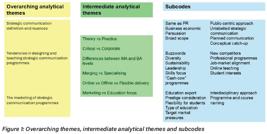
Several significant intermediate analytical themes, including tensions highlighting the field's complexities, were discovered in the analytical coding process. Focusing on tensions in studies of professionalisation processes has previously been considered beneficial (Tobias, 2003). This article focuses on one central tension: Theory vs. practice. This tension was analytically identified as present across all overarching themes and it related to other intermediate analytical themes. Therefore, it can be regarded as the central tension in the data. Furthermore, this tension showcases the diverse opinions and challenges the respondents perceive, which are vital in shaping the professionalisation processes. By examining these, the study provides a comprehensive understanding of the complex dynamics of professionalisation that influence strategic communication as a teaching discipline.
The empirical findings include quotes from the participants, who were represented anonymously to protect their professional integrity. This was regarded as an appropriate approach because the purpose was not to compare potential differences between universities on different continents. In addition, following the ethical principles outlined by the Swedish Research Council (Swedish Research Council, 2017), participants were provided with information about the research goals. Verbal consent was received from all participants and interviews were audio-recorded with permission. They were informed that the audio files would be transcribed.
EMPIRICAL FINDINGSThe empirical findings show that interviewees perceive the dichotomy between theory and practice as the central tension shaping the professionalisation of strategic communication as an academic discipline. The interviews with teachers, programme directors and departments reveal that some master programmes prioritise theory to give students a deep understanding of fundamental principles. In contrast, others emphasise practical skills to improve students' employability. The interviews demonstrate variations in how this perceived dichotomy between theory and practice is understood, including recognising inherent tension and nuances, its impact on educational programme development and how it relates to professionalisation. In the section below, the perceptions and significance of these tensions are illustrated and discussed.
A balanced approach
In the interviews, respondents insisted on striving for a balanced approach in which theory is taught alongside practice. While applied communication disciplines are seemingly becoming more confident in their approach, the academics in this study still emphasised the importance of theory and academic grounding, especially in educational programmes at research universities. One interviewee described the relationship between theoretical and applied components as follows:
I mean, you have to learn the theory around this, which can be connected to rhetoric or whatever. And then, of course, you also need to somehow train it a little bit, definitely. We should do both, basically, that's what I think. I don't think we should do a super theoretical version, and we should definitely not just do a practical version. We should connect them. That is what we do. [...] I would say it is 75 theory, 25 practice. It is mainly an academic education still.
Several respondents struggled to have a balanced approach at the master's level by integrating practical pedagogies and education with theory. They admitted that this approach corresponds better with students' preference for hands-on learning than theoretical approaches. Despite the faculty's recognition of the significance of theoretical foundations, deliberate efforts had sometimes been made to minimise theoretical content. Practical components are intentionally woven into every course, affording students substantial exposure to real-world applications while remaining rooted in relevant theoretical principles. A respondent elaborated on this approach:
Our master's degree is more practical. I would say, on average, our students prefer practical education rather than theoretical. Although, as a faculty, we think it is important to have some theoretical grounding. But I will say that compared to other communication master's degrees at other universities, we probably have less theory in our courses. It just [has not been] emphasised so much We have no class that is only theory. So, every course has a practical aspect.
However, what exactly is a balanced approach? Respondents have various opinions. One respondent emphasised the importance of connecting theoretical concepts with real-life examples and demonstrating how these theories can be implemented in practice. The respondent acknowledged that there may not be a definitive correct balance. However, if students understand the purpose and relevance of their learning, they are more likely to be engaged and retain the knowledge. Other interviewees also discussed this understanding:
50/50 sounds great. But you know, as long as we can teach the theory and show how this is enacted, how are we going to use it? What are examples of it? I'm not sure there is a correct balance, but as long as students can see, I'm learning this because ... why? Why am I learning this? I think that they're going to be more receptive to it. If you just have them taking notes on theory, after theory, after theory. And then they would be like, why? They're going to lose it the second they walk out of the classroom. If we teach them the theory, give them examples, and have them utilise the theory and make strategic decision making, it's much more likely to be retained. But asking students to retain anything these days is very hard, and they usually forget. Cumulative knowledge for students is, you know, really hard to maintain these days. Like they usually will forget everything they learned the previous year, they are starting over again, scrapped.
According to another respondent, the ratio between theory and practice should be 75% theory and 25% practice, emphasising theory within the academic framework: "We should connect them. That is what we do. [...] I would say it is 75 theory, 25 practice. It is mainly an academic education still" As the interviewee explained, the aim would be to establish a balanced and interconnected relationship between theory and practice, fostering an educational, academic approach that predominantly revolves around theoretical learning, but always connected to practice.
All in all, most interviewees discussed the dynamic tension between teaching theory and practice. They described how they strive for a good balance between them, which could lead to higher educational quality. In this study, this was also interpreted as working to increase the level of professionalisation. The quotes display the dynamic quality of this tension, as seen in the subtle understanding of the imagined dichotomy and the delicacy of finding a well-balanced approach. This is assumed to impact the students' capacity to retain knowledge: presenting theories without practical context may lead to disengagement and forgetfulness among students. The discussion of cumulative knowledge emphasises how understanding the balance impacts the development of educational programmes as part of the professionalisation process.
The relationship between bachelor and master level
The interview study extended the understanding of perceived differences between theory and practice by pointing out the relations between bachelor's and master's levels and the role theories and practice play in programmes at different levels.
The respondents addressed the theory-practice tension in relation to educational levels in different ways. While some stressed the risk of lacking relevance by not teaching how theories might be applied in practice and submitted to the urge to cultivate analytical skills, others noted the importance of having curricula that admit progression between bachelor's and master's level education programmes.
Another interviewee emphasised the need for a solid theoretical foundation for bachelor's programmes and acknowledged that these programmes historically heavily emphasised theory in the early years. Admittedly, students had reportedly complained about the perceived lack of relevance of extensive theoretical content in the past.
They used to put a lot of theory in the first year. A lot. And we complained as students, obviously. You know: Why am I studying this? It is completely irrelevant. And I can see where that criticism came from back then because we were doing theory for theory's sake. So, there was very little emphasis on application. And now we try to integrate that in our courses as well, like do not just read theory, when you are observing things every day, try to apply it. If you read about, I do not know, gender in PR [public relations], try to see how this gender plays out, not just in PR but also in your everyday life. And how can that potentially impact the industry, how can that impact public communication, how are gender stereotypes ingrained in that, etc.?
This interviewee emphasised the necessity of a solid theoretical foundation in public relations at the bachelor level. This interviewee also recognised the need to integrate theory into practice in courses by encouraging students to use theoretical concepts in real-world observations. This way, the interviewee highlighted the importance of understanding the practical implications of theoretical knowledge, especially in areas such as gender in public relations. The interviewee distinguished what they perceived as more pertinent to the bachelor and master levels, as shown in the forthcoming quote:
So anyway, for undergraduates, I do think that they need a very strong theoretical basis. I really do think that, in public relations, in particular. I think even Aristotle was saying this with philosophy and philosophers; it is not new. But I also think they need some basic skills and a toolkit. For undergraduates, for me, it is to teach them political theory, social theory and psychology, which are really important in public relations. And then try to apply this to public relations practice, giving them the basics of public relations and ethics. So, you know, analytical skills.
According to the interviewee, an essential component of a bachelor's education is cultivating a theoretical foundation and analytical skills, suggesting a desire to foster critical abilities among students for a well-rounded and thoughtful approach.
While some interviewees stressed cultivating analytical skills, other participants understood the relationship between bachelor and master levels as progression. In the following quote, the interviewee delves into their perspective regarding the significance of critical thinking in master's programmes, highlighting its heightened importance at this level. This includes taking a critical stance on issues and actively theorising experiences, indicating a move beyond foundational knowledge towards a more advanced exploration:
For me, postgraduate is much more concerned with critical thinking, taking a critical stance and really theorising that experience. But yeah, I have not taught undergraduate courses for a really long time now, almost 10 years. So, it is very difficult for me to say what undergraduate courses should have. I would see it more like basic versions of what we have on a postgraduate degree. And, you know, because you have more time to study things, I think at the beginning, the first year needs to be more theory based. And then, as you progress, in the second or third year, depending on how long the degree is, it can be either three or four years, then you give them a little bit more practice. And also, maybe some kind of practical research placements, or practice placements, if the curriculum allows. So, you have more time to work through this theory, practice and practical implications. Then, on the postgraduate level, it is when you have, you know, kind of critical thinking and applying that critical thinking.
The interviewee above suggested conceptualising bachelor courses as offering "basic versions" of what is covered in master's degrees, which stresses the cultivation of analytical skills. This implies a structured progression from foundational concepts at the bachelor level to more advanced, critical exploration at the master level. This way of understanding the relation between the levels - as progression - can also be interpreted as negotiable choices that are part of the professionalisation process of the teaching discipline.
Practice leads to an appreciation of theory
Contrary to the widespread belief that students prefer practical modules, some participants have observed that students returning to the university after gaining practical experience often express a keen interest and desire to delve into the theoretical aspects of the discipline:
We have more practitioners who return, and they really like theory. You know because they know how to do practice. So, for me, to teach them how to practise and develop their skills, I mean, come on. [laughter] You know, they worked in practice. Having said that, with media relations, they struggle, even though they have worked in media relations daily. But when they have to do, you know, something more academically based and theorise, or outside of their comfort zone, you know, they think, they do this all the time, it is fine. But when they produce that work, they are quite surprised sometimes that they do not do as well as they thought they would.
Some interviewees also believed that despite the value of practical aspects, a strong foundation in historical and theoretical knowledge should be the priority. They argued that while practical aspects are important, the theories should extend beyond communication theories and include broader societal debates, such as sociological and philosophical theories. The expectation is for master's students to explore the entire history of communication and grasp the fundamental philosophical principles that underlie communication processes.
On the master's side it has to be, I think, much more historically and theoretically anchored. So, great if they do some practical stuff. I think they should be doing practical things even on the master's level. But the theories they are linking to should be much more ... Like not communication theories, but sociological theories or philosophical theories, much deeper societal debates. So, you know, in the bachelor's programme, it is probably enough to introduce them to four or five theories of communication in society. At the master's level, they need to go through the whole history of that but also understand some of the philosophical principles of communication.
This understanding underpins the role of theory in master's programmes as one that stimulates critical thinking and significantly shapes students' mindsets and outlooks. It further shows that the value of theory is often acknowledged by students who have been working in practice for a couple of years.
The interviews, however, demonstrate that the straightforward dichotomy of a bachelor's degree equating to skills and a master's degree equating to theory and managerial attributes is not clear-cut; it consists of subtle nuances, which are further elaborated on below.
Skills versus theory
Some of our interviewees from departments with a legacy of critical theory made an interesting point about raising a tension between teaching theories and teaching skills that makes students "employable"! They talked about "pressures" on focusing on these employability "skills":
I think, across the board, across the three programmes, we kept a quite strong theoretical orientation. Our university is known to be a cradle of critical public relations, and we are very strongly committed to keeping that legacy. There have been a lot of pressures on employability and training, but we have held our fort, and we said no. You know, what we are offering is more theoretical. It is a theoretically oriented programme. It does not mean they do not get any skills, but skills are not our primary focus.
The discussion about skills is not only related to simple assumptions about teaching employability skills but also to skills in connecting theory to practice. The interview study shows that many participants expressed the importance of teaching students a comprehensive exploration of the skills that incorporate a theoretical framework into practical work tasks. By adopting this approach, students are informed about the underlying reasons behind specific procedures and the potential consequences of different choices. Students are encouraged to consider the theoretical implications of their decisions. One interviewee elaborated on the topic:
Even when we do teach skills, we put quite a bit of emphasis on theorisation of those skills. So, you know, you produce a podcast; why did you produce it that way? Why did you use that kind of music? What does the theory say? (...) And equally, they produce a blog reflecting on semiotics and semiotics theory and why they positioned the elements the way they did. We have got quite a strong theoretical orientation. That is why we also have our programme as a Master of Science, not an MA.
This way of grounding theories in practice can be challenging to communicate and understand, even for academics at the same university. One respondent explained that they sometimes hear comments from colleagues at other departments, such as "Oh yeah, you just do practice" And I said, "no! This is not what we do" Further, they think that their unit and programme are misunderstood in this respect. This uncomprehending understanding from colleagues illustrates an implicit interpretation and definition of practice, which equates practice with real-life situations outside academia as being theoretically conducted and as instrumental handling of working tasks.
The subsequent comment from the same interviewee brought the discussion full circle, echoing the sentiment expressed in one of the initial quotes of this article regarding the necessity of a theoretical foundation when the education comes from a specific type of department and when they explain to students who want only practice that this might not be the ideal place for them:
If I ever get an applicant who says, "Oh, I really want to learn how to work in practice and how to write press releases", or something along those lines, we usually advise that applicant that this is probably not the right programme and that they should consider taking an MA or look into doing training in practice. CIPR [The Chartered Institute of Public Relations] offers these kinds of courses that are very practical-oriented, while we have quite a strong commitment to theory.
In the following comment, another respondent questioned the standard expectation in strategic communication: graduates should be immediately ready for practical tasks. The respondent drew a parallel with surgeons who require additional training before operating. In their case, they expressed concern about the rapidly changing nature of the industry, where specific practical skills learned today might become outdated quickly:
You know, we do not expect doctors, when they finish their university education, to be able to go into the operation theatre and operate on someone. You need to train them. So why do we have these expectations in PR practice that graduates will come into practice ready to start? And I know that some of the programmes do that. They train them for practice, but then things are changing so quickly, that if you learn today how to write the news release, by the time you start working in practice, things might really kind of change and move on. So, for us, it is really important to teach them not just how to but also why. Because "why is" does not change that quickly, but "how" tools can.
This interviewee's insight prompted reflection on the role of a strategic communicator and what employers expect of them as they enter the labour market. The essence of the message lies in recognising that understanding the fundamental principles provides a more enduring foundation for a professional role than learning solely practical skills connected to specific tools. In the context of university programmes, the goal is to equip students with a profound understanding that makes them capable of navigating and adapting to the dynamic changes in the surrounding world and their field over time.
Finally, a noteworthy reflection addressed the type of skills that are especially sought at the master's level. According to some interviewees, students often choose master's studies because they aspire to attain management or leadership roles, or even start their own consulting businesses:
They don't need a master's to break into the business - they already are - but they aspire to management or leadership. [...] Maybe they want their bosses' job, maybe they're an agency executive, but they want to be a partner, or they want to break off and form their own consulting business.
This quote urges the need to consider what skills make students employable for upper management positions and to integrate these into curricula. Considering the various aspects mentioned by the interviewees in this section, skill emerges as a malleable construct. It is related to analytical skills as well as to employability skills. The notion was also discussed in relation to practice as having a somewhat lower status than theory, equating it with instrumentally conducted activities without a theoretical understanding of implications. This indicates that the reputational aspect is important to consider in the educational development process. The reputational aspect is implicitly addressed also when students are recommended to apply and study elsewhere if they do not appreciate theory.
Critical and corporate view
The interview study further extended the understanding of perceived differences between theory and practice by relating it to a critical and corporate view of teaching strategic communication.
The critical view emphasises strategic communication's societal, ethical and cultural implications by discussing connections to power dynamics. It seeks to uncover hidden biases and injustices in communication practices. It can be illustrated in the following quote where the respondent pointed out the importance of instilling a critical view in students:
Strategic communication is incredibly powerful, and if they go out into the world and start using this tool without understanding that power and without taking responsibility for the effects they have, then I think I would have failed in my mission to educate them.
The quote highlights the importance of accountability and ethics in education, which another respondent further stressed: "You need to understand wider societal implications of what you are doing and how you look for creative solutions within" As interpreted in this study, the corporate view relates to adapting to business, where education prioritises career preparation in a professional context. Representatives of this view try to foster communication professionals who can move on and work in corporate environments and who can significantly contribute to the strategic direction of organisations. However, even the most critical scholars have a balanced approach and are fully aware that students will work for an organisation one day:
The assumption is that even if you're critical, somehow you still are about how organisations communicate and making them do it better. In the business school arena, it aligns with things like critical management studies and critical marketing. Some interviewees highlight that it is crucial to approach the critical view cautiously as critical theory courses might garner interest from only a limited number of students and it is important to have a balanced approach also in this respect.
I think we are far too focused on teaching skills as opposed to thinking about how we are going to elevate these people into actual thinkers who will contribute to organisational direction. [...] But I would be reluctant to ever teach just a critical theory course on its own. I think that only a very select group of students who are very interested in critical theory would actually want to do that.
Stability versus flexibility in the professionalisation process
Through this study, attempts were made to deal with different dynamic tensions concerning the professionalisation processes of strategic communication. The last theme concerns the subject's status in the world. Some professions try to remain more stable when developing their education programmes, while other actors choose to be more flexible by continuously addressing current issues. The following interviewee acknowledged the need for critical education about current social issues, even if only to stay relevant in education:
I think one of the challenges is that you have to make sure that your curriculum continues to engage with the critical problems of the world. So, sustainability would be one example. Digital would be another, migration would be another, and global justice and social justice would be another. Those themes actually do not change a huge amount, but they kind of trend upwards and downwards. [...] I think they are important for curricula to maintain their relevance too. So, if I did, you know, a critical perspective course this year and did not mention Black Lives Matter, did not mention #metoo, did not mention the environment, did not mention digital trends, I mean, it would just be nonsense.
To offer this kind of education, the participants balanced stability and flexibility by offering flexible current issues and a stable core curriculum. They followed their reasoning by presenting what they call "branching out [the education] into different areas":
But I do not know that we necessarily have to present a whole master's programme in those areas. And I think it is partly because, once you did that, you would actually be branching out into different areas anyway. So yes, we did consider putting on a master's degree in environmental communication, but what would we do there? [...] You know, it would be similar to what we are already doing. And I think we can still do that by having a core curriculum.
This point of view highlights the importance of incorporating current societal issues as a transversal component in curricula. The challenges lie in ensuring the curriculum remains relevant by engaging with critical international problems such as sustainability, digital trends, migration and social justice. Some respondents agree that while these themes may fluctuate in significance, they should be consistently addressed within the core curriculum of programmes rather than necessitating the creation of entirely separate master's degrees. This approach involves integrating relevant courses from different disciplines to explore the multifaceted aspects of these issues and their impact on communication strategies.
DISCUSSION
The theory versus practice tension has persisted over the centuries and is prominent in the results of our study. Even if the interviewees used the theory vs practice dichotomy as a reference point, their understandings were more nuanced than expected. Overall, the division between theory and practice is constructed as opposing skills or capabilities, stemming from an archaic comprehension of different types of knowledge (cf. Aristotle, 1998), which through the centuries have proven to be problematic in various ways (cf. Dewey, 1999[1916]; Liedman, 2007). This was also evident in the results of this empirical study. It prompts the question of whether a simplified preconception should be dissolved to allow for a more nuanced understanding of how it affects the struggles of professionalisation in educational programmes at university.
The study illustrates how universities in different parts of the world balance the pressing demands and diverse expectations from stakeholders such as students and employers, contrasting them with internal pressures from colleagues, faculty and university management. In this respect, the study demonstrates that education for professions is a site of struggles, which has been acknowledged in earlier studies (Tobias, 2003). This study contributes to a broader understanding of professionalisation processes as it illustrates how they manifest in a would-be profession that still seeks its future trajectory.
This discussion raises further issues about the expectations of the role of a strategic communicator based on the perception of the tension between theory and practice. The findings echo earlier findings about public relations, such as the division into the manager-technician role (Dozier & Broom, 1995) and the more recent division into managers, technicians and strategists (Steyn & Nieman, 2010). Even if strategic communication researchers have criticised these divisions, and today, communication roles are by many considered indiscernible (Falkheimer et al., 2016) or changing in extraordinary circumstances (Månsson & Eksell, 2024), the distinction was still vivid in the interviewees' minds. This distinction influences the management of stakeholder perspectives and the planning of university education programmes. It is, therefore, clear that strategic communication has conceptual baggage from public relations that burdens studies in the emerging field.
The study's findings also demonstrate that master programmes in strategic communication endorse specific theoretical frameworks, but the curriculum varies, at least to some extent, among universities. Therefore, these programmes cultivate various skills related to different job responsibilities, preparing students for a dynamic strategic communication role. This role, or rather, these roles encompass many understandings of tasks and responsibilities, which can be challenging to distinguish. In this sense, the findings align with Falkheimer et al. (2016) who argue that a clear division between these roles is not easily discernible in practice.
Interestingly, the different understandings of strategic communication as an educational subject, with its different theoretical departure points and promotion of various skills and distinctions, are subject to professionalisation processes that are understood differently at the various universities.
Educational programmes concentrating on teaching hands-on skills and real-world applications, such as planning, conducting and evaluating communication campaigns and strategies, managing different communication channels or working on software and tools, tend to focus on how the work is done. Professionalism, to be a professional strategic communicator, in this context, is connected to a specific behaviour or quality related to the performance of the work task (cf. Brante, 2011). In contrast, education programmes that emphasise theory and provide students with a thorough understanding of underlying principles, concepts and theories behind communication strategies are subject to a somewhat different understanding of professionalism. In this context, being a professional strategic communicator is more related to developing a specific general approach towards different stakeholders and society, including an ability to reflect on the role and task themselves.
As a result, the findings echo the ambitions of reflection-in-action presented by Schön (1983) in The Reflective Practitioner, as interviewees emphasised the role of theory and education as a process that develops individuals' capacity to apply theories in the performance of tasks and to continue reflective thinking in practice. However, it may be a token of the would-be professions' unstable ground to stress this aspect of education for professionalisation. To some extent, the universities that put theoretical studies in the centre recognise Schön's (1983) exhortation that professionalisation must lead to independent practitioners who can perform their work tasks but also reflect and evaluate these and their work roles. The findings show that the perceived tension between theory and practice and its relationship to professionalisation processes is collectively held, negotiated and agreed upon (cf. Foucault, 1971/1981). The tensions, including nuances and distinctions, result from implicit agreement to the same reference point (of distinguishing between theory and practice), while the variations within this discourse have been illustrated by the various quotes presented in this article. These variations simultaneously showcase what Houle (1981) defines as the dynamic approach to professionalisation where different actors within the field of strategic communication elaborate remotely but collectively to find a common identity and reach a high level of professionalisation. In the context of university programmes, the goal is to equip students with profound and enduring knowledge that makes them capable of navigating, adapting to and managing the dynamic changes in the surrounding world. Through the rapid evolution of emerging technologies, such as artificial intelligence, new questions about the future role of knowledge will merge, probably impacting the understanding of theory and practice and the professionalisation process in previously unseen ways.
CONCLUSIONS
This study explored and analysed perceptions of strategic communication held by programme directors, professors and departments from an educational perspective, thereby gaining a deeper understanding of the dynamic tensions shaping the discipline's professionalisation.
The empirical findings show that the tension between theory and practice was the central tension perceived by the interviewees. The interviewees understood that education programmes emphasise theory by focusing on providing students with a thorough understanding of underlying principles, concepts and theories behind communication strategies. In contrast, programmes focusing more on practice prioritise employability, hands-on skills and real-world application. This involves teaching how to plan, conduct and evaluate communication campaigns and strategies, handle various communication channels and situations effectively, and use digital software and other tools. The former stresses the "why aspects" while the latter highlights the "how aspects".
The relationship between theory and practice is not as straightforward as initially indicated by the data. While many interviewees initially made easy estimations of the scope of theory and practice in their programmes, the findings reveal a greater complexity. The complexity is tied to varying distinctions between master's and bachelor's programmes and considerations of how progression is met within and between programmes at different levels. It also involves differing understandings of the practical application of theory and seemingly contradictory considerations of student skills during a programme and after graduation. Further, it relates to preconceived notions about student interests, experiences and values of education.
While the study was ambitious about finding a balanced approach between theory and practice, some interviewees emphasised external aspects outside academia, such as students' employability and consideration of societal and ethical factors in their future work. Others focused on internal academic elements, explaining how the balance between theories and practice might impact students' ability to retain knowledge. These perspectives collectively demonstrate a unified understanding of how theory and practice are closely intertwined rather than being seen as mutually exclusive.
The findings display a variety of understandings that simultaneously address subtle but essential aspects of the professionalisation process. Some of these aspects might be seen as universal parts of all professionalisation processes, while others are rooted in varying understandings of strategic communication as a subject.
The findings clearly show that strategic communication is a dynamic subject that lacks convergence towards a singular core but evolves through diversification. In addition, this study contributes to knowledge on the processes of professionalisation by shedding light on a profession not considered to be a profession in the strict sense but rather a would-be profession. Further, it illustrates the struggles with the legitimacy of a relatively new university subject - a would-be profession - that is relatively flexible in its choices regarding where the subject core lies.
Moreover, as perceptions are often manifested in decisions taken by programme directors, professors and departments of masters' programmes in strategic communication in different parts of the world, this study gives a flavoured understanding of how the perceived dynamic tensions of educational development impact the professionalisation process.
PRACTICAL IMPLICATIONSThis study explored perceptions of strategic communication from an educational perspective, as held by programme directors, professors and departments, to gain a deeper understanding of the dynamic tensions that shape the professionalisation of the discipline. The findings revealed a variety of interpretations regarding both strategic communication as a subject and how professionalisation processes influence the development of education programmes. As a result, the practical implications are equally diverse.
One implication of this study is that educational institutions should sustain and develop a competitive advantage based on their current strengths. Educational programmes that emphasise theory by providing students with a thorough understanding of the underlying principles, concepts and theories behind communication strategies - often associated with critical approaches - should continue to develop curricula and teaching methods that reinforce these strengths.
Conversely, programmes that focus more on practical skills and that prioritise employability and real-world applications should also enhance their approach. However, we recognise that there is a clear limit to how applied a master's programme can be given restrictions in university legislation and other factors. In another section of this article, we highlighted the risks associated with an overemphasis on practical skills in an ever-changing landscape and we discussed the expectations of significant changes in strategic communication practices due to the introduction of computer-aided AI tools in the workplace. Several recent reports indicate changes in strategic communication roles as a result of the introduction of AI. This change necessitates further analysis and measures on how educational institutions should address these changes, integrate new components into the curriculum and prepare students for an increasingly computer-aided work life. This issue is particularly relevant for programmes focused on developing applied skills.
In terms of future development, creating a mixed environment that balances theory and practice may pose the greatest challenge. This approach aims to integrate the best aspects of both worlds: developing theoretical knowledge alongside practical skills. Recent developments highlight the practical skills that should be emphasised in the context of strategic communication. It is reasonable to anticipate even greater diversification within these types of programmes, some of which may still be difficult to predict. Establishing a specialisation or focus within this genre of programme could be essential, given both the current influence of related subfields in strategic communication and the emerging technological advancements that will impact the future careers of strategic communicators.
In terms of professionalisation, it is important to recognise that strategic communication is a relatively new field and that it is still defining its future direction. As such, it is likely to be more affected by changes in the external environment. This means that different interpretations of what professionalisation entails may arise, especially during periods of change and crisis, which could lead to unforeseen consequences for this field of education. Given that we are at the beginning of what is being called the fourth industrial revolution, it may be worthwhile to revisit this topic in the near future.
LIMITATIONS AND SUGGESTIONS FOR FUTURE RESEARCHThe purpose of this study was not to compare educational systems or traditions on different continents. However, it is essential to recognise the significance of the contextual factors of the respective educational programmes included in this research, such as educational systems, traditions and societal values. These factors have likely implications for perceptions of professionalisation, expectations of occupational roles and performance of work tasks. It is a limitation of this study that these aspects were not explored in any greater depth.
Future research could investigate how emerging academic disciplines, such as strategic communication, establish legitimacy for their educational programmes through struggles related to institutional practices such as positioning, professionalisation and discourse. Analysing how universities and industry stakeholders frame the essence and value of these relatively new fields over time may offer insights into broader patterns of professionalisation and the formation of academic identity.
The study also raised new questions about the impact of a significant financial investment in education. Does it result in a greater emphasis on acquiring practical skills that improve graduates' resumes for the job market? Moreover, it would be interesting to investigate whether employers in different regions have different preferences when evaluating candidates based on these varying educational priorities and profiles.
REFERENCES
- Abbott, A. (1988). The systems of professions. Chicago: University of Chicago Press.
- Alvesson, M. & Sköldberg, K. (2018). Reflexive methodology: New vistas for qualitative research. 3rd ed. Los Angeles: Sage publications.
- Alvesson, M. (2022). The triumph of emptiness. 2nd ed. Oxford University Press.
-
Andersson, R., Heide, M. & Simonsson, C. (2023). Kommunikatörers professionalisering - en balansakt mellan olika roller. Lund: Lund University. Available from: https://lucris.lub.lu.se/ws/portalfiles/portal/160751729/Kommunikat_rers_professionalisering.pdf
» https://lucris.lub.lu.se/ws/portalfiles/portal/160751729/Kommunikat_rers_professionalisering.pdf - Aristotle. (1998). The Metaphysics. UK: Penguin Classics.
-
Brante, T. (2011). Professions as science-based occupations. Professions and Professionalism, 1(1):4-20. http://journals.hioa.no/index.php/pp/article/view/147
» http://journals.hioa.no/index.php/pp/article/view/147 - Bridgen, E. (2017). Experiencing public relations. London: Routledge.
- Brinkmann, S. & Kvale, S. (2015). Interviews: Learning the craft of qualitative research interviewing. 3rd ed. Los Angeles: Sage publications.
-
Broom, G.M. & Dozier, D.M. (1986). Advancement for public relations role models. Public Relations Review, 12 (Spring):37-56. https://doi.org/10.1016/S0363-8111(86)80039-X
» https://doi.org/10.1016/S0363-8111(86)80039-X -
Broom, G.M. & Smith, G.D. (1979). Testing the practitioner's impact on clients. Public Relations Review, 5(3):47-59. https://doi.org/10.1016/S0363-8111(79)80027-2
» https://doi.org/10.1016/S0363-8111(79)80027-2 - Charmaz, K. (2014). Constructing grounded theory. Sage publications.
-
Cheney, G. & Ashcraft, K.L (2007). Considering "the professional" in communication studies: Implications for theory and research within and beyond the boundaries of organizational communication. Communication Theory, 17(2):146-175, https://doi.org/10.1111/j.1468-2885.2007.00290.x
» https://doi.org/10.1111/j.1468-2885.2007.00290.x - Collins, R. (1990). Changing conceptions in the sociology of professions: Formation of professions. In: R. Torstendahl and M. Burrage (eds). The formation of professions. London: Sage.
- Collins, R. (2002). Credential inflation and the future of universities. In S. Brint (ed.). The future of the city of intellect. Stanford: Stanford University Press.
- Cutlip, S.M., Center, A. H. & Broom, G. M. (2000). Effective public relations. 8th ed. Upper Saddle River, NJ: Prentice Hall.
- Denzin, N.K. & Lincoln, Y.S. (eds). (2018). The SAGE handbook of qualitative research. 5th ed. Los Angeles, CA: Sage.
- Dewey, J. (1999)[1916]. Democracy and education: An introduction to the philosophy of education. New York: Free Press.
-
Dozier, D.M. & Broom, G.M. (1995). Evolution of the manager role in public relations practice. Journal of Public Relations Research, 7 (spring):3-26. https://doi.org/10.1207/s1532754xjprr0701_02
» https://doi.org/10.1207/s1532754xjprr0701_02 - Falkheimer, J. & Heide, M. (2018). Strategic communication: An introduction. Abingdon, Oxon: Routledge.
-
Falkheimer, J., Heide, M., Simonsson, C., Zerfass, A. & Verhoeven, P. (2016). Doing the right things or doing things right? Paradoxes and Swedish communication professionals' roles and challenges. Corporate Communications: An International Journal, 21(2):142-159. https://doi.org/10.1108/CCIJ-06-2015-0037
» https://doi.org/10.1108/CCIJ-06-2015-0037 - Foucault, M. (1971/1981). The order of discourse. London: Routledge.
- Frandsen, F. & Johansen, W. (2015). The role of communication executives in strategy and strategizing. In D.R. Holtzhausen & A. Zerfass (eds). The Routledge handbook of strategic communication. Routledge, 229-243.
- Freidson, E. (2001). Professionalism: The third logic. Cambridge: Polity Press.
-
Gregory, A. (2011). The state of the public relations profession in the UK: A review of the first decade of the twenty-first century. Corporate Communications: An International Journal, 16(2): 89-104. https://doi.org/10.1108/13563281111141633
» https://doi.org/10.1108/13563281111141633 - Grunig, J. E. (1992). Communication, public relations and effective organizations: An overview of the book. In J. E. Grunig (ed.). Excellence in public relations and communication management. Hillsdale, NJ: Lawrence Erlbaum, 1-30.
- Grunig, J. E. & Hunt, T. (1984). Managing public relations. New York: Holt.
- Grunig, L.A., Grunig, J.E. & Dozier, D.M. (2002). Excellent public relations and effective organizations. Mahwah, NJ: Lawrence Erlbaum.
-
Hallahan, K., Holtzhausen, D., van Ruler, B., Verčič, D. & Sriramesh, K. (2007). Defining strategic communication. International Journal of Strategic Communication, 1(1):3-35. https://doi.org/10.1080/15531180701285244
» https://doi.org/10.1080/15531180701285244 - Houle, C.O. (1981). Continuing learning in the professions. San Francisco, CA: Jossey-Bass.
- Hudson, K. (1978). The jargon of the professions. London: Macmillan.
- Johnson, T.R. (1972). Professions and power. London: Macmillan.
- Kultgren, J. (1988). Ethics and professionalism. Philadelphia: University of Pennsylvania Press.
- L'Etang, J. (2008). Public relations: Concepts, practice, and critique. Los Angeles: Sage publications.
- Larson, M.S. (1990). In the matter of experts and professionals, or how impossible it is to leave nothing unsaid. In R. Torstendal & M. Burrage (eds). The formation of the professions: Knowledge, state and strategy. London: Sage Publications, 24-50.
- Liedman, S-E. (2007). Ett oändligt äventyr. Viborg: Albert Bonniers Förlag.
-
Månsson, M. & Eksell, J. (2024). Communication work for influencing destination resilience - DMOs experiences during the COVID-19 pandemic. Scandinavian Journal of Hospitality and Tourism, 1-20. https://doi.org/10.1080/15022250.2024.2308857
» https://doi.org/10.1080/15022250.2024.2308857 - Millerson, G.L. (1964). The qualifying association. London: Routledge & Kegan Paul.
-
Moss, D., Newman, A. & DeSanto, B. (2005). What do communication managers do? Defining and refining the core elements of management in a public relations/ corporate communication context. Journalism & Mass Communication Quarterly, 82(4):873-890. https://doi.org/10.1177/107769900508200408
» https://doi.org/10.1177/107769900508200408 -
Noordegraaf, M. (2007). From "pure" to "hybrid" professionalism: Present-day professionalism in ambiguous public domains. Administration & Society, 39(6):761-785. https://doi.org/10.1177/0095399707304434
» https://doi.org/10.1177/0095399707304434 - Nothhaft, H. & Zerfass, A. (2023). Public relations in a postdisciplinary world: On the possibility of establishing a constitutive theory within the tribal struggles of communication disciplines. In C.H. Botan & E.J. Sommerfeldt (eds). Public Relations III: In the Age of Publics. Routledge.
-
Nothhaft, H., Werder, K.P., Verčič, D. & Zerfass, A. (2018). Strategic communication: Reflections on an elusive concept. International Journal of Strategic Communication, 12(4):352-366. https://doi.org/10.1080/1553118X.2018.1492412
» https://doi.org/10.1080/1553118X.2018.1492412 -
Nowell, L.S., Norris, J.M., White, D.E. & Moules, N.J. (2017). Thematic analysis: Striving to meet the trustworthiness criteria. International Journal of Qualitative Methods, 16(1). https://doi.org/10.1177/1609406917733847
» https://doi.org/10.1177/1609406917733847 -
Overton-de Klerk, N. (2023). Reflections on the current state and future of strategic communication as paradigm and practice. Communicare: Journal for Communication Studies in Africa, 42(1):4-21. https://doi.org/10.36615/jcsa.v42i1.2486
» https://doi.org/10.36615/jcsa.v42i1.2486 - Patton, M. (2015). Qualitative research & evaluation methods. 4th ed. Sage publications.
- Prasad, P. (2018). Crafting qualitative research: Beyond positivist traditions. 2nd ed. New York: Routledge.
- Rennstam, J & Wästerfors, D (2018) Analyze - Crafting your data in qualitative research. Lund: Studentlitteratur.
-
Rosén, M.E. (2014). From ad-man to digital manager: Professionalization through Swedish job advertisements 1960-2010. Journal of Communication Management, 18( 1):16-39. https://doi.org/10.1108/JCOM-04-2013-0038
» https://doi.org/10.1108/JCOM-04-2013-0038 - Saldaña, J. (2016). The coding manual for qualitative researchers. Sage publications.
- Schön, D.A. (1983). The reflective practitioner: How professionals think in action. New York: Basic Books.
- Schreier M. (2012). Qualitative content analysis in practice. Sage publications.
-
Simonsson, C. & Heide, M. (2021). Developing a communicative logic -The key to communication professionalism. In International Journal of Strategic Communication, 15(3):253-273. https://doi.org/10.1080/1553118X.2021.1906682
» https://doi.org/10.1080/1553118X.2021.1906682 -
Steyn, B. & Niemann, L. (2010). Enterprise strategy: A concept that explicates corporate communication's strategic contribution at the macro-organisational level. Journal of Communication Management, 14(2): 06-126. https://doi.org/10.1108/13632541011034574
» https://doi.org/10.1108/13632541011034574 - Steyn, B. (2000). Strategic management roles of the corporate communication function. Dissertation. Pretoria: University of Pretoria.
- Swedish Research Council (2017). God forskningssed.
-
Tindall, N.T.J. & Holtzhausen, D.R. (2011). Toward a roles theory for strategic communication: The case of South Africa. International Journal of Strategic Communication, 5(2):74-94. https://doi.org/10.1080/1553118X.2011.561075
» https://doi.org/10.1080/1553118X.2011.561075 -
Tobias, R. (2003). Continuing professional education and professionalization: Travelling without a map or compass? International Journal of Lifelong Education, 22(5):445-456. https://doi.org/10.1080/0260137032000102823
» https://doi.org/10.1080/0260137032000102823 - Torstendahl, R. (1990). Essential properties, strategic aims and historical development: Three approaches to theories of professionalism. In M. Burrage and R. Torstendahl (eds). Professions in Theory and History: Rethinking the Study of the Professions. London: Sage, 44-61.
-
Werder, K.P., Nothhaft, H., Verčič, D. & Zerfass, A. (2018). Strategic communication as an emerging interdisciplinary paradigm. International Journal of Strategic Communication, 12(4):333-351. https://doi.org/10.1080/1553118X.2018.1494181
» https://doi.org/10.1080/1553118X.2018.1494181 -
Zerfass, A. & Volk, S.C. (2018). How communication departments contribute to corporate success: The communications contributions framework. Journal of Communication Management, 22(4):397-415. https://doi-org.ludwig.lub.lu.se/10.1108/JCOM-12-2017-0146
» https://doi-org.ludwig.lub.lu.se/10.1108/JCOM-12-2017-0146 -
Zerfass, A., Verčič, D., Nothhaft, H. & Werder, K.P. (2018). Strategic communication: Defining the field and its contribution to research and practice. International Journal of Strategic Communication, 12(4):487-505. https://doi.org/10.1080/1553118X.2018.1493485
» https://doi.org/10.1080/1553118X.2018.1493485
Accepted March 2025