GPTs and Digital Superintermediaries: Dynamics, Dilemmas, Dangers of Generative AI: A Conceptual Framework
Abstract
The arms race in generative artificial intelligence and artificial intelligence has transformed digital markets, with artificial-intelligence-powered platforms projected to drive market growth to nearly $740 billion by 2030. However, scholarly understanding of how these technologies affect platform competition remains limited. This article explores how generative pre-trained transformers influence digital superintermediaries' market power, and examines whether generative artificial intelligence capabilities reinforce or challenge existing platform dominance. Using a conceptual literature analysis of platforms and artificial intelligence development patterns, the research uncovers a critical paradox: While generative pre-trained transformers represent revolutionary advancement, they create novel forms of artificial intelligence market concentration. The findings reveal how digital superintermediaries leverage artificial-intelligence-powered platforms through control over computational resources and data access, creating self-reinforcing cycles of artificial intelligence capability enhancement. This research demonstrates how artificial intelligence capabilities, particularly generative pre-trained transformers, create new mechanisms of market power consolidation, suggesting the need for innovative regulatory approaches that address the unique characteristics of generative artificial-intelligence-enhanced digital multisided platforms.
Artificial intelligence (AI); AI market concentration; Al-powered platforms; digital superintermediaries; generative AI; generative pre-trained transformers (GPTs)
INTRODUCTION
Andreessen (2011), an industry expert, envisaged that software would be the engine of growth and value creation that would be applied in every industry. Andreessen (2011) predicted a period when virtually all human tasks would depend on software and become digitalised. Likewise, Ghodsi (2023), CEO of Databricks, predicts that in roughly 10 years, the disruptive effects of artificial intelligence (AI) will be unfathomable and will make software intelligent. Notably, since November 2022, the exponential growth and widespread use of generative pre-trained transformers (GPTs) among consumers, a type of generative AI, has sparked an AI arms race among a group of powerful digital multisided platforms operating as digital superintermediaries. In 2023 alone, a record $29.1 billion was invested across 691 generative AI projects, which represents a 268.4% increase in deal value over 2022's total (Hodgson, 2024). Consequently, the AI market is projected to grow to nearly $740 billion by 2030 (Statista, 2024). Simultaneously, there is an ongoing battle in the AI landscape that is dominated by companies in the United States (US). OpenAI, one of the dominant brands in the AI race linked with Microsoft, is forging ahead in creating newer models with greater functionality. OpenAI has enabled its GPT-4o ("o" for Omni) with multimodalities that accept text or image inputs. OpenAI o1 is a reasoning model designed to allocate more time to thinking before generating responses, enhancing its ability to tackle complex problems in coding, mathematics, and science. Similarly, OpenAI is preparing to release agentic AI capable of autonomously planning and performing complicated activities (Kolt, 2024).
Simultaneously, Microsoft has embedded AI across all its platforms. Google has responded with Gemini 2.0, an agentic AI model capable of understanding its environment, planning multiple steps ahead and completing tasks with minimal human supervision (Pichal, 2024). Meta released LLaMA 3 open-source software and introduced several chatbots on all its social media platforms to intensify the competition (Al-Amin et al., 2024; Meta LLaMA 3, 2024). Concurrently, Amazon is investing heavily in Anthropic to ensure it remains competitive in the ongoing AI technology race. Claude 3.5, Anthropic's latest model, achieves near-human performance in complex tasks, thereby advancing general intelligence (Anthropic, 2024). Analysts also posit that, as AI gains momentum, individuals seeking information online will gravitate towards platforms embedded with generative AI. For example, OpenAI Search GPT, a new AI search engine, can potentially challenge Google's dominance in the search engine market. Apple's generative artificial intelligence (GenAI) offering, Apple Intelligence, is reportedly "two years behind its competitors" (Market Insider, 2024). China's open-source DeepSeek is the notable challenger to the American dominated AI landscape as its models outperform the incumbent Open AI on various parameters. These companies, collectively and coupled with the rapid acceleration of their AI advancements and models, are disrupting and transforming daily life and reshaping the corporate landscape. Their GPTs are redefining how individuals live, work and interact with one another using their general problem-solving applications - horizontal AI - and specific industry solutions - vertical AI (Dehouche, 2021; Kolade et al., 2023).
This technological shift, which Zerfass et al. (2018:496) describe as an example of "environment-driven strategic complexity", underscores the necessity for strategic communicators to anticipate and adapt with agility to these innovations to remain effective in a rapidly evolving, vague, risky and complex digital ecosystem.
Zerfass et al. (2018:493) broadly define strategic communication in this way:
All communication that is substantial for the survival and sustained success of an entity ... [or] the purposeful use of communication by an organisation or other entity to engage in conversations of strategic significance to its goals.
AI-powered superintermediaries enhance message crafting, dissemination and evaluation through advanced analytics for real-time feedback and personalised engagement (Cropley, 2024). The influence of AI on strategic communication extends beyond technological and tactical implementation. It influences how organisations or entities present and promote themselves through deliberate activities that utilise the "strategic calculus as their defining perspective" to achieve their objectives and ensure sustained success (Zerfass et al., 2018:502).
For end users, AI benefits include recommendation systems in e-commerce platforms that tailor suggestions based on consumer behaviour. In addition, conversational AI provides round-the-clock support through chatbots and virtual assistants that can interpret natural language commands to perform tasks such as scheduling appointments or reading emails aloud. AI tools such as ChatGPT are revolutionising strategic communication praxis by automating processes and workflows and augmenting practitioners' capabilities. Furthermore, intelligent user interfaces (IUIs) powered by machine-learning methods are transforming human-machine interactions and how entities across various sectors engage in "conversations of strategic significance" (Zerfass et al., 2018:493) with stakeholders, especially regarding their community relations and crisis management programmes (Moore & Hübscher, 2021). The nature of hyper-personalised interaction displayed by and on superintermediaries' digital platforms raises pertinent questions about whether their brand of persuasion constitutes control, nudging or influence (Moore & Hübscher, 2021).
The research gap
While scholars have extensively examined the economics of digital multisided platforms (MSPs) (Belleflamme & Peitz, 2021) and the technical capabilities of AI (Wilson & Daugherty, 2018), there remains a critical gap in how AI capabilities, particularly GPTs, reshape platform competition dynamics. Previous research has focused primarily on network effects and data advantages in digital markets (Kenney & Zysman, 2020). However, it has not fully addressed how developing advanced AI capabilities might create new forms of market concentration that transcend traditional platform economics. Moreover, while studies have investigated the technical aspects of GPTs (Dehouche, 2021), their potential role in reinforcing or disrupting existing digital market structures remains understudied. This gap is particularly significant given the unprecedented scale of AI investments and the potential for GPTs to fundamentally alter the competitive landscape of digital markets. This article contributes to filling this research gap by employing a conceptual framework that integrates diverse areas of interest to forecast future developments. The framework is used to analyse the emergence and implications of AI-powered GPT superintermediaries.
APPROACHThis approach used in this study proves particularly appropriate for investigating emerging technological phenomena as it enables the synthesis of theoretical insights across disciplines during periods of rapid technological change (Webster & Watson, 2002). The conceptual review approach facilitates identifying and analysing patterns in digital platform evolution with AI capabilities while drawing meaningful theoretical connections across computer science, economics, communication sciences and digital studies. The analytical process follows Jaakkola's (2020) conceptual research framework, which encompasses identifying key constructs across disciplines, the analysis of relationships between these constructs, and the development of new theoretical insights about AI capabilities' influence on digital platform dynamics. This article starts by defining GPTs, and then discusses the rise and hegemony of AI-powered digital superintermediaries, their characteristics and challenges before concluding with predictions.
WHAT ARE GENERATIVE PRE-TRAINED TRANSFORMERS?
GPTs belong to a group of neural network models that use natural language processing (NLP) and GenAI to comprehend and analyse human language and produce text, images or other media in response to prompts (Harvard Online, 2023). GenAI is a transformer-based large language model (LLM). GPTs employ a transformer architecture to forecast or predict the following word or token in a given sequence (Roisenzvit, 2023). For the computer to understand text, phrases or paragraphs, the GPTs break it down into individual words or tokens. In this way, it breaks down natural language into digestible chunks.
Simply put, GPT technology uses NLP to convert unstructured input such as texts, photos and audio into normalised, structured data that can be used for analysis. The goal of NLP is to instruct computers to understand words or phrases written in human languages (Khurana et al., 2023). GPTs use an attention mechanism, much like the human brain, to process all tokens concurrently and calculate the attention weights between them at subsequent levels. Tokens describe the total number of words, regardless of repetition rate, in a text corpus (Turner, 2015).
GPTs use attention mechanisms to break down problems into attention-based reasoning tasks, focusing on specific subsets (Hernández & Amigó, 2021). GPTs generate responses based on user commands (Kalla et al., 2023), which enables content creation, query understanding and the solving of complex societal issues. Beyond synthetic content generation, GPTs can build AI agents capable of autonomously navigating the Internet and performing various online activities, including acting as automated personal assistants (Kolt, 2024).
GPTs are trained on massive unstructured data at scale and are fine-tuned for specific tasks. Initially trained on extensive Internet-sourced data, GPTs are refined through reinforcement learning based on user input (Shumailov et al., 2023). This fine-tuning enhances their proficiency and specialisation (Kamnis, 2023), enabling the models to generalise language structures and patterns for different projects. Despite the impressive nature of these capabilities, it is important to raise questions about computational bias and the replication of results. The reliance on training data from existing sources can perpetuate historical biases and limit creative and innovative thinking (Dehouche, 2021).
Furthermore, these models' black-box nature raises significant concerns about the transparency and accountability displayed in the decision-making processes. Algorithmic bias is the phenomenon witnessed when a machine-learning model consistently yields incorrect results over time (Nelson, 2019). As GPTs are deployed in decision making, how do we ensure that they are always transparent? Transparency entails that AI authors must explain not only what went into an algorithm and what its output is but also the decisions they took and the reasoning behind them (Nelson, 2019). These reflect more significant cultural discussions on race, representation and technology and draw attention to the difficulties faced by AI developers in striking a balance between representation and avoiding the perpetuation of prejudices or biases (Umbrello, 2024).
Datafication
In the era of AI, data plays a more crucial role than ever. Data is a critical enterprise asset, value creator and currency for competitiveness over rivals. Datafication is the conversion of social action into online quantified data that enables real-time monitoring and forecasting (Mayer-Schönberger & Cukier, 2013). Datafication as a concept suggests that the behaviours, attention spans and conduct of individuals are converted into measurements that are inputted into big data networks, enabling improved tracking and statistical evaluation across technological and societal domains. In addition, real-time quantifiable data can also be gleaned from observing, tracking and converting customer brand experiences and other interactions (Azionya, 2022a). Data mining and application are fundamental to understanding the real value of data (Gu, 2023). However, this commodification of personal data raises fundamental questions about privacy rights and democratic control. The assumption that data-driven decision making inherently leads to better outcomes requires careful scrutiny, particularly given the opacity of algorithmic processes. A case in point is the algorithmic study and commodification of user interactions on digital MSPs such as Meta, Google and Amazon. Therefore, user-generated behavioural metrics and demographic data are monetised by digital superintermediaries using a synthesis of platform users' digital footprints. These sophisticated targeting mechanisms use precision-targeted marketing initiatives to generate considerable financial returns for the digital superintermediaries. Consumer interactions generate big data through online, mobile and data-driven services (Huberty, 2015), which platforms analyse using machine learning and deep learning algorithms. For example, e-commerce platforms employ machine learning for sales forecasting and deep learning for analysing user sentiment and generating recommendations (Sarker, 2021; Taherdoost & Madanchian, 2023). Consequently, even in perfectly competitive markets, the organisation with access to superior data has a competitive advantage. With the ongoing AI arms race, the importance of data and data centres cannot be overemphasised.
Data centre
Data centres are places where data is stored, processed and released in real time. Most data centres consist of computing, storage and network infrastructures. While no individual, firm or brand is precluded from owning digital infrastructure, such as data centres, the mega data centres worldwide are owned and managed by digital superintermediaries such as Amazon Web Services (AWS), Microsoft Azure and Google Cloud, resulting in what is often called cloud data centres. The prohibitive costs of establishing and operating data centres create significant barriers to entry for new companies, more so for those based in Africa. In addition, the lack of capital investments in African infrastructure is a further barrier. Currently, venture capital investments in Africa's digital startups are less than 1% of the global total (Robinson & Bhatia, 2025). Despite this challenge, Africa's digital economy exhibits potential for growth but is constrained by structural challenges, including the external control of its Internet infrastructure and reliance on global tech giants for essential digital services such as cloud computing and AI capabilities (African Union, 2020; World Bank Group, 2024). This external control exacerbates technological dependencies (Robinson & Bhatia) and compounds existing digital divides across the continent.
Big tech's dominance of the data centre space has the self-serving purpose of managing data and AI model training. Therefore, propriety data centres provide essential computing power through specialised hardware for processing multiple data streams simultaneously (Gilani, 2025) to help maintain their dominance. This concentration of computational resources entrenches digital superintermediaries' market position, which reinforces their AI capabilities and market dominance. To counter this AI market concentration in Africa, "data centre infrastructure" and investments "designed to host mission critical servers and computer systems, with fully redundant subsystems" (African Union, 2020:11) are needed for context-specific solutions to achieve significant scale. As the influence and dominance of these organisations grow, it is important to examine the mechanisms through which Al-powered digital superintermediaries rise to prominence and establish their hegemony in the digital economy.
THE RISE AND HEGEMONY OF AI-POWERED DIGITAL SUPERINTERMEDIARIES
Digital superintermediaries
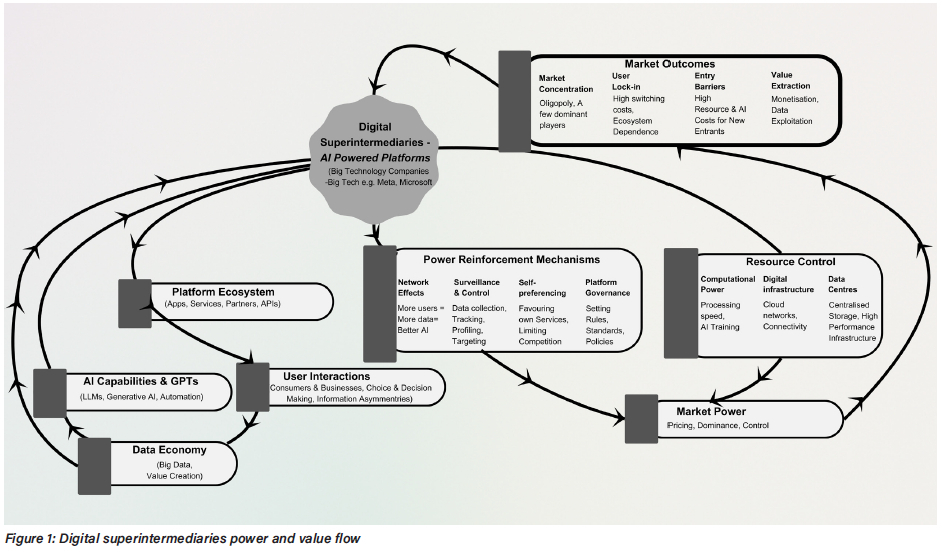
The term digital superintermediaries refers to a set of tech giants far above ordinary digital intermediaries, middlemen and brokers in the digital economy (Azionya, 2022a; Overton-de Klerk, 2023). These digital MSPs are the result of the fusion of social interaction and exponential fourth industrial revolution (4IR) technology. Digital superintermediaries possess considerable market power, making it difficult to displace them from their dominant positions. Based on their strong financial position, these digital behemoths have the ability to act significantly and independently of their rivals, clients and, ultimately, end users (Franck & Peitz, 2023). It is on this note that the European Commission (2023) has singled out several US brands, namely Google (Alphabet), Apple, Meta, Microsoft and Amazon, and among them one Chinese company, ByteDance, and named them gatekeepers of the digital economy. A digital gatekeeper is a platform that allows some users to access only certain goods or only certain users at certain times (Alexiadis & de Streel, 2020). This raises concerns regarding the concentration of power in the hands of a few oligopolists. Therefore, digital superintermediaries, who exhibit monopolistic and self-preferring inclinations, serve as gatekeepers in the 4IR and are the champions of AI. It is crucial to understand the characteristics of digital superintermediaries to grasp how these powerful entities shape the digital economy and influence market dynamics. This is depicted in Figure 1 (Digital superintermediaries power and value flow).
CHARACTERISTICS OF DIGITAL SUPERINTERMEDIARIES
Although the list is not exhaustive, the subsequent section discusses important characteristics of superintermediaries. Characteristics include their approach to preferencing, competition, ecosystems, choice and decision making, data and related concepts, and network effects.
DIGITAL SUPERINTERMEDIARIES ACT AS SELF-PREFERENCERS
Self-preferencing is the practice of a major provider of core platform services favouring their own goods and services over those provided by rivals on the same platform (Colangelo, 2022; Hutchinson & Trescáková, 2022). For example, Apple and Google have been accused of favouring their own apps while demanding disproportionate access fees from app developers. The gatekeepers gain substantive enduring market power in the intermediation services market, which has a significant impact on the underlying market or markets and is essential for users on all sides of the platform (Büchel & Rusche, 2020). Users pay extra costs and charges for the use of digital MSPs that can restrict their migration to competitors. Platform owners impose a substantial amount of listing fees and (ad valorem) commissions on app developers. Ad valorem is a tariff rate expressed as a proportion of the price (WTO, 2023). These represent 30% of revenues on the App Store and Google Play in the first year and 15% in future years (Padilla et al., 2022). They also charge advertisers who advertise their products on their platform and customers who access the list of advertised prices on their platform. The business models of digital superintermediaries demonstrate how market power is reinforced through strategic pricing mechanisms.
Al-enhanced business models build and maintain market power
Business models of digital superintermediaries demonstrate a sophisticated interplay between traditional platform economics and AI capabilities. These AI-enabled business models operate through interdependent customer relationships, where AI enhances both supply-side and demand-side interactions (Ardolino et al., 2020; Climent et al., 2024). Superintermediaries can shore up their platforms by making one side free while letting the other side pay (Azionya, 2022a). This policy of "plug-and-play" for the sides that are free, otherwise known as zero price market, and "pay-to-play" for the other sides of their platforms is often known as a non-neutral price mechanism. Azionya (2022a) and the Organization for Economic Cooperation and Development (OECD) Interim Report (2018) highlight how non-neutral pricing systems create market imbalances, where users with lower price sensitivity face inflated charges while other segments experience below-cost pricing across different sides of the market. The integration of AI has transformed the traditional "plug-and-play" and "pay-to-play" dynamics in several ways.
For instance, in most cases, the free tier provides basic features that generate valuable training data to improve the model (e.g. the free version of ChatGPT). The premium tier involves a paid subscription with advanced capabilities and privileges (for instance, the $20 paid version), and an enterprise tier is customised using AI solutions with enhanced computing power (requires a quote). As Lianos and Carballa-Smichowski (2022) note, this effectively means that advertising revenue and premium subscriptions in the AI-enhanced marketplace offset the cost of providing free AI services; enterprise services create business-to-business (B2B) lock-in while simultaneously strengthening the superintermediaries' AI capabilities and market position.
The AI-enhanced business model generates more robust network effects than traditional platform models (Climent & Haftor, 2021; Gregory et al., 2021) due to several synergistic factors: the data generated by free users enhances AI performance across all tiers, advanced AI features increase switching costs for users, enterprise-level AI integration fosters technological lock-in and continuous improvements in AI capabilities incrementally augment the overall value proposition of the platform. Unlike traditional digital platform business models that rely on interaction, AI-enhanced business models uniquely leverage data feedback loops to improve continuously and create stronger technological dependencies among users. These models benefit from data network effects, where the more users interact with the AI service, the more data are generated, which in turn enhances AI performance (Climent & Haftor, 2021; Gregory et al., 2021). This creates a virtuous cycle where better AI performance attracts more users.
Data network effects
Like traditional digital platforms, digital superintermediaries are digital infrastructures characterised by network effects. Network externalities, also known as network effects, represent a phenomenon where a component, element, system or product's value increases exponentially with its user base, creating positive externalities for all participants. The telephone is the standard illustration whose utility increases logarithmically as the number of users increases. Digital superintermediaries have successfully used 4IR technologies to create natural monopolies around their brands, which have a constant increase in return on the value of the network. Digital superintermediaries tend to exhibit low variable costs as more users join their network. Low variable costs and network externalities can generate enormous profits through viral expansion, otherwise known as critical mass. For example, Amazon benefits from network effects when more providers and consumers join the network. And as more providers and consumers/users join, its value improves.
Gregory et al. (2023) propose a new type of network effect, termed data network effects, which have arisen due to advancements in AI and the increasing availability of data. Gregory et al. (2023:534) contend that "a platform exhibits data network effects if the more that the platform learns from the data it collects on users, the more valuable the platform becomes to each user". This creates a virtuous cycle where better AI performance attracts more users.
However, network effects have some potential drawbacks. Network effects have strengthened the market dominance of digital superintermediaries, reduced competition and innovation, and created path dependence, which makes it difficult for customers to switch from one platform to another. Specifically, advanced AI features can create higher switching costs for users by integrating deeply into their workflows or offering unique functionalities that competitors cannot easily replicate. Whenever critical mass is reached and a strong network effect is enabled, digital superintermediaries can acquire significant market power. This allows them to dominate supply chains, influence prices and create asymmetric relations in value networks (Azionya, 2022a).
Competition
The argument for being positive about competition in the digital economy hinges on the possibility that incumbents could be caught off guard by the disruptive innovation of a small startup company or an unanticipated technological change. However, digital superintermediaries are hardly dislodged that way. They have both the financial and technological capabilities to clone new products or services, crowd out smaller competitors or simply buy the fledgling company to stifle competition. The capacity that they have over other conventional businesses or ordinary digital intermediaries is severely diminished when it comes to rivalry with other digital superintermediaries due to the significant repercussions of customer lock-in effects (Büchel & Rusche, 2020). Digital superintermediaries also distinguish themselves through their capacity to establish and orchestrate value-creating ecosystems.
Ecosystem
Platform ecosystems, emblematic of 4IR, emerge from cross-boundary interactions among interdependent customers, fundamentally transforming business strategy in the digital economy (Tang & Qian, 2020). At their foundation lies the value proposition, which delineates the ecosystem's endogenous boundaries (Adner, 2017) and serves as the primary mechanism for attracting or repelling interdependent participants. Within these ecosystems, users engage in cooperative value creation and co-creation processes, simultaneously generating value for themselves and the broader network. The resultant economic benefits manifest through enhanced efficiency, stimulated innovation and the development of novel goods and services (Kretschmer et al., 2022). The ecosystem's architecture comprises three principal constituents: platform owners, interdependent complementors and consumers (Azionya, 2022a; Hilbolling et al., 2021).
Platform owners establish governance frameworks that regulate participation and interactions. They implement measures to facilitate and promote value-creating mechanisms within these domains of varied content creation (Hein et al., 2020) through centralised systems of power, where platform owners exclusively define, establish and nurture governance processes. This centralised structure allows them to rapidly build and modify governance measures that foster ecosystem growth (Hein et al., 2020). Examples include Amazon, Facebook (Meta), Apple iOS, Google Android and Microsoft.
This centrality positions them at the core of their networks, enabling control over ecosystems and regulation of value flow. This often leads to reduced competition due to the concentration of economic power in the hands of platform owners (Gawer, 2022). This governance-centric approach to ecosystem management raises critical questions about power concentration and democratic participation, particularly as platform owners increasingly shape both market dynamics and societal interactions through their control of these digital infrastructures.
Choice and decision making
Since value exchange is a key fundamental of choice, digital superintermediaries endeavour to provide services efficiently to consumers and users. They offer services such as real-time chat, recommendations, ratings, evaluations, payments and e-commerce (Quarta, 2020), which help them, and their customers, to make important market decisions. Choice and decision making on digital MSPs depend on interoperability. Interoperability reduces clusters of people on a single platform and allows users to migrate from one platform to another in real time (Belleflamme, 2020). The choices and wants of brands and consumers are enhanced when products are easily accessible on more than one digital MSP. Therefore, lack of interoperability results in users' inability to multihome, thereby curtailing users' choices and wants (Azionya, 2022b).
Contrastingly, mandatory interoperability (Fei, 2023) can be a barrier to entry for smaller competitors, thereby limiting consumer choices. While interoperability appears to promote consumer choice and market efficiency, this perspective overlooks significant drawbacks such as reduced innovation incentives that diminish platform differentiation and unique value propositions.
Decision making can also be affected adversely. Algorithms can be useful for real-time data to increase end-customer knowledge, forecast their purchase intent and aid decision making. However, this can result in an algorithmic bubble that leads to fewer choices for consumers and users. According to Lundqvist (2019), this phenomenon stems from consumers progressively delegating their purchasing decisions to digital intermediaries. Lundqvist (2019) further contends that by surrendering their personal and non-personal data to intermediaries, consumers effectively relinquish their responsibility to remain informed, allowing these platforms to streamline or make decisions on their behalf. This raises the question of whether consumers have the illusion of choice and whether they are truly empowered.
Power and information asymmetries
Power and information asymmetries refer to the notion that there is always a power imbalance that is perpetually skewed in favour of certain actors and players. Information is considered unequally distributed and will always benefit certain actors and players more than others (Arko, 2019). Information asymmetries often lead to a lack of trust and increased uncertainty in social relations.
Overton-de Klerk and Azionya (2020) demonstrate how digital superintermediaries employ algorithmic and AI-driven behavioural modelling to shape and prime users' perceptual bubbles through targeted content, which effectively predicts and influences their responses to digital information. This then becomes a self-reinforcing cycle that could lead to polarising effects in broader society as users are seldom exposed to new or varying perspectives.
In addition, digital superintermediaries have the power of censorship through the suppression or regulation of content and opinions on their platforms, giving them the ability to manipulate and remotely control stakeholders, shape societal perceptions and culture by banning, shadow banning and de-platforming users and their content or offering. These capabilities are traditionally associated with institutions, organisations and governments with a degree of centralised control.
Therefore, one could ponder whether the old power imbalances still exist or have merely been rebuilt and mutated into a form that customers are unaware of. Has the disintermediation of media created the false impression that digital consumers have been empowered, giving them the appearance of control and agency? As power asymmetries shape digital interactions, the data economy and the quest for data sovereignty become pivotal in redefining control and value.
The data economy, sovereignty and surveillance
The emergence of the data economy has fundamentally transformed how value is created and captured in the digital age. Data has become a crucial economic resource that has enabled profit generation through various channels, including cloud services, e-commerce platforms and targeted advertising (UNCTAD, 2020). This economy's viability depends on the efficient extraction and refinement of data into digital intelligence that can be monetised through commercial applications. At the centre of this economic transformation are digital superintermediaries whose technological capabilities enable them to rapidly convert digital data into economic value. Their dominance in data intermediary services raises significant concerns about data sovereignty, particularly for African nations. These superintermediaries, predominantly US-based, exercise considerable control over the collection, analysis, storage and use of valuable data that spans multiple domains - from user behaviour and health to socio-political issues and law enforcement.
The centralised nature of data storage and governance by these superintermediaries creates a power dynamic that extends beyond mere economic advantages. Their position as corporate gatekeepers allows them to determine participation in value creation processes, potentially enabling discriminatory practices and compromising data privacy (Doerr et al., 2023). This control mechanism has evolved into what scholars' term "surveillance capitalism" (Zuboff et al., 2019), where personal data is systematically harvested and monetised, often without explicit user consent.
The surveillance capabilities of these platforms have been significantly enhanced by current AI, particularly facial recognition systems that use artificial neural networks (Cîrneanu et al., 2023). Major platforms such as Meta, Google and X leverage their extensive user networks to facilitate this surveillance infrastructure. This system not only serves profit motives but unintentionally provides a platform for the spread of digital disinformation and misinformation while maintaining the ability to share encrypted information with governmental entities upon request (Marx, 2015). This synthesis reveals the complex interplay between economic power, technological capability and surveillance in the data economy. The concentration of control in the hands of digital superintermediaries raises crucial questions about data sovereignty, privacy rights and the democratic governance of digital resources in an increasingly data-driven world.
CHALLENGES POSED BY AI-POWERED DIGITAL SUPERINTERMEDIARIES
Energy and resources for running GPTs
The high costs and immense energy consumption associated with developing and training AI models have historically been barriers to entry and have limited meaningful competition. This has led to a market where only a few well-capitalised entities can afford to participate, fostering natural monopolies. In such an environment, tech giants act as digital superintermediaries, consolidating their power and influence (Azionya, 2022a; Kerber & Schweitzer, 2017). While the AI landscape is currently dominated by giants such as OpenAI, the emergence of innovative startups like Chinese tech company DeepSeek offers a promising counterbalance. Despite the narrative that DeepSeek's model trains at 3% of the cost of OpenAI, Kajal (2025) counters this assertion by stating that the actual training cost is $1.3 billion and not $6 million. Kajal (2025) further clarifies that DeepSeek's Multi-Head Latent Attention innovation reduces inference costs by 94%. The hope is that reductions to the financial and environmental burden of AI development will lower the barriers to entry, making it feasible for more startups and smaller companies to compete. This could pave the way for a more diverse and competitive AI ecosystem, where innovation is driven by a broader range of players rather than being concentrated in the hands of a few - breaking the hegemony of big AI incumbents and fostering a more dynamic and competitive market. This underscores the importance of supporting and investing in innovative startups that prioritise sustainability and cost efficiency, as they hold the key to a more equitable AI future. However, incumbents could adapt their models to run with the same efficiencies and effectively limit competition.
AI ethics and algorithmic bias
As AI is gradually falling into the hands of dominant digital superintermediaries, other challenges include how to handle issues related to algorithmic bias, transparency, ethics and data access. How can it be ensured that AI or GPTs will not be manipulated to discriminate against anyone based on ethnicity, race or colour? How do society, regulators and big tech ensure that AI or GPTs do not hallucinate? For refusing to produce photos of White people, Google Gemini 1.5 image generation was accused of racial bigotry against White people (Umbrello, 2024). The concentration of both computational and market power in these entities creates a concerning feedback loop - their dominant market position provides access to more data, which in turn strengthens their AI capabilities, further cementing their market control (Franck & Peitz, 2023). This self-reinforcing cycle raises fundamental questions about the sustainability of market competition in the AI era.
DISCUSSION
This conceptual framework focuses not on the existential threats posed by AI but rather on the implications of AI industry domination by a small group of actors who have already established dominance in the platform economy. While the efficiency gains from AI-powered digital superintermediaries are clear, the societal implications of concentrating such fundamental technological capabilities in so few hands demand greater scrutiny. The current trajectory suggests a future where these entities may become too integral to the functioning of the digital economy to effectively regulate. Moreover, the increasing integration of AI capabilities into core platform services raises profound questions about democratic oversight and market accountability. The tension between innovation and consolidation creates a complex regulatory challenge - how to preserve the benefits of scale and network effects while preventing the entrenchment of digital monopolies. This paradox is particularly acute given the self-reinforcing nature of AI development, where access to data and computational resources creates cumulative advantages that may be impossible to overcome through market forces alone. As an increasing volume of exchanges, searches, transactions and data generation occurs online and accumulates within digital superintermediaries' systems, power becomes increasingly concentrated in their hands. Digital superintermediaries function both vertically and horizontally to manage the complete hardware and software infrastructure required to provide Internet users with content and services (Smyrnaios, 2016).
Given that these digital superintermediaries have access to the largest datasets, the most substantial computing power, the most accomplished teams of AI researchers and considerable financial reserves for acquisitions, it is probable that AI will strengthen their market position (Kenney & Zysman, 2020). The implications suggest that, with generative AI-enabled software, digital superintermediaries will dominate the market as they are already dictating the pace of the AI revolution. As this revolution continues, it will likely reduce competition and innovation, resulting in winner-take-all scenarios while creating path dependence that discourages customers from switching between platforms.
CONCLUSION
The conceptual framework presented in this article presents the dynamics, dangers and dilemmas created by the development of generative AI technologies. Dynamism is reflected in how these technologies significantly reinforce the existing market power of digital superintermediaries through self-reinforcing cycles of data accumulation, infrastructure control and AI capability enhancement that consequently create unprecedented barriers to market entry and competition. Secondly, the dilemmas are illustrated by recent developments in generative AI technologies' minimal challenge to the existing market power of digital superintermediaries as high infrastructure costs, data requirements and established platform ecosystems make it extremely difficult for new entrants to compete effectively, despite technological innovations. However, this trajectory is not predetermined. While evidence suggests the dangers of market consolidation, alternative paths exist. Innovations regarding efficient AI training could lower entry barriers, regulatory interventions around data access might reshape competition, and the rise of open-source AI models such as DeepSeek could challenge centralised AI development. This framework provides a structured approach to understanding these evolving dynamics while acknowledging that uncertainties around regulatory effectiveness and technological disruption are speculative. The conceptual model offers insights into how AI capabilities interact with platform economics, establishing the groundwork for analysing future developments in this rapidly evolving landscape.
RECOMMENDATIONSTo counter this, regulatory agencies must examine existing antitrust and tax policies and identify methods to strengthen them to effectively govern the powers and influence of digital superintermediaries. These organisations must be subject to regulations that advance interoperability, encourage competition by lowering entry barriers and promote public interest through structural remedies (Montero & Finger, 2021). The European Union (EU) has taken the lead in enacting regulations that govern AI. They have already implemented stringent rules for digital superintermediaries designated as gatekeepers of the digital economy. The Digital Markets Act (DMA) of the EU mandates that designated gatekeepers of the digital economy must allow consumers to choose which applications to pre-install on their devices and they must make their messaging applications compatible with competitors' products. In addition, they cannot prohibit consumers from uninstalling pre-installed software or applications or favour their own services over those of competitors (European Commission, 2023). While the decision taken by the EU represents a significant step in the right direction, this research suggests that these crucial players in the digital economy should not be subjected to excessive regulation. Evidence demonstrates that imposing excessive regulations on economic actors impedes economic growth (Braunerhjelm & Eklund, 2014; Vannoni & Morelli, 2021). This article supports a regulatory structure that protects consumers, rewards investors and encourages businesses to innovate and create value, as an economy can only flourish with appropriate regulation.
REFERENCES
- Adner, R. (2017). Ecosystem as structure: An actionable construct for strategy. Journal of Management, 43(1):39-58.
-
African Union. (2020). The digital transformation strategy for Africa 2020-2030. Available from: https://au.int/sites/default/files/documents/38507-doc-dts-english.pdf
» https://au.int/sites/default/files/documents/38507-doc-dts-english.pdf - Al-Amin, M., Ali, M. S., Salam, A., Khan, A., Ali, A., Ullah, A., Alam, M. N. & Chowdhury, S. K. (2024). History of generative artificial intelligence (AI) chatbots: Past, present, and future development. arXiv.
- Alexiadis, P., & de Streel, A. (2020). Designing an EU intervention standard for digital platforms. Robert Schuman Centre for Advanced Studies Florence School of Regulation. RSCAS 2020/14.
-
Andreessen, M. (2011). Why software is eating the world. The Wall Street Journal, August 20. Available from: https://www.wsj.com/articles/SB10001424053111903480904576512250915629460
» https://www.wsj.com/articles/SB10001424053111903480904576512250915629460 -
Anthropic. (2024). Claude 3.5 Sonnet, June 21. Available from: https://www.anthropic.com/news/claude-3-5-sonnet
» https://www.anthropic.com/news/claude-3-5-sonnet - Ardolino, M., Saccani, N., Adrodegari, F. & Perona, M. (2020). A business model framework to characterise digital multisided platforms. Journal of Open Innovation: Technology, Market, and Complexity, 6(1):10.
- Arko, B. (2019). Understanding power asymmetry in participatory development spaces: Insights from Ghana's Decent Work Programme. Regional Studies, Regional Science, 6(1):399-404.
- Azionya, C. (2022)a. Value creation in the 4IR: Millennials and digital multisided platforms (MSPs). Digital Policy Studies, 1(2):1-17.
-
Azionya, C.M. (2022)b. The value creation of South African millennial interactions on digital multisided platforms in the Fourth Industrial Revolution (PhD Thesis). Johannesburg: University of Johannesburg. Available from: https://hdl.handle.net/10210/503191
» https://hdl.handle.net/10210/503191 -
Belleflamme, P. (2020). An introduction to the economics of platform competition - Part 2. IpdigIT, April 14. Available from: http://www.ipdigit.eu/2020/04/an-introduction-to-the-economics-of-platform-competition-part-2/
» http://www.ipdigit.eu/2020/04/an-introduction-to-the-economics-of-platform-competition-part-2/ - Belleflamme, P. & Peitz, M. (2021). The economics of platforms: Concepts and strategy. Cambridge: Cambridge University Press.
- Braunerhjelm, P. & Eklund, J.E. (2014). Taxes, tax administrative burdens, and new firm formation. Kyklos, 67(1):1-11.
- Büchel, J. & Rusche, C. (2020). Competition in the digital economy: An analysis of gatekeepers and regulations. IW-Policy Paper No. 26/2020. Institut der deutschen Wirtschaft (IW).
-
Cîrneanu, A.-L., Popescu, D. & Iordache, D. (2023). New trends in emotion recognition using image analysis by neural networks, a systematic review. Sensors, 23(16):7092. Available from: https://doi.org/10.3390/s23167092
» https://doi.org/10.3390/s23167092 - Climent, R.C. & Haftor, D.M. (2021). Value creation through the evolution of business model themes. Journal of Business Research, 122:353-361.
- Climent, R.C., Haftor, D.M. & Staniewski, M.W. (2024). AI-enabled business models for competitive advantage. Journal of Innovation & Knowledge, 9(3):100532.
-
Colangelo, G. (2022). Antitrust unchained: The EU's case against self-preferencing. ICLE White Paper. SSRN. Available from: https://doi.org/10.2139/ssrn.4227839
» https://doi.org/10.2139/ssrn.4227839 -
Cropley, A. (2024). The evolution of AI in strategic communication: Exploring the opportunity. Centre for Strategic Communication Excellence. Available from: https://thecsce.com/resources/the-evolution-of-ai-in-strategic-communication-exploring-the-opportunity/
» https://thecsce.com/resources/the-evolution-of-ai-in-strategic-communication-exploring-the-opportunity/ -
Dehouche, N. (2021). Plagiarism in the age of massive generative pre-trained transformers (GPT-3). Ethics in Science and Environmental Politics, 21:17-23. Available from: https://doi.org/10.3354/esep00195
» https://doi.org/10.3354/esep00195 -
Doerr, S., Frost, J., Gambacorta, L. & Shreeti, V. (2023). Big techs in finance. BIS Working Papers, No WP1129. Bank for International Settlements. Available from: https://www.bis.org/publ/work1129.pdf
» https://www.bis.org/publ/work1129.pdf -
European Commission. (2023). Digital Markets Act: The Commission designates six gatekeepers. Available from: https://ec.europa.eu/commission/presscorner/detail/en/ip_23_4328
» https://ec.europa.eu/commission/presscorner/detail/en/ip_23_4328 -
Fei, L. (2023). Regulation under administrative guidance: The case of China's forcing interoperability on digital platforms. Computer Law & Security Review, 48(1):105786. Available from: https://doi.org/10.1016/j.clsr.2023.105786
» https://doi.org/10.1016/j.clsr.2023.105786 -
Franck, J.U. & Peitz, M. (2023). Market power of digital platforms. Oxford Review of Economic Policy, 39(1):34-46. Available from: https://doi.org/10.1093/oxrep/grac045
» https://doi.org/10.1093/oxrep/grac045 -
Gawer, A. (2022). Digital platforms and ecosystems: Remarks on the dominant organisational forms of the digital age. Innovation, 24(1):110-124. Available from: https://doi.org/10.1080/14479338.2022.2036987
» https://doi.org/10.1080/14479338.2022.2036987 -
Ghodsi, A. (2023), September 1). I run a $38 billion software company. In 10 years, CEOs who don't understand data and AI won't be eligible for the top job in any industry. Business Insider, September 1. Available from https://www.businessinsider.com/databricks-ali-ghodsi-unqualified-ceos-dont-know-ai-data-2023-8
» https://www.businessinsider.com/databricks-ali-ghodsi-unqualified-ceos-dont-know-ai-data-2023-8 -
Gilani, T.T. (2025). AI performance optimisation with the latest GPU Servers. Seimaxim, February 17. Available from https://www.seimaxim.com/ai/ai-performance-optimization-with-the-latest-gpu-servers
» https://www.seimaxim.com/ai/ai-performance-optimization-with-the-latest-gpu-servers - Gregory, R. W., Henfridsson, O., Kaganer, E. & Kyriakou, H. (2021). The role of artificial intelligence and data network effects in creating user value. Academy of Management Review, 46(3):534-551.
-
Gu, H. (2023). Data, Big Tech, and the new concept of sovereignty. Journal of Chinese Political Science. Available from: https://doi.org/10.1007/s11366-023-09855-1
» https://doi.org/10.1007/s11366-023-09855-1 -
Harvard Online. (2023). The benefits and limitations of generative AI: Harvard experts answer your questions. Available from: https://www.harvardonline.harvard.edu/blog/benefits-limitations-generative-ai
» https://www.harvardonline.harvard.edu/blog/benefits-limitations-generative-ai -
Hein, A., Schreieck, M., Riasanow, T., Setzke, D. S., Wiesche, M., Böhm, M., & Krcmar, H. (2020). Digital platform ecosystems. Electronic Markets, 30(1):87-98. Available from: https://doi.org/10.1007/s12525-019-00377-4
» https://doi.org/10.1007/s12525-019-00377-4 -
Hernández, A. & Amigó, J.M. (2021). Attention mechanisms and their applications to complex systems. Entropy, 23(3):283. Available from: https://doi.org/10.3390/e23030283
» https://doi.org/10.3390/e23030283 -
Hilbolling, S., Berends, H., Deken, F. & Tuertscher, P. (2021). Sustaining complement quality for digital product platforms: A case study of the Philips Hue ecosystem. Journal of Product Innovation Management, 38(1):21-48. Available from: https://doi.org/10.1111/jpim.12551
» https://doi.org/10.1111/jpim.12551 -
Hodgson, L. (2024). VCs go vertical in backing specialised AI. PitchBook. Available from https://pitchbook.com/news/articles/vertical-ai-vc
» https://pitchbook.com/news/articles/vertical-ai-vc -
Huberty, M. (2015). Awaiting the second big data revolution: From digital noise to value creation. Journal of Industry, Competition and Trade, 15(1):35-47. Available from: https://doi.org/10.1007/s10842-015-0186-x
» https://doi.org/10.1007/s10842-015-0186-x - Hutchinson, C.S. & Trescáková, D. (2022). Tackling gatekeepers' self-preferencing practices. European Competition Journal, 18(3):567-590.
- Jaakkola, E. (2020). Designing conceptual articles: Four approaches. AMS Review, 10:18-26.
-
Kajal, K. (2025). Research exposes DeepSeek's AI training cost is not $6M, it's a staggering $1.3B. Interesting Engineering, January 31. Available from: https://interestingengineering.com/culture/deepseeks-ai-training-cost-billion
» https://interestingengineering.com/culture/deepseeks-ai-training-cost-billion - Kalla, D., Smith, N., Samaah, F. & Kuraku, S. (2023). Study and analysis of chat GPT and its impact on different fields of study. International Journal of Innovative Science and Research Technology, 8(3).
-
Kamnis, S. (2023). Generative pre-trained transformers (GPT) for surface engineering. Surface and Coatings Technology, 202:129680. Available from: https://doi.org/10.1016/j.surfcoat.2023.129680
» https://doi.org/10.1016/j.surfcoat.2023.129680 -
Kenney, M., & Zysman, J. (2020). The platform economy: Restructuring the space of capitalist accumulation. Cambridge Journal of Regions, Economy and Society, 13(1):55-76. Available from: https://doi.org/10.1093/cjres/rsaa001
» https://doi.org/10.1093/cjres/rsaa001 -
Kerber, W., & Schweitzer, H. (2017). Special issue on contracts on digital goods and services: Interoperability in the digital economy. In A. Metzger, H. Schweitzer, R. Janal, & S. Golla (eds). International Journal of Property Information Technology and Electronic Communication, 8(1):39-58. Available from: https://doi.org/10.2139/ssrn.2922515
» https://doi.org/10.2139/ssrn.2922515 -
Khurana, D., Koli, A., Khatter, K. & Singh, S. (2023). Natural language processing: State of the art, current trends and challenges. Multimedia Tools and Applications, 82(3):3713-3744. https://doi.org/10.1007/s11042-022-13428-4
» https://doi.org/10.1007/s11042-022-13428-4 - Kolade, O., Owoseni, A., & Egbetokun, A. (2023). Frenemy of progress? Investigation of the disruptive impacts of generative pre-trained transformers (GPT) on learning and assessment in higher education. Paper presented at the British Academy of Management Annual Conference 2023, September. University of Sussex, Brighton, UK.
-
Kolt, N. (2024). Governing AI agents. Available from: https://papers.ssrn.com/sol3/papers.cfm?abstract_id=4772956
» https://papers.ssrn.com/sol3/papers.cfm?abstract_id=4772956 -
Kretschmer, T., Leiponen, A., Schilling, M. & Vasudeva, G. (2022). Platform ecosystems as meta-organisations: Implications for platform strategies. Strategic Management Journal, 43(3):405-424. Available from: https://doi.org/10.1002/smj.3257
» https://doi.org/10.1002/smj.3257 -
Lianos, I. & Carballa-Smichowski, B. (2022). A coat of many colours - new concepts and metrics of economic power in competition law and economics. Journal of Competition Law & Economics, 18(4):795-831. Available from: https://doi.org/10.1093/joclec/nhac002
» https://doi.org/10.1093/joclec/nhac002 - Lundqvist, B. (2019). Regulating competition in the digital economy. In Competition Law for the Digital Economy. Massachusetts: Edward elgar Publishing, 1-30.
-
Market Insider. (2024). Apple 'over two years' behind leaders in generative AI, Bloomberg reports. Business Insider, October 21. Available from: https://markets.businessinsider.com/news/stocks/apple-over-two-years-behind-leaders-in-generative-ai-bloomberg-reports-1033864317
» https://markets.businessinsider.com/news/stocks/apple-over-two-years-behind-leaders-in-generative-ai-bloomberg-reports-1033864317 -
Marx, G.T. (2015). Surveillance studies. In International Encyclopaedia of the Social & Behavioural Sciences. 2nd ed. Massachusetts Institute of Technology, 733-741. Available from: https://doi.org/10.1016/B978-0-08-097086-8.64025-4
» https://doi.org/10.1016/B978-0-08-097086-8.64025-4 - Mayer-Schönberger, V., & Cukier, K. (2013). Big data: A revolution that will transform how we live, work, and think. Boston, Massachusetts: Houghton Mifflin Harcourt.
-
Meta Llama 3. (2024). Introducing Meta Llama 3: The most capable openly available LLM to date. Meta, April 18. Available from https://ai.meta.com/blog/meta-llama-3/
» https://ai.meta.com/blog/meta-llama-3/ -
Montero, J. & Finger, M. (2021). Regulating digital platforms as the new network industries. Competition and Regulation in Network Industries, 22(2):111-126. Available from: https://doi.org/10.1177/17835917211011567
» https://doi.org/10.1177/17835917211011567 -
Moore, S. & Hübscher, R. (2021). Strategic communication and AI: Public relations with intelligent user interfaces. 1st ed. Routledge. Available from: https://doi.org/10.4324/9781003111320
» https://doi.org/10.4324/9781003111320 -
Nelson, G.S. (2019). Bias in artificial intelligence. North Carolina Medical Journal, 80(4):220-222. Available from: https://doi.org/10.18043/ncm.80.4.220
» https://doi.org/10.18043/ncm.80.4.220 - OECD Interim Report. (2018). Digitalisation, business models and value creation. In Tax challenges arising from digitalisation - interim report 2018: Inclusive framework on BEPS.
- Overton-de Klerk, N. (2023). Reflections on the current state and future of strategic communication as paradigm and practice. Communicare: Journal for Communication Sciences in Southern Africa, 42(1):4-21.
-
Overton-de Klerk, N. & Azionya, C.M. (2020). The world is drowning in COVID-19 communication but isn't much smarter for it. Daily Maverick. October 12. Available from: https://www.dailymaverick.co.za/article/2020-10-12-the-world-is-drowning-in-covid-19-communication-but-isnt-much-smarter-for-it/
» https://www.dailymaverick.co.za/article/2020-10-12-the-world-is-drowning-in-covid-19-communication-but-isnt-much-smarter-for-it/ -
Padilla, J., Perkins, J. & Piccolo, S. (2022). Self-preferencing in markets with vertically integrated gatekeeper platforms. The Journal of Industrial Economics, 70(2):371-395. Available from: https://doi.org/10.1111/joie.12287
» https://doi.org/10.1111/joie.12287 -
Pichal, S. (2024). Introducing Gemini 2.0: Our new AI model for the agentic era. Google blog. Available from: https://blog.google/technology/google-deepmind/google-gemini-ai-update-december-2024/#ceo-message
» https://blog.google/technology/google-deepmind/google-gemini-ai-update-december-2024/#ceo-message -
Quarta, A. (2020). Narratives of the digital economy: How platforms are challenging consumer law and hierarchical organisation. Global Jurist, 20(2). Available from: https://doi.org/10.1515/gj-2020-0026
» https://doi.org/10.1515/gj-2020-0026 -
Robinson, B & Bhatia, R. (2025). Driving Growth: The impact of digital transformation on African economies. Wilson Centre, January 16. Available from: https://gbv.wilsoncenter.org/article/driving-growth-impact-digital-transformation-african-economies
» https://gbv.wilsoncenter.org/article/driving-growth-impact-digital-transformation-african-economies - Roisenzvit, A.B. (2023). From Euclidean distance to spatial classification: Unraveling the technology behind GPT models. Universidad del CEMA.
-
Sarker, I.H. (2021). Machine learning: Algorithms, real-world applications and research directions. SN Computer Science, 2:160. Available from: https://doi.org/10.1007/s42979-021-00592-x
» https://doi.org/10.1007/s42979-021-00592-x -
Shumailov, I., Shumaylov, Z., Zhao, Y., Gal, Y., Papernot, N. & Anderson, R. (2023). The curse of recursion: Training on generated data makes models forget. arXiv preprint arxiv:2305.17493. Available from: https://arxiv.org/abs/2305.17493
» https://arxiv.org/abs/2305.17493 -
Smyrnaios, N. (2016). The GAFAM effect: Strategies and logics of the internet oligopoly. Communication Languages, 188(2):61-83. Available from: https://doi.org/10.1080/03057070.2016.1182345
» https://doi.org/10.1080/03057070.2016.1182345 -
Statista. (2024). Artificial intelligence - Worldwide. Available from: https://www.statista.com/outlook/tmo/artificial-intelligence/worldwide
» https://www.statista.com/outlook/tmo/artificial-intelligence/worldwide -
Taherdoost, H. & Madanchian, M. (2023). Artificial intelligence and sentiment analysis: A review in competitive research. Computers, 12(2):37. Available from: https://doi.org/10.3390/computers12020037
» https://doi.org/10.3390/computers12020037 -
Tang, F. & Qian, Z. (2020). Leveraging interdependencies among platforms and complementors in the innovation ecosystem. PLOS ONE, 15(10):e0239972. Available from: https://doi.org/10.1371/journal.pone.0239972
» https://doi.org/10.1371/journal.pone.0239972 -
Turner, C. (2015). Re: What is the difference between word type and token? ResearchGate. Available from: https://www.researchgate.net/post/What_is_the_difference_between_Word_Type_and_Token/5640fb975dbbbd13038b4586/citation/download
» https://www.researchgate.net/post/What_is_the_difference_between_Word_Type_and_Token/5640fb975dbbbd13038b4586/citation/download -
Umbrello, S. (2024). Beyond computation: The human spirit in the age of AI. Word on Fire. Available from: https://www.wordonfire.org/articles/beyond-computation-the-human-spirit-in-the-age-of-ai/
» https://www.wordonfire.org/articles/beyond-computation-the-human-spirit-in-the-age-of-ai/ - UNCTAD. (2020). Digital platforms and value creation in developing countries: Implications for national and international policies. Trade and Development Board Intergovernmental Group of Experts on E-commerce and the Digital Economy, Fourth session Geneva, April 29-May 1, 2020. Item 3 of the provisional agenda.
-
Vannoni, M. & Morelli, M. (2021). Regulation and economic growth: A 'contingent' relationship. Available from: https://cepr.org/voxeu/columns/regulation-and-economic-growth-contingent-relationship
» https://cepr.org/voxeu/columns/regulation-and-economic-growth-contingent-relationship - Webster, J. & Watson, R.T. (2002). Analysing the past to prepare for the future: Writing a literature review. MIS Quarterly, 26(2):xiii-xxiii.
- Wilson, H.J. & Daugherty, P.R. (2018). Collaborative intelligence: Humans and AI are joining forces. Harvard Business Review, 96(4):114-123.
-
World Bank Group. (2024). Digital transformation drives development in Africa. World Bank Group Results Briefs. Available from: https://www.worldbank.org/en/results/2024/01/18/digital-transformation-drives-development-in-afe-afw-africa
» https://www.worldbank.org/en/results/2024/01/18/digital-transformation-drives-development-in-afe-afw-africa -
WTO. (2023). Ad valorem. Available from: https://www.wto.org/english/thewto_e/glossary_e/glossary_e.htm
» https://www.wto.org/english/thewto_e/glossary_e/glossary_e.htm -
Zerfass, A., Verčič, D., Nothhaft, H. & Werder, K. P. (2018). Strategic communication: Defining the field and its contribution to research and practice. International Journal of Strategic Communication, 12(4):487-505. Available from: https://doi.org/10.1080/1553118X.2018.1493485
» https://doi.org/10.1080/1553118X.2018.1493485 -
Zuboff, S., Möllers, N., Wood, D. M. & Lyon, D. (2019). Surveillance capitalism: An interview with Shoshana Zuboff. Surveillance & Society, 17(1/2):257-266. https://doi.org/10.24908/ss.v17i1/2.13101
» https://doi.org/10.24908/ss.v17i1/2.13101
Accepted March 2025