Journalistic Questioning in a Ghanaian Presidential Press Conference
Abstract
Questions are a journalistic resource for demanding accountability from public office holders. However, the types of questions posed by journalists in African cultures remain elusive in the journalism literature. This study examined forms of questions asked by Ghanaian journalists (n=16) to President Nana Addo Dankwa Akufo-Addo at his maiden press conference, following his historic victory in the 2016 general elections. Data that constituted the question and response exchanges between the journalists and the president were analysed using content analysis. The study uncovered five types of questions that varied in their degree of deference and hostility. It was found that the questions probed the president's philosophy of governance, interrogated his government's agenda and examined his vision for reviving the nation's fragile economy. The study also found that while the president provided detailed responses about gender, constitutionalism and human rights issues on the one hand, his submissions about the economy, finance and debt management, on the other hand, were vague and evasive. The study's implications for ongoing conversations in accountability journalism and presidential communication are considered.
Journalist; media event; presidential communication; press conference; question
INTRODUCTION
Presidential press conferences are mammoth media events that journalists, who are either permanently or temporarily accredited to be present at the events, look up to. These media encounters afford the president the platform to provide vital information to the public (Steven et al., 2006; Steven, 2010). They are important media events because they are carefully staged occasions in which the press and broadcast media cooperate with government to guide audiences towards high moments of integration (Liebes, 1998). At these official state media encounters, reporters usually ask questions on different subjects to the president and/or cabinet. In addition, immediately a press conference is broadcast live, a transcript of this "on-the-record" session is generated and made available to the public. Joynt Kumar (2003) notes that, given that presidential press conferences reveal the president's thinking about policies, people and events, and also monitor "the growth of the on-the-record presidency" (2003:172), they tend to be "announced-in-advance" events in an "agreed upon location" (2003:227). Clearly, the role played by media and their reporters in scrutinising the work of politicians cannot be underestimated. Grossman and Kumar (1984) point out that journalists play a number of roles, including influencing the selection and removal of those who hold office, bringing attention to issues they think the public should pay attention to, commenting on the significance of a leader's actions, making interpretations that can lead to changes in decision making - particularly when these interpretations contain leaked information - and stimulating investigation, among other roles. As they note, the media "legitimize and delegitimize individuals, points of views of issues, and even institutions such as the presidency itself" (Grossman & Kumar, 1984:197). Scholarly evidence suggests that presidents and heads of state usually employ a number of strategies to address questions posed by journalists during press conferences. Examples include interruptions, disagreements, rejection of criticisms, jokes and laughter (Ekström, 2009). Sometimes, they appear quite adversarial during these encounters. Scholars have also uncovered vagueness, evasion, equivocation and deception in the speeches of politicians. For instance, the use of hedging as both a linguistic and rhetorical resource has been extensively examined in press conferences of George Bush in 2007 (Davis, 1992; Kernell, 1986; Smith, 1990). The studies show that hedging is largely a mechanism for evading tough questions. Partington (2003) adds that hedging enables political actors to refuse to answer questions, feign ignorance, refer the questions, refuse to speculate, state that the answer is well-known or claim that the question has been answered already.
While research on the ways journalists ask questions during presidential encounters abound, the phenomenon remains elusive in African cultures. Moreover, although there exists a huge corpus of current studies on tools used in journalistic practice in Africa, such as on the use of new media in news reporting (Atton & Mabweazara, 2011); newswriting (Toussaint, 2018), fact checking (van Wyk, 2024), artificial intelligence (Kothari & Cruikshank, 2021), the utility of language as a basic resource as exploited by African journalists remains elusive in the literature. For this reason, little is known about how African journalists use direct, assertive, deferential, aggressive and adversarial questions in making demands of accountability. Existing studies on journalistic questioning, such as those pioneered by Clayman and his colleagues (see Clayman & Heritage, 2002), have focused on the aggressive nature of questions journalists pose to public figures. These studies have developed a classificatory system of journalistic questioning based on whether the questions are initiative (how enterprising rather than passive); direct (how blunt rather than cautious); assertive (how invitational/opinionated rather than neutral); adversarial (how agenda seeking); or accountability-focused (how explicitly the questions ask the president to justify a policy or decision) (Clayman & Heritage, 2022). Although very useful, the taxonomy could be misconstrued as a prescriptive framework of journalistic questioning. Other studies have also examined the topical content of journalistic questioning as well as gender differences in journalistic questioning (Clayman et al., 2020).
Grounded in media events theory, the present study builds on what has already been learned about basic forms of question that journalists ask of public figures in press conferences and broadcast news events (Clayman & Heritage, 2002). Specifically, the study examined linguistic forms of question posed by Ghanaian journalists at the first-ever presidential media encounter organised by President Nana Addo Dankwa Akufo-Addo at the Jubilee House, the seat of government, on 18 July 2017. Dubbed "Presidential Encounter with the Media" the event, conducted in English, focused on the president's first six months in office. The period was considered novel by watchers when compared to the media approach used by his predecessors after the Rawlings regime. Former Presidents Kufuor, Atta Mills and Mahama had all addressed the media one year into office.
This media event also marks a significant landmark in the history of President Akufo-Addo; it represents a moment in the life of the president, his party and the nation coming together to reflect on events leading to his massive victory over his main opponent, former President John Dramani Mahama of the National Democratic Congress. Then candidate Akufo-Addo of the New Patriotic Party polled 53.85% of total valid votes cast over the incumbent President Mahama (BBC News, 2016).
MEDIA EVENT THEORYMedia events, such as presidential press conferences, have often been described as the live broadcasting of history. Dayan and Katz (1992: ix) posit that "[o]ften such events portray an idealized version of society, reminding society of what it aspires to be rather than what it is" They are broadcast live, are preplanned and are shot outside of the broadcasting house. Dayan and Katz (1992) explain that media events are staged as "historic" occasions because they have ceremonial reverence. The theory explains the power that the media have in creating media events or spectacles in contemporary societies. The theory focuses on the political impact of the live broadcasting of preplanned historic events. Dayan and Katz (1992) stress that such events have attracted the largest audiences of any kind in the history of the world.
They are often performed using scripts. Media "scripts" such as contests (for example, the Olympics), conquests (such as the moon landing) and coronation (such as funerals), according to Dayan and Katz (1992), are often negotiated among organisers, performed by broadcasters and celebrated by audiences. For instance, presidential press conferences may be considered a type of coronation because they consolidate the authority and power of the leader (Clancy, 2019). Media scripts are developed collaboratively among organisers, broadcasters and audiences. This claim brings up two important issues. The first is what Dayan and Katz (1992) term disintermediation, a process of short-circuiting or relationship of dependency in which organisers of media can choose to bypass broadcasters in reaching their audiences. Dayan and Katz (1992) stress that the effects of media events on audiences are differentiated. They strongly reject the media effects thesis of experimental communication researchers. They note that media events have different effects on political institutions, diplomacy, the family, religion, public ceremony and collective memory.
Scholars have called for the need to rethink media event theory because media events themselves have changed in a global age. Hepp and Couldry (2010:5), in particular, believe that a global perspective to defining media events is important for grasping "rituals of mediated communicative integration" that are often "marked by a neo-Durkheimian perspective than focusing on the question of possible (national) order" It could, thus, be argued that the theory takes for granted that the rituals of media events are, to a large extent, homogeneous across cultures. It is therefore important to distinguish historical contexts as mediated performances (Cottle, 1997) from mediatised rituals (Cottle, 2006) as those "exceptional and performative media phenomena that serve to sustain and/or mobilize collective sentiments and solidarities on the basis of symbolization and a subjunctive orientation to what should or ought to be" (cited in Hepp & Couldry, 2010:7).
Essentially, media events theory highlights basic criteria for analysing local or global media events. These are emphasis, performativity, loyalty and shared experience. As Hepp and Couldry (2010:9) assert, "In our perspective, these four criteria are a good starting point for defining a general frame for researching media events". The four features are believed to be the core of the theory because they enhance our understanding of media cultures as resulting from specific "thickenings" of meaning that have links of varying strengths with specific cultures. For example, the idea of emphasis - to repeat the omnipresence of transmitted events - shows that the original idea of the monopolising aspect of media events only has to do with the situative thickening of media communication. Loyalty is the acceptance of the definition of the event as proposed by the organisers. In my mind, it is the degree to which thematic cores of a media event are carried and covered by different media houses or media based on journalistic doxa, interests and internal news epistemes. Hepp and Couldry (2010:12) conclude by redefining media events as "situated, thickened centering performances of mediated communication that are focused on a specific thematic core, cross different media products and reach a wide and diverse multiplicity of audiences and participation".
DATA AND STUDY METHODSData for this study constituted questions posed by journalists at the first-ever press conference organised by the presidency of Nana Addo Dankwa Akufo-Addo, on 18 July 2017, in Accra at the Jubilee House, Ghana's seat of government. The event as available on YouTube was uploaded by Joy News, a reputable television network. It lasted one hour and 17 minutes (JoyNews, 2018). Addressing the press, President Nana Addo Dankwa Akufo-Addo expressed delight at the vibrancy of the Ghanaian media since the repeal of the Criminal Libel Law in 2001, which he championed when he was the Attorney General and Minister for Justice under the presidency of John Agyekum Kufour (Graphic Online, 2017). The president admitted that the Ghanaian media has enriched the nation's governance by its persistence, curiosity and investigative skills to the extent that critics even think that the media has become, in his own words, "too free'! He informed the journalists that the purpose of the press conference was "to take stock of what has happened and the way forward" because the citizenry needed to be informed about the activities and policies of the government.
President Akufo-Addo stressed that there was the need to explain Ghana's fragile economic condition, and discuss what his government was doing about it. He noted that the macroeconomic indices were beginning to show a turn for the better, and that the monetary policy rate of the Bank of Ghana had been cut from 25.5% to 22.5% in the first half of the year. He added that inflation had gone down from 15.4% in December 2016 to 12.1% in June 2017, i.e. a period of six months, which, according to him, was the lowest in four years. The president also outlined flagship programmes his government had embarked on since coming into office. These include the National Identification System; One-Village One-Dam Irrigation Policy; and Planting for Food and Jobs. For instance, the latter initiative, according to him, had registered 185,000 farmers out of the 200,000 targeted, and the New Patriotic Party government was bearing 50% of the cost of fertiliser for farmers; and to 80,037 tonnes of fertiliser had been distributed to farmers enrolled in the programme (Graphic Online, 2017).
In attendance at the press conference were Vice President Alhaji Dr Mahamudu Bawumia and other senior members of the president's cabinet. These included Senior Minister Yaw Osafo Marfo; Trade Minister Allan Kyeremanteg; Hawa Koomson Minister for Presidential Special Initiatives; National Chairman of the New Patriotic Party Freddie Blay; and Defence Minister Dominic Nitiwul. The event was moderated by Information Minister Dr Mustapha Hamid. According to him, the journalists were selected from the former 10 regions of the country, and he assured them of gender parity, regional representativeness and fairness in media in terms of networked media versus non-network strength/penetration. Only one question at a time was to be allowed.
Although a total of 45 journalists attended the event, only 16 journalists were able to directly ask questions to the president (Adu-Gyamfi, 2025, personal communication; JoyNews, 2016).1 To ensure accuracy in transcribing the exchanges between the journalists and the president, I downloaded the event from YouTube (JoyNews, 2016) and transcribed it using Turbo Scribe, an application software. To tidy up the transcribed data, I expunged repetitive questions in two ways: those repeated by the journalist at the instance, and questions that were repeated when the journalist had a second chance to pose a question at a later time. Although my focus was on the linguistic nature of the questions, I included the responses of the president in the analysis to make way for a comprehensive analysis of the questions the journalists posed. In doing so, I was guided by the works of Clayman (2001), Clayman & Heritage (2002) and Clayman et al. (2022).
The analysis of the data was guided by the descriptive grammar model and supported by Clayman and Heritage's (2002) question design. This includes direct, assertive, deferential, aggressive and adversarial questions. Descriptive grammar refers to the study of a language that is actually used by its speakers by analysing its structure and rules. With regard to the rules governing questions, I applied the framework developed by Quirk and Greenbaum (2012). According to them, questions are linguistically distinct in three main ways. They can be constructed by placing the operator (do, can, will, ...) immediately in front of the subject. An example is, Does the government accept reducing taxes for Ghanaians? Speakers also pose questions, according to Quirk and Greenbaum (2012), by rising their tone at the end of the sentence. An example is Mr President, you are willing to get committed to the Free SHS policy? Quirk and Greenbaum (2012) stress that questions can be classified into three based on the type of answer the questioner expects:
a. There are questions that expect only affirmation or rejection. These questions are usually called yes/no questions or polar questions. Quirk and Greenbaum (2012) explain that this type of question is usually formed by placing the operator before the subject and by giving the sentence a rising intonation. Here is an example: The boat has LEFT; Has the boat LEFT? (Quirk & Greenbaum, 2012:192).
b. There are also questions that expect a reply supplying an item of information. These are usually known as wh- questions. An example is Where is the country headed? This type of question is formed with the aid of any of the following interrogative words: who, whom, whose, what, which, when, where, how and why.
c. There also are questions that expect as the reply one of two options presented in the question. Quirk and Greenbaum (2012:192) call them alternative questions. An example is Would you like to go for a WALK or stay at HOME? Other types of question identified by the authors include tag questions and declarative questions.
Greenbaum and Quirk (1990) consider exclamatory, rhetorical and echo questions as minor types of question.
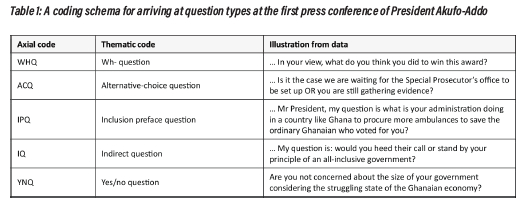
A content analysis of the data was conducted. Content analysis is a research technique for making replicable and valid inferences from texts to the contexts of their use (Krippendorf, 2022). The author notes that this analytical method acknowledges that society is enacted in modalities of communication such as talk, and that understanding social phenomena cannot be achieved without understanding how language operates in the social world. This methodological approach makes content analysis an empirically grounded method, exploratory in process, and predictive or inferential in intent (Krippendorf, 2022). Analysing data using this technique involved four basic steps: immersion, codification, categorisation and thematisation. I immersed myself by going beyond simply analysing the transcribed data but also by watching three times the YouTube video of the press conference to contextualise the exchanges between the journalists and the president. This level of detailed immersion in the data led me to develop codes. I paid close attention to the questions posed by each of the 16 journalists and the corresponding response given by the president. This was at the level of first cycle coding. Next, I began to underline and circle each question and response to form emerging patterns. This led me to develop categories. My analysis of the transcribed data led me to arrive at five basic question types. Table 1 demonstrates how I coded the data, it highlights how theme categories were generated and includes examples from the data.
DATA ANALYSIS
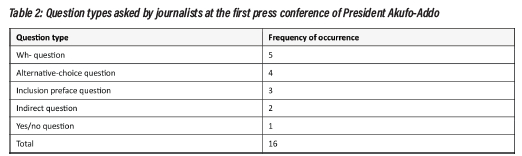
Analysis of the data showed that the journalists at the press conference employed seven main linguistic forms of questioning. These are wh- questions, alternative-choice questions, statement plus tag questions, indirect questions and yes/no questions. The others are inclusion question prefaces and negative interrogatives. Table 2 provides a breakdown of the types of question posed by the reporters at the presidential press conference and their frequency of occurrence.
It is important to note that, beyond the statistics contained in Table 2, the analysis of the questions placed a lot of emphasis on the nature of the questions and their significance in generating answers from the president as well as creating the news. The analysis, which draws on Clayman and Heritage's (2002) question, also carefully considers the responses of President Akufo-Addo and members of his cabinet.
Wh- questions
Analysis of the data revealed that this type of question was predominantly employed by the journalists at the media event. The study showed that the journalists used this linguistic resource to probe into the workings and activities of the government of President Akufo-Addo. Clayman and Heritage (2002) may consider wh-questions to fall in between initiative and/or assertive questions. An example is found in the first illustration.
Example 1
Naana Ntiri:
You were rewarded with the gender champion in the just ended AU Summit. In your view, what do you think you did to win this award?
President Akufo-Addo:
It is because of the gestures they have seen that we have made. Frankly, I think, this is the era I could still do much better than I have done so far. I have not been able to meet the 30% benchmark that we have stated in our manifesto across the spectrum of public life and appointments and significant efforts have been made. I have one or two firsts to my credit. First chief of staff is a woman; first secretary of the cabinet is a woman and the others as well. Nevertheless, I think that much more work needs to be done. So far, it is an area which I think we can do much. Hopefully, the award was also meant to inspire me to work better and work stronger in this area.
A close examination of Example 1 shows that the questioner, Naana Ntiri (media house unspecified), employed the linguistic item "what" to request thorough information on the thoughts of President Akufo-Addo about the activities he engaged in to receive an award on gender advocacy. Clearly, the form of the question asked by the journalist prompted the president to disclose the specific reasons that contributed to his success for the honour he received for his gender advocacy. The analysis of the president's response to the question indicates that he was also able to give details by highlighting his accomplishments which resulted in the award. He explained that women hold key positions in his administration as chief of staff and secretary of the state's cabinet. Another example of the use of wh- questions is given below.
Example 2
Bernard Avle:
Mr President, I remember during the campaign, yourself and the vice president expressed worry about the level of debt that Ghana was incurring and among other things you said that because of the mismanagement we were having to borrow, and that we had enough internal resources and therefore we should block the loopholes. Permit me to give you some figures. In March, this year, we went for GHC1 billion three-year bond. In April, a $2.25bn which translates to GHC10.2 billion was announced. In the same month, we announced a $2.4bn bond to clear legacy debts in the energy sector translates that to GH(t12bn. Last week, we were told that there is a GH(t17.4bn bond being sought for Q3. Putting all the figures bond being in GH φ that is about 40 billion, if all these bonds go through by Q3. The last time I checked our GDP was about GHC80 billion. If within the first year, we are already borrowing up to half of our GDP, where are the internal resources? How much resources have we generated internally? Why are we still borrowing this much?
A careful reading of Example 2 shows that the journalist's questions, signalled by the interrogative particles where, how and why, are directed at President Akufo-Addo after being premised by a number of factual statements such as a history, dates and statistical data. The journalist employed these elements to adequately contextualise the line of questioning. The study showed that the president was unable to squarely respond to the concerns raised by the journalist, and, therefore, invited his vice president, Dr Mahamudu Bawumia, who was the head of the economic management team to do so.
Vice President Bawumia:
Last year, the deficit was 9.4% of GDP that's where it ended and thanks to Asempa Budget, we have gone back on the path of physical consolidation to bring back the deficit this year to 6.5% of GDP. Now, in doing so, you are going to be bringing down the debt stock in the process and also let you that in the last years, between 2012 and 2016, the debt stock went up from 45% of the GDP to 72% of the GDP, that means on average every year the government was adding 6.5% of the GDP to the debt stock. Now the GDP is not 80billion as you said but it is closer to 200 billion this year and we are going to end the year with, after inheriting about 72% of GDP, we are hoping to bring it down slightly between 70 and 71% of GDP so we are looking at how we manage the finances to bring down the debt burden so even if you are borrowing, the burden of that, we are trying to bring down through the process of physical consolidation and the finance Minister is here, he is keeping all of us in line ...
In fact, the idea of falling on members of a president's cabinet is not new. Studies suggest that some American presidents such as Reagan did that too (Clayman & Heritage, 2022; Heritage & Roth, 1995; Kernell, 1986). The analysis showed that the vice president used economic data that better explain the persistent borrowing that the state engages in.
Alternative-choice questions
The study also showed that some journalists employed alternative-choice questions to demand accountability from the president. Alternative-choice questions are forms of question that present the respondent, in this case the president, with two options. This type of question is coordinated by the conjunction "or" The study showed that this type of question was answered with ease during the presidential media encounter because the choices were clearly made available to the president. This claim is shown in the following examples in the exchange between journalist Charles Takyi-Boadi of the Daily Guide Newspaper and President Akufo- Addo.
Example 3
Charles Takyi-Boadi:
Mr President, one of the things you complained about in meetings of your party was the fact that corruption was so endemic in the country during the previous administration and the public service. You have been government for six months; I have not seen a single person standing prosecution for some of these things. Is it the case we are waiting for the Special Prosecutor's office to be set up OR you are still gathering evidence?
President Akufo-Addo:
It is important that the fight against corruption be seen as a fight against crime and not struggle or fight about political opponents. I won't accept that the process of bringing people before the court for acts of corruption is done for political purposes. They are done because you have evidence. The people have breached the law and thereby caused damage to the public interest. To be able to do so, you need to be able to build strong, well-documented and well researched allegations. There are a lot of allegations in our country. My people in office, many of them, when you probe turn out not be the case. If we are to go along with all the allegations, many of them the court will not support so the statement that I have made all kinds of allegations have come to my notice and come to the notice of my government and there are farer justifications going forth and I will not accept prosecutions being brought just in order to satisfy the appetite of people that people should be prosecuted .
An analysis of Example 3 shows that the journalist offered President Akufo-Addo two alternatives to speak on whether his approach to fight corruption was pending the arrival of the Special Prosecutor's Office or whether he was still in the process of gathering evidence against alleged corrupt individuals. This means that Charles Takyi-Boadi asked the President Akufo-Addo to select an answer from the options he presented to him. An examination of the president's response indicates that he sought to tread cautiously by drawing on his knowledge of the law. Evidently, President Akufo-Addo was philosophical rather than exact in his response. Another example of an alternative-choice question is captured in the question posed by Nana Aba Anamoah of TV3.
Example 4
Nana Aba Anamoah:
The honourable member for Assin-North, Mr Kennedy Agyapong, has been making a number of utterances on radio. The latest was that you have not nominated enough people from the Central Region. How do you feel about his utterances? Do they irritate you OR do they affect the thinking of your government?
President Akufo-Addo:
The utterances of Kennedy Agyapong do not irritate me. I do not have a problem with speech and expression. We can all have our views to the validity of some government interventions that have been made. I think that the statement has been kept for considerations before me and the government. That I will not accept because I don't believe.
The alternative-choice question posed by the journalist appears to be both direct and assertive. Notice that the illocutionary force of both questions is not mitigated by any deferential marker. The analysis showed that the president stated that the utterances did not irritate him because he did not envisage the expression to be a problem. Here it could be noted that the president sought to come across as tolerant and in control of his government regardless of accusations and criticisms. In fact, he answered both options.
Inclusion preface questions
It was discovered that some reporters asked President Akufo-Addo inclusion preface questions. Inclusion preface questions are declarative statements that have been constructed into extensive questions. This form of question is used to express strong interest in an idea. In the context of the present study, they were deployed by the journalists to contribute to national discourse and sometimes provide the president with current news. Examples of the inclusion preface questions are seen below.
Example 5
Captain Smart:
Our emergency medical services in this country are actually collapsing. A country of 27 million people as of 8pm yesterday were operating only 31 ambulances in this country. By statistics, we are losing over 3000 lives every year for the lack of ambulances with about 662 innocent pregnant women also losing their lives. Mr President, my question is what is your administration doing in a country like Ghana to procure more ambulances to save the ordinary Ghanaian who voted for you?
President Akufo-Addo:
The ambulance and the state of our emergency healthcare I think it tells you about the nature of my inheritance. Yes, you see how very bad the cabin was and how very rundown the public services in our country are. We are having to deal with this thing while improving revenue generation so that we can be more self-sufficient. Bringing your efficiency into the matter to deal with our public finances is a whole array of things that we have to co-ordinate together which will result in us being able to improve public services in our country. What am I doing? That is why I am here to try and correct the situation about those who decided to put their confidence in and voted for me.
A close analysis of Adom FM journalist Captain Smart's question shows that he first prefaced his question to the president with three levels of statistics before finally ending his submission with the question: "What is your administration doing in a country like Ghana to procure more ambulances to save the ordinary Ghanaian who voted for you?" Thus, the use of the inclusion preface question by the journalist sought to provide the audience of the press conference with vivid information directly from the president about an incidence of limited health transport available in the country. The inclusion preface question form, which appeared less deferential, therefore required President Akufo-Addo to give information on the engagements of the president to procure more ambulances to sustain lives. The president's response to the question was quite vague and evasive (Clayman, 2001). This line of response was calculable to avoid making a non-factual statement as it was obvious that he did not have enough information on the state of ambulances in the country. Another example is given in the following illustration:
Example 6
Adel Majdoub:
Mr President, there is the issue of encroachment of the lands along the railway lines. This issue if not watched may lead to major disasters. As your government takes measures to ensure that the railway sector is revamped, Mr President, how are you going to ensure that encroachment on railway lines is curbed in a way and manner that Ghanaians and those who will be affected would see that it is a necessity and not insensitivity on the part of government?
President Akufo-Addo:
The encroachment of the railways, it is obvious that before any major work begins that the ministry is going to have to talk to those who are the encroachers. You can't just begin the process without engaging the communities and it is very much out of the programme of the Minister.
Example 6 presents us with the question form containing declaratives. These statements before the question provide information about procedures put in place to ensure that encroachment is eradicated. Adel Maljoub (media house unspecified), the journalist, specifically made mention of where the encroachment activity took place. The inclusion preface question form, therefore, required President Akufo-Addo to give details about his government's resolve to deal with the encroachment problem. It could be noted that the vague response of the president showed that he had little knowledge concerning how his local government functionaries were addressing the challenge. The next type of questions posed by the journalists were indirect questions.
Indirect questions
Analysis of indirect questions in the data showed that they were often hidden within a statement or another interrogative sentence. This is why they are termed embedded questions. The study indicated that they were deferentially deployed by the journalists to moderately exert pressure or control the hostility of the question to the president as they sought answers to urgent issues facing the country. The analysis revealed that the journalists posed indirect questions by drawing on such modal verbs as would and could, usually employed to make formal requests. Instances of indirect questions are provided below:
Example 7
Nana Esi Boateng:
Some Ghanaians have called for the removal of former government appointees who are still in strategic positions in your government and their reason is they could hinder the progress of your vision. My question is: would you heed their call or stand by your principle of an all-inclusive government?
President Akufo-Addo:
I think there are people in the public service who are not committed to the programme that we are putting in the office. There are others who are there but they may not share your political views. They are those who are actively hindering. Obviously, we have got to do something about it. We need a public service that will deliver support for the mandate that the Ghanaian people have given me. So, for me, the debate is not about former government appointees. The debate is about whether they are holding jobs which are clearly political appointments. Then, it is normal for me to expect that those who support the present political arrangements are those who will be there in the public service, but you have different perspectives on the politics of our country.
In this extract, the journalist deployed the modal would to request information on the decision of President Nana Akufo-Addo pertaining to the removal of past government appointees. The analysis showed that the nature of the question asked by the journalist enabled the president to affirm his stand to relieve the appointees of the previous government of their duties rather than uphold his principle of an all-inclusive government. The president's response clearly indicates that he rewarded loyalty as he sought to work with appointees who could support his cause to succeed as president. Another use of indirect questions was posed by ace veteran journalist Kwesi Pratt of the New Crusading Guide and is found in the next example.
Example 8
Kwesi Pratt:
For some time now, Morocco has been pushing for the de-recognition of Sahrawi Arab Democratic Republic. Would your government bow to Moroccan pressure and is your government in anyway involved in the move to admit a colonial power to AU?
President Akufo-Addo:
Morocco is an African country by geography and by involvement. This is why Ghana supported the admission of Morocco into AU. It was done both on the part of Morocco and the Union without any preconditions but we supported that point of view. It is an African country. It is an anomaly that a country on the continent can for one reason or the other be denied entry to a continental organisation as far as that is concerned, which is the AU. The matter to do with the AU is a matter that is now under consideration. AU is about to go through all kinds of procedures to examine the proposition ...
Just as in Example 7, the journalist employed the modal would to seek clarity from the government of President Akufo-Addo concerning Morocco's membership application to the African Union. Clearly, the questioner sounded deferential (Clayman & Heritage, 2002). It could be stressed that the question sought to appeal to the president to clearly express his position on the matter. The response proffered by the president indicates that he was forthright in explaining the issue within the context of African geopolitics. The final type of questions employed by journalists to be discussed are yes/no questions.
Yes/no questions
Yes/no questions are forms of question posed by a speaker in anticipation of a yes or no answer. They are relatively straight forward, and so could be a form of direct question in terms of Clayman and Heritage's (2002) question design. The structure of a yes/no question is usually inverted. Examples are that the subject comes after the verb such as "are you?" and "is there?" Analysis of the data set showed that some of the journalists at the presidential press conference used yes/no interrogatives. The final example below illustrates the point being made.
Example 9
Thomas Naadi:
Are you not concerned about the size of your government considering the struggling state of the Ghanaian economy?
President Akufo-Addo:
I am not worried about the size of my government because I think that, first of all, the overwhelming majority of the people in the government are members of Parliament who are already in public. If checked, it's something like two thirds or almost three fifths of the appointees are all members of Parliament ...
In this example, we see the journalist begin his question directly with the inverted form, "Are you...?" The journalist wanted to understand the president's logic for appointing over 120 ministers vis-à-vis what the journalist termed as "the struggling state of the Ghanaian economy" a move that had attracted considerable uproar in public opinion. Although this form of questioning clearly required a straight forward answer, it was, nonetheless, face threatening and, to some extent, hostile. The question was face threatening in the sense that it put the president on his toes to deal with the unpleasant idea of talking about a struggling economy in the face of appointing, what many Ghanaians considered, a large cohort of ministers and deputy ministers. The analysis of President Akufo-Addo's response clearly indicates his reliance on Ghana's constitutional provision that enjoins him to select as many as two thirds of his ministers from Parliament, and that there seems to be no fixed number to how many ministers a president can have. One would notice that the president's answer did not carefully consider how the number of ministerial appointees could have a toll on a nation's fragile economy.
DISCUSSION
The study underscores the importance of journalistic questioning in relation to presidential communication, especially in African cultures such as Ghana given that the subject has received marginal attention. To address this gap, the research uncovered linguistic forms of question asked by journalists to Ghanaian President Nana Addo Dankwa Akufo-Addo at his first-ever press conference at the Jubilee House, the seat of government, following his historic victory in the 2016 presidential elections. Using a combination of the descriptive grammar and question design models, the study revealed that the journalists solicited information from the president by employing five basic forms of question, namely wh-questions, alternative-choice questions, inclusion preface questions, indirect questions and yes/no questions.
Although wh-questions were the most frequent and yes/no questions the least used among the reporters, it is important to stress that the impact of the other forms of question was felt based on the manner in which they had been framed by the journalists. The study showed that these forms of question -varying in deference and hostility - were strategically employed by the journalists to probe the president's philosophy of governance, interrogate his government's agenda and examine his vision for reviving the nation's economy. The study also found that the responses of President Akufo-Addo to the journalists' probing showed that he demonstrated in-depth knowledge about and commitment to concerns such as gender and human rights issues. His submissions on the state of the economy, corruption and debt management under his government, however, appeared vague and evasive as an index of presidential power (Clayman, 2001; Ekström, 2009).
The study has implications for research in accountability journalism, the pragmatics of questioning and presidential communication. Media accountability research promotes accountability as a professional conduct necessary for ensuring the highest ethical standards among journalists (Fengler, 2004; Fengler et al., 2022). In much the same vein, accountability journalism should be considered as a normative framework for demanding accountability from public office holders such as politicians. This form of journalism resonates with the idea that reporters perform the role of "democracy detectives" (Newton & Hodges, 2004). Related to the above, the work reveals that contrary to the claim that wh-questions usually elicit probing and detailed answers, polar or yes/no questions as well as alternative-choice questions are equally useful in demanding accountability from public officials (Clancy, 2019; Steven, 2010). This is because yes/no questions are direct, assertive and less deferential. They have the power to unsettle the hearer and demand factual responses.
The research also draws attention to the quality of presidential communication during press conferences, especially in sub-Saharan African cultures. The study is important for understanding how politicians, such as the executive president, deal with information. The work extends our knowledge of presidential ethos or charisma, and helps us to address the level of competence political leaders exhibit in office.
Suggestions for future research
The study concludes by making some recommendations for practice. First, the research suggests a reconsideration of the conduct and composition of presidential press conferences as a special media event (Hughes, 2009; Joynt Kumar, 2005). The introduction of follow-up questions by reporters who asked initial questions is highly recommended. This practice could bolster the growing influence of fact-checking journalism for public scrutiny (Van Wyck, 2024). Rather than handlers of the president allowing random questions, it is recommended that journalists themselves should peer review reporters who would ask the questions in order not to miss the opportunity of asking salient questions to the president. This could also avoid preventing moles or supposed government-sponsored reporters or assigns from asking easy questions to the president. Analyses of audience receptions of the questions posed by reporters during presidential press conferences as well as examining, beyond the laughter, jokes and interruptions (Ekström, 2009; Kellner, 2007), the quality of responses that the president and/or the cabinet give will be useful in advancing accountability journalism research.
REFERENCES
-
Atton, C & Mabweazara, H. (2011). New media and journalism practice in Africa: An agenda for research. Journalism, 12(6):667-673. Available from: https://doi.org/10.1177/1464884911405467
» https://doi.org/10.1177/1464884911405467 -
BBC News. (2016). Ghana election: Opposition leader Akufo-Addo declared winner. Available from: https://www.bbc.com/news/world-africa-38270956
» https://www.bbc.com/news/world-africa-38270956 -
Clancy, L. (2019) 'Queen's Day - TV's Day': The British monarchy and the media industries, Contemporary British History, 33(3):427-450. doi: 10.1080/13619462.2019.1597710
» https://doi.org/10.1080/13619462.2019.1597710 - Clayman, S.E. & Heritage, J. (2002). Questioning presidents: journalistic deference and adversarialness in the press conferences of US Presidents Eisenhower and Reagan. Journal of Communication, 749-775.
- Clayman, S.E. & Heritage, J. (2022). Question design and press-state relations: The case of U.S. presidential news conferences. In Y. Porsche, R. Scholz, & J. Singh (eds.). Institutionality: studies of discursive and material (re) ordering. Palgrave Macmillan, 301-332.
- Clayman, S.E. (2001). Answers and evasions. Language in Society, 30, 403-442.
-
Clayman, S.E., Heritage, J. & Hill, A.M.J. (2020). Gender matters in questioning presidents. Journal of Language and Politics, 9(4):125-143. doi: 10.1075/jlp.19087.cla
» https://doi.org/10.1075/jlp.19087.cla - Davis, R. (1992). The press and American politics: the new mediator. White Plains, New York: Longman.
- Dayan, T. & Katz, E. (1992). Media events theory: the live broadcasting of history. Oxford: Oxford University Press.
-
Ekström, M. (2009). Power and affiliation in presidential press conferences: a study on interruptions, jokes and laughter. Journal of Language & Politics, 8(3):386-415. doi:10.1075/jlp.8.3.03eks
» https://doi.org/10.1075/jlp.8.3.03eks - Fengler, S. (2019). Accountability in journalism. Oxford research encyclopedia of communication. Oxford University Press.
- Fengler, S. Eberwein, T. & Karmasin, M. (2022). The global handbook of media accountability. Routledge.
-
Graphic Online (2017). Nana Addo's full statement at maiden meeting with the media. 19 July. Available from: https://www.graphic.com.gh/news/general-news/nana-addo-s-full-statement-at-maiden-meeting-with-the-media.html
» https://www.graphic.com.gh/news/general-news/nana-addo-s-full-statement-at-maiden-meeting-with-the-media.html - Greenbaum, S. & Quirk, R. (1990). A student's grammar of the English language. Longman.
- Grossman, M.B., & Kumar, M.J. (1984). The refracting lens. In D. Graber (ed.), Media power in politics (pp. 196-201). CQ Press.
- Hepp, A. & Couldry, N. (2010). Introduction: media events in globalized media cultures. In N. Couldry, A. Hepp, Andreas & F. Krotz (Eds.), Media events in a global age. Routledge, (pp. 1-20).
- Heritage, J. & Roth, A. (1995). Grammar and institution: questions and questioning in the broadcast news interview. Research on Language and Social Interaction, 28(1):1-60.
- Hughes, J.L. (2009). Analyzing policy issues in presidential speeches and the media: an agenda-setting study. UNLV.
-
JoyNews. (2018). Presidential encounter - Journalists quiz Akufo-Addo. 17 January. YouTube. Available from: https://www.youtube.com/watch?v=PBSG6XHc-pg
» https://www.youtube.com/watch?v=PBSG6XHc-pg - Joynt Kumar, M. (2003). Does this constitute a press conference? Defining and tabulating modern presidential press conferences. Presidential Studies Quarterly, 33(1):221-237.
- Joynt Kumar, M. (2005). Presidential press conferences: the importance and evolution of an enduring form. Presidential Studies Quarterly, 35(1):166-192.
- Kellner, D. (2007). Bushspeak and the politics of lying: presidential rhetoric in the "war on terror" Presidential Studies Quarterly, 37(4):622-645.
- Kernell, S. (1986). Going public: new strategies of presidential leadership. Congressional Quarterly Press. Washington, D.C.
-
Kothari, A., & Cruikshank, S. A. (2021). Artificial intelligence and journalism: An agenda for journalism research in Africa. African Journalism Studies, 43(1):17-33. https://doi.org/10.1080/23743670.2021.1999840
» https://doi.org/10.1080/23743670.2021.1999840 - Krippendorf, K. (2022). Content analysis: an introduction to methodology. Sage.
- Liebes, T. (1998) Television's disaster marathons: a danger for democratic processes? In T. Liebes, J. Curran & E. Katz (eds). Media, ritual and identity. Routledge, 71-84.
- Newton, L.H. & Hodges, L. (2004). Accountability in the professions: Accountability in journalism. Mass Media Ethics, 19(3 & 4):166-190.
- Partington, A. (2003). The linguistics of political argument: the spin-doctor and the wolf-pack at the white house. Routledge.
- Quirk, R. & Greenbaum, S. (2012). A university grammar of English (7th ed.). South Asia Pearson Education.
- Smith, C. (1990). Presidential press conferences: A critical approach. Praeger.
- Steven, E.C. (2010). Questions in broadcast journalism. In A. Freed & S. Ehrlich (eds). Why do you ask: The function of questions in institutional discourse. Oxford University Press, 256-278.
- Steven, E.C., Marc, E., John. H. & Laurie M. (2006). Historical trends in questioning presidents. Presidential Studies Quarterly, 36:561-583.
-
Toussaint, N. (2018) How western journalists actually write about Africa. Journalism Studies, 19(8):1138-1159. doi: 10.1080/1461670X.2016.1262748
» https://doi.org/10.1080/1461670X.2016.1262748 -
Van Wyk, C. (2024). The influence of dedicated fact-checking on journalism practice in South Africa. African Journalism Studies, 45(2):77-93. https://doi.org/10.1080/23743670.2024.2374401
» https://doi.org/10.1080/23743670.2024.2374401
Accepted September 2025