Determination of optimum shape of pinned parabolic arch structures under uniformly distributed loads: a blend of cost and functionality
Abstract
The construction industries are faced with multiple decisions that border around functionality and cost. Such a decision is made when considering the geometry of arches. In this work, hinged arch structures were examined under uniformly distributed static loads, and an attempt to find the best arch height for any given arch span was made. An optimum orientation of the elements of two-hinged parabolic arch structures was selected based on the manufacturing cost, which was adjudged by the volume of concrete consumed. Stress - strain analysis was used to compute the volume of the arch, while the usefulness or benefit of the arch was taken as the ratio of the frames' cross-sectional area to their perimeter. Graphs of the cost-benefit ratio against arch height f were plotted for different values of arch span, and the values of arch height corresponding to minima cost/benefit were obtained. These values were found to be independent of the ratio of the load to the product of arch thickness and grade of arch material (w/σb). A table showing the values of economic arch height for different values of arch span was presented, and a reliable model (polynomial equation) was developed.
Parabolic arch; economic arch height; arch cost; engineering economics; cost-benefit ratio
1. INTRODUCTION
An arch is a structural system with a curved single branch topology supported on two external supports (Onyeyili 2003). Just like in cables, arches are used to reduce the bending moments on long span structures (Hibbeler 2006). Arches convert most transverse loads on it to compressive forces with very little bending moments. This is sometimes known as arch action (Vaidyanathan 2004). Arches could also be formed due to deformation occasioned by poorly distributed load on beams. According to Cucuzza et. al (2021a), limited deflection arching effects were observed while trying to minimize beam's weight and stress.
Arch development was influenced by the construction materials available at a time (Tang, 2015). Because most constructional materials are good in compression, arches are considered a good structural assemblage. Arches can be semi-circular, semi-elliptic, segmental or parabola (Gupta and Gupta 2010). Arch construction in reinforced concrete occurs mainly in bridges but sometimes in roofs (Reynolds and Steedman 2001). In the classical periods arch bridges were a symbol of cultural heritage used to service roads, railways and waterways (Kumar and Vutukuru 2017). In modern times arch bridges have been constructed of iron and steel, concrete and their composite (Martinez 2004). The choice of a height to span ratio for an arch is largely dependent on the recommendation in the building's architectural drawings or the intuition of the design engineer. Studies by Altunisik et al (2015) showed that arch thickness affects the displacements, tensile stresses and strains in masonry arches. The carrying capacity and deflection of a bridge is improved upon by use of a set of cables connecting the arch and the bridge deck, as seen in tield-arches (Garcia-Guerrero and Jorguera-Lucerga, 2020). These might not yield an economic design. When economy is of prime importance, a parabola comes to mind because of its efficiency in converting all stresses to compressive force in the structural elements. Pouraminian and Ghaemian (2015) tried to determine the optimum geometry of an arch bridge structure using a Simultaneous Perturbation Stochastic Approximation. They realized that there could be savings of up to 35% in concrete volume when the structure is optimized. These were further buttressed in the works of other scholars (Lute et al., 2011; Baldomir et al., 2010). Mbachu et al. (2022) highlighted the importance of having an economic based comparative analysis for engineering feasible alternatives. In Cucuzza et al. (2021b), minimum steel consumption, which translates to minimization of manufacturing and construction cost, was identified following the determination of the cross sections properties of a steel arch shaped trusses using a genetic algorithm. Similarly, this work seeks to determine the most economic height for each span length of uniformly loaded two hinged arches.
As far back as 1976, nonlinear systems of equations for optimal thrust, minimum length, and minimum volume were developed for an arch with specified span and loading (Farshad 1976), although these were not solved. Since then, various works have been done in getting optimal height for a given arch span. The Prager-Shield criteria were employed to determine the optimal shape of hinged-hinge frames (of two rigidly connected inclined beams with a point load applied at mid-span). Here, an optimal height of the arch was determined to be is 0.5*L (Rozvany et al. 1980). In the same year an automated design routine was used to determine optimal arch design, with the arch shape and cross-sectional dimensions allowed to vary. A numerical analysis of a uniformly loaded parabolic arch of constant depth and width was carried out, and the resulting relationship for the parabolic arch height (H) and span length (L) was found to be 0.342 * L (Lipson and Muhammad 1980).
Few years later, the plastically designed non-funicular arches (of rectangular cross-section) under a uniformly distributed load were investigated. This was solved by using spline functions and a smoothing function was also employed to approximate the non-smooth objective function (arch weight) for the parameterized unspecified arch axis (Ang et al. 1988). The optimum shape of the arch was found to be a parabola with a height of 0.433 times the span length, which is significantly different from Lipson's results above (Lipson and Muhammad 1980).
By 1990, Charles Scott McDavid of the Naval Postgraduate School investigated the optimization of circular arches subjected to various loading and boundary conditions. He modelled the arches as systems of straight segments. He also proposed several further topics of research in this area (McDavid 1990). Ever since then several other research have been on, on the optimum geometry of arches. Notable is the work of Belevicius et al (2021) on the mathematical optimization of a light plane deck pedestrian bridge of 60m span to determine the least mass. He observed that some design recommendations for automobile and railway bridges are not fully applicable in pedestrian bridges. Wali et al (2021) also carried out the optimization of composite arch steel bridges depending on the arch flexibility. His analysis however was based on a second order effects using non-linear p-delta analysis.
2. METHODS
The internal stress equation for a parabolic arch structure under a uniformly distributed load was developed. The maximum stress in the arch structure was used to calculate the minimum depth of arch section that can resist such stresses. These depths were used to compute the volume of the arch structure. The cost of the arch structure was assumed to be directly proportional to its volume; hence, a cost coefficient Cc, which is a ratio of the Cost of the arch to the product of its thickness and a proportionality constant K (cost/bK), was used as an estimation of its cost. K is actually the cost of a unit volume of the arch construction material. The usefulness or Benefit of the arch was expressed as the ratio of its area to perimeter (A/p). The economical arch structure is the one that will give the minimum cost/benefit ratio. The graphs of Cc/B against height (f) of arch were plotted for different values of the ratio of load to the product of arch thickness and material grade (w/bσ). The values of height (f) corresponding to minimum Cc/B were noted. Later these values of height (f) were plotted against L to obtain the relationship between the span of the arch L and the value of f corresponding to minimum cost benefit. These were fitted into a polynomial equation through a regression analysis to obtain an equation for finding the economical height for different values of arch span L.
3. CALCULATION
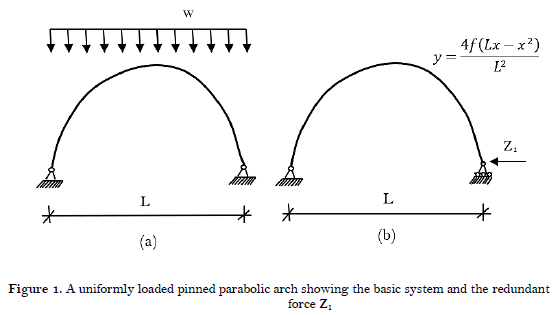
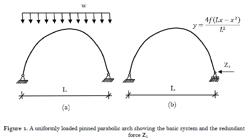
The arch chosen for the study is the moment-less arch governed by the polynomial:  . The depth of any section of the economic arch were computed such that the stress at any point on a section of the arch is not greater than the characteristic stress a or grade of the material of the arch.
The basic system or reduced structure for the parabolic arch structure in Figure 1a is given in Figure 1b. The removed redundant force was depicted with Z1. The structure can be analyzed using the principle of virtual work. By applying the unit load theorem, the deflection in beams or frames can be determined for the action of bending moment with

Where  are the virtual internal stresses while M is the real/actual internal stress. E is the modulus of elasticity of the structural material. I is the second moment of area of the beam section.
If dij is the deformation in the direction of i due to a unit load at j then by evaluating equation (1) the following are obtained.
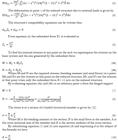
Since the stress σ is the grade of the material, N the axial force at the section, d is therefore the minimum depth of section that can overcome these internal stresses. It would be seen that d depends on the ratio of the internal stress N to the grade of the material. But under an elastic analysis of structures, the internal stresses are proportional to the load w; hence d is dependent on the ratio of the load w to the product of thickness and grade of material w/bσ).
The cost of an arch structure is proportional to its volume. For an arch structure made up of prismatic members the cost can be expressed as

where p is the length or perimeter of the arch, b is the breadth or thickness of the arch, d is the depth of the section and K is a constant of proportionality equivalent to the cost of a unit volume of the material of the portal frame.
For an arch structure of uniform thickness b equation (11) reduces to

where Cc is a cost coefficient equal to cost/Kb.
The usefulness/benefit of an arch is obtained as the ratio of its area to perimeter. The less compact the arch is, the more beneficial it would be for a range of uses, hence
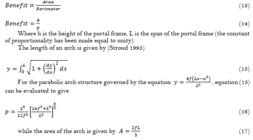
4. RESULTS AND DISCUSSION
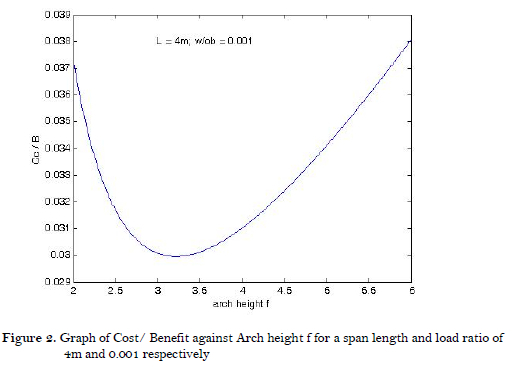
The graph of Cc/B against arch height f for specific values of arch span L and load ratio (w/bσ) is a curve. The graph for an arch span length L = 4 and load ratio (w/bσ) = 0.001 is shown in Figure 2. From Figure 2 it would be observed that the graph has a minimum at a particular value of arch height (f).
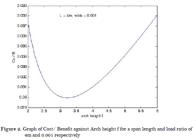
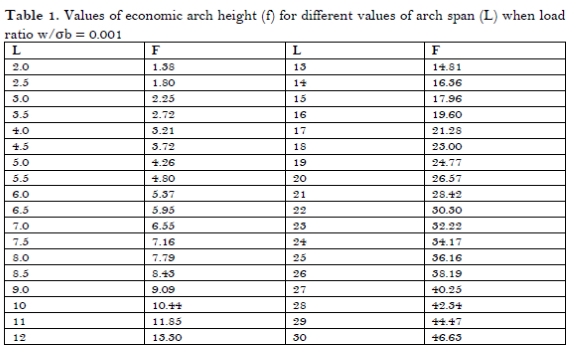
The values of arch height f corresponding to minimum cost benefit Cc/B are presented in Table 1 for the load ratio (w/bσ)= 0.001. These values were found to be the same for other values of load ratios, which show that the values of arch span corresponding to minimum Cc/B do not depend on the load ratio. In fact, when the graph of Figure 2 is plotted for other load ratios but with the same value of L, curves parallel to the one in Figure 2 are produced. The reason for this can be deduced from equations (8), (10) and (12). In equation (8), we see a linear relationship between the axial force N and the load w. From equation (10), we see a linear relationship between the depth of section of the arch d and the axial force in the arch N. In equation (12), we see a linear relationship between the cost coefficient and depth of section d. Therefore, there is a linear relationship between the Cost coefficient Cc and the load w.
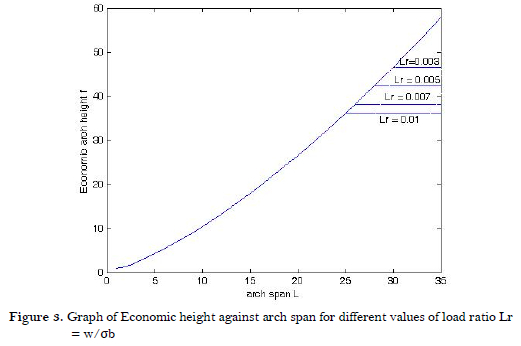
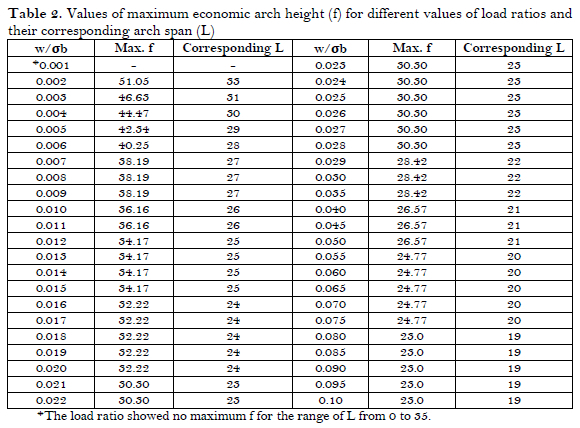
Depending on the load ratio there is a maximum value of arch span L above which the corresponding economical height f becomes a constant. This can be observed in a plot of economical arch height f to arch span L for different values of load ratio shown in Figure 3.
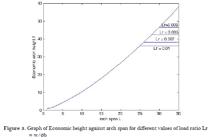
These constant values of arch height f represent the maximum economical arch heights for those load ratios. The values for different load ratios and spans are presented in Table 2. From Table 2 it would be seen that the values of maximum economic arch height drop with increasing values of load ratio.
The drop could be a result of an increase in the depth of section d that would normally accompany an increased load. A reduction in the corresponding span L was also observed. This, too is to lower the stresses N in the arch, hence resulting in a lighter and more economical arch.
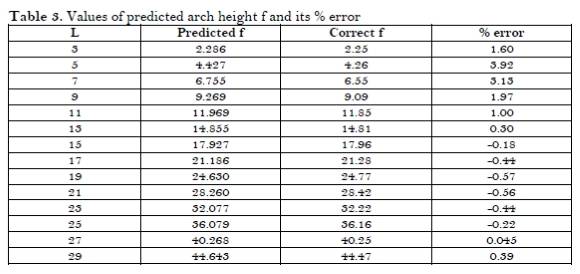
In order to obtain an equation for calculating the economical arch span f for every value of arch length, the results of Table I were fitted to polynomial curve via a regression analysis. (18)
The polynomial above gave a coefficient of determination R2 of 0.998 which shows good fit. Further numerical validation of the goodness of fit is presented in Table 3. From Table 3, it would be seen that the maximum error was 3.92% which shows that the polynomial is reliable.
5. CONCLUSION
The determination of the geometric shape of the arch structure is chosen arbitrarily in building structures by architects based on aesthetics, which is without economic considerations. In this work the parabolic arch produced minimum bending moment (M = 0) and so completely eliminates tensile stresses in the arch. With equation (18), the best arch height f can be calculated for any arch span L. Thus, the work provided a model for design of arch structure that fulfils the functionality and cost demand on the design, by providing optimum geometry based on cost/benefit ratio from the feasible alternatives that satisfies all the functional constraints.
REFERENCES
-
Altunisik, A. C., Kanbur, B., and Genc, A. F. (2015). The effect of arch geometry on the structural behavior of masonry bridges, Smart Structures and Systems. 16(6), DOI:10.12989/sss2015.16.6:1069
» https://doi.org/10.12989/sss2015.16.6:1069 - Ang, B.W., Teo, K.L., and Wang, C.M. (1988). Optimal Shape of Arches under Bending and Axial Compression. Journal of the Engineering Mechanics Division, ASCE, 114, 898-905.
- Baldamir, A., Hernandez, S., and Nieto, F. (2010), Cable optimization of a long span cable stayed bridge in La Coruna, Advances in Engineering Software, DOI: 10.1016/j.advengsoft.2010.05.001
-
Belevicius, R., Juozopaitis, A., Rusakeviciu,s D., and Zilenaite, S. (2021). Parametric study on mass minimization of radial network arch pedestrian bridges, Engineering Structures, 237, 112 - 182 Elsevier, DOI:1016/j.engstruct.2021.112182
» https://doi.org/1016/j.engstruct.2021.112182 -
Cucuzza, R., Costi, M., Rosso, M., Domaneschi, M., Marano, G. C., and Masera, D. (2021). Optimal strengthening by steel truss arches in prestressed girder bridges. Proceedings of the Institution of Civil Engineers. Bridge Engineering. pp 1 - 21 https://dx.doi.org/10.1680/jbren.21.00056
» https://doi.org/10.4236/jsea.2011.4.10066 - Farshad, M.(1976). On Optimal Form of Arches. Journal of the Franklin Institute, 302(2), 187-194.
-
Garcia-Guerrero J.M, and Jorguera-Lucerga J.J (2020). Improving the structural behavior of tied-arch bridges by doubling the set hangers, Applied Sciences, DOI:10.3390/app10238711
» https://doi.org/10.14256/JCE.1223.2015 - Gupta, B. L.,and Gupta, A. (2010). Highway and Bridge Engineering. A K Jain for Standard Publishers and Distributors. India
-
Hibbeler, R. C.(2006). Structural Analysis. Sixth Edition, Pearson Prentice Hall, New Jersey
» https://doi.org/10.1080/15732479.2014.951858 - Kumar, R., and Vutukuru K. S. (2017), Analysis of Retrofitting of Arch Bridges- A review, International Journal of Bridge Engineering (IJBE), 5(2), 113 - 138.
- Lipson, S.L., and Muhammad, I.H., (1980). Optimal Design of Arches using the Complex Method. Journal of the Structural Division, ASCE, ST12, 2509-2525
- Martinez SPF (2004). Evolution and future trends, Arch Bridges IV, Advances in Assessment, Structural design and construction, CIMNE, 11-25, Barcelona.
-
Mbachu, V. M., Muogbo, G. A., Ezeanaka, S.O., Ejimchukwu, E. O., and Ekwunife, T. D. (2022). An Economic Based Analysis of Fossil Fuel Powered Generator and Solar Photovoltaic System as Complementary Electricity Source for a University Student's Room. Journal of Solar Energy Research, 7(4), 1159-1173. doi:10.22059/jser.2021.332724.1225
» https://doi.org/10.22059/jser.2021.332724.1225 - McDavid, C.S. (1990). Weight Optimum Arch Structures. Master's Thesis, Naval Postgraduate School, Monterey, CA.
- McGuire, W. and Gallagher R. H., Ziemian, R. D. (2000). Matrix Structural Analysis, Second Edition, John Wiley and Sons, Inc. New York.
- Nash, W.,(1998). Schaum's Outline of Theory and Problems of Strength of Materials. Fourth Edition, McGraw-Hill Companies, New York
- Onyeyili, I. O. (2003). Analysis of Statically indeterminate Structures, El Demak Publishers Enugu, Nigeria
- Reynolds, C. E., and Steedman J. C. (2001). Reinforced Concrete Designer's Handbook, 10th Edition) E & FN Spon, Taylor & Francis Group, London
- Stroud K. A.(1995). Engineering Mathematics. Fourth Edition, Macmillan Press Ltd, London