Exploring the Barriers of Implementing Technology Transfer Practices in Construction Firms in a Developing Economy
Abstract
Technology Transfer (TT) remains a critical component for enhancing productivity, innovation, and competitiveness in developing economies. However, in Nigeria's construction sector, its full implementation is hindered by a complex mix of institutional, financial, and structural challenges. This study investigates the barriers to implementing technology transfer practices among construction firms in a developing economy, with a focus on professionals in Lagos State, Nigeria. A quantitative approach was adopted using structured questionnaires administered to professionals in consulting and contracting firms. Data from 258 valid responses were analysed and interpreted using descriptive and inferential statistics. The findings reveal that barriers to implementing TT practices include the high cost of technologies, inadequate training programmes, maintenance challenges, and a shortage of skilled labour. The findings categorise these challenges into three broad factors: Cost barrier, inadequate resources, and technology gap. The study recommends that government policy should focus on financial incentives, structured training initiatives, and institutional collaborations to promote more effective technology transfer in the construction industry.
Barriers; Construction Firms; Nigeria; Practices; Technology Transfer
1. INTRODUCTION
The Nigerian construction industry significantly contributes to the country's social and economic development globally. It plays a vital role in Gross Domestic Product (GDP) due to its linkages with other sectors (Owolabi et al., 2019). However, the construction industry has been criticised for its low productivity and quality compared to other sectors, mainly due to its poor adoption of innovation (Winch, 2003). The primary barrier to innovation within Nigeria's construction industry is a lack of understanding of its benefits (Owolabi et al., 2019). This knowledge gap creates perceptions that the industry performs adequately without innovation, further hindering progress. Significant constraints also include innovation costs, inadequate research and development funding, and limited technical knowledge. However, technology transfer has been identified as a tool that fosters organisational creativity and innovation in the construction industry.
While the Nigerian government recognises the importance of technology transfer, policy focus has concentrated on the manufacturing, agriculture, and petroleum sectors. The absence of construction-specific technology transfer policies has limited the industry's capacity for modernisation and competitive effectiveness (Odigie & Egbu, 2009). Owusu-Manu et al. (2017) noted that technology transfer initiatives enhance the management and technical capabilities of the construction industry, with enablers such as the learning environment, the transfer environment, government influence, transferor and transferee characteristics, communication and relationship building, and absorptive capability.
Technology transfer requires substantial upfront investment in training, software, and equipment, which can be challenging for smaller firms with limited financial resources. The workforce's existing skill set plays a critical role, as a lack of expertise in operating new technologies can impede successful technology transfer and necessitate additional training. Garengo (2019) conducted an empirical study on the management of technology transfer in small and medium-sized enterprises (SMEs) through bridging organisations. The study highlighted significant hurdles to technology transfer due to a lack of a clear strategy, limited resources, and limited awareness. Similarly, Rani et al. (2018) highlighted limited understanding of the potential and possible applications, a lack of a relevant and consistent framework, a lack of systematic planning, ethical issues, etc., as barriers to technology transfer. Technology transfer has a wide range of impacts on the receiving country or organisation by enhancing organisations' competitiveness, increasing organisations' facilities of technological and managerial knowledge, improving people's welfare, increasing job opportunities, productivity of labour, capital, and natural resources, including land (Khan, Haleem, & Husain, 2017).
Nigeria established its technology transfer policy framework in 1983 through the National Office for Industrial Property (NOIP) under Decree No. 70 of 1979. Recognising international obligations, the government amended the decree (Decree No. 83 of 1983). It renamed the office the National Office for Technology Acquisition and Promotion (NOTAP), reflecting a shift towards developmental and promotional roles in fostering technology transfer for economic development (Nwaedozie, 2012). It is based on this understanding that this study explores the barriers to implementing technology transfer practices in construction firms in a developing economy.
2.1. Technology and Technology Transfer
The importance of technology cannot be overemphasised, and investment in developing and deploying technology is a key driver of economic growth by enhancing innovation, improving efficiency, creating opportunities, and boosting gross domestic product growth (Khan, Haleem & Husain, 2017). Therefore, technology is a tool for the survival and economic growth of any nation or organisation. Technology encompasses comprehensive knowledge, skills, ideas, equipment, and facilities that organisations need to produce goods and services effectively. (Saad et al., 2002; Fredland, 2000; Onyango, 1997; Perrow, 1967). According to Adeyemi and Adegbembo (2023), the construction industry in Nigeria needs to prioritise incorporating technology into its processes to meet global standards.
Technology can be transferred in different modes, either vertically or horizontally. Vertical technology transfer involves the application of skill and knowledge derived from a development phase to production, while horizontal transfer involves the transfer of technology from one place, context and organisation to another country or organisation (Amaechi, 2020). This implies the adaptation or sharing of technologies, practices, or expertise between organisations of a similar nature. In a similar vein, Owusu-Manu et al. (2017) describe technology transfer as a two-way process that involves the flow of technology and knowledge from one firm or individual to another, and it is only successful when both the transferor and transferee collaborate to determine what needs to be transferred.
Technology Transfer, as defined by Bozeman (2000), involves the movement of know-how, technology, and technological knowledge and skills from one organisation to another. Simkoko (1989) described technology transfer for the construction industry as "the planned conveyance and acquisition of technical knowledge and techniques of construction firms". Technology transfer is the exchange of knowledge, skills, technologies, or innovations between individuals, organisations, or sectors, involving the transmission of technical know-how, intellectual property, and expertise to foster innovation, improve productivity, and accelerate economic development. Odigie & Egbu (2009) argue that the technology transfer process begins with identifying the transfer technology, including skills, techniques, and knowledge.
Technology transfer in Nigeria encompasses various forms, including licensing contracts, international trade, turnkey packages, management contracts, and collaborations with international agencies and others (Ajibo et al., 2019). Research has focused on evaluating specific technology transfer practices (Frank & Du, 2018), with limited research specifically evaluating different technology transfer practices among Nigerian construction firms. According to Afolabi et al. (2019), substantial investments in local construction projects have facilitated the adoption of new technologies and improved construction methodologies in Nigeria. Ogunbiyi et al. (2014) argue that increased domestic investment in construction facilitates the acquisition of modern equipment and training of local personnel, enhancing the sector's capacity for technological innovation. Technology transfer is necessary among organisations to enhance innovation, improve productivity, reduce costs, and enhance project quality. Nonetheless, technology transfer can be complex, and construction organisations must adopt appropriate strategies to strengthen technology transfer (Kruger & Steyn, 2020).
2.2 Barriers to Technology Transfer
Globally, organisations have changed how they compete. They no longer rely on their capital and financial strength but compete based on the knowledge and technology they possess (Adegbembo et al., 2020). The movement of knowledge, skills, expertise, and technology from one individual or organisation to another is technology transfer. According to Rani et al. (2018), technology transfer is a continuous process that requires follow-up activities; therefore, receiving organisations are to nurture the process and ensure continuous training, reinforcement, and R&D to keep the technology alive and develop it. This is because, when technology is not supported, it can easily fade into obsolescence. Technology generally has the potential to improve processes and outcomes in the construction industry (Adeyemi & Adegbembo, 2023). With improved processes and deliveries, organisations may need to transfer such technology either vertically or horizontally for wider benefits. However, the Nigerian construction industry faces specific barriers to effective technology transfer, including organisational culture, limited resources, and regulatory inefficiencies (Odediran et al., 2012). Many professionals perceive the acquisition and implementation of new technologies as overly complex or beyond their technical capacity, which, in turn, diminishes their motivation to pursue innovative solutions. However, Adegbembo (2022) noted that knowledge exchange is a major driver of innovation within organisations. Afolabi et al. (2021) suggest that the prevailing organisational mindset often discourages investment in technological innovation, thereby contributing to stagnation in the sector's growth.
Financial limitations remain a concern, particularly for small and medium-sized construction firms. The high costs associated with purchasing, installing, and maintaining new technologies are often prohibitive, resulting in limited technological advancement across the sector (Owolabi et al., 2019). Moreover, many Nigerian construction firms have relatively low absorptive capacity. Agunde et al. (2007) note that the shortage of skilled indigenous personnel capable of planning, managing, and executing technology-driven projects poses a significant constraint. Inadequate technical training further exacerbates this issue, as many firms either lack access to structured training programmes or fail to invest in workforce development. This limits the effectiveness of technology transfer and increases the risk of project delays and failures due to improper use of new technologies (Osabutey et al., 2014). Limited emphasis on research and development (R&D) within the construction sector further impedes the localisation of foreign technologies. Although R&D is essential for adapting technologies to specific environmental and operational contexts, it has received minimal attention (Agunde et al., 2007).
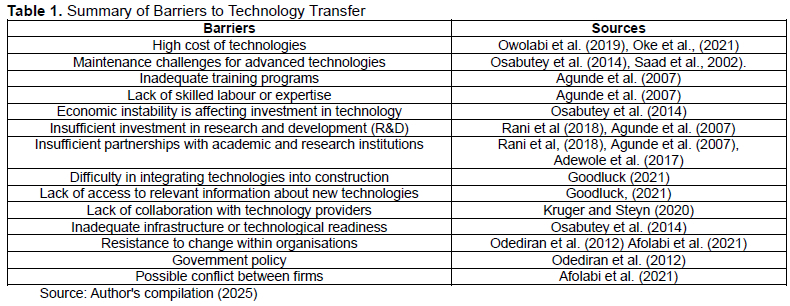
Additionally, weak collaboration between local construction firms and technology providers reduces opportunities for knowledge transfer and technical support. As Kruger and Steyn (2020) argue, such collaborations are essential for ensuring that technologies are appropriately adapted and effectively integrated into practice. Access to information about emerging technologies is also constrained, particularly among smaller firms that may lack the resources or networks to stay up to date on industry advancements. This information gap hampers timely adoption and strategic decision-making (Goodluck, 2021). Furthermore, without proper maintenance and long-term operational planning, technology transfer benefits often diminish over time, leading to frustration and further adoption resistance (Saad et al., 2002). The barriers to technology transfer identified are summarised in Table 1.
3. RESEARCH METHODOLOGY
This study adopted a survey research approach to examine barriers to technology transfer practices in the Nigerian construction industry. Lagos State was selected as the case study due to its concentration of construction activities and high incidence of foreign partnerships, multinational projects, and technology transfer practices. A structured questionnaire was developed based on a detailed review of existing literature on innovation and technology transfer barriers. The questionnaire was divided into three sections. Section A captured respondents' background information, including profession, years of experience, and firm characteristics. Section B examined firms' exposure to technology transfer practices. Section C measured perceived barriers to technology transfer using 15 barrier variables measured on a 5-point Likert scale ranging from 5 (Strongly Agree) to 1 (Strongly Disagree). The research population for this study consists of quantity surveyors, builders, architects, and engineers working in public and private construction firms in Lagos State, Nigeria. Moreover, considering diverse populations enhances the study's external validity. Stratified random sampling was employed to ensure representation across small, medium, and large-scale firms. Three hundred sixty-two questionnaire copies were distributed, 258 valid responses retrieved, yielding a 71.3% response rate. Data were analysed using the Statistical Package for Social Sciences (SpSS). Descriptive statistics, including mean scores and standard deviations, were used to rank the barriers to technology transfer. Also, exploratory factor analysis was conducted to identify underlying barrier structures and group them into meaningful dimensions.
4. RESULTS AND DISCUSSION
4.1
Background InformationThe data shows that quantity surveyors constituted the largest professional group, representing 32.9% of the respondents, followed by civil engineers and builders at 21.3% and 17.4%, respectively. The majority of respondents held bachelor's degrees (56.6%), with a significant proportion also holding higher academic qualifications, such as master's degrees (19.0%) and PhDs (5.8%). Additionally, most firms represented in the survey were privately owned (85.3%), and a substantial proportion had staff strength of 1 to 60 employees, indicating that the survey primarily captured data from small- to medium-sized firms.
4.2
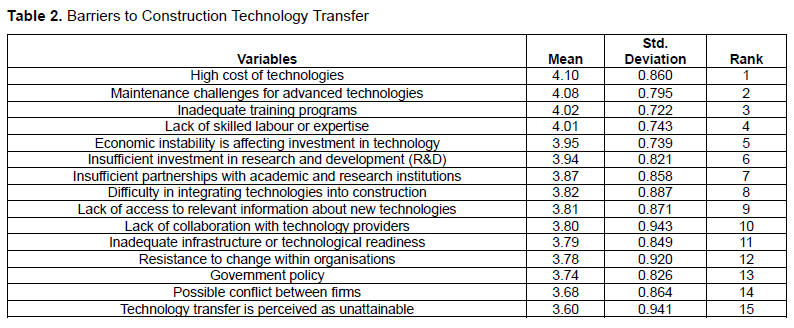
Barriers to Technology TransferThe result from the mean score analysis, as shown in Table 2, highlights that the most significant barriers to technology transfer practices are the high cost of technologies, maintenance challenges for advanced technologies, inadequate training programs, and a lack of skilled personnel, with mean scores of 4.10, 4.08, 4.02 and 4.01, respectively. The least significant barriers, according to the study's results, were: technology transfer perceived as unattainable, and possible conflict between firms and government policy, with mean scores of 3.61, 3.68, and 3.74, respectively. All barriers were found to exceed the 3-point threshold and are therefore deemed significant to the implementation of technology transfer practices.
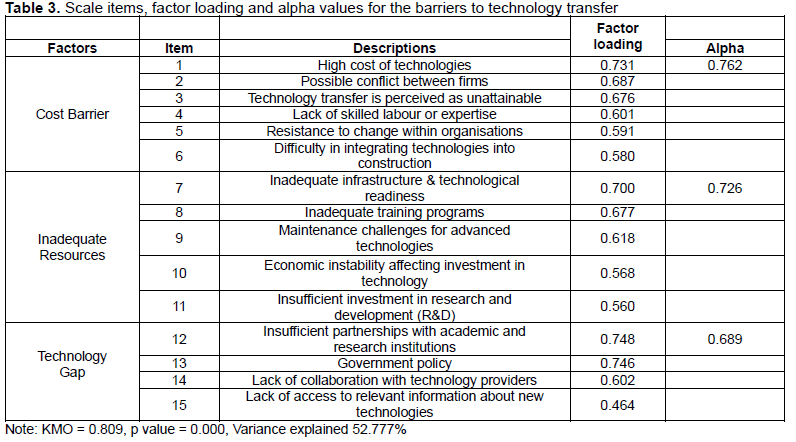
Exploratory factor analysis was further conducted to identify and establish similar underlying effects that explain a pattern of correlation with the identified variables (Nunayon et al. 2020). The 15 barriers to the implementation of technology transfer practices were subjected to principal component analysis (PCA) with varimax rotation. To ascertain the reliability of data for factor analysis, the size of the sample as described by Winter et al. (2009) should be at least 50. Therefore, the sample size of 263 in this study is deemed adequate for factor analysis. Also, to ensure that the data set was suitable for factor analysis, both the Kaiser-Meyer-Olkin (KMO) measure of sampling adequacy and Bartlett's test of sphericity were conducted. A minimum value of 0.60 is suggested for the KMO measure of sampling adequacy. At the same time, the Bartlett's test of sphericity should be significant (i.e., p-value < 0.05) for factor analysis to be considered appropriate (Pallant 2011). From the analysis, a KmO value of 0.809 was obtained, and Bartlett's test of Sphericity was significant (p = 0.000), both exceeding the minimum values and requirements for factor analysis.
According to Tabachnick and Fidell (2007), a high factor loading is considered a good indicator of a factor; therefore, any value above 0.5 is acceptable. This was met by all 15 variables. The analysis identified 15 variables, which yielded three main components: cost barrier, inadequacy barrier, and cooperation barrier. The three-factor solution explains 52.77% of the variance. A reliability test was also conducted using Cronbach's alpha across the three factors to assess the dataset's consistency and reliability. The values range between 0.689 and 0.762. These are higher than 0.6, which is recommended by Hair et al. (2010). The details of the individual items, factor loading and Cronbach alpha values are shown in Table 3.
5. DISCUSSION OF FINDINGS
This study revealed that the most significant barriers to technology transfer practices are the high cost of technologies, maintenance challenges for advanced technologies, inadequate training programs, and a lack of skilled labour. These findings align with recent studies that identify cost and technology-related factors as major barriers to the adoption of advanced technologies such as robotics in construction (Oke et al., 2021). The top-ranked barrier, the high cost of technologies, indicates that financial constraints are a primary concern for industry stakeholders, potentially hindering the broader adoption of innovative solutions. The difficulty in integrating technologies and the insufficient investment in research and development further emphasise the need for enhanced training and capacity-building initiatives.
5.1
Cost BarrierThe cost barrier accounted for 20.95% of the total variance in barriers to implementing technology transfer practices in construction firms. This component comprises six factors: high cost of technology (0.731), conflicts between firms (0.687), perceived impossibility (0.676), lack of skilled labour and expertise (0.601), resistance to change (0.591), and difficulty integrating technology into construction (0.580). These items have factor loadings ranging from 0.580 to 0.731, with a Cronbach's Alpha of 0.762, indicating a strong internal consistency. This component was therefore named 'cost barrier'. This is supported by the descriptive analysis, which found that high cost ranked highest among the identified barriers to technology transfer. Also, Osabutey et al. (2014) note that most construction firms in developing countries are small-to medium-sized enterprises that often lack sufficient resources, such as money, technical know-how, and machines, to carry out their activities effectively.
5.2
Inadequate ResourcesInadequate resources accounted for 17.066% of the total variance explained and were associated with five factors. These factors, along with their factor loadings, are: inadequate infrastructure and technological readiness (0.700), inadequate training programs (0.677), maintenance challenges (0.618), economic instability (0.598), and insufficient investment in research and development (0.560). Inadequate resources had a Cronbach's Alpha value of 0.726. Garengo (2019) and Osabutey et al. (2014) had identified inadequate resources as key barriers to technology transfer. These resources may include relevant infrastructure technologies and inadequate funding for training and maintenance of such facilities. This also corroborates the findings of Rani et al. (2018), who noted that technology transfer requires training to keep the transferred technology functional and to grow into greater innovations.
5.3
Technology GapThe third component has four factor loadings as follows: insufficient partnership with academic and research institutes (0.748), government policy (0.746), lack of collaboration with technology providers (0.602), and lack of access to relevant information about new technologies (0.464). These factors accounted for 14.761% of the variance explained. The factor loadings range from 0.464 to 0.748, with an alpha value of 0.602, indicating strong consistency. These factors collectively highlight the major challenges hindering the effective implementation of technology transfer practices in construction firms in Nigeria. Adelowo et al. (2017) opined that technology transfer in developing countries can be effectively achieved only when academia, policymakers, and industry stakeholders have access to and participate in knowledge transfer processes. This will be enhanced with equal access to modern information and communication Technology. This is also supported by Rani et al. (2018), who affirmed that collaboration among governments, industries, research institutes, and universities in research and development will enhance technology transfer.
5.4
Implications of the FindingsThe study's findings hold key practical implications for the Nigerian construction industry and other developing countries. Overcoming these cost barriers will go a long way toward promoting technology transfer within firms. The high costs of adopting new technologies and the friction that can lead to disputes between firms can deter an organisation from innovating. To overcome these two challenges, construction firms should seek joint-funding models that will share the costs and risks of adopting a new technology. This could involve stakeholders from both the private and public sectors in developing a partnership mechanism that reduces conflicts and friction to innovation. Similarly, the lack of resources, especially the required infrastructure and training programs, indicates the dire need for investment. Construction firms have a long way to go in providing sufficient training to update workers' skills and prepare them to adopt and integrate new technologies. Investing in infrastructure can also increase technology readiness by reducing the hassle of maintaining new systems, thereby integrating them well into the existing workflow. More importantly, beyond practices at the firm level, there is a dire need to promote collaboration between construction firms and academic or research institutions. The findings show a significant gap in technology acquisition due to a lack of partnerships. Establishing relevant links with such institutions will facilitate knowledge sharing and the development of new ways to adapt technology. Again, workshops, seminars, and group research can provide promising avenues for sharing ideas and best practices. Theoretically, the findings contribute to the literature on technology transfer in construction organisations. The identification of different groups of challenges in this study will support existing work in highlighting that barriers to technology adoption in construction firms are indeed multi-dimensional. Thus, more refined theories can emerge by taking into account the problems within the context, especially in emerging economies like Nigeria.
6. CONCLUSION
The study has explored the barriers to implementing technology transfer practices in construction firms in a developing economy and categorised the factors into three barriers: cost barriers, inadequate resources, and a technology gap. The factor analysis identified the most significant barriers as the high cost of technologies, maintenance challenges for advanced technologies, inadequate training programs, and a lack of skilled labour. In the Nigerian case study, the government recognises the importance of technology transfer; however, its policies are concentrated on other sectors outside construction. These findings suggest the need for affordable technologies and comprehensive training programs to develop labour and expertise. The study recommends that governments enact policies that provide financial incentives, such as tax rebates and grants, to encourage construction firms to transfer technology. Clear technology transfer policy frameworks can create more conducive environments for innovation. Although our study contributes to the literature on technology transfer in developing economies, there is a need for studies beyond single-country case studies. Further technology transfer studies could investigate its impacts on firms or factors influencing technology transfer practices.
REFERENCES
2. LITERATURE REVIEW
- Adegbembo, T. F., Awodele, O. A., & Oke, A. E. (2020). A principal component analysis of knowledge management success factors in construction firms in Nigeria. Journal of Construction Project Management and Innovation, 10(1), 42-54.
- Adegbembo, T. F. (2022). The importance and use of key performance indicators of knowledge management in quantity surveying firms in Nigeria. Journal of Surveying, Construction and Property (JSCP), 13(1), 66-76.
- Adelowo, C. M., Akinwale, Y. O., & Olaopa, O. R. (2017). Innovation and knowledge transfer in Nigeria. International Journal of Research, Innovation and Commercialisation, 1(1), 57-73.
- Adeyemi, P., & Adegbembo, T. F. (2023). Assessing innovative tools and techniques for managing knowledge in construction firms in Nigeria. Journal of Construction Project Management and Innovation, 13(1), 45-56.
- Afolabi, A., Onyia, E. A., & Ogunbayo, B. F. (2021). Construction industry in Nigeria: Key challenges and prospects for sustainable development. International Journal of Construction Engineering and Management, 10(3), 87-99.
- Agunde, P. U. C., Okwandu, G. A., & Owuala, E. A. (2007). Construction project management in Nigeria: Challenges and the way forward. In P. Arthur (Ed.), COBRA (pp. 5). RICS, Georgia Tech, 6-7 September.
- Ajibo, C. C., Anozie, M. C., Onyeabor, E., Umahi, T. O., Odinkonigbo, J. J., & Agu, H. (2019). Technology transfer for development in Nigeria: Patterns, problems, and prospects. Commonwealth Law Bulletin, 45(1), 70-91.
- Amaechi, L. (2020). Technological dependence and Nigeria's role in the 21st century globalised economy. University of Nigeria Journal of Political Economy, 10, 161-167.
- Chan, D. W. M., Olawumi, T. O., Saka, A. B., & Ekundayo, D. (2022). Comparative analysis of the barriers to smart sustainable practices adoption in the construction industry between Hong Kong and Nigeria. International Journal of Construction Management, 1-11.
- Fredland, R. A. (2000). Technology transfer to the public sector in developing states: Three phases. Journal of Technology Transfer, 25(3), 265-275.
- Garengo, P. (2019). How bridging organisations manage technology transfer in SMEs: An empirical investigation. Technology Analysis & Strategic Management, 31(4), 477-491.
- Goodluck, E. E. (2021). A survey of the knowledge and application of digital construction technology such as building information modelling and digital twin technology in Lagos, Nigeria (Doctoral dissertation, The Robert Gordon University).
- Khan, J., Haleem, A., & Husain, Z. (2017). Barriers to technology transfer: A total interpretative structural model approach. International Journal of Manufacturing Technology and Management, 31(6), 511-536.
- Kruger, S., & Steyn, A. A. (2020). Enhancing technology transfer through entrepreneurial development: Practices from innovation spaces. The Journal of Technology Transfer, 45(6), 1655-1689.
- Nunayon, S. S., Olanipekun, E. A., & Famakin, I. O. (2020). Determining key drivers of efficient electricity management practices in public universities in Southwestern Nigeria: An empirical study. International Journal of Sustainability in Higher Education, 21(2), 281-314.
- Nwaedozie, I. M. (2010). Overview of foreign technology transfer efforts in Nigeria (2000-2010): NOTAP's perspective. https://ako77.blogspot.com/2012/12/overview-of-foreign-technology-transfer_6.html
- Odediran, S. J., Adeyinka, B. F., Opatunji, O. A., & Morakinyo, K. O. (2012). Business structure of indigenous firms in the Nigerian construction industry. International Journal of Business Research and Management, 3(5), 255264.
- Odigie, H., & Egbu, C. (2009). Technology transfer practices and strategies: Issues for Nigerian construction organisations and for research. In Proceedings of the 9th International Postgraduate Research Conference held at Greater Manchester, United Kingdom, January 29 - 30, 2009.
- Onyango, R. O. (1997). Information resources and technology transfer management in developing countries. Routledge Library Edition.
- Osabutey, E. L., Williams, K., & Debrah, Y. A. (2014). The potential for technology and knowledge transfers between foreign and local firms: A study of the construction industry in Ghana. Journal of World Business, 49(4), 560571.
- Owolabi, J. D., Faleye, D., Eshofonie, E. E., Tunji-Olayeni, P. F., & Afolabi, A. O. (2019). Barriers and drivers of innovation in the Nigerian construction industry. Technology, 10(2), 334-339.
- Owusu-Manu, D., Parn, E. A., Antwi-Afari, M. F., & Edwards, D. J. (2017). Modelling a conceptual framework of technology transfer process in construction projects: An empirical approach. Journal of Construction Project Management and Innovation, 7(1), 1824-1842.
- Pallant, J. (2011). SPSS survival manual: A step by step guide to data analysis using SPSS (4th ed.). China: Everbest Printing Company.
- Perrow, C. A. (1967). Framework for the comparative analysis of organisations. American Sociological Review, 32, 1967.
- Rani, S. S., Rao, M., Ramarao, P., & Kumar, M. (2018). Technology transfer-Models and mechanisms. International Journal of Mechanical Engineering and Technology, 9(6), 971-982.
- Saad, M., Cicmil, S., & Greenwood, M. (2002). Technology transfer projects in developing countries-Furthering the project management perspectives. International Journal of Project Management, 20, 617-625.
- Simkoko, E. E. (1989). Analysis of factors impacting technology transfer in construction projects: Case studies from developing countries. Stockholm, Sweden: Swedish Council for Building Research.
- Tabachnick, B. G., & Fidell, L. S. (2007). Using multivariate statistics (5th ed.). Boston, MA: Pearson Education.
- Winch, G. M. (2003). How innovative is construction? Comparing aggregated data on construction innovation and other sectors: A case of apples and pears. Construction Management and Economics, 21(6), 651-654.
Taiwo Fadeke Adegbembo
Department of Quantity Surveying, Federal University of Technology
Akure, Nigeria
Email address:

Revised: 13-11-2025
Accepted: 30-11-2025